REVIEW 4 major objections 5 minor 76 references
Durgapal-Fuloria Bose-Einstein condensate stars within $ f(R,T) $ gravity theory
T0 review · 4 major / 5 minor · reviewed 2026-08-06 · deepseek-v4-flash
Pith's one-line read The paper constructs isotropic BEC star interiors with the Durgapal-Fuloria metric in f(R,T)=R+2ηT gravity and claims they satisfy all standard energy and stability conditions.
desk verdict Boundary matching fails: the tabulated F values do not satisfy Eq. (18), so the stability analysis is computed on a solution that is not the claimed compact star. read the letter →
The pith
A machine-rendered reading of the paper's core claim, the machinery that carries it, and where it could break.
The reading
What carries the argument
The central machinery is the Durgapal-Fuloria metric ansatz, a rational form for the radial metric function that is finite everywhere inside the star and yields well-behaved density and pressure profiles. It closes the $f(R,T)$ field equations once the matter is fixed as an isotropic perfect fluid with the Gross-Pitaevskii BEC equation of state $p=U\rho^2$; the coupling constant $\eta$ in $f(R,T)=R+2\eta T$ measures the deviation from general relativity. The parameter $F$ is fixed by demanding continuity with the Schwarzschild exterior at $r=R$, and the stability analysis uses the velocity of sound, the adiabatic index, and the surface redshift as criteria.
What would settle it
Compute $2M/R$ for each Table 1 entry in geometrized units, with one solar mass equal to about 1.475 km. The CEN X-3 row gives $2M/R \approx 1.05$, exceeding the limit of 1 required for a Schwarzschild exterior, so if that star's listed mass and radius are correct the boundary matching used to fix $F$ cannot hold for it.
Extended reading notes
Core claim
The central claim is that the Durgapal-Fuloria metric $e^{j(r)}=(7+14Fr^2+7Fr^4)/(7-10Fr^2-F^2r^4)$, combined with $f(R,T)=R+2\eta T$ and the Gross-Pitaevskii-derived equation of state $p=U\rho^2$, yields a one-parameter family of isotropic stellar models that pass every standard viability test. For the five observed compact objects listed in Table 1, the matching condition fixes the parameter $F$, and numerical profiles for $\eta=0.2$ show energy conditions, causality, adiabatic stability, and redshift bounds satisfied throughout the interior. The authors therefore conclude that they have introduced new, stable BEC stellar solutions in $f(R,T)$ gravity with enhanced precision relative to earlier models.
Load-bearing premise
The model stands or falls on the assumption that each tabulated star's radius is larger than its Schwarzschild radius so the interior can be matched to the exterior; the CEN X-3 entry, at its listed mass and radius, violates that condition.
Editorial extensions
If this is right
- The same Durgapal-Fuloria ansatz can generate new isotropic-fluid stellar models in $f(R,T)$ gravity by swapping in different equations of state.
- The tabulated values of $F$ give a ready-made normalization for fitting the model to the masses and radii of the five candidate compact objects.
- Because $\eta=0$ recovers general relativity, the model offers a controlled way to quantify how modified gravity shifts BEC star density, pressure, and stability.
- The positive energy-condition and causality results make this solution available as a background for future perturbation or oscillation studies.
Reading between the lines
- Not in the paper: a continuous mass-radius relation. Computing $M(R)$ from the matched solutions and comparing with compact-star constraints would make the model testable beyond the five tabulated points.
- Not in the paper: a check of the exterior-matching condition for every table entry. In geometrized units the CEN X-3 row gives $2M/R \approx 1.05 > 1$, so the Schwarzschild match used to fix $F$ cannot be valid for that candidate as listed.
- Not in the paper: a survey over the coupling constant $\eta$. Mapping the stability criteria as $\eta$ varies would show how much modified-gravity coupling the solution can tolerate.
Signed reviews
Editorial analysis
A structured set of objections, weighed in public.
Referee Report
Summary. The paper constructs static, spherically symmetric Bose-Einstein condensate (BEC) star models in f(R,T)=R+2ηT gravity using the Durgapal-Fuloria metric ansatz and the BEC equation of state p=Uρ^2. The parameter F in the metric is fixed by matching to a Schwarzschild exterior using the observed masses and radii of five compact stars listed in Table 1. The paper states that numerical derivation yields the density and pressure profiles, and then reports checks of energy conditions, the EoS parameter, density and pressure gradients, sound speed, adiabatic index, and surface redshift. The authors conclude that the models are stable, causal, and realistic, and that new BEC stellar solutions in modified gravity have been introduced.
Significance. If the construction were valid, it would offer a moderately interesting extension of BEC star models to f(R,T) gravity, with the virtue of checking several physical viability criteria. The paper also engages a relevant literature and presents the material in a readable outline. However, the central result is not currently established: the derivation of the density and pressure profiles is not shown, the tabulated boundary parameters do not satisfy the stated junction conditions, and the reported adiabatic index is inconsistent with the assumed BEC equation of state. The manuscript provides no reproducible code or machine-checked derivations, so the claimed 'enhanced precise results' cannot be verified from the text as it stands.
major comments (4)
- [Section 3, after Eq. (23)] The paper states that 'Numerical derivation yields the density and the pressure outcomes' but does not provide the differential equations solved, the boundary conditions used, the numerical scheme, or any code. Since every subsequent check (energy conditions, EoS parameter, sound speed, adiabatic index, surface redshift) is evaluated on these numerical profiles, this omission makes the central claim of the paper unverifiable and non-reproducible.
- [Eq. (18) and Table 1] The tabulated values of F do not satisfy the boundary matching condition. With G=c=1 and 1 M_sun = 1.475 km, the compactness 2M/R for PSR B0943+10 is about 0.227, so the exterior Schwarzschild factor is 1-2M/R ≈ 0.773; yet substituting R=2.6 km and F=1.49e-5 into Eq. (19) gives e^{j(R)} ≈ 1.0003. For CEN X-3, 2M/R ≈ 1.05, so no Schwarzschild exterior with the advertised mass exists at all. Thus the F values in Table 1 are not the solutions of Eq. (18), and all subsequent profiles and stability tests describe configurations that are not matched to the claimed compact objects.
- [Eq. (23) and Figure 10] The adiabatic index shown in Figure 10 is inconsistent with the assumed BEC equation of state. For p = U ρ^2, one has dp/dρ = 2Uρ = 2p/ρ, so Γ = (ρ+p)/p · dp/dρ = 2(1+p/ρ), which is always ≥ 2. Figure 10 reports Γ ≈ 1.5 throughout the star. Figure 6 similarly shows ω = p/ρ increasing with r, whereas p=Uρ^2 with a radially decreasing density profile would require ω to decrease outward. The numerical profiles therefore do not satisfy the BEC EoS that the paper claims to use.
- [Section 2, Eqs. (11)-(22)] The metric function i(r) is never explicitly determined. Equations (21) and (22) involve i'(r) and i''(r), and Eq. (14) is a first-order equation for p, but the paper does not state how i(r) is obtained or how the boundary condition p(R)=0 is enforced in the numerical derivation. Consequently, the surface redshift calculation using Eq. (31) and the gradients shown in Figures 7 and 8 are not reproducible from the information given.
minor comments (5)
- [Throughout] The text repeatedly uses 'adiabetic' instead of 'adiabatic' (e.g., Section 4.2 and the conclusion).
- [Abstract and Introduction] The abstract describes 'finite temperature BEC stars,' but the introduction states the paper aims to explore 'zero temperature BEC stellar framework'; the manuscript should clarify which regime is actually modeled.
- [Table 1] The table does not state the units of F, and the numerical values for masses and radii are given without uncertainties or references to the observational sources; this is needed for a quantitative comparison.
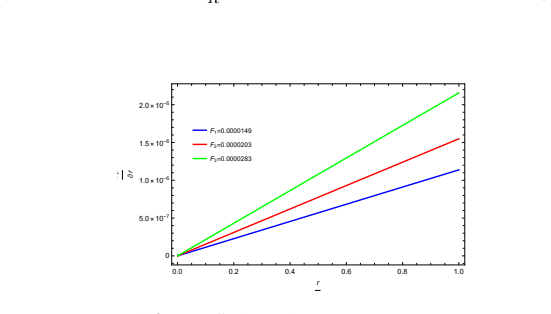
- [Figures 1-11] The figures lack axis labels with physical units, and the legend entries such as 'F1', 'F2', 'F3' are not defined consistently with the table values; for example, Figure 1 uses 'F1=0.0000149', 'F2=0.0000203', 'F3=0.0000283' but Table 1 contains five F values.
- [References] Several references are incomplete or informal, including [10] with lowercase 'f(r)' and [31] cited as an arXiv preprint; the paper should be checked against the journal's reference style.
Circularity Check
No significant circularity: the only fitted parameter is anchored to observed masses and radii, and the subsequent stability tests are independent checks rather than predictions of the same data.
full rationale
The paper does not derive any target quantity from a quantity that was defined in terms of it. The only fitted parameter is F, determined (in principle) from the boundary condition Eq. (18) using the observed M and R of five candidate stars; mass and radius are inputs, not predictions. The subsequent profiles (density, pressure, energy conditions, sound speed, adiabatic index, redshift) are checks of physical viability of the resulting solution, not independent predictions to be compared with the same data. There are no self-citations by the present authors; the DP metric and BEC EoS are cited from external prior work. Some stability criteria are weak—for the quadratic EoS p = Uρ², the adiabatic index is identically Γ = 2(1+p/ρ) > 4/3 and the sound speed is V² = 2Uρ, so these tests largely restate the EoS—but this is a limitation of the validation, not a circular reduction of the central model construction. A separate concern, external to circularity, is that the tabulated F values do not appear to satisfy the advertised Schwarzschild matching condition e^{j(R)} = 1 − 2M/R (e.g., for PSR B0943+10, e^{j(R)} ≈ 1.00035 while 1 − 2M/R ≈ 0.773), which would undermine the physical interpretation but does not constitute input–output circularity.
Assumptions & free parameters
free parameters (4)
- eta (f(R,T) coupling constant) =
0.2
- F (Durgapal-Fuloria metric parameter) =
0.0000149, 0.0000203, 0.0000283 (plus two others in Table 1)
- U (BEC interaction strength in EoS p = U ρ^2) =
4.17e-43 g cm^5/s^2 (from [55])
- M_cond (condensate particle mass) =
2m = 3.35e-24 g
assumptions (5)
- domain assumption The gravitational theory is f(R,T) = R + 2ηT, with matter Lagrangian L_m = -p.
- domain assumption The stellar interior is a perfect fluid with isotropic pressure.
- domain assumption The matter obeys the BEC equation of state p(ρ) = U ρ^2.
- ad hoc to paper The interior metric is given by the Durgapal-Fuloria ansatz (19).
- domain assumption The exterior spacetime is Schwarzschild, with matching conditions at r=R.
Cite this review
Pith. "Pith review of Durgapal-Fuloria Bose-Einstein condensate stars within $ f(R,T) $ gravity theory." pith.science (2026). https://pith.science/paper/LYX2VHEP
@misc{pith2026250617334,
  author       = {Pith},
  title        = {Pith review of: Durgapal-Fuloria Bose-Einstein condensate stars within $ f(R,T) $ gravity theory},
  year         = {2026},
  howpublished = {\url{https://pith.science/paper/LYX2VHEP}},
  note         = {Machine review of arXiv:2506.17334}
}
abstract
This manuscript studies the Bose-Einstein condensate (BEC) stars in the light of $ f(R,T) $ gravity here with Durgapal-Fuloria (DP) metric ansatz. The function under this study features as $ f(R,T) = R + 2\eta T $, where $ \eta $ represents the coupling constant. With the help of it, we have formulated a stellar model describing the isotropic matter here within. Our analysis covers energy conditions, equation of state (EoS) parameter and gradients of the energy-momentum tensor components for a valid BEC stellar framework within $ f(R,T) $ gravitational theory with satisfactory results. The model's stability has been validated via multiple stability criteria viz., the velocity of sound, study of adiabetic index and surface redshift where all are found to be lying within the acceptable range for our stellar model. Thus in all the cases we have found our model to be stable and realistic. From the graphical representations the impact of the coupling constant and the parameter of the DP metric potential are clearly visible. Thus we can state that with all the above-mentioned features we have introduced new stellar solutions for BEC stars with enhanced precise results in this modified gravity.
Figures


Figures from the paper (8 more)




Reference graph
Works this paper leans on
- [1]
- [2]
-
[3]
D. J. Eisenstein et al, Astrophys. J. 633, 560 (2005)
work page 2005
-
[4]
A. G. Riess et al, Astrophys. J. 607, 665 (2004)
work page 2004
-
[5]
A. D. Felice. S. Tsujikawa, Living Rev. Rel. 13, 3 (2010)
work page 2010
- [6]
-
[7]
S Capozziello, A. Stabile, A. Troisi, Class. Quant. Grav. 24, 2153 ( 2007)
work page 2007
- [8]
Show all 76 references
-
[9]
T. P. Sotiriou, V. Faraoni, f (r) theories of gravity, Rev. Mod. Phys. 82, 451 (2010)
2010
-
[10]
Faraoni, f (R) gravity: Successes and challenges, in 18th SIGRA V Conference ( 2008) arXiv:0810.2602 [gr-qc]
V. Faraoni, f (R) gravity: Successes and challenges, in 18th SIGRA V Conference ( 2008) arXiv:0810.2602 [gr-qc]
2008 arXiv
-
[11]
A. A. Starobinsky, A New Type of Isotropic Cosmological Models Without Singularity, Phys. Lett. B 91, 99 (1980)
1980
-
[12]
Nojiri, S
S. Nojiri, S. D. Odintsov, V. K. Oikonomou, Modified Gravity Theo ries on a Nutshell: Inflation, Bounce and Late-time Evolution, Phys. Rept. 692, 1 (2017), arXiv :1705.11098 [gr-qc]
2017 arXiv
-
[13]
Capozziello, M
S. Capozziello, M. De Laurentis, Extended theories of gravity, Phys. Rep. 509, 167 (2011)
2011
-
[14]
Harko, F.S.N
T. Harko, F.S.N. Lobo, S. Nojiri, S.D. Odintsov, Phys. Rev. D 84 ( 2011) 024020
2011
-
[15]
Moraes, J.D.V
P.H.R.S. Moraes, J.D.V. Arba˜ nil, M. Malheiro, J. Cosmol. Astropar t. Phys. 06 (2016) 005
2016
-
[16]
Yousaf, K
Z. Yousaf, K. Bamba et al., Phys. Rev. D 93, 064059 (2016)
2016
-
[17]
Yousaf, K
Z. Yousaf, K. Bamba, M.Z.-u-H. Bhatti, Phys. Rev. D 93, 12404 8 (2016)
2016
-
[18]
S. S. Yazadjiev, D. D. Doneva, K. D. Kokkotas, Phys. Rev. D 9 1 (2015) 084018
2015
-
[19]
A. Das, S. Ghosh, B.K. Guha, S. Das, F. Rahaman, S. Ray, Phys . Rev. D 95 (2017) 124011
2017
-
[20]
Bhatti, Z
M.Z. Bhatti, Z. Yousaf, M. Ilyas, Eur. Phys. J. C 77 (2017) 690
2017
-
[21]
Harko, Phys
T. Harko, Phys. Rev. D 90 (2014) 044067
2014
-
[22]
Myrzakulov, Eur
R. Myrzakulov, Eur. Phys. J. C 72, 2203 (2012)
2012
-
[23]
Jamil, D
M. Jamil, D. Momeni, and R. Myrzakulov, Chin. Phys. Lett. 29, 10 9801 (2012)
2012
-
[24]
Shabani, M
H. Shabani, M. Farhoudi, Phys. Rev. D 88, 044048 (2013)
2013
-
[25]
Sharif, Z
M. Sharif, Z. Yousaf, Astrophys. Space Sci. 354, 471 (2014)
2014
-
[26]
Noureen, M
I. Noureen, M. Zubair, Astrophys. Space Sci. 356, 103 (2015 )
2015
-
[27]
Noureen, M
I. Noureen, M. Zubair, Eur. Phys. J. C 75, 62 (2015)
2015
-
[28]
Noureen, M
I. Noureen, M. Zubair, A. A. Bhatti, and G. Abbas, Eur. Phys. J. C 75, 323 (2015)
2015
-
[29]
Hansraj, A
S. Hansraj, A. Banerjee, Phys. Rev. D 97, 104020 (2018). 13
2018
-
[30]
Kumar, H
J. Kumar, H. D. Singh, A. K. Prasad (2021). A generalized Buch dahl model for compact stars in f (R, T ) gravity. Physics of the Dark Universe, 34, 100880
2021
-
[31]
A. Das, S. Ghosh, B. K. Guha, S. Das, F. Rahaman, S. Ray, (20 17). Gravastars in f (R, T ) gravity. arXiv preprint arXiv:1702.08873
-
[32]
Alhamzawi, R
A. Alhamzawi, R. Alhamzawi, Int. J. Mod. Phys. D 25, 1650020 (2 016)
-
[33]
Zubair, G
M. Zubair, G. Abbas, I. Noureen, Astrophys. Space Sci. 361, 8 (2016)
2016
-
[34]
Psaltis, Living Rev
D. Psaltis, Living Rev. Relativity 11, 9 (2008)
2008
-
[35]
Aad et al., Observation of a new particle in the search for the S tandard Model Higgs boson with the ATLAS detector at the LHC, Phys
G. Aad et al., Observation of a new particle in the search for the S tandard Model Higgs boson with the ATLAS detector at the LHC, Phys. Lett. B 716, 1–29 (2012), arXiv:1207.7214 [hep-ex]
2012 arXiv
-
[36]
Chatrchyan et al
S. Chatrchyan et al. (CMS), Observation of a New Boson at a Ma ss of 125 GeV with the CMS Experiment at the LHC, Phys. Lett. B 716, 30–61 (2012), arXiv:12 07.7235 [hep-ex]
2012
-
[37]
Jetzer, Boson stars, Phys
P. Jetzer, Boson stars, Phys. Rept. 220, 163–227 (1992)
1992
-
[38]
F. E. Schunck, E. W. Mielke, General relativistic boson stars, C lass. Quant. Grav. 20, R301 – R356 (2003), arXiv:0801.0307 [astro-ph]
2003 arXiv
-
[39]
S. L. Liebling, C. Palenzuela, Dynamical boson stars, Living Rev. Rel. 26, 1 (2023), arXiv:1202.5809 [gr-qc]
2023 arXiv
-
[40]
J. R. Anglin, W. Ketterle, Bose-Einstein condensation of atomic gases, Nature (London) 416, 211–218 (2002)
2002
-
[41]
Georgescu, 25 years of BEC, Nature Reviews Physics 2, 396 –396 (2020)
I. Georgescu, 25 years of BEC, Nature Reviews Physics 2, 396 –396 (2020)
2020
-
[42]
Dalfovo, S
F. Dalfovo, S. Giorgini, L. P. Pitaevskii, S. Stringari, Theory of b ose-einstein condensation in trapped gases, Reviews of Modern Physics 71, 463–512 (1999)
1999
-
[43]
Pitaevskii, S
L. Pitaevskii, S. Stringari, Bose-Einstein Condensation (Claren don Press, Oxford, 2003)
2003
-
[44]
Pethick, H
C. Pethick, H. Smith, Bose-Einstein Condensation in Dilute Gases (Cambridge University Press, UK, 2002)
2002
-
[45]
O’Dell, S
D. O’Dell, S. Giovanazzi, G. Kurizki, V. M. Akulin, Bose-einstein con densates with 1/r interatomic attraction: Electromagnetically induced gravity, Phys. Rev. Lett . 84, 5687–5690 (2000)
2000
-
[46]
K. R. W. Jones, D. Bernstein, The self-gravitating Bose-Einst ein condensate, Classical and Quan- tum Gravity 18, 1513–1533 (2001)
2001
-
[47]
P. H. Chavanis, Mass-radius relation of newtonian self-gravita ting bose-einstein condensates with short-range interactions. i. analytical results, Physical Review D 84 (2011), 10.1103. Phys Rev D.84.043531
2011
-
[48]
P. H. Chavanis, T. Harko, BoseEinstein Condensate general r elativistic stars, Phys. Rev. D 86, 064011 (2012), arXiv:1108.3986 [astro-ph.SR]. 14
2012 arXiv
-
[49]
Kling, A
F. Kling, A. Rajaraman, Towards an Analytic Construction of th e Wavefunction of Boson Stars, Phys. Rev. D 96, 044039 (2017), arXiv:1706.04272 [hepth]
2017 arXiv
-
[50]
Annulli, V
L. Annulli, V. Cardoso, R. Vicente, Stirred and shaken: Dynamic al behavior of boson stars and dark matter cores, Phys. Lett. B 811, 135944 (2020), arXiv:200 7.03700 [astro-ph.HE]
2020
-
[51]
C. G. Boehmer, T. Harko, Can dark matter be a Bose-Einstein c ondensate? JCAP 06, 025 (2007), arXiv:0705.4158 [astro-ph]
2007 arXiv
-
[52]
Harko, Bose-Einstein condensation of dark matter solves t he core/cusp problem, JCAP 05, 022 (2011), arXiv:1105.2996 [astro-ph.CO]
T. Harko, Bose-Einstein condensation of dark matter solves t he core/cusp problem, JCAP 05, 022 (2011), arXiv:1105.2996 [astro-ph.CO]
2011 arXiv
-
[53]
E. J. M. Madarassy, V. T. Toth, Evolution and dynamical prope rties of Bose-Einstein condensate dark matter stars, Phys. Rev. D 91, 044041 (2015), arXiv:1412.7 152 [hep-ph]
2015
-
[54]
P. S. Aswathi, P. S. Keerthi, O. P. Jyothilakshmi, L. J. Naik, V. S reekanth, V. (2023). Rotating Bose-Einstein condensate stars at finite temperature. Physical Review D, 108(12), 123001
2023
-
[55]
O. P. Jyothilakshmi, L. J. Naik, V. Sreekanth, (2024). Bose-E instein condensate stars in combined Rastall-Rainbow gravity. General Relativity and Gravitation, 56(11 ), 1-20
2024
-
[56]
N. K. Glendenning, Compact stars: Nuclear physics, particle ph ysics, and general relativity (Springer, 2000)
2000
-
[57]
C. J. Pethick, T. Schaefer, A. Schwenk, Bose-Einstein conde nsates in neutron stars, (2015), arXiv:1507.05839 [nucl-th]
2015 arXiv
-
[58]
Silveira, C
V. Silveira, C. M. G. de Sousa, Boson star rotation: A Newtonian approximation, Phys. Rev. D 52, 5724–5728 (1995), arXiv:astro-ph/9508034
1995 arXiv
-
[59]
X. Z. Wang, Cold bose stars: Selfgravitating BoseEinstein cond ensates, Phys. Rev. D 64, 124009 (2001)
2001
-
[60]
Zhang, M
X. Zhang, M. H. Chan, T. Harko, S. D. Liang, C. S. Leung, Slowly rotating Bose Einstein Con- densate galactic dark matter halos, and their rotation curves, Eu r. Phys. J. C 78, 346 (2018), arXiv:1804.08079 [gr-qc]
2018 arXiv
-
[61]
Danila, T
B. Danila, T. Harko, a Z. Kov /acute.ts1acs, Thin accretion disks around cold Bose–Einstein condensate stars, Eur. Phys. J. C 75, 203 (2015), arXiv:1504.06014 [gr-qc]
2015 arXiv
-
[62]
Harko, E
T. Harko, E. J. M. Madarassy, Finite temperature effects in Bo se-Einstein Condensed dark matter halos, JCAP 01, 020 (2012), arXiv:1110.2829 [astroph.GA]
2012 arXiv
-
[63]
Harko, G
T. Harko, G. Mocanu, Cosmological evolution of finite temperat ure Bose-Einstein Condensate dark matter, Phys. Rev. D 85, 084012 (2012), arXiv:1203.2984 [gr-qc]
2012 arXiv
-
[64]
Latifah, A
S. Latifah, A. Sulaksono, T. Mart, Boson star at finite temper ature, Phys. Rev. D 90, 127501 (2014), arXiv:1412.1556 [astro-ph.SR]
2014 arXiv
-
[65]
Bilic, H
N. Bilic, H. Nikolic, Selfgravitating bosons at nonzero temperatu re, Nucl. Phys. B 590, 575–595 (2000), arXiv:gr-qc/0006065. 15
2000 arXiv
-
[66]
J. R. Bhatt, V. Sreekanth, Boson stars: Chemical potential and quark condensates, (2009), arXiv:0910.1972 [hep-ph]
2009 arXiv
-
[67]
Griffin, Conserving and gapless approximations for an inhomog eneous bose gas at finite temper- atures,” Phys
A. Griffin, Conserving and gapless approximations for an inhomog eneous bose gas at finite temper- atures,” Phys. Rev. B 53, 9341–9347 (1996)
1996
-
[68]
Zaremba, T
E. Zaremba, T. Nikuni, A. Griffin, Dynamics of trapped bose gase s at finite temperatures, (1999), arXiv:cond-mat/9903029 [cond-mat.stat-mech]
1999 arXiv
-
[69]
Griffin, T
A. Griffin, T. Nikuni, E. Zaremba, Bose-Condensed Gases at Finit e Temperatures (Cambridge University Press, New York, 2009)
2009
-
[70]
G. Q. Angulo, L. de la C. S. Gonzalez, A. P. Martinez, H. P. Rojas , Finite temperature effects on magnetized BoseEinstein condensate stars,” (2022), arXiv:2209.0 0136 [astro-ph.HE]
2022
-
[71]
Harko, F
T. Harko, F. S. N. Lobo, S. Nojiri, S. D. Odintsov, Phys. Rev. D 84, 024020 (2011)
2011
-
[72]
P. H. R. S. Moraes, Astrophys. Space Sci. 352, 273 (2014)
2014
-
[73]
Singh, C
V. Singh, C. P. Singh, Astrophys. Space Sci. 356, 153(2015)
2015
-
[74]
M. C. Durgapal, R. S. Fuloria, Gen. Relativity Gravitation 17 (198 5) 671
-
[75]
S. K. Maurya, G. Mustafa, S. Ray, B. Dayanandan, A. Aziz, A. Errehymy, Constraining maximum mass limit and physical properties of Durgapal–Fuloria complexity-fr ee solution under gravitational decoupling approach, Physics of the Dark Universe, Volume 42, 202 3, 101284, ISSN 22...
-
[76]
Sokoliuk, S
O. Sokoliuk, S. Pradhan, P. K. Sahoo. Buchdahl quark stars w ithin f (Q) theory. Eur. Phys. J. Plus 137, 1077 (2022). https://doi.org/10.1140/epjp/s13360-022- 03273-7. 16
2022 doi
Reviewed August 6, 2026 · model on record in the stance chip above.
Discussion (0). Continue with ORCID to comment.