REVIEW 2 major objections 5 minor 7 cited by
HumanEval Pro and MBPP Pro: Evaluating Large Language Models on Self-invoking Code Generation
T0 review · 2 major / 5 minor · reviewed 2026-08-10 · deepseek-v4-flash
Pith's one-line read This paper claims that current LLMs perform 10–15 percentage points worse on code-generation tasks that require the model to call its own earlier solution, and that instruction tuning barely narrows that gap.
desk verdict Harder code benchmark, but the self-invocation claim isn't valid without a call-structure check. read the letter →
The pith
A machine-rendered reading of the paper's core claim, the machinery that carries it, and where it could break.
The reading
What carries the argument
The load-bearing object is the self-invoking code generation task, a paired-problem setup in which a model must solve a base problem and then a second, harder problem whose reference solution calls the first solution one or more times. The benchmark-construction pipeline generates the harder problems with a general-purpose code model, then iteratively executes candidate solutions with Python and manually reviews and fixes them until all canonical solutions pass the full test suite. Evaluation uses the standard pass@1 metric with the prompt instructing the model to write a Python file whose second solution requires single or multiple calls to the first, and error analysis classifies failures into assertion, name, value, index, type, and other runtime errors.
What would settle it
Modify the evaluation harness to log and inspect each generated program for a syntactic or semantic call to the base function before running hidden tests. If programs that contain no such call pass HumanEval Pro at a rate comparable to programs that do, the benchmark measures overall difficulty rather than self-invocation; if they fail, the phenomenon is real.
Extended reading notes
Core claim
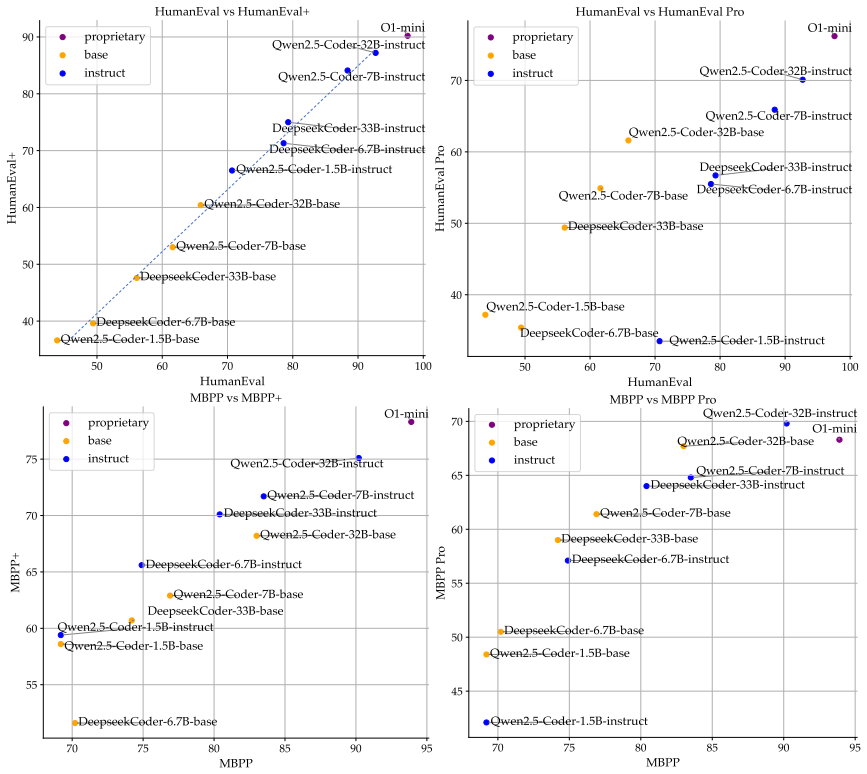
The central claim is that current large language models are much better at generating a standalone function than at generating a related harder function that builds on it, and the paper calls this deficit "self-invoking code generation." The benchmarks operationalize the task by pairing a base problem with a self-invoking problem and asking the model to write both solutions in one response, with the second solution explicitly expected to make single or multiple calls to the first. The paper reports that o1-mini passes 96.2% of HumanEval but only 76.2% of HumanEval Pro, and that across the model family the decline is concentrated in failures on the harder self-invoking problems rather than in the base problems. It further claims that instruction-based fine-tuning, which lifts base models by large margins on HumanEval, gives only marginal gains on HumanEval Pro and MBPP Pro, suggesting that existing training recipes do not target this reuse capability.
Load-bearing premise
The scoring only runs final hidden tests, so a model that solves the harder problem without ever calling its base-solution function still passes; the benchmark therefore measures whether the model can solve a harder related problem, not necessarily whether it actually reuses its own code.
Editorial extensions
If this is right
- Scores on HumanEval and MBPP overstate practical code generation ability, because a large share of the problems most models solve directly are not solved when the task requires composing a solution from the model's own code.
- Instruction tuning as currently practiced is not sufficient for self-invoking code generation; closing this gap will require training data or objectives that specifically reward calling an earlier generated function.
- Chain-of-thought prompting can be used as a partial mitigation: several models gain a few points on HumanEval Pro when asked to reason step by step, and the co-occurring drop in NameErrors suggests the reasoning makes generated code more self-contained.
- The construction recipe is reproducible on other code benchmarks, as demonstrated by BigCodeBench-Lite Pro showing the same pattern, so the task can be extended as older benchmarks saturate.
Reading between the lines
- A testable extension the authors did not run: instrument the evaluator to require, in addition to passing hidden tests, that the emitted code actually contains a call to the base function; this would separate "reuses own code" from "solves a harder related problem directly."
- If self-invocation is the real bottleneck, then techniques that encourage decomposition—such as planning prompts, explicit function signatures, or training on compositional execution traces—should move HumanEval Pro scores more than further scaling of base-model data.
- The observed NameError pattern suggests one concrete mechanism: models fail to carry the required function name or signature from the base problem into the second function, a determinable failure that could be fixed by consistency-aware decoding or prompt design.
- Because the benchmarks are derived from a single generator model, part of the measured gap could be an artifact of how that generator phrases self-invoking problems; a multi-generator variant would show whether the 10–15 point drop is stable across problem phrasing.
Signed reviews
Editorial analysis
A structured set of objections, weighed in public.
Referee Report
Summary. This paper proposes a new code-generation task, self-invoking code generation, in which a model must solve a base problem and then solve a related, more complex problem by calling the function it wrote for the base problem. The authors generate three benchmarks, HumanEval Pro, MBPP Pro, and BigCodeBench-Lite Pro, by prompting DeepSeek-V2.5 to create harder variants of existing problems, then iteratively executing and manually reviewing canonical solutions and test cases. They evaluate more than twenty proprietary and open-source LLMs, reporting a consistent 10-15 point absolute pass@1 drop on the Pro benchmarks relative to their base counterparts (e.g., o1-mini at 96.2% on HumanEval versus 76.2% on HumanEval Pro), and they present error-type analyses and a chain-of-thought study. The central interpretation is that the performance gap measures LLMs' ability to invoke their own generated code, and that instruction-tuned models improve less on this ability than on standard code generation.
Significance. If the benchmarks validly require self-invocation, the paper makes a useful contribution: it provides a reproducible recipe for upgrading saturated benchmarks, public datasets and model checkpoints, consistent tables across three benchmark families, and a concrete failure-mode taxonomy. The reported drop is large and coherent across models, and the base-versus-instruct comparison is thought-provoking. However, the paper's central construct-validity claim is not yet established because the evaluation never verifies that generated code actually calls the base solution; without such verification, the observed gaps may simply reflect the higher difficulty of the Pro problems. The benchmark could still be valuable as a difficulty-scaled extension of HumanEval and MBPP even if the self-invocation interpretation is weakened, but the title, abstract, and Section 5 conclusions currently overstate what the experiments establish.
major comments (2)
- [Section 4 and Appendix F.2] The evaluation protocol only executes the final test cases and never inspects whether the model's second solution calls the first solution. A solution that inlines the base logic, defines a separate helper, or solves the harder problem directly passes the same assertions. The prompt instruction in Appendix F.2 ('requires single or multiple calls to the first solution') is not enforced by the harness. Consequently, the 10-15 point pass@1 drops in Table 2 and the confusion-matrix analysis in Section 5.2 may reflect overall problem difficulty rather than self-invocation ability. This is load-bearing for the paper's central claim, so I request a static or execution-based check that passing solutions actually invoke the base function, or a report of the fraction of passing solutions that contain such a call, with conclusions re-stated accordingly.
- [Section 5.1 and Eq. (1)] The claim that instruction-tuned models show 'marginal improvements' on self-invoking tasks rests on absolute point differences between HumanEval and HumanEval Pro (e.g., Qwen2.5-Coder-32B-instruct improves by 26.8 points on HumanEval but only 8.5 points on HumanEval Pro). Because the Pro problems are more difficult, absolute gains are not a clean measure of instruction-tuning efficacy, and the pattern is not uniform: Qwen2.5-Coder-1.5B-instruct loses 3.7 points on HumanEval Pro while gaining 26.8 points on HumanEval. The ratio defined in Eq. (1) is never used in the analysis. Please provide a difficulty-controlled or normalized comparison, and adjust the conclusion if the pattern is not robust.
minor comments (5)
- [Section 4] Specify exactly how pass@1 is computed for API models when temperature=0.2; the text says greedy decoding for open-source models and temperature=0.2 for API models, which leaves unclear the number of samples and whether the reported numbers are single-sample pass rates.
- [Table 2] The column header 'HumanEval (+)' is ambiguous; clarify which columns correspond to HumanEval, HumanEval+, MBPP, and MBPP+.
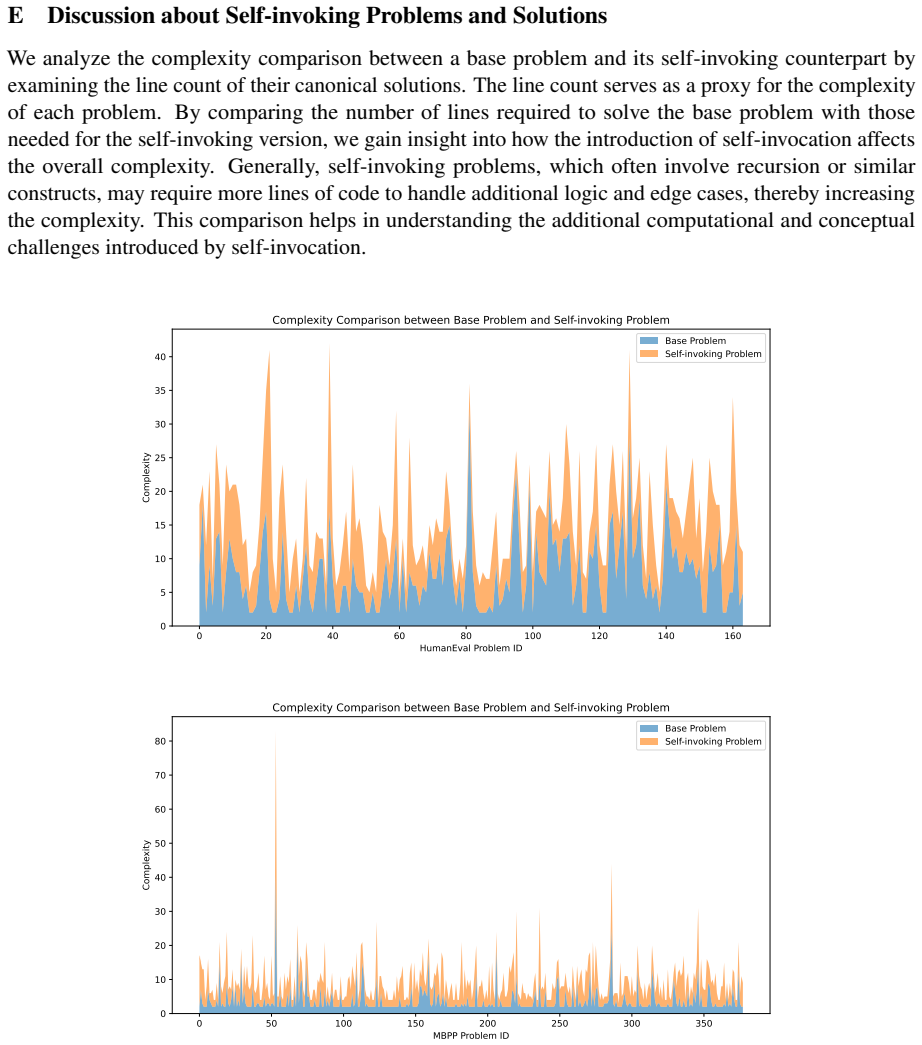
- [Appendix E] Using the line count of canonical solutions as a proxy for problem complexity is not validated; a more direct measure, such as the number of required calls or test-case difficulty, would better support the complexity claim.
- [Limitations] The Limitations section should acknowledge that the evaluation does not enforce the self-invocation constraint; currently it only mentions the Python-only restriction and the diversity of the generated problems.
- [Section 6.1] The choice of a 50%-70% solve-rate window for selecting BigCodeBench-Lite problems is not justified; please state the rationale and any sensitivity of the downstream results to this window.
Circularity Check
No significant circularity; the central pass@1 comparisons are self-contained and no derivation reduces to its inputs.
full rationale
The paper's reasoning is empirical rather than derivational: it constructs fixed benchmarks through a documented pipeline, evaluates more than twenty models with pass@1, and compares results against external HumanEval and MBPP baselines. No parameter is fitted to a subset of the data and then renamed as a prediction, no result is justified by a load-bearing self-citation chain, and no uniqueness theorem from the authors' prior work is invoked to forbid alternatives. The closest concern is that DeepSeek-V2.5 is both the benchmark generator and one of the evaluated models; this could bias that model's row, but it is a potential alignment issue rather than a circular derivation of the paper's main claims, which concern the general performance gap across many models. A second caveat is that the evaluator executes only final test cases and never verifies that generated code actually calls the base function, so the benchmark's construct validity as a measure of self-invocation is not fully established; however, that is a validity threat, not a circularity, because the observed 10%-15% pass@1 drop is measured directly from test execution and the analysis uses no fitted parameters. The benchmark construction, manual verification, and external-baseline comparisons make the paper self-contained under the circularity definition used here.
Assumptions & free parameters
free parameters (2)
- BigCodeBench-Lite solve-rate window =
50% to 70%
- Iteration stopping rule =
3 rounds
assumptions (3)
- domain assumption Generated test cases, after iterative execution and manual review, correctly capture the intended problem behavior
- domain assumption Passing the final test suite is a valid proxy for solving the self-invoking task, including the requirement to call the base solution
- domain assumption The base problem and self-invoking problem are semantically linked such that solving the base is a necessary prerequisite
Cite this review
Pith. "Pith review of HumanEval Pro and MBPP Pro: Evaluating Large Language Models on Self-invoking Code Generation." pith.science (2026). https://pith.science/paper/LZBA242B
@misc{pith2026241221199,
  author       = {Pith},
  title        = {Pith review of: HumanEval Pro and MBPP Pro: Evaluating Large Language Models on Self-invoking Code Generation},
  year         = {2026},
  howpublished = {\url{https://pith.science/paper/LZBA242B}},
  note         = {Machine review of arXiv:2412.21199}
}
read the original abstract
We introduce self-invoking code generation, a new task designed to evaluate the progressive reasoning and problem-solving capabilities of LLMs. In this task, models are presented with a base problem and a related, more complex problem. They must solve the base problem and then utilize its solution to address the more complex one. This work features three key contributions. First, we propose a general recipe for generating more challenging versions of existing benchmarks, resulting in three new benchmarks: HumanEval Pro, MBPP Pro, and BigCodeBench-Lite Pro, specifically designed to assess LLMs on self-invoking code generation. Second, from the analysis of experimental results over twenty LLMs on our benchmarks, we have two important observations: (i) Most LLMs excel in traditional code generation benchmarks like HumanEval and MBPP, but their performance declines on self-invoking tasks. For example, o1-mini achieves 96.2% pass@1 on HumanEval but only 76.2% on HumanEval Pro. (ii) On self-invoking code generation task, the instruction-tuned models demonstrate only marginal improvements compared to the base models. Third, we disclose the types of failure modes that exist in our evaluation results. All these results underscore the need for further advancements in self-invoking code generation tasks and provide a new direction for future research on enhancing LLMs' code reasoning capabilities.
Figures


Figures from the paper (7 more)


Forward citations
Cited by 7 Pith papers
-
ACPO: Adaptive Credit Policy Optimization via Fine-Grained Surrogate Entropy
Mode-local surrogate entropy asymmetrically reweights token advantages in RLVR, improving LLM math and code reasoning over SAPO, DAPO, and GTPO.
-
Where Do LLMs Still Struggle? An In-Depth Analysis of Code Generation Benchmarks
Across four benchmarks and six LLMs, consistently failed code-generation tasks are driven by four recurring error patterns rather than by solution-code complexity.
-
Can LLMs Generate High-Quality Test Cases for Algorithm Problems? TestCase-Eval: A Systematic Evaluation of Fault Coverage and Exposure
TestCase-Eval introduces fault coverage and fault exposure tasks over 500 Codeforces problems and finds that 19 LLMs, led by Qwen3-32B, remain far below human expert performance.
-
AutoGEEval: A Multimodal and Automated Framework for Geospatial Code Generation on GEE with Large Language Models
An automated, execution-based benchmark of 1,325 Google Earth Engine unit tests shows 18 LLMs scoring between 31.40% and 71.55% pass@1, with parameter-knowledge errors the dominant failure mode.
-
HackerRank-ASTRA: Evaluating Correctness & Consistency of Large Language Models on cross-domain multi-file project problems
A new 65-problem, multi-file benchmark evaluates LLM code generation on project-style tasks and reports that top models tie near 75%, with Claude-3.5-Sonnet most consistent.
-
HiBayES: A Hierarchical Bayesian Modeling Framework for AI Evaluation Statistics
A hierarchical Bayesian GLM framework, HiBayES, provides uncertainty-aware performance estimates and formal model comparison for AI evaluation, with a software package and demonstrations on LLM benchmarks.
-
Reasoning as a Resource: Optimizing Fast and Slow Thinking in Code Generation Models
Reasoning depth in code LLMs should be managed as a controllable resource across synthetic data generation, benchmarking, and deployment, rather than left implicit.
Reference graph
Works this paper leans on
-
[1]
online" 'onlinestring :=
ENTRY address archivePrefix author booktitle chapter edition editor eid eprint eprinttype howpublished institution journal key month note number organization pages publisher school series title type volume year doi pubmed url lastchecked label extra.label sort.label short.list INTEGERS output.state before.all mid.sentence after.sentence after.block STRING...
-
[2]
write newline
" write newline "" before.all 'output.state := FUNCTION n.dashify 't := "" t empty not t #1 #1 substring "-" = t #1 #2 substring "--" = not "--" * t #2 global.max substring 't := t #1 #1 substring "-" = "-" * t #2 global.max substring 't := while if t #1 #1 substring * t #2 global.max substring 't := if while FUNCTION word.in bbl.in capitalize " " * FUNCT...
-
[3]
01.AI. 2024. Meet yi-coder: A small but mighty llm for code
work page 2024
-
[4]
Anthropic. 2024. https://api.semanticscholar.org/CorpusID:268232499 The claude 3 model family: Opus, sonnet, haiku
2024
-
[5]
Ben Athiwaratkun, Sanjay Krishna Gouda, Zijian Wang, Xiaopeng Li, Yuchen Tian, Ming Tan, Wasi Uddin Ahmad, Shiqi Wang, Qing Sun, Mingyue Shang, et al. 2022. Multi-lingual evaluation of code generation models. arXiv preprint arXiv:2210.14868
arXiv 2022
-
[6]
Jacob Austin, Augustus Odena, Maxwell Nye, Maarten Bosma, Henryk Michalewski, David Dohan, Ellen Jiang, Carrie Cai, Michael Terry, Quoc Le, et al. 2021. Program synthesis with large language models. arXiv preprint arXiv:2108.07732
arXiv 2021
-
[7]
Antonio Valerio Miceli Barone and Rico Sennrich. 2017. A parallel corpus of python functions and documentation strings for automated code documentation and code generation. arXiv preprint arXiv:1707.02275
arXiv 2017
-
[8]
Mark Chen, Jerry Tworek, Heewoo Jun, Qiming Yuan, Henrique Ponde de Oliveira Pinto, Jared Kaplan, Harri Edwards, Yuri Burda, Nicholas Joseph, Greg Brockman, et al. 2021. Evaluating large language models trained on code. arXiv preprint arXiv:2107.03374
arXiv 2021
Show all 44 references
-
[9]
DeepSeek-AI. 2024. https://arxiv.org/abs/2405.04434 Deepseek-v2: A strong, economical, and efficient mixture-of-experts language model . Preprint, arXiv:2405.04434
2024 arXiv
-
[10]
Alex Gu, Baptiste Roziere, Hugh James Leather, Armando Solar-Lezama, Gabriel Synnaeve, and Sida Wang. 2024. Cruxeval: A benchmark for code reasoning, understanding and execution. In Forty-first International Conference on Machine Learning
2024
-
[11]
Daya Guo, Qihao Zhu, Dejian Yang, Zhenda Xie, Kai Dong, Wentao Zhang, Guanting Chen, Xiao Bi, Yu Wu, YK Li, et al. 2024. Deepseek-coder: When the large language model meets programming--the rise of code intelligence. arXiv preprint arXiv:2401.14196
2024 arXiv
-
[12]
Md Mahim Anjum Haque, Wasi Uddin Ahmad, Ismini Lourentzou, and Chris Brown. 2022. Fixeval: Execution-based evaluation of program fixes for competitive programming problems
2022
-
[13]
Masum Hasan, Tanveer Muttaqueen, Abdullah Al Ishtiaq, Kazi Sajeed Mehrab, Md Mahim Anjum Haque, Tahmid Hasan, Wasi Uddin Ahmad, Anindya Iqbal, and Rifat Shahriyar. 2021. Codesc: A large code-description parallel dataset. arXiv preprint arXiv:2105.14220
2021 arXiv
-
[14]
Siming Huang, Tianhao Cheng, Jason Klein Liu, Jiaran Hao, Liuyihan Song, Yang Xu, J Yang, JH Liu, Chenchen Zhang, Linzheng Chai, et al. 2024. Opencoder: The open cookbook for top-tier code large language models. arXiv preprint arXiv:2411.04905
2024 arXiv
-
[15]
Binyuan Hui, Jian Yang, Zeyu Cui, Jiaxi Yang, Dayiheng Liu, Lei Zhang, Tianyu Liu, Jiajun Zhang, Bowen Yu, Keming Lu, et al. 2024. Qwen2. 5-coder technical report. arXiv preprint arXiv:2409.12186
2024 arXiv
-
[16]
Naman Jain, King Han, Alex Gu, Wen-Ding Li, Fanjia Yan, Tianjun Zhang, Sida Wang, Armando Solar-Lezama, Koushik Sen, and Ion Stoica. 2024. Livecodebench: Holistic and contamination free evaluation of large language models for code. arXiv preprint
2024
-
[17]
Nan Jiang, Kevin Liu, Thibaud Lutellier, and Lin Tan. 2023. Impact of code language models on automated program repair. arXiv preprint arXiv:2302.05020
2023 arXiv
-
[18]
Carlos E Jimenez, John Yang, Alexander Wettig, Shunyu Yao, Kexin Pei, Ofir Press, and Karthik Narasimhan. 2023. Swe-bench: Can language models resolve real-world github issues? arXiv preprint arXiv:2310.06770
2023 arXiv
-
[19]
Matthew Jin, Syed Shahriar, Michele Tufano, Xin Shi, Shuai Lu, Neel Sundaresan, and Alexey Svyatkovskiy. 2023. Inferfix: End-to-end program repair with llms. arXiv preprint arXiv:2303.07263
2023 arXiv
-
[20]
Jia Li, Ge Li, Xuanming Zhang, Yunfei Zhao, Yihong Dong, Zhi Jin, Binhua Li, Fei Huang, and Yongbin Li. 2024. https://openreview.net/forum?id=kvjbFVHpny Evocodebench: An evolving code generation benchmark with domain-specific evaluations . In The Thirty-eight Conference on Neu...
2024
-
[21]
Raymond Li, Loubna Ben Allal, Yangtian Zi, Niklas Muennighoff, Denis Kocetkov, Chenghao Mou, Marc Marone, Christopher Akiki, Jia Li, Jenny Chim, et al. 2023. Starcoder: may the source be with you! arXiv preprint arXiv:2305.06161
2023 arXiv
-
[22]
Jiawei Liu, Chunqiu Steven Xia, Yuyao Wang, and Lingming Zhang. 2024. Is your code generated by chatgpt really correct? rigorous evaluation of large language models for code generation. Advances in Neural Information Processing Systems, 36
2024
-
[23]
Tianyang Liu, Canwen Xu, and Julian McAuley. 2023. Repobench: Benchmarking repository-level code auto-completion systems. arXiv preprint arXiv:2306.03091
2023 arXiv
-
[24]
Ziyang Luo, Can Xu, Pu Zhao, Qingfeng Sun, Xiubo Geng, Wenxiang Hu, Chongyang Tao, Jing Ma, Qingwei Lin, and Daxin Jiang. 2023. Wizardcoder: Empowering code large language models with evol-instruct. arXiv preprint arXiv:2306.08568
2023 arXiv
-
[25]
Mistral. 2024. https://mistral.ai/news/codestral/ Codestral
2024
-
[26]
Niklas Muennighoff, Qian Liu, Armel Randy Zebaze, Qinkai Zheng, Binyuan Hui, Terry Yue Zhuo, Swayam Singh, Xiangru Tang, Leandro Von Werra, and Shayne Longpre. 2024. https://openreview.net/forum?id=mw1PWNSWZP Octopack: Instruction tuning code large language models . In The Twe...
2024
-
[27]
Ansong Ni, Pengcheng Yin, Yilun Zhao, Martin Riddell, Troy Feng, Rui Shen, Stephen Yin, Ye Liu, Semih Yavuz, Caiming Xiong, Shafiq Joty, Yingbo Zhou, Dragomir Radev, Arman Cohan, and Arman Cohan. 2024. https://doi.org/10.1162/tacl_a_00705 L 2 CE val: Evaluating language-to-cod...
2024 doi
-
[28]
OpenAI. 2024 a . https://openai.com/index/hello-gpt-4o Gpt-4o
2024
-
[29]
OpenAI. 2024 b . https://api.semanticscholar.org/CorpusID:272648256 Openai o1 system card
2024
-
[30]
Long Ouyang, Jeffrey Wu, Xu Jiang, Diogo Almeida, Carroll Wainwright, Pamela Mishkin, Chong Zhang, Sandhini Agarwal, Katarina Slama, Alex Ray, et al. 2022. Training language models to follow instructions with human feedback. Advances in neural information processing systems, 3...
2022
-
[31]
Houxing Ren, Mingjie Zhan, Zhongyuan Wu, Aojun Zhou, Junting Pan, and Hongsheng Li. 2024. https://arxiv.org/abs/2405.17057 Reflectioncoder: Learning from reflection sequence for enhanced one-off code generation . Preprint, arXiv:2405.17057
2024 arXiv
-
[32]
Baptiste Roziere, Jonas Gehring, Fabian Gloeckle, Sten Sootla, Itai Gat, Xiaoqing Ellen Tan, Yossi Adi, Jingyu Liu, Tal Remez, J \'e r \'e my Rapin, et al. 2023. Code llama: Open foundation models for code. arXiv preprint arXiv:2308.12950
2023 arXiv
-
[33]
Disha Shrivastava, Hugo Larochelle, and Daniel Tarlow. 2023. Repository-level prompt generation for large language models of code. In International Conference on Machine Learning, pages 31693--31715. PMLR
2023
-
[34]
Jason Wei, Xuezhi Wang, Dale Schuurmans, Maarten Bosma, Fei Xia, Ed Chi, Quoc V Le, Denny Zhou, et al. 2022. Chain-of-thought prompting elicits reasoning in large language models. Advances in Neural Information Processing Systems, 35:24824--24837
2022
-
[35]
Yuxiang Wei, Zhe Wang, Jiawei Liu, Yifeng Ding, and Lingming Zhang. 2024. Magicoder: Empowering code generation with oss-instruct. In Forty-first International Conference on Machine Learning
2024
-
[36]
Chunqiu Steven Xia, Yinlin Deng, and Lingming Zhang. 2024. Top leaderboard ranking = top coding proficiency, always? evoeval: Evolving coding benchmarks via llm. arXiv preprint
2024
-
[37]
Chunqiu Steven Xia, Yuxiang Wei, and Lingming Zhang. 2022. Practical program repair in the era of large pre-trained language models. arXiv preprint arXiv:2210.14179
2022 arXiv
-
[38]
Zhaojian Yu, Xin Zhang, Ning Shang, Yangyu Huang, Can Xu, Yishujie Zhao, Wenxiang Hu, and Qiufeng Yin. 2024. Wavecoder: Widespread and versatile enhancement for code large language models by instruction tuning. In Proceedings of the 62nd Annual Meeting of the Association for C...
2024
-
[39]
Ziyin Zhang, Chaoyu Chen, Bingchang Liu, Cong Liao, Zi Gong, Hang Yu, Jianguo Li, and Rui Wang. 2023. https://arxiv.org/abs/2311.07989 A survey on language models for code
2023 arXiv
-
[40]
Qinkai Zheng, Xiao Xia, Xu Zou, Yuxiao Dong, Shan Wang, Yufei Xue, Zihan Wang, Lei Shen, Andi Wang, Yang Li, et al. 2023. Codegeex: A pre-trained model for code generation with multilingual evaluations on humaneval-x. arXiv preprint arXiv:2303.17568
2023 arXiv
-
[41]
Tianyu Zheng, Ge Zhang, Tianhao Shen, Xueling Liu, Bill Yuchen Lin, Jie Fu, Wenhu Chen, and Xiang Yue. 2024. Opencodeinterpreter: Integrating code generation with execution and refinement. arXiv preprint arXiv:2402.14658
2024 arXiv
-
[42]
Ming Zhu, Aneesh Jain, Karthik Suresh, Roshan Ravindran, Sindhu Tipirneni, and Chandan K Reddy. 2022. Xlcost: A benchmark dataset for cross-lingual code intelligence. arXiv preprint arXiv:2206.08474
2022 arXiv
-
[43]
Qihao Zhu, Daya Guo, Zhihong Shao, Dejian Yang, Peiyi Wang, Runxin Xu, Y Wu, Yukun Li, Huazuo Gao, Shirong Ma, et al. 2024. Deepseek-coder-v2: Breaking the barrier of closed-source models in code intelligence. arXiv preprint arXiv:2406.11931
2024 arXiv
-
[44]
Terry Yue Zhuo, Minh Chien Vu, Jenny Chim, Han Hu, Wenhao Yu, Ratnadira Widyasari, Imam Nur Bani Yusuf, Haolan Zhan, Junda He, Indraneil Paul, et al. 2024. Bigcodebench: Benchmarking code generation with diverse function calls and complex instructions. arXiv preprint arXiv:2406.15877
2024 arXiv
Reviewed August 10, 2026 · model on record in the stance chip above.
Discussion (0). Continue with ORCID to comment.