REVIEW 2 major objections 4 minor 35 references
Revisiting Simple Domain Adaptation Methods in Unsupervised Neural Machine Translation
T0 review · 2 major / 4 minor · reviewed 2026-08-14 · deepseek-v4-flash
Pith's one-line read Flipping the out-of-domain batch ratio and fine-tuning on cross-entropy-selected pseudo in-domain sentences improves unsupervised translation by 4.4 to 11.9 BLEU.
desk verdict First serious take on UNMT domain adaptation, with a clean scenario taxonomy and consistent gains — but single-run BLEU and an untested back-translation proxy keep me from trusting the numbers as reported. read the letter →
The pith
A machine-rendered reading of the paper's core claim, the machinery that carries it, and where it could break.
The reading
What carries the argument
The carrying mechanism is a pair of simple formulas applied to UNMT training. The first is a flipped batch-weighting ratio, $R_{\mathrm{out}} = N_{\mathrm{out}}/(N_{\mathrm{out}}+N_{\mathrm{in}})$, with $N_{\mathrm{in}}=1$ and $N_{\mathrm{out}}$ around 30, which controls how many out-of-domain mini-batches are loaded between in-domain mini-batches; up-weighting out-of-domain data rather than in-domain data is what prevents overfitting to the smaller in-domain side. The second is a data-selection scorer, the cross-entropy difference $\mathrm{CE}_I(s)-\mathrm{CE}_O(s)$, which ranks out-of-domain sentences by how much more they resemble a cross-lingual in-domain language model than an out-of-domain language model. The in-domain language model is trained on back-translated L2 in-domain text, which lets the selector work even when no native in-domain text exists for language L1.
What would settle it
A direct test would take a language pair with a small held-out set of genuine L1 in-domain sentences, back-translate the L2 in-domain corpus, and compare CED-selected L1 sentences against random selection by overlap with the held-out set; if the selected set shows no greater lexical or topic overlap than random selection, the proxy assumption fails. Alternatively, rerun the IO scenario with the back-translated proxy replaced by an equally sized random sample of L1 out-of-domain text; if BLEU does not drop, the selection step is not the cause of the reported gains.
Extended reading notes
Core claim
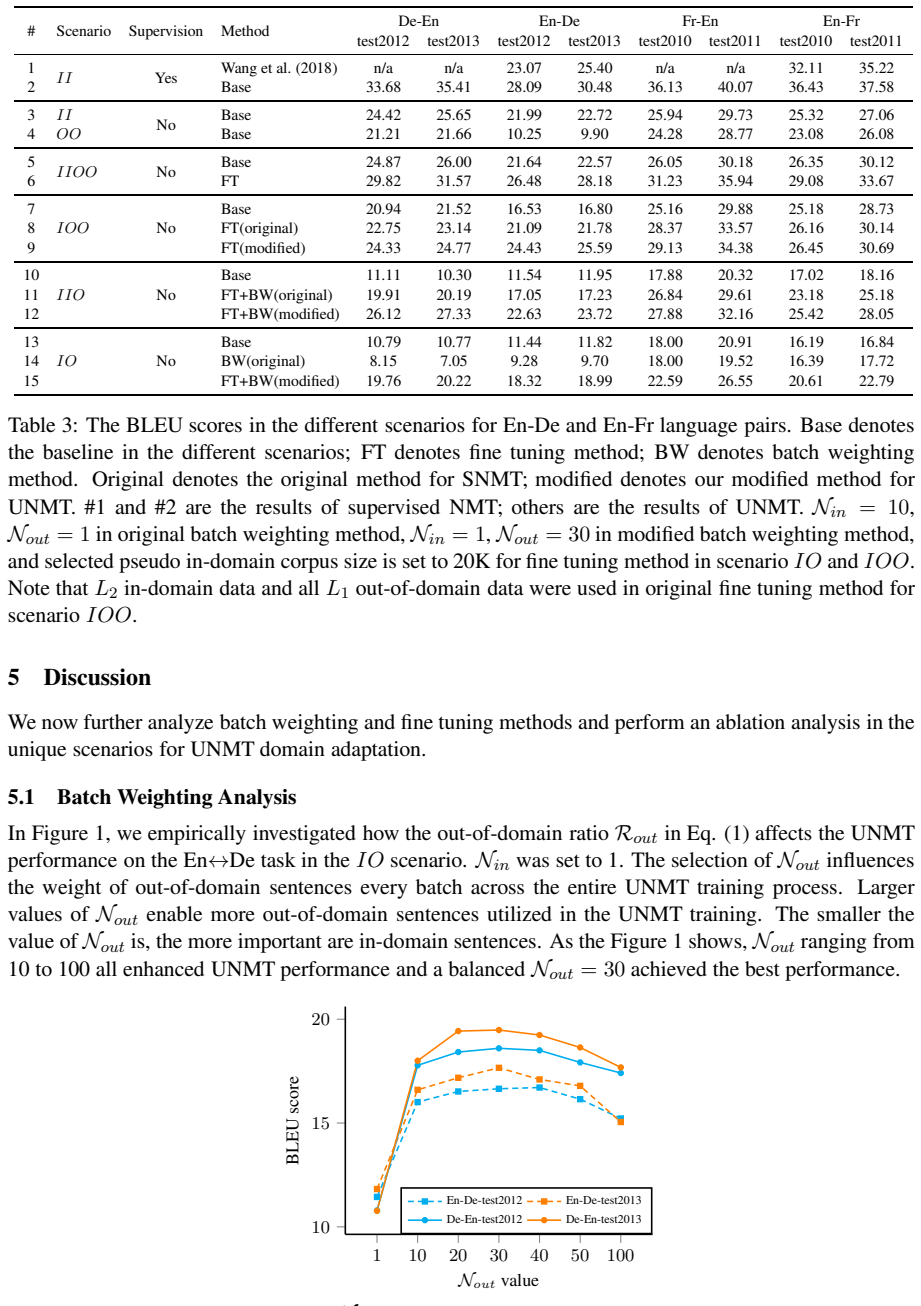
The central claim is that domain adaptation for UNMT is not the same problem as for supervised NMT, and the standard recipe must be reversed. When training data mixes a large out-of-domain corpus and a small in-domain corpus, the SNMT approach of over-sampling the in-domain sentences (for example, $N_{\mathrm{in}}=10, N_{\mathrm{out}}=1$) actively hurts UNMT; instead, setting $N_{\mathrm{in}}=1, N_{\mathrm{out}}=30$ and letting the model see far more out-of-domain data yields a robust base model. When in-domain data exists for only one language, the paper's modified fine-tuning step back-translates that data into the other language, trains a cross-lingual language model on the result, and ranks candidate sentences by $\mathrm{CE}_I(s)-\mathrm{CE}_O(s)$, fine-tuning on the lowest-scoring 20K sentences. Across the four scenarios IIOO, IOO, IIO, and IO, the paper reports average BLEU improvements of 4.8, 4.4, 11.9, and 6.6 over the mixed-corpus baseline, with the largest gains in the mismatched-domain scenarios unique to UNMT.
Load-bearing premise
The load-bearing premise is that back-translated L2 in-domain text is a faithful proxy for true L1 in-domain text, so that a cross-lingual language model trained on it ranks candidate L1 sentences correctly; if back-translation systematically distorts the domain, the CED selector will pick the wrong sentences and the fine-tuning gains will not transfer.
Editorial extensions
If this is right
- When both languages have both in- and out-of-domain data (IIOO), fine-tuning on the small in-domain corpora after convergence yields an average 4.8 BLEU gain, so no special sampling is needed.
- When only one language has in-domain data (IOO and IO), back-translating it into the other language and selecting by cross-entropy difference supplies a usable pseudo in-domain corpus for fine tuning.
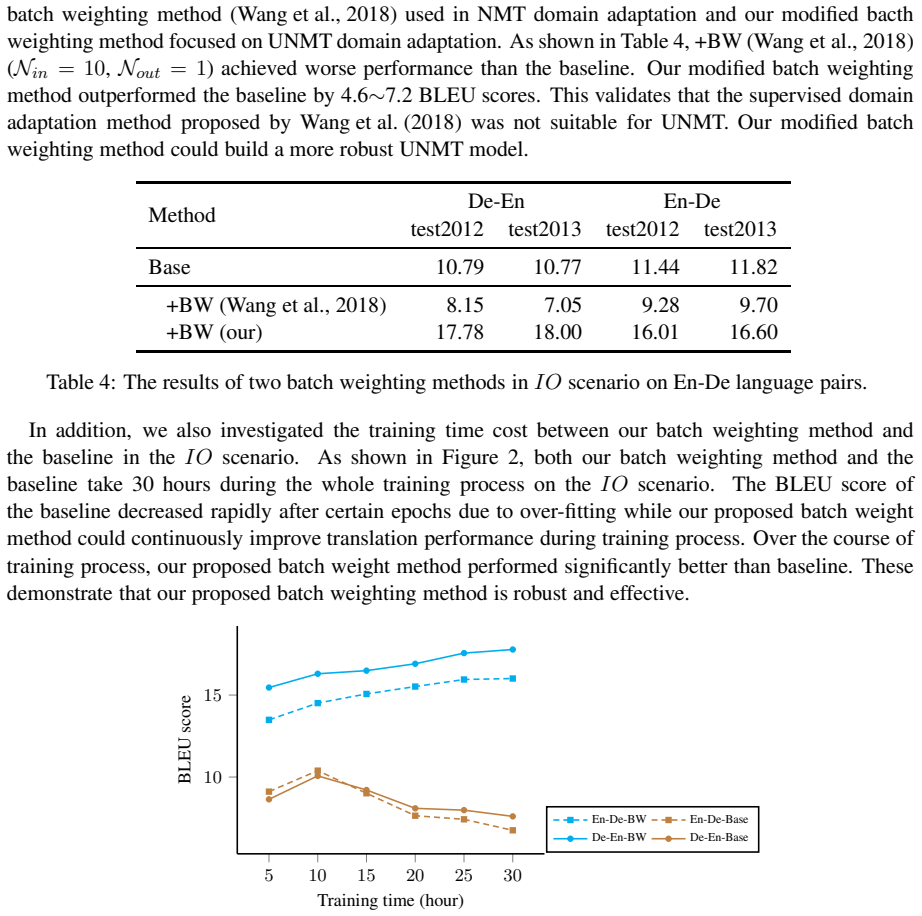
- When only one language has out-of-domain data (IIO and IO), setting $N_{\mathrm{out}}=30$ rather than $N_{\mathrm{out}}=1$ is worth roughly 4.6 to 7.2 BLEU over the original batch-weighting recipe and keeps the base UNMT model from degrading during training.
- The combination of fine tuning and batch weighting is complementary: in the IO scenario, fine tuning alone adds about 1 to 2.5 BLEU, batch weighting about 4.6 to 7.2 BLEU, and together about 7 to 9 BLEU over baseline.
- Gains appear in both translation directions for both German–English and French–English, suggesting the effects are not limited to one language pair.
Reading between the lines
- A natural extension the paper leaves untested is iterative pseudo in-domain selection: after the first fine-tuning round, re-back-translate with the improved model and re-select, which could compound the reported one-shot CED gains.
- The flipped ratio suggests a general principle for UNMT: when the two monolingual sides are unbalanced, the large out-of-domain corpus should be treated as the training backbone and the small in-domain corpus as a fine-tuning set, inverting the usual supervised-NMT instinct to protect the in-domain signal during training.
- Because the gains are largest where domains are far apart (TED talks versus news), the same recipe might transfer to other unsupervised cross-lingual tasks, such as speech recognition or OCR, provided a cross-lingual model can rank candidate sentences.
Signed reviews
Editorial analysis
A structured set of objections, weighed in public.
Referee Report
Summary. The paper defines four domain adaptation scenarios for unsupervised neural machine translation (UNMT) based on whether in-domain and out-of-domain monolingual corpora are available in each of two languages (IIOO, IOO, IIO, IO). It revisits two existing methods, batch weighting and fine tuning, and proposes modifications: for batch weighting, the out-of-domain mini-batch interval is increased (Nout=30 instead of Nout=1), and for fine tuning, back-translated L2 in-domain data is used to train a cross-lingual in-domain language model that selects pseudo in-domain L1 sentences via the cross-entropy difference in Eq. (2). Experiments on German-English and French-English with WMT news crawl as out-of-domain and IWSLT TED as in-domain report BLEU gains over mixed-data baselines in all four scenarios, with average improvements of 4.4, 11.9, and 6.6 points in IOO, IIO, and IO, plus ablations and hyperparameter analyses.
Significance. If the results hold, this is the first systematic study of domain adaptation specifically for UNMT and provides a simple, practical recipe for asymmetric domain availability: upweight out-of-domain data when one language lacks in-domain data, and fine-tune on cross-lingual-LM-selected pseudo in-domain data. The paper's strengths are the consistent pattern of improvements across two language pairs and four scenarios, the inclusion of ablations in Tables 7 and 8, and the explicit analysis of hyperparameters in Figures 1 and 3. However, the empirical claims rest entirely on single-run BLEU scores without variance or significance tests, and the key proxy assumption in Section 3.2 is not validated. These issues prevent the stated significance from being fully established as written.
major comments (2)
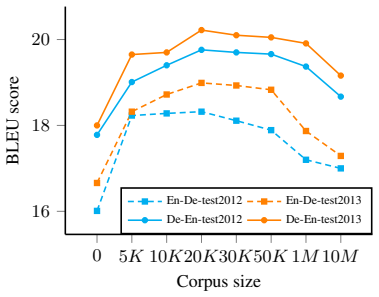
- [§4.3, §5, Tables 3, 7, 8 and Figures 1, 3] All reported BLEU scores are single runs with no error bars, no multiple seeds, and no significance tests. In addition, the key hyperparameters Nout=30 and the selected pseudo in-domain corpus size of 20K are chosen by sweeping values on the same IWSLT test sets used for the main results (Figures 1 and 3), then used to report the gains in Tables 3, 7, and 8. This testing-on-the-validation-set procedure makes the reported improvements potentially optimistic and makes it impossible to assess whether the differences are meaningful. Please add multiple seeds with standard deviations or significance tests, and select hyperparameters on a held-out validation split rather than on test2012/test2013.
- [§3.2, Eq. (2), Tables 3 and 7] The modified fine-tuning method for the IOO and IO scenarios assumes that back-translated L2 in-domain data is a faithful proxy for the missing L1 in-domain data, so that a cross-lingual language model trained on this pseudo in-domain corpus can correctly rank L1 out-of-domain sentences via CE_I(s) - CE_O(s). This assumption is load-bearing because the selected pseudo in-domain corpus is used to fine-tune the UNMT model, and the paper never tests whether back-translation distorts the domain distribution. Since the simulated setup actually has the true L1 IWSLT in-domain corpus available but withholds it, an oracle-selection comparison using the true L1 in-domain data would directly settle whether the proxy holds; without such a comparison, the transfer of the reported gains to settings where L1 in-domain data is genuinely absent remains uncertain.
minor comments (4)
- [§5.1] There is a typo: "modified bacth weighting method" should read "modified batch weighting method."
- [§1] In the introduction, "we proposed modified domain adaptation methods" should be "we propose modified domain adaptation methods" to match the present-tense framing of the paper.
- [§5.1, Figure 2] The text says the proposed method "performed significantly better than baseline," but no significance test is reported; please either add statistical tests or rephrase as "consistently better" throughout.
- [Table 1] The table formatting makes the two variants of the IO scenario hard to distinguish; please add explicit row labels or a note clarifying that IO covers both (L1 in-domain, L2 out-of-domain) and (L2 in-domain, L1 out-of-domain) cases.
Circularity Check
No significant circularity: the reported gains are empirical BLEU scores against external test sets, not derivations from fitted quantities.
full rationale
The paper's central claim is that modified batch weighting and fine-tuning methods improve UNMT performance in the four defined scenarios. This is supported by BLEU evaluations on held-out IWSLT test sets, which are external to the training data and the proposed selection procedure. The methods are described procedurally rather than derived from the conclusion: batch weighting changes the out-of-domain sentence ratio in training batches, and fine-tuning selects pseudo in-domain data via cross-entropy difference. The use of back-translated L2 in-domain data to train an in-domain language model is an empirical approximation that could be a correctness risk, but it does not make the final BLEU result equal to an input or fitted quantity by construction. The paper contains self-citations to prior work by overlapping authors, such as Wang et al. (2017b, 2018) and Chu and Wang (2018), but these are used to describe baseline methods and related work, not to justify the paper's central empirical claim. No uniqueness theorem, ansatz, or fitted parameter is smuggled in as a prediction. Therefore no circular step can be exhibited, and the paper is self-contained against external benchmarks.
Assumptions & free parameters
free parameters (2)
- Nout, out-of-domain mini-batch interval in modified batch weighting =
30 (with Nin=1)
- Selected pseudo in-domain corpus size for fine tuning =
20K
assumptions (3)
- domain assumption IWSLT TED data is in-domain and WMT news crawl data is out-of-domain for the target task.
- domain assumption Back-translation of L2 in-domain data produces L1 pseudo in-domain data that represents the in-domain distribution closely enough for selection.
- domain assumption Cross-entropy difference CED = CE_I(s) - CE_O(s) correctly ranks out-of-domain sentences for pseudo in-domain selection in UNMT.
Cite this review
Pith. "Pith review of Revisiting Simple Domain Adaptation Methods in Unsupervised Neural Machine Translation." pith.science (2026). https://pith.science/paper/LZH7YPJ4
@misc{pith2026190809605,
  author       = {Pith},
  title        = {Pith review of: Revisiting Simple Domain Adaptation Methods in Unsupervised Neural Machine Translation},
  year         = {2026},
  howpublished = {\url{https://pith.science/paper/LZH7YPJ4}},
  note         = {Machine review of arXiv:1908.09605}
}
read the original abstract
Domain adaptation has been well-studied in supervised neural machine translation (SNMT). However, it has not been well-studied for unsupervised neural machine translation (UNMT), although UNMT has recently achieved remarkable results in several domain-specific language pairs. Besides the inconsistent domains between training data and test data for SNMT, there sometimes exists an inconsistent domain between two monolingual training data for UNMT. In this work, we empirically show different scenarios for unsupervised neural machine translation. Based on these scenarios, we revisit the effect of the existing domain adaptation methods including batch weighting and fine tuning methods in UNMT. Finally, we propose modified methods to improve the performances of domain-specific UNMT systems.
Figures
Reference graph
Works this paper leans on
-
[1]
Mikel Artetxe, Gorka Labaka, Eneko Agirre, and Kyunghyun Cho. 2018. Unsupervised neural machine translation. In ICLR , Vancouver, Canada, April
work page 2018
-
[2]
Amittai Axelrod, Xiaodong He, and Jianfeng Gao. 2011. Domain adaptation via pseudo in-domain data selection. In EMNLP , Edinburgh, Scotland, UK., July
work page 2011
-
[3]
Lo \" c Barrault, Ond r ej Bojar, Marta R. Costa-juss \`a , Christian Federmann, Mark Fishel, Yvette Graham, Barry Haddow, Matthias Huck, Philipp Koehn, Shervin Malmasi, Christof Monz, Mathias M \"u ller, Santanu Pal, Matt Post, and Marcos Zampieri. 2019. Findings of the 2019 conference on machine translation ( WMT 19). In WMT , Florence, Italy, August
work page 2019
-
[4]
Ond r ej Bojar, Christian Federmann, Mark Fishel, Yvette Graham, Barry Haddow, Philipp Koehn, and Christof Monz. 2018. Findings of the 2018 conference on machine translation ( WMT 18). In WMT , Brussels, Belgium, October
work page 2018
-
[5]
Denny Britz, Quoc Le, and Reid Pryzant. 2017. Effective domain mixing for neural machine translation. In WMT , Copenhagen, Denmark, September
work page 2017
-
[6]
Boxing Chen, Colin Cherry, George F. Foster, and Samuel Larkin. 2017. Cost weighting for neural machine translation domain adaptation. In NMT@ACL , Vancouver, Canada
work page 2017
-
[7]
Chenhui Chu and Rui Wang. 2018. A survey of domain adaptation for neural machine translation. In COLING , Santa Fe, New Mexico, USA
work page 2018
-
[8]
Chenhui Chu, Raj Dabre, and Sadao Kurohashi. 2017. An empirical comparison of domain adaptation methods for neural machine translation. In ACL , Vancouver, Canada, July
work page 2017
Show all 35 references
-
[9]
Amin Farajian, Marco Turchi, Matteo Negri, and Marcello Federico
M. Amin Farajian, Marco Turchi, Matteo Negri, and Marcello Federico. 2017. Multi-domain neural machine translation through unsupervised adaptation. In WMT , Copenhagen, Denmark
2017
-
[10]
Markus Freitag and Yaser Al - Onaizan. 2016. Fast domain adaptation for neural machine translation. CoRR , abs/1612.06897
2016 arXiv
-
[11]
Shuhao Gu, Yang Feng, and Qun Liu. 2019. Improving domain adaptation translation with domain invariant and specific information. In NAACL , Minneapolis, Minnesota, June
2019
-
[12]
Junjie Hu, Mengzhou Xia, Graham Neubig, and Jaime Carbonell. 2019. Domain adaptation of neural machine translation by lexicon induction. In ACL , Florence, Italy, July
2019
-
[13]
Huda Khayrallah, Gaurav Kumar, Kevin Duh, Matt Post, and Philipp Koehn. 2017. Neural lattice search for domain adaptation in machine translation. In IJCNLP , Taipei, Taiwan, November
2017
-
[14]
Diederik P Kingma and Jimmy Ba. 2015. Adam: A method for stochastic optimization. In ICLR , San Diego, California, USA
2015
-
[15]
Catherine Kobus, Josep Maria Crego, and Jean Senellart. 2017. Domain control for neural machine translation. In RANLP , pages 372--378, Varna, Bulgaria
2017
-
[16]
Philipp Koehn and Rebecca Knowles. 2017. Six challenges for neural machine translation. In WMT , Vancouver, Canada, August
2017
-
[17]
Philipp Koehn, Hieu Hoang, Alexandra Birch, Chris Callison-Burch, Marcello Federico, Nicola Bertoldi, Brooke Cowan, Wade Shen, Christine Moran, Richard Zens, Chris Dyer, Ondrej Bojar, Alexandra Constantin, and Evan Herbst. 2007. M oses: Open source toolkit for statistical mach...
2007
-
[18]
Guillaume Lample and Alexis Conneau. 2019. Cross-lingual language model pretraining. CoRR , abs/1901.07291
2019 arXiv
-
[19]
Guillaume Lample, Alexis Conneau, Ludovic Denoyer, and Marc'Aurelio Ranzato. 2018a. Unsupervised machine translation using monolingual corpora only. In ICLR , Vancouver, Canada
-
[20]
Guillaume Lample, Myle Ott, Alexis Conneau, Ludovic Denoyer, and Marc'Aurelio Ranzato. 2018b. Phrase-based & neural unsupervised machine translation. In EMNLP , Brussels, Belgium
-
[21]
Minh-Thang Luong and Christopher D. Manning. 2015. Stanford neural machine translation systems for spoken language domain. In IWSLT , Da Nang, Vietnam
2015
-
[22]
Moore and William Lewis
Robert C. Moore and William Lewis. 2010. Intelligent selection of language model training data. In ACL , Uppsala, Sweden, July
2010
-
[23]
Danielle Saunders, Felix Stahlberg, Adri \`a de Gispert, and Bill Byrne. 2019. Domain adaptive inference for neural machine translation. In ACL , Florence, Italy, July
2019
-
[24]
Rico Sennrich, Barry Haddow, and Alexandra Birch. 2016a. Improving neural machine translation models with monolingual data. In ACL , Berlin, Germany, August
-
[25]
Rico Sennrich, Barry Haddow, and Alexandra Birch. 2016b. Neural machine translation of rare words with subword units. In ACL , Berlin, Germany
-
[26]
Christophe Servan, Josep Maria Crego, and Jean Senellart. 2016. Domain specialization: a post-training domain adaptation for neural machine translation. CoRR , abs/1612.06141
2016 arXiv
-
[27]
Haipeng Sun, Rui Wang, Kehai Chen, Masao Utiyama, Eiichiro Sumita, and Tiejun Zhao. 2019. Unsupervised bilingual word embedding agreement for unsupervised neural machine translation. In ACL , Florence, Italy, July
2019
-
[28]
Marlies van der Wees, Arianna Bisazza, and Christof Monz. 2017. Dynamic data selection for neural machine translation. In EMNLP , Copenhagen, Denmark
2017
-
[29]
Rui Wang, Andrew Finch, Masao Utiyama, and Eiichiro Sumita. 2017a. Sentence embedding for neural machine translation domain adaptation. In ACL , Vancouver, Canada, July
-
[30]
Rui Wang, Masao Utiyama, Lemao Liu, Kehai Chen, and Eiichiro Sumita. 2017b. Instance weighting for neural machine translation domain adaptation. In EMNLP , Copenhagen, Denmark, September
-
[31]
Wang , Masao Utiyama , Andrew Finch , Lemao Liu , Kehai Chen , and Eiichiro Sumita
Rui. Wang , Masao Utiyama , Andrew Finch , Lemao Liu , Kehai Chen , and Eiichiro Sumita . 2018. Sentence selection and weighting for neural machine translation domain adaptation. TASLP , 26, Oct
2018
-
[32]
Jiawei Wu, Xin Wang, and William Yang Wang. 2019. Extract and edit: An alternative to back-translation for unsupervised neural machine translation. In NAACL , Minneapolis, Minnesota, June
2019
-
[33]
Zhen Yang, Wei Chen, Feng Wang, and Bo Xu. 2018. Unsupervised neural machine translation with weight sharing. In ACL , Melbourne, Australia
2018
-
[34]
Xuan Zhang, Pamela Shapiro, Gaurav Kumar, Paul McNamee, Marine Carpuat, and Kevin Duh. 2019. Curriculum learning for domain adaptation in neural machine translation. In NAACL , Minneapolis, Minnesota, June
2019
-
[35]
write newline
" write newline "" before.all 'output.state := FUNCTION fin.entry add.period write newline FUNCTION new.block output.state before.all = 'skip after.block 'output.state := if FUNCTION new.sentence output.state after.block = 'skip output.state before.all = 'skip after.sentence '...
Reviewed August 14, 2026 · model on record in the stance chip above.
Discussion (0). Continue with ORCID to comment.