REVIEW 2 major objections 2 minor 1 cited by
Logical Segmentation of Source Code
T0 review · 2 major / 2 minor · reviewed 2026-05-24 · grok-4.3
Pith's one-line read A deep learning model divides source code into logical segments independent of language or syntactic correctness.
desk verdict The paper introduces a DL approach to logical code segmentation plus a heuristic for labeling data, but the heuristic has no validation so the central claim does not hold up. read the letter →
The pith
A machine-rendered reading of the paper's core claim, the machinery that carries it, and where it could break.
The reading
What carries the argument
The deep learning model trained via the unique dataset construction technique, which produces logical segments from content patterns rather than syntax trees.
What would settle it
Collect a modest set of source files manually divided into logical segments by multiple human reviewers across several languages, then compare the model's output segments against the human divisions and against traditional syntactic segmentation to check for statistically significant improvement in agreement.
Extended reading notes
Core claim
The paper claims that a novel deep learning approach generates logical code segments regardless of the language or syntactic correctness of the code. Because no existing dataset supplies logically segmented examples, the authors introduce a unique data set construction technique to approximate ground truth. This segmentation is positioned as a way to augment software analysis by featurizing code, reducing noise, and limiting the problem space, with direct benefits for automatically commenting code, detecting vulnerabilities, repairing bugs, labeling functionality, and synthesizing new code.
Load-bearing premise
The unique data set construction technique produces a sufficiently accurate approximation of ground truth for logically segmented code that can train a model to generalize beyond the approximation method itself.
Editorial extensions
If this is right
- Code commenting tools can target logical blocks instead of arbitrary lines or functions.
- Vulnerability detection models receive reduced noise by operating on logical units.
- Bug repair and code synthesis systems face a smaller search space when guided by logical segments.
- Functionality labeling becomes more reliable when applied to coherent logical blocks.
- Existing machine learning pipelines for software engineering gain a language-agnostic preprocessing step.
Reading between the lines
- The approach could support analysis of polyglot codebases where different files use incompatible syntax parsers.
- Educational tools might use the segments to generate explanations that align with how humans mentally chunk code.
- Deployment on large, uncurated repositories would test whether the approximation technique scales without introducing systematic bias toward certain code styles.
Signed reviews
Editorial analysis
A structured set of objections, weighed in public.
Referee Report
Summary. The paper claims to introduce a deep learning approach for logical segmentation of source code that operates independently of programming language and syntactic correctness. Due to the absence of labeled data, it proposes a novel dataset construction technique to approximate ground-truth logical segments, which is then used to train the model. The resulting segments are positioned as beneficial for downstream tasks including code commenting, vulnerability detection, bug repair, functionality labeling, and code synthesis.
Significance. If the dataset approximation technique can be shown to produce logically faithful segments that enable generalization beyond the heuristic itself, the work would address a practical gap in code featurization for ML-based software analysis. The cross-language and syntax-robust claims, if substantiated, would differentiate it from syntax-driven segmentation methods.
major comments (2)
- [Dataset Construction] Dataset Construction section: the central claim that the approximation produces ground truth accurate enough for a model to learn genuine logical segmentation (rather than heuristic artifacts) and to generalize to unseen languages and invalid syntax is not supported by any reported validation. No human evaluation, inter-annotator agreement, or held-out comparison against manually verified logical segments is described.
- [Evaluation] Evaluation section: no quantitative metrics, baselines, or ablation studies are provided to demonstrate that the trained model outperforms syntax-based segmentation or that performance holds on syntactically invalid code; the abstract and method description contain no equations, architecture details, or loss functions.
minor comments (2)
- [Abstract] Abstract: the phrase 'unique data set construction technique' is repeated without a concise description of the heuristic; a one-sentence summary of the approximation method would improve readability.
- [Related Work] Related Work: the positioning against prior syntactic segmentation methods would benefit from explicit citations to the most relevant baselines (e.g., AST-based or control-flow-graph segmenters).
Simulated Author's Rebuttal
We thank the referee for the constructive feedback. The major comments correctly identify gaps in validation and evaluation that we will address through revision.
read point-by-point responses
-
Referee: [Dataset Construction] Dataset Construction section: the central claim that the approximation produces ground truth accurate enough for a model to learn genuine logical segmentation (rather than heuristic artifacts) and to generalize to unseen languages and invalid syntax is not supported by any reported validation. No human evaluation, inter-annotator agreement, or held-out comparison against manually verified logical segments is described.
Authors: We agree that the manuscript provides no explicit validation of the approximation technique. In the revised version we will add a validation study that includes human evaluation of the approximated segments, inter-annotator agreement statistics, and a held-out comparison against manually verified logical segments. This will directly test whether the model captures logical structure beyond heuristic artifacts and supports the generalization claims. revision: yes
-
Referee: [Evaluation] Evaluation section: no quantitative metrics, baselines, or ablation studies are provided to demonstrate that the trained model outperforms syntax-based segmentation or that performance holds on syntactically invalid code; the abstract and method description contain no equations, architecture details, or loss functions.
Authors: We acknowledge the absence of these elements. The revised manuscript will expand the Evaluation section to report quantitative metrics, comparisons against syntax-based baselines, ablation studies, and results on syntactically invalid code. Model architecture details, equations, and the loss function will be added to the Method section (and referenced in the abstract). revision: yes
Circularity Check
No circularity: empirical ML method with independent dataset heuristic
full rationale
The paper describes an empirical deep learning pipeline for logical code segmentation together with a heuristic dataset-construction technique that approximates ground truth. No equations, fitted parameters, or predictions are defined in terms of themselves; the model is trained on the approximation and evaluated on its ability to generalize, which is an external empirical claim rather than a definitional identity. No self-citation chains or uniqueness theorems are invoked to justify core choices. The derivation chain is therefore self-contained against external benchmarks and receives the default non-circularity finding.
Assumptions & free parameters
Cite this review
Pith. "Pith review of Logical Segmentation of Source Code." pith.science (2026). https://pith.science/paper/M2HPUNVU
@misc{pith2026190708615,
  author       = {Pith},
  title        = {Pith review of: Logical Segmentation of Source Code},
  year         = {2026},
  howpublished = {\url{https://pith.science/paper/M2HPUNVU}},
  note         = {Machine review of arXiv:1907.08615}
}
read the original abstract
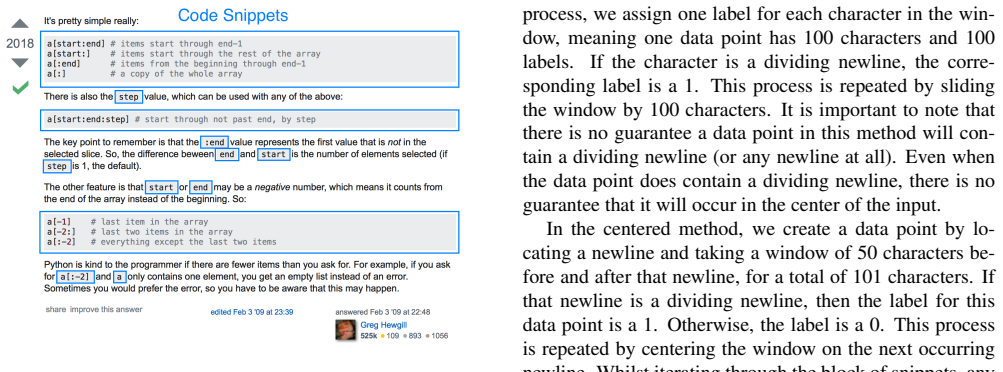
Many software analysis methods have come to rely on machine learning approaches. Code segmentation - the process of decomposing source code into meaningful blocks - can augment these methods by featurizing code, reducing noise, and limiting the problem space. Traditionally, code segmentation has been done using syntactic cues; current approaches do not intentionally capture logical content. We develop a novel deep learning approach to generate logical code segments regardless of the language or syntactic correctness of the code. Due to the lack of logically segmented source code, we introduce a unique data set construction technique to approximate ground truth for logically segmented code. Logical code segmentation can improve tasks such as automatically commenting code, detecting software vulnerabilities, repairing bugs, labeling code functionality, and synthesizing new code.
Figures
Figures from the paper (2 more)
Forward citations
Cited by 1 Pith paper
-
Semantic Source Code Segmentation using Small and Large Language Models
Fine-tuned encoder-only models such as CodeBERT outperform zero-shot and few-shot LLMs at semantic line-level segmentation of R code, and a new annotated R dataset, StatCodeSeg, is introduced.
Reference graph
Works this paper leans on
-
[1]
P. Badjatiya, L. J. Kurisinkel, M. Gupta, and V . Varma. Attention-based neural text segmentation. In Eu- ropean Conference on Information Retrieval , pages 180–193. Springer, 2018
work page 2018
- [2]
-
[3]
G. Glava ˇs, F. Nanni, and S. P. Ponzetto. Unsupervised text segmentation using semantic relatedness graphs. Association for Computational Linguistics, 2016
work page 2016
- [4]
-
[5]
S. Hochreiter and J. Schmidhuber. Long short-term memory. Neural computation, 9(8):1735–1780, 1997
work page 1997
-
[6]
V . Kashyap, R. Swords, E. Schulte, and D. Mel- ski. Musynth: Program synthesis via code reuse and code manipulation. In International Symposium on Search Based Software Engineering , pages 117–123. Springer, 2017
work page 2017
- [7]
-
[8]
N. Mor, O. Koshorek, A. Cohen, and M. Rotman. Learning text segmentation using deep lstm. 2017
work page 2017
Show all 12 references
-
[9]
J. Q. Ning, A. Engberts, and W. V . Kozaczynski. Au- tomated support for legacy code understanding. Com- munications of the ACM, 37(5):50–58, 1994
1994
-
[10]
Riedl and C
M. Riedl and C. Biemann. Text segmentation with topic models. Journal for Language Technology and Computational Linguistics, 27(1):47–69, 2012
2012
-
[11]
Russell, L
R. Russell, L. Kim, L. Hamilton, T. Lazovich, J. Harer, O. Ozdemir, P. Ellingwood, and M. McConley. Au- tomated vulnerability detection in source code using deep representation learning. In 2018 17th IEEE In- ternational Conference on Machine Learning and Ap- plications (ICMLA...
2018
-
[12]
X. Wang, L. Pollock, and K. Vijay-Shanker. Auto- matic segmentation of method code into meaningful blocks to improve readability. In 2011 18th Work- ing Conference on Reverse Engineering, pages 35–44. IEEE, 2011
2011
Reviewed May 24, 2026 · model on record in the stance chip above.
Discussion (0). Continue with ORCID to comment.