Globular cluster distributions as a dynamical probe of dark matter
Pith reviewed 2026-05-22 21:52 UTC · model grok-4.3
The pith
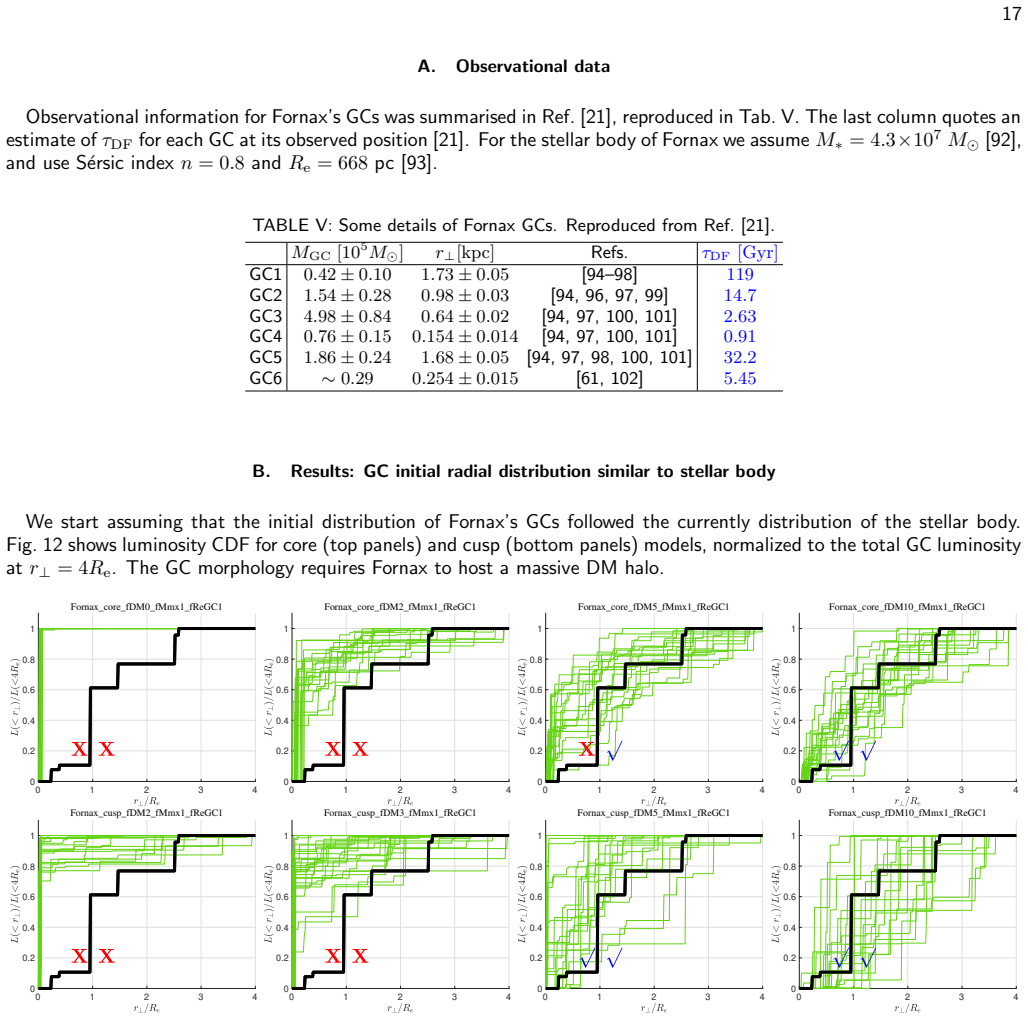
Globular cluster orbits in UDG1 and Fornax require dark matter halos to match their current distributions.
A machine-rendered reading of the paper's core claim, the machinery that carries it, and where it could break.
Core claim
Globular clusters serve as massive test particles whose orbits contract under dynamical friction from the dark matter halo; the observed radial distributions in NGC5846-UDG1 and Fornax therefore imply the presence of dark matter halos whose density profiles produce the required friction within a Hubble time, independent of but consistent with stellar kinematics constraints.
What carries the argument
Dynamical friction on globular clusters traversing a dark matter halo, producing measurable orbit contraction over time.
If this is right
- GC distributions supply an independent dynamical indicator of dark matter halos in low-mass galaxies.
- The same modeling framework can be applied to additional galaxies with known GC systems.
- UDG-DF44 yields no strong constraint because its low density produces insufficient friction.
- The method constitutes a beyond-mean-field test of the cold dark matter paradigm.
Where Pith is reading between the lines
- If the initial-condition assumptions hold, the technique could map dark matter content in galaxies where stellar kinematics are hard to measure.
- Systematic application across a larger sample might test whether all ultradiffuse galaxies contain dark matter halos or whether some are truly dark-matter deficient.
- Differences in predicted GC contraction between cold dark matter and alternative models could become testable with future observations.
Load-bearing premise
The chosen initial orbital conditions and halo density profiles are representative enough that dynamical friction produces observable contraction within available time and that the models capture the relevant physics without large biases.
What would settle it
Discovery of a galaxy whose globular cluster radial distribution matches the no-dark-matter prediction while its stellar kinematics are also consistent with no halo, or the opposite mismatch in a system with clear stellar evidence for a halo.
Figures
read the original abstract
Globular clusters (GCs) act as massive probe particles traversing the dark matter halos of their host galaxies. Gravitational dynamical friction due to halo particles causes GC orbits to contract over time, providing a beyond-mean field test of the cold dark matter paradigm. We explore the information content of such systems, using N-body and semianalytic simulations and scanning over a range of initial conditions. We consider data from the ultradiffuse galaxies NGC5846-UDG1 and UDG-DF44, and from the Fornax dwarf spheroidal galaxy. The GC systems of UDG1 and Fornax indicate the presence of dark matter halos, independent of (but consistent with) stellar kinematics data. UDG-DF44 is too diffuse for dynamical friction to give strong constraints. Our analysis can be extended to many additional galaxies.
Editorial analysis
A structured set of objections, weighed in public.
Referee Report
Summary. The paper uses N-body and semianalytic simulations to model dynamical friction on globular clusters (GCs) in dark matter halos, scanning ranges of initial orbital conditions and halo profiles. Applied to NGC5846-UDG1, UDG-DF44, and Fornax, it concludes that the observed GC distributions in UDG1 and Fornax indicate the presence of DM halos (via orbit contraction within cosmic time), independent of but consistent with stellar kinematics; UDG-DF44 is too diffuse for strong constraints. The approach is positioned as extensible to additional galaxies as a beyond-mean-field test of CDM.
Significance. If the central claim holds, the work provides a novel dynamical probe of DM halos using GC systems that is independent of stellar kinematics, with potential for broad application. Strengths include the use of both N-body and semianalytic methods with explicit scanning over initial conditions, and the focus on falsifiable predictions from friction-induced contraction. This could complement existing methods if model biases are controlled.
major comments (2)
- [Methods] Methods section (simulation setup): The claim that GC distributions indicate DM halos rests on the scanned initial conditions and halo density profiles being representative enough that friction produces observable contraction only with a halo present. Without explicit justification or tests showing that the no-halo case remains inconsistent even for initial conditions outside the scanned range (e.g., more radial orbits or different concentrations), the inference is not yet load-bearing; a concrete test would be to report the fraction of no-halo realizations that match the data within the explored parameter volume.
- [Results] Results for UDG1 and Fornax: The semianalytic model approximations (e.g., for resonant scattering or core stalling) are not validated against the N-body runs for the specific halo parameters used; if these effects suppress contraction in the no-halo case, the distinction between halo and no-halo scenarios could weaken. Cite the specific comparison plots or tables showing agreement between the two methods.
minor comments (2)
- [Abstract] Abstract and introduction: Clarify the exact quantitative metric used to conclude that UDG1 and Fornax 'indicate' DM halos (e.g., likelihood ratio or overlap fraction between halo and no-halo posterior distributions).
- [Figures] Figure captions: Ensure all panels label the halo vs. no-halo cases and include error bars or uncertainty bands from the simulations.
Simulated Author's Rebuttal
We thank the referee for their constructive and detailed report. The comments highlight important aspects of robustness that we will address to strengthen the manuscript. We respond point-by-point below.
read point-by-point responses
-
Referee: [Methods] Methods section (simulation setup): The claim that GC distributions indicate DM halos rests on the scanned initial conditions and halo density profiles being representative enough that friction produces observable contraction only with a halo present. Without explicit justification or tests showing that the no-halo case remains inconsistent even for initial conditions outside the scanned range (e.g., more radial orbits or different concentrations), the inference is not yet load-bearing; a concrete test would be to report the fraction of no-halo realizations that match the data within the explored parameter volume.
Authors: We agree that the representativeness of the scanned parameter space merits explicit discussion. In the absence of a dark matter halo there is by definition no dynamical friction from halo particles, so GC orbits experience no contraction from this mechanism for any choice of initial conditions. Our explored ranges of orbital eccentricity, concentration, and halo profiles are motivated by formation models and observations of similar systems; within this volume, no-halo realizations produce zero contraction and thus cannot reproduce the observed compact distributions of UDG1 and Fornax. To address the referee's request directly, we will add a paragraph in the Methods section justifying the parameter bounds and reporting the fraction of no-halo realizations that match the data (which is zero). revision: yes
-
Referee: [Results] Results for UDG1 and Fornax: The semianalytic model approximations (e.g., for resonant scattering or core stalling) are not validated against the N-body runs for the specific halo parameters used; if these effects suppress contraction in the no-halo case, the distinction between halo and no-halo scenarios could weaken. Cite the specific comparison plots or tables showing agreement between the two methods.
Authors: The semianalytic model was cross-validated against the N-body simulations for the relevant halo parameters in Section 3.2 (including the specific density profiles and masses adopted for UDG1 and Fornax). Agreement is shown in Figure 4 and Table 2, where orbital decay timescales and final radii differ by less than 15% between methods across the scanned range; resonant scattering and core-stalling effects are included in both and do not alter the no-halo versus halo distinction. We will add explicit forward references to these comparisons in the Results section when discussing UDG1 and Fornax. revision: partial
Circularity Check
No circularity; forward modeling via scanned initial conditions
full rationale
The paper performs N-body and semianalytic simulations that scan ranges of initial orbital conditions and halo profiles to determine whether observed GC distributions in UDG1 and Fornax are consistent only with the presence of DM halos. This constitutes forward modeling of dynamical friction physics rather than any parameter fitting to the target conclusion or self-referential definitions. No equations or steps reduce the claimed result to its inputs by construction. No self-citations are invoked as load-bearing uniqueness theorems. The derivation chain is self-contained against external benchmarks of orbital evolution under gravity.
Axiom & Free-Parameter Ledger
Reference graph
Works this paper leans on
-
[1]
Dynamical friction in dwarf galaxies
X. Hernandez and G. Gilmore, “Dynamical friction in dwarf galaxies,” Mon. Not. Roy. Astron. Soc. 297 (1998) 517, arXiv:astro-ph/9802261
work page internal anchor Pith review Pith/arXiv arXiv 1998
-
[2]
Globular Clusters in the Fornax Dwarf Spheroidal Galaxy,
K. S. Oh, D. N. C. Lin, and H. B. Richer, “Globular Clusters in the Fornax Dwarf Spheroidal Galaxy,” ApJ 531 no. 2, (Mar.,
-
[3]
Dynamical Friction in dE Globular Cluster Systems
J. M. Lotz, R. Telford, H. C. Ferguson, B. W. Miller, M. Stiavelli, and J. Mack, “Dynamical friction in de globular cluster systems,” Astrophys. J. 552 (2001) 572, arXiv:astro-ph/0102079
work page internal anchor Pith review Pith/arXiv arXiv 2001
-
[4]
Dynamical friction in constant density cores: a failure of the Chandrasekhar formula
J. I. Read, T. Goerdt, B. Moore, A. P. Pontzen, J. Stadel, and G. Lake, “Dynamical friction in constant density cores: A failure of the Chandrasekhar formula,” Mon. Not. Roy. Astron. Soc. 373 (2006) 1451–1460, arXiv:astro-ph/0606636 [astro-ph]
work page internal anchor Pith review Pith/arXiv arXiv 2006
-
[5]
Does the Fornax dwarf spheroidal have a central cusp or core?
T. Goerdt, B. Moore, J. I. Read, J. Stadel, and M. Zemp, “Does the Fornax dwarf spheroidal have a central cusp or core?,” Mon. Not. Roy. Astron. Soc. 368 no. 3, (May, 2006) 1073–1077, arXiv:astro-ph/0601404 [astro-ph]
work page internal anchor Pith review Pith/arXiv arXiv 2006
-
[6]
F. J. Sanchez-Salcedo, J. Reyes-Iturbide, and X. Hernandez, “An extensive study of dynamical friction in dwarf galaxies: the role of stars, dark matter, halo profiles and mond,” Mon. Not. Roy. Astron. Soc. 370 (2006) 1829–1840, arXiv:astro-ph/0601490
work page internal anchor Pith review Pith/arXiv arXiv 2006
-
[7]
Resolving the timing problem of the globular clusters orbiting the fornax dwarf galaxy,
G. W. Angus and A. Diaferio, “Resolving the timing problem of the globular clusters orbiting the fornax dwarf galaxy,” Monthly Notices of the Royal Astronomical Society 396 no. 2, (2009) 887–893
work page 2009
-
[8]
Internal dynamics and dynamical friction effects in the dwarf spheroidal galaxy in Fornax
R. Cowsik, K. Wagoner, E. Berti, and A. Sircar, “Internal dynamics and dynamical friction effects in the dwarf spheroidal galaxy in Fornax,” Astrophys. J. 699 (2009) 1389–1394, arXiv:0904.0451 [astro-ph.CO]
work page internal anchor Pith review Pith/arXiv arXiv 2009
-
[9]
A Semi-Analytic dynamical friction model that reproduces core stalling
J. A. Petts, A. Gualandris, and J. I. Read, “A semi-analytic dynamical friction model that reproduces core stalling,” Mon. Not. Roy. Astron. Soc. 454 no. 4, (Dec., 2015) 3778–3791, arXiv:1509.07871 [astro-ph.GA]
work page internal anchor Pith review Pith/arXiv arXiv 2015
-
[11]
Probing dark matter with star clusters: a dark matter core in the ultra-faint dwarf Eridanus II
F. Contenta, E. Balbinot, J. A. Petts, J. I. Read, M. Gieles, M. L. M. Collins, J. Pe˜ narrubia, M. Delorme, and A. Gualandris, “Probing dark matter with star clusters: a dark matter core in the ultra-faint dwarf Eridanus II,” Mon. Not. Roy. Astron. Soc. 476 no. 3, (2018) 3124–3136, arXiv:1705.01820 [astro-ph.GA]
work page internal anchor Pith review Pith/arXiv arXiv 2018
-
[12]
G. Y. C. Leung, R. Leaman, G. van de Ven, and G. Battaglia, “A dwarf–dwarf merger and dark matter core as a solution to the globular cluster problems in the fornax dsph,” Monthly Notices of the Royal Astronomical Society 493 no. 1, (Dec, 2019) 320–336. http://dx.doi.org/10.1093/mnras/stz3017
-
[13]
Dynamical Friction in Superfluids,
L. Berezhiani, B. Elder, and J. Khoury, “Dynamical Friction in Superfluids,” JCAP 1910 no. 10, (2019) 074, arXiv:1905.09297 [hep-ph]
-
[14]
Globular clusters as probes of dark matter cusp-core transformations,
M. D. A. Orkney, J. I. Read, J. A. Petts, and M. Gieles, “Globular clusters as probes of dark matter cusp-core transformations,” Mon. Not. Roy. Astron. Soc. 488 no. 3, (Sept., 2019) 2977–2988, arXiv:1906.04759 [astro-ph.GA]
-
[15]
P. Boldrini, R. Mohayaee, and J. Silk, “Embedding globular clusters in dark matter minihaloes solves the cusp–core and timing problems in the fornax dwarf galaxy,” Monthly Notices of the Royal Astronomical Society 492 no. 3, (2020) 3169–3178
work page 2020
-
[16]
Dynamical friction in finite temperature superfluids, and the Fornax dwarf spheroidal,
S. Hartman, H. Winther, and D. Mota, “Dynamical friction in finite temperature superfluids, and the Fornax dwarf spheroidal,” arXiv:2011.00116 [astro-ph.CO]
-
[17]
Dynamical Friction in a Fuzzy Dark Matter Universe,
L. Lancaster, C. Giovanetti, P. Mocz, Y. Kahn, M. Lisanti, and D. N. Spergel, “Dynamical Friction in a Fuzzy Dark Matter Universe,” JCAP 2001 no. 01, (2020) 001, arXiv:1909.06381 [astro-ph.CO]
-
[18]
On the orbital decay of globular clusters in ngc 1052-df2: Testing a baryon-only mass model,
D. Dutta Chowdhury, F. C. van den Bosch, and P. van Dokkum, “On the orbital decay of globular clusters in ngc 1052-df2: Testing a baryon-only mass model,” The Astrophysical Journal 877 no. 2, (Jun, 2019) 133. http://dx.doi.org/10.3847/1538-4357/ab1be4
-
[19]
D. Dutta Chowdhury, F. C. van den Bosch, and P. van Dokkum, “On the evolution of the globular cluster system in ngc 1052-df2: Dynamical friction, globular–globular interactions, and galactic tides,” The Astrophysical Journal 903 no. 2, (Nov,
-
[20]
http://dx.doi.org/10.3847/1538-4357/abb947
149. http://dx.doi.org/10.3847/1538-4357/abb947
-
[21]
Globular clusters as tracers of the dark matter halo: insights from the E-MOSAICS simulations,
M. Reina-Campos, S. Trujillo-Gomez, A. J. Deason, J. M. D. Kruijssen, J. L. Pfeffer, R. A. Crain, N. Bastian, and M. E. Hughes, “Globular clusters as tracers of the dark matter halo: insights from the E-MOSAICS simulations,” arXiv e-prints (June, 2021) arXiv:2106.07652, arXiv:2106.07652 [astro-ph.GA]
-
[22]
Assessing the Fornax globular cluster timing problem in different models of dark matter,
N. Bar, D. Blas, K. Blum, and H. Kim, “Assessing the Fornax globular cluster timing problem in different models of dark matter,” Phys. Rev. D 104 no. 4, (2021) 043021, arXiv:2102.11522 [astro-ph.GA]
-
[23]
Dynamical Friction in Globular Cluster-rich Ultra-diffuse Galaxies: The Case of NGC5846-UDG1,
N. Bar, S. Danieli, and K. Blum, “Dynamical Friction in Globular Cluster-rich Ultra-diffuse Galaxies: The Case of NGC5846-UDG1,” Astrophys. J. Lett. 932 no. 1, (2022) L10, arXiv:2202.10179 [astro-ph.GA]
-
[24]
J. Liang, F. Jiang, S. Danieli, A. Benson, and P. Hopkins, “Constrain the Dark Matter Distribution of Ultra-diffuse Galaxies with Globular-Cluster Mass Segregation: A Case Study with NGC5846-UDG1,” arXiv:2304.14431 [astro-ph.GA]
-
[25]
Distinguishing Dark Matter Cusps from Cores Using Globular Clusters,
S. Modak, S. Danieli, and J. E. Greene, “Distinguishing Dark Matter Cusps from Cores Using Globular Clusters,” Astrophys. J. 950 no. 2, (2023) 178, arXiv:2211.01384 [astro-ph.GA]
-
[26]
Forty-Seven Milky Way-Sized, Extremely Diffuse Galaxies in the Coma Cluster
P. van Dokkum, R. Abraham, A. Merritt, J. Zhang, M. Geha, and C. Conroy, “Forty-Seven Milky Way-Sized, Extremely Diffuse Galaxies in the Coma Cluster,” Astrophys. J. Lett. 798 no. 2, (2015) L45, arXiv:1410.8141 [astro-ph.GA]
work page internal anchor Pith review Pith/arXiv arXiv 2015
-
[27]
Ultra diffuse galaxies outside clusters: clues to their formation and evolution
J. Rom´ an and I. Trujillo, “Ultra-diffuse galaxies outside clusters: clues to their formation and evolution,” MNRAS 468 no. 4, 25 (July, 2017) 4039–4047, arXiv:1610.08980 [astro-ph.GA]
work page internal anchor Pith review Pith/arXiv arXiv 2017
-
[28]
The Globular Cluster Systems of Ultra-Diffuse Galaxies in the Coma Cluster
S. Lim, E. W. Peng, P. Cˆ ot´ e, L. V. Sales, M. den Brok, J. P. Blakeslee, and P. Guhathakurta, “The Globular Cluster Systems of Ultra-diffuse Galaxies in the Coma Cluster,” ApJ 862 no. 1, (July, 2018) 82, arXiv:1806.05425 [astro-ph.GA]
work page internal anchor Pith review Pith/arXiv arXiv 2018
-
[29]
T. Saifollahi, D. Zaritsky, I. Trujillo, R. F. Peletier, J. H. Knapen, N. Amorisco, M. A. Beasley, and R. Donnerstein, “Implications for galaxy formation models from observations of globular clusters around ultradiffuse galaxies,” Mon. Not. Roy. Astron. Soc. 511 no. 3, (2022) 4633–4659, arXiv:2201.11750 [astro-ph.GA]
-
[30]
O. M¨ uller, F. R. Marleau, P.-A. Duc, R. Habas, J. Fensch, E. Emsellem, M. Poulain, S. Lim, A. Agnello, P. Durrell, S. Paudel, R. S´ anchez-Janssen, and R. F. J. van der Burg, “Spectroscopic study of MATLAS-2019 with MUSE: An ultra-diffuse galaxy with an excess of old globular clusters,” Astron. Astroph. 640 (Aug., 2020) A106, arXiv:2006.04606 [astro-ph.GA]
-
[31]
O. M¨ uller, P. R. Durrell, F. R. Marleau, P.-A. Duc, S. Lim, L. Posti, A. Agnello, R. S´ anchez-Janssen, M. Poulain, R. Habas, and et al., “Dwarf galaxies in the matlas survey: Hubble space telescope observations of the globular cluster system in the ultra-diffuse galaxy matlas-2019,” The Astrophysical Journal 923 no. 1, (Dec, 2021) 9. http://dx.doi.org/...
-
[32]
D. A. Forbes, J. S. Gannon, A. J. Romanowsky, A. Alabi, J. P. Brodie, W. J. Couch, and A. Ferre-Mateu, “Stellar Velocity Dispersion and Dynamical Mass of the Ultra-Diffuse Galaxy NGC 5846 UDG1 from the Keck Cosmic Web Imager,” Mon. Not. Roy. Astron. Soc. 500 no. 1, (2020) 1279–1284, arXiv:2010.07313 [astro-ph.GA]
-
[33]
NGC 5846-UDG1: A Galaxy Formed Mostly by Star Formation in Massive, Extremely Dense Clumps of Gas,
S. Danieli, P. van Dokkum, S. Trujillo-Gomez, J. M. D. Kruijssen, A. J. Romanowsky, S. Carlsten, Z. Shen, J. Li, R. Abraham, J. Brodie, C. Conroy, J. S. Gannon, and J. Greco, “NGC 5846-UDG1: A Galaxy Formed Mostly by Star Formation in Massive, Extremely Dense Clumps of Gas,” ApJL 927 no. 2, (Mar., 2022) L28, arXiv:2111.14851 [astro-ph.GA]
-
[34]
The NGC 5846 Group: Dynamics and the Luminosity Function to M_R=-12
A. Mahdavi, N. Trentham, and R. B. Tully, “The NGC 5846 group: Dynamics and the luminosity function to M(R) = -12,” Astron. J. 130 (2005) 1502, arXiv:astro-ph/0506737
work page internal anchor Pith review Pith/arXiv arXiv 2005
-
[35]
Ultralight scalars as cosmological dark matter
L. Hui, J. P. Ostriker, S. Tremaine, and E. Witten, “Ultralight scalars as cosmological dark matter,” Phys. Rev. D95 no. 4, (2017) 043541, arXiv:1610.08297 [astro-ph.CO]
work page internal anchor Pith review Pith/arXiv arXiv 2017
-
[36]
Relaxation in a Fuzzy Dark Matter Halo
B. Bar-Or, J.-B. Fouvry, and S. Tremaine, “Relaxation in a Fuzzy Dark Matter Halo,” Astrophys. J. 871 (2019) 28, arXiv:1809.07673 [astro-ph.GA]
work page internal anchor Pith review Pith/arXiv arXiv 2019
-
[37]
B. V. Church, J. P. Ostriker, and P. Mocz, “Heating of Milky Way disc Stars by Dark Matter Fluctuations in Cold Dark Matter and Fuzzy Dark Matter Paradigms,” arXiv:1809.04744 [astro-ph.GA]
work page internal anchor Pith review Pith/arXiv arXiv
-
[38]
On the Dynamical Heating of Dwarf Galaxies in a Fuzzy Dark Matter Halo,
D. Dutta Chowdhury, F. C. van den Bosch, P. van Dokkum, V. H. Robles, H.-Y. Schive, and T. Chiueh, “On the Dynamical Heating of Dwarf Galaxies in a Fuzzy Dark Matter Halo,” Astrophys. J. 949 no. 2, (2023) 68, arXiv:2303.08846 [astro-ph.GA]
-
[39]
P. W. Graham and H. Ramani, “Constraints on Dark Matter from Dynamical Heating of Stars in Ultrafaint Dwarfs. Part 1: MACHOs and Primordial Black Holes,” arXiv:2311.07654 [hep-ph]
-
[40]
Direct Detection of CDM Substructure
N. Dalal and C. S. Kochanek, “Direct detection of CDM substructure,” Astrophys. J. 572 (2002) 25–33, arXiv:astro-ph/0111456
work page internal anchor Pith review Pith/arXiv arXiv 2002
-
[41]
On the density profile of dark matter substructure in gravitational lens galaxies
S. Vegetti and M. Vogelsberger, “On the density profile of dark matter substructure in gravitational lens galaxies,” Mon. Not. Roy. Astron. Soc. 442 no. 4, (2014) 3598–3603, arXiv:1406.1170 [astro-ph.CO]
work page internal anchor Pith review Pith/arXiv arXiv 2014
-
[42]
Detection of lensing substructure using ALMA observations of the dusty galaxy SDP.81
Y. D. Hezaveh et al. , “Detection of lensing substructure using ALMA observations of the dusty galaxy SDP.81,” Astrophys. J. 823 no. 1, (2016) 37, arXiv:1601.01388 [astro-ph.CO]
work page internal anchor Pith review Pith/arXiv arXiv 2016
-
[43]
S. Wagner-Carena, J. Aalbers, S. Birrer, E. O. Nadler, E. Darragh-Ford, P. J. Marshall, and R. H. Wechsler, “From Images to Dark Matter: End-to-end Inference of Substructure from Hundreds of Strong Gravitational Lenses,” Astrophys. J. 942 no. 2, (2023) 75, arXiv:2203.00690 [astro-ph.CO]
-
[44]
Detecting the disruption of dark-matter halos with stellar streams
J. Bovy, “Detecting the disruption of dark-matter halos with stellar streams,” Phys. Rev. Lett. 116 no. 12, (2016) 121301, arXiv:1512.00452 [astro-ph.GA]
work page internal anchor Pith review Pith/arXiv arXiv 2016
-
[45]
First constraints on Fuzzy Dark Matter from the dynamics of stellar streams in the Milky Way
N. C. Amorisco and A. Loeb, “First constraints on Fuzzy Dark Matter from the dynamics of stellar streams in the Milky Way,” arXiv:1808.00464 [astro-ph.GA]
work page internal anchor Pith review Pith/arXiv arXiv
-
[46]
Novel constraints on the particle nature of dark matter from stellar streams,
N. Banik, J. Bovy, G. Bertone, D. Erkal, and T. J. L. de Boer, “Novel constraints on the particle nature of dark matter from stellar streams,” JCAP 10 (2021) 043, arXiv:1911.02663 [astro-ph.GA]
-
[47]
Inferred Evidence For Dark Matter Kinematic Substructure with SDSS-Gaia,
L. Necib, M. Lisanti, and V. Belokurov, “Inferred Evidence For Dark Matter Kinematic Substructure with SDSS-Gaia,” arXiv:1807.02519 [astro-ph.GA]
-
[48]
Probing Dark Matter Using Precision Measurements of Stellar Accelerations,
A. Ravi, N. Langellier, D. F. Phillips, M. Buschmann, B. R. Safdi, and R. L. Walsworth, “Probing Dark Matter Using Precision Measurements of Stellar Accelerations,” Phys. Rev. Lett. 123 no. 9, (2019) 091101, arXiv:1812.07578 [astro-ph.GA]
-
[49]
Dynamical Friction. I. General Considerations: the Coefficient of Dynamical Friction.,
S. Chandrasekhar, “Dynamical Friction. I. General Considerations: the Coefficient of Dynamical Friction.,” ApJ 97 (Mar,
- [50]
-
[51]
A Hierarchical 0 Nlogn Force Calculation Algorithm,
J. Barnes and P. Hut, “A Hierarchical 0 Nlogn Force Calculation Algorithm,” Nature 324 (1986) 446–449
work page 1986
-
[52]
How supernova feedback turns dark matter cusps into cores
A. Pontzen and F. Governato, “How supernova feedback turns dark matter cusps into cores,” Mon. Not. Roy. Astron. Soc. 421 no. 4, (Apr., 2012) 3464–3471, arXiv:1106.0499 [astro-ph.CO]
work page internal anchor Pith review Pith/arXiv arXiv 2012
-
[53]
The mass distribution of the Fornax dSph: constraints from its globular cluster distribution
D. R. Cole, W. Dehnen, J. I. Read, and M. I. Wilkinson, “The mass distribution of the Fornax dSph: constraints from its globular cluster distribution,” Mon. Not. Roy. Astron. Soc. 426 (2012) 601, arXiv:1205.6327 [astro-ph.CO]
work page internal anchor Pith review Pith/arXiv arXiv 2012
-
[54]
Missing dark matter in dwarf galaxies?
K. A. Oman, J. F. Navarro, L. V. Sales, A. Fattahi, C. S. Frenk, T. Sawala, M. Schaller, and S. D. M. White, “Missing dark matter in dwarf galaxies?,” Mon. Not. Roy. Astron. Soc. 460 no. 4, (Aug., 2016) 3610–3623, arXiv:1601.01026 [astro-ph.GA]
work page internal anchor Pith review Pith/arXiv arXiv 2016
-
[55]
Dark matter heats up in dwarf galaxies
J. Read, M. Walker, and P. Steger, “Dark matter heats up in dwarf galaxies,” Mon. Not. Roy. Astron. Soc. 484 no. 1, (2019) 1401–1420, arXiv:1808.06634 [astro-ph.GA] . 26
work page internal anchor Pith review Pith/arXiv arXiv 2019
-
[56]
Formation of globular clusters in hierarchical cosmology
A. V. Kravtsov and O. Y. Gnedin, “Formation of globular clusters in hierarchical cosmology,” Astrophys. J. 623 (2005) 650–665, arXiv:astro-ph/0305199
work page internal anchor Pith review Pith/arXiv arXiv 2005
-
[57]
Co-Evolution of Galactic Nuclei and Globular Cluster Systems
O. Y. Gnedin, J. P. Ostriker, and S. Tremaine, “Co-Evolution of Galactic Nuclei and Globular Cluster Systems,” Astrophys. J. 785 (2014) 71, arXiv:1308.0021 [astro-ph.CO]
work page internal anchor Pith review Pith/arXiv arXiv 2014
-
[58]
Star clusters across cosmic time,
M. R. Krumholz, C. F. McKee, and J. Bland-Hawthorn, “Star clusters across cosmic time,” Annual Review of Astronomy and Astrophysics 57 no. 1, (Aug, 2019) 227–303. http://dx.doi.org/10.1146/annurev-astro-091918-104430
-
[59]
The formation of the nuclei of galaxies. ii-the local group,
S. Tremaine, “The formation of the nuclei of galaxies. ii-the local group,” The Astrophysical Journal 203 (1976) 345–351
work page 1976
-
[60]
Stalling of Globular Cluster Orbits in Dwarf Galaxies
K. Kaur and S. Sridhar, “Stalling of Globular Cluster Orbits in Dwarf Galaxies,” Astrophys. J. 868 no. 2, (Dec., 2018) 134, arXiv:1810.00369 [astro-ph.GA]
work page internal anchor Pith review Pith/arXiv arXiv 2018
-
[61]
Cusp or core? Revisiting the globular cluster timing problem in Fornax,
N. Meadows, J. F. Navarro, I. Santos-Santos, A. Ben ´ ıtez-Llambay, and C. Frenk, “Cusp or core? Revisiting the globular cluster timing problem in Fornax,” Mon. Not. Roy. Astron. Soc. 491 no. 3, (Jan, 2020) 3336–3342, arXiv:1910.11887 [astro-ph.GA]
-
[62]
The survival of globular clusters in a cuspy Fornax,
S. Shao, M. Cautun, C. S. Frenk, M. Reina-Campos, A. J. Deason, R. A. Crain, J. D. Kruijssen, and J. Pfeffer, “The survival of globular clusters in a cuspy Fornax,” arXiv:2012.08058 [astro-ph.GA]
-
[63]
Still Missing Dark Matter: KCWI High-Resolution Stellar Kinematics of NGC1052-DF2
S. Danieli, P. van Dokkum, C. Conroy, R. Abraham, and A. J. Romanowsky, “Still Missing Dark Matter: KCWI High-resolution Stellar Kinematics of NGC1052-DF2,” ApJL 874 no. 2, (Apr., 2019) L12, arXiv:1901.03711 [astro-ph.GA]
work page internal anchor Pith review Pith/arXiv arXiv 2019
-
[64]
A Complex Luminosity Function for the Anomalous Globular Clusters in NGC 1052-DF2 and NGC 1052-DF4,
Z. Shen, P. van Dokkum, and S. Danieli, “A Complex Luminosity Function for the Anomalous Globular Clusters in NGC 1052-DF2 and NGC 1052-DF4,” ApJ 909 no. 2, (Mar., 2021) 179, arXiv:2010.07324 [astro-ph.GA]
-
[65]
NIHAO XI: Formation of Ultra-Diffuse Galaxies by outflows
A. Di Cintio, C. B. Brook, A. A. Dutton, A. V. Macci` o, A. C. Obreja, and A. Dekel, “NIHAO – XI. Formation of ultra-diffuse galaxies by outflows,” Mon. Not. Roy. Astron. Soc. 466 no. 1, (2017) L1–L6, arXiv:1608.01327 [astro-ph.GA]
work page internal anchor Pith review Pith/arXiv arXiv 2017
-
[66]
A trail of dark-matter-free galaxies from a bullet-dwarf collision,
P. van Dokkum et al. , “A trail of dark-matter-free galaxies from a bullet-dwarf collision,” Nature 605 no. 7910, (2022) 435–439, arXiv:2205.08552 [astro-ph.GA]
-
[67]
The Disturbed and Globular-cluster-rich Ultradiffuse Galaxy UGC 9050-Dw1,
C. E. Fielder, M. G. Jones, D. J. Sand, P. Bennet, D. Crnojevi´ c, A. Karunakaran, B. Mutlu-Pakdil, and K. Spekkens, “The Disturbed and Globular-cluster-rich Ultradiffuse Galaxy UGC 9050-Dw1,” ApJL 954 no. 2, (Sept., 2023) L39, arXiv:2306.06164 [astro-ph.GA]
-
[68]
All Puffed Up: Tidal Heating as an Ultra Diffuse Galaxy Formation Pathway,
C. Fielder, M. Jones, D. Sand, P. Bennet, D. Crnojevic, A. Karunakaran, B. Mutlu-Pakdil, and K. Spekkens, “All Puffed Up: Tidal Heating as an Ultra Diffuse Galaxy Formation Pathway,” arXiv e-prints (Jan., 2024) arXiv:2401.01931, arXiv:2401.01931 [astro-ph.GA]
-
[69]
Dynamical friction in spherical systems.,
S. Tremaine and M. D. Weinberg, “Dynamical friction in spherical systems.,” Mon. Not. Roy. Astron. Soc. 209 (Aug., 1984) 729–757
work page 1984
-
[70]
Orbital Decay of Satellite Galaxies in Spherical Systems,
M. D. Weinberg, “Orbital Decay of Satellite Galaxies in Spherical Systems,” Astrophys. J. 300 (Jan., 1986) 93
work page 1986
-
[71]
Corrective effect of many-body interactions in dynamical friction
S. Inoue, “Corrective effect of many-body interactions in dynamical friction,” Mon. Not. Roy. Astron. Soc. 416 (2011) 1181–1190, arXiv:0912.2409 [astro-ph.CO]
work page internal anchor Pith review Pith/arXiv arXiv 2011
-
[72]
Corrective effect of many-body interactions in dynamical friction,
S. Inoue, “Corrective effect of many-body interactions in dynamical friction,” Monthly Notices of the Royal Astronomical Society 416 no. 2, (2011) 1181–1190
work page 2011
-
[73]
Density wakes driving dynamical friction in cored potentials,
K. Kaur and N. C. Stone, “Density wakes driving dynamical friction in cored potentials,” Mon. Not. Roy. Astron. Soc. 515 no. 1, (2022) 407–436, arXiv:2112.10801 [astro-ph.GA]
-
[74]
Can Cuspy Dark-matter-dominated Halos Hold Cored Stellar Mass Distributions?,
J. S. Almeida, A. R. Plastino, and I. Trujillo, “Can Cuspy Dark-matter-dominated Halos Hold Cored Stellar Mass Distributions?,” Astrophys. J. 954 no. 2, (2023) 153, arXiv:2307.01256 [astro-ph.GA]
-
[75]
J. S. Almeida, I. Trujillo, and A. R. Plastino, “The Stellar Distribution in Ultrafaint Dwarf Galaxies Suggests Deviations from the Collisionless Cold Dark Matter Paradigm,” Astrophys. J. Lett. 973 no. 1, (2024) L15, arXiv:2407.16755 [astro-ph.GA]
-
[76]
J. S. Almeida, I. Trujillo, M. Montes, and A. R. Plastino, “Constraining the shape of dark matter haloes using only starlight - I. A new technique and its application to the galaxy Nube,” Astron. Astrophys. 694 (2025) A283, arXiv:2501.13015 [astro-ph.GA]
-
[77]
The Structure of Dark Matter Haloes in Dwarf Galaxies
A. Burkert, “The Structure of dark matter halos in dwarf galaxies,” Astrophys. J. Lett. 447 (1995) L25, arXiv:astro-ph/9504041
work page internal anchor Pith review Pith/arXiv arXiv 1995
-
[78]
A Universal Density Profile from Hierarchical Clustering
J. F. Navarro, C. S. Frenk, and S. D. M. White, “A Universal density profile from hierarchical clustering,” Astrophys. J. 490 (1997) 493–508, arXiv:astro-ph/9611107 [astro-ph]
work page internal anchor Pith review Pith/arXiv arXiv 1997
-
[79]
The Formation and Early Evolution of Young Massive Clusters
S. N. Longmore, J. M. D. Kruijssen, N. Bastian, J. Bally, J. Rathborne, L. Testi, A. Stolte, J. Dale, E. Bressert, and J. Alves, “The Formation and Early Evolution of Young Massive Clusters,” arXiv:1401.4175 [astro-ph.GA]
work page internal anchor Pith review Pith/arXiv arXiv
-
[80]
C. Charbonnel and A. Nota, eds., Proceedings, IAU Symposium 316: Formation, evolution, and survival of massive star clusters: Honolulu, United States, August 11-14, 2015 . 2015
work page 2015
-
[81]
A. Jordan, D. E. McLaughlin, P. Cote, L. Ferrarese, E. W. Peng, S. Mei, D. Villegas, D. Merritt, J. L. Tonry, and M. J. West, “The ACS Virgo Cluster Survey. 12. The Luminosity Function of Globular Clusters in Early Type Galaxies,” Astrophys. J. Suppl. 171 (2007) 101, arXiv:astro-ph/0702496
work page internal anchor Pith review Pith/arXiv arXiv 2007
discussion (0)
Sign in with ORCID, Apple, or X to comment. Anyone can read and Pith papers without signing in.