REVIEW 1 major objections 2 minor 13 references
Formally Verified Code Synthesis for Structured Data Translation in a Medical Internet of Things
T0 review · 1 major / 2 minor · reviewed 2026-06-26 · grok-4.3
Pith's one-line read Formal verification integrated into LLM code synthesis guarantees that generated translators always produce FHIR-compliant output from device JSON.
desk verdict This is a domain case study applying LLM code synthesis plus formal verification to JSON-to-FHIR translation for a pulse oximeter, with no new algorithms or broad claims. read the letter →
The pith
A machine-rendered reading of the paper's core claim, the machinery that carries it, and where it could break.
The reading
What carries the argument
The formal verification stage that accepts or rejects candidate translation code by checking conformance to a predefined specification of the target output schema.
What would settle it
A counter-example in which a translation function passes the formal verification check yet, on some input allowed by the source schema, produces output that violates the target FHIR schema.
Extended reading notes
Core claim
By embedding a formal verification stage that checks generated translation functions against the requirements of both source and target schemas, the system ensures that any accepted code will map every valid input to output that satisfies the FHIR schema.
Load-bearing premise
The formal specification used for verification is complete and correctly encodes all safety and interoperability requirements of the target FHIR schema and the source JSON schema.
Editorial extensions
If this is right
- Any code accepted by the pipeline can be deployed without further manual review of its data-mapping behavior.
- New sensor devices can be integrated into an existing FHIR-based network by supplying only their JSON schema and letting the system produce the translator.
- The cost of adding devices remains low because the verification step filters out incorrect candidates automatically.
- The same pipeline structure can be reused for other structured-data translation tasks that have both a source schema and a target schema.
Reading between the lines
- The method could be applied to translation between any pair of formally specified data formats, not only JSON and FHIR.
- If the verification specification itself contains an error, the guarantee disappears even though the code still passes the check.
- Extending the approach to streaming or stateful translations would require a richer specification language than the one used for simple schema conformance.
Editorial analysis
A structured set of objections, weighed in public.
Referee Report
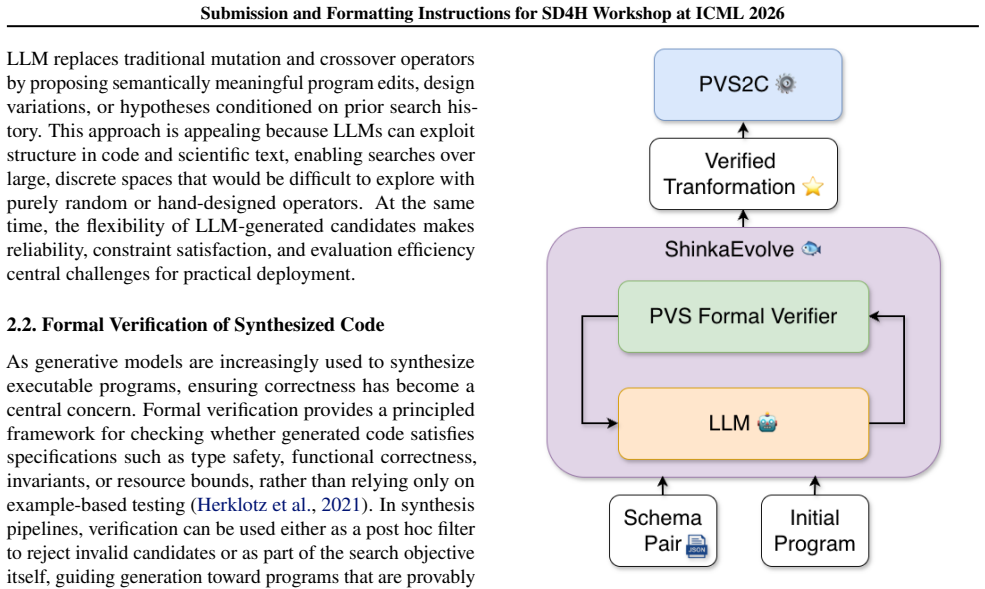
Summary. The manuscript presents an LLM-powered evolutionary code synthesis pipeline for structured data translation in a Medical IoT setting. The core contribution is a case study in which the system generates translation code from a novel pulse-oximeter device's JSON schema to the FHIR format used by an existing device network; a formal verification stage is inserted into the pipeline with the claim that it guarantees any synthesized code will always produce output conforming to the target FHIR schema. Experimental results are reported to show consistent generation of correct translations at low cost.
Significance. If the formal verification step supplies a machine-checked guarantee that holds for a complete encoding of the relevant FHIR constraints, the work would be significant for safety-critical code synthesis in healthcare interoperability. The integration of evolutionary LLM synthesis with formal methods is a promising direction, and the pulse-oximeter integration case study illustrates a concrete, high-stakes application. Credit is due for attempting to combine these techniques rather than relying on LLM generation alone.
major comments (1)
- [Abstract / formal verification stage] Abstract and formal verification description: The central claim that 'This formal verification stage ensures structured data translated by the generated code will always be in the target output schema' is load-bearing for the paper's contribution. However, the manuscript supplies no evidence that the formal specification was derived from or cross-checked against the complete FHIR resource definition (including cardinality constraints, value sets, invariants, and interoperability rules for the pulse-oximeter data). An incomplete specification would allow verified code to emit invalid instances, directly undermining the guarantee.
minor comments (2)
- [Experimental results] The experimental results section should report concrete error rates, comparison baselines, and the number of synthesis attempts or cost metrics to substantiate the claim of 'consistently generate correct translation at low cost.'
- [Case study / verification step] Notation for the formal specification language and the precise properties checked by the verifier should be introduced explicitly rather than left at the level of high-level description.
Simulated Author's Rebuttal
We thank the referee for their detailed review and for highlighting the critical importance of the formal verification claim. We address the major comment below and agree that revisions are needed to avoid overstating the guarantee.
read point-by-point responses
-
Referee: [Abstract / formal verification stage] Abstract and formal verification description: The central claim that 'This formal verification stage ensures structured data translated by the generated code will always be in the target output schema' is load-bearing for the paper's contribution. However, the manuscript supplies no evidence that the formal specification was derived from or cross-checked against the complete FHIR resource definition (including cardinality constraints, value sets, invariants, and interoperability rules for the pulse-oximeter data). An incomplete specification would allow verified code to emit invalid instances, directly undermining the guarantee.
Authors: We agree that the manuscript does not supply evidence or details demonstrating that the formal specification was derived from or cross-checked against the complete FHIR resource definition, including all cardinality constraints, value sets, invariants, and interoperability rules. Our case study focused on a practical subset of constraints relevant to the pulse-oximeter JSON-to-FHIR translation as required by the target device network. To address this, we will revise the abstract to remove the absolute claim of 'always be in the target output schema' and replace it with a more precise statement that the verification guarantees conformance to the specified subset of the FHIR schema used in our integration. We will also expand the formal verification section to explicitly describe the scope of the specification, list the constraints that were encoded, and add a limitations paragraph acknowledging that the guarantee applies only to the modeled subset rather than the full FHIR resource definition. This revision will be made in the next version of the manuscript. revision: yes
Circularity Check
No circularity: system description with no derivation chain or fitted predictions
full rationale
The paper describes an LLM-based code synthesis pipeline augmented with formal verification for JSON-to-FHIR translation. Its central claim—that verified code produces output in the target schema—rests on the (unproven here) completeness of the hand-written specification rather than any equation, parameter fit, or self-referential derivation. No mathematical predictions, uniqueness theorems, ansatzes, or renamings appear; the work is an engineering case study whose correctness depends on external validation of the spec, not on internal reduction to its own inputs. This matches the default non-circular case for descriptive systems papers.
Assumptions & free parameters
Cite this review
Pith. "Pith review of Formally Verified Code Synthesis for Structured Data Translation in a Medical Internet of Things." pith.science (2026). https://pith.science/paper/M3SRTO2S
@misc{pith2026260620776,
  author       = {Pith},
  title        = {Pith review of: Formally Verified Code Synthesis for Structured Data Translation in a Medical Internet of Things},
  year         = {2026},
  howpublished = {\url{https://pith.science/paper/M3SRTO2S}},
  note         = {Machine review of arXiv:2606.20776}
}
read the original abstract
In this work we present a LLM powered, evolutionary code synthesis system for structured data translation in a Medical Internet of Things settings. A key challenge in this domain is ensuring that the synthesized code is trustworthy and reliable. To this end, we integrate a formal verification step into our code synthesis pipeline to ensure that any generated code is guaranteed to satisfy predefined requirements. In particular, we present a case study of integrating a novel device (a pulse oximeter) into the existing network of devices. Our system generates a formally verified translation between the device's JSON schema and the Fast Healthcare Interoperability Resources (FHIR) format used by the wider system. This formal verification stage ensures structured data translated by the generated code will always be in the target output schema. We provide a set of experimental results which demonstrate that our system is able to consistently generate correct translation at low cost.
Figures

Reference graph
Works this paper leans on
-
[1]
ShinkaEvolve: Towards Open-Ended And Sample-Efficient Program Evolution
ShinkaEvolve: Towards Open-Ended And Sample-Efficient Program Evolution , author=. arXiv preprint arXiv:2509.19349 , year=
-
[2]
The formal semantics of PVS , author=
-
[3]
2025 , publisher =
OpenEvolve: an open-source evolutionary coding agent , author =. 2025 , publisher =
2025
-
[4]
AlphaEvolve: A coding agent for scientific and algorithmic discovery
Alphaevolve: A coding agent for scientific and algorithmic discovery , author=. arXiv preprint arXiv:2506.13131 , year=
-
[5]
Why Language Models Hallucinate
Why language models hallucinate , author=. arXiv preprint arXiv:2509.04664 , year=
-
[6]
JMIR medical informatics , volume=
Fast healthcare interoperability resources (FHIR) for interoperability in health research: systematic review , author=. JMIR medical informatics , volume=. 2022 , publisher=
2022
-
[7]
International Journal of Innovation and Applied Studies , volume=
Interoperability in healthcare: benefits, challenges and resolutions , author=. International Journal of Innovation and Applied Studies , volume=
-
[8]
Foundations and Trends in Machine Learning , volume=
A tutorial on thompson sampling , author=. Foundations and Trends in Machine Learning , volume=. 2018 , publisher=
2018
Show all 13 references
-
[9]
Proceedings of the ACM on Programming Languages , volume=
Formal verification of high-level synthesis , author=. Proceedings of the ACM on Programming Languages , volume=. 2021 , publisher=
2021
-
[10]
arXiv preprint arXiv:2601.03267 , year=
Openai gpt-5 system card , author=. arXiv preprint arXiv:2601.03267 , year=
-
[11]
2025 International Conference on Artificial Intelligence, Computer, Data Sciences and Applications (ACDSA) , pages=
The transformative influence of llms on software development & developer productivity , author=. 2025 International Conference on Artificial Intelligence, Computer, Data Sciences and Applications (ACDSA) , pages=. 2025 , organization=
2025
-
[12]
Healthcare informatics research , volume=
Medical internet of things and big data in healthcare , author=. Healthcare informatics research , volume=. 2016 , publisher=
2016
-
[13]
2015 International conference on innovations in information, embedded and communication systems (ICIIECS) , pages=
Big Data solutions in Healthcare: Problems and perspectives , author=. 2015 International conference on innovations in information, embedded and communication systems (ICIIECS) , pages=. 2015 , organization=
2015
Reviewed June 26, 2026 · model on record in the stance chip above.
Discussion (0). Sign in to comment.