REVIEW 4 major objections 6 minor 42 references
Reversible training eliminates long-range drift in video interpolation
Reviewed by Pith at T0; open to challenge. T0 means a machine referee read the full paper against a public rubric. the ladder, T0–T4 →
T0 review · deepseek-v4-flash
2026-08-02 16:53 UTC pith:M4DOZ4FO
load-bearing objection A plausible training-time regularizer for video interpolation, but the central ablation confounds bidirectional supervision with doubled data volume; the main claim needs a matched-data control. the 4 major comments →
Can Video Diffusion Models Predict Past Frames? Bidirectional Cycle Consistency for Reversible Interpolation
The pith
A machine-rendered reading of the paper's core claim, the machinery that carries it, and where it could break.
Core claim
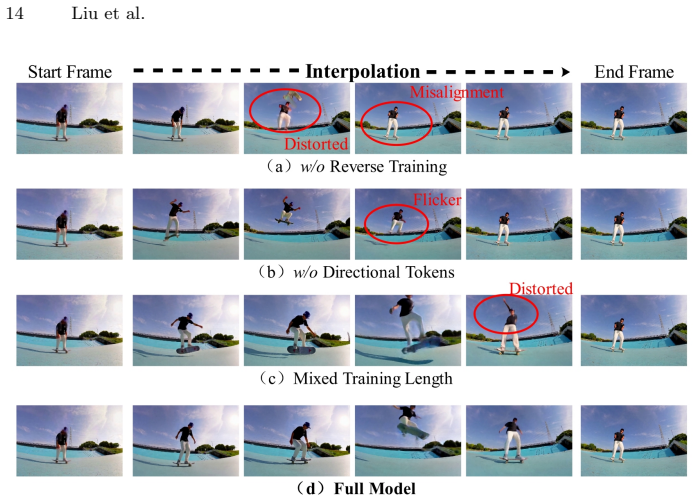
The central claim is that temporal cycle consistency—requiring the same model to return to the original start frame after generating forward and then backward—is a strong self-supervised regularizer for video interpolation. Concretely, the paper shows that appending backward reconstruction losses in both latent and pixel space, plus two learnable directional tokens, to a pretrained rectified-flow video backbone improves frame-level quality metrics and long-range consistency at both 37 and 73 frames while keeping inference identical to the base model. Their ablation attributes the largest benefit to the reverse training: without it, the dynamic-degree metric drops sharply (0.90 to 0.58 on 37
What carries the argument
The load-bearing mechanism is a pair of learnable directional tokens appended to the text conditioning of a shared diffusion-transformer backbone; the choice of token switches the same velocity-field network between forward and backward temporal generation. During training, each ground-truth clip is used twice—once in its original order and once time-reversed—and the total loss sums latent-space and pixel-space reconstruction errors for both directions. This forces the learned velocity field to be consistent under time reversal. A curriculum that first trains on short clips, then on long clips, stabilizes the objective and prevents the model from settling into a static-frame shortcut.
Load-bearing premise
The method assumes real-world video dynamics are approximately reversible—that training the model to generate from the end frame back to the start teaches it something useful; if the true dynamics are stochastic or dissipative, the reversal constraint can bias the model toward smoothed or physically wrong trajectories.
What would settle it
Train the same bidirectional framework on a dataset of irreversible processes (smoke dispersal, splashing water, shattering glass) and compare against a forward-only baseline; if the bidirectional model shows worse FVD/dynamic-degree on those clips, or if its forward-backward reconstruction error on real irreversible videos is substantially higher than on reversible ones, the reversibility assumption fails. More directly, compute the round-trip error: generate forward from A to B, then backward from B to A with the same model, and measure the distance between the reconstructed A and the origin
If this is right
- If the claim holds, any unidirectional video generator can be turned into an interpolator with reversible dynamics and no change to inference speed.
- Bidirectional cycle-consistency can act as a regularization principle for long-horizon video generation, not just interpolation, anchoring generated trajectories to their endpoints.
- Directional tokens give explicit temporal-orientation control, which could support applications such as consistent reverse playback or time-editing.
- The short-to-long curriculum is a practical training recipe that avoids the still-video collapse common when training long-sequence video models from scratch.
- Because the constraints are training-only, existing efficient autoregressive or flow-based samplers remain untouched at deployment.
Where Pith is reading between the lines
- The reversibility assumption limits the method to near-deterministic, entropy-preserving dynamics; for irreversible processes (smoke, splashes, shattering), the paper's own limitation note suggests cycle-consistency may bias outputs toward smoothed, physically wrong trajectories—an empirically testable prediction.
- The same bidirectional regularizer could transfer to audio or time-series interpolation, where time-reversal symmetry is a better approximation than in complex video scenes.
- Directional tokens might learn an implicit 'arrow-of-time' representation; probing them could show whether the model truly encodes temporal direction or merely memorizes a label.
- A direct stress test is measuring the forward-backward round-trip error on videos with irreversible dynamics—if the model fails to return to the start frame, the reversibility prior is not doing the claimed work.
Editorial analysis
A structured set of objections, weighed in public.
Referee Report
Summary. The paper proposes a bidirectional cycle-consistent training framework for text-guided video frame interpolation. Built on pre-trained long-video diffusion/flow backbones (FramePack and Wan2.1-Fun), it introduces learnable directional tokens (τ_fwd, τ_bwd) to condition a shared backbone on temporal orientation, and trains the model jointly on forward and time-reversed sequences with latent- and pixel-space reconstruction losses. A curriculum schedule first trains on 37-frame clips then fine-tunes on 73-frame clips. At inference, only a single forward pass is used, so the method adds no computational overhead relative to its backbone. Experiments report FVD and VBench metrics on 37- and 73-frame interpolation, claim state-of-the-art quality, and include ablations removing reverse training, directional tokens, and the curriculum.
Significance. If the central claim is validated, the proposal is a practical and low-cost regularizer: cycle-consistent bidirectional training improves long-range interpolation quality without increasing inference cost. The idea of using temporal symmetry as a training-only constraint is well motivated, and the paper provides a clean architectural mechanism (directional tokens) and a clear experimental protocol. The manuscript also includes qualitative demonstrations that the full model produces more coherent motion than unidirectional baselines. However, the empirical evidence for the central attribution — that cycle consistency, rather than additional training data or length mismatch, drives the gains — is currently inconclusive due to a confounded ablation, a small evaluation set without significance testing, and ambiguous train/evaluation disjointness.
major comments (4)
- [§4.3, Table 2] The 'w/o Reverse Training' ablation is confounded with data volume. In the full model, each ground-truth video contributes two training samples (forward and backward), while the forward-only ablation contributes one. Under the stated 'all other settings remain identical' protocol (same 4 epochs, same batch size), the full model sees roughly twice as many gradient updates. The large FVD/dynamic-degree gaps (e.g., 885 vs. 937 at 37 frames; 0.90 vs. 0.58 dynamic degree) could therefore reflect additional training samples rather than the cycle-consistency constraint. A matched-data control is needed — e.g., training forward-only on the same number of samples (by duplicating forward sequences or sampling additional videos) — or a variant that trains on reversed sequences without the bidirectional consistency objective. Without such a control, the paper's central attribution of gains to cycle-
- [§4.1, §4.2, Tables 1–2] All quantitative claims rest on a single evaluation set of only 100 videos, with no error bars, no multiple random seeds, and no statistical significance tests. Many reported differences are small in absolute terms (e.g., Table 1: FVD 885 vs. 901, VBench imaging quality 0.6024 vs. 0.5941; Table 2: FVD 885 vs. 901, temporal flickering 0.9877 vs. 0.9774). Given the noise typical of generative video evaluation, the claimed state-of-the-art improvements may not be distinguishable from run-to-run variation. The authors should report standard deviations across seeds, bootstrap confidence intervals, or per-video paired significance tests. The 100-video evaluation also limits the generalizability of the conclusions.
- [§4.1, Datasets] Training and evaluation sets are both sampled from VidGen-1M, but the manuscript does not explicitly state that the 100 evaluation videos are disjoint from the 5,000 training videos. The phrase 'we further sample additional 100 high-quality videos from VidGen-1M' suggests a separate sample, but it is not guaranteed to be non-overlapping. If any evaluation videos overlap with training, the reported FVD and VBench numbers are inflated and the comparison to baselines is invalid. The authors must state explicitly that the evaluation set is disjoint from the training set and, ideally, verify no near-duplicate content.
- [§4.2, Table 1] The baseline comparison is complicated by mismatched sequence lengths: GI is evaluated at 25 frames, SFI at 33/65 frames, while the proposed methods are evaluated at 37/73 frames. FVD and VBench metrics, especially dynamic degree and motion smoothness, are sensitive to sequence length and frame rate. The paper acknowledges these length differences in the text but does not control for their effect. For a fair 'state-of-the-art' claim, the authors should either evaluate all methods at matched output lengths (e.g., generate 37/73 frames from GI and SFI where possible) or provide a length-controlled comparison that isolates the effect of the proposed training objective from the effect of generating longer sequences.
minor comments (6)
- [§3.3, Eq. (3)] The ground-truth latent for the backward direction, x^*_bwd, is used in Eq. (3) but never defined. It should be defined as the latent encoding of Reverse(V^*_fwd), consistent with the pixel-space definition V^*_bwd = Reverse(V^*_fwd).
- [§4.3, Table 2 caption] The caption says 'five VBench metrics' but the table lists six metrics (Subject Consistency, Aesthetic Quality, Imaging Quality, Temporal Flickering, Motion Smoothness, Dynamic Degree). Please correct the caption or the table.
- [§4.2, Figure 4] The text says the VBench score in Figure 4 is the average of six perceptual metrics, but the ablation table refers to five. Please ensure consistent counting of the VBench dimensions.
- [§3.4, Multi-Rate Temporal Sampling] The description says the 37-frame and 73-frame variants of the same clip 'share identical start and end frames.' If the same clip is temporally resampled to different lengths, it is unclear how both can have literally identical end frames unless the end frame is defined as the last frame of the resampled clip. Please clarify the construction.
- [§2, Related Work] Reference [28] (Framer) is cited in the introduction and related work but has no publication venue in the reference list. Also, the claim that 'our work is the first to adapt such a long video generator for bidirectional interpolation' is strong given that [15,29,34] also use backward/time-reversed generation; please soften or more precisely distinguish the contribution.
- [§4.2, Baselines] Table 1 reports parameter counts and frame lengths, but not inference times in the table. Figure 4 provides a trade-off plot, but no numerical latency values are given; adding a table with mean inference time and standard deviation would strengthen the 'no extra computational cost' claim.
Circularity Check
No circular derivation: benchmark-validated training recipe with no fitted-then-predicted quantities.
full rationale
The paper's derivation chain is an empirical training recipe. Section 3.3 defines a four-term loss (Eq. 3) that supervises forward and backward reconstructions against ground-truth latent and pixel sequences (V*_bwd = Reverse(V*_fwd)); the directional tokens in Eq. (1)-(2) are learned parameters, not fitted constants that are later reported as predictions. The central claims are validated by Table 1's FVD/VBench comparisons on separately sampled evaluation videos from VidGen-1M, and by the Table 2 ablation. No equation in the paper reduces to its own inputs: nothing is fit to the evaluation metrics and then 'predicted'; no uniqueness theorem or prior result by the authors is invoked to force the architecture. The citation to cycle-consistency of time [30] is used as inspiration, not as load-bearing evidence, and the only overlapping-author citation (Open-SORA [41]) appears in related work without argumentative weight. The acknowledged reversibility assumption in the Limitations is an honest boundary condition, not circularity. The skeptic's concern that the 'w/o Reverse Training' ablation also halves the number of training samples is a real experimental confound, but it concerns attribution of the improvement to cycle-consistency vs. data volume; it is not a case where a prediction is equivalent by construction to a fitted input. Therefore no circular step is identifiable.
Axiom & Free-Parameter Ledger
free parameters (5)
- LoRA rank =
64
- Directional token learning rate =
2e-3
- Curriculum sequence lengths =
37 frames then 73 frames
- Training set size =
5,000 videos from VidGen-1M
- Training epochs / batch size =
4 epochs, batch size 6
axioms (3)
- domain assumption Approximate reversibility of real-world video dynamics
- domain assumption Time-reversed videos are valid learning signals
- domain assumption Evaluation videos from the same dataset as training are representative
invented entities (1)
-
Learnable directional tokens τ_fwd and τ_bwd
no independent evidence
read the original abstract
Video frame interpolation aims to synthesize realistic intermediate frames between given endpoints while adhering to specific motion semantics. While recent generative models have improved visual fidelity, they predominantly operate in a unidirectional manner, lacking mechanisms to self-verify temporal consistency. This often leads to motion drift, directional ambiguity, and boundary misalignment, especially in long-range sequences. Inspired by the principle of temporal cycle-consistency in self-supervised learning, we propose a novel bidirectional framework that enforces symmetry between forward and backward generation trajectories. Our approach introduces learnable directional tokens to explicitly condition a shared backbone on temporal orientation, enabling the model to jointly optimize forward synthesis and backward reconstruction within a single unified architecture. This cycle-consistent supervision acts as a powerful regularizer, ensuring that generated motion paths are logically reversible. Furthermore, we employ a curriculum learning strategy that progressively trains the model from short to long sequences, stabilizing dynamics across varying durations. Crucially, our cyclic constraints are applied only during training; inference requires a single forward pass, maintaining the high efficiency of the base model. Extensive experiments show that our method achieves state-of-the-art performance in imaging quality, motion smoothness, and dynamic control on both 37-frame and 73-frame tasks, outperforming strong baselines while incurring no additional computational overhead.
Figures


Reference graph
Works this paper leans on
-
[1]
In: Proceedings of the IEEE/CVF conference on computer vision and pattern recognition
Bao, W., Lai, W.S., Ma, C., Zhang, X., Gao, Z., Yang, M.H.: Depth-aware video frame interpolation. In: Proceedings of the IEEE/CVF conference on computer vision and pattern recognition. pp. 3703–3712 (2019)
2019
-
[2]
arXiv preprint arXiv:2311.15127 (2023)
Blattmann, A., Dockhorn, T., Kulal, S., Mendelevitch, D., Kilian, M., Lorenz, D., Levi, Y., English, Z., Voleti, V., Letts, A., et al.: Stable video diffusion: Scaling latent video diffusion models to large datasets. arXiv preprint arXiv:2311.15127 (2023)
Pith/arXiv arXiv 2023
-
[3]
In: Proceedings of the IEEE/CVF conference on computer vision and pattern recognition
Blattmann, A., Rombach, R., Ling, H., Dockhorn, T., Kim, S.W., Fidler, S., Kreis, K.: Align your latents: High-resolution video synthesis with latent diffusion mod- els. In: Proceedings of the IEEE/CVF conference on computer vision and pattern recognition. pp. 22563–22575 (2023)
2023
-
[4]
arXiv e-prints pp
Chen, L., Cun, X., Li, X., He, X., Yuan, S., Chen, J., Shan, Y., Yuan, L.: Sci-fi: Symmetric constraint for frame inbetweening. arXiv e-prints pp. arXiv–2505 (2025)
2025
-
[5]
In: Proceedings of the AAAI Conference on Artificial Intelligence
Danier, D., Zhang, F., Bull, D.: Ldmvfi: Video frame interpolation with latent diffusion models. In: Proceedings of the AAAI Conference on Artificial Intelligence. vol. 38, pp. 1472–1480 (2024)
2024
-
[6]
IEEE Transactions on Multimedia26, 9187–9202 (2024)
Ding, C., Lin, M., Zhang, H., Liu, J., Yu, L.: Video frame interpolation with stereo event and intensity cameras. IEEE Transactions on Multimedia26, 9187–9202 (2024)
2024
-
[7]
In: European Conference on Computer Vision
Feng, H., Ding, Z., Xia, Z., Niklaus, S., Abrevaya, V., Black, M.J., Zhang, X.: Explorative inbetweening of time and space. In: European Conference on Computer Vision. pp. 378–395. Springer (2024)
2024
-
[8]
Advances in neural information processing systems35, 8633– 8646 (2022)
Ho, J., Salimans, T., Gritsenko, A., Chan, W., Norouzi, M., Fleet, D.J.: Video diffusion models. Advances in neural information processing systems35, 8633– 8646 (2022)
2022
-
[9]
arXiv preprint arXiv:2507.05173 (2025)
Hong, Y., Zhang, J., Yi, R., Wang, Y., Cao, W., Hu, X., Xue, Z., Wang, Y., Wang, C., Ma, L.: Semantic frame interpolation. arXiv preprint arXiv:2507.05173 (2025)
Pith/arXiv arXiv 2025
-
[10]
In: Proceedings of the IEEE/CVF conference on computer vision and pattern recognition
Hu, M., Jiang, K., Zhong, Z., Wang, Z., Zheng, Y.: Iq-vfi: Implicit quadratic mo- tion estimation for video frame interpolation. In: Proceedings of the IEEE/CVF conference on computer vision and pattern recognition. pp. 6410–6419 (2024)
2024
-
[11]
In: European conference on computer vision
Huang, Z., Zhang, T., Heng, W., Shi, B., Zhou, S.: Real-time intermediate flow estimation for video frame interpolation. In: European conference on computer vision. pp. 624–642. Springer (2022)
2022
-
[12]
In: Proceedings of the 32nd ACM International Conference on Multimedia
Huang, Z., Yu, Y., Yang, L., Qin, C., Zheng, B., Zheng, X., Zhou, Z., Wang, Y., Yang, W.: Motion-aware latent diffusion models for video frame interpolation. In: Proceedings of the 32nd ACM International Conference on Multimedia. pp. 1043– 1052 (2024) 16 Liu et al
2024
-
[13]
In: Proceedings of the IEEE/CVF Conference on Computer Vision and Pattern Recognition (2024)
Huang, Z., He, Y., Yu, J., Zhang, F., Si, C., Jiang, Y., Zhang, Y., Wu, T., Jin, Q., Chanpaisit, N., Wang, Y., Chen, X., Wang, L., Lin, D., Qiao, Y., Liu, Z.: VBench: Comprehensive benchmark suite for video generative models. In: Proceedings of the IEEE/CVF Conference on Computer Vision and Pattern Recognition (2024)
2024
-
[14]
In: Proceedings of the IEEE/CVF Conference on Computer Vision and Pattern Recognition
Jain, S., Watson, D., Tabellion, E., Poole, B., Kontkanen, J., et al.: Video inter- polation with diffusion models. In: Proceedings of the IEEE/CVF Conference on Computer Vision and Pattern Recognition. pp. 7341–7351 (2024)
2024
-
[15]
In: The Fourteenth International Conference on Learning Representations (2026)
Jeon, W., Shin, S., Shin, D., Jeon, H.G.: Motion prior distillation in time reversal sampling for generative inbetweening. In: The Fourteenth International Conference on Learning Representations (2026)
2026
-
[16]
arXiv preprint arXiv:2412.03603 (2024)
Kong, W., Tian, Q., Zhang, Z., Min, R., Dai, Z., Zhou, J., Xiong, J., Li, X., Wu, B., Zhang, J., et al.: Hunyuanvideo: A systematic framework for large video generative models. arXiv preprint arXiv:2412.03603 (2024)
Pith/arXiv arXiv 2024
-
[17]
In: Proceedings of the IEEE/CVF Conference on Computer Vision and Pattern Recognition
Li, Z., Zhu, Z.L., Han, L.H., Hou, Q., Guo, C.L., Cheng, M.M.: Amt: All-pairs multi-field transforms for efficient frame interpolation. In: Proceedings of the IEEE/CVF Conference on Computer Vision and Pattern Recognition. pp. 9801– 9810 (2023)
2023
-
[18]
In: Proceedings of the IEEE/CVF conference on computer vision and pattern recognition
Liu, C., Zhang, G., Zhao, R., Wang, L.: Sparse global matching for video frame interpolation with large motion. In: Proceedings of the IEEE/CVF conference on computer vision and pattern recognition. pp. 19125–19134 (2024)
2024
-
[19]
In: Proceedings of the IEEE international conference on computer vision
Niklaus, S., Mai, L., Liu, F.: Video frame interpolation via adaptive separable convolution. In: Proceedings of the IEEE international conference on computer vision. pp. 261–270 (2017)
2017
-
[20]
In: Proceedings of the IEEE/CVF International Conference on Computer Vision
Pardo, A., Pizzati, F., Zhang, T., Pondaven, A., Torr, P., Perez, J.C., Ghanem, B.: Matchdiffusion: Training-free generation of match-cuts. In: Proceedings of the IEEE/CVF International Conference on Computer Vision. pp. 14973–14982 (2025)
2025
-
[21]
In: 2024 International Conference on Knowledge Engi- neering and Communication Systems (ICKECS)
Prasanna, B., Niranjan, S., et al.: Video frame interpolation using real-time inter- mediate flow estimation. In: 2024 International Conference on Knowledge Engi- neering and Communication Systems (ICKECS). vol. 1, pp. 1–5. IEEE (2024)
2024
-
[22]
In: European Conference on Computer Vi- sion
Reda, F., Kontkanen, J., Tabellion, E., Sun, D., Pantofaru, C., Curless, B.: Film: Frame interpolation for large motion. In: European Conference on Computer Vi- sion. pp. 250–266. Springer (2022)
2022
-
[23]
In: European Conference on Computer Vision
Shen, L., Liu, T., Sun, H., Ye, X., Li, B., Zhang, J., Cao, Z.: Dreammover: Lever- aging the prior of diffusion models for image interpolation with large motion. In: European Conference on Computer Vision. pp. 336–353. Springer (2024)
2024
-
[24]
arXiv preprint arXiv:2408.02629 (2024)
Tan, Z., Yang, X., Qin, L., Li, H.: Vidgen-1m: A large-scale dataset for text-to- video generation. arXiv preprint arXiv:2408.02629 (2024)
Pith/arXiv arXiv 2024
-
[25]
Unterthiner, T., Van Steenkiste, S., Kurach, K., Marinier, R., Michalski, M., Gelly, S.: Fvd: A new metric for video generation (2019)
2019
-
[26]
Advances in neural information processing systems35, 23371–23385 (2022)
Voleti, V., Jolicoeur-Martineau, A., Pal, C.: Mcvd-masked conditional video diffu- sion for prediction, generation, and interpolation. Advances in neural information processing systems35, 23371–23385 (2022)
2022
-
[27]
arXiv preprint arXiv:2503.20314 (2025)
Wan, T., Wang, A., Ai, B., Wen, B., Mao, C., Xie, C.W., Chen, D., Yu, F., Zhao, H., Yang, J., et al.: Wan: Open and advanced large-scale video generative models. arXiv preprint arXiv:2503.20314 (2025)
Pith/arXiv arXiv 2025
-
[28]
In: The Thirteenth International Conference on Learning Representations
Wang, W., Wang, Q., Zheng, K., OUYANG, H., Chen, Z., Gong, B., Chen, H., Shen, Y., Shen, C.: Framer: Interactive frame interpolation. In: The Thirteenth International Conference on Learning Representations
-
[29]
arXiv preprint arXiv:2408.15239 (2024) Title Suppressed Due to Excessive Length 17
Wang, X., Zhou, B., Curless, B., Kemelmacher-Shlizerman, I., Holynski, A., Seitz, S.M.: Generative inbetweening: Adapting image-to-video models for keyframe in- terpolation. arXiv preprint arXiv:2408.15239 (2024) Title Suppressed Due to Excessive Length 17
Pith/arXiv arXiv 2024
-
[30]
In: Proceedings of the IEEE/CVF conference on computer vision and pattern recognition
Wang, X., Jabri, A., Efros, A.A.: Learning correspondence from the cycle- consistency of time. In: Proceedings of the IEEE/CVF conference on computer vision and pattern recognition. pp. 2566–2576 (2019)
2019
-
[31]
ACM Transactions on Graphics (TOG)43(6), 1–11 (2024)
Xing, J., Liu, H., Xia, M., Zhang, Y., Wang, X., Shan, Y., Wong, T.T.: Tooncrafter: Generative cartoon interpolation. ACM Transactions on Graphics (TOG)43(6), 1–11 (2024)
2024
-
[32]
In: European Conference on Computer Vision
Xing, J., Xia, M., Zhang, Y., Chen, H., Yu, W., Liu, H., Liu, G., Wang, X., Shan, Y., Wong, T.T.: Dynamicrafter: Animating open-domain images with video diffusion priors. In: European Conference on Computer Vision. pp. 399–417. Springer (2024)
2024
-
[33]
ACM computing surveys56(4), 1–39 (2023)
Yang, L., Zhang, Z., Song, Y., Hong, S., Xu, R., Zhao, Y., Zhang, W., Cui, B., Yang, M.H.: Diffusion models: A comprehensive survey of methods and applications. ACM computing surveys56(4), 1–39 (2023)
2023
-
[34]
In: The Thirteenth International Conference on Learning Representations
Yang, S., Kwon, T., Ye, J.C.: Vibidsampler: Enhancing video interpolation using bidirectional diffusion sampler. In: The Thirteenth International Conference on Learning Representations
-
[35]
In: The Thirteenth International Conference on Learning Representations
Yang, Z., Teng, J., Zheng, W., Ding, M., Huang, S., Xu, J., Yang, Y., Hong, W., Zhang, X., Feng, G., et al.: Cogvideox: Text-to-video diffusion models with an expert transformer. In: The Thirteenth International Conference on Learning Representations
-
[36]
In: Proceedings of the IEEE/CVF International Confer- ence on Computer Vision
Yang, Z., Zhang, J., Yu, Y., Lu, S., Bai, S.: Versatile transition generation with image-to-video diffusion. In: Proceedings of the IEEE/CVF International Confer- ence on Computer Vision. pp. 16981–16990 (2025)
2025
-
[37]
In: The Fourteenth International Conference on Learning Representations (2026)
Zhang, G., Wang, H., Wang, C., Zhou, Y., Lu, Q., Wang, L.: Arbitrary genera- tive video interpolation. In: The Fourteenth International Conference on Learning Representations (2026)
2026
-
[38]
In: Proceedings of the IEEE/CVF Conference on Computer Vision and Pattern Recognition
Zhang, G., Zhu, Y., Wang, H., Chen, Y., Wu, G., Wang, L.: Extracting motion and appearance via inter-frame attention for efficient video frame interpolation. In: Proceedings of the IEEE/CVF Conference on Computer Vision and Pattern Recognition. pp. 5682–5692 (2023)
2023
-
[39]
arXiv preprint arXiv:2504.12626 (2025)
Zhang, L., Agrawala, M.: Packing input frame context in next-frame prediction models for video generation. arXiv preprint arXiv:2504.12626 (2025)
arXiv 2025
-
[40]
In: Proceedings of the Computer Vision and Pattern Recognition Conference
Zhang, Z., Chen, H., Zhao, H., Lu, G., Fu, Y., Xu, H., Wu, Z.: Eden: Enhanced diffusion for high-quality large-motion video frame interpolation. In: Proceedings of the Computer Vision and Pattern Recognition Conference. pp. 2105–2115 (2025)
2025
-
[41]
arXiv preprint arXiv:2412.20404 (2024)
Zheng, Z., Peng, X., Yang, T., Shen, C., Li, S., Liu, H., Zhou, Y., Li, T., You, Y.: Open-sora: Democratizing efficient video production for all. arXiv preprint arXiv:2412.20404 (2024)
Pith/arXiv arXiv 2024
-
[42]
In: Proceedings of the Computer Vision and Pattern Recognition Conference
Zhu, T., Ren, D., Wang, Q., Wu, X., Zuo, W.: Generative inbetweening through frame-wise conditions-driven video generation. In: Proceedings of the Computer Vision and Pattern Recognition Conference. pp. 27968–27978 (2025)
2025
discussion (0)
Sign in with ORCID, Apple, or X to comment. Anyone can read and Pith papers without signing in.