Generalizing the interacting dilatonic ghost condensate as a dark energy model
Pith reviewed 2026-06-29 02:40 UTC · model grok-4.3
The pith
A generalized interacting dilatonic ghost condensate reproduces standard cosmology and reaches dark energy-dominated attractors at late times.
A machine-rendered reading of the paper's core claim, the machinery that carries it, and where it could break.
Core claim
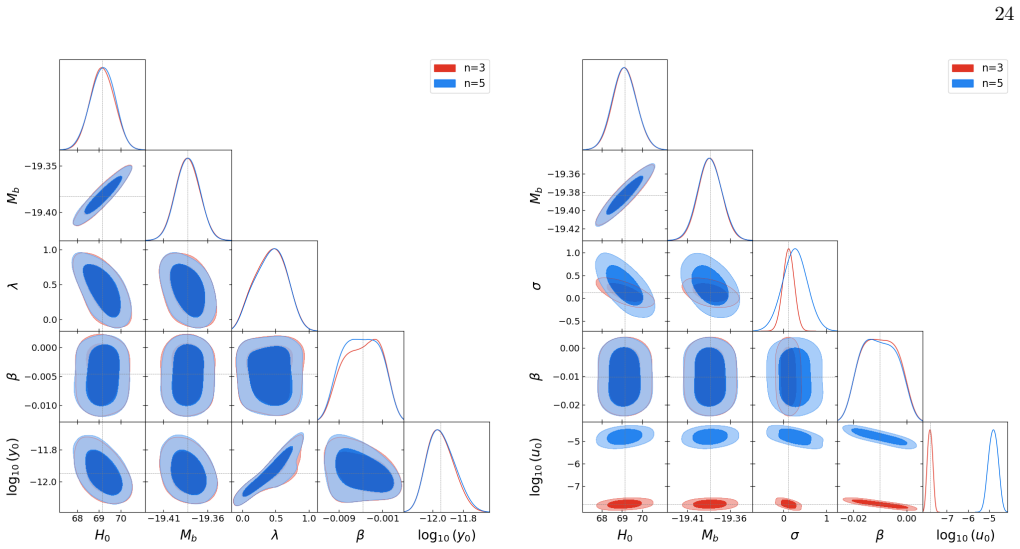
In all examined scenarios, including non-interacting and two forms of interaction between the scalar field and dark matter, the dynamical system reaches stable late-time attractors where dark energy dominates the universe's energy density. The nature of these attractors—quintessence-like or phantom-like—depends on the sign of the coupling parameter α associated with the standard kinetic term. For the interaction proportional to H ρ_m, energy always transfers from dark matter to dark energy regardless of α. Parameter constraints are derived from Cosmic Chronometers, PantheonPlus, and DESI data for n=3 and n=5.
What carries the argument
The generalized Lagrangian density with linear and n>2 kinetic terms, exponential potential, and interaction source terms Q, analyzed via autonomous phase-space equations.
If this is right
- The model reproduces standard cosmological dynamics across all interaction scenarios.
- Late-time attractors are dark energy dominated with quintessence or phantom features set by the sign of α.
- For Q ∝ ρ_m φ̇ the direction of energy flow depends on the sign of α.
- For Q ∝ ρ_m H the energy flow is always from dark matter to dark energy independent of α.
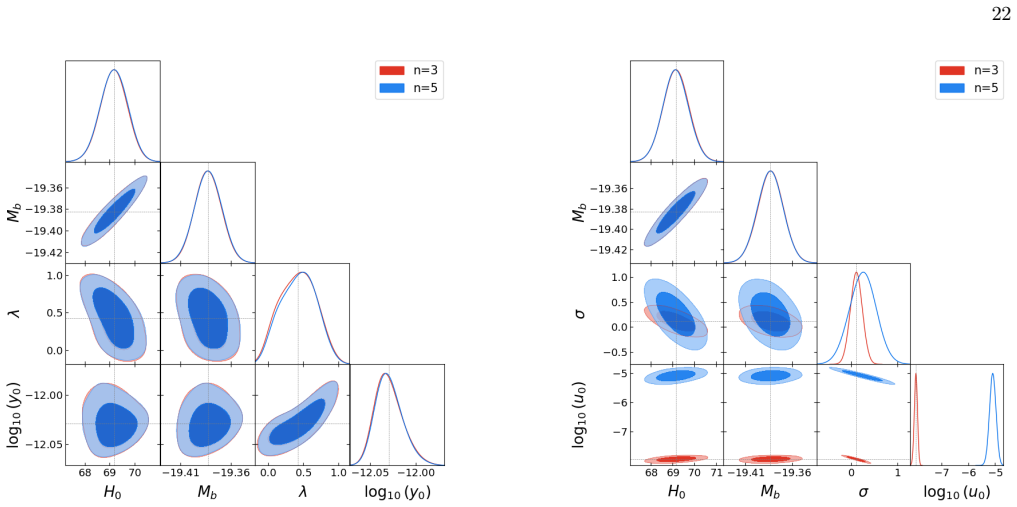
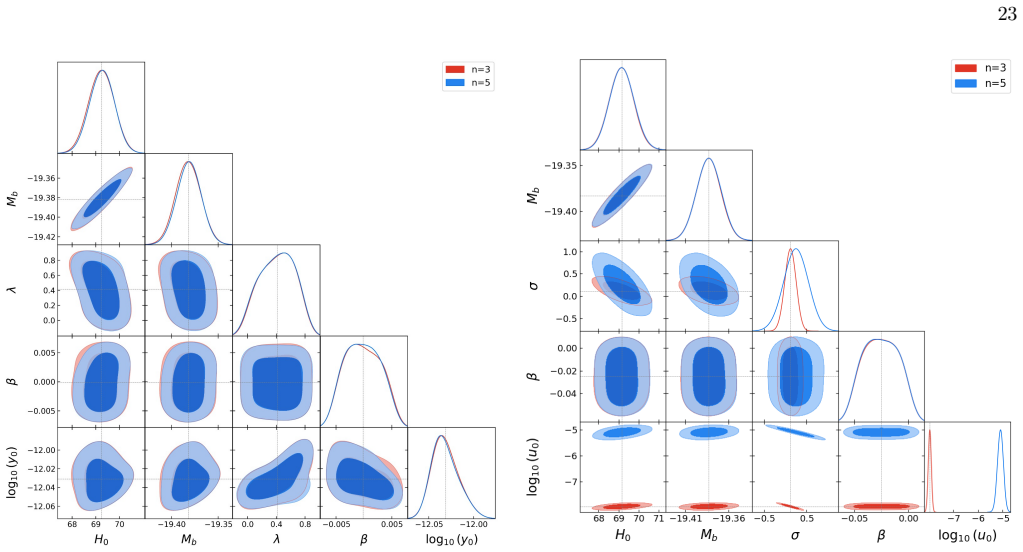
- Observational constraints at 68% and 95% confidence are obtained for n=3 and n=5 using current datasets.
Where Pith is reading between the lines
- The model's robustness across interaction choices indicates it could serve as a template for testing other scalar-field dark energy models.
- Future surveys measuring the sign of energy transfer between sectors could directly test the distinction between the two Q forms.
- Extending the phase-space analysis to radiation-dominated epochs might show whether the n>2 term influences early-universe behavior.
Load-bearing premise
The specific interaction source terms proportional to ρ_m φ̇ and ρ_m H are the physically relevant choices and the generalized Lagrangian remains a valid effective description at late times.
What would settle it
A direct measurement showing energy flow from dark energy to dark matter under the Q ∝ H ρ_m interaction would contradict the claimed sign-independent direction of transfer.
Figures
read the original abstract
In this article, we study the cosmic evolution of a generalized dilatonic ghost condensate field as a dark energy candidate, formulated from a Lagrangian density with two dominant kinetic terms; one linear and one of arbitrary integer $n>2$ in combination with an exponential potential, which interacts with dark matter through a source term. We analyzed three scenarios: the non-interacting situation $Q=0$ and two different interaction models, $Q\propto\rho_m\dot{\phi}$ and $Q\propto \rho_m H$ to describe the evolution of the present universe. For each interaction $Q$, we perform a detailed phase-space analysis to obtain stability conditions and identify critical points. In all situations, the system reproduces the standard cosmological dynamics and evolves toward late-time dark energy-dominated attractors, with quintessence or phantom features depending on the sign of the coupling parameter $\alpha$ associated with the standard kinetic term. Furthermore, a joint likelihood analysis with Cosmic Chronometers, PantheonPlus, and DESI observations is performed for two values of power $n$ ($n=3$ and $n=5$) to determine marginalized parameter constraints at the confidence levels of 68$\%$ and 95$\%$ for the different $Q-$models. For the interaction term $Q\propto \dot{\phi}\rho_m$, we find that the direction of the flow of energy depends on the sign of the coupling parameter $\alpha$ associated with the standard kinetic term. However, for the interaction $Q\propto H\,\rho_m$, the direction of the energy flow is independent of the sign of the coupling parameter $\alpha$ and always remains negative, corresponding to an energy transfer from dark matter to dark energy.
Editorial analysis
A structured set of objections, weighed in public.
Referee Report
Summary. The paper examines a generalized interacting dilatonic ghost condensate as a dark energy model, using a Lagrangian with a linear kinetic term, an n>2 power-law kinetic term (n integer), and an exponential potential. It considers three cases (Q=0, Q∝ρ_m φ̇, Q∝ρ_m H), performs phase-space analysis to identify stable critical points, and shows evolution toward late-time dark energy-dominated attractors with quintessence or phantom behavior depending on the sign of α. For Q∝H ρ_m the energy flow is always from dark matter to dark energy independent of α. Observational constraints are obtained via joint likelihood analysis with Cosmic Chronometers, PantheonPlus, and DESI data for n=3 and n=5.
Significance. The phase-space results, if robust, add to the literature on interacting dark energy by generalizing the ghost condensate with higher-order kinetic terms and demonstrating attractor behavior plus data-driven parameter bounds. The independence of energy-flow direction from α for the Q∝H ρ_m case is a concrete, testable feature. The work is primarily phenomenological; its significance is reduced by the absence of a derivation or symmetry argument for the chosen interaction forms and the n>2 Lagrangian extension.
major comments (2)
- [Model and interaction terms] The specific interaction source terms Q∝ρ_m φ̇ and Q∝ρ_m H are adopted without derivation from a more fundamental theory, symmetry, or EFT matching (Abstract). Because the reported energy-flow direction and the quintessence/phantom classification depend directly on these choices, the lack of motivation is load-bearing for the central claims about late-time attractors and flow direction.
- [Phase-space analysis] The abstract asserts that for Q∝H ρ_m the energy flow is always negative (DM→DE) independent of α, yet the phase-space analysis is performed only inside the chosen phenomenological setup; no independent prediction or falsification test outside the fitted α is supplied, making the direction claim circular with the model choice.
minor comments (2)
- The abstract supplies no error budgets, prior choices, or goodness-of-fit diagnostics for the n=3,5 likelihood fits; these details are needed to assess the robustness of the reported constraints.
- Clarify whether the coupling α in the kinetic term is the same parameter appearing in the interaction Q, and provide the explicit autonomous-system equations used for the stability analysis.
Simulated Author's Rebuttal
We thank the referee for the careful reading and constructive comments. We address the major comments point by point below, maintaining a focus on the phenomenological nature of the study.
read point-by-point responses
-
Referee: [Model and interaction terms] The specific interaction source terms Q∝ρ_m φ̇ and Q∝ρ_m H are adopted without derivation from a more fundamental theory, symmetry, or EFT matching (Abstract). Because the reported energy-flow direction and the quintessence/phantom classification depend directly on these choices, the lack of motivation is load-bearing for the central claims about late-time attractors and flow direction.
Authors: We agree that the chosen interaction forms are phenomenological and are not derived from a fundamental theory, symmetry principle, or EFT matching in this work. These specific forms are selected because they are commonly employed in the interacting dark energy literature to explore distinct energy-transfer mechanisms and their effects on cosmic dynamics. The manuscript will be revised to expand the discussion of this motivation, including additional references to similar interaction terms used in prior studies, while clarifying that the results are specific to these choices. revision: partial
-
Referee: [Phase-space analysis] The abstract asserts that for Q∝H ρ_m the energy flow is always negative (DM→DE) independent of α, yet the phase-space analysis is performed only inside the chosen phenomenological setup; no independent prediction or falsification test outside the fitted α is supplied, making the direction claim circular with the model choice.
Authors: The result that the energy flow direction for Q∝H ρ_m is independent of the sign of α follows directly from the autonomous system derived from the model equations and the stability analysis of the critical points. This is an internal finding of the dynamical system under the chosen interaction, not a circular assertion. The study does not supply an external falsification test because the analysis is confined to the dynamics of this generalized setup, consistent with standard phase-space investigations in cosmology. No revision is required on this point. revision: no
- Derivation of the specific interaction terms or the n>2 Lagrangian extension from a fundamental theory, symmetry, or EFT, as the model is constructed as a phenomenological generalization.
Circularity Check
No significant circularity; results are direct consequences of the defined model equations
full rationale
The paper defines a specific generalized Lagrangian (linear + n>2 kinetic terms with exponential potential) and chooses two phenomenological interaction forms Q ∝ ρ_m φ̇ and Q ∝ ρ_m H, then performs phase-space analysis to locate critical points, stability conditions, and late-time attractors. The reported behaviors—including α-dependent quintessence/phantom features and the energy-flow direction for each Q—are obtained by solving the autonomous system derived from those definitions. No step equates a claimed prediction to an input parameter by construction, renames a fitted quantity, or relies on a load-bearing self-citation whose content reduces to the present work. Observational constraints on n=3,5 are separate posterior fits and do not retroactively alter the dynamical claims. The derivation chain is self-contained within the chosen setup.
Axiom & Free-Parameter Ledger
free parameters (3)
- n (power of kinetic term)
- α (coupling of linear kinetic term)
- interaction strength parameters
axioms (2)
- domain assumption The generalized Lagrangian with linear plus n-power kinetic terms plus exponential potential is a valid effective description of dark energy.
- ad hoc to paper The two chosen interaction forms Q ∝ ρ_m φ̇ and Q ∝ ρ_m H exhaust the relevant late-time phenomenology.
Reference graph
Works this paper leans on
-
[1]
They exploit the relationH(z) =− 1 1+z dz dt , which gives the expansion rate in terms of the redshift zwithout relying on any integrated distance
Cosmic Chronometers CC provides model-independent measurements of the Hubble parameter from the differential aging of passively evolving galaxies. They exploit the relationH(z) =− 1 1+z dz dt , which gives the expansion rate in terms of the redshift zwithout relying on any integrated distance. We use a compilation ofN CC data points{z i, Hobs(zi), σHi }dr...
-
[2]
Type Ia Supernovae Type Ia supernovae probe the luminosity distance through the distance modulus. The observed modulus is defined as µobs =m corr B −M,(4.3) whereas its theoretical value reads µth(z;p) = 5 log 10 DL(z;p) Mpc + 25,(4.4) with the luminosity distance given by DL(z;p) = (1 +z) Z z 0 c dz′ H(z ′;p) .(4.5) We adopt the PantheonPlus + SH0ES comp...
-
[3]
We employ the DESI DR2 dataset [74, 75] 2, which delivers both transverse and radial distance information
Baryon Acoustic Oscillations BAO measurements act as a geometric ruler, comparing the observed clustering scale with the sound horizon at the drag epoch. We employ the DESI DR2 dataset [74, 75] 2, which delivers both transverse and radial distance information. The data vector reads Xobs = DM(z) rd , DH(z) rd , DV (z) rd obs ,(4.7) with the relevant distan...
-
[4]
A. G. Riess et al., Astron. J.116, 1009 (1998), astro-ph/9805200
Pith/arXiv arXiv 1998
-
[5]
S. Perlmutter et al., Astrophys. J.517, 565 (1999), astro-ph/9812133
Pith/arXiv arXiv 1999
-
[6]
Weinberg, Rev
S. Weinberg, Rev. Mod. Phys.61, 1 (1989)
1989
-
[7]
P. J. E. Peebles and B. Ratra, Rev. Mod. Phys.75, 559 (2003), astro-ph/0207347
Pith/arXiv arXiv 2003
-
[9]
Ratra and P
B. Ratra and P. J. E. Peebles, Phys. Rev. D37, 3406 (1988)
1988
-
[16]
L. Amendola, G. Camargo Campos, and R. Rosenfeld, Phys. Rev. D75, 083506 (2007), astro-ph/0610806
Pith/arXiv arXiv 2007
-
[29]
A. D. Linde, Phys. Lett. B114, 431 (1982)
1982
-
[30]
N. D. Birrell and P. C. W. Davies,Quantum Fields in Curved Space(Cambridge Univ. Press, Cambridge, UK, 1984)
1984
- [31]
-
[32]
J.-H. He, B. Wang, and E. Abdalla, Phys. Rev. D78, 123508 (2008), 0807.3471
Pith/arXiv arXiv 2008
-
[33]
J. Valiviita, E. Majerotto, and R. Maartens, JCAP07, 020 (2008), 0804.0232
Pith/arXiv arXiv 2008
- [34]
- [35]
-
[36]
J. Valiviita, R. Maartens, and E. Majerotto, Mon. Not. Roy. Astron. Soc.402, 2355 (2010), 0907.4987
Pith/arXiv arXiv 2010
-
[37]
S. Kumar and R. C. Nunes, Phys. Rev. D94, 123511 (2016), 1608.02454
Pith/arXiv arXiv 2016
-
[38]
R. Murgia, S. Gariazzo, and N. Fornengo, JCAP04, 014 (2016), 1602.01765
Pith/arXiv arXiv 2016
-
[39]
E. Di Valentino, A. Melchiorri, and O. Mena, Phys. Rev. D96, 043503 (2017), 1704.08342
Pith/arXiv arXiv 2017
- [40]
-
[41]
W. Yang, S. Zhang, O. Mena, S. Pan, and E. Di Valentino (2025), 2508.19109
arXiv 2025
-
[42]
X. Dai, Y. Yang, Y. Wang, Y. Qu, S. Yi, and F. Wang, Phys. Rev. D113, 063514 (2026), 2602.22840
Pith/arXiv arXiv 2026
-
[43]
D. Figueruelo, M. van der Westhuizen, A. Abebe, and E. Di Valentino, Phys. Dark Univ.52, 102238 (2026), 2601.03122
arXiv 2026
-
[45]
M. Gonzalez-Espinoza and R. Herrera, Phys. Dark Univ.49, 101976 (2025), 2504.05435
arXiv 2025
-
[46]
C. Armendariz-Picon, T. Damour, and V. F. Mukhanov, Phys. Lett. B458, 209 (1999), hep-th/9904075
Pith/arXiv arXiv 1999
-
[47]
J. Garriga and V. F. Mukhanov, Phys. Lett. B458, 219 (1999), hep-th/9904176
Pith/arXiv arXiv 1999
-
[48]
T. Chiba, T. Okabe, and M. Yamaguchi, Phys. Rev. D62, 023511 (2000), astro-ph/9912463
Pith/arXiv arXiv 2000
-
[49]
Ratra and P
B. Ratra and P. Peebles, Phys. Rev. D37, 3406 (1988)
1988
-
[50]
E. J. Copeland, M. Sami, and S. Tsujikawa, Int. J. Mod. Phys. D15, 1753 (2006), hep-th/0603057
Pith/arXiv arXiv 2006
-
[51]
N. Arkani-Hamed, P. Creminelli, S. Mukohyama, and M. Zaldarriaga, JCAP04, 001 (2004), hep-th/0312100
Pith/arXiv arXiv 2004
-
[52]
T. Damour and A. M. Polyakov, Nucl. Phys. B423, 532 (1994), hep-th/9401069
Pith/arXiv arXiv 1994
-
[53]
T. Damour and A. Vilenkin, Phys. Rev. D53, 2981 (1996), hep-th/9503149
Pith/arXiv arXiv 1996
-
[54]
S. Foffa, M. Maggiore, and R. Sturani, Nucl. Phys. B552, 395 (1999), hep-th/9903008
Pith/arXiv arXiv 1999
- [55]
-
[56]
A. Chakraborty, A. Ghosh, and N. Banerjee, Phys. Rev. D99, 103513 (2019), 1904.10149
Pith/arXiv arXiv 2019
-
[57]
B. R. Dinda and N. Banerjee, Eur. Phys. J. C84, 177 (2024), 2309.10538
arXiv 2024
-
[58]
S. del Campo, R. Herrera, and D. Pavon, JCAP01, 020 (2009), 0812.2210
Pith/arXiv arXiv 2009
-
[59]
S. del Campo, R. Herrera, and D. Pavon, Phys. Rev. D78, 021302 (2008), 0806.2116. 28
Pith/arXiv arXiv 2008
-
[60]
S. del Campo, R. Herrera, G. Olivares, and D. Pavon, Phys. Rev. D74, 023501 (2006), astro-ph/0606520
Pith/arXiv arXiv 2006
-
[61]
R. Herrera, W. S. Hipolito-Ricaldi, and N. Videla, JCAP08, 065 (2016), 1607.01806
Pith/arXiv arXiv 2016
- [62]
-
[63]
L. P. Chimento, A. S. Jakubi, D. Pavon, and W. Zimdahl, Phys. Rev. D67, 083513 (2003), astro-ph/0303145
Pith/arXiv arXiv 2003
-
[64]
B. Wang, E. Abdalla, F. Atrio-Barandela, and D. Pavon, Rept. Prog. Phys.79, 096901 (2016), 1603.08299
Pith/arXiv arXiv 2016
- [65]
-
[66]
W. Yang, S. Pan, R. Herrera, and S. Chakraborty, Phys. Rev. D98, 043517 (2018), 1808.01669
Pith/arXiv arXiv 2018
-
[67]
R. Herrera, D. Pavon, and W. Zimdahl, Gen. Rel. Grav.36, 2161 (2004), astro-ph/0404086
Pith/arXiv arXiv 2004
-
[68]
S. del Campo, R. Herrera, and D. Pav´ on, Phys. Rev. D91, 123539 (2015), 1507.00187
Pith/arXiv arXiv 2015
-
[69]
S. del Campo, R. Herrera, and D. Pavon, Phys. Rev. D71, 123529 (2005), astro-ph/0506482
Pith/arXiv arXiv 2005
- [70]
-
[71]
M. Moresco, R. Jimenez, L. Verde, A. Cimatti, and L. Pozzetti, Astrophys. J.898, 82 (2020), 2003.07362
arXiv 2020
-
[72]
Cao, X.-W
S.-L. Cao, X.-W. Duan, X.-L. Meng, and T.-J. Zhang, The European Physical Journal C78, 1 (2018)
2018
-
[73]
Farooq and B
O. Farooq and B. Ratra, The Astrophysical Journal Letters766, L7 (2013)
2013
-
[74]
S. R. Brownsberger, D. Brout, D. Scolnic, C. W. Stubbs, and A. G. Riess, Astrophys. J.944, 188 (2023), 2110.03486
arXiv 2023
-
[75]
D. Brout et al., Astrophys. J.938, 110 (2022), 2202.04077
Pith/arXiv arXiv 2022
-
[76]
D. Scolnic et al., Astrophys. J.938, 113 (2022), 2112.03863
Pith/arXiv arXiv 2022
-
[77]
M. Abdul Karim et al. (DESI), Phys. Rev. D112, 083515 (2025), 2503.14738
Pith/arXiv arXiv 2025
-
[78]
M. Abdul Karim et al. (DESI), Phys. Rev. D112, 083514 (2025), 2503.14739
Pith/arXiv arXiv 2025
-
[79]
N. Aghanim et al. (Planck), Astron. Astrophys.641, A6 (2020), [Erratum: Astron.Astrophys. 652, C4 (2021)], 1807.06209
Pith/arXiv arXiv 2020
discussion (0)
Sign in with ORCID, Apple, or X to comment. Anyone can read and Pith papers without signing in.