REVIEW 4 major objections 6 minor 9 references
Semi-knockoffs let any pre-trained ML model test conditional independence in finite samples, without a train-test split.
Reviewed by Pith at T0; open to challenge. T0 means a machine referee read the full paper against a public rubric. the ladder, T0–T4 →
T0 review · deepseek-v4-flash
2026-08-03 06:14 UTC pith:M5QFQ7LY
load-bearing objection Genuinely new two-sided resampling trick with a clean oracle FDR proof, but the practical algorithm's finite-sample guarantees rest on an openly stated conjecture and the abstract overclaims. the 4 major comments →
Semi-knockoffs: a model-agnostic conditional independence testing method with finite-sample guarantees
The pith
A machine-rendered reading of the paper's core claim, the machinery that carries it, and where it could break.
Core claim
On its own terms, the paper's claim is that conditional independence can be tested with an arbitrary black-box predictive model while retaining finite-sample type-I error and FDR control and no train-test split, by the asymmetric construction of two synthetic populations: one mixes the feature with residuals from a regression on the remaining variables, the other from a regression on the remaining variables together with the response. Under the null, ρ_j(X_{-j}, y) = ν_j(X_{-j}), so the two populations are exchangeable and the loss difference l(m(X̃1), y) − l(m(X̃2), y) is symmetric; this symmetry is exactly what makes valid p-values and knockoff-style FDR control possible. For the practical
What carries the argument
Two conditional-expectation imputers — ν_j(X_{-j}) = E[X_j|X_{-j}] and ρ_j(X_{-j}, y) = E[X_j|X_{-j}, y] — generate the synthetic features X̃1 and X̃2 whose losses are compared. The identity ρ_j = ν_j under the null turns the loss difference into an exchangeable statistic whose sign, in the oracle version, is provably a Rademacher random variable, entitling the knockoff threshold T_q to control the FDR. Two supporting results carry the estimated version: a stability theorem (Theorem 4.1) showing an l2-regularized empirical risk minimizer changes by O_P(sqrt(log(1/δ)/n)) when an uninformative coordinate is suppressed, and a double-robustness theorem (Theorem 4.3) showing the loss discrepancy
Load-bearing premise
The practical version's finite-sample guarantees rest on the unproved conjecture that each estimated statistic's sign is a fair coin flip independent of the other features; the paper proves the oracle case and only bounds the error magnitude, not the sign, in the estimated case.
What would settle it
Simulate data where a null feature is strongly correlated with a signal feature, use a deliberately overfit or small-sample model so its derivative with respect to the null feature is not small, and estimate ν and ρ with regularized linear imputers; then check whether the signs of the Semi-knockoff statistics across many null features are i.i.d. Rademacher. If the sign distribution is biased or dependent in this regime, or the empirical FDR exceeds the target q substantially, the conjecture and the practical guarantee fail.
If this is right
- Variable selection with complex models — random forests, gradient boosting, neural networks — becomes feasible in high dimensions with finite-sample FDR control, without splitting the sample.
- Scientists no longer need the model-X assumption of a known input distribution; estimating two conditional expectations suffices, which widens the class of accessible problems.
- The method sidesteps the difficult construction of exact knockoff variables and antisymmetric statistics, removing a major practical bottleneck of knockoffs.
- Because the model is used only as an importance scorer, any pre-trained model can be reused directly, saving the cost of refitting per feature.
- Empirically, a few extra permutations (derandomization) substantially raise power while preserving error control.
Where Pith is reading between the lines
- If the sign-exchangeability conjecture fails in regimes where the model keeps nontrivial sensitivity to null features or the imputers are too noisy relative to the signal, the practical FDR guarantee would degrade gracefully to asymptotic rather than finite-sample control; the paper's own limits motivate a diagnostic.
- The two-imputer trick is a general symmetry-engine: any statistic symmetric in X̃1 and X̃2 under the null, not just loss differences, could carry the same argument, suggesting immediate extension to rank-based or kernel-based scores.
- The double-robustness product structure suggests a practical safeguard: monitor a_n·b_n per feature and flag cases where the product is not small, treating them as outside the verified regime.
- Because the imputers condition on the response, the method connects naturally to missing-data imputation practice, where conditioning on y is known to matter; transferring those insights could raise power further.
Editorial analysis
A structured set of objections, weighed in public.
Referee Report
Summary. The paper introduces Semi-knockoffs, a method for conditional independence testing with arbitrary pre-trained ML models that avoids a train-test split. The central idea is to compare the loss of a model evaluated on two perturbed versions of each feature: one sampled using the conditional expectation of X_j given X_{-j} (ν_j), and one using the conditional expectation given X_{-j} and y (ρ_j). Under the null hypothesis X_j ⊥ y | X_{-j}, both samplers coincide, producing exchangeable loss distributions; under the alternative, the second sampler is less perturbing. The authors prove oracle type-I error control (Theorem 3.3) and oracle FDR control (Theorem 3.4) via knockoff exchangeability. For the practical version with estimated imputers (Algorithm 4), they provide a stability theorem for regularized ERMs (Theorem 4.1), a Wasserstein convergence result (Theorem 4.2), and a double-robustness rate bound (Theorem 4.3). The finite-sample guarantees for the estimated version, however, rest on an explicit conjecture in Section 4.5 that the sign of the empirical statistic matches the oracle sign with probability tending to one.
Significance. The oracle version of Semi-knockoffs is an elegant and potentially useful construction. The idea of comparing two conditional samplers (with and without y) to eliminate the train-test split is novel, and the oracle FDR proof (Appendix E.2) is a correct application of Barber–Candès exchangeability, giving finite-sample FDR control when the conditional expectations are known. The stability and double-robustness results are of independent interest, and the experiments are extensive and well documented. However, the advertised contribution—finite-sample guarantees for a practical method that works with arbitrary pre-trained models and estimated imputers—is not established. The load-bearing sign-preservation conjecture is explicitly left unproved, and Theorem 3.3's proof appears incomplete for the actual paired-test implementation. If the oracle results are separated from the estimated-version claims and the practical claims are weakened to asymptotic or conditional guarantees, the paper could be a useful contribution.
major comments (4)
- [§3.1, Theorem 3.3; Appendix E.1] The proof of Theorem 3.3 only shows that under the null the two populations have the same marginal law. Algorithm 2 returns the standard Wilcoxon or sign-test p-value, whose validity requires the paired differences to be independent (or the test statistic to have the usual randomization null). Here the residual permutations π1 and π2 are global permutations without replacement, so the pairs (l(bm(eX1,i), y_i), l(bm(eX2,i), y_i)) are dependent across i. Marginal symmetry of each difference does not imply that the signed-rank or sign statistic has the standard null distribution. Consequently, finite-sample type-I error control for the oracle version is not established as stated. Please either prove exactness under the dependent permutation structure or modify the algorithm (e.g., independent residual resampling with replacement) and re-derive the test.
- [§4.5 and Algorithm 4; abstract] The abstract and Section 1 claim finite-sample FDR control for the practical Semi-knockoffs (Algorithm 4), but Theorem 3.4 is proved only for oracle νj and ρj. For estimated imputers, the route to Lemma 2.1 is the conjecture in Section 4.5 that the sign of the empirical statistic equals the oracle sign with probability tending to 1. Even if this sign-matching held asymptotically, it would give at best asymptotic exchangeability, not the exact conditional Rademacher signs required for the finite-sample bound FDR(Ŝ^SKO) ≤ q. Theorems 4.2 and 4.3 are magnitude/rate bounds (W1 convergence and O_P(an bn) for loss differences) and do not control the sign of the average difference, nor do they address joint sign-flip invariance across features. Please either prove a finite-sample sign-preservation result under explicit assumptions, or weaken the practical claims to asymptotic FDR control.
- [§4.2, Theorem 4.1; Appendix E.3.2] The proof of Theorem 4.1 applies Prop. 5.2 of Reyero-Lobo et al. (2025b) to assert that the population coefficient of the null input (y for ρj) is zero. Under H0: X_j ⊥⊥ y | X_{-j}, the coefficient of y in the best linear predictor of X_j on (X_{-j}, y) is not zero in general when E[X_j | X_{-j}] is nonlinear; conditional independence implies zero partial correlation only if the model is correctly specified. Thus Theorem 4.1 appears to require correct specification of the imputer (e.g., linear/Gaussian), a condition not stated in the theorem and not guaranteed for arbitrary practical imputers. In addition, the proof's final bound includes a √p factor from Eq. (15), so the statement O_P(√(log(1/δ)/n)) in Eq. (3) omits the dimension dependence.
- [§4.4, Theorem 4.3] The statement says l(bm(eX'), y) − l(bm(eX), y) = O_P(an bn), with an = ∂_{x_j} bm(X_{-j}, t) for a t between eX'^j and eX^j. Since t is an unspecified intermediate point from the mean value theorem, an is not a well-defined deterministic or simple random sequence, so the O_P statement is ambiguous. Please define an as a supremum over the interval or state the bound uniformly. This matters because Theorem 4.3 is the formal basis for the sign-preservation conjecture in §4.5.
minor comments (6)
- [§4.1] "the FDR procedure is provided in Appendix 4" should read "provided in Algorithm 4".
- [Notation] Use consistent notation for eX'^{(j)} vs eX'^j and W_j^SKO vs W_j SKO; the current mixing is confusing.
- [Abstract] The abstract states "provides valid p-values and FDR control" without qualification; this overclaims because the practical estimated version relies on the unproved conjecture in §4.5. Please qualify the guarantees as oracle or asymptotic.
- [Appendix F.1, Table 2] The table lists "Semi KO Ours FDR" and "Semi KO ST/ Wilcox Ours Type-I error"; the main text uses "Semi-knockoffs". Please harmonize the naming.
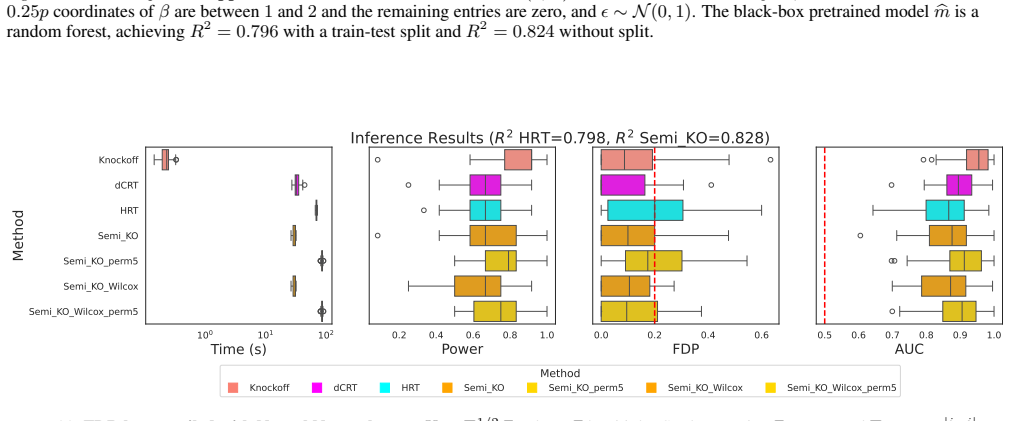
- [Figure 3 and §4.5] The caption says the blue distribution is the semi-knockoff statistic and the orange is the difference between theoretical and estimated imputers; Figure 2 and the surrounding text refer to similar quantities. Clarify the exact pair of random variables in each histogram to avoid ambiguity.
- [References] The paper relies on a companion preprint (Reyero-Lobo et al., 2025b) for a key proposition used in Theorem 4.1. If this proposition is not published, include its statement and assumptions in the appendix or state the dependence explicitly in the main text.
Circularity Check
Practical finite-sample FDR control rests on the Section 4.5 sign-preservation conjecture, an ansatz inherited from the authors' own double-robustness work; the oracle theorems are self-contained.
specific steps
-
ansatz smuggled in via citation
[Section 4.5 ('Applications of double robustness to Semi-knockoffs'), with Section 4.1 and Theorem 4.3]
"We conjecture that this is the case, based on a double robustness argument. Indeed, we expect that the sign of the empirical difference matches the sign of the theoretical one, yielding the desired independent Rademacher variable."
The abstract and contribution bullets advertise finite-sample FDR control for the practical Semi-knockoffs (Algorithm 4). Such control requires the null statistics Ŵ_j^SKO to have exactly i.i.d. Rademacher signs conditional on their magnitudes (Lemma 2.1). For the estimated imputers bν and bρ, the only stated route to this property is the Section 4.5 conjecture. Theorem 4.3 bounds the loss difference only in magnitude (O_P(a_n b_n)), and Theorem 4.2 bounds W1 distance; neither establishes exact sign exchangeability. Thus the advertised practical guarantee is not derived from the proved theorems—it is assumed as an ansatz motivated by the authors' own double-robustness preprint (Reyero-Lobo et al., 2025a). The claim of finite-sample FDR therefore reduces, by construction, to an unproven co
full rationale
The oracle results are not circular: Theorem 3.3 and Theorem 3.4 are proved directly from conditional-exchangeability of the two samplers under the null, exactly as in the standard knockoff argument, and they do not depend on the authors' prior work. The stability and double-robustness theorems (4.1 and 4.3) are also genuine derivations given their assumptions, although Theorem 4.1 uses a zero-coefficient fact cited from the authors' companion preprint (Prop. 5.2 of Reyero-Lobo et al. 2025b); that citation is not the source of the oracle guarantees and is a standard regression fact, so it is not circular by itself. The single significant circularity-adjacent step is the practical FDR claim: the paper explicitly labels the required sign-preservation property for estimated imputers as a conjecture, then still presents the method as providing finite-sample FDR control. Since the conjecture is the missing condition needed to apply Lemma 2.1 and Theorem 3.4 to Algorithm 4, the practical guarantee is not an independent derivation but an assumed premise. I therefore set the circularity score at 3: the oracle core is self-contained, but the headline practical claim leans on an ansatz from the authors' own self-cited double-robustness framework.
Axiom & Free-Parameter Ledger
free parameters (3)
- ridge regularization λ in imputer regressions
- number of derandomization permutations K =
5
- loss function ℓ for the importance statistic
axioms (7)
- domain assumption The conditional expectations ν_j(X_{-j}) = E[X_j|X_{-j}] and ρ_j(X_{-j},y) = E[X_j|X_{-j},y] exist and are estimable for each continuous feature j.
- standard math No covariate is exactly a function of the others, so the Markov blanket is unique.
- domain assumption Assumptions E.1–E.4: design χ and score s* are sub-Gaussian, loss is L-Lipschitz in the prediction argument, regularizer is λ-strongly convex, and the population minimizer satisfies E[∂_u l(μ(χ),z)|χ] = 0.
- domain assumption For Theorem 4.2: model bm and loss are Lipschitz in the prediction argument.
- domain assumption For Theorem 4.3: loss t→l(t,y) is C2 with bounded derivatives, bm is differentiable in the j-th coordinate, and bν−ν = O_P(b_n).
- standard math Prop. 5.2 of Reyero-Lobo et al. (2025b): under X_j ⊥ z | X_{-j}, the population coefficient β_j of the regression of z on X is 0.
- ad hoc to paper Sign-preservation conjecture: the sign of the empirical Semi-knockoff statistic matches the oracle sign with probability tending to 1.
read the original abstract
Conditional independence testing (CIT) is essential for reliable scientific discovery. It prevents spurious findings and enables controlled feature selection. Recent CIT methods have used machine learning (ML) models as surrogates of the underlying distribution. However, model-agnostic approaches require a train-test split, which reduces statistical power. We introduce Semi-knockoffs, a CIT method that can accommodate any pre-trained model, avoids this split, and provides valid p-values and false discovery rate (FDR) control for high-dimensional settings. Unlike methods that rely on the model-$X$ assumption (known input distribution), Semi-knockoffs only require conditional expectations for continuous variables. This makes the procedure less restrictive and more practical for machine learning integration. To ensure validity when estimating these expectations, we present two new theoretical results of independent interest: (i) stability for regularized models trained with a null feature and (ii) the double-robustness property.
Figures




Reference graph
Works this paper leans on
-
[1]
, p}, the original and the knockoff variables are exchangeable, i.e
For any subset s⊂ {1, . . . , p}, the original and the knockoff variables are exchangeable, i.e. (X, eX) swap(s) d = (X, eX)
-
[2]
We observe that the second property can be obtained by constructing the knockoffs without using the output
eX⊥ ⊥y|X. We observe that the second property can be obtained by constructing the knockoffs without using the output. Moreover, these imitation variables must satisfy the exchangeability condition that is stronger than merely sampling from the conditional distribution, as it must hold over the joint distribution rather than feature-wise. Consequently, com...
2019
-
[8]
It is a function of the inputX, the knockoff eXand the outputy:W j =w j h X, eX i , y
-
[9]
This statistic provides a hint of how important the feature is
It satisfies the flip-sign property: fors⊂[p], wj h X, eX i swap(s) , y = wj h X, eX i , y ifj ∈s, −wj h X, eX i , y ifj∈s. This statistic provides a hint of how important the feature is. The most intuitive example is given by the Lasso Coefficient Difference (LCD), which, to assign importance, compares the coefficients of a Lasso regression of y on...
2018
-
[1995]
ISSN 0035-9246. doi: 10.1111/j.2517-6161.1995. tb02031.x. URL https://doi.org/10.1111/j. 2517-6161.1995.tb02031.x. Blain, A., Lobo, A. R., Linhart, J., Thirion, B., and Neu- vial, P. When knockoffs fail: diagnosing and fixing non-exchangeability of knockoffs, 2025. URL https: //arxiv.org/abs/2407.06892. Bottou, L. and Bousquet, O. The tradeoffs of large s...
arXiv 1995
-
[2007]
URL https://proceedings.neurips. cc/paper_files/paper/2007/file/ 0d3180d672e08b4c5312dcdafdf6ef36-Paper. pdf. Bousquet, O. and Elisseeff, A. Stability and generalization. Journal of machine learning research, 2(Mar):499–526, 2002. Breiman, L. Random forests.Machine Learning, 45 (1):5–32, 2001. ISSN 1573-0565. doi: 10.1023/ A:1010933404324. URL https://doi...
Pith/arXiv arXiv 2007
-
[2020]
URL https://proceedings.mlr.press/ v119/nguyen20a.html. Pedregosa, F., Varoquaux, G., Gramfort, A., Michel, V ., Thirion, B., Grisel, O., Blondel, M., Prettenhofer, P., Weiss, R., Dubourg, V ., Vanderplas, J., Passos, A., Cour- napeau, D., Brucher, M., Perrot, M., and Duchesnay, E. Scikit-learn: Machine learning in Python.Journal of Machine Learning Resea...
arXiv 2011
-
[2023]
URL https://proceedings.mlr.press/ v206/shaer23a.html. Shah, R. and Peters, J. The hardness of conditional in- dependence testing and the generalised covariance mea- sure.Annals of Statistics, 48, 04 2018. doi: 10.1214/ 19-AOS1857. Strobl, C., Boulesteix, A.-L., Kneib, T., Augustin, T., and Zeileis, A. Conditional variable importance for random forests.BM...
2018
-
[2105]
URL https: //doi.org/10.1186/1471-2105-9-307
doi: 10.1186/1471-2105-9-307. URL https: //doi.org/10.1186/1471-2105-9-307. Tansey, W., Veitch, V ., Zhang, H., Rabadan, R., and and, D. M. B. The holdout randomization test for feature selection in black box models.Journal of Computational and Graphical Statistics, 31(1):151–162, 2022. doi: 10. 1080/10618600.2021.1923520. URL https://doi. org/10.1080/106...
arXiv 2022
discussion (0)
Sign in with ORCID, Apple, or X to comment. Anyone can read and Pith papers without signing in.