Learning quantum ground states in the space of measurement outcomes
Pith reviewed 2026-06-29 11:37 UTC · model grok-4.3
The pith
Quantum ground states are found by optimizing probability distributions over SIC-POVM outcomes with autoregressive networks under enforced positivity constraints.
A machine-rendered reading of the paper's core claim, the machinery that carries it, and where it could break.
Core claim
Ground states are obtained by gradient descent that updates the probability distribution to minimize the energy with respect to a given Hamiltonian, while enforcing positivity constraints that ensure that the distribution of measurement outcomes correspond to a physical quantum state. The probability distribution is encoded in the parameters of an autoregressive neural-network based on gated recurrent units.
What carries the argument
Autoregressive GRU network that parametrizes the probability distribution over SIC-POVM outcomes and is optimized by gradient descent subject to a hierarchy of positivity constraints.
If this is right
- The approach reaches system sizes up to L=128 for both the transverse-field Ising model and the Heisenberg model with gapping fields.
- Success depends on the choice of neural-network architecture, including number of layers, dilation, and input modifications.
- Enforcing the positivity constraints during training is required to keep the learned distribution physically valid.
- The same optimization procedure applies across a variety of one-dimensional spin Hamiltonians without explicit construction of the wave function.
Where Pith is reading between the lines
- The representation may allow direct sampling of measurement statistics without first reconstructing the full density matrix.
- Varying the underlying POVM could produce analogous methods for different measurement bases or for open quantum systems.
- If the positivity hierarchy remains tractable, the method could be tested on two-dimensional lattices where standard tensor-network approaches become costly.
Load-bearing premise
The hierarchy of positivity conditions enforced during optimization is sufficient to guarantee that the resulting distribution corresponds to a valid quantum state for the Hamiltonians and system sizes considered, without introducing uncontrolled bias.
What would settle it
For a system size or model outside the tested range, reconstruct the density matrix from the final distribution and observe a negative eigenvalue or a trace that deviates from one.
Figures
read the original abstract
We investigate variational learning of quantum many-body ground states directly in measurement space using autoregressive neural networks. In particular, we represent quantum states via probability distributions of outcomes over a symmetric informationally complete positive operator-valued measure (SIC-POVM). The probability distribution is encoded in the parameters of an autoregressive neural-network-based on gated recurrent units (GRUs). Ground states are obtained by gradient descent that updates the probability distribution to minimize the energy with respect to a given Hamiltonian, while enforcing positivity constraints that ensure that the distribution of measurement outcomes correspond to a physical quantum state. We analyze the role of constraint enforcement (hierarchy of positivity conditions), variety of neural network architectures (multiple layers, dilation, and modifications of input data) in determining the success of this approach. We benchmark our approach on one-dimensional transverse-field Ising model and the Heisenberg model, along with gapping fields, for system sizes up to L=128, illustrating its efficacy across a wide variety of models.
Editorial analysis
A structured set of objections, weighed in public.
Referee Report
Summary. The manuscript proposes representing quantum states via probability distributions over SIC-POVM measurement outcomes, parameterized by autoregressive GRU networks. Ground states are obtained by gradient descent on the network parameters to minimize the variational energy of a given Hamiltonian, subject to a hierarchy of positivity constraints on the outcome probabilities that are intended to guarantee the reconstructed density operator is physical. The role of constraint enforcement and network architecture choices is analyzed, with benchmarks on the 1D transverse-field Ising and Heisenberg models (with and without gapping fields) for system sizes up to L=128.
Significance. If the positivity hierarchy is shown to produce unbiased, physical states whose energies match known benchmarks, the approach would constitute a distinct variational framework operating directly in measurement space. Strengths include the use of autoregressive networks for exact sampling of the outcome distribution and the systematic study of architecture variants and constraint levels on standard spin models.
major comments (2)
- [Abstract and sections describing constraint enforcement and numerical results] The load-bearing assumption is that the enforced hierarchy of positivity conditions on the SIC-POVM probabilities is sufficient to guarantee that the reconstructed density operator is positive semidefinite and that the variational minimum coincides with the true ground state. For an informationally complete SIC-POVM the map to ρ is linear and invertible, yet positivity of ρ is a semidefinite constraint whose size grows with L; a truncated (e.g., k-body) hierarchy can admit distributions that reconstruct to operators with negative eigenvalues or that systematically lower the variational energy below the physical value. The manuscript analyzes the role of constraint enforcement but does not state the truncation order employed for L=128 nor report the minimum eigenvalue of the reconstructed ρ after optimization.
- [Benchmark sections on TFIM and Heisenberg models] No comparison of the obtained variational energies against exact diagonalization (small L) or DMRG (larger L) is described, nor are convergence data, error bars on the energy, or the final minimum eigenvalue of ρ provided. Without these, it is impossible to verify that the optimization succeeds and that the hierarchy does not introduce uncontrolled bias.
minor comments (2)
- [Neural-network architecture description] Clarify the precise form of the input encoding to the GRU (e.g., how previous measurement outcomes are fed) and whether any dilation or multi-layer modifications alter the autoregressive property.
- [Introduction and methods] Add explicit references to prior work on SIC-POVM representations of quantum states and on positivity hierarchies in quantum marginal problems.
Simulated Author's Rebuttal
We thank the referee for the thorough review and constructive suggestions. We address the major comments point-by-point below and will revise the manuscript to incorporate the requested clarifications and comparisons.
read point-by-point responses
-
Referee: [Abstract and sections describing constraint enforcement and numerical results] The load-bearing assumption is that the enforced hierarchy of positivity conditions on the SIC-POVM probabilities is sufficient to guarantee that the reconstructed density operator is positive semidefinite and that the variational minimum coincides with the true ground state. For an informationally complete SIC-POVM the map to ρ is linear and invertible, yet positivity of ρ is a semidefinite constraint whose size grows with L; a truncated (e.g., k-body) hierarchy can admit distributions that reconstruct to operators with negative eigenvalues or that systematically lower the variational energy below the physical value. The manuscript analyzes the role of constraint enforcement but does not state the truncation order employed for L=128 nor report the minimum eigenvalue of the reconstructed ρ after optimization.
Authors: We agree that explicit documentation of the truncation order and verification of the reconstructed ρ are necessary. The hierarchy employed is a k-body truncation with k chosen to balance computational cost and positivity enforcement; for L=128 we used a 2-body truncation consistent with the scaling analysis in the manuscript. In the revised version we will state the precise truncation order for each L, report the minimum eigenvalues of the reconstructed ρ (which remain non-negative to machine precision in our runs), and add a brief discussion of why the truncated hierarchy suffices for the models studied without introducing detectable bias below the variational minimum. revision: yes
-
Referee: [Benchmark sections on TFIM and Heisenberg models] No comparison of the obtained variational energies against exact diagonalization (small L) or DMRG (larger L) is described, nor are convergence data, error bars on the energy, or the final minimum eigenvalue of ρ provided. Without these, it is impossible to verify that the optimization succeeds and that the hierarchy does not introduce uncontrolled bias.
Authors: We acknowledge that direct numerical benchmarks against established methods strengthen the validation. The original manuscript focused on demonstrating the feasibility of the measurement-space approach and the effect of architecture and constraint choices, but did not include side-by-side energy tables. In the revision we will add comparisons to exact diagonalization for L≤16 and to published DMRG energies for larger L, together with convergence plots, standard deviations over independent runs, and the final minimum eigenvalues of ρ for all reported system sizes. revision: yes
Circularity Check
No circularity: direct variational minimization in measurement space
full rationale
The paper describes a variational procedure that directly encodes a probability distribution over SIC-POVM outcomes in an autoregressive GRU network and performs gradient descent to minimize the Hamiltonian expectation value while enforcing positivity constraints on the distribution. No step reduces the target ground-state energy or reconstructed density operator to a fitted parameter, self-referential definition, or load-bearing self-citation. The method is self-contained: the optimization objective and constraints are stated explicitly in terms of the Hamiltonian and the linear map from probabilities to the density matrix, without renaming known results or smuggling ansatzes via prior work. The hierarchy of positivity conditions is presented as an enforced input rather than derived from the output, so the derivation chain does not collapse by construction.
Axiom & Free-Parameter Ledger
free parameters (1)
- Neural-network weights
axioms (1)
- domain assumption Enforcing a hierarchy of positivity conditions on the outcome probabilities ensures the distribution corresponds to a physical quantum state
Reference graph
Works this paper leans on
-
[1]
Any qubit density matrix can be written as ρ= 1 2(I+r·σ),(4) whereris the Bloch vector with magnituder≤1, and σ= (σ x, σy, σz) is the vector of Pauli operators
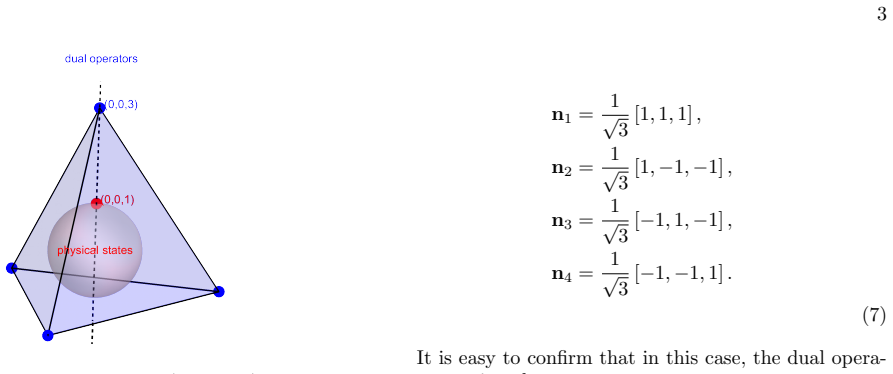
Tetrahedral SIC POVM We now specialize to spin-1/2 which is the main inter- est in this work and where the effects and corresponding dual operators can be readily stated. Any qubit density matrix can be written as ρ= 1 2(I+r·σ),(4) whereris the Bloch vector with magnituder≤1, and σ= (σ x, σy, σz) is the vector of Pauli operators. A canonical example is th...
-
[2]
Explicitly, we can see this by noting the form of physical single-qubit density matrices, as seen in Eq
Non-physicality of dual operators It is worth noting that the dual frame operatorsF i do not correspond to physical density matrices. Explicitly, we can see this by noting the form of physical single-qubit density matrices, as seen in Eq. (4), characterized by the vectorsrwith magnituder≤1. The operatorF i are of this form withr= 3, implying a density mat...
-
[3]
Un- fortunately, this is not the case, and increasing the num- ber of effects does not change the factor of 3 in theF i
General qubit POVM Given the above discussion, it may be tempting to con- sider increased number of POVM effects and dual oper- ators in the hope that the convex hull of these dual op- erators now tightly wrap around the Bloch sphere. Un- fortunately, this is not the case, and increasing the num- ber of effects does not change the factor of 3 in theF i. W...
-
[4]
It is therefore worth understanding the sampling variance of various observables
Finite sample variance Finally, it is important to note that, to find ground states of quantum systems comprising hundreds of qubits, we will need to sample the distribution{p i}. It is therefore worth understanding the sampling variance of various observables. LetAbe a single qubit observable with decomposition A=a·σ,|a|= 1.(16) We have chosenAto be trac...
-
[5]
Thus, Fi1,...in =F i1 ⊗ · · · ⊗F in .(22) Unbiased estimators of an observableAcan now we extracted by sample averagingA i := Tr [FiA]
Multiple qubits We will assume that the POVM effects overn-qubits are simply the product of the effects on each site— Ei1,...in =E i1 ⊗ · · · ⊗E in .(21) The dual frame operators follow analogously to the sin- gle qubit case and are merely products of the individual site operators. Thus, Fi1,...in =F i1 ⊗ · · · ⊗F in .(22) Unbiased estimators of an observ...
-
[6]
Single qubit case For a single qubit, once the trace of the density matrix is fixed to 1 as is the case for the inferred ˆρ, positivity only requires one further condition, equivalent to |r|2 ≤1,(29) or 3 X i pini 2 ≤1.(30) Thus, for a single qubit, one must merely ensure a sin- gle quadratic constraint on the probabilities{p i}along with attempting to mi...
-
[7]
In general, given the fact that the density matrix scales exponen- tially in the number of qubits, this task may be expected to be exponentially hard
Multiple qubits: Operator Gram matrices The positivity constraints for a density matrix on mul- tiple qubits are considerably more involved. In general, given the fact that the density matrix scales exponen- tially in the number of qubits, this task may be expected to be exponentially hard. Indeed, prior work shows that related quantum representability pr...
-
[8]
The variance constraint is given by Var[H] = Tr ˆρH2 −Tr [ˆρH]2 = 0,(32) for states ˆρcorresponding to the eigenstates, including the ground state, of the many-body system
Variance and Purity Constraints Besides these constraints, one can also enforce con- straints on the variance and the purity of the state. The variance constraint is given by Var[H] = Tr ˆρH2 −Tr [ˆρH]2 = 0,(32) for states ˆρcorresponding to the eigenstates, including the ground state, of the many-body system. In practice, we find that this constraint doe...
-
[9]
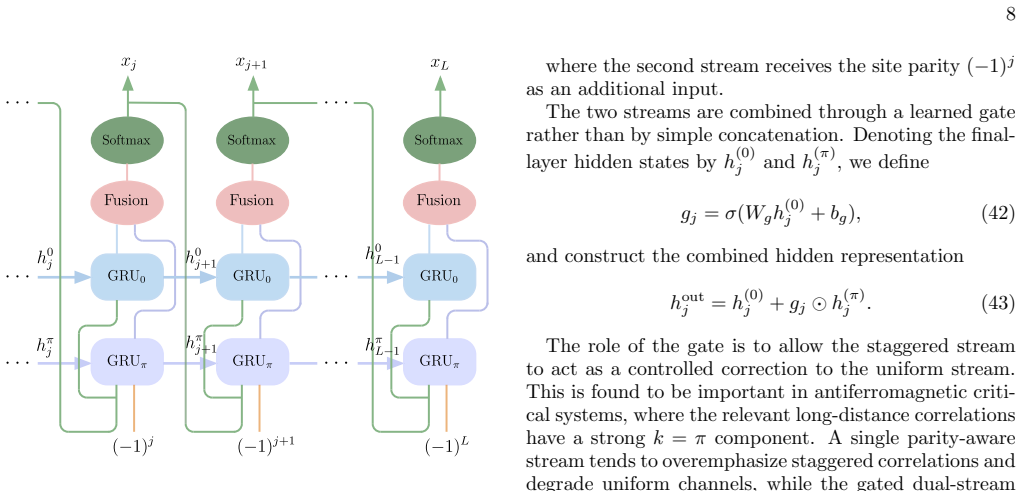
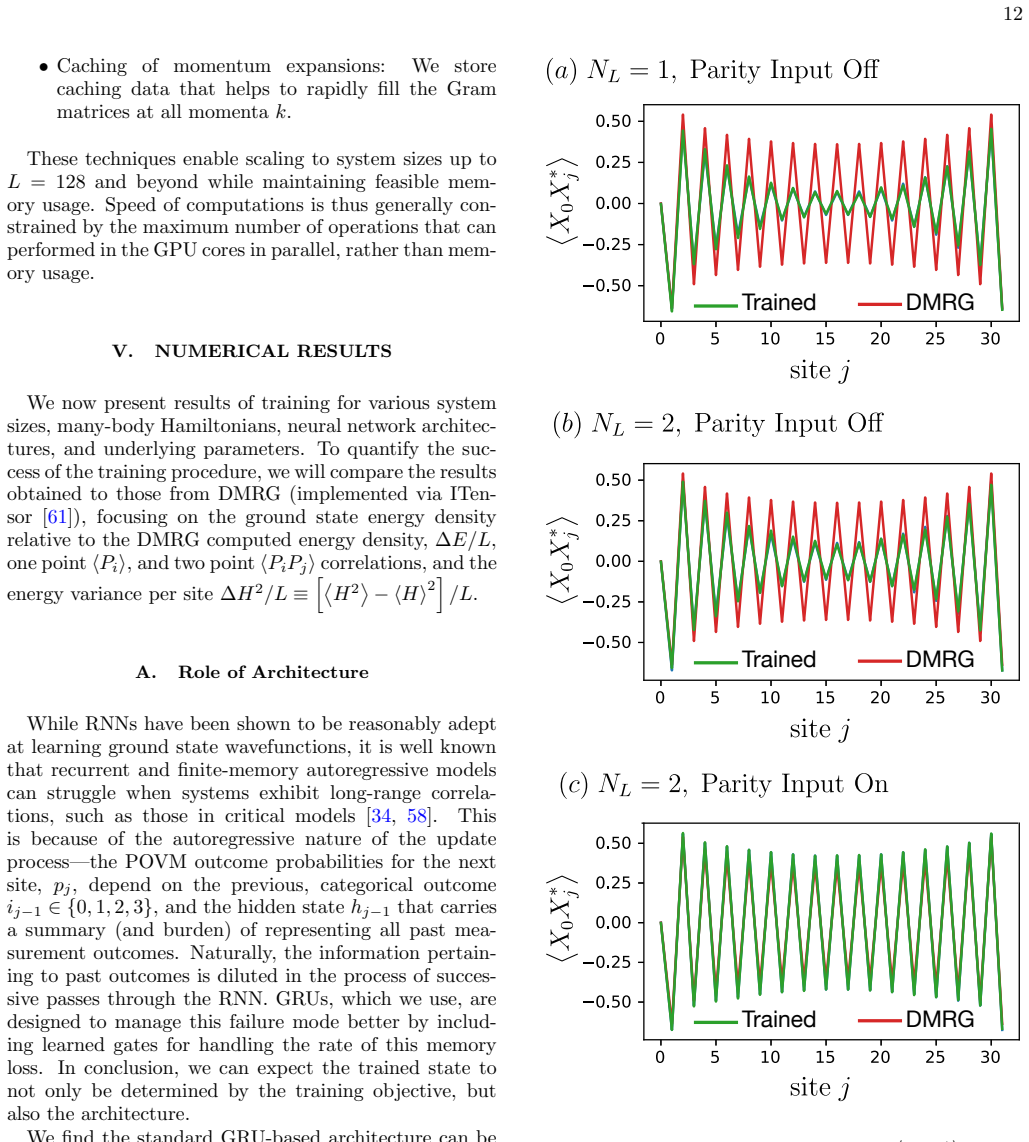
Dual-stream architecture. In general, we find that to capture long-range correla- tions, particularly in models with anti-ferromagnetic cor- relations, it becomes important to encode the parity of the site as an input into the GRU. We thus also consider architectures in which two independent GRU chains are maintained— h(0) j = GRU0(xj, h(0) j−1),(40) h(π)...
-
[10]
Stacked and dilated recurrent architectures In addition to increasing the hidden dimension, a nat- ural way to enhance the expressivity of recurrent models is to increase the number of stacked recurrent layers. In this setting, each layer maintains its own hidden state, and the input to layerℓat sitejis the hidden state from the previous layer at the same...
-
[11]
The corresponding loss is LE =⟨ ˆH⟩.(49) As discussed previously, minimizingL E alone is insuf- ficient, as it does not enforce physicality of the inferred state
Energy objective The expectation value of the Hamiltonian, ⟨ ˆH⟩= X i pi X j hjTr [FiPj],(48) is linear in the probabilitiesp i. The corresponding loss is LE =⟨ ˆH⟩.(49) As discussed previously, minimizingL E alone is insuf- ficient, as it does not enforce physicality of the inferred state
-
[12]
In this work, we focus on translationally in- variant models with periodic boundary conditions
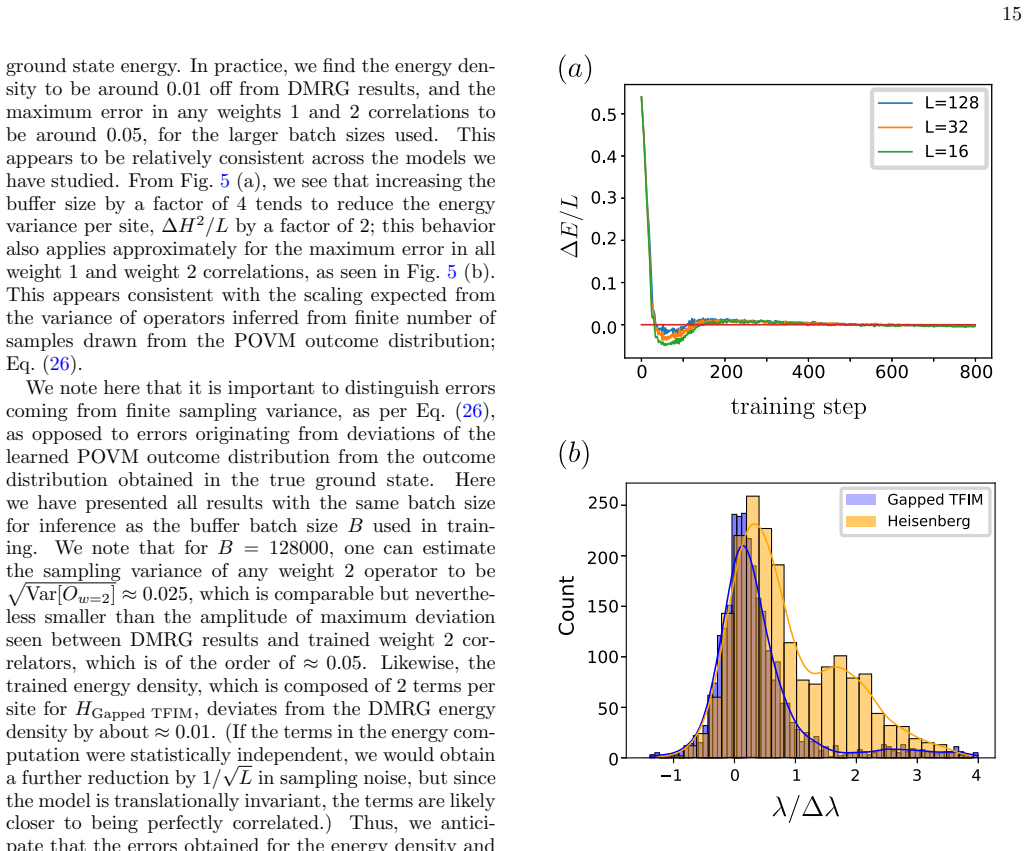
Momentum-resolved PSD constraints To enforce physicality, we impose positivity constraints on operator Gram matrices constructed from low-weight operators. In this work, we focus on translationally in- variant models with periodic boundary conditions. To get clear signals from the PSD constraints, and to reduce the dimensionality of the Gram matrix to ena...
-
[13]
As a result, these expectation val- ues are generally noisy approximations to the true ex- pectation value of these operators and this stochasticity must be handled with care
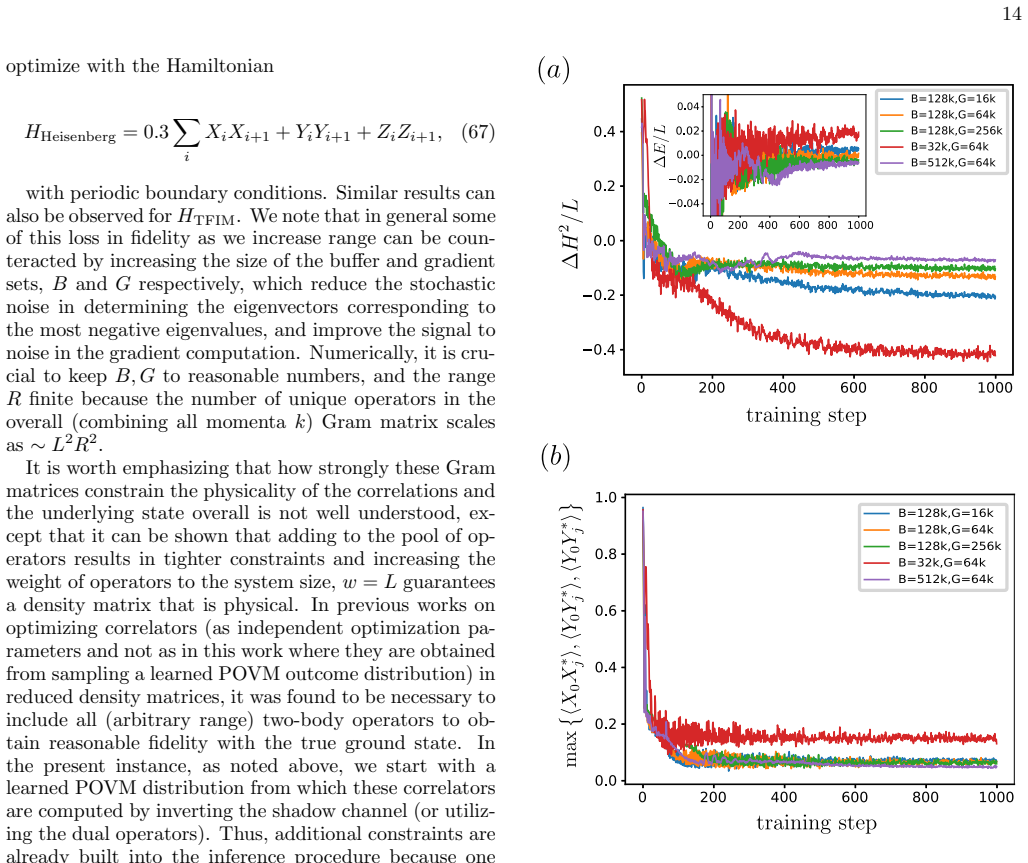
Handling stochastic noise via buffer and gradient batches In general, the Gram matrices are constructed by com- puting expectation values of operators by sampling the underlying POVM outcome distribution encoded in the RNN architecture. As a result, these expectation val- ues are generally noisy approximations to the true ex- pectation value of these oper...
-
[14]
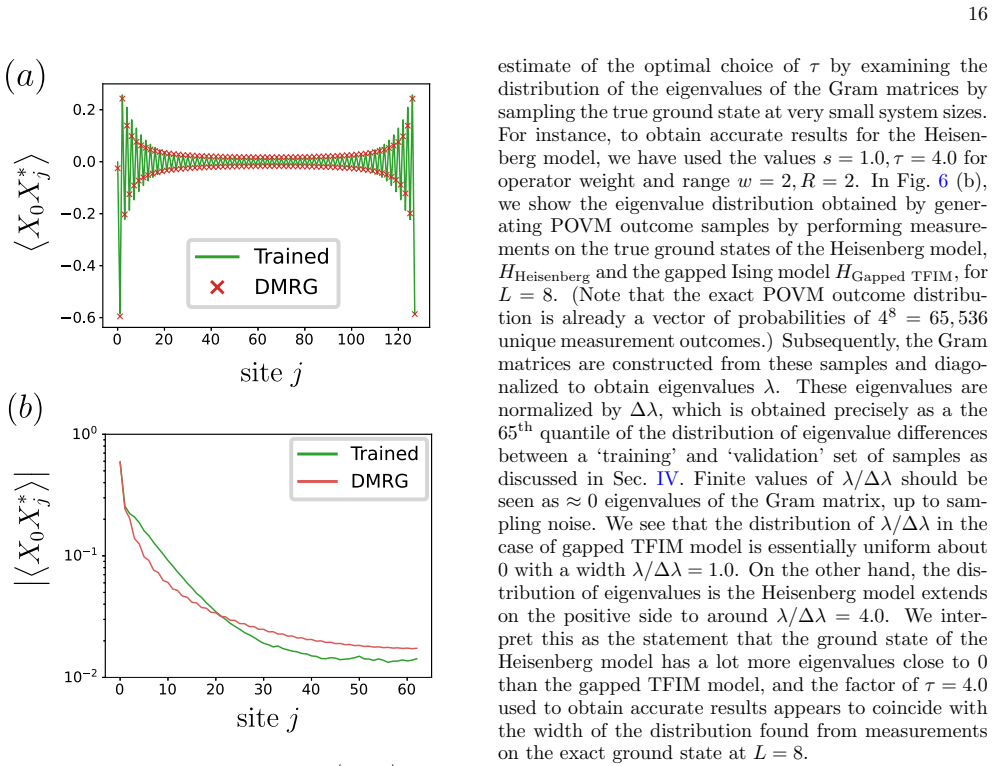
PSD constraint objective We can now define the PSD constraint objective. This is given by LPSD = X k,α f(λ (k) α,val, τk, sk) h v(k) α,tr i† ·M (k) grad ·v (k) α,tr, (54) where the prefactorfis defined as f(λ (k) val, τk, sk) = 1 1 + exp h λ(k) α,val +τ k /sk i ,(55) and the tolerances are set as the Fermi function τk =τ·P 65 hn ∆λ(k) α oi , sk =s·P 65 hn...
-
[15]
Over training runs,λ tgt is adapted to ensure that the total violation of the PSD constraints, quantified by P= max k,α h f(λ (k) α,val, τk, sk) i (59) remains finite and small
Adaptive balancing of loss terms The total loss minimized in training is given by L=L E +λ PSDLPSD.(57) The relative strengthλ PSD is not fixed, but determined dynamically by comparing gradient norms: λPSD =λ tgt · ∥∇LE∥ ∥∇LPSD∥ .(58) whereλ tgt ∼ O(1) ensures that neither term domi- nates excessively at any point during the training. Over training runs,λ...
-
[16]
It cannot be allowed to grow large as that signals that the optimization routine is exploring un- physical space of states
Projection of Conflicting Gradients We note that the PSD loss objective is not a conven- tional loss term. It cannot be allowed to grow large as that signals that the optimization routine is exploring un- physical space of states. To stabilize training, it greatly helps to prevent motion in directions that minimize en- ergy but can increase the PSD loss. ...
-
[17]
Gumbel-softmax straight-through estimator A central difficulty in training autoregressive genera- tive models arises from the discrete nature of the sampled POVM outcomes. Sampling a discrete outcome from the conditional distribution p(ij |i <j) (61) is not differentiable, preventing gradients from propagat- ing through the sampling procedure in the stand...
-
[18]
Gradient schedule The gradient schedule is computed using the AdamW optimizer which we find to be superior for training com- pared to Adam. We anticipate this is because our opti- mization already carefully balances multiple competing objectives, and the implicit, gradient-dependent regular- ization in Adam interferes with that balance in an un- controlle...
-
[19]
To address this, we employ: •Batching of samples: We compute gradients with respect to batches of samples
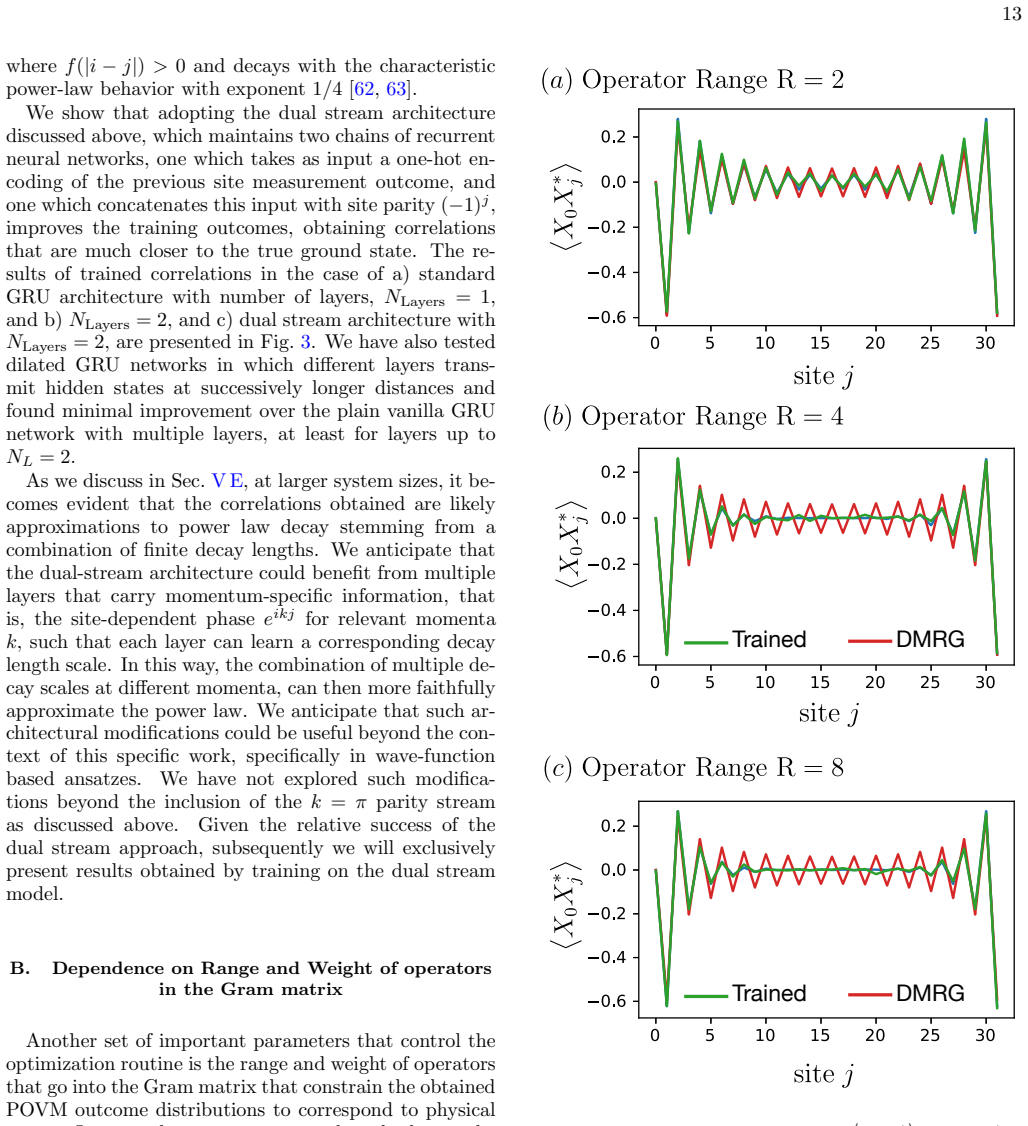
Optimizations The computation of PSD constraints requires evaluat- ing expectations over many operator combinations, lead- ing to significant memory usage. To address this, we employ: •Batching of samples: We compute gradients with respect to batches of samples. The overall gradi- ents, particularly for the memory-intensive∇L PSD can be computed by adding...
-
[20]
Carleo and M
G. Carleo and M. Troyer, Solving the quantum many- body problem with artificial neural networks, Science 355, 602 (2017)
2017
-
[21]
Carrasquilla, G
J. Carrasquilla, G. Torlai, R. G. Melko, and L. Aolita, Reconstructing quantum states with generative models, Nature Machine Intelligence1, 155 (2019)
2019
-
[22]
Lange, A
H. Lange, A. Van de Walle, A. Abedinnia, and A. Bohrdt, From architectures to applications: a review of neural quantum states, Quantum Science and Technology9, 040501 (2024)
2024
-
[23]
Vicentini, D
F. Vicentini, D. Hofmann, A. Szab´ o, D. Wu, C. Roth, C. Giuliani, G. Pescia, J. Nys, V. Vargas-Calder´ on, N. Astrakhantsev, et al., Netket 3: Machine learn- ing toolbox for many-body quantum systems, SciPost Physics Codebases , 007 (2022)
2022
-
[24]
Luo and B
D. Luo and B. K. Clark, Backflow transformations via neural networks for quantum many-body wave functions, Physical review letters122, 226401 (2019)
2019
-
[25]
Sharir, Y
O. Sharir, Y. Levine, N. Wies, G. Carleo, and A. Shashua, Deep autoregressive models for the efficient variational simulation of many-body quantum systems, Physical re- view letters124, 020503 (2020)
2020
-
[26]
Hibat-Allah, M
M. Hibat-Allah, M. Ganahl, L. E. Hayward, R. G. Melko, and J. Carrasquilla, Recurrent neural network wave func- tions, Physical Review Research2, 023358 (2020)
2020
-
[27]
D. Pfau, J. S. Spencer, A. G. Matthews, and W. M. C. Foulkes, Ab initio solution of the many-electron schr¨ odinger equation with deep neural networks, Physical review research2, 033429 (2020)
2020
-
[28]
Nomura and M
Y. Nomura and M. Imada, Dirac-type nodal spin liq- uid revealed by refined quantum many-body solver using neural-network wave function, correlation ratio, and level spectroscopy, Physical Review X11, 031034 (2021)
2021
-
[29]
I. von Glehn, J. S. Spencer, and D. Pfau, A self-attention ansatz for ab-initio quantum chemistry, arXiv preprint arXiv:2211.13672 (2022)
-
[30]
L. L. Viteritti, R. Rende, and F. Becca, Transformer vari- ational wave functions for frustrated quantum spin sys- tems, Physical Review Letters130, 236401 (2023)
2023
-
[31]
Rende, L
R. Rende, L. L. Viteritti, L. Bardone, F. Becca, and S. Goldt, A simple linear algebra identity to optimize large-scale neural network quantum states, Communica- tions Physics7, 260 (2024)
2024
-
[32]
K. Choo, T. Neupert, and G. Carleo, Two-dimensional frustratedj 1–j2 model studied with neural network quan- tum states, Phys. Rev. B100, 125124 (2019)
2019
-
[33]
Schmitt and M
M. Schmitt and M. Heyl, Quantum many-body dynamics in two dimensions with artificial neural networks, Physi- cal Review Letters125, 100503 (2020)
2020
-
[34]
M. J. Hartmann and G. Carleo, Neural-network approach to dissipative quantum many-body dynamics, Physical review letters122, 250502 (2019)
2019
-
[35]
Vicentini, A
F. Vicentini, A. Biella, N. Regnault, and C. Ciuti, Vari- ational neural-network ansatz for steady states in open quantum systems, Physical review letters122, 250503 (2019)
2019
-
[36]
Donatella, Z
K. Donatella, Z. Denis, A. Le Boit´ e, and C. Ciuti, Dy- namics with autoregressive neural quantum states: Ap- plication to critical quench dynamics, Physical Review A 108, 022210 (2023)
2023
-
[37]
Torlai, G
G. Torlai, G. Mazzola, J. Carrasquilla, M. Troyer, R. Melko, and G. Carleo, Neural-network quantum state tomography, Nature physics14, 447 (2018)
2018
-
[38]
Koutn` y, L
D. Koutn` y, L. Motka, Z. Hradil, J. ˇReh´ aˇ cek, and L. L. S´ anchez-Soto, Neural-network quantum state tomogra- phy, Physical Review A106, 012409 (2022)
2022
-
[39]
Czischek, M
S. Czischek, M. S. Moss, M. Radzihovsky, E. Merali, and R. G. Melko, Data-enhanced variational monte carlo sim- ulations for rydberg atom arrays, Physical Review B105, 205108 (2022)
2022
-
[40]
Torlai, C
G. Torlai, C. J. Wood, A. Acharya, G. Carleo, J. Car- rasquilla, and L. Aolita, Quantum process tomography with unsupervised learning and tensor networks, Nature Communications14, 2858 (2023)
2023
-
[41]
V. Wei, W. Coish, P. Ronagh, and C. A. Muschik, Neural- shadow quantum state tomography, Physical Review Re- search6, 023250 (2024)
2024
-
[42]
L. L. Viteritti, R. Rende, A. Parola, S. Goldt, and F. Becca, Transformer wave function for two dimensional frustrated magnets: Emergence of a spin-liquid phase in the shastry-sutherland model, Physical Review B111, 134411 (2025)
2025
-
[43]
C.-T. Li, T. Ong, M. Geier, H. Lin, and L. Fu, Attention is all you need to solve chiral superconductivity, arXiv 19 preprint arXiv:2509.03683 (2025)
work page internal anchor Pith review Pith/arXiv arXiv 2025
-
[44]
Y. Teng, D. D. Dai, and L. Fu, Solving the fractional quantum hall problem with self-attention neural network, Physical Review B111, 205117 (2025)
2025
-
[45]
A. Chen, Z.-Q. Wan, A. Sengupta, A. Georges, and C. Roth, Neural network-augmented pfaffian wave- functions for scalable simulations of interacting fermions, arXiv preprint arXiv:2507.10705 (2025)
-
[46]
Lovato, C
A. Lovato, C. Adams, G. Carleo, and N. Rocco, Hidden- nucleons neural-network quantum states for the nu- clear many-body problem, Physical Review Research4, 043178 (2022)
2022
-
[47]
B. Fore, J. Kim, M. Hjorth-Jensen, and A. Lovato, Inves- tigating the crust of neutron stars with neural-network quantum states, Communications Physics8, 108 (2025)
2025
-
[48]
Hermann, Z
J. Hermann, Z. Sch¨ atzle, and F. No´ e, Deep-neural- network solution of the electronic schr¨ odinger equation, Nature Chemistry12, 891 (2020)
2020
-
[49]
Schollw¨ ock, The density-matrix renormalization group in the age of matrix product states, Annals of physics 326, 96 (2011)
U. Schollw¨ ock, The density-matrix renormalization group in the age of matrix product states, Annals of physics 326, 96 (2011)
2011
-
[50]
D.-L. Deng, X. Li, and S. Das Sarma, Quantum entan- glement in neural network states, Physical Review X7, 021021 (2017)
2017
-
[51]
Glasser, N
I. Glasser, N. Pancotti, M. August, I. D. Rodriguez, and J. I. Cirac, Neural-network quantum states, string-bond states, and chiral topological states, Physical Review X 8, 011006 (2018)
2018
-
[52]
Park and M
C.-Y. Park and M. J. Kastoryano, Geometry of learn- ing neural quantum states, Physical Review Research2, 023232 (2020)
2020
- [53]
-
[54]
Sorella, Wave function optimization in the variational monte carlo method, Physical Review B—Condensed Matter and Materials Physics71, 241103 (2005)
S. Sorella, Wave function optimization in the variational monte carlo method, Physical Review B—Condensed Matter and Materials Physics71, 241103 (2005)
2005
-
[55]
Stokes, J
J. Stokes, J. Izaac, N. Killoran, and G. Carleo, Quantum natural gradient, Quantum4, 269 (2020)
2020
-
[56]
Chen and M
A. Chen and M. Heyl, Empowering deep neural quantum states through efficient optimization, Nature Physics20, 1476 (2024)
2024
-
[57]
Schmitt and M
M. Schmitt and M. Reh, jvmc: Versatile and performant variational monte carlo leveraging automated differenti- ation and gpu acceleration, SciPost Physics Codebases , 002 (2022)
2022
-
[58]
M. A. Nielsen and I. L. Chuang, Quantum computation and quantum information (Cam- bridge university press, 2010)
2010
-
[59]
Schmale, M
T. Schmale, M. Reh, and M. G¨ arttner, Efficient quantum state tomography with convolutional neural networks, npj Quantum Information8, 115 (2022)
2022
-
[60]
Y. Quek, S. Fort, and H. K. Ng, Adaptive quantum state tomography with neural networks, npj Quantum Infor- mation7, 105 (2021)
2021
-
[61]
A. J. Coleman, Structure of fermion density matrices, Reviews of modern Physics35, 668 (1963)
1963
-
[62]
Garrod and J
C. Garrod and J. K. Percus, Reduction of the n-particle variational problem, Journal of Mathematical Physics5, 1756 (1964)
1964
-
[63]
Erdahl, Representability conditions, in Density Matrices and Density Functionals, edited by R
R. Erdahl, Representability conditions, in Density Matrices and Density Functionals, edited by R. Erdahl and V. H. Smith (Springer Netherlands, Dordrecht, 1987) pp. 51–75
1987
-
[64]
D. A. Mazziotti, Variational minimization of atomic and molecular ground-state energies via the two-particle re- duced density matrix, Physical Review A65, 062511 (2002)
2002
-
[65]
A. J. Coleman, Reduced-density-matrix mechanics: with application to many-electron atoms and molecules, in Reduced-Density-Matrix Mechanics: with applications to many-electron atoms and molecules (Wiley Online Library, 2007)
2007
-
[66]
Y.-K. Liu, M. Christandl, and F. Verstraete, Quantum computational complexity of the n-representability prob- lem: Qma complete, Physical review letters98, 110503 (2007)
2007
-
[67]
D. A. Mazziotti, Realization of quantum chemistry with- out wave functions through first-order semidefinite pro- gramming, Phys. Rev. Lett.93, 213001 (2004)
2004
-
[68]
D. A. Mazziotti, Two-electron reduced density matrix as the basic variable in many-electron quantum chemistry and physics, Chemical reviews112, 244 (2012)
2012
-
[69]
D. A. Mazziotti, Significant conditions for the two- electron reduced density matrix from the constructive so- lution of n representability, Physical Review A—Atomic, Molecular, and Optical Physics85, 062507 (2012)
2012
-
[70]
D. A. Mazziotti, Quantum many-body theory from a so- lution of the n-representability problem, Physical Review Letters130, 153001 (2023)
2023
-
[71]
Navascu´ es, S
M. Navascu´ es, S. Pironio, and A. Ac´ ın, A convergent hi- erarchy of semidefinite programs characterizing the set of quantum correlations, New Journal of Physics10, 073013 (2008)
2008
-
[72]
Pironio, M
S. Pironio, M. Navascu´ es, and A. Acin, Convergent re- laxations of polynomial optimization problems with non- commuting variables, SIAM Journal on Optimization20, 2157 (2010)
2010
-
[73]
Baumgratz and M
T. Baumgratz and M. B. Plenio, Lower bounds for ground states of condensed matter systems, New Jour- nal of Physics14, 023027 (2012)
2012
-
[74]
P.-G. Rozon and K. Agarwal, Learning shadows to pre- dict quantum ground state correlations, arXiv preprint arXiv:2508.00052 (2025)
-
[75]
Huang, R
H.-Y. Huang, R. Kueng, and J. Preskill, Predicting many properties of a quantum system from very few measure- ments, Nature Physics16, 1050 (2020)
2020
-
[76]
Lange, F
H. Lange, F. D¨ oschl, J. Carrasquilla, and A. Bohrdt, Neural network approach to quasiparticle dispersions in doped antiferromagnets, Communications Physics7, 187 (2024)
2024
-
[77]
A. B. Ayub, A. M. Aboussalah, and M. Hibat- Allah, Geometry-induced long-range correlations in re- current neural network quantum states, arXiv preprint arXiv:2604.08661 (2026)
work page internal anchor Pith review Pith/arXiv arXiv 2026
-
[78]
Chang, Y
S. Chang, Y. Zhang, W. Han, M. Yu, X. Guo, W. Tan, X. Cui, M. Witbrock, M. Hasegawa-Johnson, and T. S. Huang, Dilated recurrent neural networks, Advances in Neural Information Processing Systems30(2017)
2017
-
[79]
Burke, Perspective on density functional theory, The Journal of chemical physics136(2012)
K. Burke, Perspective on density functional theory, The Journal of chemical physics136(2012)
2012
-
[80]
Fishman, S
M. Fishman, S. White, and E. M. Stoudenmire, The iten- sor software library for tensor network calculations, Sci- Post Physics Codebases , 004 (2022)
2022
discussion (0)
Sign in with ORCID, Apple, or X to comment. Anyone can read and Pith papers without signing in.