GHI: Graphormer over Conditioned Hypergraph Incidence for Aspect-Based Sentiment Analysis
Pith reviewed 2026-05-22 06:03 UTC · model grok-4.3
The pith
GHI shows that representing linguistic evidence as token-hyperedge incidences on a bipartite topology lets a compact model rival much larger systems on aspect-based sentiment analysis.
A machine-rendered reading of the paper's core claim, the machinery that carries it, and where it could break.
Core claim
GHI is an incidence-based structural reasoning layer built on a bipartite topology. It represents diverse linguistic and semantic evidence as token-hyperedge incidence relations, allowing different structural signals to be incorporated through a unified interface. Extensive experiments on six standard ABSA benchmarks show that GHI outperforms all baselines on the SemEval domains, delivers stable improvements over strong DeBERTa, approaches the performance of 11B Flan-T5 based methods on the ISE benchmark with only 247M parameters, and demonstrates strong robustness on the challenging ARTS datasets where traditional models degrade.
What carries the argument
The conditioned hypergraph incidence structure, which serves as the bipartite topology enabling Graphormer to process token-hyperedge relations as a unified interface for structural signals.
If this is right
- Outperforms all baselines on the SemEval domains.
- Shows stable improvements over strong DeBERTa in multi-seed evaluations.
- Approaches 11B Flan-T5 performance on the ISE benchmark using only 247M parameters.
- Maintains highly competitive performance on ARTS datasets where traditional models degrade.
Where Pith is reading between the lines
- The same incidence mechanism might transfer to other fine-grained tasks that require binding evidence across relations.
- Treating structure as a lightweight alternative could lower the compute needed for specialized NLP applications.
- Varying the conditioning on hyperedges might reveal which structural signals contribute most to the observed robustness.
Load-bearing premise
That diverse linguistic and semantic evidence can be represented as token-hyperedge incidence relations in a way that allows different structural signals to be incorporated through a unified interface.
What would settle it
A direct comparison showing that GHI loses its robustness advantage on the ARTS datasets or that its performance gains vanish when the hypergraph incidence component is ablated would falsify the central claim.
Figures
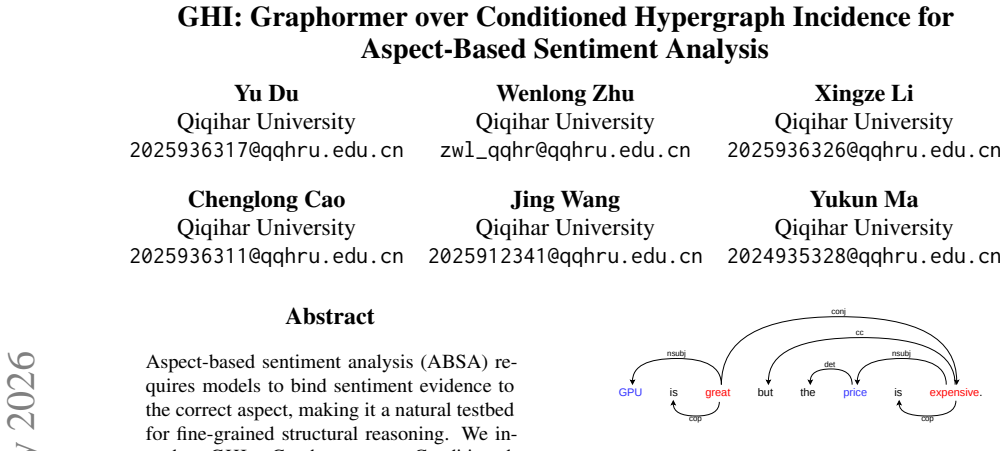


read the original abstract
Aspect-based sentiment analysis (ABSA) requires models to bind sentiment evidence to the correct aspect, making it a natural testbed for fine-grained structural reasoning. We introduce GHI, a Graphormer-over-Conditioned-Hypergraph-Incidence framework that is designed as an incidence-based structural reasoning layer built on a bipartite topology. GHI represents diverse linguistic and semantic evidence as token--hyperedge incidence relations, allowing different structural signals to be incorporated through a unified interface. Extensive experiments on six standard ABSA benchmarks show that GHI outperforms all baselines on the SemEval domains, and multi-seed evaluations show stable improvements over strong DeBERTa. Further experiments show that with only 247M parameters, GHI approaches the performance of 11B Flan-T5 based methods on the ISE benchmark. Moreover, it demonstrates strong robustness on the challenging ARTS datasets, maintaining highly competitive performance where traditional models degrade. These results demonstrate that compact structural reasoning remains a valuable alternative to scale-driven approaches for fine-grained tasks.
Editorial analysis
A structured set of objections, weighed in public.
Referee Report
Summary. The paper introduces GHI, a Graphormer-over-Conditioned-Hypergraph-Incidence framework for aspect-based sentiment analysis. It models diverse linguistic and semantic evidence as token-hyperedge incidence relations on a bipartite topology to enable unified structural reasoning. Experiments on six ABSA benchmarks report outperformance over baselines on SemEval domains, stable gains over DeBERTa with multi-seed runs, competitive results to 11B Flan-T5 on ISE using only 247M parameters, and strong robustness on ARTS where other models degrade.
Significance. If the central claims hold after proper isolation of the incidence component, the work would demonstrate that compact, incidence-based structural reasoning can serve as an efficient alternative to scale-driven approaches for fine-grained sentiment tasks, with potential implications for parameter-efficient modeling in NLP.
major comments (2)
- [Experiments] Experiments section (around the ablation and comparison tables): The central claim that the conditioned hypergraph incidence representation drives the reported SemEval improvements and ARTS robustness requires isolation from the base encoder and Graphormer capacity. No ablation is described that removes or randomizes the incidence matrix while holding Graphormer layers, base parameters, and training schedule fixed; without this, performance differences could stem from capacity or schedule rather than the claimed structural interface.
- [Method] Method section (hyperedge construction and conditioning): The assumption that aspects, opinions, and syntactic signals can be represented as hyperedges with conditioning applied in a unified bipartite topology is load-bearing for the robustness claims. The manuscript does not provide a concrete, reproducible procedure for hyperedge definition or conditioning that would allow verification independent of parser heuristics.
minor comments (2)
- [Abstract] Abstract and §1: The phrase 'approaches the performance of 11B Flan-T5' should be accompanied by the exact metric values and the specific ISE benchmark split for direct comparison.
- [Figures/Tables] Figure captions and tables: Ensure all reported numbers include standard deviations from the multi-seed runs and clarify whether the 247M parameter count includes the base encoder or only the GHI layer.
Simulated Author's Rebuttal
We thank the referee for the constructive feedback on our manuscript. We address each major comment below and outline the revisions we will make to improve clarity and strengthen the empirical support for our claims.
read point-by-point responses
-
Referee: [Experiments] The central claim that the conditioned hypergraph incidence representation drives the reported SemEval improvements and ARTS robustness requires isolation from the base encoder and Graphormer capacity. No ablation is described that removes or randomizes the incidence matrix while holding Graphormer layers, base parameters, and training schedule fixed; without this, performance differences could stem from capacity or schedule rather than the claimed structural interface.
Authors: We agree that isolating the incidence matrix contribution is important for validating the central claim. In the revised version, we will add a controlled ablation that replaces the learned incidence matrix with a randomized matrix of identical shape and sparsity while freezing the Graphormer architecture, base encoder weights, and training hyperparameters. Results from this ablation will be reported alongside the existing tables to demonstrate that performance gains are attributable to the structured incidence relations rather than incidental capacity differences. revision: yes
-
Referee: [Method] The assumption that aspects, opinions, and syntactic signals can be represented as hyperedges with conditioning applied in a unified bipartite topology is load-bearing for the robustness claims. The manuscript does not provide a concrete, reproducible procedure for hyperedge definition or conditioning that would allow verification independent of parser heuristics.
Authors: We acknowledge that the current description of hyperedge construction could be made more explicit for independent reproduction. Section 3.2 outlines the use of dependency parses to form hyperedges for aspect-opinion pairs and syntactic constituents, with conditioning implemented via masked attention in the bipartite incidence graph. In the revision, we will include a detailed algorithmic procedure with pseudocode, specify the exact input format expected from any dependency parser, and clarify how conditioning vectors are derived and applied, thereby reducing reliance on specific parser heuristics. revision: yes
Circularity Check
No circularity: architectural proposal with external empirical validation
full rationale
The paper introduces GHI as a new model architecture consisting of a Graphormer layer over conditioned hypergraph incidence on a bipartite token-hyperedge topology. No equations, parameter-fitting steps, or derivations are presented that reduce the claimed structural reasoning or performance gains to self-defined quantities or prior self-citations. The central claims rest on experimental results across SemEval benchmarks, ARTS robustness tests, and comparisons to DeBERTa and Flan-T5 baselines, which constitute independent external evidence rather than tautological reuse of the model's own inputs. The design choices (incidence relations for linguistic signals) are presented as an engineering construction, not as a result derived from the target metrics by construction.
Axiom & Free-Parameter Ledger
invented entities (1)
-
Conditioned Hypergraph Incidence structure
no independent evidence
Lean theorems connected to this paper
-
IndisputableMonolith/Foundation/AbsoluteFloorClosure.leanreality_from_one_distinction unclear?
unclearRelation between the paper passage and the cited Recognition theorem.
GHI represents diverse linguistic and semantic evidence as token–hyperedge incidence relations, allowing different structural signals to be incorporated through a unified interface... bipartite star-expanded token–hyperedge graph
What do these tags mean?
- matches
- The paper's claim is directly supported by a theorem in the formal canon.
- supports
- The theorem supports part of the paper's argument, but the paper may add assumptions or extra steps.
- extends
- The paper goes beyond the formal theorem; the theorem is a base layer rather than the whole result.
- uses
- The paper appears to rely on the theorem as machinery.
- contradicts
- The paper's claim conflicts with a theorem or certificate in the canon.
- unclear
- Pith found a possible connection, but the passage is too broad, indirect, or ambiguous to say the theorem truly supports the claim.
Reference graph
Works this paper leans on
- [1]
-
[2]
Publications Manual , year = "1983", publisher =
work page 1983
-
[3]
Ashok K. Chandra and Dexter C. Kozen and Larry J. Stockmeyer , year = "1981", title =. doi:10.1145/322234.322243
- [4]
-
[5]
Dan Gusfield , title =. 1997
work page 1997
-
[6]
Mohammad Sadegh Rasooli and Joel R. Tetreault , title =. Computing Research Repository , volume =. 2015 , url =
work page 2015
-
[7]
A Framework for Learning Predictive Structures from Multiple Tasks and Unlabeled Data , Volume =
Ando, Rie Kubota and Zhang, Tong , Issn =. A Framework for Learning Predictive Structures from Multiple Tasks and Unlabeled Data , Volume =. Journal of Machine Learning Research , Month = dec, Numpages =
-
[8]
A Survey on Aspect-Based Sentiment Analysis: Tasks, Methods, and Challenges , year=
Zhang, Wenxuan and Li, Xin and Deng, Yang and Bing, Lidong and Lam, Wai , journal=. A Survey on Aspect-Based Sentiment Analysis: Tasks, Methods, and Challenges , year=
-
[9]
Wang, Zhihao and Zhang, Bo and Yang, Ru and Guo, Chang and Li, Maozhen. DAGCN : Distance-based and Aspect-oriented Graph Convolutional Network for Aspect-based Sentiment Analysis. Findings of the Association for Computational Linguistics: NAACL 2024. 2024. doi:10.18653/v1/2024.findings-naacl.120
-
[10]
Proceedings of the AAAI Conference on Artificial Intelligence , author=
TextGT: A Double-View Graph Transformer on Text for Aspect-Based Sentiment Analysis , volume=. Proceedings of the AAAI Conference on Artificial Intelligence , author=. 2024 , month=. doi:10.1609/aaai.v38i17.29911 , abstractNote=
-
[11]
Aspect-based sentiment classification with aspect-specific hypergraph attention networks , journal =
Jihong Ouyang and Chang Xuan and Bing Wang and Zhiyao Yang , keywords =. Aspect-based sentiment classification with aspect-specific hypergraph attention networks , journal =. 2024 , issn =. doi:https://doi.org/10.1016/j.eswa.2024.123412 , url =
-
[12]
Xinyi Ju and Ling Ding and Ru Yang and Chang Guo and Guojian Zou and Bo Zhang and Meizi Li , keywords =. Dual contrastive learning-based hypergraph convolutional network for aspect-based sentiment classification , journal =. 2025 , issn =. doi:https://doi.org/10.1016/j.knosys.2025.114701 , url =
-
[13]
From Graphs to Hypergraphs: Enhancing Aspect-Based Sentiment Analysis via Multi-Level Relational Modeling , author=. 2025 , eprint=
work page 2025
-
[14]
Do Transformers Really Perform Badly for Graph Representation? , url =
Ying, Chengxuan and Cai, Tianle and Luo, Shengjie and Zheng, Shuxin and Ke, Guolin and He, Di and Shen, Yanming and Liu, Tie-Yan , booktitle =. Do Transformers Really Perform Badly for Graph Representation? , url =
-
[15]
YOLOv13: Real-Time Object Detection with Hypergraph-Enhanced Adaptive Visual Perception , author=. 2025 , eprint=
work page 2025
-
[16]
Jie Zhou and Jimmy Xiangji Huang and Qinmin Vivian Hu and Liang He , keywords =. SK-GCN: Modeling Syntax and Knowledge via Graph Convolutional Network for aspect-level sentiment classification , journal =. 2020 , issn =. doi:https://doi.org/10.1016/j.knosys.2020.106292 , url =
-
[17]
Inducing Target-Specific Latent Structures for Aspect Sentiment Classification
Chen, Chenhua and Teng, Zhiyang and Zhang, Yue. Inducing Target-Specific Latent Structures for Aspect Sentiment Classification. Proceedings of the 2020 Conference on Empirical Methods in Natural Language Processing (EMNLP). 2020. doi:10.18653/v1/2020.emnlp-main.451
-
[18]
Relational Graph Attention Network for Aspect-based Sentiment Analysis
Wang, Kai and Shen, Weizhou and Yang, Yunyi and Quan, Xiaojun and Wang, Rui. Relational Graph Attention Network for Aspect-based Sentiment Analysis. Proceedings of the 58th Annual Meeting of the Association for Computational Linguistics. 2020. doi:10.18653/v1/2020.acl-main.295
-
[19]
Dependency Graph Enhanced Dual-transformer Structure for Aspect-based Sentiment Classification
Tang, Hao and Ji, Donghong and Li, Chenliang and Zhou, Qiji. Dependency Graph Enhanced Dual-transformer Structure for Aspect-based Sentiment Classification. Proceedings of the 58th Annual Meeting of the Association for Computational Linguistics. 2020. doi:10.18653/v1/2020.acl-main.588
-
[20]
Dual Graph Convolutional Networks for Aspect-based Sentiment Analysis
Li, Ruifan and Chen, Hao and Feng, Fangxiang and Ma, Zhanyu and Wang, Xiaojie and Hovy, Eduard. Dual Graph Convolutional Networks for Aspect-based Sentiment Analysis. Proceedings of the 59th Annual Meeting of the Association for Computational Linguistics and the 11th International Joint Conference on Natural Language Processing (Volume 1: Long Papers). 20...
-
[21]
Aspect-based Sentiment Analysis with Type-aware Graph Convolutional Networks and Layer Ensemble
Tian, Yuanhe and Chen, Guimin and Song, Yan. Aspect-based Sentiment Analysis with Type-aware Graph Convolutional Networks and Layer Ensemble. Proceedings of the 2021 Conference of the North American Chapter of the Association for Computational Linguistics: Human Language Technologies. 2021. doi:10.18653/v1/2021.naacl-main.231
-
[22]
Zhang, Zheng and Zhou, Zili and Wang, Yanna. SSEGCN : Syntactic and Semantic Enhanced Graph Convolutional Network for Aspect-based Sentiment Analysis. Proceedings of the 2022 Conference of the North American Chapter of the Association for Computational Linguistics: Human Language Technologies. 2022. doi:10.18653/v1/2022.naacl-main.362
-
[23]
Discrete Opinion Tree Induction for Aspect-based Sentiment Analysis
Chen, Chenhua and Teng, Zhiyang and Wang, Zhongqing and Zhang, Yue. Discrete Opinion Tree Induction for Aspect-based Sentiment Analysis. Proceedings of the 60th Annual Meeting of the Association for Computational Linguistics (Volume 1: Long Papers). 2022. doi:10.18653/v1/2022.acl-long.145
-
[24]
The Journal of Supercomputing , volume =
Yu, Bengong and Zhang, Shuwen , title =. The Journal of Supercomputing , volume =. 2023 , doi =
work page 2023
-
[25]
Ma, Fukun and Hu, Xuming and Liu, Aiwei and Yang, Yawen and Li, Shuang and Yu, Philip S. and Wen, Lijie. AMR -based Network for Aspect-based Sentiment Analysis. Proceedings of the 61st Annual Meeting of the Association for Computational Linguistics (Volume 1: Long Papers). 2023. doi:10.18653/v1/2023.acl-long.19
-
[26]
Chen, Bingfeng and Ouyang, Qihan and Luo, Yongqi and Xu, Boyan and Cai, Ruichu and Hao, Zhifeng. S ^2 GSL : Incorporating Segment to Syntactic Enhanced Graph Structure Learning for Aspect-based Sentiment Analysis. Proceedings of the 62nd Annual Meeting of the Association for Computational Linguistics (Volume 1: Long Papers). 2024. doi:10.18653/v1/2024.acl...
-
[27]
Song Jin and Qing He and Yuji Wang and Nisuo Du and Wenjing Lei , keywords =. Aspect-based sentiment analysis with semantic and syntactic enhanced multi-layer fusion model , journal =. 2025 , issn =. doi:https://doi.org/10.1016/j.engappai.2025.111654 , url =
-
[28]
Zhang, Chen and Li, Qiuchi and Song, Dawei , title =. Proceedings of the 42nd International ACM SIGIR Conference on Research and Development in Information Retrieval , pages =. 2019 , isbn =. doi:10.1145/3331184.3331351 , abstract =
-
[29]
Does syntax matter? A strong baseline for Aspect-based Sentiment Analysis with R o BERT a
Dai, Junqi and Yan, Hang and Sun, Tianxiang and Liu, Pengfei and Qiu, Xipeng. Does syntax matter? A strong baseline for Aspect-based Sentiment Analysis with R o BERT a. Proceedings of the 2021 Conference of the North American Chapter of the Association for Computational Linguistics: Human Language Technologies. 2021. doi:10.18653/v1/2021.naacl-main.146
-
[30]
Journal of Big Data , volume =
Feng, Ao and Cai, Jiazhi and Gao, Zhengjie and Li, Xiaojie , title =. Journal of Big Data , volume =. 2023 , doi =
work page 2023
-
[31]
Wang, Bo and Shen, Tao and Long, Guodong and Zhou, Tianyi and Chang, Yi. Eliminating Sentiment Bias for Aspect-Level Sentiment Classification with Unsupervised Opinion Extraction. Findings of the Association for Computational Linguistics: EMNLP 2021. 2021. doi:10.18653/v1/2021.findings-emnlp.258
-
[32]
Local aggressive and physically realizable adversarial attacks on 3d point cloud
Zhongquan Jian and Jiajian Li and Qingqiang Wu and Junfeng Yao , keywords =. Retrieval Contrastive Learning for Aspect-Level Sentiment Classification , journal =. 2024 , issn =. doi:https://doi.org/10.1016/j.ipm.2023.103539 , url =
-
[33]
AGCL : Aspect Graph Construction and Learning for Aspect-level Sentiment Classification
Jian, Zhongquan and Wu, Daihang and Wang, Shaopan and Wang, Yancheng and Yao, Junfeng and Wang, Meihong and Wu, Qingqiang. AGCL : Aspect Graph Construction and Learning for Aspect-level Sentiment Classification. Proceedings of the 31st International Conference on Computational Linguistics. 2025
work page 2025
-
[34]
Li, Zhengyan and Zou, Yicheng and Zhang, Chong and Zhang, Qi and Wei, Zhongyu. Learning Implicit Sentiment in Aspect-based Sentiment Analysis with Supervised Contrastive Pre-Training. Proceedings of the 2021 Conference on Empirical Methods in Natural Language Processing. 2021. doi:10.18653/v1/2021.emnlp-main.22
-
[35]
Proceedings of the AAAI Conference on Artificial Intelligence , author=
Aspect-Based Sentiment Analysis with Explicit Sentiment Augmentations , volume=. Proceedings of the AAAI Conference on Artificial Intelligence , author=. 2024 , month=. doi:10.1609/aaai.v38i17.29849 , abstractNote=
-
[36]
Reasoning Implicit Sentiment with Chain-of-Thought Prompting
Fei, Hao and Li, Bobo and Liu, Qian and Bing, Lidong and Li, Fei and Chua, Tat-Seng. Reasoning Implicit Sentiment with Chain-of-Thought Prompting. Proceedings of the 61st Annual Meeting of the Association for Computational Linguistics (Volume 2: Short Papers). 2023. doi:10.18653/v1/2023.acl-short.101
-
[37]
Proceedings of the AAAI Conference on Artificial Intelligence , author=
Counterfactual-Enhanced Information Bottleneck for Aspect-Based Sentiment Analysis , volume=. Proceedings of the AAAI Conference on Artificial Intelligence , author=. 2024 , month=. doi:10.1609/aaai.v38i16.29726 , abstractNote=
-
[38]
Modeling Aspect Sentiment Coherency via Local Sentiment Aggregation
Yang, Heng and Li, Ke. Modeling Aspect Sentiment Coherency via Local Sentiment Aggregation. Findings of the Association for Computational Linguistics: EACL 2024. 2024. doi:10.18653/v1/2024.findings-eacl.13
-
[39]
Zeng, Biqing and Yang, Heng and Xu, Ruyang and Zhou, Wu and Han, Xuli , TITLE =. Applied Sciences , VOLUME =. 2019 , NUMBER =
work page 2019
-
[40]
Tasty Burgers, Soggy Fries: Probing Aspect Robustness in Aspect-Based Sentiment Analysis
Xing, Xiaoyu and Jin, Zhijing and Jin, Di and Wang, Bingning and Zhang, Qi and Huang, Xuanjing. Tasty Burgers, Soggy Fries: Probing Aspect Robustness in Aspect-Based Sentiment Analysis. Proceedings of the 2020 Conference on Empirical Methods in Natural Language Processing (EMNLP). 2020. doi:10.18653/v1/2020.emnlp-main.292
-
[41]
Mukherjee, Rajdeep and Shetty, Shreyas and Chattopadhyay, Subrata and Maji, Subhadeep and Datta, Samik and Goyal, Pawan. Reproducibility, Replicability and Beyond: Assessing Production Readiness of Aspect Based Sentiment Analysis in the Wild. Advances in Information Retrieval. 2021. doi:10.1007/978-3-030-72240-1_7 , url =
-
[42]
Yang, Heng and Zhang, Chen and Li, Ke , title =. Proceedings of the 32nd ACM International Conference on Information and Knowledge Management , pages =. 2023 , isbn =. doi:10.1145/3583780.3614752 , abstract =
-
[43]
Proceedings of the AAAI Conference on Artificial Intelligence , author=
Hypergraph Neural Networks , volume=. Proceedings of the AAAI Conference on Artificial Intelligence , author=. 2019 , month=. doi:10.1609/aaai.v33i01.33013558 , abstractNote=
-
[44]
Jie Ji and Wenlong Zhu and Chengle Hou and Qiaoyan Song and YuKun Ma and Youruo Wang , keywords =. DAGF: A dual GCN and auxiliary graph fusion based model for aspect-based sentiment analysis , journal =. 2026 , issn =. doi:https://doi.org/10.1016/j.asoc.2026.115040 , url =
-
[45]
DeBERTa: Decoding-enhanced BERT with Disentangled Attention
Pengcheng He and Xiaodong Liu and Jianfeng Gao and Weizhu Chen , title =. CoRR , volume =. 2020 , url =. 2006.03654 , timestamp =
work page internal anchor Pith review Pith/arXiv arXiv 2020
-
[46]
S em E val-2014 Task 4: Aspect Based Sentiment Analysis
Pontiki, Maria and Galanis, Dimitris and Pavlopoulos, John and Papageorgiou, Harris and Androutsopoulos, Ion and Manandhar, Suresh. S em E val-2014 Task 4: Aspect Based Sentiment Analysis. Proceedings of the 8th International Workshop on Semantic Evaluation ( S em E val 2014). 2014. doi:10.3115/v1/S14-2004
-
[47]
Adaptive Recursive Neural Network for Target-dependent T witter Sentiment Classification
Dong, Li and Wei, Furu and Tan, Chuanqi and Tang, Duyu and Zhou, Ming and Xu, Ke. Adaptive Recursive Neural Network for Target-dependent T witter Sentiment Classification. Proceedings of the 52nd Annual Meeting of the Association for Computational Linguistics (Volume 2: Short Papers). 2014. doi:10.3115/v1/P14-2009
-
[48]
S em E val-2015 Task 12: Aspect Based Sentiment Analysis
Pontiki, Maria and Galanis, Dimitris and Papageorgiou, Haris and Manandhar, Suresh and Androutsopoulos, Ion. S em E val-2015 Task 12: Aspect Based Sentiment Analysis. Proceedings of the 9th International Workshop on Semantic Evaluation ( S em E val 2015). 2015. doi:10.18653/v1/S15-2082
-
[49]
S em E val-2016 Task 5: Aspect Based Sentiment Analysis
Pontiki, Maria and Galanis, Dimitris and Papageorgiou, Haris and Androutsopoulos, Ion and Manandhar, Suresh and AL-Smadi, Mohammad and Al-Ayyoub, Mahmoud and Zhao, Yanyan and Qin, Bing and De Clercq, Orph. S em E val-2016 Task 5: Aspect Based Sentiment Analysis. Proceedings of the 10th International Workshop on Semantic Evaluation ( S em E val-2016). 2016...
-
[50]
A Challenge Dataset and Effective Models for Aspect-Based Sentiment Analysis
Jiang, Qingnan and Chen, Lei and Xu, Ruifeng and Ao, Xiang and Yang, Min. A Challenge Dataset and Effective Models for Aspect-Based Sentiment Analysis. Proceedings of the 2019 Conference on Empirical Methods in Natural Language Processing and the 9th International Joint Conference on Natural Language Processing (EMNLP-IJCNLP). 2019. doi:10.18653/v1/D19-1654
discussion (0)
Sign in with ORCID, Apple, or X to comment. Anyone can read and Pith papers without signing in.