Magneto-rotational instabilities in solids: application to neutron-star crusts
Pith reviewed 2026-07-03 19:09 UTC · model grok-4.3
The pith
Only strongly sheared flows allow the magneto-rotational instability to grow in elastic solids like neutron-star crusts.
A machine-rendered reading of the paper's core claim, the machinery that carries it, and where it could break.
Core claim
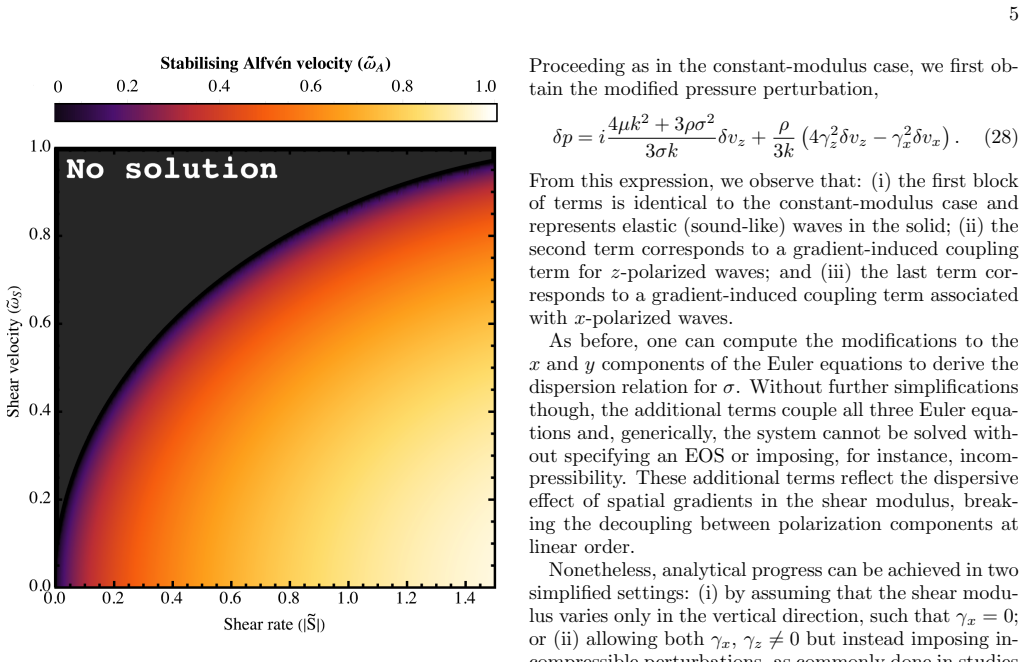
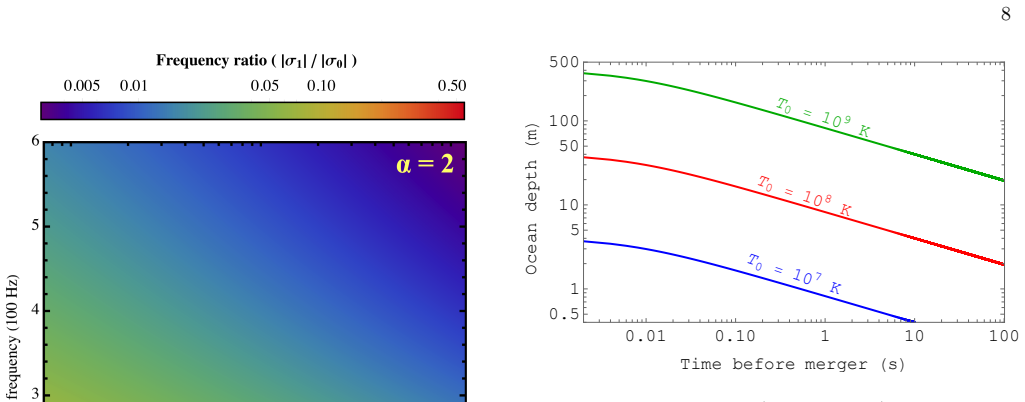
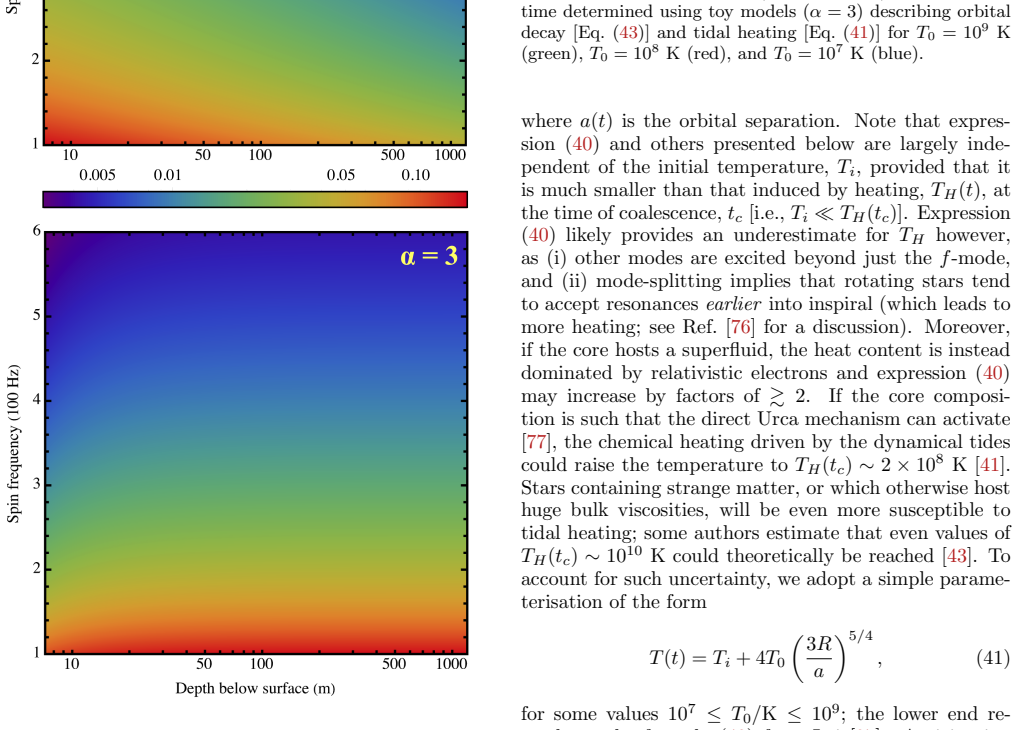
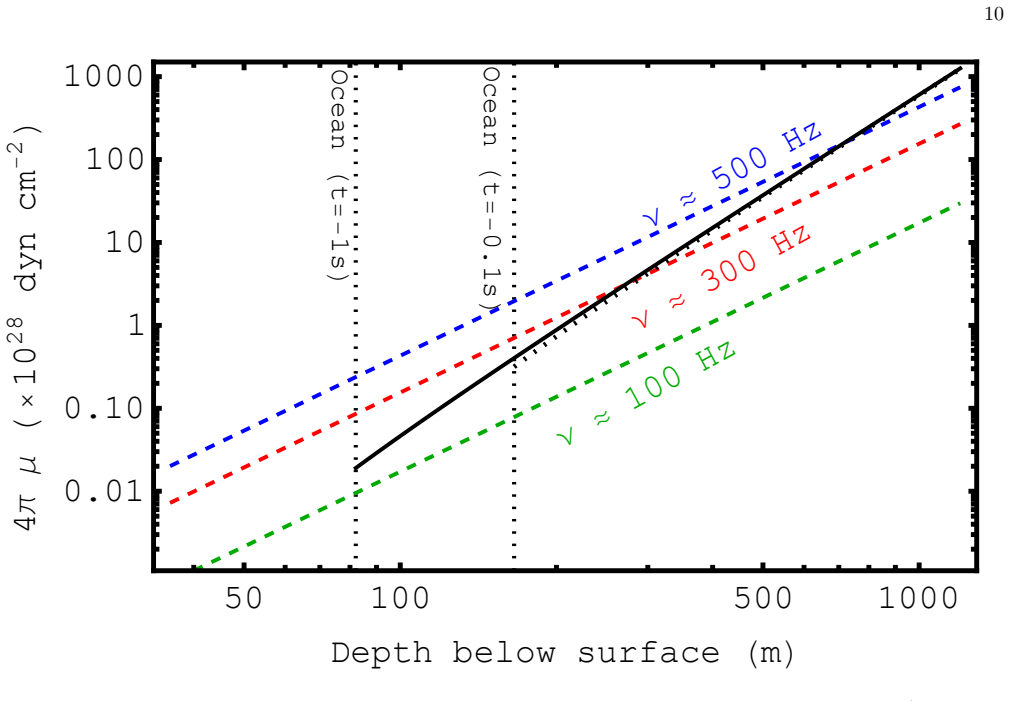
A simplified, plane-parallel analysis reveals that only in cases where the flow is strongly sheared, such that the magnetic tension that would result from the instability in a liquid exceeds the shear modulus of the elastic cavity, can magnetic growth occur. In the context of dynamical tides in binary neutron-star mergers, this implies that the magnetic field can be amplified in the crust prior to coalescence only if the star boasts a spin frequency of ≳ 300Hz. If viscous heating weakens the crystalline structure prior to resonance, the required spin frequency is reduced.
What carries the argument
The threshold condition comparing magnetic tension to the shear modulus in an elastic solid under plane-parallel shear flow.
If this is right
- Magnetic field amplification in neutron-star crusts before merger requires spin frequencies of at least 300 Hz.
- Viscous heating can reduce the required spin frequency by weakening the crystalline structure.
- The instability remains suppressed in solids whenever magnetic tension stays below the shear modulus.
Where Pith is reading between the lines
- The same elastic suppression may limit differential-rotation-driven field growth in other solid astrophysical layers such as planetary cores.
- Models of electromagnetic signals from neutron-star mergers would need to account for this spin threshold if the result holds.
- Adding radial structure or a time-varying modulus would likely shift the precise 300 Hz boundary.
Load-bearing premise
The analysis assumes a constant shear modulus and a plane-parallel geometry without radial structure or time-dependent weakening except for the separate viscous-heating case.
What would settle it
Detection of magnetic field amplification in the crust of a merging neutron star with spin frequency well below 300 Hz, without prior viscous heating, would falsify the suppression claim.
Figures
read the original abstract
The magneto-rotational instability can generate strong, turbulent substructure within magnetised shear flows. The efficacy of the mechanism as a function of microphysical aspects of the fluid, such as stratification and diffusivity, has been explored extensively. One aspect that has not been studied thus far, however, is whether the instability can also operate in solids. Motivated by the possibility that solid regions within planets or degenerate stars may rotate differentially with respect to liquid or gaseous layers during some phase of their life, we examine the extent to which elasticity suppresses the instability. A simplified, plane-parallel analysis reveals that only in cases where the flow is strongly sheared, such that the magnetic tension that would result from the instability in a liquid exceeds the shear modulus of the elastic cavity, can magnetic growth occur. In the context of dynamical tides in binary neutron-star mergers, this implies that the magnetic field can be amplified in the crust prior to coalescence only if the star boasts a spin frequency of $\gtrsim 300$Hz. If viscous heating weakens the crystalline structure prior to resonance, the required spin frequency is reduced.
Editorial analysis
A structured set of objections, weighed in public.
Referee Report
Summary. The manuscript claims that the magneto-rotational instability (MRI) can operate in elastic solids only when the flow is strongly sheared such that the magnetic tension that would arise in the liquid case exceeds the shear modulus. A simplified plane-parallel analysis yields this condition; applied to dynamical tides in binary neutron-star mergers, it implies that magnetic amplification in the crust is possible only for spin frequencies ≳300 Hz (or lower if viscous heating weakens the crystalline structure).
Significance. If the central inequality holds under the stated assumptions, the work supplies a parameter-free criterion (magnetic tension versus shear modulus) for when MRI can amplify fields inside solids, with direct implications for pre-merger magnetic evolution in neutron-star crusts. The derivation from the liquid-MRI tension compared to a fixed modulus is a clear strength.
major comments (1)
- [simplified plane-parallel analysis (abstract)] The headline threshold of ≳300 Hz rests on a dispersion-relation comparison performed under constant shear modulus and plane-parallel, unstratified geometry (abstract). In a neutron-star crust μ ∝ ρ^{4/3} (or steeper) and the background is radially stratified in spherical geometry; both the local Alfvén frequency and the elastic restoring force therefore vary with radius. No radially structured or spherical-shell calculation is reported to quantify how much the critical spin frequency shifts when the fastest-growing mode samples regions of different μ(r).
minor comments (1)
- The abstract states that viscous heating can reduce the required spin frequency but provides no quantitative estimate or scaling for the weakened modulus.
Simulated Author's Rebuttal
We thank the referee for their thoughtful review and address the major comment below. Our response focuses on the substance of the point raised.
read point-by-point responses
-
Referee: The headline threshold of ≳300 Hz rests on a dispersion-relation comparison performed under constant shear modulus and plane-parallel, unstratified geometry (abstract). In a neutron-star crust μ ∝ ρ^{4/3} (or steeper) and the background is radially stratified in spherical geometry; both the local Alfvén frequency and the elastic restoring force therefore vary with radius. No radially structured or spherical-shell calculation is reported to quantify how much the critical spin frequency shifts when the fastest-growing mode samples regions of different μ(r).
Authors: We agree that the analysis employs a plane-parallel geometry with constant shear modulus, as stated explicitly in the abstract and Section 2. This simplification yields a clear, parameter-free criterion by comparing the magnetic tension that would arise in the liquid case to the shear modulus. A radially stratified spherical-shell calculation would be a natural extension and could shift the precise numerical value of the critical frequency. However, the local dispersion relation already isolates the essential condition for MRI to overcome elasticity, and radial variations in μ are expected to affect growth rates locally without removing the requirement for strong differential rotation. The 300 Hz threshold is therefore presented as an order-of-magnitude estimate under the stated assumptions. In a revised manuscript we will add a short paragraph in the discussion explicitly noting this limitation and the scope for future work. revision: partial
Circularity Check
No circularity; derivation compares independent physical quantities
full rationale
The central claim follows from a plane-parallel dispersion-relation analysis that sets the magnetic tension (computed from the standard liquid MRI) against a fixed shear modulus μ. This inequality is obtained directly from the linearized equations of an elastic MHD fluid and does not reduce to a fitted parameter, a self-citation, or a redefinition of the input. The resulting spin-frequency threshold is an output of that comparison under the stated assumptions, not an input. No load-bearing self-citations or ansatz smuggling appear in the abstract or described derivation chain.
Axiom & Free-Parameter Ledger
Reference graph
Works this paper leans on
-
[1]
signals will also be influenced by spin, providing an independent channel to test the framework. This work is organised as follows. In Section II we in- troduce the elastic-MHD equations of motion, which are then linearised about a background shear flow (Sec. II A) and projected into plane waves (Sec. II B), to set up the problem. Dispersion relations are...
-
[2]
E. P. Velikhov, Soviet Journal of Experimental and The- oretical Physics9, 995 (1959)
1959
-
[3]
Chandrasekhar, Proceedings of the National Academy of Science46, 253 (1960)
S. Chandrasekhar, Proceedings of the National Academy of Science46, 253 (1960)
1960
-
[4]
S. A. Balbus and J. F. Hawley, ApJ376, 214 (1991)
1991
-
[5]
S. A. Balbus and J. F. Hawley, Reviews of Modern Physics70, 1 (1998)
1998
- [6]
-
[7]
A. Griffiths, P. Eggenberger, G. Meynet, F. Moyano, and M.-´A. Aloy, A&A665, A147 (2022), arXiv:2204.00016 [astro-ph.SR]
-
[8]
The magnetorotational instability as a jet launching mechanism
G. Lesur, J. Ferreira, and G. I. Ogilvie, A&A550, A61 (2013), arXiv:1210.6660 [astro-ph.HE]
work page internal anchor Pith review Pith/arXiv arXiv 2013
-
[9]
J. F. Hawley, C. Fendt, M. Hardcastle, E. Nokhrina, and A. Tchekhovskoy, Space Science Reviews191, 441 (2015), arXiv:1508.02546 [astro-ph.HE]
work page internal anchor Pith review Pith/arXiv arXiv 2015
-
[10]
W.-T. Kim, E. C. Ostriker, and J. M. Stone, ApJ599, 1157 (2003), arXiv:astro-ph/0309080 [astro-ph]
work page internal anchor Pith review Pith/arXiv arXiv 2003
-
[11]
R. A. Piontek and E. C. Ostriker, ApJ663, 183 (2007), arXiv:astro-ph/0703648 [astro-ph]
work page internal anchor Pith review Pith/arXiv arXiv 2007
-
[12]
J. Guilet and E. M¨ uller, MNRAS450, 2153 (2015), arXiv:1501.07636 [astro-ph.HE]
work page internal anchor Pith review Pith/arXiv arXiv 2015
- [13]
-
[14]
X.-N. Bai and J. M. Stone, ApJ767, 30 (2013), arXiv:1210.6661 [astro-ph.HE]
work page internal anchor Pith review Pith/arXiv arXiv 2013
-
[15]
Celora, C
T. Celora, C. Palenzuela, D. Vigan` o, and R. Aguilera- Miret, A&A706, A37 (2026)
2026
-
[16]
M. D. Duez, Y. T. Liu, S. L. Shapiro, M. Shibata, and B. C. Stephens, Physical Review D73, 104015 (2006)
2006
-
[17]
Z. B. Etienne, Y. T. Liu, and S. L. Shapiro, Physi- cal Review D74, 044030 (2006), arXiv:astro-ph/0609634 [astro-ph]
work page internal anchor Pith review Pith/arXiv arXiv 2006
-
[18]
D. J. Acheson and M. P. Gibbons, Philosophical Trans- actions of the Royal Society of London Series A289, 459 (1978)
1978
-
[19]
M. J. Korpi, P. J. K¨ apyl¨ a, and M. S. V¨ ais¨ al¨ a, Astronomische Nachrichten331, 34 (2010), arXiv:0909.1724 [astro-ph.GA]
work page internal anchor Pith review Pith/arXiv arXiv 2010
- [20]
-
[21]
C. J. Horowitz, A. S. Schneider, and D. K. Berry, Phys. Rev. Lett.104, 231101 (2010), arXiv:1005.2441 [astro- ph.SR]
work page internal anchor Pith review Pith/arXiv arXiv 2010
-
[22]
Bodenheimer and J
P. Bodenheimer and J. B. Pollack, Icarus67, 391 (1986)
1986
-
[23]
J. Fuller, D. Lai, and N. I. Storch, Icarus231, 34 (2014), arXiv:1309.0045 [astro-ph.EP]
work page internal anchor Pith review Pith/arXiv arXiv 2014
-
[24]
Fast fossil rotation of neutron star cores
A. Melatos, ApJ761, 32 (2012), arXiv:1210.5872 [astro- ph.HE]
work page internal anchor Pith review Pith/arXiv arXiv 2012
-
[25]
Persistent crust-core spin lag in neutron stars
K. Glampedakis and P. D. Lasky, MNRAS450, 1638 (2015), arXiv:1501.05473 [astro-ph.SR]
work page internal anchor Pith review Pith/arXiv arXiv 2015
-
[26]
F. Anzuini and A. Melatos, MNRAS494, 3095 (2020), arXiv:2003.13851 [astro-ph.HE]
-
[27]
Shibata, Progress of Theoretical Physics91, 871 (1994)
M. Shibata, Progress of Theoretical Physics91, 871 (1994)
1994
-
[28]
Lai, MNRAS270, 611 (1994)
D. Lai, MNRAS270, 611 (1994)
1994
-
[29]
K. D. Kokkotas and G. Schafer, MNRAS275, 301 (1995)
1995
-
[30]
W. C. G. Ho and D. Lai, MNRAS308, 153 (1999), arXiv:astro-ph/9812116 [astro-ph]
work page internal anchor Pith review Pith/arXiv arXiv 1999
- [31]
-
[32]
A. Reboul-Salze, A. Astoul, H.-J. Kuan, and A. G. Su- vorov, A&A704, A265 (2025), arXiv:2503.24154 [astro- ph.HE]
-
[33]
J. A. Faber and F. A. Rasio, Living Reviews in Relativity 15, 8 (2012), arXiv:1204.3858 [gr-qc]
work page internal anchor Pith review Pith/arXiv arXiv 2012
-
[34]
A. Tsokaros, M. Ruiz, and S. L. Shapiro, ApJ905, 48 (2020), arXiv:2007.05526 [astro-ph.HE]
-
[35]
X. Zhu, E. Thrane, S. Os lowski, Y. Levin, and P. D. Lasky, Physical Review D98, 043002 (2018)
2018
- [36]
-
[37]
Tsang, J
D. Tsang, J. S. Read, T. Hinderer, A. L. Piro, and R. Bondarescu, Phys. Rev. Lett.108, 011102 (2012)
2012
-
[38]
Tsang, ApJ777, 103 (2013)
D. Tsang, ApJ777, 103 (2013)
2013
- [39]
- [40]
- [41]
-
[42]
Urca reactions during neutron star inspiral
P. Arras and N. N. Weinberg, MNRAS486, 1424 (2019), arXiv:1806.04163 [astro-ph.HE]
work page internal anchor Pith review Pith/arXiv arXiv 2019
-
[43]
Z. Pan, Z. Lyu, B. Bonga, N. Ortiz, and H. Yang, Phys. Rev. Lett.125, 201102 (2020)
2020
- [44]
- [45]
-
[46]
H. Ho-Yin Ng, J.-L. Jiang, and L. Rezzolla, arXiv e-prints , arXiv:2601.15650 (2026), arXiv:2601.15650 [astro-ph.HE]
-
[47]
B. Karakas,, R. Matur, and M. Ruffert, MNRAS545, staf2009 (2026), arXiv:2405.13687 [astro-ph.HE]
-
[48]
S. Rosswog, P. Diener, F. Torsello, T. M. Tauris, and N. Sarin, MNRAS530, 2336 (2024), arXiv:2310.15920 [astro-ph.HE]
- [49]
- [50]
-
[52]
J. L. Friedman and B. F. Schutz, ApJ221, 937 (1978)
1978
-
[53]
Lynden-Bell and J
D. Lynden-Bell and J. P. Ostriker, MNRAS136, 293 (1967)
1967
- [54]
- [55]
-
[56]
Magnetars oscillations in the presence of a crust
A. Colaiuda and K. D. Kokkotas, MNRAS414, 3014 (2011), arXiv:1012.3103 [gr-qc]
work page internal anchor Pith review Pith/arXiv arXiv 2011
-
[57]
J. J. Anagnost and C. A. Desoer, Circuits Systems and Signal Processing10, 101 (1991)
1991
-
[58]
M. Miravet-Ten´ es and M. E. Pessah, A&A696, A2 (2025), arXiv:2411.05064 [astro-ph.HE]
- [59]
- [60]
-
[61]
H.-J. Kuan, A. G. Suvorov, and K. D. Kokkotas, MN- RAS506, 2985 (2021)
2021
-
[62]
L. S. Finn, MNRAS227, 265 (1987)
1987
-
[63]
Reisenegger and P
A. Reisenegger and P. Goldreich, ApJ395, 240 (1992)
1992
-
[64]
Andersson and P
N. Andersson and P. Pnigouras, MNRAS489, 4043 (2019)
2019
-
[65]
H.-J. Kuan, C. J. Kr¨ uger, A. G. Suvorov, and K. D. Kokkotas, MNRAS513, 4045 (2022)
2022
- [66]
-
[67]
Xu and D
W. Xu and D. Lai, Physical Review D96, 083005 (2017)
2017
-
[68]
A. G. Suvorov and K. D. Kokkotas, Physical Review D 101, 083002 (2020)
2020
-
[69]
H.-J. Kuan and K. D. Kokkotas, Physical Review D106, 064052 (2022), arXiv:2205.01705 [gr-qc]
-
[70]
Strohmayer, S
T. Strohmayer, S. Ogata, H. Iyetomi, S. Ichimaru, and H. M. van Horn, ApJ375, 679 (1991)
1991
-
[71]
C. J. Horowitz and J. Hughto, arXiv e-prints , arXiv:0812.2650 (2008), arXiv:0812.2650 [astro-ph]
work page internal anchor Pith review Pith/arXiv arXiv 2008
-
[72]
D. A. Baiko, MNRAS416, 22 (2011), arXiv:1104.0173 [astro-ph.SR]
work page internal anchor Pith review Pith/arXiv arXiv 2011
-
[73]
E. H. Gudmundsson, C. J. Pethick, and R. I. Epstein, ApJ272, 286 (1983)
1983
-
[74]
R. T. Farouki and S. Hamaguchi, Physical Review E47, 4330 (1993)
1993
-
[75]
Chamel and P
N. Chamel and P. Haensel, Living Reviews in Relativity 11, 10 (2008)
2008
-
[76]
S. K. Lander and K. N. Gourgouliatos, MNRAS486, 4130 (2019), arXiv:1902.02121 [astro-ph.HE]
work page internal anchor Pith review Pith/arXiv arXiv 2019
-
[77]
H.-J. Kuan, A. G. Suvorov, and K. D. Kokkotas, A&A 676, A59 (2023)
2023
-
[78]
A. Sedrakian, Phys. Rev. Lett.133, 171401 (2024), arXiv:2406.16183 [nucl-th]
-
[79]
Ultraviolet Emission from the Millisecond Pulsar J0437-4715
O. Kargaltsev, G. G. Pavlov, and R. W. Romani, ApJ 602, 327 (2004), arXiv:astro-ph/0310854 [astro-ph]
work page internal anchor Pith review Pith/arXiv arXiv 2004
-
[80]
Internal Heating of Old Neutron Stars: Contrasting Different Mechanisms
D. Gonzalez and A. Reisenegger, A&A522, A16 (2010), arXiv:1005.5699 [astro-ph.HE]
work page internal anchor Pith review Pith/arXiv arXiv 2010
- [81]
discussion (0)
Sign in with ORCID, Apple, or X to comment. Anyone can read and Pith papers without signing in.