REVIEW 4 major objections 7 minor 34 references
ViDTA: Enhanced Drug-Target Affinity Prediction via Virtual Graph Nodes and Attention-based Feature Fusion
T0 review · 4 major / 7 minor · reviewed 2026-08-11 · deepseek-v4-flash
Pith's one-line read A virtual node in a Graph Transformer plus gated attention fusion improves drug-target affinity prediction on Davis, Metz, and KIBA.
desk verdict Plausible incremental DTA architecture with consistent gains, but the SOTA claim needs matched baselines and variance before it convinces. read the letter →
The pith
A machine-rendered reading of the paper's core claim, the machinery that carries it, and where it could break.
The reading
What carries the argument
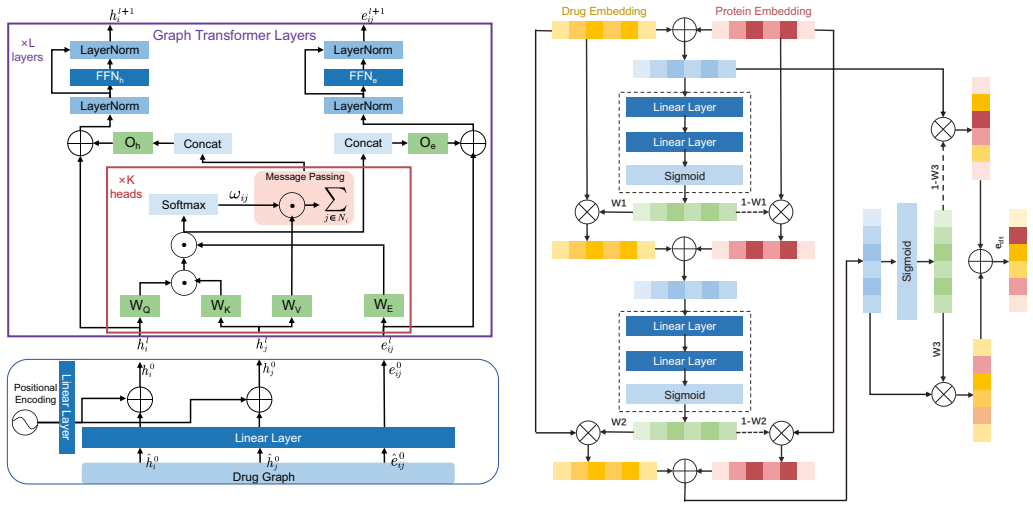
The load-bearing components are the virtual graph node, a node connected to every atom in the molecular graph and initialized to zero, whose final hidden state after the Graph Transformer layers serves as the drug's global representation; and the attention-based linear feature fusion network, which computes gate weights, blends drug and protein features, repeats the weighting, and then applies a gated skip connection so the final fused vector preserves the original features while emphasizing the fused representation. The virtual node widens the receptive field of the message-passing layers, and the fusion module replaces a static combination with a data-dependent interpolation.
What would settle it
Run the identical pipeline with the virtual node removed, using a pooling readout instead, and with the fusion module replaced by concatenation, on the same five-fold splits; if the reported gaps in Tables VI and VII do not reproduce, the attributed mechanism is falsified. Re-running all compared baselines under ViDTA's exact split and preprocessing protocol would similarly settle whether the headline state-of-the-art margin is protocol-independent.
Extended reading notes
Core claim
The paper's central claim is that a Graph Transformer with one additional zero-initialized virtual node, connected to all atoms and updated by the same message passing, produces a more informative whole-molecule representation than pooling local atom embeddings, and that a cascaded attention-based linear fusion with a gated skip connection better combines drug and protein representations than addition or concatenation. The final virtual-node embedding is used as the drug descriptor. The paper reports that this combination makes ViDTA the top performer, by concordance index, modified $r^2_m$, Pearson correlation, and mean squared error, across Davis, Metz, and KIBA.
Load-bearing premise
The claim stands on the assumption that the baseline scores in Tables III-V were produced under the same five-fold splits, preprocessing (including the pKd transform and sequence truncation), and metrics as ViDTA; if those numbers came from different protocols, the reported advantage may be an artifact of comparison.
Editorial extensions
If this is right
- Adding a virtual node to a graph-based drug encoder is a minimal change that can be dropped into existing molecular-graph models and improve affinity prediction without new data.
- Attention-weighted gating outperforms both addition and concatenation as a feature fusion rule for drug-protein representations on the Metz dataset.
- On Davis, the reported concordance index of 0.9052 is higher than 0.9, a threshold none of the compared methods reach in the paper.
- The method accepts standard SMILES and FASTA inputs, so it can be applied to new drug-target pairs without structural biology input.
Reading between the lines
- Editorial inference: the virtual-node trick is a general graph readout mechanism, so other molecular property prediction tasks with similar graph encoders could inherit the same receptive-field benefit.
- Editorial inference: the paper's ablation varies one component at a time and therefore does not isolate interactions between the virtual node and the fusion module; a factorial ablation would reveal whether the two gains add or overlap.
- Editorial inference: because many baseline numbers are quoted from prior papers, a controlled re-implementation under identical splits and preprocessing is the decisive experiment before translating the reported margin into a practical screening advantage.
- Editorial inference: the gated fusion weights can be inspected as per-sample emphasis on the drug versus the protein, giving a possible interpretability handle for ranking which modality drives each prediction.
Editorial analysis
A structured set of objections, weighed in public.
Referee Report
Summary. The paper proposes ViDTA, a drug-target affinity prediction model that combines a Graph Transformer drug encoder augmented with a virtual node, a 1D-CNN protein encoder, and an attention-based linear feature fusion module with gated skip connections. The authors evaluate ViDTA on the Davis, Metz, and KIBA benchmark datasets using CI, r2_m, PCC, and MSE, and report that it outperforms a range of published baselines. Ablation studies on the Metz dataset compare alternative drug encoders and feature fusion strategies, attributing gains to the virtual node and the proposed fusion network. The central claim is that ViDTA achieves state-of-the-art affinity prediction accuracy on all three benchmarks.
Significance. If the empirical claim is supported under matched evaluation conditions, the virtual-node design and attention-based fusion are plausible and potentially useful contributions to DTA prediction. The manuscript is clearly written, the method is reproducible in architecture-level detail, and the ablation experiments investigate the two main design choices directly. The main value of the paper would be as an empirical demonstration that a global virtual node and gated attention fusion improve predictive performance over concatenation-based fusion. However, the strength of this contribution currently rests on comparisons to literature-reported baseline numbers that are not shown to follow the same protocol, and no uncertainty quantification is provided. The small reported margins over prior methods make this a load-bearing issue rather than a presentation concern.
major comments (4)
- [Section III-A and Table II] The experimental protocol is internally inconsistent: Section III-A states that training continues for 1000 epochs, while Table II reports "Epoch 500". Since the early-stopping rule (200 epochs without loss decrease) also interacts with the total epoch budget, this ambiguity prevents exact reproduction and weakens confidence in all reported results. Please correct the inconsistency and specify the actual epoch cap used for each dataset.
- [Section III-C, Tables III–V] The headline claim that ViDTA outperforms all baselines depends on comparing ViDTA's five-fold cross-validation results with numbers quoted from prior publications. The paper does not state that the baseline results were obtained with the same data splits, the same pKd transformation (Eq. 1), the same protein truncation at length 1000, and the same metric computation. Reported margins are small, e.g., Davis CI 0.9052 versus DGDTA 0.899 and Metz CI 0.8848 versus AttentionDTA 0.8755. Without matched splits and identical preprocessing, these differences are within the range of protocol-induced variation. Please re-run the baselines under the identical protocol or clearly justify why the literature numbers are directly comparable.
- [Section III-C, Tables III–VII] No standard deviations, confidence intervals, or statistical significance tests are reported for any of the main results or ablations. A single run per configuration is insufficient to establish that the observed improvements are not due to random seed or initialization effects, especially for the small margins over several baselines. Please report the mean and standard deviation over multiple seeds, and ideally a paired test for the key comparisons.
- [Section III-D, Tables VI and VII] The ablations are conducted only on the Metz dataset and without uncertainty quantification. The conclusion that "incorporating virtual nodes further enhanced the performance across all metrics" is supported by point estimates only. Since the comparison in Table VI includes GCN, GAT, GIN, and Graph Transformer, the marginal improvement of the virtual node over the Graph Transformer (CI 0.8848 versus 0.8667) is plausible but not established without variance information. Please provide repeated-run statistics or at least a clear statement of the number of runs and seeds used.
minor comments (7)
- [Section II-E, Eq. (15)] In Eq. (15), the sentence introducing the gated skip connection says "the initial features ed and ed" where the second feature should be et. Please correct this typo.
- [Section II-C2, heading] The subsection heading reads "Graph-Transformer-bsed Drug Encoder"; "bsed" should be "based".
- [Section II-C2, Eq. (4)] Eq. (4) writes the attention score as a product of the scaled-dot-product term and the edge feature term, which is an unusual and potentially undefined combination if the edge feature is a vector. Please clarify the intended operation (e.g., element-wise product after projection) and ensure the dimensions are consistent.
- [Section III-A] The learning rate schedule is described as "initialize at 0.0003 and decay it to 0.0001 after completing 100 epochs", but Table II lists the learning rate as {3e-4, 1e-4}. Please specify how the two values are used (e.g., which datasets use which value).
- [Table II] The row "Dimension of the drug encoder hidden layers" is set to 16, which is much smaller than the input and output dimensions (128). If this is intentional, please clarify; if it is a typo, please correct it.
- [Figure 3] Figure 3 is difficult to interpret: the two "Linear Block" branches appear to share structure but the information flow from W1 to the second block is not clearly drawn. Please revise the figure or its caption to clarify the exact data flow and the role of each sigmoid output.
- [Abstract] The abstract says "we proposed" but should use the present or past consistent with the rest of the paper; minor language polishing throughout would improve readability.
Circularity Check
No significant circularity: ViDTA's reported gains come from held-out five-fold evaluation against external baselines, not from definitional or self-cited equivalences.
full rationale
ViDTA is an empirical method paper. The central claim (Tables III–V) is that its architecture improves CI, r^2_m, PCC, and MSE on Davis, Metz, and KIBA relative to prior published numbers. The paper does not derive these metrics from any fitted parameter that is then relabeled as a prediction. The virtual-node readout ed = h_L(vn) (Section II-C-2) is a modeling choice; Eqs. (12)–(15) define an attention/gated fusion block whose parameters are learned on training folds and evaluated on test folds. Ablations in Tables VI–VII are the authors' own evidence, but they are not circular: the compared configurations are independent variants sharing the same data split. There is no load-bearing self-citation: the only 'following' citation (atom featurization, Section II-C-1, citing AttentionMGT-DTA [21]) is to an external prior method, and it supplies input features rather than the target conclusion. I flag one non-circular reporting inconsistency: Section III-A says training continues for 1000 epochs while Table II lists Epoch 500; this is a correctness/reproducibility concern, not circularity. Similarly, the SOTA comparison assumes that quoted baseline numbers were produced under the same splits and preprocessing; if not, the comparison is unfair, but unfair comparison is not the same as the prediction reducing to its input. No circular step identified.
Assumptions & free parameters
free parameters (12)
- learning rate schedule =
initial 3e-4, decay to 1e-4 after 100 epochs
- batch size =
128
- training epochs =
500 in Table II, 1000 in text with early stopping after 200 no-improvement epochs
- Graph Transformer layers =
10
- Graph Transformer heads =
8
- drug encoder dimensions =
input 128, hidden 16, output 128
- protein encoder dimensions =
input 128, hidden 256, output 128
- protein max sequence length =
1000
- atom feature dimension =
44
- bond feature dimension =
10
- CNN kernel sizes =
2, 3, 5
- dropout =
0.2 in Graph Transformer layers
assumptions (5)
- domain assumption Davis, Metz, and KIBA benchmarks are valid proxies for drug-target affinity prediction performance.
- domain assumption The baseline results cited from prior papers were obtained under evaluation protocols equivalent to ViDTA's 5-fold cross-validation.
- ad hoc to paper The virtual node provides a global receptive field that improves drug feature extraction.
- ad hoc to paper The attention-based linear feature fusion with gated skip connection captures interaction information better than concatenation or addition.
- standard math The pKd transformation for Davis is the appropriate label scaling.
invented entities (1)
-
virtual node in drug molecular graph
Cite this review
Pith. "Pith review of ViDTA: Enhanced Drug-Target Affinity Prediction via Virtual Graph Nodes and Attention-based Feature Fusion." pith.science (2026). https://pith.science/paper/MAHVZ3ZH
@misc{pith2026241219589,
  author       = {Pith},
  title        = {Pith review of: ViDTA: Enhanced Drug-Target Affinity Prediction via Virtual Graph Nodes and Attention-based Feature Fusion},
  year         = {2026},
  howpublished = {\url{https://pith.science/paper/MAHVZ3ZH}},
  note         = {Machine review of arXiv:2412.19589}
}
read the original abstract
Drug-target interaction is fundamental in understanding how drugs affect biological systems, and accurately predicting drug-target affinity (DTA) is vital for drug discovery. Recently, deep learning methods have emerged as a significant approach for estimating the binding strength between drugs and target proteins. However, existing methods simply utilize the drug's local information from molecular topology rather than global information. Additionally, the features of drugs and proteins are usually fused with a simple concatenation operation, limiting their effectiveness. To address these challenges, we proposed ViDTA, an enhanced DTA prediction framework. We introduce virtual nodes into the Graph Neural Network (GNN)-based drug feature extraction network, which acts as a global memory to exchange messages more efficiently. By incorporating virtual graph nodes, we seamlessly integrate local and global features of drug molecular structures, expanding the GNN's receptive field. Additionally, we propose an attention-based linear feature fusion network for better capturing the interaction information between drugs and proteins. Experimental results evaluated on various benchmarks including Davis, Metz, and KIBA demonstrate that our proposed ViDTA outperforms the state-of-the-art baselines.
Figures

Reference graph
Works this paper leans on
-
[1]
Overview of the immune response[J]
Chaplin D D. Overview of the immune response[J]. Journal of allergy and clinical immunology, 2010, 125(2): S3-S23
work page 2010
-
[2]
Prediction of Drug-Target B inding Affinity Based on Deep Learning Models[J]
Zhang H, Liu X, Cheng W, et al. Prediction of Drug-Target B inding Affinity Based on Deep Learning Models[J]. Computers in Biol ogy and Medicine, 2024: 108435
work page 2024
-
[3]
Darnell Jr J E. STA Ts and gene regulation[J]. Science, 19 97, 277(5332): 1630-1635
-
[4]
The nature of statistical learning theory[M]
V apnik V . The nature of statistical learning theory[M]. Springer science & business media, 2013
work page 2013
-
[5]
Qiu T, Qiu J, Feng J, et al. The recent progress in proteoch emometric modelling: focusing on target descriptors, cross-term des criptors and application scope[J]. Briefings in Bioinformatics, 2017, 1 8(1): 125-136
work page 2017
-
[6]
Wang S, Song X, Zhang Y , et al. MSGNN-DTA: Multi-Scale Top ological Feature Fusion Based on Graph Neural Networks for Drug–Targ et Bind- ing Affinity Prediction[J]. International Journal of Molec ular Sciences, 2023, 24(9): 8326
work page 2023
-
[7]
Zhu Y , Zhao L, Wen N, et al. DataDTA: a multi-feature and du al- interaction aggregation framework for drug–target bindin g affinity pre- diction[J]. Bioinformatics, 2023, 39(9): btad560
work page 2023
-
[8]
Predicting drug–target bin ding affinity with cross-scale graph contrastive learning[J]
Wang J, Xiao Y , Shang X, et al. Predicting drug–target bin ding affinity with cross-scale graph contrastive learning[J]. Briefings in Bioinformat- ics, 2024, 25(1): bbad516
work page 2024
Show all 34 references
-
[9]
DeepDTA: deep drug–target binding affinity prediction[J]
¨Ozt¨ urk H, ¨Ozg¨ ur A, Ozkirimli E. DeepDTA: deep drug–target binding affinity prediction[J]. Bioinformatics, 2018, 34(17): i82 1-i829
2018
-
[10]
AttentionDTA: Drug–target bind- ing affinity prediction by sequence-based deep learning wit h attention mechanism[J]
Zhao Q, Duan G, Y ang M, et al. AttentionDTA: Drug–target bind- ing affinity prediction by sequence-based deep learning wit h attention mechanism[J]. IEEE/ACM Transactions on Computational Bio logy and Bioinformatics, 2022, 20(2): 852-863
2022
-
[11]
TEFDTA: a transformer encoder a nd finger- print representation combined prediction method for bonde d and non- bonded drug–target affinities[J]
Li Z, Ren P , Y ang H, et al. TEFDTA: a transformer encoder a nd finger- print representation combined prediction method for bonde d and non- bonded drug–target affinities[J]. Bioinformatics, 2024, 4 0(1): btad778
2024
-
[12]
GraphDTA: predicting dru g–target binding affinity with graph neural networks[J]
Nguyen T, Le H, Quinn T P , et al. GraphDTA: predicting dru g–target binding affinity with graph neural networks[J]. Bioinforma tics, 2021, 37(8): 1140-1147
2021
-
[13]
GSAML-DTA: an interpretable drug- target binding affinity prediction model based on graph neur al networks with self-attention mechanism and mutual information[J]
Liao J, Chen H, Wei L, et al. GSAML-DTA: an interpretable drug- target binding affinity prediction model based on graph neur al networks with self-attention mechanism and mutual information[J]. Computers in Biology and Medicine, 2022, 150: 106145
2022
-
[14]
Gefa: early fusion appr oach in drug-target affinity prediction[J]
Nguyen T M, Nguyen T, Le T M, et al. Gefa: early fusion appr oach in drug-target affinity prediction[J]. IEEE/ACM transaction s on computa- tional biology and bioinformatics, 2021, 19(2): 718-728
2021
-
[15]
MGraphDTA: deep multiscal e graph neural network for explainable drug–target binding affinit y prediction[J]
Y ang Z, Zhong W, Zhao L, et al. MGraphDTA: deep multiscal e graph neural network for explainable drug–target binding affinit y prediction[J]. Chemical science, 2022, 13(3): 816-833
2022
-
[16]
SGNet: Sequence-based Con volution and Ligand Graph Network for Protein Binding Affinity Predic tion[J]
Chen P , Shen H, Zhang Y , et al. SGNet: Sequence-based Con volution and Ligand Graph Network for Protein Binding Affinity Predic tion[J]. IEEE/ACM Transactions on Computational Biology and Bioinf ormatics, 2023
2023
-
[17]
ColdDTA: utilizing data augm entation and attention-based feature fusion for drug-target bindin g affinity pre- diction[J]
Fang K, Zhang Y , Du S, et al. ColdDTA: utilizing data augm entation and attention-based feature fusion for drug-target bindin g affinity pre- diction[J]. Computers in Biology and Medicine, 2023, 164: 1 07372
2023
-
[18]
Comprehensive ana lysis of kinase inhibitor selectivity[J]
Davis, M I, Hunt J P , Herrgard S, et al. Comprehensive ana lysis of kinase inhibitor selectivity[J]. Nature Biotechnology, 2021, 29 (11): 1046-1051
2021
-
[19]
Navigating the kinome [J]
Metz J T, Johnson E F, Soni N, et al. Navigating the kinome [J]. Nature Chemical Biology, 2011, 7: 200–202
2011
-
[20]
Making sense of lar ge-scale kinase inhibitor bioactivity data sets: A comparative and i ntegrative analysis[J]
Tang J, Szwajda A, Shakyawar S, et al. Making sense of lar ge-scale kinase inhibitor bioactivity data sets: A comparative and i ntegrative analysis[J]. Journal of Chemical Information and Modeling , 2014, 54(3): 735-743
2014
-
[21]
AttentionMGT-DTA: A multi-mo dal drug-target affinity prediction using graph transformer an d attention mechanism[J]
Wu H, Liu J, Jiang T, et al. AttentionMGT-DTA: A multi-mo dal drug-target affinity prediction using graph transformer an d attention mechanism[J]. Neural Networks, 2024, 169: 623-636
2024
-
[22]
A generalization of transformer networks to graphs[J]
Dwivedi V P , Bresson X. A generalization of transformer networks to graphs[J]. arXiv preprint arXiv:2012.09699, 2020
2012 arXiv
-
[23]
Neural message passing for Quantum chemistry[C]
Gilmer J, Schoenholz S S, Riley P F, et al. Neural message passing for Quantum chemistry[C]. International Conference on Machin e Learning, 2017, pp. 1263–1272
2017
-
[24]
Compound–protein interacti on prediction with end-to-end learning of neural networks for graphs and s equences[J]
Tsubaki M, Tomii K, Sese J. Compound–protein interacti on prediction with end-to-end learning of neural networks for graphs and s equences[J]. Bioinformatics, 2019, 35: 309–318
2019
-
[25]
Deeply learning molecular st ructure- property relationships using attention and gate-augmente d graph convo- lutional network
Ryu S, Lim J, Hong S H, et al. Deeply learning molecular st ructure- property relationships using attention and gate-augmente d graph convo- lutional network. arXiv, 2018, arXiv:1805.10988
2018 arXiv
-
[26]
Multivariable prognosti c models: issues in developing models, evaluating assumptions and ad equacy, and measuring and reducing errors[J]
Harrell Jr F E, Lee K L, Mark D B. Multivariable prognosti c models: issues in developing models, evaluating assumptions and ad equacy, and measuring and reducing errors[J]. Statistics in medicine, 1996, 15(4):
1996
-
[27]
Some case studies on application of “rm2” metrics for judging quality of quantitative struct ure–activity relationship predictions: emphasis on scaling of response data[J]
Roy K, Chakraborty P , Mitra I, et al. Some case studies on application of “rm2” metrics for judging quality of quantitative struct ure–activity relationship predictions: emphasis on scaling of response data[J]. Journal of computational chemistry, 2013, 34(12): 1071-1082
2013
-
[28]
Kullback, R.A
S. Kullback, R.A. Leibler, On Information and Sufficien cy, vol. 22, 1951, pp. 79–86
1951
-
[29]
Gene Ontology aided compound p rotein binding affinity prediction using BERT encoding[C]
Zhao L, Xie P , Hao L, et al. Gene Ontology aided compound p rotein binding affinity prediction using BERT encoding[C]. IEEE In ternational Conference on Bioinformatics and Biomedicine, 2020, pp. 12 31-1236
2020
-
[30]
rzMLP-DTA: gMLP network with ReZero for sequence-based drug-target affinity prediction
Qiu Z, Jiao Q, Wang Y , et al. rzMLP-DTA: gMLP network with ReZero for sequence-based drug-target affinity prediction. IEEE I nternational Conference on Bioinformatics and Biomedicine, 2021, pp. 30 8-313
2021
-
[31]
TF-DTA: A Deep Learning Approach Usi ng Transformer Encoder to Predict Drug-Target Binding Affinit y[C]
Li W, Zhou Y , Tang X. TF-DTA: A Deep Learning Approach Usi ng Transformer Encoder to Predict Drug-Target Binding Affinit y[C]. IEEE International Conference on Bioinformatics and Biomedici ne, 2023, pp. 418-421
2023
-
[32]
DGDTA: dynamic graph attentio n network for predicting drug–target binding affinity[J]
Zhai H, Hou H, Luo J, et al. DGDTA: dynamic graph attentio n network for predicting drug–target binding affinity[J]. BMC Bioinf ormatics, 2023, 24(1): 367
2023
-
[33]
TransV AE-DTA: Transformer an d varia- tional autoencoder network for drug-target binding affinit y prediction[J]
Zhou C, Li Z, Song J, et al. TransV AE-DTA: Transformer an d varia- tional autoencoder network for drug-target binding affinit y prediction[J]. Computer Methods and Programs in Biomedicine, 2024, 244: 10 8003
2024
-
[34]
ArkDTA: attention regulariz ation guided by non-covalent interactions for explainable drug–target binding affinity prediction[J]
Gim M, Choe J, Baek S, et al. ArkDTA: attention regulariz ation guided by non-covalent interactions for explainable drug–target binding affinity prediction[J]. Bioinformatics, 2023, 39(Supplement 1): i448-i457
2023
Reviewed August 11, 2026 · model on record in the stance chip above.
Discussion (0). Continue with ORCID to comment.