Local and nonlocal STM transport signatures of spin polarization in second order topological superconductors
Pith reviewed 2026-06-26 02:23 UTC · model grok-4.3
The pith
Majorana corner states in 2D second-order topological superconductors carry opposite perpendicular spin polarizations that STM measures via local and nonlocal conductance.
A machine-rendered reading of the paper's core claim, the machinery that carries it, and where it could break.
Core claim
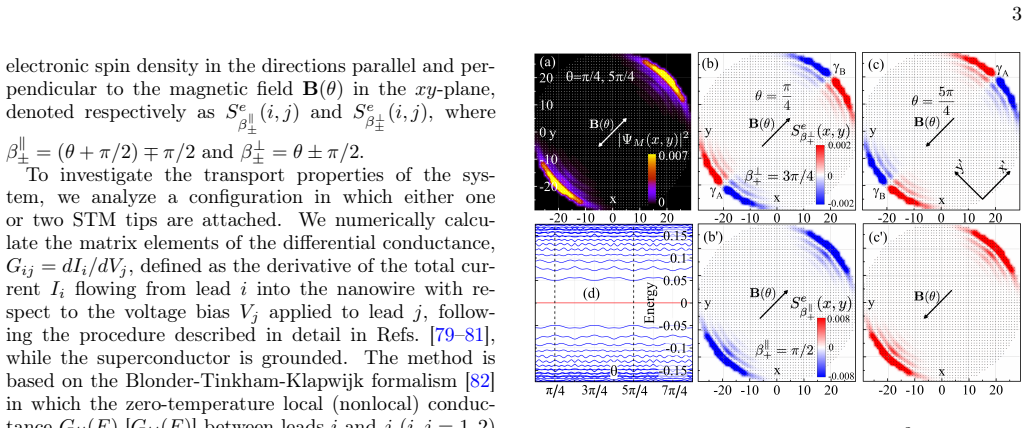
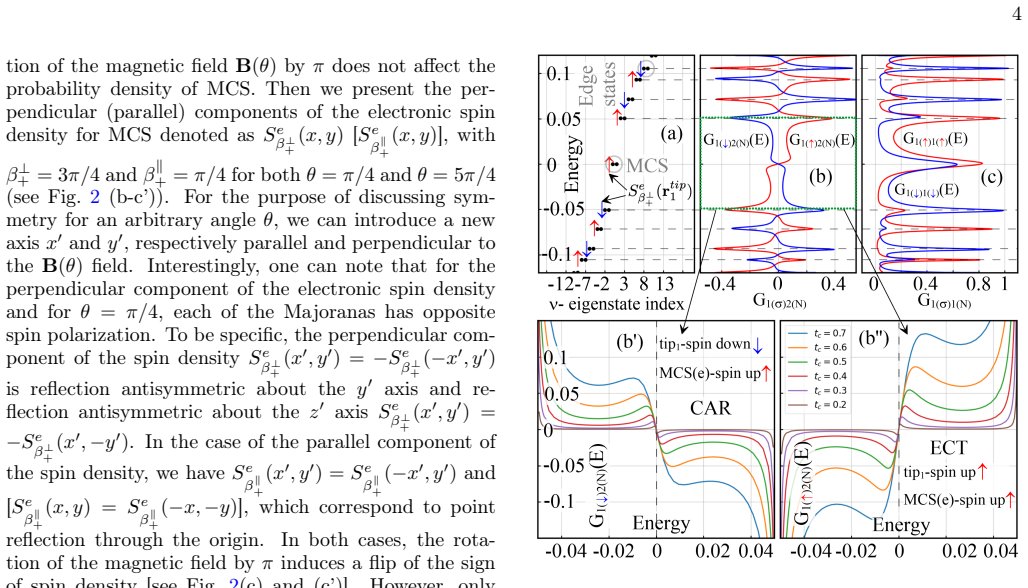
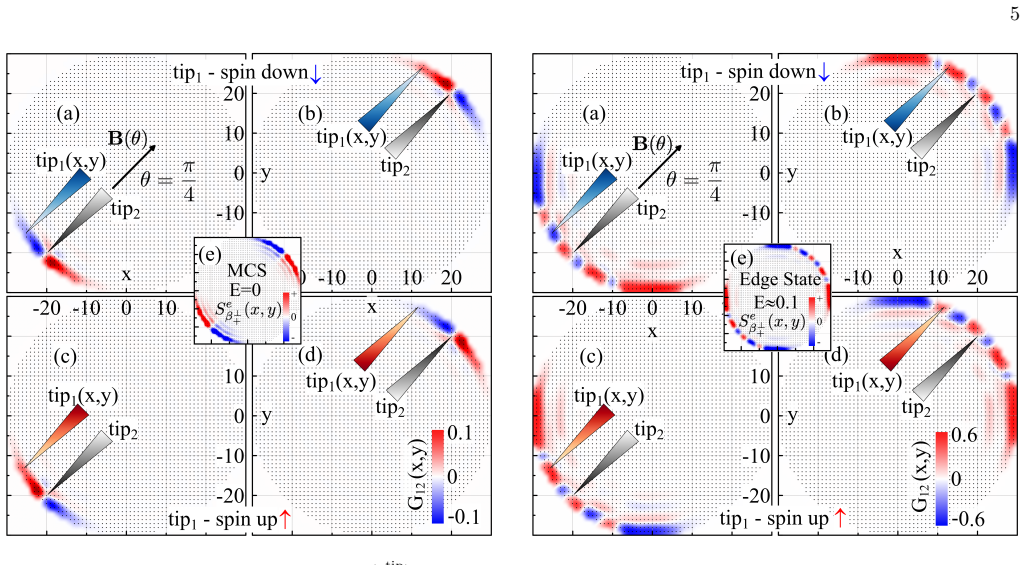
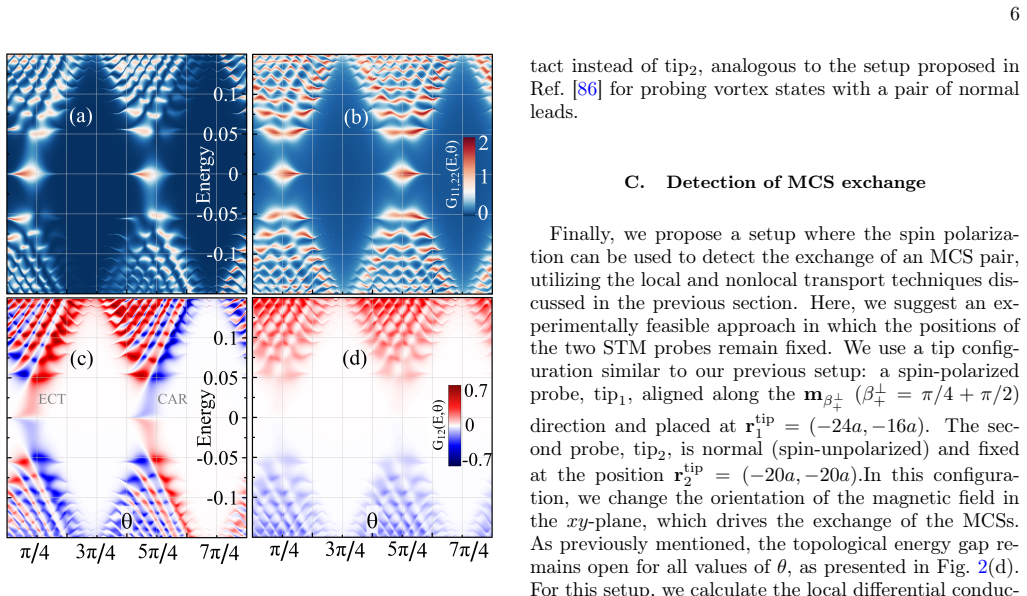
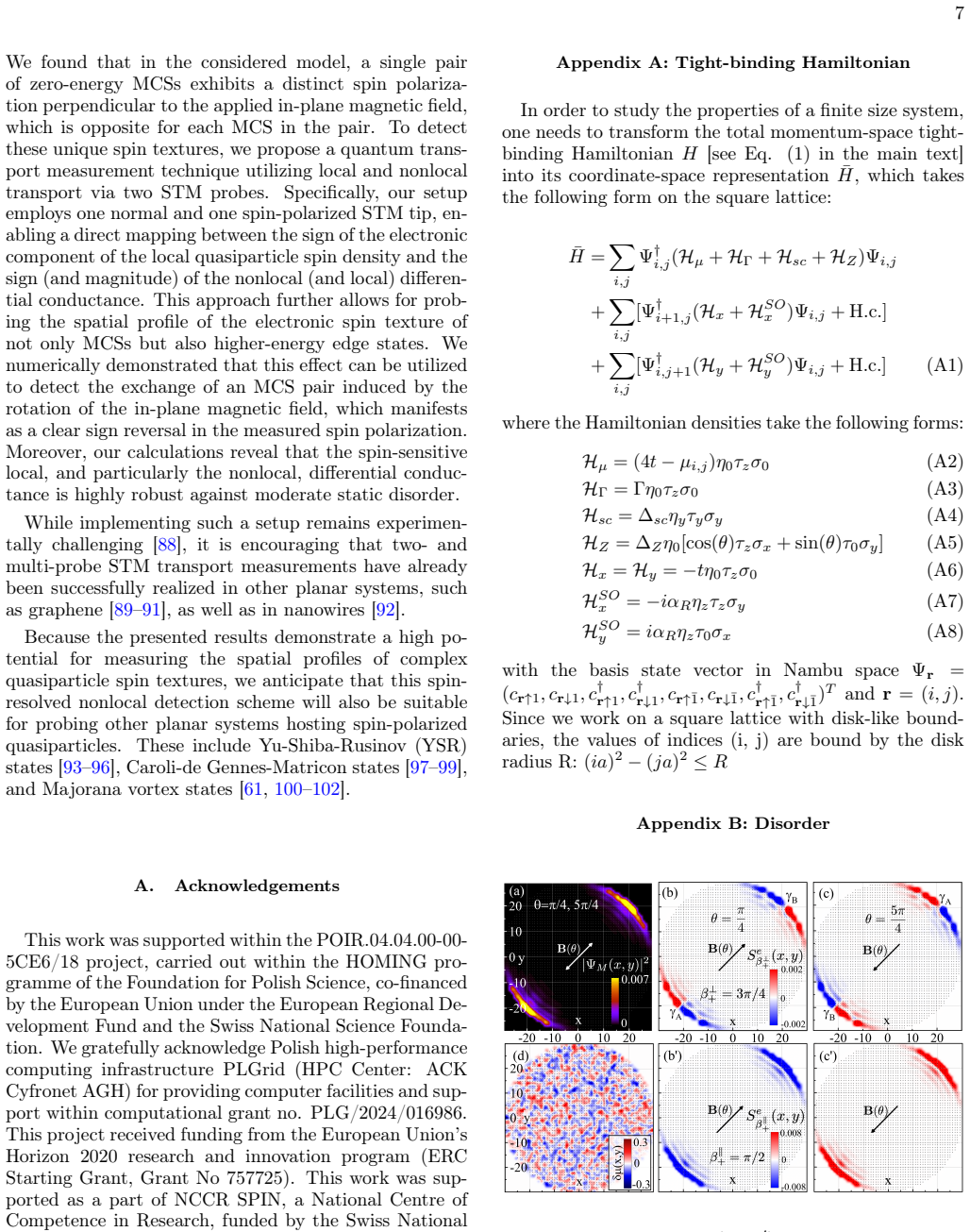
MCSs in the considered setup are characterized by a distinct spatial distribution of electronic spin polarization in the direction perpendicular to an applied in-plane magnetic field, with opposite signs for each MCS. Such a property can be used to label MCSs in a pair by their electronic spin. The magnitude of local conductance and the sign of nonlocal conductance are precisely linked to the sign of the electronic part of the MCS spin density and the spin polarization of the probe. The proposed technique can be used to detect the spin density profile of higher-energy quasiparticle states, and all analyzed features are highly robust to strong static disorder.
What carries the argument
Spin texture of Majorana corner states, defined as the spatial distribution of electronic spin polarization perpendicular to the in-plane magnetic field, which determines the magnitude of local conductance and sign of nonlocal conductance in spin-resolved STM measurements.
If this is right
- The magnitude of local conductance directly reflects the sign of the MCS electronic spin density.
- The sign of nonlocal conductance is set by the relative alignment between the probe spin polarization and the MCS spin density.
- The same conductance protocol detects braiding of the MCS pair.
- Spin density profiles of higher-energy edge states and other quasiparticles can be mapped with the same method.
- All conductance signatures persist under strong static disorder.
Where Pith is reading between the lines
- The opposite-spin labeling supplies an experimental handle for distinguishing true MCSs from trivial corner modes that lack this spin texture.
- Because the signatures survive strong disorder, the protocol may remain usable in fabricated devices that contain realistic imperfections.
- The method could be extended to systems with more than two corners to read out multi-qubit operations without requiring direct interference measurements.
- Spin-resolved transport offers an indirect test of topological protection by confirming the predicted spin structure rather than relying solely on zero-bias peaks.
Load-bearing premise
The numerical model of the 2D SOTSC under in-plane magnetic field produces MCSs whose spin texture is accurately captured by the chosen Hamiltonian parameters and boundary conditions.
What would settle it
An STM experiment on a 2D SOTSC in which the two corner states show the same sign of perpendicular spin polarization, or in which local conductance magnitude fails to track the sign of the electronic spin density.
Figures
read the original abstract
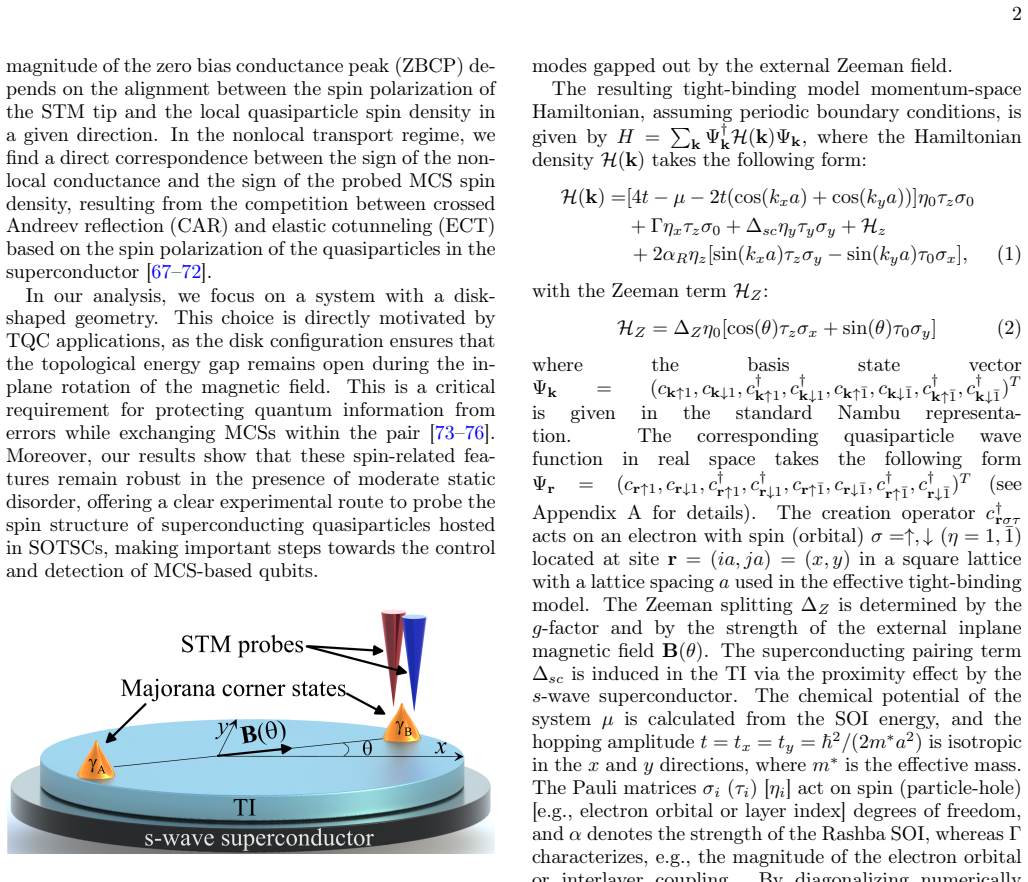
We investigate numerically the spin and transport properties of two-dimensional second-order topological superconductors (2D SOTSCs) hosting a pair of Majorana corner states (MCSs). First, we show that MCSs in the considered setup are characterized by a distinct spatial distribution of electronic spin polarization in the direction perpendicular to an applied in-plane magnetic field, with opposite signs for each MCS. Such a property can be used to label MCSs in a pair by their electronic spin. We propose a comprehensive spin-resolved transport protocol for measuring such a spin texture and further detecting the braiding (exchange) of a pair of MCSs, a crucial prerequisite for topological quantum computing. To be specific, we show that the magnitude of local conductance and the sign of nonlocal conductance are precisely linked to the sign of the electronic part of the MCS spin density and the spin polarization of the probe. Moreover, we show that the proposed technique can be used to detect the spin density profile of higher-energy quasiparticle states, e.g., edge states hosted in the SOTSC. We showed that all analyzed features are highly robust to strong static disorder , which makes our findings a clear experimental pathway to verify the spin structure of MCS and other quasiparticles hosted in SOTSCs.
Editorial analysis
A structured set of objections, weighed in public.
Referee Report
Summary. The manuscript numerically investigates spin and transport properties of 2D second-order topological superconductors hosting Majorana corner states (MCSs) under an in-plane magnetic field. It claims that the MCSs exhibit a distinct spatial distribution of electronic spin polarization perpendicular to the field, with opposite signs at each corner. A spin-resolved STM transport protocol is proposed in which the magnitude of local conductance and the sign of nonlocal conductance are directly linked to the sign of the MCS electronic spin density and the probe polarization; the same protocol is said to detect braiding and to resolve spin textures of higher-energy states such as edge states. All features are reported to remain intact under strong static disorder.
Significance. If the numerical findings are reliable and general, the work supplies a concrete, disorder-robust experimental route to label MCSs by their spin texture and to detect their exchange, both of which are prerequisites for topological quantum computation. The explicit mapping between conductance observables and spin-density sign is a useful addition to the SOTSC literature.
major comments (2)
- [Abstract] Abstract: the central claim that MCSs possess opposite perpendicular spin polarizations 'in the considered setup' rests entirely on numerical results whose Hamiltonian, lattice termination, Zeeman orientation, and pairing parameters are not specified. Without an analytic argument or a demonstration that the sign structure survives changes in chemical potential, pairing amplitude, or boundary conditions, the transport protocol (local |G| and sign of nonlocal G linked to spin-density sign) inherits the same model dependence and cannot be regarded as established.
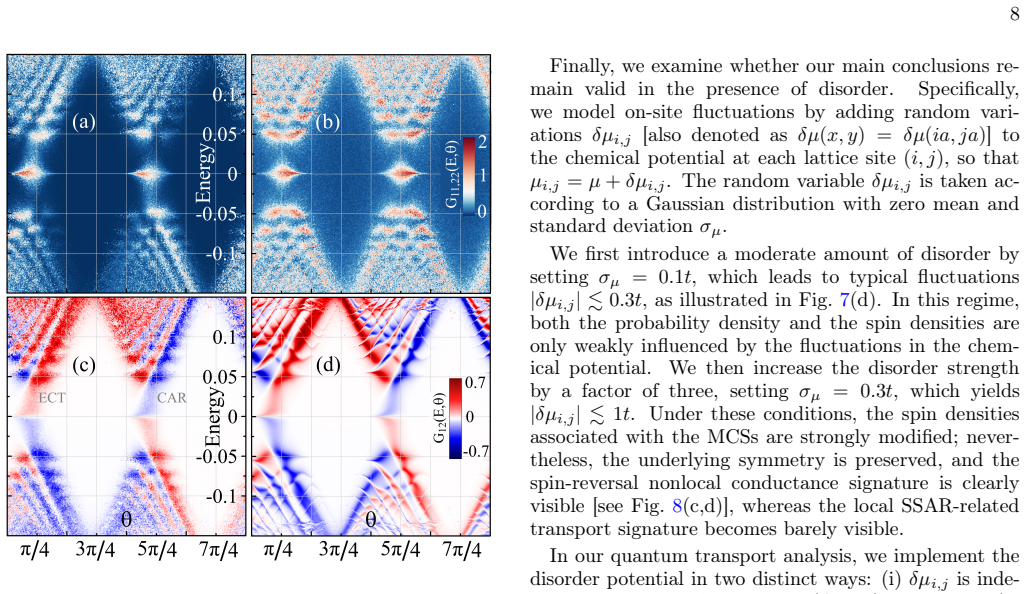
- [Abstract] Abstract: the statement that 'all analyzed features are highly robust to strong static disorder' is presented without any quantitative information on disorder strength relative to the gap, the disorder ensemble size, or convergence metrics. Because disorder robustness is invoked to support the experimental pathway, this omission is load-bearing for the main conclusion.
minor comments (1)
- [Abstract] The abstract uses the past tense 'we showed' for results that are presumably demonstrated in later sections; the manuscript should explicitly cross-reference the relevant figures or subsections where the conductance-spin mapping and disorder tests appear.
Simulated Author's Rebuttal
We thank the referee for the careful reading of our manuscript and the constructive comments. We address each major comment point by point below. Our responses focus on clarifying the numerical scope of the work, the model details already present in the manuscript, and the quantitative aspects of the disorder analysis.
read point-by-point responses
-
Referee: [Abstract] Abstract: the central claim that MCSs possess opposite perpendicular spin polarizations 'in the considered setup' rests entirely on numerical results whose Hamiltonian, lattice termination, Zeeman orientation, and pairing parameters are not specified. Without an analytic argument or a demonstration that the sign structure survives changes in chemical potential, pairing amplitude, or boundary conditions, the transport protocol (local |G| and sign of nonlocal G linked to spin-density sign) inherits the same model dependence and cannot be regarded as established.
Authors: The full manuscript (Section II) specifies the Bogoliubov-de Gennes Hamiltonian on a square lattice with open boundaries, including Rashba spin-orbit coupling, s-wave pairing, and an in-plane Zeeman field oriented along one lattice direction. The opposite perpendicular spin polarizations at the two MCSs follow from the spin texture induced by the Zeeman term combined with the corner localization enforced by the second-order topology. We have explicitly checked that the sign structure persists across a range of chemical potentials and pairing amplitudes inside the topological phase (see supplementary Figs. S1-S3). While the work is numerical and does not contain an analytic derivation of the sign, the consistency across parameter variations supports the proposed transport protocol within the class of models considered. We will revise the abstract to explicitly reference the model parameters and the checks performed. revision: partial
-
Referee: [Abstract] Abstract: the statement that 'all analyzed features are highly robust to strong static disorder' is presented without any quantitative information on disorder strength relative to the gap, the disorder ensemble size, or convergence metrics. Because disorder robustness is invoked to support the experimental pathway, this omission is load-bearing for the main conclusion.
Authors: We agree that the abstract should include quantitative details. Section IV of the manuscript presents results for on-site disorder with strength up to 0.4 times the superconducting gap, averaged over ensembles of 100 realizations, with convergence verified by monitoring variance across increasing ensemble sizes. The local and nonlocal conductance signatures remain intact in these calculations (Figs. 5-7). We will update the abstract to incorporate these quantitative statements and add a brief reference to the ensemble size and metrics. revision: yes
Circularity Check
No significant circularity; numerical model investigation
full rationale
The paper conducts a numerical study of spin and transport properties in a defined 2D SOTSC Hamiltonian with in-plane Zeeman term. All reported features (MCS spin polarization signs, local/nonlocal conductance mappings) are direct outputs of solving the model equations for the chosen parameters and boundaries. No parameters are fitted to data subsets and then relabeled as predictions; no self-citations justify load-bearing uniqueness theorems or ansatze; the derivation chain consists of model definition followed by numerical diagonalization and conductance calculations. The qualifier 'in the considered setup' correctly signals model dependence without creating definitional loops. This is a standard self-contained numerical exploration.
Axiom & Free-Parameter Ledger
Reference graph
Works this paper leans on
-
[1]
M. H. Freedman, M. Larsen, and Z. Wang, A modu- lar functor which is universal for quantum computation, Commun. Math. Phys.227, 605 (2002)
2002
-
[2]
M. H. Freedman, A. Kitaev, and Z. Wang, Simulation of topological field theories by quantum computers, Com- mun. Math. Phys.227, 587 (2002)
2002
-
[3]
A. Y. Kitaev, Fault-tolerant quantum computation by anyons, Ann. Phys.303, 2 (2003)
2003
-
[4]
Nayak, S
C. Nayak, S. H. Simon, A. Stern, M. Freedman, and S. Das Sarma, Non-Abelian anyons and topologi- cal quantum computation, Rev. Mod. Phys.80, 1083 (2008)
2008
-
[5]
M. Z. Hasan and C. L. Kane, Colloquium: Topological insulators, Rev. Mod. Phys.82, 3045 (2010)
2010
-
[6]
Qi and S.-C
X.-L. Qi and S.-C. Zhang, Topological insulators and superconductors, Rev. Mod. Phys.83, 1057 (2011)
2011
-
[7]
B. A. Bernevig and T. L. Hughes,Topological Insulators and Topological Superconductors(Princeton University Press, Princeton, New Jersey, 2013)
2013
-
[8]
C.-K. Chiu, J. C. Y. Teo, A. P. Schnyder, and S. Ryu, Classification of topological quantum matter with sym- metries, Rev. Mod. Phys.88, 035005 (2016)
2016
-
[9]
W. A. Benalcazar, B. A. Bernevig, and T. L. Hughes, Quantized electric multipole insulators, Science357, 61 (2017)
2017
-
[10]
W. A. Benalcazar, B. A. Bernevig, and T. L. Hughes, Electric multipole moments, topological multipole mo- ment pumping, and chiral hinge states in crystalline in- sulators, Phys. Rev. B96, 245115 (2017)
2017
-
[11]
Langbehn, Y
J. Langbehn, Y. Peng, L. Trifunovic, F. von Oppen, and P. W. Brouwer, Reflection-Symmetric Second-Order Topological Insulators and Superconductors, Phys. Rev. Lett.119, 246401 (2017)
2017
-
[12]
S.A.ParameswaranandY.Wan,TopologicalInsulators Turn a Corner, Physics10, 132 (2017)
2017
-
[13]
Z. Song, Z. Fang, and C. Fang,(d−2)-dimensional edge states of rotation symmetry protected topological states, Phys. Rev. Lett.119, 246402 (2017)
2017
-
[14]
Y. Peng, Y. Bao, and F. Von Oppen, Boundary Green functions of topological insulators and superconductors, Phys. Rev. B95, 235143 (2017)
2017
-
[15]
Imhof, C
S. Imhof, C. Berger, F. Bayer, J. Brehm, L. W. Molenkamp, T. Kiessling, F. Schindler, C. H. Lee, M. Greiter, T. Neupert, and R. Thomale, Topolectrical- circuit realization of topological corner modes, Nat. Phys.14, 925 (2018)
2018
-
[16]
Schindler, A
F. Schindler, A. M. Cook, M. G. Vergniory, Z. Wang, S. S. P. Parkin, B. A. Bernevig, and T. Neupert, Higher- order topological insulators, Sci. Adv.4, eaat0346 (2018)
2018
-
[17]
Geier, L
M. Geier, L. Trifunovic, M. Hoskam, and P. W. Brouwer, Second-order topological insulators and su- perconductors with an order-two crystalline symmetry, Phys. Rev. B97, 205135 (2018)
2018
-
[18]
Serra-Garcia, V
M. Serra-Garcia, V. Peri, R. Süsstrunk, O. R. Bilal, T. Larsen, L. G. Villanueva, and S. D. Huber, Obser- 9 vation of a phononic quadrupole topological insulator, Nature (London)555, 342 (2018)
2018
-
[19]
Trifunovic and P
L. Trifunovic and P. W. Brouwer, Higher-Order Bulk- Boundary Correspondence for Topological Crystalline Phases, Phys. Rev. X9, 011012 (2019)
2019
-
[20]
Slager, L
R.-J. Slager, L. Rademaker, J. Zaanen, and L. Balents, Impurity-bound states and green’s function zeros as lo- cal signatures of topology, Phys. Rev. B92, 085126 (2015)
2015
-
[21]
Mittal, V
S. Mittal, V. V. Orre, G. Zhu, M. A. Gorlach, A. Pod- dubny, and M. Hafezi, Photonic quadrupole topological phases, Nat. Photon.13, 692 (2019)
2019
-
[22]
H. Xue, Y. Yang, F. Gao, Y. Chong, and B. Zhang, Acoustic higher-order topological insulator on a kagome lattice, Nat. Mater.18, 108 (2019)
2019
-
[23]
X. Ni, M. Weiner, A. Alù, and A. B. Khanikaev, Obser- vation of higher-order topological acoustic states pro- tected by generalized chiral symmetry, Nat. Mater.18, 113 (2019)
2019
-
[24]
El Hassan, F
A. El Hassan, F. K. Kunst, A. Moritz, G. Andler, E. J. Bergholtz, and M. Bourennane, Corner states of light in photonic waveguides, Nat. Photon.13, 697 (2019)
2019
-
[25]
Rodriguez-Vega, A
M. Rodriguez-Vega, A. Kumar, and B. Seradjeh, Higher-order Floquet topological phases with corner and bulk bound states, Phys. Rev. B100, 085138 (2019)
2019
-
[26]
A. K. Ghosh, G. C. Paul, and A. Saha, Higher order topological insulator via periodic driving, Phys. Rev. B 101, 235403 (2020)
2020
-
[27]
Laubscher, D
K. Laubscher, D. Loss, and J. Klinovaja, Majorana and parafermion corner states from two coupled sheets of bilayer graphene, Phys. Rev. Res.2, 013330 (2020)
2020
-
[28]
Laubscher, D
K. Laubscher, D. Chughtai, D. Loss, and J. Klinovaja, Kramers pairs of majorana corner states in a topological insulator bilayer, Phys. Rev. B102, 195401 (2020)
2020
-
[29]
Hirosawa, S
T. Hirosawa, S. A. Díaz, J. Klinovaja, and D. Loss, Magnonic quadrupole topological insulator in anti- skyrmion crystals, Phys. Rev. Lett.125, 207204 (2020)
2020
-
[30]
Y. Ren, Z. Qiao, and Q. Niu, Engineering Corner States from Two-Dimensional Topological Insulators, Phys. Rev. Lett.124, 166804 (2020)
2020
-
[31]
Szumniak, D
P. Szumniak, D. Loss, and J. Klinovaja, Hinge modes and surface states in second-order topological three- dimensional quantum hall systems induced by charge density modulation, Phys. Rev. B102, 125126 (2020)
2020
-
[32]
Xie, H.-X
B. Xie, H.-X. Wang, X. Zhang, P. Zhan, J.-H. Jiang, M. Lu, and Y. Chen, Higher-order band topology, Nat. Rev. Phys.3, 520 (2021)
2021
-
[33]
Costa, G
M. Costa, G. R. Schleder, C. Mera Acosta, A. C. M. Padilha, F. Cerasoli, M. Buongiorno Nardelli, and A. Fazzio, Discovery of higher-order topological insu- lators using the spin Hall conductivity as a topology signature, npj Comput. Mater.7, 49 (2021)
2021
-
[34]
W. Zhu, H. Xue, J. Gong, Y. Chong, and B. Zhang, Time-periodic corner states from Floquet higher-order topology, Nat. Commun.13, 11 (2022)
2022
-
[35]
Yang, J.-H
Y.-B. Yang, J.-H. Wang, K. Li, and Y. Xu, Higher-order topological phases in crystalline and non-crystalline sys- tems: a review, J. Phys.: Condens. Matter36, 283002 (2024)
2024
-
[36]
Chatterjee, A
P. Chatterjee, A. K. Ghosh, A. K. Nandy, and A. Saha, Second-order topological superconductor via noncollinear magnetic texture, Phys. Rev. B109, L041409 (2024)
2024
-
[37]
Y. Han, C. Cui, X.-P. Li, T.-T. Zhang, Z. Zhang, Z.- M. Yu, and Y. Yao, Cornertronics in Two-Dimensional Second-Order Topological Insulators, Phys. Rev. Lett. 133, 176602 (2024)
2024
-
[38]
Hussain, G
G. Hussain, G. Cuono, P. Dziawa, D. Janaszko, J. Sad- owski, S. Kret, B. Kurowska, J. Polaczyński, K. Warda, S. Sattar, C. M. Canali, A. Lau, W. Brzezicki, T. Story, and C. Autieri, Pentagonal nanowires from topological crystalline insulators: a platform for intrinsic core–shell nanowires and higher-order topology, Nanoscale Horiz. 9, 1290 (2024)
2024
-
[39]
Luo, J.-Z
X.-J. Luo, J.-Z. Li, M. Xiao, and F. Wu, Characteriza- tion of higher-order topological superconductors using Bott indices, Phys. Rev. B111, 184516 (2025)
2025
-
[40]
H. Qian, M. Gong, J. Zhang, S. Guo, C. Zha, F. Chen, Y. Ye, Y. Wu, S. Cao, C. Ying, Q. Zhu, H.-L. Huang, Y. Zhao, S. Li, J. Yu, D. Fan, D. Wu, H. Su, H. Deng, H.Rong, Y.Li, K.Zhang, T.-H.Chung, F.Liang, J.Lin, Y. Xu, C. Guo, N. Li, K. Yan, F.-F. Su, G. Wu, Y.-H. Huo, C.-Z. Peng, C.-Y. Lu, F. Mei, S. Jia, X. Zhu, and J.-W. Pan, Programmable higher-order no...
2025
-
[41]
Zhu, Tunable Majorana corner states in a two- dimensional second-order topological superconductor induced by magnetic fields, Phys
X. Zhu, Tunable Majorana corner states in a two- dimensional second-order topological superconductor induced by magnetic fields, Phys. Rev. B97, 205134 (2018)
2018
-
[42]
Franca, D
S. Franca, D. V. Efremov, and I. C. Fulga, Phase- tunable second-order topological superconductor, Phys. Rev. B100, 075415 (2019)
2019
-
[43]
Volpez, D
Y. Volpez, D. Loss, and J. Klinovaja, Second-Order Topological Superconductivity inπ-Junction Rashba Layers, Phys. Rev. Lett.122, 126402 (2019)
2019
-
[44]
Plekhanov, M
K. Plekhanov, M. Thakurathi, D. Loss, and J. Klino- vaja, Floquet second-order topological superconductor driven via ferromagnetic resonance, Phys. Rev. Res.1, 032013(R) (2019)
2019
-
[45]
Laubscher, D
K. Laubscher, D. Loss, and J. Klinovaja, Fractional topological superconductivity and parafermion corner states, Phys. Rev. Res.1, 032017(R) (2019)
2019
-
[46]
Zhang, W
S.-B. Zhang, W. B. Rui, A. Calzona, S.-J. Choi, A. P. Schnyder, and B. Trauzettel, Topological and holonomic quantum computation based on second-order topologi- cal superconductors, Phys. Rev. Res.2, 043025 (2020)
2020
-
[47]
Y.-J. Wu, J. Hou, Y.-M. Li, X.-W. Luo, X. Shi, and C. Zhang, In-plane zeeman-field-induced Majorana cor- ner and hinge modes in ans-wave superconductor het- erostructure, Phys. Rev. Lett.124, 227001 (2020)
2020
-
[48]
A. K. Ghosh, T. Nag, and A. Saha, Floquet genera- tion of a second-order topological superconductor, Phys. Rev. B103, 045424 (2021)
2021
-
[49]
Subhadarshini, A
M. Subhadarshini, A. Mishra, and A. Saha, Engineering a second-order topological superconductor hosting tun- able Majorana corner modes in a magnet/d-wave super- conductor hybrid platform, Phys. Rev. B112, 125426 (2025)
2025
-
[50]
Wang, C.-C
Q. Wang, C.-C. Liu, Y.-M. Lu, and F. Zhang, High- Temperature Majorana Corner States, Phys. Rev. Lett. 121, 186801 (2018)
2018
-
[51]
Z. Yan, F. Song, and Z. Wang, Majorana corner modes in a high-temperature platform, Phys. Rev. Lett.121, 096803 (2018)
2018
-
[52]
Alicea, Y
J. Alicea, Y. Oreg, G. Refael, F. von Oppen, and M. P. A. Fisher, Non-Abelian statistics and topological 10 quantum information processing in 1D wire networks, Nat. Phys.7, 412 (2011)
2011
-
[53]
D. J. Clarke, J. D. Sau, and S. Tewari, Majorana fermion exchange in quasi-one-dimensional networks, Phys. Rev. B84, 035120 (2011)
2011
-
[54]
Kornich, X
V. Kornich, X. Huang, E. Repin, and Y. V. Nazarov, Braiding and All Quantum Operations with Majorana Modes in 1D, Phys. Rev. Lett.126, 117701 (2021)
2021
-
[55]
Plekhanov, N
K. Plekhanov, N. Müller, Y. Volpez, D. M. Kennes, H.Schoeller, D.Loss,andJ.Klinovaja,Quadrupolespin polarization as signature of second-order topological su- perconductors, Phys. Rev. B103, L041401 (2021)
2021
-
[56]
Wang, P.-Z
A.-Q. Wang, P.-Z. Xiang, T.-Y. Zhao, and Z.-M. Liao, Topological nature of higher-order hinge states revealed by spin transport, Sci. Bull.67, 788 (2022)
2022
-
[57]
J. Lee, J. Kwon, E. Lee, J. Park, S. Cha, K. Watan- abe, T. Taniguchi, M.-H. Jo, and H. Choi, Spinful hinge states in the higher-order topological insulators WTe2, Nat. Commun.14, 1801 (2023)
2023
-
[58]
Q. Wang, R. Song, and N. Hao, Spin-dependent high- order topological states and corner modes in a mono- layer FeSe/GdClO heterostructure, Phys. Rev. B107, 235406 (2023)
2023
-
[59]
Zhang, L
Y.-L. Zhang, L. Liu, Q.-F. Sun, J.-J. Liu, and Y.- T. Zhang, Spin-selective higher-order topological cor- ner states in a bilayer Kane-Mele-Haldane model, Phys. Rev. B113, 125427 (2026)
2026
-
[60]
J. J. He, T. Ng, P. A. Lee, and K. Law, Selective Equal-Spin Andreev Reflections Induced by Majorana Fermions, Phys. Rev. Lett.112, 037001 (2014)
2014
-
[61]
Sun, K.-W
H.-H. Sun, K.-W. Zhang, L.-H. Hu, C. Li, G.-Y. Wang, H.-Y. Ma, Z.-A. Xu, C.-L. Gao, D.-D. Guan, Y.-Y. Li, C. Liu, D. Qian, Y. Zhou, L. Fu, S.-C. Li, F.-C. Zhang, and J.-F. Jia, Majorana Zero Mode Detected with Spin Selective Andreev Reflection in the Vortex of a Topo- logical Superconductor, Phys. Rev. Lett.116, 257003 (2016)
2016
-
[62]
L.-H. Hu, C. Li, D.-H. Xu, Y. Zhou, and F.-C. Zhang, Theory of spin-selective Andreev reflection in the vortex core of a topological superconductor, Phys. Rev. B94, 224501 (2016)
2016
-
[63]
M. M. Maśka and T. Domański, Polarization of the Ma- jorana quasiparticles in the Rashba chain, Sci. Rep.7, 16193 (2017)
2017
-
[64]
S. Jeon, Y. Xie, J. Li, Z. Wang, B. A. Bernevig, and A. Yazdani, Distinguishing a Majorana zero mode using spin-resolved measurements, Science358, 772 (2017)
2017
-
[65]
D. Wang, J. Wiebe, R. Zhong, G. Gu, and R. Wiesen- danger, Spin-Polarized Yu-Shiba-Rusinov States in an Iron-Based Superconductor, Phys. Rev. Lett.126, 076802 (2021)
2021
-
[66]
J. Zeng, J. J. He, Z. Ning, D.-H. Xu, and R. Wang, Spin signature of Majorana fermions in topological nodal- point superconductors, npj Quantum Mater.10, 48 (2025)
2025
-
[67]
Mélin and D
R. Mélin and D. Feinberg, Sign of the crossed conduc- tances at a ferromagnet/superconductor/ferromagnet double interface, Phys. Rev. B70, 174509 (2004)
2004
-
[68]
Beckmann, H
D. Beckmann, H. B. Weber, and H. v. Löhneysen, Evi- dence for crossed andreev reflection in superconductor- ferromagnet hybrid structures, Phys. Rev. Lett.93, 197003 (2004)
2004
-
[69]
Trocha and I
P. Trocha and I. Weymann, Spin-resolved andreev transport through double-quantum-dot cooper pair splitters, Phys. Rev. B91, 235424 (2015)
2015
-
[70]
Trocha and K
P. Trocha and K. Wrześniewski, Cross-correlations in a quantum dot cooper pair splitter with ferromagnetic leads, J. Phys.: Condens. Matter30, 305303 (2018)
2018
-
[71]
Bordoloi, V
A. Bordoloi, V. Zannier, L. Sorba, C. Schönenberger, and A. Baumgartner, Spin cross-correlation experi- ments in an electron entangler, Nature (London)612, 454 (2022)
2022
-
[72]
Szumniak, D
P. Szumniak, D. Loss, and J. Klinovaja, Spin-resolved nonlocal transport in proximitized Rashba nanowires, Phys. Rev. B110, 115413 (2024)
2024
-
[73]
Park and P
S. Park and P. Recher, Detecting the exchange phase of Majorana bound states in a corbino geometry topolog- ical josephson junction, Phys. Rev. Lett.115, 246403 (2015)
2015
-
[74]
V. o. T. Phong, N. R. Walet, and F. Guinea, Majorana zero modes in a two-dimensionalp-wave superconduc- tor, Phys. Rev. B96, 060505(R) (2017)
2017
-
[75]
Park, H.-S
S. Park, H.-S. Sim, and P. Recher, Electron-tunneling- assisted non-abelian braiding of rotating Majorana bound states, Phys. Rev. Lett.125, 187702 (2020)
2020
-
[76]
L. Yang, A. Principi, and N. R. Walet, Rotating Majo- rana zero modes in a disk geometry, Phys. Rev. B105, 085417 (2022)
2022
-
[77]
Sticlet, C
D. Sticlet, C. Bena, and P. Simon, Spin and Majorana Polarization in Topological Superconducting Wires, Phys. Rev. Lett.108, 096802 (2012)
2012
-
[78]
J. Li, S. Jeon, Y. Xie, A. Yazdani, and B. A. Bernevig, Majorana spin in magnetic atomic chain systems, Phys. Rev. B97, 125119 (2018)
2018
-
[79]
Danon, A
J. Danon, A. B. Hellenes, E. B. Hansen, L. Casparis, A. P. Higginbotham, and K. Flensberg, Nonlocal Con- ductance Spectroscopy of Andreev Bound States: Sym- metry Relations and BCS Charges, Phys. Rev. Lett. 124, 036801 (2020)
2020
-
[80]
H. Pan, J. D. Sau, and S. Das Sarma, Three-terminal nonlocal conductance in Majorana nanowires: Distin- guishing topological and trivial in realistic systems with disorder and inhomogeneous potential, Phys. Rev. B 103, 014513 (2021)
2021
discussion (0)
Sign in with ORCID, Apple, or X to comment. Anyone can read and Pith papers without signing in.