REVIEW 3 major objections 5 minor 101 references
Generalization Guarantees for Multi-View Representation Learning and Application to Regularization via Gaussian Product Mixture Prior
T0 review · 3 major / 5 minor · reviewed 2026-08-16 · deepseek-v4-flash
Pith's one-line read For distributed multi-view representation learning, the paper establishes that the generalization gap is controlled by the minimum description length of the latent code against a symmetric prior, with statistically redundant views…
desk verdict Solid extension of the authors' MDL bounds to multi-view learning with a practical regularizer and consistent gains; the symmetry concern does not land, but the theory-to-practice link and the oracle-style experiments are the real soft spots. read the letter →
The pith
A machine-rendered reading of the paper's core claim, the machinery that carries it, and where it could break.
The reading
What carries the argument
Three objects carry the argument. (1) The symmetric prior (Definition 1): a conditional distribution $Q$ over the $2n$ latent codes that is invariant under every permutation of samples preserving the labels; the theorems hold for any such $Q$, and this invariance is what licenses the reshuffling of latent codes among same-label samples in the proof. (2) The MDL functional $\mathrm{MDL}(Q)$: the expected relative entropy between the representation distributions produced by the stochastic encoders on the training and ghost sets and $Q$; this is the complexity measure the regularizer penalizes, and the bound's dominant term is $\mathrm{MDL}(Q)/n$. (3) The decomposition of Theorem 4: one admissible prior makes the joint MDL equal to the sum of per-view marginal MDLs minus the relative entropy between the joint representation distribution and the product of per-view priors, and the negative sign of this joint term is the formal reason redundant views shrink the bound. On the algorithmic side, the machinery is a per-class Gaussian product mixture prior, updated with an EM-like procedure in which the KL divergence to the mixture is approximated by the average of a variational lower bound and a product-Gaussian upper bound, and whose membership weights $\gamma_{i,m}$ reduce to a weighted attention rule when the lossy objective is used.
What would settle it
Re-run the two-view CIFAR10 experiments of Table 3 while measuring, on every training checkpoint, the actual symmetry violation of the online-learned prior (the change in prior mass under a label-preserving permutation of the latent codes) and all terms of the Theorem 3 bound, then compare the bound with the realized test-minus-train risk across the five seeds: if the inequality fails by more than the $\sqrt{C/n}$-sized residual, or if increasing the measured joint-KL term (more redundant representations) is accompanied by a strictly larger generalization gap, the central claim is false in exactly the regime the paper applies it.
Extended reading notes
Core claim
The central claim is that for any symmetric conditional prior $Q$ — invariant under permutations of the $2n$ training and ghost-test samples that preserve labels — the expected generalization gap of a $K$-view representation learning algorithm is bounded by $(\mathrm{MDL}(Q)+\log n)/n$ plus a residual that involves only the empirical label distributions of the two sample sets, where $\mathrm{MDL}(Q)$ is the expected relative entropy between the posterior distribution of the latent codes given the views and $Q$; the gap is measured through a binary-entropy function $h_D$ that upper-bounds both the expected 0-1 risk difference and its square. The paper further shows that one admissible choice of $Q$ splits this MDL into the sum of per-view marginal MDL terms minus a joint relative-entropy term, and because that joint term enters negatively, the more the views' representations agree statistically, the smaller the bound. From this the authors conclude that distributed encoders should be steered to emit redundant features, and that the description length of the latent code — not its mutual information with the input — is the quantity a regularizer should penalize. They instantiate the idea with class-conditional Gaussian mixture priors over the joint latent space, updated online so that most computation stays at the clients, and a lossy variant whose mixture-membership weights update through a formula that is structurally a weighted attention mechanism.
Load-bearing premise
Every main theorem requires the prior to be exactly symmetric — invariant under any reshuffling of the samples that keeps the labels fixed — but the priors used in the experiments are updated online from the training data and are not guaranteed to satisfy that condition; the paper itself flags in a footnote to Section 4.1 that the relaxation to 'almost symmetric' priors is only formally proved for the single-view setup, not for the multi-view experiments.
Editorial extensions
If this is right
- If the bounds hold, a multi-view system's generalization guarantee depends on the encoders alone — the decoder's complexity drops out entirely — so MDL of the latent code is a legitimate standalone regularizer, replacing mutual-information-based information bottleneck penalties.
- The Theorem 4 decomposition makes redundancy beneficial for generalization: adding statistically correlated structure across views lowers the joint term and tightens the bound, while a marginals-only regularizer that penalizes the same structure twice works against the theory.
- The lossy variant of the bound stays non-vacuous for deterministic encoders and offers a quantitative handle on the empirically observed 'geometrical compression' of learned representations, something mutual-information bounds cannot do.
- In the reported experiments the GM-MDL regularizer improves test accuracy over VIB and CDVIB baselines in the single-view setting and over per-view VIB and no-regularization in settings with 2 to 8 views across CIFAR10, CIFAR100, USPS, and INTEL.
Reading between the lines
- The learned membership weights $\gamma_{i,m}$ provide a ready-made per-view relevance score: a view whose marginal MDL contribution is large relative to its share of the joint term is a candidate for pruning, a view-selection protocol the paper does not develop.
- Because the regularizer touches only the encoders, the approach carries over to settings with a privacy boundary between clients and server: the distributed update protocol already keeps per-view statistics local, so the joint mixture could be aggregated without ever sharing raw representations or full latent codes.
- The redundancy conclusion is a statement about the generalization bound; whether test accuracy itself is monotone in the joint term is an empirical question the paper's experiments do not isolate, and a natural follow-up is a controlled sweep in which the same data is encoded with deliberately correlated versus decorrelated representations.
Signed reviews
Editorial analysis
A structured set of objections, weighed in public.
Referee Report
Summary. The paper studies distributed multi-view representation learning where K agents each observe a distinct view and independently produce a latent representation, and a decoder predicts a shared label from the K representations. The main theoretical contribution is a set of generalization bounds, in expectation and in probability, expressed in terms of the minimum description length (MDL) of the latent variables, defined as the KL divergence between the representation distribution on training/test data and a data-dependent symmetric prior. A further decomposition (Theorem 4) separates MDL into per-view marginal MDL terms minus a joint KL term, which is interpreted as showing that statistically redundant representations are favorable for generalization. The paper then proposes data-dependent Gaussian mixture priors and a Gaussians-product mixture prior for the multi-view setting, leading to the GM-MDL and GPM-MDL regularizers, and reports experiments on image classification benchmarks showing gains over no regularization, VIB, and CDVIB.
Significance. If the bounds are correct, the paper provides a principled MDL-based alternative to mutual-information-based IB regularizers for multi-view representation learning, with a concrete theoretical mechanism for the role of redundancy across views. The proof strategy based on Donsker-Varadhan change of measure and MGF bounding is concrete, and the multi-view decomposition in Theorem 4 is a genuinely useful conceptual step. The experimental study is broad (single-view and multi-view, several datasets, several encoder architectures, K up to 8) and the code is provided, which strengthens the empirical contribution. However, the formal support for the lossy regularizer actually used in the experiments is incomplete, and several symmetry-related statements in the manuscript are inconsistent and need clarification before the application claims are fully supported.
major comments (3)
- [Section 3.3 and Appendix A.1; Section 4.1.2 and Appendix B.3] The lossy bound (17) is stated as an extension of Theorem 2, but Appendix A.1 derives a lossy version of Theorem 3 (Eqs. (34)-(37)) and does not prove (17). More importantly, the lossy regularizer used in the experiments (Section 4.1.2, Eqs. (27)-(28), and Appendix B.3) is not shown to correspond to a quantized encoder W_hat satisfying the distortion criterion in (17). The Gaussian-perturbation construction in Appendix B.3 defines a KL-type regularizer, but no proof is given that this regularizer is the MDL term of any quantized model covered by the stated lossy bound. The authors should either provide the missing derivation connecting the lossy regularizer to the lossy bounds, or explicitly state that the lossy regularizer is a heuristic motivated by, but not certified by, the theorems.
- [Footnote 1 and Section 4.1.1] The manuscript says that the learned priors satisfy the symmetry condition of Definition 1 only partially and defers formal 'almost symmetric' results to a companion paper, with formal results available only for the single-view setup. For the proposed factorized prior Q(U,U'|S,S',W_e) = ∏_i Q_{Y_i}(U_i)Q_{Y_i'}(U_i'), however, the same distribution Q_c is used for every sample of label c, so for any fixed S the prior appears to be exactly invariant under label-preserving permutations of the latent coordinates. The paper should resolve this inconsistency: if the prior is exactly symmetric, remove the caveat and the multi-view gap disappears; if some aspect of the online updates or the lossy construction breaks exact symmetry, the multi-view version of the almost-symmetric relaxation needs to be supplied before the bounds can be applied to the proposed algorithm.
- [Appendix D.2, proof of Theorem 4] The proof of Theorem 4 constructs a prior P in Eq. (12) and states that it satisfies the symmetry property with respect to the particular permutation π_{Y,Y'}, while Theorem 2 as stated (with Definition 1) requires invariance under all label-preserving permutations. The proof then asserts, without proof, that the symmetry requirement of Theorem 2 can be weakened to this single permutation. This is a load-bearing step: if the weaker condition is not sufficient, the derivation of the bound MDL(P) ≤ MDLdist does not go through. The authors should either prove the weakened-symmetry claim or prove that P is fully symmetric under Definition 1 (which appears to follow from exchangeability of X,X' given Y,Y'); as written, the proof is incomplete.
minor comments (5)
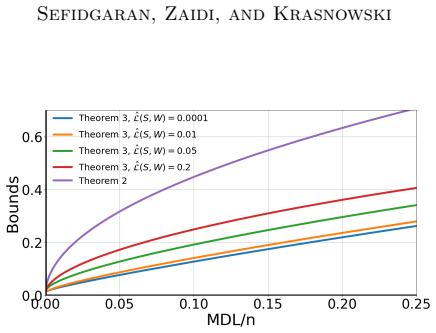
- [Section 3.1, Eq. (11) and surrounding text] The claim that the residual term B_emp_diff is negligible because ||p_Y - p_Y'||_1 is of order sqrt(C/n) is only supported by a numerical illustration (Figure 2). The function h_C is not uniformly Lipschitz on [0,1]^2, so an analytical bound or a clear heuristic qualification would be preferable.
- [Throughout] There are several typos and notation issues: 'nultiterminal' should be 'multiterminal', 'orrder' should be 'order', 'satisfing' should be 'satisfying', 'Theorme' in Appendix D.1 should be 'Theorem', and 'Xβ' in Section 4.2.2 should be 'X_B'. The Markov chain in Section 3.1 is written with 'Ø' symbols and should use arrows (U1 -> X1 -> Y -> X2 -> U2).
- [Section 3.1, Eqs. (14)-(15)] The comparison with Aguerri and Zaidi's complexity term is informal: the Markov-chain condition and the equivalence between the two forms of R1+R2 should be stated more carefully, and it should be made explicit that the comparison is an analogy between different theoretical frameworks rather than a direct implication.
- [Section 5 and Table 3] All multi-view results are reported as averages over 5 runs without error bars or standard deviations; adding variance information would make the comparisons more convincing, especially where gains are small (e.g., Table 3, several rows).
- [Section 4.2.2, Eqs. (31)-(32)] The joint regularizer involves a sum over M^K mixture components, which can be large for K up to 8. The paper does not discuss the computational cost or how M is chosen in the experiments; a brief complexity note would be helpful.
Circularity Check
No significant circularity identified; bounds are derived inequalities and the regularizer is an application of them.
full rationale
The paper's central derivation is a PAC-Bayesian/change-of-measure argument: Theorem 3 bounds the expected generalization gap in terms of MDL(Q), which is itself defined as an expected KL divergence between the encoder-induced representation distribution and a chosen symmetric prior (Eq. 4). The regularizer used in experiments is then obtained by minimizing this same MDL term, so the regularizer is an application of the bound rather than an input that forces the bound. Theorem 4's redundancy conclusion follows algebraically from the decomposition MDLdist = sum of marginal MDLs minus a non-negative joint KL term (Eq. 13); it is a mathematical consequence of the construction, not a hidden restatement of the desired result. The main self-citations, notably the restatement of (Sefidgaran et al., 2023, Theorem 4) as Theorem 2 and the reuse of that paper's MGF argument in the proof of Theorem 3, cite previously proved theorems with independent content and are used as standard lemmas rather than as unverified assumptions that presuppose the present claim. The acknowledged gap that the practical online-learned prior may not satisfy the exact symmetry condition of Definition 1 is a soundness/rigor concern about applying the bounds to the implemented algorithm, not a circularity: the bounds themselves are stated for arbitrary symmetric priors. Experimental comparisons against VIB, CDVIB, and no-regularizer baselines further show that the empirical claims are tested against external alternatives rather than being determined by construction.
Assumptions & free parameters
free parameters (4)
- Gaussian mixture component parameters (means, variances, weights) =
Per-class, per-component, per-view; learned during training
- Lossy distortion hyperparameter epsilon =
Not specified (fixed constant)
- Mixture component count M =
Not specified in main text
- Update smoothing coefficients eta1, eta2, eta3 and noise scale zeta =
Fixed constants in (25)
assumptions (5)
- standard math Donsker-Varadhan variational inequality
- standard math Berend-Kontorovich bound on the total variation between empirical distributions
- domain assumption i.i.d. training and ghost samples; encoders are conditionally independent; representations are Gaussian with diagonal covariance
- ad hoc to paper Almost-symmetric prior relaxation holds for the multi-view setup with a small penalty
- ad hoc to paper The lossy MDL bound applies at the operating point used in experiments
Cite this review
Pith. "Pith review of Generalization Guarantees for Multi-View Representation Learning and Application to Regularization via Gaussian Product Mixture Prior." pith.science (2026). https://pith.science/paper/MAQXY44Q
@misc{pith2026250418455,
  author       = {Pith},
  title        = {Pith review of: Generalization Guarantees for Multi-View Representation Learning and Application to Regularization via Gaussian Product Mixture Prior},
  year         = {2026},
  howpublished = {\url{https://pith.science/paper/MAQXY44Q}},
  note         = {Machine review of arXiv:2504.18455}
}
abstract
We study the problem of distributed multi-view representation learning. In this problem, $K$ agents observe each one distinct, possibly statistically correlated, view and independently extracts from it a suitable representation in a manner that a decoder that gets all $K$ representations estimates correctly the hidden label. In the absence of any explicit coordination between the agents, a central question is: what should each agent extract from its view that is necessary and sufficient for a correct estimation at the decoder? In this paper, we investigate this question from a generalization error perspective. First, we establish several generalization bounds in terms of the relative entropy between the distribution of the representations extracted from training and "test" datasets and a data-dependent symmetric prior, i.e., the Minimum Description Length (MDL) of the latent variables for all views and training and test datasets. Then, we use the obtained bounds to devise a regularizer; and investigate in depth the question of the selection of a suitable prior. In particular, we show and conduct experiments that illustrate that our data-dependent Gaussian mixture priors with judiciously chosen weights lead to good performance. For single-view settings (i.e., $K=1$), our experimental results are shown to outperform existing prior art Variational Information Bottleneck (VIB) and Category-Dependent VIB (CDVIB) approaches. Interestingly, we show that a weighted attention mechanism emerges naturally in this setting. Finally, for the multi-view setting, we show that the selection of the joint prior as a Gaussians product mixture induces a Gaussian mixture marginal prior for each marginal view and implicitly encourages the agents to extract and output redundant features, a finding which is somewhat counter-intuitive.
Figures


Reference graph
Works this paper leans on
-
[1]
Distributed variational representation learning
Iñaki Estella Aguerri and Abdellatif Zaidi. Distributed variational representation learning. IEEE Transactions on Pattern Analysis and Machine Intelligence, 43 0 (1): 0 120--138, 2021. doi:10.1109/TPAMI.2019.2928806
arXiv 2021
-
[2]
Alemi, Ian Fischer, Joshua V
Alexander A. Alemi, Ian Fischer, Joshua V. Dillon, and Kevin Murphy. Deep variational information bottleneck. In International Conference on Learning Representations, 2017. URL https://openreview.net/forum?id=HyxQzBceg
2017
-
[3]
User-friendly introduction to pac-bayes bounds
Pierre Alquier. User-friendly introduction to pac-bayes bounds. arXiv preprint arXiv:2110.11216, 2021
arXiv 2021
-
[4]
An exact characterization of the generalization error for the gibbs algorithm
Gholamali Aminian, Yuheng Bu, Laura Toni, Miguel Rodrigues, and Gregory Wornell. An exact characterization of the generalization error for the gibbs algorithm. Advances in Neural Information Processing Systems, 34: 0 8106--8118, 2021
2021
-
[5]
Learning representations for neural network-based classification using the information bottleneck principle
Rana Ali Amjad and Bernhard C Geiger. Learning representations for neural network-based classification using the information bottleneck principle. IEEE transactions on pattern analysis and machine intelligence, 42 0 (9): 0 2225--2239, 2019
2019
-
[6]
Stronger generalization bounds for deep nets via a compression approach
Sanjeev Arora, Rong Ge, Behnam Neyshabur, and Yi Zhang. Stronger generalization bounds for deep nets via a compression approach. In International Conference on Machine Learning, pages 254--263. PMLR, 2018
2018
-
[7]
K-means++: The advantages if careful seeding
David Arthur. K-means++: The advantages if careful seeding. In Proc. Eighteenth Annual ACM-SIAM Symposium on Discrete Algorithms, 2007, pages 1027--1035, 2007
2007
-
[8]
Heavy tails in SGD and compressibility of overparametrized neural networks
Melih Barsbey, Milad Sefidgaran, Murat A Erdogdu, Ga \"e l Richard, and Umut S im s ekli. Heavy tails in SGD and compressibility of overparametrized neural networks. In Thirty-Fifth Conference on Neural Information Processing Systems, 2021
2021
Show all 101 references
-
[9]
Pac-bayesian bounds based on the r \'e nyi divergence
Luc B \'e gin, Pascal Germain, Fran c ois Laviolette, and Jean-Francis Roy. Pac-bayesian bounds based on the r \'e nyi divergence. In Artificial Intelligence and Statistics, pages 435--444. PMLR, 2016
2016
-
[10]
On the convergence of the empirical distribution
Daniel Berend and Aryeh Kontorovich. On the convergence of the empirical distribution. arXiv preprint arXiv:1205.6711, 2012
2012 arXiv
-
[11]
Intrinsic dimension, persistent homology and generalization in neural networks
Tolga Birdal, Aaron Lou, Leonidas Guibas, and Umut S im s ekli. Intrinsic dimension, persistent homology and generalization in neural networks. In Advances in Neural Information Processing Systems (NeurIPS), 2021
2021
-
[12]
Pac-mdl bounds
Avrim Blum and John Langford. Pac-mdl bounds. In Learning Theory and Kernel Machines: 16th Annual Conference on Learning Theory and 7th Kernel Workshop, COLT/Kernel 2003, Washington, DC, USA, August 24-27, 2003. Proceedings, pages 344--357. Springer, 2003
2003
-
[13]
Occam's razor
Anselm Blumer, Andrzej Ehrenfeucht, David Haussler, and Manfred K Warmuth. Occam's razor. Information processing letters, 24 0 (6): 0 377--380, 1987
1987
-
[14]
Proper learning, helly number, and an optimal svm bound
Olivier Bousquet, Steve Hanneke, Shay Moran, and Nikita Zhivotovskiy. Proper learning, helly number, and an optimal svm bound. In Conference on Learning Theory, pages 582--609. PMLR, 2020
2020
-
[15]
Veeravalli
Yuheng Bu, Shaofeng Zou, and Venugopal V. Veeravalli. Tightening mutual information-based bounds on generalization error. IEEE Journal on Selected Areas in Information Theory, 1 0 (1): 0 121–130, May 2020. ISSN 2641-8770
2020
-
[16]
A pac-bayesian approach to adaptive classification
Olivier Catoni. A pac-bayesian approach to adaptive classification. preprint, 840, 2003
2003
-
[17]
Learning with metric losses
Dan Tsir Cohen and Aryeh Kontorovich. Learning with metric losses. In Conference on Learning Theory, pages 662--700. PMLR, 2022
2022
-
[18]
A novel approach for effective multi-view clustering with information-theoretic perspective
Chenhang Cui, Yazhou Ren, Jingyu Pu, Jiawei Li, Xiaorong Pu, Tianyi Wu, Yutao Shi, and Lifang He. A novel approach for effective multi-view clustering with information-theoretic perspective. Advances in Neural Information Processing Systems, 36, 2024
2024
-
[19]
Approximating priors by mixtures of natural conjugate priors
SR Dalal and WJ Hall. Approximating priors by mixtures of natural conjugate priors. Journal of the Royal Statistical Society: Series B (Methodological), 45 0 (2): 0 278--286, 1983
1983
-
[20]
Asymptotic evaluation of certain markov process expectations for large time, i
Monroe D Donsker and SR Srinivasa Varadhan. Asymptotic evaluation of certain markov process expectations for large time, i. Communications on pure and applied mathematics, 28 0 (1): 0 1--47, 1975
1975
-
[21]
Learning optimal representations with the decodable information bottleneck
Yann Dubois, Douwe Kiela, David J Schwab, and Ramakrishna Vedantam. Learning optimal representations with the decodable information bottleneck. Advances in Neural Information Processing Systems, 33: 0 18674--18690, 2020
2020
-
[22]
Computing nonvacuous generalization bounds for deep (stochastic) neural networks with many more parameters than training data
Gintare Karolina Dziugaite and Daniel M Roy. Computing nonvacuous generalization bounds for deep (stochastic) neural networks with many more parameters than training data. arXiv preprint arXiv:1703.11008, 2017
2017 arXiv
-
[23]
Data-dependent pac-bayes priors via differential privacy
Gintare Karolina Dziugaite and Daniel M Roy. Data-dependent pac-bayes priors via differential privacy. Advances in neural information processing systems, 31, 2018
2018
-
[24]
Generalization error bounds via R \'enyi-, f -divergences and maximal leakage, 2020
Amedeo Roberto Esposito, Michael Gastpar, and Ibrahim Issa. Generalization error bounds via R \'enyi-, f -divergences and maximal leakage, 2020
2020
-
[25]
Distributed information bottleneck method for discrete and gaussian sources
I \ n aki Estella Aguerri and Abdellatif Zaidi. Distributed information bottleneck method for discrete and gaussian sources. In International Zurich Seminar on Information and Communication (IZS 2018). Proceedings, pages 35--39. ETH Zurich, 2018
2018
-
[26]
Learning robust representations via multi-view information bottleneck
Marco Federici, Anjan Dutta, Patrick Forr \'e , Nate Kushman, and Zeynep Akata. Learning robust representations via multi-view information bottleneck. arXiv preprint arXiv:2002.07017, 2020
2002 arXiv
-
[27]
The conditional entropy bottleneck
Ian Fischer. The conditional entropy bottleneck. Entropy, 22 0 (9): 0 999, 2020
2020
-
[28]
On information plane analyses of neural network classifiers--a review
Bernhard C Geiger. On information plane analyses of neural network classifiers--a review. IEEE Transactions on Neural Networks and Learning Systems, 2021
2021
-
[29]
On the information dimension of stochastic processes
Bernhard C Geiger and Tobias Koch. On the information dimension of stochastic processes. IEEE transactions on information theory, 65 0 (10): 0 6496--6518, 2019
2019
-
[30]
Pac-bayesian learning of linear classifiers
Pascal Germain, Alexandre Lacasse, Fran c ois Laviolette, and Mario Marchand. Pac-bayesian learning of linear classifiers. In Proceedings of the 26th Annual International Conference on Machine Learning, pages 353--360, 2009
2009
-
[31]
Understanding the difficulty of training deep feedforward neural networks
Xavier Glorot and Yoshua Bengio. Understanding the difficulty of training deep feedforward neural networks. In Proceedings of the thirteenth international conference on artificial intelligence and statistics, pages 249--256. JMLR Workshop and Conference Proceedings, 2010
2010
-
[32]
Estimating information flow in deep neural networks
Ziv Goldfeld, Ewout Van Den Berg, Kristjan Greenewald, Igor Melnyk, Nam Nguyen, Brian Kingsbury, and Yury Polyanskiy. Estimating information flow in deep neural networks. In Kamalika Chaudhuri and Ruslan Salakhutdinov, editors, Proceedings of the 36th International Conference ...
2019
-
[33]
Deep learning, 2016
Ian Goodfellow, Yoshua Bengio, and Aaron Courville. Deep learning, 2016
2016
-
[34]
Mahdi Haghifam, Gintare Karolina Dziugaite, Shay Moran, and Daniel M. Roy. Towards a unified information-theoretic framework for generalization. In Thirty-Fifth Conference on Neural Information Processing Systems, 2021
2021
-
[35]
Limitations of information-theoretic generalization bounds for gradient descent methods in stochastic convex optimization
Mahdi Haghifam, Borja Rodr \' guez-G \'a lvez, Ragnar Thobaben, Mikael Skoglund, Daniel M Roy, and Gintare Karolina Dziugaite. Limitations of information-theoretic generalization bounds for gradient descent methods in stochastic convex optimization. In International Conference...
2023
-
[36]
A sharp lower bound for agnostic learning with sample compression schemes
Steve Hanneke and Aryeh Kontorovich. A sharp lower bound for agnostic learning with sample compression schemes. In Algorithmic Learning Theory, pages 489--505. PMLR, 2019
2019
-
[37]
Stable sample compression schemes: New applications and an optimal svm margin bound
Steve Hanneke and Aryeh Kontorovich. Stable sample compression schemes: New applications and an optimal svm margin bound. In Algorithmic Learning Theory, pages 697--721. PMLR, 2021
2021
-
[38]
Sample compression for real-valued learners
Steve Hanneke, Aryeh Kontorovich, and Menachem Sadigurschi. Sample compression for real-valued learners. In Algorithmic Learning Theory, pages 466--488. PMLR, 2019
2019
-
[39]
Universal bayes consistency in metric spaces
Steve Hanneke, Aryeh Kontorovich, Sivan Sabato, and Roi Weiss. Universal bayes consistency in metric spaces. In 2020 Information Theory and Applications Workshop (ITA), pages 1--33. IEEE, 2020
2020
-
[40]
Information-theoretic generalization bounds for black-box learning algorithms
Hrayr Harutyunyan, Maxim Raginsky, Greg Ver Steeg, and Aram Galstyan. Information-theoretic generalization bounds for black-box learning algorithms. Advances in Neural Information Processing Systems, 34, 2021
2021
-
[41]
A new family of generalization bounds using samplewise evaluated cmi
Fredrik Hellstr \"o m and Giuseppe Durisi. A new family of generalization bounds using samplewise evaluated cmi. Advances in Neural Information Processing Systems, 35: 0 10108--10121, 2022
2022
-
[42]
Approximating the kullback leibler divergence between gaussian mixture models
John R Hershey and Peder A Olsen. Approximating the kullback leibler divergence between gaussian mixture models. In 2007 IEEE International Conference on Acoustics, Speech and Signal Processing-ICASSP'07, volume 4, pages IV--317. IEEE, 2007
2007
-
[43]
Generalization bounds using lower tail exponents in stochastic optimizers
Liam Hodgkinson, Umut Simsekli, Rajiv Khanna, and Michael Mahoney. Generalization bounds using lower tail exponents in stochastic optimizers. In International Conference on Machine Learning, pages 8774--8795. PMLR, 2022
2022
-
[44]
Generalization bounds via distillation
Daniel Hsu, Ziwei Ji, Matus Telgarsky, and Lan Wang. Generalization bounds via distillation. In International Conference on Learning Representations, 2021
2021
-
[45]
A survey on information bottleneck
Shizhe Hu, Zhengzheng Lou, Xiaoqiang Yan, and Yangdong Ye. A survey on information bottleneck. IEEE Transactions on Pattern Analysis and Machine Intelligence, 2024
2024
-
[46]
On the multi-view information bottleneck representation
Teng-Hui Huang, Aly El Gamal, and Hesham El Gamal. On the multi-view information bottleneck representation. In 2022 IEEE Information Theory Workshop (ITW), pages 37--42. IEEE, 2022
2022
-
[47]
Generalized information-theoretic multi-view clustering
Weitian Huang, Sirui Yang, and Hongmin Cai. Generalized information-theoretic multi-view clustering. Advances in Neural Information Processing Systems, 36, 2024
2024
-
[48]
Jonathan J. Hull. A database for handwritten text recognition research. IEEE Transactions on pattern analysis and machine intelligence, 16 0 (5): 0 550--554, 1994
1994
-
[49]
Kenji Kawaguchi, Zhun Deng, Xu Ji, and Jiaoyang Huang. How does information bottleneck help deep learning? In Andreas Krause, Emma Brunskill, Kyunghyun Cho, Barbara Engelhardt, Sivan Sabato, and Jonathan Scarlett, editors, Proceedings of the 40th International Conference on Ma...
2023
-
[50]
Kingma and Jimmy Ba
Diederik P. Kingma and Jimmy Ba. Adam: A method for stochastic optimization. In 3rd International Conference on Learning Representations, ICLR 2015, San Diego, CA, USA, May 7-9, 2015, Conference Track Proceedings , 2015
2015
-
[51]
Auto-encoding variational bayes
Diederik P Kingma and Max Welling. Auto-encoding variational bayes. ICLR, 2014
2014
-
[52]
Gacs-korner common information variational autoencoder
Michael Kleinman, Alessandro Achille, Stefano Soatto, and Jonathan Kao. Gacs-korner common information variational autoencoder. arXiv preprint arXiv:2205.12239, 2022
2022 arXiv
-
[53]
Caveats for information bottleneck in deterministic scenarios
Artemy Kolchinsky, Brendan D Tracey, and Steven Van Kuyk. Caveats for information bottleneck in deterministic scenarios. arXiv preprint arXiv:1808.07593, 2018
2018 arXiv
-
[54]
Nonlinear information bottleneck
Artemy Kolchinsky, Brendan D Tracey, and David H Wolpert. Nonlinear information bottleneck. Entropy, 21 0 (12): 0 1181, 2019
2019
-
[55]
Learning multiple layers of features from tiny images
Alex Krizhevsky, Geoffrey Hinton, et al. Learning multiple layers of features from tiny images. Toronto, ON, Canada, 2009
2009
-
[56]
(not) bounding the true error
John Langford and Rich Caruana. (not) bounding the true error. Advances in Neural Information Processing Systems, 14, 2001
2001
-
[57]
Chaotic regularization and heavy-tailed limits for deterministic gradient descent
Soon Hoe Lim, Yijun Wan, and Umut S im s ekli. Chaotic regularization and heavy-tailed limits for deterministic gradient descent. arXiv preprint arXiv:2205.11361, 2022
2022 arXiv
-
[58]
Dual contrastive prediction for incomplete multi-view representation learning
Yijie Lin, Yuanbiao Gou, Xiaotian Liu, Jinfeng Bai, Jiancheng Lv, and Xi Peng. Dual contrastive prediction for incomplete multi-view representation learning. IEEE Transactions on Pattern Analysis and Machine Intelligence, 45 0 (4): 0 4447--4461, 2022
2022
-
[59]
Relating data compression and learnability
Nick Littlestone and Manfred Warmuth. Relating data compression and learnability. Citeseer, 1986
1986
-
[60]
Information theoretic lower bounds for information theoretic upper bounds
Roi Livni. Information theoretic lower bounds for information theoretic upper bounds. Advances in Neural Information Processing Systems, 36, 2023
2023
-
[61]
Generalization bounds via convex analysis
G \'a bor Lugosi and Gergely Neu. Generalization bounds via convex analysis. In Conference on Learning Theory, pages 3524--3546. PMLR, 2022
2022
-
[62]
Recognizable information bottleneck
Yilin Lyu, Xin Liu, Mingyang Song, Xinyue Wang, Yaxin Peng, Tieyong Zeng, and Liping Jing. Recognizable information bottleneck. arXiv preprint arXiv:2304.14618, 2023
2023 arXiv
-
[63]
A note on the pac bayesian theorem
Andreas Maurer. A note on the pac bayesian theorem. arXiv preprint cs/0411099, 2004
2004 arXiv
-
[64]
Communication-efficient learning of deep networks from decentralized data
Brendan McMahan, Eider Moore, Daniel Ramage, Seth Hampson, and Blaise Aguera y Arcas. Communication-efficient learning of deep networks from decentralized data. In Artificial intelligence and statistics, pages 1273--1282. PMLR, 2017
2017
-
[65]
In-network learning for distributed training and inference in networks
Matei Moldoveanu and Abdellatif Zaidi. In-network learning for distributed training and inference in networks. In 2021 IEEE Globecom Workshops (GC Wkshps), pages 1--6. IEEE, 2021
2021
-
[66]
In defense of uniform convergence: Generalization via derandomization with an application to interpolating predictors
Jeffrey Negrea, Gintare Karolina Dziugaite, and Daniel Roy. In defense of uniform convergence: Generalization via derandomization with an application to interpolating predictors. In International Conference on Machine Learning, pages 7263--7272. PMLR, 2020 a
2020
-
[67]
Jeffrey Negrea, Mahdi Haghifam, Gintare Karolina Dziugaite, Ashish Khisti, and Daniel M. Roy. Information-theoretic generalization bounds for sgld via data-dependent estimates, 2020 b
2020
-
[68]
Gergely Neu, Gintare Karolina Dziugaite, Mahdi Haghifam, and Daniel M. Roy. Information-theoretic generalization bounds for stochastic gradient descent, 2021
2021
-
[69]
A pac-bayesian approach to spectrally-normalized margin bounds for neural networks, 2018
Behnam Neyshabur, Srinadh Bhojanapalli, and Nathan Srebro. A pac-bayesian approach to spectrally-normalized margin bounds for neural networks, 2018
2018
-
[70]
Improving transformers with probabilistic attention keys
Tam Minh Nguyen, Tan Minh Nguyen, Dung DD Le, Duy Khuong Nguyen, Viet-Anh Tran, Richard Baraniuk, Nhat Ho, and Stanley Osher. Improving transformers with probabilistic attention keys. In International Conference on Machine Learning, pages 16595--16621. PMLR, 2022
2022
-
[71]
Pytorch: An imperative style, high-performance deep learning library
Adam Paszke, Sam Gross, Francisco Massa, Adam Lerer, James Bradbury, Gregory Chanan, Trevor Killeen, Zeming Lin, Natalia Gimelshein, Luca Antiga, et al. Pytorch: An imperative style, high-performance deep learning library. Advances in neural information processing systems, 32, 2019
2019
-
[72]
Tighter risk certificates for neural networks
Mar \' a P \'e rez-Ortiz, Omar Rivasplata, John Shawe-Taylor, and Csaba Szepesv \'a ri. Tighter risk certificates for neural networks. Journal of Machine Learning Research, 22 0 (227): 0 1--40, 2021
2021
-
[73]
Pac-bayes analysis beyond the usual bounds
Omar Rivasplata, Ilja Kuzborskij, Csaba Szepesv \'a ri, and John Shawe-Taylor. Pac-bayes analysis beyond the usual bounds. Advances in Neural Information Processing Systems, 33: 0 16833--16845, 2020
2020
-
[74]
The information bottleneck: Connections to other problems, learning and exploration of the ib curve, 2019
Borja Rodriguez Galvez. The information bottleneck: Connections to other problems, learning and exploration of the ib curve, 2019
2019
-
[75]
The convex information bottleneck lagrangian
Borja Rodr \' guez G \'a lvez, Ragnar Thobaben, and Mikael Skoglund. The convex information bottleneck lagrangian. Entropy, 22 0 (1): 0 98, 2020
2020
-
[76]
Controlling bias in adaptive data analysis using information theory
Daniel Russo and James Zou. Controlling bias in adaptive data analysis using information theory. In Arthur Gretton and Christian C. Robert, editors, Proceedings of the 19th International Conference on Artificial Intelligence and Statistics, volume 51 of Proceedings of Machine ...
2016
-
[77]
Pac-bayesian generalisation error bounds for gaussian process classification
Matthias Seeger. Pac-bayesian generalisation error bounds for gaussian process classification. Journal of machine learning research, 3 0 (Oct): 0 233--269, 2002
2002
-
[78]
Data-dependent generalization bounds via variable-size compressibility
Milad Sefidgaran and Abdellatif Zaidi. Data-dependent generalization bounds via variable-size compressibility. IEEE Transactions on Information Theory, 2024
2024
-
[79]
Rate-distortion theoretic generalization bounds for stochastic learning algorithms
Milad Sefidgaran, Amin Gohari, Gael Richard, and Umut Simsekli. Rate-distortion theoretic generalization bounds for stochastic learning algorithms. In Conference on Learning Theory, pages 4416--4463. PMLR, 2022
2022
-
[80]
Minimum description length and generalization guarantees for representation learning
Milad Sefidgaran, Abdellatif Zaidi, and Piotr Krasnowski. Minimum description length and generalization guarantees for representation learning. In Thirty-seventh Conference on Neural Information Processing Systems (NeurIPS), 2023
2023
-
[81]
Generalization guarantees for representation learning via data-dependent gaussian mixture priors
Milad Sefidgaran, Abdellatif Zaidi, and Piotr Krasnowski. Generalization guarantees for representation learning via data-dependent gaussian mixture priors. In The Thirteenth International Conference on Learning Representations, 2025. URL https://openreview.net/forum?id=fGdF8Bq1FV
2025
-
[82]
Learning and generalization with the information bottleneck
Ohad Shamir, Sivan Sabato, and Naftali Tishby. Learning and generalization with the information bottleneck. Theoretical Computer Science, 411 0 (29-30): 0 2696--2711, 2010
2010
-
[83]
Hausdorff dimension, heavy tails, and generalization in neural networks
Umut S im s ekli, Ozan Sener, George Deligiannidis, and Murat A Erdogdu. Hausdorff dimension, heavy tails, and generalization in neural networks. In H. Larochelle, M. Ranzato, R. Hadsell, M. F. Balcan, and H. Lin, editors, Advances in Neural Information Processing Systems, vol...
2020
-
[84]
R easoning about generalization via conditional mutual information
Thomas Steinke and Lydia Zakynthinou. R easoning about generalization via conditional mutual information. In Jacob Abernethy and Shivani Agarwal, editors, Proceedings of Thirty Third Conference on Learning Theory, volume 125 of Proceedings of Machine Learning Research, pages 3...
2020
-
[85]
Spectral pruning: Compressing deep neural networks via spectral analysis and its generalization error
Taiji Suzuki, Hiroshi Abe, Tomoya Murata, Shingo Horiuchi, Kotaro Ito, Tokuma Wachi, So Hirai, Masatoshi Yukishima, and Tomoaki Nishimura. Spectral pruning: Compressing deep neural networks via spectral analysis and its generalization error. In International Joint Conference o...
2020
-
[86]
A strongly quasiconvex pac-bayesian bound
Niklas Thiemann, Christian Igel, Olivier Wintenberger, and Yevgeny Seldin. A strongly quasiconvex pac-bayesian bound. In International Conference on Algorithmic Learning Theory, pages 466--492. PMLR, 2017
2017
-
[87]
The information bottleneck method
Naftali Tishby, Fernando C Pereira, and William Bialek. The information bottleneck method. arXiv preprint physics/0004057, 2000
2000 arXiv
-
[88]
Pac-bayes-empirical-bernstein inequality
Ilya O Tolstikhin and Yevgeny Seldin. Pac-bayes-empirical-bernstein inequality. Advances in Neural Information Processing Systems, 26, 2013
2013
-
[89]
The role of the information bottleneck in representation learning
Mat \' Vera, Pablo Piantanida, and Leonardo Rey Vega. The role of the information bottleneck in representation learning. In 2018 IEEE International Symposium on Information Theory (ISIT), pages 1580--1584, 2018. doi:10.1109/ISIT.2018.8437679
2018
-
[90]
A general framework for the disintegration of pac-bayesian bounds
Paul Viallard, Pascal Germain, Amaury Habrard, and Emilie Morvant. A general framework for the disintegration of pac-bayesian bounds. arXiv preprint arXiv:2102.08649, 2021
2021 arXiv
-
[91]
Multi-view information-bottleneck representation learning
Zhibin Wan, Changqing Zhang, Pengfei Zhu, and Qinghua Hu. Multi-view information-bottleneck representation learning. In Proceedings of the AAAI conference on artificial intelligence, volume 35, pages 10085--10092, 2021
2021
-
[92]
Cross-view representation learning for multi-view logo classification with information bottleneck
Jing Wang, Yuanjie Zheng, Jingqi Song, and Sujuan Hou. Cross-view representation learning for multi-view logo classification with information bottleneck. In Proceedings of the 29th ACM International Conference on Multimedia, pages 4680--4688, 2021
2021
-
[93]
Deep multi-view information bottleneck
Qi Wang, Claire Boudreau, Qixing Luo, Pang-Ning Tan, and Jiayu Zhou. Deep multi-view information bottleneck. In Proceedings of the 2019 SIAM International Conference on Data Mining, pages 37--45. SIAM, 2019
2019
-
[94]
Information-theoretic analysis of generalization capability of learning algorithms
Aolin Xu and Maxim Raginsky. Information-theoretic analysis of generalization capability of learning algorithms. Advances in Neural Information Processing Systems, 30, 2017
2017
-
[95]
Deep multi-view learning methods: A review
Xiaoqiang Yan, Shizhe Hu, Yiqiao Mao, Yangdong Ye, and Hui Yu. Deep multi-view learning methods: A review. Neurocomputing, 448: 0 106--129, 2021
2021
-
[96]
Differentiable information bottleneck for deterministic multi-view clustering
Xiaoqiang Yan, Zhixiang Jin, Fengshou Han, and Yangdong Ye. Differentiable information bottleneck for deterministic multi-view clustering. arXiv preprint arXiv:2403.15681, 2024
2024 arXiv
-
[97]
On the information bottleneck problems: Models, connections, applications and information theoretic views
Abdellatif Zaidi, I \ n aki Estella-Aguerri, and Shlomo Shamai. On the information bottleneck problems: Models, connections, applications and information theoretic views. Entropy, 22 0 (2): 0 151, 2020
2020
-
[98]
Individually conditional individual mutual information bound on generalization error
Ruida Zhou, Chao Tian, and Tie Liu. Individually conditional individual mutual information bound on generalization error. IEEE Transactions on Information Theory, 68 0 (5): 0 3304--3316, 2022. doi:10.1109/TIT.2022.3144615
2022
-
[99]
@esa (Ref
\@ifxundefined[1] #1\@undefined \@firstoftwo \@secondoftwo \@ifnum[1] #1 \@firstoftwo \@secondoftwo \@ifx[1] #1 \@firstoftwo \@secondoftwo [2] @ #1 \@temptokena #2 #1 @ \@temptokena \@ifclassloaded agu2001 natbib The agu2001 class already includes natbib coding, so you should ...
-
[100]
\@lbibitem[] @bibitem@first@sw\@secondoftwo \@lbibitem[#1]#2 \@extra@b@citeb \@ifundefined br@#2\@extra@b@citeb \@namedef br@#2 \@nameuse br@#2\@extra@b@citeb \@ifundefined b@#2\@extra@b@citeb @num @parse #2 @tmp #1 NAT@b@open@#2 NAT@b@shut@#2 \@ifnum @merge>\@ne @bibitem@firs...
-
[101]
@open @close @open @close and [1] URL: #1 \@ifundefined chapter * \@mkboth \@ifxundefined @sectionbib * \@mkboth * \@mkboth\@gobbletwo \@ifclassloaded amsart * \@ifclassloaded amsbook * \@ifxundefined @heading @heading NAT@ctr thebibliography [1] @ \@biblabel @NAT@ctr \@bibset...
Reviewed August 16, 2026 · model on record in the stance chip above.
Discussion (0). Continue with ORCID to comment.