REVIEW 4 major objections 4 minor 68 references
Where are the missing Kuiper Belt binaries?
T0 review · 4 major / 4 minor · reviewed 2026-08-06 · deepseek-v4-flash
Pith's one-line read Kuiper belt binaries show a pronounced scarcity between roughly 10^19 and 10^20 kg—a gap the paper argues encodes how planetesimals formed.
desk verdict A transparent, well-sourced call to attention on a possible KBO binary mass gap; the physical interpretation is plausible but the dearth is not yet quantified against detection bias. read the letter →
The pith
A machine-rendered reading of the paper's core claim, the machinery that carries it, and where it could break.
The reading
What carries the argument
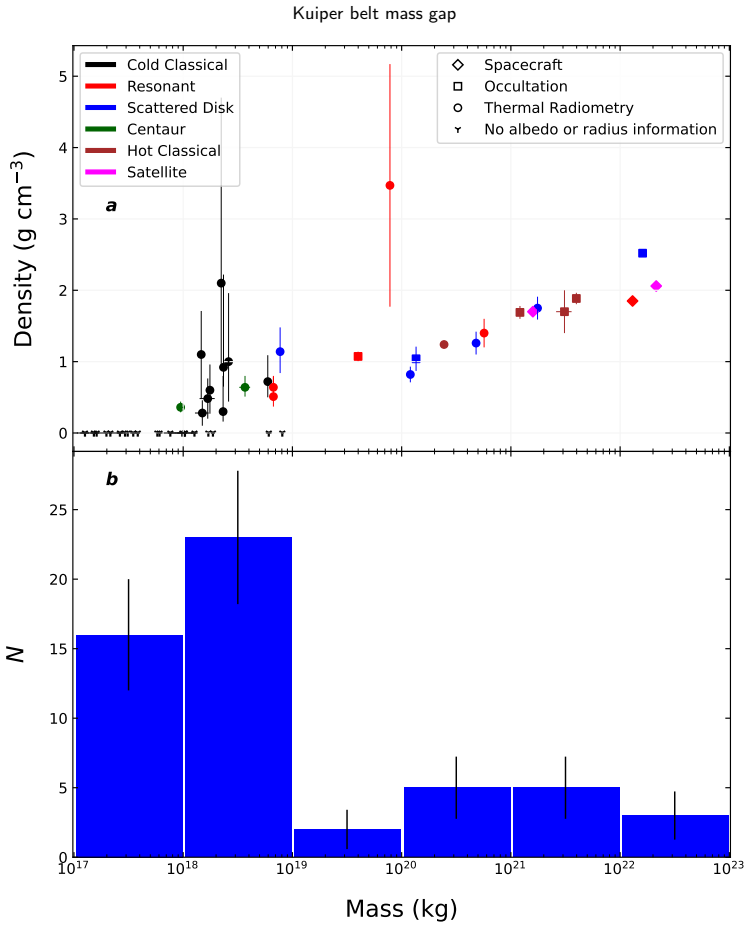
The data products carrying the argument are the mass–density diagram and mass histogram of Kuiper belt binaries with dynamical masses (Fig. 1), assembled from the Johnston (2019) compilation and updated with non-Keplerian fits, occultation radii, and new density determinations. The continuity of the H-magnitude distribution of all KBOs (Fig. 2) is what turns the empty histogram bin at $10^{19}$–$10^{20}$ kg into a puzzle. The dynamical argument is carried by two scalings plotted against mass: the binary semimajor axis as a fraction of Hill radius, a/R_H, and the square of the primary radius over the secondary semimajor axis, (R_p/a)^2, used as a proxy for the quadrupole term in non-Keplerian motion. The mass–magnitude scaling ($m^{{2/3}}$ for brightness versus $m^{{1/3}}$ for Hill separation) is the key explanatory mechanism for why observational bias would preferentially hide gap binaries.
What would settle it
A search for satellites around every known Kuiper belt object with 4 < H < 5, using high-resolution imaging deep enough to detect companions at the magnitude and separation limits implied by the adjacent mass bins, would settle the question: finding many such systems would fill the gap and make it a detection artifact, while a completeness-corrected null result would confirm that binaries in this mass range are genuinely scarce.
Extended reading notes
Core claim
The paper's central claim is that the known census of Kuiper belt binaries contains a pronounced dearth in the mass range approximately $10^{19}$–$10^{20}$ kg, with only two objects (Huya and 2002 WC19) in that bin, mirrored by a shortage of binaries with absolute magnitude 4 < H < 5. Because the H-magnitude distribution of all KBOs is continuous through this range, the absence is not simply the absence of planetesimals; the binaries themselves are missing or hidden. The paper reads the lower edge of the gap as the high-mass end of the cold classical population, whose size distribution is truncated near 400 km in the OSSOS data and whose formation by streaming instability naturally tapers at high masses. The upper edge is less clear; the objects there carry small satellites on tight orbits, and the paper proposes that these objects lost their original wide binary companions during growth by pebble accretion, before or while Neptune scattered them outward. An alternative, explicitly considered, is observational bias: at these masses a companion of a given fractional size is dimmer than the corresponding separation suggests, because magnitude scales as $mass^{{2/3}}$ while Hill radius scales as $mass^{{1/3}}$, so faint close-in satellites could hide in the gap. The paper concludes the gap is likely a combination of formation imprint and observational bias, and flags the two known gap objects as possibly fragments of differentiated parent bodies.
Load-bearing premise
The load-bearing premise is that the Johnston (2019) compilation, as updated by the paper, is a fair census of binaries with dynamical masses; if the surveys that found these binaries systematically miss companions in the $10^{19}$–$10^{20}$ kg range, the gap could be an artifact rather than a physical feature.
Editorial extensions
If this is right
- If the gap is real, the cold classical truncation near 400 km marks the high-mass end of planetesimals formed by streaming instability, so future surveys should see a corresponding scarcity of equal-mass binaries above 10^19 kg in that population.
- Binaries in the gap, if they exist, should be systems with small, faint satellites on tight orbits; the two known examples, Huya and 2002 WC19, already follow the small-satellite trend of the higher-mass objects.
- Mass determinations of gap objects may require non-Keplerian orbit models, because (R_p/a)^2 is large enough there; some binaries in the gap may have been detected without dynamical masses.
- The absence of dynamically widened ultra-wide binaries among high-mass objects suggests that their primordial satellites were lost during growth, and the paper identifies pebble-accretion dynamical friction as a previously unstudied disruption channel.
- If the observational-bias explanation dominates, the missing binaries are likely to be found as secondaries more easily than as primaries; Vanth and Dysnomia, satellites whose masses fall in or near the gap, support this possibility.
- The trend of increasing (R_p/a)^2 with decreasing mass implies that any new gap binaries should show strong non-Keplerian orbital signatures; that signal could be used to estimate masses even when a resolved orbit is impossible, turning the suspected bias into a discovery tool.
Reading between the lines
- The paper leaves implicit that a targeted deep-imaging campaign on known single KBOs with 4 < H < 5 could directly distinguish the two explanations: finding close, faint companions would fill the gap observationally, while a completeness-corrected null result would support physical destruction.
- A quantitative completeness simulation—synthetic binaries drawn from the mass-ratio and separation distributions of the adjacent mass bins and passed through actual detection limits—would measure how much of the gap is expected from visibility alone; the paper does not run such a calculation.
- The same mass range could be examined in other trans-Neptunian populations, such as Neptune Trojans or detached objects, to see whether the gap reflects a universal planetesimal-formation boundary or something specific to the cold classical and implanted populations.
- The (R_p/a)^2 trend also suggests that, if gap binaries are found, mutual-event timing or light-curve analysis could independently verify their masses, which would help calibrate whether the current mass measurements are biased by assuming Keplerian orbits.
Editorial analysis
A structured set of objections, weighed in public.
Referee Report
Summary. The paper compiles Kuiper Belt objects with dynamically determined binary masses, updating the Johnston (2019) compilation with recent measurements and with explicit curation choices (removing Mors, 2001 QW322, and 2001 QG298; adding 2003 QA91 and 2002 VT130 under the equal-density assumption; updating Pluto, Charon, Quaoar, Gonggong, Huya, and others). It calls attention to a mass interval between roughly 10^19 and 10^20 kg that contains only two objects, Huya and 2002 WC19, and to a corresponding deficiency in binaries with absolute magnitude H between 4 and 5. The paper shows that the H distribution of all KBOs is continuous through this range, so many primaries exist, and then discusses two classes of explanation: physical suppression or disruption of binaries, and observational bias. It also reports a trend of increasing (R_p/a)^2 with decreasing mass on the high-mass side of the gap, suggesting that non-Keplerian effects may complicate mass determinations for gap objects.
Significance. If the gap is real, it would be a substantive constraint on KBO formation and evolution, linking the cold classical size cutoff, binary survival, and the transition between wide equal-mass binaries and small close satellites. The paper has clear strengths: the data compilation is transparent, the judgment calls are stated explicitly, the appendices check robustness to the system-mass versus primary-mass choice, and the comparison to independent results (OSSOS cutoff, streaming-instability mass functions, binary-widening simulations) grounds the discussion in existing literature. However, the central dearth is not yet established quantitatively: no significance test is attached to the mass histogram, and no completeness model is provided to separate a physical gap from a detection or mass-determination bias. The paper is an interesting and clearly written research letter, but its headline claim currently rests on an unquantified sparse bin.
major comments (4)
- [Section 2, Fig. 1b] The central claim of a mass gap is presented without a statistical significance test. The 10^19-10^20 kg bin contains just two objects, and with a total sample of order 40-50 binaries, a decade-wide bin with one or two objects can be a Poisson fluctuation under a smooth underlying mass distribution. Please provide expected counts from a fitted or assumed mass distribution, a bootstrap analysis, or an equivalent test, and check sensitivity to the choice of bin boundaries.
- [Section 3, 'The other possibility, of observational bias'] No completeness calculation is given for how binaries are found and how their masses are measured. The mass histogram in Fig. 1b includes only binaries with dynamical masses, and the paper itself notes that more binaries in the gap may have been detected without measured masses. The continuity of the H distribution of all KBOs in Fig. 2 shows that primaries exist, but it does not show that their companions would have been detected, resolved, or assigned orbits by the heterogeneous surveys that populate the Johnston compilation. Because the H=4-5 bin lies at the boundary between HST wide-binary surveys and AO/occultation small-satellite searches, a quantitative detectability model as a function of primary H, separation, and flux ratio is needed to distinguish a physical dearth from the bias the paper explicitly acknowledges as possible.
- [Abstract and Fig. 2] The abstract's phrase 'corresponding dearth in binaries between 4th and 5th absolute magnitude H' overstates the correspondence. The two objects in the mass gap, Huya (H=5.31) and 2002 WC19 (H=5.0), lie on the dim side of the H=4-5 bin, while the two objects in the H=4-5 bin, Salacia (H=4.24) and 2000 YW134 (H=4.72), are not in the mass gap: Salacia is on the high-mass side and YW134 has an estimated mass near 5x10^18 kg, on the low-mass side. The paper notes this in the caption, but the claim as stated in the abstract should be revised or supported by a quantitative H-to-mass mapping that reconciles the two gaps.
- [Section 3, Fig. 3b] The (R_p/a)^2 trend is used to argue that non-Keplerian effects should become significant inside the gap, but the regression is presented without a correlation coefficient, significance level, or assessment of how the assumed equal-density masses and heterogeneous radius methods affect it. Given that this trend is one of the paper's forward-looking predictions, please report the fit statistics and their sensitivity to the adopted mass assumptions, or explicitly label the trend as speculative.
minor comments (4)
- [Section 1] The statement 'As noted by Bernstein et al. (2023)' appears to cite the 2023 PSJ paper on synchronous rotation in the Eris-Dysnomia system, which does not obviously contain the population-difference claim attributed to it; please verify the reference or supply the intended one.
- [Fig. 2 and Section 2] For reproducibility, please report the query date and selection criteria used for the JPL Small-Body Database 'all KBOs' sample, including how objects without dynamical classifications are treated.
- [Section 2] Until the significance analysis is added, consider using a neutral term such as 'sparsely populated interval' rather than 'gap' for the two-object bin, since 'gap' implies a deficit relative to an expected count.
- [Section 3, Fig. 3a] The whiskers marking eccentricity excursions are described in the caption but their exact definition (which eccentricities, apoastron versus periastron of which orbit) is not fully specified; a sentence in the text would help.
Circularity Check
No circularity in the derivation chain: the mass/magnitude gap is a direct census reading, the extrapolated (Rp/a)^2 trend is explicitly conditional, and self-citations are contextual only.
full rationale
The central 'gap' claim is an empirical reading of the Johnston (2019) compilation plus stated updates ('The data we use is from Johnston (2019, hereafter J19), with masses from non-Keplerian orbital fits from (Proudfoot et al. 2024) when available'), not the output of a derivation that re-injects its conclusion. The comparisons that give the gap physical meaning are external: OSSOS completeness at 400 km and streaming-instability simulations are independent of the author's own work, and the (Rp/a)^2 trend is a linear regression on the high-mass subset whose extension into the gap is explicitly conditional ('If binaries in the gap follow the same trend, non-Keplerian effects on the orbit should be significant'), not a 'prediction' that was fitted to the gap bin. The paper also openly considers the competing explanation ('The other possibility, of observational bias, is that binaries in the gap exist...') and even states 'the hypothesis that the satellites exist but are too dim to observe may be the correct one.' The paper explicitly disclaims novelty of the pattern itself: 'The gap has appeared in graphs in the literature before, but focus has been put on density trends or size ratio and separation of the binaries.' Author self-citations (Lyra et al. 2023; Cañas et al. 2024) appear only as contextual support for formation location and density trends, not as the source of the gap or as a uniqueness argument. No equation is defined in terms of the target result, no fitted parameter is renamed as an independent prediction, and no load-bearing uniqueness theorem is imported from the author's prior work. The skeptic's completeness and small-number concerns are empirical robustness issues, not circularity. There is therefore no circular step that can be quoted and exhibited; the only reason the score is not exactly 0 is the presence of self-citations, which are non-load-bearing.
Assumptions & free parameters
free parameters (1)
- Linear regression slope and intercept for (Rp/a)^2 versus mass =
Not stated numerically; dashed line in Fig. 3b
assumptions (5)
- domain assumption OSSOS survey is complete for cold classical KBOs down to about 400 km diameter.
- domain assumption Streaming instability produces an initial mass function with an exponential taper at the high-mass end.
- domain assumption Equal primary and secondary densities for cold classical binaries when converting system mass to primary mass.
- domain assumption The H magnitude distribution of all KBOs is a reliable proxy for the mass distribution across the gap.
- standard math (Rp/a)^2 is a valid proxy for the importance of non-Keplerian quadrupole effects.
Cite this review
Pith. "Pith review of Where are the missing Kuiper Belt binaries?." pith.science (2026). https://pith.science/paper/MARGLRPM
@misc{pith2026250708948,
  author       = {Pith},
  title        = {Pith review of: Where are the missing Kuiper Belt binaries?},
  year         = {2026},
  howpublished = {\url{https://pith.science/paper/MARGLRPM}},
  note         = {Machine review of arXiv:2507.08948}
}
abstract
In this letter, we call attention to a gap in binaries in the Kuiper belt in the mass range between $\approx$10$^{19}$-10$^{20}$ kg, with a corresponding dearth in binaries between 4th and 5th absolute magnitude $H$. The low-mass end of the gap is consistent with the truncation of the cold classical population at 400 km, as suggested by the OSSOS survey, and predicted by simulations of planetesimal formation by streaming instability. The distribution of magnitudes for all KBOs is continuous, which means that many objects exist in the gap, but the binaries in this range have either been disrupted, or the companions are too close to the primary and/or too dim to be detected with the current generation of observational instruments. At the high-mass side of the gap, the objects have small satellites at small separations, and we find a trend that as mass decreases, the ratio of primary radius to secondary semimajor increases. If this trend continues into the gap, non-Keplerian effects should make mass determination more challenging.
Figures


Figures from the paper (2 more)


Reference graph
Works this paper leans on
-
[1]
author Agnor , C.B. , author Hamilton , D.P. , year 2006 . title Neptune's capture of its moon Triton in a binary-planet gravitational encounter . journal volume 441 , pages 192--194 . :10.1038/nature04792
-
[2]
Early formation of moons around large trans-Neptunian objects via giant impacts
author Arakawa , S. , author Hyodo , R. , author Genda , H. , year 2019 . title Early formation of moons around large trans-Neptunian objects via giant impacts . journal Nature Astronomy volume 3 , pages 802--807 . :10.1038/s41550-019-0797-9, arXiv:1906.10833 http://arxiv.org/abs/1906.10833
work page Pith review arXiv 2019
-
[3]
author Barucci , M.A. , author Boehnhardt , H. , author Cruikshank , D.P. , author Morbidelli , A. , author Dotson , R. , year 2008 . title The Solar System Beyond Neptune
work page 2008
-
[4]
author Batygin , K. , author Brown , M.E. , author Fraser , W.C. , year 2011 . title Retention of a Primordial Cold Classical Kuiper Belt in an Instability-Driven Model of Solar System Formation . journal volume 738 , pages 13 . :10.1088/0004-637X/738/1/13, arXiv:1106.0937 http://arxiv.org/abs/1106.0937
arXiv 2011
-
[5]
Synchronous rotation in the (136199) Eris-Dysnomia system
author Bernstein , G.M. , author Holler , B.J. , author Navarro-Escamilla , R. , author Bernardinelli , P.H. , author Abbott , T.M.C. , author Aguena , M. , author Allam , S. , author Alves , O. , author Andrade-Oliveira , F. , author Annis , J. , author Bacon , D. , author Brooks , D. , author Burke , D.L. , author Carnero Rosell , A. , author Carretero ...
work page Pith review arXiv 2023
-
[6]
author Bernstein , G.M. , author Trilling , D.E. , author Allen , R.L. , author Brown , M.E. , author Holman , M. , author Malhotra , R. , year 2004 . title The Size Distribution of Trans-Neptunian Bodies . journal volume 128 , pages 1364--1390 . :10.1086/422919, arXiv:astro-ph/0308467 http://arxiv.org/abs/astro-ph/0308467
arXiv 2004
-
[7]
author Bierson , C.J. , author Nimmo , F. , year 2019 . title Using the density of Kuiper Belt Objects to constrain their composition and formation history . journal volume 326 , pages 10--17 . :10.1016/j.icarus.2019.01.027
-
[8]
author Bottke , W.F. , author Vokrouhlick \'y , D. , author Marschall , R. , author Nesvorn \'y , D. , author Morbidelli , A. , author Deienno , R. , author Marchi , S. , author Dones , L. , author Levison , H.F. , year 2023 . title The Collisional Evolution of the Primordial Kuiper Belt, Its Destabilized Population, and the Trojan Asteroids . journal vol...
work page Pith review arXiv 2023
Show all 68 references
-
[9]
, author Sicardy , B
author Braga-Ribas , F. , author Sicardy , B. , author Ortiz , J.L. , author Lellouch , E. , author Tancredi , G. , author Lecacheux , J. , author Vieira-Martins , R. , author Camargo , J.I.B. , author Assafin , M. , author Behrend , R. , author Vachier , F. , author Colas , F...
2013
-
[10]
, year 2013 a
author Brown , M.E. , year 2013 a. title On the Size, Shape, and Density of Dwarf Planet Makemake . journal volume 767 , pages L7 . :10.1088/2041-8205/767/1/L7, arXiv:1304.1041 http://arxiv.org/abs/1304.1041
2013 arXiv
-
[11]
, year 2013 b
author Brown , M.E. , year 2013 b. title The Density of Mid-sized Kuiper Belt Object 2002 UX25 and the Formation of the Dwarf Planets . journal volume 778 , pages L34 . :10.1088/2041-8205/778/2/L34, arXiv:1311.0553 http://arxiv.org/abs/1311.0553
2013 arXiv
-
[12]
, author Butler , B.J
author Brown , M.E. , author Butler , B.J. , year 2017 . title The Density of Mid-sized Kuiper Belt Objects from ALMA Thermal Observations . journal volume 154 , pages 19 . :10.3847/1538-3881/aa6346, arXiv:1702.07414 http://arxiv.org/abs/1702.07414
2017 arXiv
-
[13]
, author Butler , B.J
author Brown , M.E. , author Butler , B.J. , year 2018 . title Medium-sized Satellites of Large Kuiper Belt Objects . journal volume 156 , pages 164 . :10.3847/1538-3881/aad9f2, arXiv:1801.07221 http://arxiv.org/abs/1801.07221
2018 arXiv
-
[14]
, author Butler , B.J
author Brown , M.E. , author Butler , B.J. , year 2023 . title Masses and Densities of Dwarf Planet Satellites Measured with ALMA . journal volume 4 , pages 193 . :10.3847/PSJ/ace52a, arXiv:2307.04848 http://arxiv.org/abs/2307.04848
2023 arXiv
-
[15]
, author van Dam , M.A
author Brown , M.E. , author van Dam , M.A. , author Bouchez , A.H. , author Le Mignant , D. , author Campbell , R.D. , author Chin , J.C.Y. , author Conrad , A. , author Hartman , S.K. , author Johansson , E.M. , author Lafon , R.E. , author Rabinowitz , D.L. , author Stomski...
2006 arXiv
-
[16]
, author Jacobson , R.A
author Brozovi \'c , M. , author Jacobson , R.A. , year 2024 . title Post-new-horizons Orbits and Masses for the Satellites of Pluto . journal volume 167 , pages 256 . :10.3847/1538-3881/ad39f0
2024 doi
-
[17]
, author Zanardi , M
author Brunini , A. , author Zanardi , M. , year 2016 . title Dynamical and collisional evolution of Kuiper belt binaries . journal volume 455 , pages 4487--4497 . :10.1093/mnras/stv2602
2016 doi
-
[18]
, author Lyra , W
author Ca \ n as , M.H. , author Lyra , W. , author Carrera , D. , author Krapp , L. , author Sengupta , D. , author Simon , J.B. , author Umurhan , O.M. , author Yang , C.C. , author Youdin , A.N. , year 2024 . title A Solution for the Density Dichotomy Problem of Kuiper Belt...
2024 arXiv
-
[19]
, author Anderson , K.E
author Campbell , H.M. , author Anderson , K.E. , author Kaib , N.A. , year 2025 . title A non-primordial origin for the widest binaries in the Kuiper belt . journal Nature Astronomy volume 9 , pages 75--80 . :10.1038/s41550-024-02388-4, arXiv:2411.09908 http://arxiv.org/abs/2...
2025 arXiv
-
[20]
, author Stone , L.R
author Campbell , H.M. , author Stone , L.R. , author Kaib , N.A. , year 2023 . title Close Trans-Neptunian Object Passages as a Driver of the Origin and Evolution of Ultrawide Kuiper Belt Binaries . journal volume 165 , pages 19 . :10.3847/1538-3881/aca08e, arXiv:2211.06383 h...
2023 arXiv
-
[21]
, year 2005
author Canup , R.M. , year 2005 . title A Giant Impact Origin of Pluto-Charon . journal Science volume 307 , pages 546--550 . :10.1126/science.1106818
2005 doi
-
[22]
, year 2011
author Canup , R.M. , year 2011 . title On a Giant Impact Origin of Charon, Nix, and Hydra . journal volume 141 , pages 35 . :10.1088/0004-6256/141/2/35
2011 doi
-
[23]
, author Harrington , R.S
author Christy , J.W. , author Harrington , R.S. , year 1978 . title The satellite of Pluto. journal volume 83 , pages 1005 . :10.1086/112284
1978 doi
-
[24]
, year 2015
author Descamps , P. , year 2015 . title Dumb-bell-shaped equilibrium figures for fiducial contact-binary asteroids and EKBOs . journal volume 245 , pages 64--79 . :10.1016/j.icarus.2014.08.002, arXiv:1410.7962 http://arxiv.org/abs/1410.7962
2015 arXiv
-
[25]
, author Brasser , R
author Dones , L. , author Brasser , R. , author Kaib , N. , author Rickman , H. , year 2015 . title Origin and Evolution of the Cometary Reservoirs . journal volume 197 , pages 191--269 . :10.1007/s11214-015-0223-2
2015 doi
-
[26]
, author Brown , M.E
author Fraser , W.C. , author Brown , M.E. , author Schwamb , M.E. , year 2010 . title The luminosity function of the hot and cold Kuiper belt populations . journal volume 210 , pages 944--955 . :10.1016/j.icarus.2010.08.001, arXiv:1008.1058 http://arxiv.org/abs/1008.1058
2010 arXiv
-
[27]
, author Levison , H.F
author Gomes , R. , author Levison , H.F. , author Tsiganis , K. , author Morbidelli , A. , year 2005 . title Origin of the cataclysmic Late Heavy Bombardment period of the terrestrial planets . journal volume 435 , pages 466--469 . :10.1038/nature03676
2005 doi
-
[28]
, author Noll , K.S
author Grundy , W.M. , author Noll , K.S. , author Roe , H.G. , author Buie , M.W. , author Porter , S.B. , author Parker , A.H. , author Nesvorn \'y , D. , author Levison , H.F. , author Benecchi , S.D. , author Stephens , D.C. , author Trujillo , C.A. , year 2019 . title Mut...
2019 doi
-
[29]
, author Porter , S.B
author Grundy , W.M. , author Porter , S.B. , author Benecchi , S.D. , author Roe , H.G. , author Noll , K.S. , author Trujillo , C.A. , author Thirouin , A. , author Stansberry , J.A. , author Barker , E. , author Levison , H.F. , year 2015 . title The mutual orbit, mass, and...
2015 arXiv
-
[30]
, year 2003
author Hahn , J.M. , year 2003 . title The Secular Evolution of the Primordial Kuiper Belt . journal volume 595 , pages 531--549 . :10.1086/377195, arXiv:astro-ph/0305602 http://arxiv.org/abs/astro-ph/0305602
2003 arXiv
-
[31]
, author Luu , J
author Jewitt , D. , author Luu , J. , year 1993 . title Discovery of the candidate Kuiper belt object 1992 QB _ 1 . journal volume 362 , pages 730--732 . :10.1038/362730a0
1993 doi
-
[32]
, author Mac Low , M.M
author Johansen , A. , author Mac Low , M.M. , author Lacerda , P. , author Bizzarro , M. , year 2015 . title Growth of asteroids, planetary embryos, and Kuiper belt objects by chondrule accretion . journal Science Advances volume 1 , pages 1500109 . :10.1126/sciadv.1500109, a...
2015 arXiv
-
[33]
, year 2019
author Johnston , W.R. , year 2019 . title Binary Minor Planets Compilation V3.0 . howpublished NASA Planetary Data System, urn:nasa:pds:ast\_binary\_parameters\_compilation::3.0 . :10.26033/bb68-pw96
2019 doi
-
[34]
, author Petit , J.M
author Kavelaars , J.J. , author Petit , J.M. , author Gladman , B. , author Bannister , M.T. , author Alexandersen , M. , author Chen , Y.T. , author Gwyn , S.D.J. , author Volk , K. , year 2021 . title OSSOS Finds an Exponential Cutoff in the Size Distribution of the Cold Cl...
2021 arXiv
-
[35]
, author Marton , G
author Kiss , C. , author Marton , G. , author Parker , A.H. , author Grundy , W.M. , author Farkas-Tak \'a cs , A. , author Stansberry , J. , author P \'a l , A. , author M \"u ller , T. , author Noll , K.S. , author Schwamb , M.E. , author Barr , A.C. , author Young , L.A. ,...
2019 arXiv
-
[36]
, author Doressoundiram , A
author Kovalenko , I.D. , author Doressoundiram , A. , author Lellouch , E. , author Vilenius , E. , author M \"u ller , T. , author Stansberry , J. , year 2017 . title ``TNOs are Cool'': A survey of the trans-Neptunian region. XIII. Statistical analysis of multiple trans-Nept...
2017 doi
-
[37]
, year 2011
author Lacerda , P. , year 2011 . title A Change in the Light Curve of Kuiper Belt Contact Binary (139775) 2001 QG _ 298 . journal volume 142 , pages 90 . :10.1088/0004-6256/142/3/90, arXiv:1107.3507 http://arxiv.org/abs/1107.3507
2011 arXiv
-
[38]
, author Santos-Sanz , P
author Lellouch , E. , author Santos-Sanz , P. , author Lacerda , P. , author Mommert , M. , author Duffard , R. , author Ortiz , J.L. , author M \"u ller , T.G. , author Fornasier , S. , author Stansberry , J. , author Kiss , C. , author Vilenius , E. , author Mueller , M. , ...
2013
-
[39]
, author Johansen , A
author Lyra , W. , author Johansen , A. , author Ca \ n as , M.H. , author Yang , C.C. , year 2023 . title An Analytical Theory for the Growth from Planetesimals to Planets by Polydisperse Pebble Accretion . journal arXiv e-prints , pages arXiv:2301.03825 :10.48550/arXiv.2301....
-
[40]
, year 2019
author Malhotra , R. , year 2019 . title Resonant Kuiper belt objects: a review . journal Geoscience Letters volume 6 , pages 12 . :10.1186/s40562-019-0142-2, arXiv:1911.07897 http://arxiv.org/abs/1911.07897
2019 arXiv
-
[41]
, author Stern , S.A
author McKinnon , W.B. , author Stern , S.A. , author Weaver , H.A. , author Nimmo , F. , author Bierson , C.J. , author Grundy , W.M. , author Cook , J.C. , author Cruikshank , D.P. , author Parker , A.H. , author Moore , J.M. , author Spencer , J.R. , author Young , L.A. , a...
2017
-
[42]
, author Brown , M.E
author Morbidelli , A. , author Brown , M.E. , author Morbidelli , H.F. , year 2003 . title The Kuiper Belt and its Primordial Sculpting . journal Earth Moon and Planets volume 92 , pages 1--27 . :10.1023/B:MOON.0000031921.37380.80
2003
-
[43]
, author Levison , H.F
author Morbidelli , A. , author Levison , H.F. , author Gomes , R. , year 2008 . title The Dynamical Structure of the Kuiper Belt and Its Primordial Origin , in: editor Barucci , M.A. , editor Boehnhardt , H. , editor Cruikshank , D.P. , editor Morbidelli , A. , editor Dotson ...
-
[44]
, author Nesvorn \'y , D
author Morbidelli , A. , author Nesvorn \'y , D. , year 2020 . title Kuiper belt: formation and evolution , in: editor Prialnik , D. , editor Barucci , M.A. , editor Young , L. (Eds.), booktitle The Trans-Neptunian Solar System , pp. pages 25--59 . :10.1016/B978-0-12-816490-7.00002-3
2020 doi
-
[45]
, author Valsecchi , G.B
author Morbidelli , A. , author Valsecchi , G.B. , year 1997 . title NOTE: Neptune Scattered Planetesimals Could Have Sculpted the Primordial Edgeworth-Kuiper Belt . journal volume 128 , pages 464--468 . :10.1006/icar.1997.5745
1997
-
[46]
, author Sicardy , B
author Morgado , B.E. , author Sicardy , B. , author Braga-Ribas , F. , author Ortiz , J.L. , author Salo , H. , author Vachier , F. , author Desmars , J. , author Pereira , C.L. , author Santos-Sanz , P. , author Sfair , R. , author de Santana , T. , author Assafin , M. , aut...
2023
-
[47]
, author Lellouch , E
author M \"u ller , T.G. , author Lellouch , E. , author Stansberry , J. , author Kiss , C. , author Santos-Sanz , P. , author Vilenius , E. , author Protopapa , S. , author Moreno , R. , author Mueller , M. , author Delsanti , A. , author Duffard , R. , author Fornasier , S. ...
2010 arXiv
-
[48]
, author Grundy , W.M
author Noll , K. , author Grundy , W.M. , author Nesvorn \'y , D. , author Thirouin , A. , year 2020 . title Trans-Neptunian binaries (2018) , in: editor Prialnik , D. , editor Barucci , M.A. , editor Young , L. (Eds.), booktitle The Trans-Neptunian Solar System , pp. pages 20...
2018 doi
-
[49]
, author Grundy , W.M
author Noll , K.S. , author Grundy , W.M. , author Chiang , E.I. , author Margot , J.L. , author Kern , S.D. , year 2008 a. title Binaries in the Kuiper Belt . p. pages 345
2008
-
[50]
, author Grundy , W.M
author Noll , K.S. , author Grundy , W.M. , author Stephens , D.C. , author Levison , H.F. , author Kern , S.D. , year 2008 b. title Evidence for two populations of classical transneptunian objects: The strong inclination dependence of classical binaries . journal volume 194 ,...
2008 arXiv
-
[51]
, author Kavelaars , J.J
author Parker , A.H. , author Kavelaars , J.J. , year 2010 . title Destruction of Binary Minor Planets During Neptune Scattering . journal volume 722 , pages L204--L208 . :10.1088/2041-8205/722/2/L204, arXiv:1009.3495 http://arxiv.org/abs/1009.3495
2010 arXiv
-
[52]
, author Kavelaars , J.J
author Parker , A.H. , author Kavelaars , J.J. , author Petit , J.M. , author Jones , L. , author Gladman , B. , author Parker , J. , year 2011 . title Characterization of Seven Ultra-wide Trans-Neptunian Binaries . journal volume 743 , pages 1 . :10.1088/0004-637X/743/1/1, ar...
2011 arXiv
-
[53]
, author Sicardy , B
author Pereira , C.L. , author Sicardy , B. , author Morgado , B.E. , author Braga-Ribas , F. , author Fern \'a ndez-Valenzuela , E. , author Souami , D. , author Holler , B.J. , author Boufleur , R.C. , author Margoti , G. , author Assafin , M. , author Ortiz , J.L. , author ...
2023 arXiv
-
[54]
, author Kavelaars , J.J
author Petit , J.M. , author Kavelaars , J.J. , author Gladman , B.J. , author Jones , R.L. , author Parker , J.W. , author Van Laerhoven , C. , author Nicholson , P. , author Mars , G. , author Rousselot , P. , author Mousis , O. , author Marsden , B. , author Bieryla , A. , ...
2011 arXiv
-
[55]
, author Kavelaars , J.J
author Petit , J.M. , author Kavelaars , J.J. , author Gladman , B.J. , author Margot , J.L. , author Nicholson , P.D. , author Jones , R.L. , author Parker , J.W. , author Ashby , M.L.N. , author Campo Bagatin , A. , author Benavidez , P. , author Coffey , J. , author Roussel...
2008 doi
-
[56]
, author Barucci , M.A
author Prialnik , D. , author Barucci , M.A. , author Young , L. , year 2020 . title The Trans-Neptunian Solar System
2020
-
[57]
, author Ragozzine , D.A
author Proudfoot , B.C.N. , author Ragozzine , D.A. , author Thatcher , M.L. , author Grundy , W. , author Spencer , D.J. , author Alailima , T.M. , author Allen , S. , author Bowden , P.C. , author Byrd , S. , author Camacho , C.D. , author Campbell , G.H. , author Carlisle ,...
2024 arXiv
-
[58]
, author Fern \'a ndez-Valenzuela , E
author Rommel , F.L. , author Fern \'a ndez-Valenzuela , E. , author Proudfoot , B.C.N. , author Ortiz , J.L. , author Morgado , B.E. , author Sicardy , B. , author Morales , N. , author Braga-Ribas , F. , author Desmars , J. , author Vieira-Martins , R. , author Holler , B.J....
2025 arXiv
-
[59]
, author Ragozzine , D
author Sheppard , S.S. , author Ragozzine , D. , author Trujillo , C. , year 2012 . title 2007 TY430: A Cold Classical Kuiper Belt Type Binary in the Plutino Population . journal volume 143 , pages 58 . :10.1088/0004-6256/143/3/58, arXiv:1112.2708 http://arxiv.org/abs/1112.2708
2012 arXiv
-
[60]
, author Bellucci , A
author Sicardy , B. , author Bellucci , A. , author Gendron , E. , author Lacombe , F. , author Lacour , S. , author Lecacheux , J. , author Lellouch , E. , author Renner , S. , author Pau , S. , author Roques , F. , author Widemann , T. , author Colas , F. , author Vachier , ...
2006
-
[61]
, year 1930
author Slipher , V.M. , year 1930 . title Planet X-Lowell Observatory Observation Circular . journal volume 24 , pages 282
1930
-
[62]
, author Grundy , W
author Stansberry , J. , author Grundy , W. , author Brown , M. , author Cruikshank , D. , author Spencer , J. , author Trilling , D. , author Margot , J.L. , year 2008 . title Physical Properties of Kuiper Belt and Centaur Objects: Constraints from the Spitzer Space Telescope...
-
[63]
, author Noll , K.S
author Stephens , D.C. , author Noll , K.S. , year 2006 . title Detection of Six Trans-Neptunian Binaries with NICMOS: A High Fraction of Binaries in the Cold Classical Disk . journal volume 131 , pages 1142--1148 . :10.1086/498715, arXiv:astro-ph/0510130 http://arxiv.org/abs/...
2006 arXiv
-
[64]
, year 1996
author Stern , S.A. , year 1996 . title On the Collisional Environment, Accretion Time Scales, and Architecture of the Massive, Primordial Kuiper Belt. journal volume 112 , pages 1203 . :10.1086/118091
1996 doi
-
[65]
, author Colwell , J.E
author Stern , S.A. , author Colwell , J.E. , year 1997 . title Collisional Erosion in the Primordial Edgeworth-Kuiper Belt and the Generation of the 30-50 AU Kuiper Gap . journal volume 490 , pages 879--882 . :10.1086/304912
1997 doi
-
[66]
, year 1946
author Tombaugh , C.W. , year 1946 . title The Search for the Ninth Planet, Pluto . journal Leaflet of the Astronomical Society of the Pacific volume 5 , pages 73
1946
-
[67]
, author Gomes , R
author Tsiganis , K. , author Gomes , R. , author Morbidelli , A. , author Levison , H.F. , year 2005 . title Origin of the orbital architecture of the giant planets of the Solar System . journal volume 435 , pages 459--461 . :10.1038/nature03539
2005 doi
-
[68]
, author Kiss , C
author Vilenius , E. , author Kiss , C. , author M \"u ller , T. , author Mommert , M. , author Santos-Sanz , P. , author P \'a l , A. , author Stansberry , J. , author Mueller , M. , author Peixinho , N. , author Lellouch , E. , author Fornasier , S. , author Delsanti , A. , ...
2014 arXiv
Reviewed August 6, 2026 · model on record in the stance chip above.
Discussion (0). Sign in to comment.