REVIEW 4 major objections 5 minor 4 cited by
MoRE: Mixture of Residual Experts for Humanoid Lifelike Gaits Learning on Complex Terrains
T0 review · 4 major / 5 minor · reviewed 2026-08-07 · deepseek-v4-flash
Pith's one-line read One policy switches walk, run, squat and high-knees on rough terrain.
desk verdict A solid two-stage MoE residual policy for multi-gait humanoid locomotion on complex terrains, with real robot demos, but the 'controllable seamless switching' claim is asserted rather than measured. read the letter →
The pith
A machine-rendered reading of the paper's core claim, the machinery that carries it, and where it could break.
The reading
What carries the argument
The load-bearing object is the mixture of latent residual experts (MoRE) module: $N$ expert MLPs and a gate network, all taking the actor feature and gait command as input, produce a latent residual $z' = \sum_i z^e_i \cdot \mathrm{softmax}(w)_i$ that is added to the base policy's last hidden layer. Multi-discriminators implement adversarial motion priors with a least-squares GAN loss plus gradient penalty; each discriminator judges five-step trajectories of 16 joint angles, and the style reward is gated by the gait command. Hand-crafted gait rewards such as knee-lift height and squat height add command-dependent behavioral constraints. Two-stage PPO training with a depth encoder, history encoder, privileged critic, and terrain curriculum completes the mechanism.
What would settle it
Run the second training stage with the style-reward weight set to zero on the same hard terrain benchmark; if the success rate on hard stairs, steps, or gaps does not drop when the style reward is active, the claimed simultaneous preservation of locomotion and lifelike gaits is not established. A second check is to issue a gait command change mid-traversal on a difficult gap or stair; if the robot falls or the gait remains indistinguishable, the seamless-transition claim fails.
Extended reading notes
Core claim
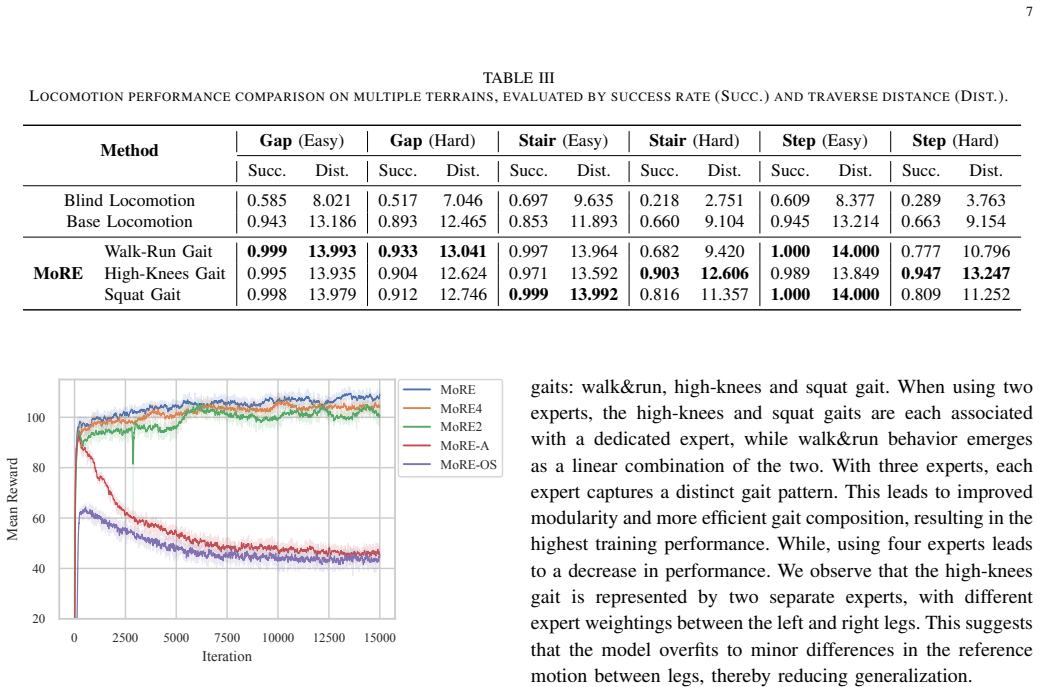
The central claim is that lifelike multi-gait locomotion and complex-terrain traversal are not competing objectives: a base policy trained first for terrain skill can be augmented by a gait-command-gated mixture of latent residual experts without losing its original capability. In the paper's account, the residual module takes the actor feature and a one-hot gait command, and a gating network produces a weighted sum of expert outputs that is added to the last hidden layer of the base policy. Style is injected by multiple discriminators, each trained on five-step, 16-joint trajectories from reference motions, with the style reward selected according to the commanded gait; gait rewards further enforce interpretable targets. Simulation benchmarks show MoRE matching or exceeding the base locomotion policy on gaps, stairs and steps while also producing distinguishable gaits, and real-world deployment on Unitree G1 traverses gap, step, stair and composite terrains with seamless gait transitions.
Load-bearing premise
The method works only if the gait-command-gated style rewards can be added to the depth-based terrain-crossing rewards without degrading the base skill; the paper provides no mechanism that guarantees these two objectives will not conflict.
Editorial extensions
If this is right
- A single policy can replace per-gait controllers: changing the one-hot gait command switches behavior while the same depth-based locomotion weights remain active.
- Latent-space residual fusion is claimed to be more stable than action-space residual addition, since the pretrained actor head keeps actions within a reasonable range even when the residual is random.
- Motion priors improve hard-terrain generalization: the high-knees gait is reported to help on tall steps and stairs, and the walk-run gait is reported to help on wide gaps.
- Exteroception plus style learning enables proactive, not just reactive, terrain response, because the depth stream lets the policy anticipate obstacles before contact.
- The two-stage recipe—locomotion first, style second—keeps training tractable: starting the residual module from a pretrained policy converges, while one-stage training fails.
Reading between the lines
- One implication the paper leaves implicit is that the same gated residual-bank recipe could apply to other reinforcement-learning skills where a base competence must be preserved while a style or mode command is toggled, such as manipulation with different end-effector preferences.
- Because gait rewards let the user tune attributes without retraining the reference motion, reference motion quality becomes less critical: a rough reference plus hand-specified targets may suffice for new gaits.
- A natural stress test would scale beyond three gaits; the paper only varies expert count between two and four, so the claim that each expert captures a distinct gait may break when gaits share leg dynamics.
- The five-step trajectory discriminator suggests that longer temporal windows could stabilize style rewards on more dynamic gaits, a modification that is directly testable with the same codebase.
Editorial analysis
A structured set of objections, weighed in public.
Referee Report
Summary. The paper presents MoRE, a two-stage reinforcement learning framework for humanoid locomotion that first trains a depth-camera-based base policy for traversing complex terrains, then attaches a mixture of latent residual experts driven by a gait command and trained with multi-discriminators and hand-designed gait rewards. The authors claim that a single policy can switch between walk-run, high-knees, and squat gaits while crossing stairs, gaps, and steps, both in simulation (Isaac Gym) and on a real Unitree G1 robot, with quantitative gains over blind and base locomotion policies in Table III and qualitative real-world demonstrations.
Significance. The core algorithmic idea is timely and plausible: adding a latent-space residual mixture to a pretrained exteroceptive locomotion policy is a clean way to inject multiple motion priors without retraining the base terrain-traversal skill. The paper reports consistent quantitative improvements over two reasonable baselines in Table III, and the ablations in Figure 3 support the two-stage training and the latent-residual fusion choice. The use of a five-step trajectory input to the discriminators and gait-command-gated style rewards is a sensible extension of AMP. If the controllability and switching claims were rigorously quantified, this would be a solid contribution to humanoid locomotion. However, as written, the central 'controllable seamless multi-gait traversal' claim is underdetermined by the experiments, and the reported gait-reward modulation is only partially successful, so the significance hinges on additional evidence.
major comments (4)
- [V-A, Table III] The central quantitative comparison reports success rates and distances to three decimal places without any error bars, number of seeded runs, or trial counts. Given typical stochasticity in PPO training and terrain evaluation, the reported differences between MoRE and Base Locomotion (e.g., Stair(Hard) Succ. 0.660 vs 0.682 for Walk-Run, or Step(Hard) 0.663 vs 0.777) may not be statistically significant. Please report mean and standard deviation over at least three training seeds, plus the number of evaluation episodes per terrain.
- [V-A, Fig. 4 and V-B] The manuscript's headline claim is 'controllable lifelike gaits' and 'seamless transitions between multiple human-like gait patterns', but no quantitative experiment measures command adherence or switching. Table III evaluates each gait under a fixed commanded gait, one row per gait, so it does not test switching or command honoring. The only transitional evidence is the real-world narrative of 'smooth and seamless transitions' with no trial count, timing, or metric. Moreover, the paper's own t-SNE analysis (Section V-A, Fig. 4) states that during walk-commanded stair and gap traversal the residual latents cluster in the run region, indicating the policy can override the commanded gait on demanding terrain. Please add a quantitative command-adherence metric (e.g., the fraction of evaluation episodes in which the executed gait matches the commanded gait according to a kinematic classifier, or the measured error between commanded and executed gait-relevant quantities), and report switching-success rates with episode counts in both simulation and on the real robot.
- [IV-D, Table IV] The gait-reward modulation experiment, which is the main evidence for 'precise gait acquisition', is only partially successful. For the squat-height target of 0.550 m, the achieved value is 0.642 ± 0.015 m, a deviation of nearly 0.1 m; the text nonetheless claims the rewards 'enable tune specific motion features in an interpretable manner'. The knee-lift targets are met more accurately, but the squat-height result needs either a discussion of why the target is not reached, a tuned reward weight, or a success criterion. As reported, this table undercuts rather than supports the precision of the gait rewards.
- [V-A, Fig. 3] The MoE contribution is not tested against a single-residual-expert baseline. The ablations vary the number of experts (2, 3, 4) and compare latent vs action residuals, but never compare against a residual module with N=1 (i.e., a plain MLP residual without gating). Without this comparison, the claim that the Mixture-of-Experts architecture 'eliminates gradient conflicts' and is responsible for the improvement is not directly supported; the observed differences among MoRE2, MoRE, and MoRE4 could also be explained by total parameter count or model capacity.
minor comments (5)
- [III-C, Eq. (5)] The notation 'softmax(w)[i]' is undefined; please specify the dimension of the gate logits w and clarify that the softmax is taken over the N expert logits.
- [III-D and IV-1] There are several incorrect cross-references: 'Table III-D' appears where the reward table (Table I) is meant, and 'Table IV-3' is used for the domain-randomization table (Table II). These LaTeX artifacts should be fixed.
- [IV-2 and V-A] Minor typos: 'tree types of reference gaits' should be 'three types', and 'trails' should be 'trials' in the description of the success-rate metric.
- [V-A, Fig. 4] The t-SNE legend includes 'Pit' as a terrain label, but the evaluation terrains described in Section V-A are gaps, stairs, and steps; please clarify what 'Pit' refers to or remove it.
- [V-B] The real-world experiments are described qualitatively with no video or quantitative trajectory data; please provide trial counts, success/failure for each terrain and gait, and timing or footfall data for the claimed 'seamless transitions'.
Circularity Check
No circular derivation found; the only overlapping-author citation (ALMI, ref [24]) is background and not load-bearing.
full rationale
The paper's derivation chain is self-contained. Stage 1 trains a base locomotion policy from scratch using only locomotion rewards, and Stage 2 attaches a residual MoE module with multi-discriminators whose style reward is gated by the one-hot gait command (Eq. 4). Gait-commanded behavior is therefore a trained consequence of an explicit reward-gating mechanism, not an output assumed in the input. The gait rewards in Table III-D are hand-specified targets, and Table IV reports measured achieved values, so there is no fitted parameter renamed as a prediction. The choice of three experts is justified by an ablation curve, not by fitting to the benchmark outcomes. The only self-citation, ALMI [24] in Related Work, is used to describe prior proprioceptive methods and does not supply a load-bearing premise, uniqueness theorem, or ansatz. The t-SNE observation that walk-commanded latents can fall in the run cluster on hard terrain weakens the experimental support for the controllability claim, but that is an empirical evidence gap, not circularity. The score reflects one minor non-load-bearing self-citation; the central result has independent content.
Assumptions & free parameters
free parameters (4)
- Number of residual experts N =
3
- Reward weights and style/gait reward constants =
See Table I, e.g., style reward weight 5.0 and gait reward weights 2.0
- Gait reward target values =
Squat height 0.60 m and 0.55 m; knee height 0.58 m and 0.48 m
- Discriminator trajectory length and gradient penalty coefficient =
Five-step trajectory; alpha_d used in Eq. (3) but value not reported
assumptions (4)
- domain assumption Isaac Gym physics with domain randomization sufficiently approximates real Unitree G1 dynamics for direct sim-to-real transfer.
- domain assumption LAFAN1 motion data retargeted to Unitree G1 provides valid human-like reference gaits for walk-run, high-knees, and squat gaits.
- standard math PPO and AMP-style reward shaping converge to a policy that maximizes both locomotion and style objectives.
- ad hoc to paper Adding a latent residual to the last hidden layer of the pretrained policy does not degrade the base locomotion capability.
Cite this review
Pith. "Pith review of MoRE: Mixture of Residual Experts for Humanoid Lifelike Gaits Learning on Complex Terrains." pith.science (2026). https://pith.science/paper/MBCJCTQ2
@misc{pith2026250608840,
  author       = {Pith},
  title        = {Pith review of: MoRE: Mixture of Residual Experts for Humanoid Lifelike Gaits Learning on Complex Terrains},
  year         = {2026},
  howpublished = {\url{https://pith.science/paper/MBCJCTQ2}},
  note         = {Machine review of arXiv:2506.08840}
}
read the original abstract
Humanoid robots have demonstrated robust locomotion capabilities using Reinforcement Learning (RL)-based approaches. Further, to obtain human-like behaviors, existing methods integrate human motion-tracking or motion prior in the RL framework. However, these methods are limited in flat terrains with proprioception only, restricting their abilities to traverse challenging terrains with human-like gaits. In this work, we propose a novel framework using a mixture of latent residual experts with multi-discriminators to train an RL policy, which is capable of traversing complex terrains in controllable lifelike gaits with exteroception. Our two-stage training pipeline first teaches the policy to traverse complex terrains using a depth camera, and then enables gait-commanded switching between human-like gait patterns. We also design gait rewards to adjust human-like behaviors like robot base height. Simulation and real-world experiments demonstrate that our framework exhibits exceptional performance in traversing complex terrains, and achieves seamless transitions between multiple human-like gait patterns.
Figures


Figures from the paper (2 more)


Forward citations
Cited by 4 Pith papers
-
Extreme-RGMT: Continual Learning of Highly Dynamic Skills for Robust Generalist Humanoid Control
A two-stage continual-learning framework lets a generalist humanoid tracking policy acquire highly dynamic acrobatic skills while preserving its general-purpose motion capabilities.
-
FARM: Frame-Accelerated Augmentation and Residual Mixture-of-Experts for Physics-Based High-Dynamic Humanoid Control
FARM combines frame-accelerated augmentation with a residual mixture-of-experts to track high-dynamic humanoid motions, cutting tracking failures by 42.8% on a new HDHM benchmark.
-
Hume: Introducing System-2 Thinking in Visual-Language-Action Model
A dual-system vision-language-action model that improves robot control by ranking multiple sampled action chunks with a learned value function before fast execution.
-
Skill-Nav: Enhanced Navigation with Versatile Quadrupedal Locomotion via Waypoint Interface
A waypoint-based interface between planners and a trained quadrupedal locomotion policy enables navigation over diverse obstacles in simulation and on a real robot.
Reference graph
Works this paper leans on
-
[1]
Learning quadrupedal locomotion over challenging terrain,
J. Lee, J. Hwangbo, L. Wellhausen, V . Koltun, and M. Hutter, “Learning quadrupedal locomotion over challenging terrain,”Science robotics, vol. 5, no. 47, p. eabc5986, 2020
2020
-
[2]
Pie: Parkour with implicit-explicit learning framework for legged robots,
S. Luo, S. Li, R. Yu, Z. Wang, J. Wu, and Q. Zhu, “Pie: Parkour with implicit-explicit learning framework for legged robots,”IEEE Robotics and Automation Letters, 2024
2024
-
[3]
Learning humanoid locomotion with world model reconstruction,
W. Sun, L. Chen, Y . Su, B. Cao, Y . Liu, and Z. Xie, “Learning humanoid locomotion with world model reconstruction,”arXiv preprint arXiv:2502.16230, 2025
arXiv 2025
-
[4]
Adapting humanoid locomotion over challenging terrain via two-phase training,
W. Cui, S. Li, H. Huang, B. Qin, T. Zhang, L. Zheng, Z. Tang, C. Hu, N. Yan, J. Chenet al., “Adapting humanoid locomotion over challenging terrain via two-phase training,” in8th Annual Conference on Robot Learning, 2024
work page 2024
-
[5]
Learning humanoid locomotion with perceptive internal model,
J. Long, J. Ren, M. Shi, Z. Wang, T. Huang, P. Luo, and J. Pang, “Learning humanoid locomotion with perceptive internal model,”arXiv preprint arXiv:2411.14386, 2024
arXiv 2024
-
[6]
Z. Zhuang, S. Yao, and H. Zhao, “Humanoid parkour learning,”arXiv preprint arXiv:2406.10759, 2024
arXiv 2024
-
[7]
Beamdojo: Learning agile humanoid locomotion on sparse footholds,
H. Wang, Z. Wang, J. Ren, Q. Ben, T. Huang, W. Zhang, and J. Pang, “Beamdojo: Learning agile humanoid locomotion on sparse footholds,” inRobotics: Science and Systems (RSS), 2025
work page 2025
-
[8]
Amass: Archive of motion capture as surface shapes,
N. Mahmood, N. Ghorbani, N. F. Troje, G. Pons-Moll, and M. J. Black, “Amass: Archive of motion capture as surface shapes,” inProceedings of the IEEE/CVF international conference on computer vision, 2019, pp. 5442–5451
2019
Show all 36 references
-
[9]
Omnih2o: Universal and dexterous human- to-humanoid whole-body teleoperation and learning,
T. He, Z. Luo, X. He, W. Xiao, C. Zhang, W. Zhang, K. Kitani, C. Liu, and G. Shi, “Omnih2o: Universal and dexterous human- to-humanoid whole-body teleoperation and learning,”arXiv preprint arXiv:2406.08858, 2024
2024 arXiv
-
[10]
Exbody2: Advanced expressive humanoid whole-body control,
M. Ji, X. Peng, F. Liu, J. Li, G. Yang, X. Cheng, and X. Wang, “Exbody2: Advanced expressive humanoid whole-body control,”arXiv preprint arXiv:2412.13196, 2024
2024 arXiv
-
[11]
Asap: Aligning simulation and real-world physics for learning agile humanoid whole-body skills,
T. He, J. Gao, W. Xiao, Y . Zhang, Z. Wang, J. Wang, Z. Luo, G. He, N. Sobanbab, C. Panet al., “Asap: Aligning simulation and real-world physics for learning agile humanoid whole-body skills,”arXiv preprint arXiv:2502.01143, 2025
2025 arXiv
-
[12]
Amp: Adversarial motion priors for stylized physics-based character control,
X. B. Peng, Z. Ma, P. Abbeel, S. Levine, and A. Kanazawa, “Amp: Adversarial motion priors for stylized physics-based character control,” ACM Transactions on Graphics (ToG), vol. 40, no. 4, pp. 1–20, 2021
2021
-
[13]
Adversarial motion priors make good substitutes for complex reward functions,
A. Escontrela, X. B. Peng, W. Yu, T. Zhang, A. Iscen, K. Goldberg, and P. Abbeel, “Adversarial motion priors make good substitutes for complex reward functions,” in2022 IEEE/RSJ International Conference on Intelligent Robots and Systems (IROS). IEEE, 2022, pp. 25–32
2022
-
[14]
Humanmimic: Learning natural locomotion and transitions for humanoid robot via wasserstein adversarial imitation,
A. Tang, T. Hiraoka, N. Hiraoka, F. Shi, K. Kawaharazuka, K. Kojima, K. Okada, and M. Inaba, “Humanmimic: Learning natural locomotion and transitions for humanoid robot via wasserstein adversarial imitation,” in2024 IEEE International Conference on Robotics and Automation (ICR...
2024
-
[15]
Whole-body humanoid robot locomotion with human reference,
Q. Zhang, P. Cui, D. Yan, J. Sun, Y . Duan, G. Han, W. Zhao, W. Zhang, Y . Guo, A. Zhanget al., “Whole-body humanoid robot locomotion with human reference,” in2024 IEEE/RSJ International Conference on Intelligent Robots and Systems (IROS). IEEE, 2024, pp. 11 225–11 231
2024
-
[16]
Learning robust and agile legged locomotion using adversarial motion priors,
J. Wu, G. Xin, C. Qi, and Y . Xue, “Learning robust and agile legged locomotion using adversarial motion priors,”IEEE Robotics and Au- tomation Letters, vol. 8, no. 8, pp. 4975–4982, 2023
2023
-
[17]
Adaptive mixtures of local experts,
R. A. Jacobs, M. I. Jordan, S. J. Nowlan, and G. E. Hinton, “Adaptive mixtures of local experts,”Neural computation, vol. 3, no. 1, pp. 79–87, 1991
1991
-
[18]
Towards understanding the mixture-of-experts layer in deep learning,
Z. Chen, Y . Deng, Y . Wu, Q. Gu, and Y . Li, “Towards understanding the mixture-of-experts layer in deep learning,”Advances in neural information processing systems, vol. 35, pp. 23 049–23 062, 2022
2022
-
[19]
On the convergence of stochastic multi-objective gradient manipulation and beyond,
S. Zhou, W. Zhang, J. Jiang, W. Zhong, J. Gu, and W. Zhu, “On the convergence of stochastic multi-objective gradient manipulation and beyond,”Advances in Neural Information Processing Systems, vol. 35, pp. 38 103–38 115, 2022
2022
-
[20]
Multi-task reinforcement learning with context-based representations,
S. Sodhani, A. Zhang, and J. Pineau, “Multi-task reinforcement learning with context-based representations,” inInternational Conference on Machine Learning. PMLR, 2021, pp. 9767–9779
2021
-
[21]
Isaac gym: High performance gpu-based physics simulation for robot learning,
V . Makoviychuk, L. Wawrzyniak, Y . Guo, M. Lu, K. Storey, M. Macklin, D. Hoeller, N. Rudin, A. Allshire, A. Handaet al., “Isaac gym: High performance gpu-based physics simulation for robot learning,”arXiv preprint arXiv:2108.10470, 2021
2021 arXiv
-
[22]
Real-world humanoid locomotion with reinforcement learning,
I. Radosavovic, T. Xiao, B. Zhang, T. Darrell, J. Malik, and K. Sreenath, “Real-world humanoid locomotion with reinforcement learning,”Sci- ence Robotics, vol. 9, no. 89, p. eadi9579, 2024
2024
-
[23]
Advancing humanoid locomotion: Mastering challenging terrains with denoising world model learning,
X. Gu, Y .-J. Wang, X. Zhu, C. Shi, Y . Guo, Y . Liu, and J. Chen, “Advancing humanoid locomotion: Mastering challenging terrains with denoising world model learning,”arXiv preprint arXiv:2408.14472, 2024
2024 arXiv
-
[24]
Adversarial locomotion and motion imitation for humanoid policy learning,
J. Shi, X. Liu, D. Wang, O. Lu, S. Schwertfeger, F. Sun, C. Bai, and X. Li, “Adversarial locomotion and motion imitation for humanoid policy learning,”arXiv preprint arXiv:2504.14305, 2025
2025
-
[25]
Walk these ways: Tuning robot control for generalization with multiplicity of behavior,
G. B. Margolis and P. Agrawal, “Walk these ways: Tuning robot control for generalization with multiplicity of behavior,” inConference on Robot Learning. PMLR, 2023, pp. 22–31
2023
-
[26]
A unified and general humanoid whole-body controller for fine-grained locomotion,
Y . Xue, W. Dong, M. Liu, W. Zhang, and J. Pang, “A unified and general humanoid whole-body controller for fine-grained locomotion,” arXiv preprint arXiv:2502.03206, 2025
2025 arXiv
-
[27]
Vb- com: Learning vision-blind composite humanoid locomotion against deficient perception,
J. Ren, T. Huang, H. Wang, Z. Wang, Q. Ben, J. Pang, and P. Luo, “Vb- com: Learning vision-blind composite humanoid locomotion against deficient perception,”arXiv preprint arXiv:2502.14814, 2025
2025 arXiv
-
[28]
Deepmimic: Example-guided deep reinforcement learning of physics-based character skills,
X. B. Peng, P. Abbeel, S. Levine, and M. Van de Panne, “Deepmimic: Example-guided deep reinforcement learning of physics-based character skills,”ACM Transactions On Graphics (TOG), vol. 37, no. 4, pp. 1–14, 2018
2018
-
[29]
Hwc-loco: A hier- archical whole-body control approach to robust humanoid locomotion,
S. Lin, G. Qiao, Y . Tai, A. Li, K. Jia, and G. Liu, “Hwc-loco: A hier- archical whole-body control approach to robust humanoid locomotion,” arXiv preprint arXiv:2503.00923, 2025
2025 arXiv
-
[30]
Prox- imal policy optimization algorithms,
J. Schulman, F. Wolski, P. Dhariwal, A. Radford, and O. Klimov, “Prox- imal policy optimization algorithms,”arXiv preprint arXiv:1707.06347, 2017
2017 arXiv
-
[31]
Residual policy learning,
T. Silver, K. Allen, J. Tenenbaum, and L. Kaelbling, “Residual policy learning,”arXiv preprint arXiv:1812.06298, 2018
2018 arXiv
-
[32]
Tossing- bot: Learning to throw arbitrary objects with residual physics,
A. Zeng, S. Song, J. Lee, A. Rodriguez, and T. Funkhouser, “Tossing- bot: Learning to throw arbitrary objects with residual physics,”IEEE Transactions on Robotics, vol. 36, no. 4, pp. 1307–1319, 2020
2020
-
[33]
Gra- dient surgery for multi-task learning,
T. Yu, S. Kumar, A. Gupta, S. Levine, K. Hausman, and C. Finn, “Gra- dient surgery for multi-task learning,”Advances in neural information processing systems, vol. 33, pp. 5824–5836, 2020
2020
-
[34]
Conflict-averse gradi- ent descent for multi-task learning,
B. Liu, X. Liu, X. Jin, P. Stone, and Q. Liu, “Conflict-averse gradi- ent descent for multi-task learning,”Advances in Neural Information Processing Systems, vol. 34, pp. 18 878–18 890, 2021
2021
-
[35]
Robust motion in-betweening,
F. G. Harvey, M. Yurick, D. Nowrouzezahrai, and C. Pal, “Robust motion in-betweening,” vol. 39, no. 4, 2020
2020
-
[36]
Learning to walk in minutes using massively parallel deep reinforcement learning,
N. Rudin, D. Hoeller, P. Reist, and M. Hutter, “Learning to walk in minutes using massively parallel deep reinforcement learning,” in Conference on Robot Learning. PMLR, 2022, pp. 91–100
2022
Reviewed August 7, 2026 · model on record in the stance chip above.
Discussion (0). Sign in to comment.