REVIEW 2 major objections 1 minor 136 references
Monte Carlo simulations estimate that at least nine scalar components are needed for continuous phase transitions in three-dimensional compact lattice Abelian Higgs models.
Reviewed by Pith at T0; open to challenge. T0 means a machine referee read the full paper against a public rubric. the ladder, T0–T4 →
T0 review · grok-4.3
2026-06-29 00:40 UTC pith:MBHGRJKY
load-bearing objection The paper's new result is a Monte Carlo estimate N_cL=9(1) for the threshold where continuous DC-OD transitions appear in 3D doubly-charged lattice Abelian Higgs models. the 2 major comments →
Charged Abelian Higgs phase transitions in three-dimensional compact lattice U(1) gauge models with multicharge scalar matter
The pith
A machine-rendered reading of the paper's core claim, the machinery that carries it, and where it could break.
Core claim
Simulations of three-dimensional compact lattice Abelian Higgs models with doubly-charged N-component scalars show continuous DC-OD transitions for N=10 and weak first-order transitions for N≤7. Results for N=8 and N=9 are inconclusive. The minimum number of components for continuous transitions is therefore estimated as N_cL=9(1).
What carries the argument
Finite-size scaling analyses of Monte Carlo data for the DC-OD transition line in doubly-charged CLAH models with N from 4 to 10.
Load-bearing premise
Finite-size scaling on lattices no larger than about 100 sites can distinguish weak first-order transitions from continuous ones in the borderline cases around N=8 and N=9.
What would settle it
A clear signature of first-order behavior, such as double-peaked energy histograms, on lattices much larger than L=100 for N=10 would indicate that the transition remains first-order and falsify the continuous-transition claim.
If this is right
- Continuous transitions at N=10 belong to the 3D Abelian Higgs universality class associated with the charged fixed point.
- The charged fixed point of the 3D AH field theory exists only for N greater than or equal to approximately 9.
- Weak first-order transitions occur for smaller N.
Where Pith is reading between the lines
- If the estimate holds, it implies that the renormalization-group flow in three-dimensional scalar electrodynamics has a stable charged fixed point starting around nine complex scalar fields.
- Larger lattice simulations could resolve whether N=8 or 9 actually support continuous transitions.
- This lattice result provides a nonperturbative anchor for analytic approximations to the critical N in three dimensions.
Editorial analysis
A structured set of objections, weighed in public.
Referee Report
Summary. The manuscript examines three-dimensional compact lattice U(1) gauge models coupled to an N-component doubly-charged complex scalar field. It performs Monte Carlo simulations with finite-size scaling analyses up to L≈100 for N=4 to 10 to classify the DC-OD phase transitions, reporting continuous transitions in the 3D Abelian Higgs universality class for N=10, weak first-order transitions for N≤7, inconclusive results for N=8 and 9, and an interpolated estimate N_cL=9(1) for the minimum N yielding continuous DC-OD transitions.
Significance. If the numerical classification holds, the work supplies a concrete lattice estimate for the lower bound N_3* on the number of components required for the charged fixed point to exist in the 3D Abelian Higgs renormalization-group flow. This bound is relevant to the phase diagram of scalar electrodynamics in three dimensions. The study employs large lattices (L≈100) and standard FSS observables, which is a positive feature for attempting to resolve weak transitions.
major comments (2)
- [Abstract] Abstract: The central estimate N_cL=9(1) is obtained by interpolation across N=8 and N=9, yet the text explicitly states that the data for these values remain inconclusive. No quantitative interpolation procedure, weighting, or systematic-error quantification is provided to justify the quoted central value and uncertainty (1).
- [Finite-size scaling analyses] Finite-size scaling section (implied by the description of MC analyses for N=4..10): The classification of transitions for the borderline cases N=8,9 rests on the assumption that FSS observables (energy distributions, Binder cumulants, effective exponents) on L≤100 can reliably separate continuous AH scaling from weak first-order behavior; the manuscript itself notes the data are inconclusive, and no additional diagnostics or larger-L checks are reported to address possible mimicry of continuous scaling by weak first-order transitions with large but finite correlation lengths.
minor comments (1)
- [Introduction] The notation N_cL versus N_d* could be clarified in the introduction to avoid potential confusion between the lattice-specific estimate and the field-theoretic threshold.
Simulated Author's Rebuttal
We thank the referee for the careful reading of the manuscript and the constructive comments. We address the major comments point by point below.
read point-by-point responses
-
Referee: [Abstract] Abstract: The central estimate N_cL=9(1) is obtained by interpolation across N=8 and N=9, yet the text explicitly states that the data for these values remain inconclusive. No quantitative interpolation procedure, weighting, or systematic-error quantification is provided to justify the quoted central value and uncertainty (1).
Authors: We agree that the estimate N_cL=9(1) is qualitative rather than the result of a formal quantitative interpolation with explicit weighting or systematic-error analysis. It is intended as a rough central value reflecting continuous transitions at N=10, weak first-order behavior for N≤7, and inconclusive data at N=8 and 9. In a revised version we will clarify the basis of this estimate in the abstract and adjust the presentation to emphasize its qualitative character. revision: partial
-
Referee: [Finite-size scaling analyses] Finite-size scaling section (implied by the description of MC analyses for N=4..10): The classification of transitions for the borderline cases N=8,9 rests on the assumption that FSS observables (energy distributions, Binder cumulants, effective exponents) on L≤100 can reliably separate continuous AH scaling from weak first-order behavior; the manuscript itself notes the data are inconclusive, and no additional diagnostics or larger-L checks are reported to address possible mimicry of continuous scaling by weak first-order transitions with large but finite correlation lengths.
Authors: We acknowledge the inherent difficulty of distinguishing weak first-order transitions from continuous ones on finite lattices. The analyses for N=8 and 9 are reported as inconclusive precisely because the standard FSS observables do not permit a definitive classification. No larger-lattice runs or supplementary diagnostics were performed. The estimate N_cL=9(1) already incorporates the resulting uncertainty, and we do not believe additional checks are required to support the stated conclusions. revision: no
Circularity Check
No circularity: purely numerical estimation from direct Monte Carlo data
full rationale
The paper estimates N_cL=9(1) solely by classifying DC-OD transition order via finite-size scaling of Monte Carlo observables on lattices up to L≈100 for N=4..10. Continuous behavior is reported for N=10 and weak first-order for N≤7 (inconclusive for 8,9), with no equations, ansatze, or self-citations that reduce the central result to a fit or prior author work by construction. The derivation chain consists of standard simulation outputs and is self-contained against external benchmarks.
Axiom & Free-Parameter Ledger
axioms (2)
- standard math Monte Carlo Markov chains reach equilibrium and sample the correct Boltzmann distribution for the lattice action.
- domain assumption Finite-size scaling forms derived for continuous and first-order transitions remain valid up to L≈100 in these models.
read the original abstract
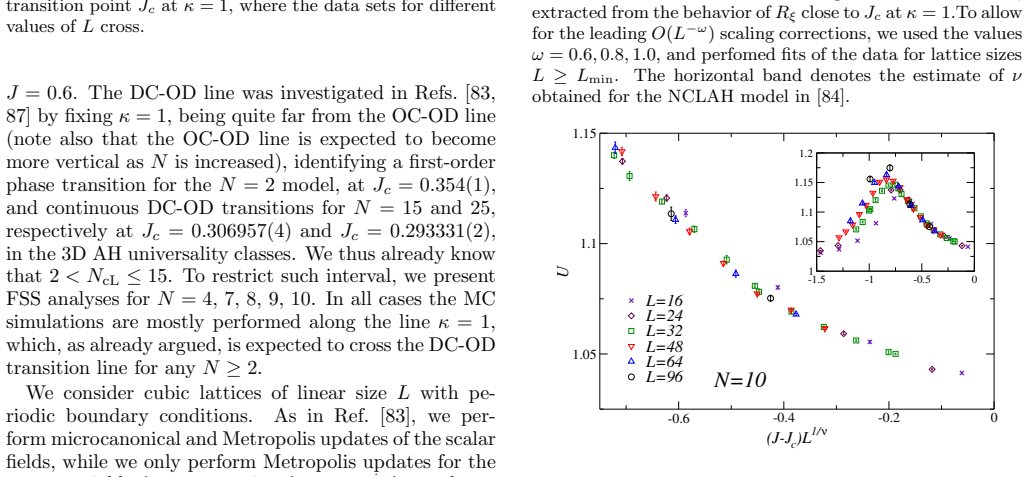
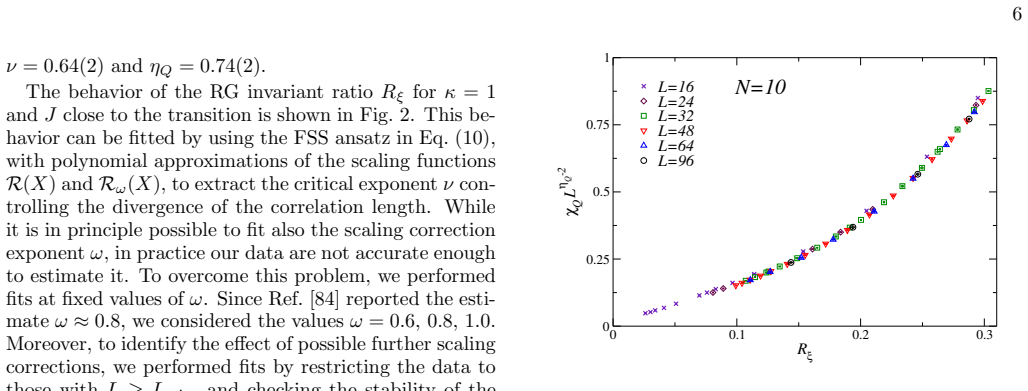
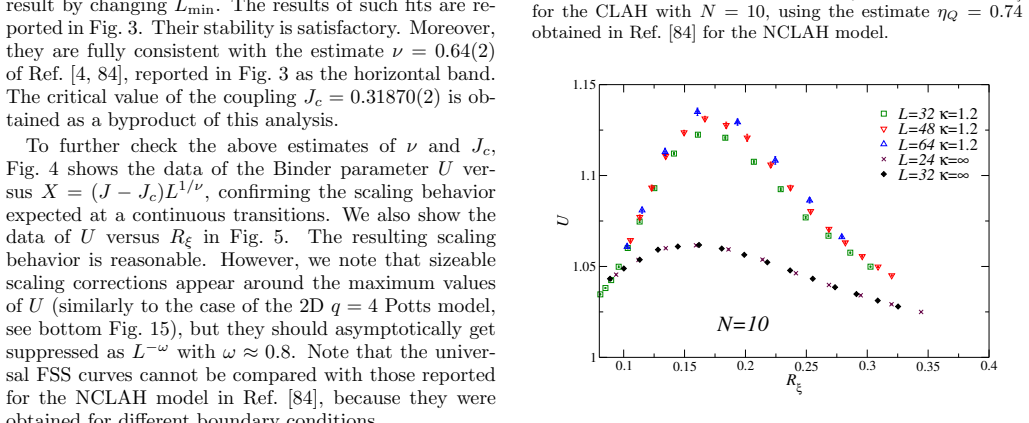
We consider three-dimensional (3D) lattice Abelian Higgs models, with compact U(1) gauge variables coupled to a doubly-charged $N$-component complex scalar field (CLAH). We focus on their phase transitions between the disordered-confined (DC) and ordered-deconfined (OD) phases. When they are continuous they belong to the 3D Abelian Higgs (AH) universality class associated with the stable charged fixed point (CFP) of the renormalization-group flow of the 3D AH field theory, or scalar electrodynamics, describing $N$-component complex scalar fields minimally coupled to a U(1) gauge field. This CFP exists only for a sufficiently large number of components, i.e., $N \ge N_d^*$, where the integer $N_d^*$ depends on the spatial dimension $d$ (for example $N_4^*=183$). To estimate $N_3^*$, we look for the minimum number $N_{\rm cL}$ of scalar components of 3D doubly-charged CLAH models developing continuous transitions along their DC-OD transition line. For this purpose, we present finite-size scaling analyses of Monte Carlo simulations for $N\in[4,10]$, up to lattice sizes $L\approx 100$. The results provide evidence of continuous DC-OD transitions for $N=10$, and weak first-order transitions for $N\le 7$. They are not conclusive for $N=8,\,9$. Therefore, we estimate $N_{\rm cL}=9(1)$.
Figures





Reference graph
Works this paper leans on
-
[1]
P. W. Anderson,Basic Notions of Condensed Matter Physics, (The Benjamin/Cummings Publishing Com- pany, Menlo Park, California, 1984)
1984
-
[2]
Zinn-Justin,Quantum Field Theory and Critical Phe- nomena(Clarendon Press, 2002)
J. Zinn-Justin,Quantum Field Theory and Critical Phe- nomena(Clarendon Press, 2002)
2002
-
[3]
Wen,Quantum field theory of many-body systems: from the origin of sound to an origin of light and elec- trons, (Oxford University Press, 2004)
X.-G. Wen,Quantum field theory of many-body systems: from the origin of sound to an origin of light and elec- trons, (Oxford University Press, 2004)
2004
-
[4]
Bonati, A
C. Bonati, A. Pelissetto, and E. Vicari, Three- dimensional Abelian and non-Abelian gauge Higgs the- ories, Phys. Rept.1133, 1 (2025)
2025
-
[5]
B. I. Halperin, T. C. Lubensky, and S. K. Ma, First-Order Phase Transitions in Superconductors and Smectic-A Liquid Crystals, Phys. Rev. Lett.32, 292 11 (1974)
1974
-
[6]
Herbut,A Modern Approach to Critical Phenomena (Cambridge University Press, 2007)
I. Herbut,A Modern Approach to Critical Phenomena (Cambridge University Press, 2007)
2007
-
[7]
Read and S
N. Read and S. Sachdev, Spin-Peierls, valence-bond solid, and N´ eel ground states of low-dimensional quan- tum antiferromagnets, Phys. Rev. B42, 4568 (1990)
1990
-
[8]
Takashima, I
S. Takashima, I. Ichinose, and T. Matsui, CP 1+U(1) lattice gauge theory in three dimensions: Phase struc- ture, spins, gauge bosons, and instantons, Phys. Rev. B 72, 075112 (2005)
2005
-
[9]
Takashima, I
S. Takashima, I. Ichinose, and T. Matsui, Decon- finement of spinons on critical points: Multiflavor CP1+U(1) lattice gauge theory in three dimension, Phys. Rev. B73, 075119 (2006)
2006
-
[10]
R. K. Kaul, Quantum phase transitions in bilayer SU(N) antiferromagnets, Phys. Rev. B85, 180411(R) (2012)
2012
-
[11]
R. K. Kaul and A. W. Sandvik, Lattice Model for the SU(N) N´ eel to Valence-Bond Solid Quantum Phase Transition at LargeN, Phys. Rev. Lett.108, 137201 (2012)
2012
-
[12]
M. S. Block, R. G. Melko, and R. K. Kaul, Fate of CPN−1 fixed point withqmonopoles, Phys. Rev. Lett. 111, 137202 (2013)
2013
-
[13]
Nahum, J
A. Nahum, J. T. Chalker, P. Serna, M. Ortu` no, and A. M. Somoza, Deconfined Quantum Criticality, Scaling Violations, and Classical Loop Models, Phys. Rev. X5, 041048 (2015)
2015
-
[14]
C. Wang, A. Nahum, M. A. Metliski, C. Xu, and T. Senthil, Deconfined Quantum Critical Points: Symme- tries and Dualities, Phys. Rev. X7, 031051 (2017)
2017
-
[15]
Sachdev, Topological order, emergent gauge fields, and Fermi surface reconstruction, Rep
S. Sachdev, Topological order, emergent gauge fields, and Fermi surface reconstruction, Rep. Prog. Phys.82, 014001 (2019)
2019
-
[16]
A. W. Sandvik, Evidence for Deconfined Quantum Crit- icality in a Two-Dimensional Heisenberg Model with Four-Spin Interactions, Phys. Rev. Lett.98, 227202 (2007)
2007
-
[17]
R. G. Melko and R. K. Kaul, Scaling in the Fan of an Unconventional Quantum Critical Point, Phys. Rev. Lett.100, 017203 (2008)
2008
-
[18]
F. J. Jiang, M. Nyfeler, S. Chandrasekharan, and U. J. Wiese, From an Antiferromagnet to a Valence Bond Solid: Evidence for a First-Order Phase Transition, J. Stat. Mech. (2008) P02009
2008
-
[19]
A. W. Sandvik, Continuous Quantum Phase Transition between an Antiferromagnet and a Valence-Bond Solid in Two Dimensions: Evidence for Logarithmic Correc- tions to Scaling, Phys. Rev. Lett.104, 177201 (2010)
2010
-
[20]
Harada, T
K. Harada, T. Suzuki, T. Okubo, H. Matsuo, J. Lou, H. Watanabe, S. Todo, and N. Kawashima, Possibility of Deconfined Criticality inSU(N) Heisenberg Models at SmallN, Phys. Rev. B88, 220408 (2013)
2013
-
[21]
K. Chen, Y. Huang, Y. Deng, A. B. Kuklov, N. V. Prokof’ev, and B.V. Svistunov, Deconfined Criticality Flow in the Heisenberg Model with Ring-Exchange In- teractions, Phys. Rev. Lett.110, 185701 (2013)
2013
-
[22]
Pujari, K
S. Pujari, K. Damle, and F. Alet, N` eel-State to Valence- Bond-Solid Transition on the Honeycomb Lattice: Evi- dence for Deconfined Criticality, Phys. Rev. Lett.111, 087203 (2013)
2013
-
[23]
H. Shao, W. Guo, and A. W. Sandvik, Quantum criti- cality with two length scales, Science352, 213 (2016)
2016
-
[24]
Senthil, L
T. Senthil, L. Balents, S. Sachdev, A. Vishwanath, and M. P. A. Fisher, Quantum Criticality beyond the Landau-Ginzburg-Wilson Paradigm, Phys. Rev. B70, 144407 (2004)
2004
-
[25]
Fradkin and S
E. Fradkin and S. Shenker, Phase diagrams of lattice gauge theories with Higgs fields, Phys. Rev. D19, 3682 (1979)
1979
-
[26]
Dasgupta and B
C. Dasgupta and B. I. Halperin, Phase Transitions in a Lattice Model of Superconductivity, Phys. Rev. Lett 47, 1556 (1981)
1981
-
[27]
Frohlich, G
J. Frohlich, G. Morchio, and F. Strocchi, Higgs phe- nomenon without symmetry breaking order parameter, Nucl. Phys.B190, 553 (1981)
1981
-
[28]
Di Vecchia, A
P. Di Vecchia, A. Holtkamp, R. Musto, F. Nicodemi, and R. Pettorino, Lattice CP N−1 models and their large-Nbehaviour, Nucl. Phys. B190, 719 (1981)
1981
-
[29]
D. J. E. Callaway and L. J. Carson, Abelian Higgs model: A Monte Carlo study, Phys. Rev. D25, 531 (1982)
1982
-
[30]
Bricmont and J
J. Bricmont and J. Frohlich, An order parameter distin- guishing between different phases of lattice gauge theo- ries with matter fields, Phys. Lett.122, 73 (1983)
1983
-
[31]
Fredenhagen and M
K. Fredenhagen and M. Marcu, Charged states inZ 2 gauge theories, Commun. Math. Phys.92, 81 (1983)
1983
-
[32]
Kennedy and C
T. Kennedy and C. King, Symmetry Breaking in the Lattice Abelian Higgs Model, Phys. Rev. Lett.55, 776 (1985)
1985
-
[33]
Kennedy and C
T. Kennedy and C. King, Spontaneous Symmetry Breakdown in the Abelian Higgs Model, Commun. Math. Phys.104, 327 (1986)
1986
-
[34]
Borgs and F
C. Borgs and F. Nill, Symmetry Breaking in Landau Gauge A comment to a paper by T. Kennedy and C. King, Commun. Math. Phys.104, 349 (1986)
1986
-
[35]
Borgs and F
C. Borgs and F. Nill, No Higgs mechanism in scalar lat- tice QED with strong electromagnetic coupling, Phys. Lett. B171, 289 (1986)
1986
-
[36]
Borgs and F
C. Borgs and F. Nill, The Phase Diagram of the Abelian Lattice Higgs Model. A Review of Rigorous Results, J. Stat. Phys.47, 877 (1987)
1987
-
[37]
Murthy and S
G. Murthy and S. Sachdev, Actions of hedgehogs instan- tons in the disordered phase of 2+1 dimensional CPN−1 model, Nucl. Phys. B344, 557 (1990)
1990
-
[38]
Kiometzis, H
M. Kiometzis, H. Kleinert, and A. M. J. Schakel, Criti- cal Exponents of the Superconducting Phase Transition, Phys. Rev. Lett.73, 1975 (1994)
1975
-
[39]
Bergerhoff, F
B. Bergerhoff, F. Freire, D.F. Litim, S. Lola, and C. Wetterich, Phase diagram of superconductors from non- perturbative flow equations, Phys. Rev. B53, 5734 (1996)
1996
-
[40]
Herbut and Z
F. Herbut and Z. Tesanovic, Critical Fluctuations in Superconductors and the Magnetic Field Penetration Depth, Phys. Rev. Lett.76, 4588 (1996)
1996
-
[41]
Folk and Y
R. Folk and Y. Holovatch, On the critical fluctuations in superconductors, J. Phys. A29, 3409 (1996)
1996
-
[42]
V. Yu. Irkhin, A. A. Katanin, and M. I. Katsnelson, 1/Nexpansion for critical exponents of magnetic phase transitions in theCP N−1 model for 2< d <4, Phys. Rev. B54, 11953 (1996)
1996
-
[43]
Kajantie, M
K. Kajantie, M. Karjalainen, M. Laine, and J. Peisa, Masses and phase structure in the Ginzburg-Landau model, Phys. Rev. B57, 3011 (1998)
1998
-
[44]
Olsson and S
P. Olsson and S. Teitel, Critical Behavior of the Meiss- ner Transition in the Lattice London Superconductor, Phys. Rev. Lett.80, 1964 (1998)
1964
-
[45]
de Calan and F.S
C. de Calan and F.S. Nogueira, Scaling critical behavior 12 of superconductors at zero magnetic field, Phys. Rev. B 60, 4255 (1999)
1999
-
[46]
Hove and A
J. Hove and A. Sudbo, Anomalous Scaling Dimensions and Stable Charged Fixed Point of Type-II Supercon- ductors, Phys. Rev. Lett.84, 3426 (2000)
2000
-
[47]
Kleinert, F
H. Kleinert, F. S. Nogueira, and A. Sudbø, Deconfine- ment Transition in Three-Dimensional Compact U(1) Gauge Theories Coupled to Matter Fields, Phys. Rev. Lett.88, 232001 (2002)
2002
-
[48]
S. Mo, J. Hove, and A. Sudbø, Order of the metal- to-superconductor transition, Phys. Rev. B65, 104501 (2002)
2002
-
[49]
Sudbø, E
A. Sudbø, E. Smørgrav, J. Smiseth, F. S. Nogueira, and J. Hove, Criticality in the (2+1)-Dimensional Compact Higgs Model and Fractionalized Insulators, Phys. Rev. Lett.89, 226403 (2002)
2002
-
[50]
Smiseth, E
J. Smiseth, E. Smørgrav, F. S. Nogueira, J. Hove, and A. Sudbø, Phase Structure ofd= 2+1 Compact Lattice Gauge Theories and the Transition from Mott Insulator to Fractionalized Insulator, Phys. Rev. B67, 205104 (2003)
2003
-
[51]
Moshe and J
M. Moshe and J. Zinn-Justin, Quantum field theory in the largeNlimit: A review, Phys. Rep.385, 69 (2003)
2003
-
[52]
Neuhaus, A
T. Neuhaus, A. Rajantie, and K. Rummukainen, Nu- merical study of duality and universality in a frozen su- perconductor, Phys. Rev. B67, 014525 (2003)
2003
-
[53]
O. I. Motrunich and A. Vishwanath, Emergent photons and transitions in the O(3)σ-model with hedgehog sup- pression, Phys. Rev. B70, 075104 (2004)
2004
-
[54]
F. S. Nogueira, J. Smiseth, E. Smørgrav, and A. Sudbø, Compact U(1) gauge theories in 2 + 1 dimensions and the physics of low dimensional insulating materials, Eur. Phys. J. C33, 885 (2004)
2004
-
[55]
Smiseth, E
J. Smiseth, E. Smorgrav, and A. Sudbø, Critical prop- erties of theN-color London model, Phys. Rev. Lett. 93, 077002 (2004)
2004
-
[56]
Wenzel, E
S. Wenzel, E. Bittner, W. Janke, A. M. J. Schakel, and A. Schiller, Kertesz Line in the Three-Dimensional Compact U(1) Lattice Higgs Model, Phys. Rev. Lett. 95, 051601 (2005)
2005
-
[57]
M. N. Chernodub, R. Feldmann, E.-M. Ilgenfritz, and A. Schiller, The compactQ= 2 Abelian Higgs model in the London limit: vortex-monopole chains and the photon propagator, Phys. Rev. D71, 074502 (2005)
2005
-
[58]
M. B. Hastings and X.-G. Wen, Quasi-adiabatic Contin- uation of Quantum States: The Stability of Topological Ground State Degeneracy and Emergent Gauge Invari- ance, Phys. Rev. B72, 045141 (2005)
2005
-
[59]
M. N. Chernodub, E.-M. Ilgenfritz, and A. Schiller, Phase structure of an Abelian two-Higgs model and high temperature superconductors, Phys. Rev. B73, 100506 (2006)
2006
-
[60]
A. B. Kuklov, N. V. Prokof’ev, B. V. Svistunov, and M. Troyer, Deconfined criticality, runaway flow in the two-component scalar electrodynamics and weak first- order superfluid-solid transitions, Ann. Phys.321, 1602 (2006)
2006
-
[61]
Wenzel, E
S. Wenzel, E. Bittner, W. Janke, and A. M. J. Schakel, Percolation of Vortices in the 3D Abelian Lattice Higgs Model, Nucl. Phys. B793, 344 (2008)
2008
-
[62]
O. I. Motrunich and A. Vishwanath, Compara- tive study of Higgs transition in one-component and two-component lattice superconductor models, arXiv:0805.1494 [cond-mat.stat-mech]
work page internal anchor Pith review Pith/arXiv arXiv
-
[63]
A. B. Kuklov, M. Matsumoto, N. V. Prokof’ev, B. V. Svistunov, and M. Troyer, Deconfined Criticality: Generic First-Order Transition in the SU(2) Symmetry Case, Phys. Rev. Lett.101, 050405 (2008)
2008
-
[64]
Charrier, F
D. Charrier, F. Alet, and P. Pujol, Gauge Theory Pic- ture of an Ordering Transition in a Dimer Model, Phys. Rev. Lett.101, 167205 (2008)
2008
-
[65]
R. K. Kaul and S. Sachdev, Quantum criticality of U(1) gauge theories with fermionic and bosonic matter in two spatial dimensions, Phys. Rev. B77, 155105 (2008)
2008
-
[66]
T. Ono, S. Doi, Y. Hori, I. Ichinose, and T. Matsui, Phase Structure and Critical Behavior of Multi-Higgs U(1) Lattice Gauge Theory in Three Dimensions, Ann. Phys. (N.Y.)324, 2453 (2009)
2009
-
[67]
J. Lou, A. W. Sandvik, and N. Kawashima, Antifer- romagnetic to valence-bond-solid transitions in two- dimensional SU(N) Heisenberg models with multispin interactions, Phys. Rev. B80, 180414 (2009)
2009
-
[68]
G. Chen, J. Gukelberger, S. Trebst, F. Alet, and L. Balents, Coulomb gas transitions in three-dimensional classical dimer models, Phys. Rev. B80, 045112 (2009)
2009
-
[69]
Charrier and F
D. Charrier and F. Alet, Phase diagram of an extended classical dimer model, Phys. Rev. B82, 014429 (2010)
2010
-
[70]
Banerjee, K
A. Banerjee, K. Damle, and F. Alet, Impurity spin tex- ture at a deconfined quantum critical point, Phys. Rev. B82, 155139 (2010)
2010
-
[71]
E. V. Herland, T. A. Bojesen, E. Babaev, and A. Sudbø, Phase structure and phase transitions in a three- dimensional SU(2) superconductor, Phys. Rev. B87, 134503 (2013)
2013
-
[72]
Bartosch, Corrections to scaling in the critical the- ory of deconfined criticality, Phys
L. Bartosch, Corrections to scaling in the critical the- ory of deconfined criticality, Phys. Rev. B88, 195140 (2013)
2013
-
[73]
T. A. Bojesen and A. Sudbø, Berry phases, current lat- tices, and suppression of phase transitions in a lattice gauge theory of quantum antiferromagnets, Phys. Rev. B88, 094412 (2013)
2013
-
[74]
Nahum, P
A. Nahum, P. Serna, J. T. Chalker, M. Ortu` no, and A. M. Somoza, Emergent SO(5) Symmetry at the N´ eel to Valence-Bond-Solid Transition, Phys. Rev. Lett.115, 267203 (2015)
2015
-
[75]
G. J. Sreejith and S. Powell, Scaling dimensions of higher-charge monopoles at deconfined critical points, Phys. Rev. B92, 184413 (2015)
2015
-
[76]
Fejos and T
G. Fejos and T. Hatsuda, Renormalization group flows of theN-component Abelian Higgs model, Phys. Rev. D96, 056018 (2017)
2017
-
[77]
Ihrig, N
B. Ihrig, N. Zerf, P. Marquard, I. F. Herbut, and M. M. Scherer, Abelian Higgs model at four loops, fixed-point collision and deconfined criticality, Phys. Rev. B100, 134507 (2019)
2019
-
[78]
Serna and A
P. Serna and A. Nahum, Emergence and spontaneous breaking of approximate O(4) symmetry at a weakly first-order deconfined phase transition, Phys. Rev. B99, 195110 (2019)
2019
-
[79]
Pelissetto and E
A. Pelissetto and E. Vicari, Three-dimensional ferro- magnetic CP N−1 models, Phys. Rev. E100, 022122 (2019)
2019
-
[80]
Pelissetto and E
A. Pelissetto and E. Vicari, Multicomponent compact Abelian-Higgs lattice models, Phys. Rev. E100, 042134 (2019)
2019
discussion (0)
Sign in with ORCID, Apple, or X to comment. Anyone can read and Pith papers without signing in.