REVIEW 2 major objections 2 minor 71 references
Building Change Detection in Earthquake: A Multi-Scale Interaction Network and A Change Detection Dataset
T0 review · 2 major / 2 minor · reviewed 2026-06-27 · grok-4.3
Pith's one-line read A multi-scale interaction network with offset calibration detects building changes in short-interval post-earthquake images.
desk verdict The new TUE-CD dataset for short-interval post-earthquake change detection is the useful part; the MSI-Net and its MOC module rest on an untested alignment assumption with thin evidence. read the letter →
The pith
A machine-rendered reading of the paper's core claim, the machinery that carries it, and where it could break.
The reading
What carries the argument
The multi-scale feature interaction network (MSI-Net) that unifies joint cross-attention for bi-temporal exchange, multi-scale offset calibration for alignment, and feature integration for final prediction.
What would settle it
If MSI-Net produces lower accuracy metrics than the strongest baseline methods when both are evaluated on the held-out TUE-CD test split, the performance advantage claim does not hold.
Extended reading notes
Core claim
MSI-Net, built from joint cross-attention, multi-scale offset calibration, and feature integration modules, produces more accurate building change maps than existing methods on the WHU-CD, CLCD, and newly collected TUE-CD datasets by explicitly estimating and correcting alignment offsets that arise from short-interval side-looking acquisitions.
Load-bearing premise
Estimating offsets at multiple scales can align bi-temporal features from different imaging angles without creating new misalignment or noise.
Editorial extensions
If this is right
- Short-interval post-event imagery becomes usable for rapid damage mapping instead of waiting for better-aligned acquisitions.
- The offset calibration step reduces the side-looking artifacts that currently limit change detection after earthquakes.
- The same three-module structure can be applied to other bi-temporal remote-sensing tasks that involve viewpoint shifts.
- The TUE-CD dataset supplies a concrete benchmark for measuring progress on emergency-response change detection.
Reading between the lines
- The approach may transfer to other sudden-onset events such as floods or landslides where acquisition intervals are also short.
- If the offset calibration proves robust, similar modules could be inserted into existing change-detection pipelines without retraining the entire network.
- Longer-interval datasets could be used to test whether the side-looking correction introduces unnecessary complexity when viewing angles already match.
Signed reviews
Editorial analysis
A structured set of objections, weighed in public.
Referee Report
Summary. The paper introduces the TUE-CD dataset for building change detection using short-interval post-earthquake remote sensing images and proposes MSI-Net, which integrates Joint Cross-Attention (JCA) modules for feature interaction, Multi-Scale Offset Calibration (MOC) modules to estimate offsets addressing side-looking misalignment from differing imaging angles, and Feature Integration (FeI) modules for fusion. Experiments on WHU-CD, CLCD, and TUE-CD report superior performance over considered state-of-the-art change detection methods.
Significance. Creation of TUE-CD fills a documented gap in short-interval post-disaster datasets and could support emergency response applications if validated. The empirical gains on three datasets, including the new one, would be noteworthy if the MOC module's alignment benefit is confirmed; however, the absence of independent validation metrics limits the strength of the contribution.
major comments (2)
- [Experiments] Experiments section: the headline claim that MSI-Net outperforms SOTA on TUE-CD rests on the MOC module's ability to mitigate side-looking effects without introducing new registration errors, yet no ablation isolating MOC on TUE-CD, no quantitative alignment metrics (e.g., before/after offset error on building edges), and no qualitative feature-map comparisons are provided to verify that learned offsets are beneficial rather than harmful.
- [Method] Method section (MOC module description): the assumption that multi-scale offset estimation aligns bi-temporal features affected by short-interval angle differences is load-bearing for the TUE-CD results, but the paper provides no evidence or test that scale-specific estimation noise does not degrade performance on textured regions.
minor comments (2)
- [Abstract] Abstract and introduction: the phrase 'side-looking problems' is used without a concrete definition, example image pair, or citation to prior remote-sensing literature on off-nadir effects.
- [Dataset] Dataset section: details on how TUE-CD was constructed (e.g., exact acquisition dates, sensor, annotation protocol, train/val/test split sizes) are referenced but not fully specified, hindering reproducibility.
Simulated Author's Rebuttal
We thank the referee for the constructive comments, which highlight important aspects of validating the MOC module's contribution. We address each major comment below and commit to revisions that strengthen the empirical support without altering the core claims.
read point-by-point responses
-
Referee: [Experiments] Experiments section: the headline claim that MSI-Net outperforms SOTA on TUE-CD rests on the MOC module's ability to mitigate side-looking effects without introducing new registration errors, yet no ablation isolating MOC on TUE-CD, no quantitative alignment metrics (e.g., before/after offset error on building edges), and no qualitative feature-map comparisons are provided to verify that learned offsets are beneficial rather than harmful.
Authors: We agree that isolating the MOC module's contribution specifically on TUE-CD, along with quantitative alignment metrics and qualitative visualizations, would provide stronger evidence. In the revised version, we will add an ablation study removing MOC on TUE-CD, report before/after offset errors measured on building edges, and include qualitative feature-map comparisons demonstrating the alignment effect. revision: yes
-
Referee: [Method] Method section (MOC module description): the assumption that multi-scale offset estimation aligns bi-temporal features affected by short-interval angle differences is load-bearing for the TUE-CD results, but the paper provides no evidence or test that scale-specific estimation noise does not degrade performance on textured regions.
Authors: The multi-scale design of MOC is motivated by the need to handle offsets at different resolutions induced by angle differences, and the overall performance gains on TUE-CD are consistent with this. However, we acknowledge the lack of targeted tests for estimation noise on textured regions. We will incorporate additional analysis in the revision, such as offset visualizations on textured areas and performance comparisons to confirm no degradation occurs. revision: yes
Circularity Check
No significant circularity in empirical architecture and dataset proposal
full rationale
The paper proposes MSI-Net (with JCA, MOC, FeI modules) and constructs TUE-CD dataset, then reports empirical results on WHU-CD, CLCD and TUE-CD against SOTA baselines. No first-principles derivation, fitted parameter renamed as prediction, or self-citation load-bearing step is present; performance claims rest on standard training/evaluation rather than any reduction to inputs by construction. The work is self-contained against external benchmarks.
Assumptions & free parameters
free parameters (1)
- MSI-Net network parameters
assumptions (1)
- domain assumption Bi-temporal remote sensing images with differing angles can be aligned via multi-scale offset estimation
invented entities (3)
-
Joint Cross-Attention (JCA) module
-
Multi-Scale Offset Calibration (MOC) module
-
Feature Integration (FeI) module
Cite this review
Pith. "Pith review of Building Change Detection in Earthquake: A Multi-Scale Interaction Network and A Change Detection Dataset." pith.science (2026). https://pith.science/paper/MCK3PALR
@misc{pith2026260610329,
  author       = {Pith},
  title        = {Pith review of: Building Change Detection in Earthquake: A Multi-Scale Interaction Network and A Change Detection Dataset},
  year         = {2026},
  howpublished = {\url{https://pith.science/paper/MCK3PALR}},
  note         = {Machine review of arXiv:2606.10329}
}
read the original abstract
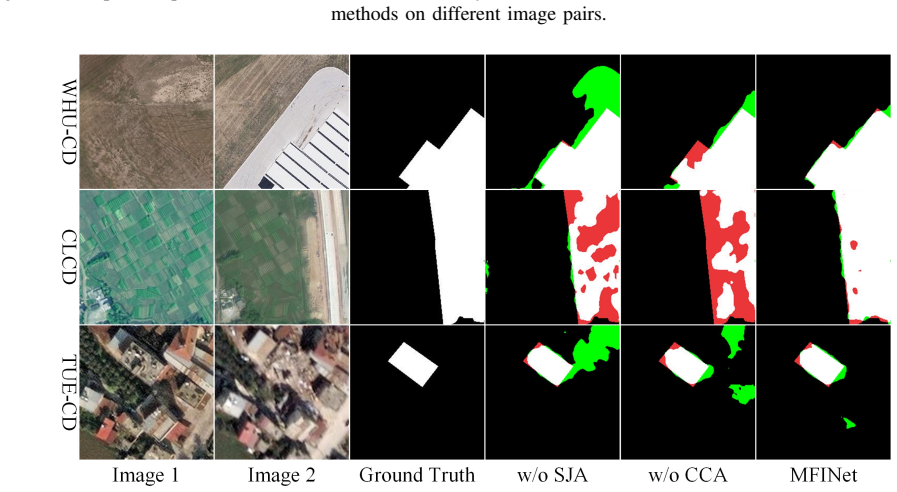
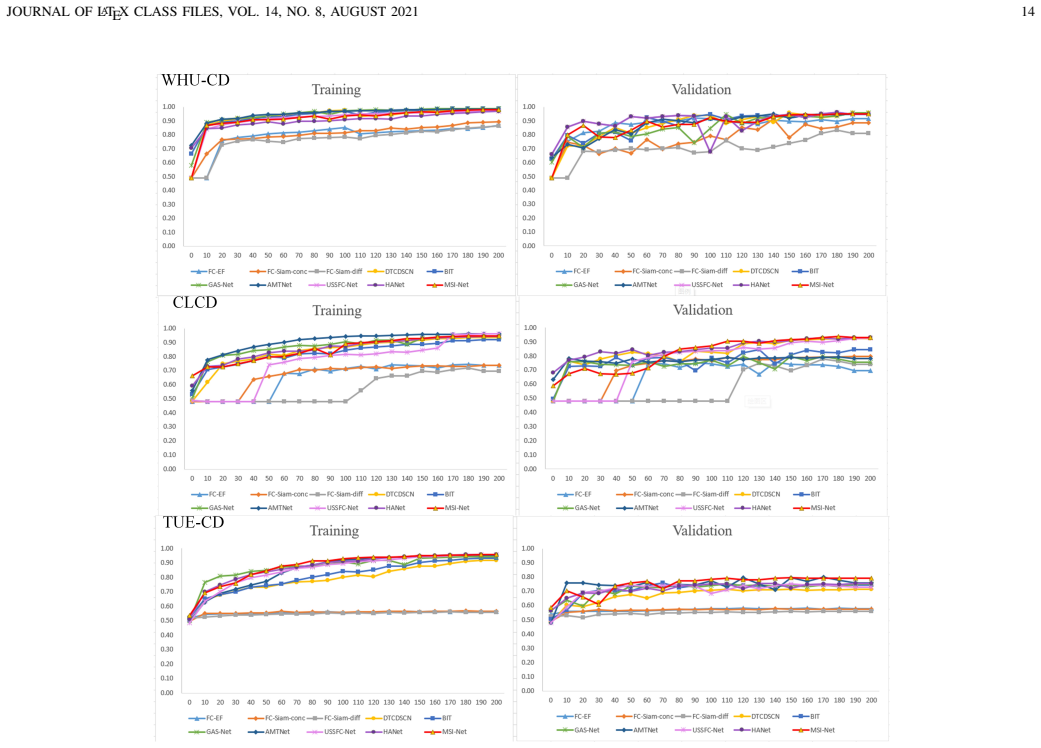
As one of the most destructive natural disasters, earthquakes have struck many countries around the world in recent years, causing serious economic losses. Change detection (CD) can be applied to post-earthquake damage assessment as it can infer destroyed change regions from multi-temporal remote sensing images. Furthermore, the CD with short imaging interval will better satisfy the needs of the emergency rescues after earthquakes. However, the capability of current methods built on deep neural networks is limited because the dataset with short imaging interval is absent. To meet post-disaster immediate relief, we create a CD dataset, Turkey earthquake CD dataset (TUE-CD), for the evaluation of building damage in the short term after an earthquake. Because of the short acquisition interval of the post-event images, the imaging angle is different for different temporal images, which leads to some side-looking problems. To deal with these challenges, we present a multi-scale feature interaction network (MSI-Net) for efficient interaction between bi-temporal features, as well as mitigating the effect of side-looking problems. Specifically, the proposed MSI-Net consists of joint cross-attention (JCA) modules, multi-scale offset calibration (MOC) modules, and feature integration (FeI) modules. The JCA module unifies channel cross-attention and spatial joint attention for sufficient feature interaction. The MOC module further estimates the offsets to align the bi-temporal image with the multi-scale features. Finally, calibrated features and multi-scale features are fused by FeI modules for the prediction of changed areas. Experiments on the WHU-CD, CLCD, and the constructed TUE-CD dataset indicate that the proposed MSI-Net provides better results than considered state-of-the-art CD methods.
Figures


Figures from the paper (12 more)



Reference graph
Works this paper leans on
-
[1]
Building-damage detection using pre- and post-seismic high-resolution satellite stereo imagery: A case study of the may 2008 wenchuan earthquake,
X. Tong, Z. Hong, S. Liu, X. Zhang, H. Xie, Z. Li, S. Yang, W. Wang, and F. Bao, “Building-damage detection using pre- and post-seismic high-resolution satellite stereo imagery: A case study of the may 2008 wenchuan earthquake,”ISPRS J. Photogramm. Remote Sens., vol. 68, pp. 13–27, 2012. JOURNAL OF LATEX CLASS FILES, VOL. 14, NO. 8, AUGUST 2021 14 Fig. 15...
2008
-
[2]
Automated machine learning driven stacked ensemble modeling for forest aboveground biomass prediction using multitemporal Sentinel-2 data,
P. Naik, M. Dalponte, and L. Bruzzone, “Automated machine learning driven stacked ensemble modeling for forest aboveground biomass prediction using multitemporal Sentinel-2 data,”IEEE J. Sel. Topics Appl. Earth Observ. Remote Sens., vol. 16, pp. 3442–3454, 2023
2023
-
[3]
A scalable high-performance unsupervised system for producing large-scale HR land cover maps: The Italian country case study,
C. Paris, L. Gasparella, and L. Bruzzone, “A scalable high-performance unsupervised system for producing large-scale HR land cover maps: The Italian country case study,”IEEE J. Sel. Topics Appl. Earth Observ. Remote Sens., vol. 15, pp. 9146–9159, 2022
2022
-
[4]
Cross-scale-guided fusion transformer for disaster assessment using satellite imagery,
W. Xiao, J. Su, Y . Chen, and G. Cao, “Cross-scale-guided fusion transformer for disaster assessment using satellite imagery,”IEEE Trans. Geosci. Remote Sens., vol. 61, no. 4600512, pp. 1–12, 2023
2023
-
[5]
Use of shadows for detection of earthquake-induced collapsed buildings in high-resolution satellite imagery,
X. Tong, X. Lin, T. Feng, H. Xie, S. Liu, Z. Hong, and P. Chen, “Use of shadows for detection of earthquake-induced collapsed buildings in high-resolution satellite imagery,”ISPRS J. Photogramm. Remote Sens., vol. 79, pp. 53–67, 2013
2013
-
[6]
Fully convolutional siamese networks for change detection,
R. C. Daudt, B. Le Saux, and A. Boulch, “Fully convolutional siamese networks for change detection,”IEEE ICIP, pp. 4063–4067, 2018
2018
-
[7]
Change detection on remote sensing images using dual-branch multilevel intertemporal network,
Y . Feng, J. Jiang, H. Xu, and J. Zheng, “Change detection on remote sensing images using dual-branch multilevel intertemporal network,” IEEE Trans. Geosci. Remote Sens., vol. 61, no. 4401015, pp. 1–15, 2023
2023
-
[8]
Remote sensing change detection via temporal feature interaction and guided refinement,
Z. Li, C. Tang, L. Wang, and A. Y . Zomaya, “Remote sensing change detection via temporal feature interaction and guided refinement,”IEEE Trans. Geosci. Remote Sens., vol. 60, no. 5628711, pp. 1–11, 2022
2022
Show all 71 references
-
[9]
Elgc-net: Efficient local–global context aggregation for remote sensing change detection,
M. Noman, M. Fiaz, H. Cholakkal, S. Khan, and F. S. Khan, “Elgc-net: Efficient local–global context aggregation for remote sensing change detection,”IEEE Trans. Geosci. Remote Sens., vol. 62, no. 4701611, pp. 1–11, 2024
2024
-
[10]
SASiamNet: Self- adaptive siamese network for change detection of remote sensing image,
X. Long, W. Zhuang, M. Xia, K. Hu, and H. Lin, “SASiamNet: Self- adaptive siamese network for change detection of remote sensing image,” IEEE J. Sel. Topics Appl. Earth Observ. Remote Sens, vol. 17, pp. 1021– 1034, 2024
2024
-
[11]
Changer: Feature interaction is what you need for change detection,
S. Fang, K. Li, and Z. Li, “Changer: Feature interaction is what you need for change detection,”IEEE Trans. Geosci. Remote Sens., vol. 61, no. 5610111, pp. 1–11, 2023
2023
-
[12]
Sdcdnet: A semi-dual change detection network framework with super- weak label for remote sensing image,
J. Wang, F. Liu, H. Wang, X. Liu, L. Jiao, H. Yang, L. Li, and P. Chen, “Sdcdnet: A semi-dual change detection network framework with super- weak label for remote sensing image,”IEEE Trans. Geosci. Remote Sens., vol. 61, no. 5612714, pp. 1–14, 2023
2023
-
[13]
Domain adaptive and interactive differential attention network for remote sensing image change detection,
Y . Ji, W. Sun, Y . Wang, Z. Lv, G. Yang, Y . Zhan, and C. Li, “Domain adaptive and interactive differential attention network for remote sensing image change detection,”IEEE Trans. Geosci. Remote Sens., vol. 62, no. 5616316, pp. 1–16, 2024
2024
-
[14]
Hyperboloid- embedded siamese network for change detection in remote sensing images,
Q. Yang, S. Zhang, J. Li, Y . Sun, Q. Han, and Y . Sun, “Hyperboloid- embedded siamese network for change detection in remote sensing images,”IEEE J. Sel. Topics Appl. Earth Observ. Remote Sens, pp. 1–14, 2024
2024
-
[15]
Content- guided spatial–spectral integration network for change detection in hr remote sensing images,
Y . Liu, F. Zhang, S. Zhang, K. Zhang, J. Sun, and L. Bruzzone, “Content- guided spatial–spectral integration network for change detection in hr remote sensing images,”IEEE Trans. Geosci. Remote Sens., vol. 62, no. 5604816, pp. 1–16, 2024
2024
-
[16]
Multiview hypergraph fusion network for change detection in high-resolution remote sensing images,
X. Zhao, K. Zhang, F. Zhang, J. Sun, W. Wan, and H. Zhang, “Multiview hypergraph fusion network for change detection in high-resolution remote sensing images,”IEEE J. Sel. Topics Appl. Earth Observ. Remote Sens, vol. 17, pp. 4597–4610, 2024
2024
-
[17]
Remote sensing image change detection with transformers,
H. Chen, Z. Qi, and Z. Shi, “Remote sensing image change detection with transformers,”IEEE Trans. Geosci. Remote Sens., vol. 60, no. 5607514, pp. 1–14, 2022
2022
-
[18]
Remote sensing change detection with transformers trained from scratch,
M. Noman, M. Fiaz, H. Cholakkal, S. Narayan, R. M. Anwer, S. Khan, and F. S. Khan, “Remote sensing change detection with transformers trained from scratch,”IEEE Trans. Geosci. Remote Sens., pp. 1–1, 2024
2024
-
[19]
Relation changes matter: Cross-Temporal difference transformer for change detection in remote sensing images,
K. Zhang, X. Zhao, F. Zhang, L. Ding, J. Sun, and L. Bruzzone, “Relation changes matter: Cross-Temporal difference transformer for change detection in remote sensing images,”IEEE Trans. Geosci. Remote Sens., vol. 61, no. 5611615, pp. 1–15, 2023
2023
-
[20]
Gcformer: Global context-aware transformer for remote sensing image change detection,
W. Yu, L. Zhuo, and J. Li, “Gcformer: Global context-aware transformer for remote sensing image change detection,”IEEE Trans. Geosci. Remote Sens., vol. 62, no. 4703212, pp. 1–12, 2024. JOURNAL OF LATEX CLASS FILES, VOL. 14, NO. 8, AUGUST 2021 15
2024
-
[21]
Creating xbd: A dataset for assessing building damage from satellite imagery,
R. Gupta, B. Goodman, N. Patel, R. Hosfelt, S. Sajeev, E. Heim, J. Doshi, K. Lucas, H. Choset, and M. Gaston, “Creating xbd: A dataset for assessing building damage from satellite imagery,” inIEEE CVPRW, 2019, pp. 10–17
2019
-
[22]
Deep residual learning for image recognition,
K. He, X. Zhang, S. Ren, and J. Sun, “Deep residual learning for image recognition,” inIEEE CVPR, 2016, pp. 770–778
2016
-
[23]
Monitoring urban land cover changes at the urban fringe from spot hrv imagery in south-east england,
N. Quarmby and J. Cushnie, “Monitoring urban land cover changes at the urban fringe from spot hrv imagery in south-east england,”Int. J. Remote Sens., vol. 10, no. 6, pp. 953–963, 1989
1989
-
[24]
Procedures for change detection using landsat digital data,
P. J. Howarth and G. M. Wickware, “Procedures for change detection using landsat digital data,”Int. J. Remote Sens., vol. 2, no. 3, pp. 277– 291, 1981
1981
-
[25]
A theoretical framework for unsupervised change detection based on change vector analysis in the polar domain,
F. Bovolo and L. Bruzzone, “A theoretical framework for unsupervised change detection based on change vector analysis in the polar domain,” IEEE Trans. Geosci. Remote. Sens., vol. 45, no. 1, pp. 218–236, 2006
2006
-
[26]
A framework for automatic and unsupervised detection of multiple changes in multitemporal im- ages,
F. Bovolo, S. Marchesi, and L. Bruzzone, “A framework for automatic and unsupervised detection of multiple changes in multitemporal im- ages,”IEEE Trans. Geosci. Remote. Sens., vol. 50, no. 6, pp. 2196–2212, 2012
2012
-
[27]
Unsupervised change detection of multispectral images based on pca and low-rank prior,
W. Zhang, J. Li, F. Zhang, J. Sun, and K. Zhang, “Unsupervised change detection of multispectral images based on pca and low-rank prior,” IEEE Geosci. Remote Sens. Lett., vol. 19, no. 5001605, pp. 1–5, 2022
2022
-
[28]
Sedanet: A new siamese ensemble difference attention network for building change detection in remotely sensed images,
Y . Yang, T. Chen, T. Lei, B. Du, A. K. Nandi, and A. Plaza, “Sedanet: A new siamese ensemble difference attention network for building change detection in remotely sensed images,”IEEE Trans. Geosci. Remote Sens., vol. 62, no. 4405316, pp. 1–16, 2024
2024
-
[29]
Adjacent-level feature cross-fusion with 3-d cnn for remote sensing image change detection,
Y . Ye, M. Wang, L. Zhou, G. Lei, J. Fan, and Y . Qin, “Adjacent-level feature cross-fusion with 3-d cnn for remote sensing image change detection,”IEEE Trans. Geosci. Remote Sens., vol. 61, no. 5618214, pp. 1–14, 2023
2023
-
[30]
Deep depthwise separable convolutional network for change detection in optical aerial images,
R. Liu, D. Jiang, L. Zhang, and Z. Zhang, “Deep depthwise separable convolutional network for change detection in optical aerial images,” IEEE J. Sel. Topics Appl. Earth Observ. Remote Sens, vol. 13, pp. 1109– 1118, 2020
2020
-
[31]
Unsupervised cd in satellite image time series by contrastive learning and feature tracking,
Y . Chen and L. Bruzzone, “Unsupervised cd in satellite image time series by contrastive learning and feature tracking,”IEEE Trans. Geosci. Remote Sens., vol. 62, no. 5401813, pp. 1–13, 2024
2024
-
[32]
Bifa: Remote sensing image change detection with bitemporal feature alignment,
H. Zhang, H. Chen, C. Zhou, K. Chen, C. Liu, Z. Zou, and Z. Shi, “Bifa: Remote sensing image change detection with bitemporal feature alignment,”IEEE Trans. Geosci. Remote Sens., vol. 62, no. 5614317, pp. 1–17, 2024
2024
-
[33]
A self-supervised approach to pixel-level change detection in bi-temporal rs images,
Y . Chen and L. Bruzzone, “A self-supervised approach to pixel-level change detection in bi-temporal rs images,”IEEE Trans. Geosci. Remote Sens., vol. 60, no. 4413911, pp. 1–11, 2022
2022
-
[34]
S2dbft: Spectral-spatial dual-branch fusion transformer for hyperspectral image classification,
Y . Zhang, Z. Wang, M. Huang, M. Li, J. Zhang, S. Wang, J. Zhang, and H. Zhang, “S2dbft: Spectral-spatial dual-branch fusion transformer for hyperspectral image classification,”IEEE Transactions on Geoscience and Remote Sensing, 2025
2025
-
[35]
Implementation of motion estimation based on heterogeneous parallel computing system with opencl,
J. Zhang, J.-F. Nezan, and J.-G. Cousin, “Implementation of motion estimation based on heterogeneous parallel computing system with opencl,” in2012 IEEE 14th International Conference on High Perfor- mance Computing and Communication & 2012 IEEE 9th International Conference on ...
2012
-
[36]
3d octave and 2d vanilla mixed convolutional neural network for hyperspectral image classification with limited samples,
Y . Feng, J. Zheng, M. Qin, C. Bai, and J. Zhang, “3d octave and 2d vanilla mixed convolutional neural network for hyperspectral image classification with limited samples,”Remote Sensing, vol. 13, no. 21, p. 4407, 2021
2021
-
[37]
Learning vertex representations for bipartite networks,
M. Gao, X. He, L. Chen, T. Liu, J. Zhang, and A. Zhou, “Learning vertex representations for bipartite networks,”IEEE transactions on knowledge and data engineering, vol. 34, no. 1, pp. 379–393, 2020
2020
-
[38]
Multi-granularity episodic contrastive learning for few-shot learning,
P. Zhu, Z. Zhu, Y . Wang, J. Zhang, and S. Zhao, “Multi-granularity episodic contrastive learning for few-shot learning,”Pattern Recognition, vol. 131, p. 108820, 2022
2022
-
[39]
A novel ground-based cloud image segmentation method by using deep transfer learning,
Z. Zhou, F. Zhang, H. Xiao, F. Wang, X. Hong, K. Wu, and J. Zhang, “A novel ground-based cloud image segmentation method by using deep transfer learning,”IEEE Geoscience and Remote Sensing Letters, vol. 19, pp. 1–5, 2021
2021
-
[40]
Ensemble meteorological cloud classification meets internet of dependable and controllable things,
J. Zhang, P. Liu, F. Zhang, H. Iwabuchi, A. A. d. H. e Ayres, V . H. C. De Albuquerqueet al., “Ensemble meteorological cloud classification meets internet of dependable and controllable things,”IEEE Internet of Things Journal, vol. 8, no. 5, pp. 3323–3330, 2020
2020
-
[41]
Automated cca-mwf algorithm for unsupervised identification and removal of eog artifacts from eeg,
M. Miao, W. Hu, B. Xu, J. Zhang, J. J. Rodrigues, and V . H. C. De Albu- querque, “Automated cca-mwf algorithm for unsupervised identification and removal of eog artifacts from eeg,”IEEE Journal of Biomedical and Health Informatics, vol. 26, no. 8, pp. 3607–3617, 2021
2021
-
[42]
Supervised learning based discrete hashing for image retrieval,
Q. Ma, C. Bai, J. Zhang, Z. Liu, and S. Chen, “Supervised learning based discrete hashing for image retrieval,”Pattern Recognition, vol. 92, pp. 156–164, 2019
2019
-
[43]
Clothing sale forecasting by a composite gru–prophet model with an attention mechanism,
Y . Li, Y . Yang, K. Zhu, and J. Zhang, “Clothing sale forecasting by a composite gru–prophet model with an attention mechanism,”IEEE Transactions on Industrial Informatics, vol. 17, no. 12, pp. 8335–8344, 2021
2021
-
[44]
Distilled large language model-driven dynamic sparse expert activation mechanism,
Q. Chen, Z. Zhang, Z. Zhang, K. Zhang, D. Li, W. Wang, J. Zhang, and C. Liu, “Distilled large language model-driven dynamic sparse expert activation mechanism,”Applied Soft Computing, p. 114037, 2025
2025
-
[45]
Dual-path aggregation transformer network for super-resolution with images occlusions and variability,
Q. Chen, L. Wang, Z. Zhang, X. Wang, W. Liu, B. Xia, H. Ding, J. Zhang, S. Xu, and X. Wang, “Dual-path aggregation transformer network for super-resolution with images occlusions and variability,” Engineering Applications of Artificial Intelligence, vol. 139, no. PartA, 2025
2025
-
[46]
Kftd: Koopman- fourier time-differentiable network for continuous ocean spatiotemporal forecasting,
Q. Chen, Z. Zhang, H. Liu, J. Zhang, and C. Bai, “Kftd: Koopman- fourier time-differentiable network for continuous ocean spatiotemporal forecasting,” inProceedings of the 32nd ACM SIGKDD Conference on Knowledge Discovery and Data Mining V . 1, 2026, pp. 94–103
2026
-
[47]
A novel dataset and lightweight distil- lation baseline for highlight transparent object detection,
Z. Zhang, G. Li, H. Zhang, Q. Chen, Q. Zhang, J. Wan, M. Xiong, C. Bai, D. Li, W. Zhanget al., “A novel dataset and lightweight distil- lation baseline for highlight transparent object detection,”International Journal of Computer Vision, vol. 134, no. 4, p. 157, 2026
2026
-
[48]
Idd-net: Industrial defect detection method based on deep-learning,
Z. Zhang, M. Zhou, H. Wan, M. Li, G. Li, and D. Han, “Idd-net: Industrial defect detection method based on deep-learning,”Engineering Applications of Artificial Intelligence, vol. 123, p. 106390, 2023
2023
-
[49]
Zero-shot learning in industrial scenarios: New large- scale benchmark, challenges and baseline,
Z. Zhang, Q. Chen, M. Xiong, S. Ding, Z. Su, X. Yao, Y . Sun, C. Bai, and J. Zhang, “Zero-shot learning in industrial scenarios: New large- scale benchmark, challenges and baseline,” inProceedings of the AAAI Conference on Artificial Intelligence, vol. 39, no. 10, 2025, pp. 10...
2025
-
[50]
Representation learning based on co-evolutionary com- bined with probability distribution optimization for precise defect loca- tion,
J. Zhang, Z. Zhang, Q. Chen, G. Li, W. Li, S. Ding, M. Xiong, W. Zhang, and S. Chen, “Representation learning based on co-evolutionary com- bined with probability distribution optimization for precise defect loca- tion,”IEEE Transactions on Neural Networks and Learning Systems...
2024
-
[51]
Unification of closed-open industrial detection scenarios: New large-scale benchmarks, challenges and baselines,
Z. Zhang, J. Zhang, Q. Chen, G. Li, D. Chen, S. Jing, H. Wang, D. Li, C. Liu, C. Baiet al., “Unification of closed-open industrial detection scenarios: New large-scale benchmarks, challenges and baselines,”IEEE Transactions on Pattern Analysis and Machine Intelligence, 2026
2026
-
[52]
Cas-net: Comparison-based attention siamese network for change detection with an open high-resolution uav image dataset,
Y . Zhai, W. Li, T. Xian, X. Jia, H. Zhang, Z. Tan, J. Zhou, J. Zeng, and C. L. Philip Chen, “Cas-net: Comparison-based attention siamese network for change detection with an open high-resolution uav image dataset,”IEEE Trans. Geosci. Remote Sens., vol. 62, no. 5619617, pp. 1–17, 2024
2024
-
[53]
Beyond pixel-level annotation: Exploring self-supervised learning for change detection with image-level supervision,
M. Zhao, X. Hu, L. Zhang, Q. Meng, Y . Chen, and L. Bruzzone, “Beyond pixel-level annotation: Exploring self-supervised learning for change detection with image-level supervision,”IEEE Trans. Geosci. Remote Sens., vol. 62, no. 5614916, pp. 1–16, 2024
2024
-
[54]
A densely attentive refinement network for change detection based on very-high-resolution bitemporal remote sensing images,
Z. Li, C. Yan, Y . Sun, and Q. Xin, “A densely attentive refinement network for change detection based on very-high-resolution bitemporal remote sensing images,”IEEE Trans. Geosci. Remote Sens., vol. 60, no. 4409818, pp. 1–18, 2022
2022
-
[55]
Cit: Content-invariant translation with hybrid attention mechanism for unsupervised change detection,
B. Fang, G. Chen, R. Kou, M. E. Paoletti, J. M. Haut, and A. Plaza, “Cit: Content-invariant translation with hybrid attention mechanism for unsupervised change detection,”ISPRS J. Photogramm. Remote Sens., vol. 204, pp. 321–339, 2023
2023
-
[56]
Cascaded attention-induced difference representation learning for multispectral change detection,
W. Zhang, Q. Zhang, H. Ning, and X. Lu, “Cascaded attention-induced difference representation learning for multispectral change detection,” Int. J. Appl. Earth Obs., vol. 121, p. 103366, 2023
2023
-
[57]
Transunetcd: A hybrid transformer network for change detection in optical remote-sensing images,
Q. Li, R. Zhong, X. Du, and Y . Du, “Transunetcd: A hybrid transformer network for change detection in optical remote-sensing images,”IEEE Trans. Geosci. Remote Sens., vol. 60, no. 5622519, pp. 1–19, 2022
2022
-
[58]
A cnn-transformer network with multiscale context aggregation for fine-grained cropland change detection,
M. Liu, Z. Chai, H. Deng, and R. Liu, “A cnn-transformer network with multiscale context aggregation for fine-grained cropland change detection,”IEEE J. Sel. Topics Appl. Earth Observ. Remote Sens, vol. 15, pp. 4297–4306, 2022
2022
-
[59]
Swinsunet: Pure transformer network for remote sensing image change detection,
C. Zhang, L. Wang, S. Cheng, and Y . Li, “Swinsunet: Pure transformer network for remote sensing image change detection,”IEEE Trans. Geosci. Remote Sens., vol. 60, no. 5224713, pp. 1–13, 2022
2022
-
[60]
Adaptformer: An adaptive hierarchical semantic ap- proach for change detection on remote sensing images,
T. Huang, Y . Hong, Y . Pang, J. Liang, J. Hong, L. Huang, Y . Zhang, Y . Jia, and P. Savi, “Adaptformer: An adaptive hierarchical semantic ap- proach for change detection on remote sensing images,”IEEE Transac. Instru. Measur., vol. 73, no. 5502612, pp. 1–1, 2024
2024
-
[61]
An unsupervised transformer-based multivariate alteration detection approach for change detection in vhr remote sensing images,
Y . Lin, S. Liu, Y . Zheng, X. Tong, H. Xie, H. Zhu, K. Du, H. Zhao, and J. Zhang, “An unsupervised transformer-based multivariate alteration detection approach for change detection in vhr remote sensing images,” JOURNAL OF LATEX CLASS FILES, VOL. 14, NO. 8, AUGUST 2021 16 IEE...
2021
-
[62]
Joint spatio-temporal modeling for semantic change detection in remote sens- ing images,
L. Ding, J. Zhang, H. Guo, K. Zhang, B. Liu, and L. Bruzzone, “Joint spatio-temporal modeling for semantic change detection in remote sens- ing images,”IEEE Trans. Geosci. Remote Sens., vol. 62, no. 5610814, pp. 1–14, 2024
2024
-
[63]
An end-to- end supervised domain adaptation framework for cross-domain change detection,
J. Liu, W. Xuan, Y . Gan, Y . Zhan, J. Liu, and B. Du, “An end-to- end supervised domain adaptation framework for cross-domain change detection,”Pattern Recognit., vol. 132, p. 108960, 2022
2022
-
[64]
Ddpm-cd: Remote sensing change detection using denoising diffusion probabilistic mod- els,
W. G. C. Bandara, N. G. Nair, and V . M. Patel, “Ddpm-cd: Remote sensing change detection using denoising diffusion probabilistic mod- els,”arXiv preprint arXiv:2206.11892, 2022
2022
-
[65]
Leveraging diffusion modeling for remote sensing change detection in built-up urban areas,
R. Wan, J. Zhang, Y . Huang, Y . Li, B. Hu, and B. Wang, “Leveraging diffusion modeling for remote sensing change detection in built-up urban areas,”IEEE Access, vol. 12, pp. 7028–7039, 2024
2024
-
[66]
Deep learning for change detection in remote sensing: A review,
T. Bai, L. Wang, D. Yinet al., “Deep learning for change detection in remote sensing: A review,”Geo spat. Inf. Sci., pp. 1–27, 2022
2022
-
[67]
Fully convolutional networks for multisource building extraction from an open aerial and satellite imagery data set,
S. Ji, S. Wei, and M. Lu, “Fully convolutional networks for multisource building extraction from an open aerial and satellite imagery data set,” IEEE Trans. Geosci. Remote Sens., vol. 57, no. 1, pp. 574–586, 2019
2019
-
[68]
Building change detection for remote sensing images using a dual-task constrained deep siamese convolutional network model,
Y . Liu, C. Pang, Z. Zhan, X. Zhang, and X. Yang, “Building change detection for remote sensing images using a dual-task constrained deep siamese convolutional network model,”IEEE Geosci. Remote Sens. Lett., vol. 18, no. 5, pp. 811–815, 2020
2020
-
[69]
An attention-based multiscale transformer network for remote sensing image change detection,
W. Liu, Y . Lin, W. Liu, Y . Yu, and J. Li, “An attention-based multiscale transformer network for remote sensing image change detection,”ISPRS J. Photogramm. Remote Sens., vol. 202, pp. 599–609, 2023
2023
-
[70]
Ultralightweight spatial–spectral feature cooperation network for change detection in remote sensing images,
T. Lei, X. Geng, H. Ning, Z. Lv, M. Gong, Y . Jin, and A. K. Nandi, “Ultralightweight spatial–spectral feature cooperation network for change detection in remote sensing images,”IEEE Trans. Geosci. Remote Sens., vol. 61, no. 4402114, pp. 1–14, 2023
2023
-
[71]
Hanet: A hierarchical attention network for change detection with bitemporal very-high- resolution remote sensing images,
C. Han, C. Wu, H. Guo, M. Hu, and H. Chen, “Hanet: A hierarchical attention network for change detection with bitemporal very-high- resolution remote sensing images,”IEEE J. Sel. Topics Appl. Earth Observ. Remote Sens, vol. 16, pp. 3867–3878, 2023
2023
Reviewed June 27, 2026 · model on record in the stance chip above.
Discussion (0). Continue with ORCID to comment.