REVIEW 1 major objections 6 minor 16 references
TwistBytes -- Hierarchical Classification at GermEval 2019: walking the fine line (of recall and precision)
T0 review · 1 major / 6 minor · reviewed 2026-08-14 · deepseek-v4-flash
Pith's one-line read A vanilla TF-IDF linear SVM with a -0.25 label threshold won the hierarchical subtask of a German book-blurb classification shared task.
desk verdict A solid shared-task system paper with real, externally verified results, but the specific -0.25 threshold is a heuristic, not an empirically established finding. read the letter →
The pith
A machine-rendered reading of the paper's core claim, the machinery that carries it, and where it could break.
The reading
What carries the argument
The load-bearing object is the global decision threshold applied to the SVM's raw scores, a scalar post-processing parameter tuned on the development set. Instead of assigning every label with a score above 0, the system assigns every label with a score above -0.25; this is a deliberately simple alternative to more elaborate per-label threshold estimators such as the label-cardinality method. The classifier itself is a local hierarchical setup: a virtual root node, then one independent linear SVM per parent node deciding which children to activate, with TF-IDF features from word and character n-grams. The threshold does the work of increasing recall without proportionally sacrificing precision, which is exactly what maximizes micro F1 when false positives and false negatives are made more symmetric.
What would settle it
Evaluate the same trained system on a held-out sample of German blurbs drawn from a different distribution (for example, a later publishing year or a different genre mix) and compare micro F1 at thresholds 0 and -0.25; if the negative threshold no longer improves or hurts, the distribution-sharing assumption fails.
Extended reading notes
Core claim
On a dataset of roughly 20,800 German blurbs with 8 root labels and 343 total nodes, the paper's central claim is that the single most valuable component is not the features or the classifier but the post-processing threshold. With the standard threshold of 0, the one-vs-all SVM is too cautious and misses labels; lowering the global threshold to -0.25 turns borderline negative scores into positive predictions. That rebalancing increases true positives and reduces false negatives while adding only a modest number of false positives, so recall rises without pushing precision below it—and because micro F1 is the harmonic mean, a balanced pair yields a higher score than an unbalanced one. The same lowered threshold was applied in the flat subtask and, per parent node, in the local hierarchical classifier, yielding first place in the hierarchical subtask (micro F1 0.6767) and second in the flat subtask (0.8634). The paper frames this as walking the fine line between recall and precision, and presents the result as evidence that traditional NLP methods still hold their own when per-label data is limited.
Load-bearing premise
The load-bearing premise is that the development and test sets come from the same distribution, so the threshold tuned to -0.25 on development data will remain near-optimal on the test set.
Editorial extensions
If this is right
- Lowering the global threshold from 0 to -0.25 can be applied to any one-vs-all SVM multi-label system without retraining, as long as scores are not calibrated to probabilities.
- On datasets with low label cardinality, threshold 0 is overly conservative; a small negative threshold is a cheap way to recover missed labels.
- The local per-parent-node hierarchy plus a shared threshold is sufficient to outperform heavier neural approaches when many labels have few examples.
- Micro F1 is maximised by balancing recall and precision, so threshold sweeps should be a standard diagnostic alongside model selection.
- The same pipeline transfers across subtasks: parameters tuned on the flat task, including the SVM cost C and the threshold, were reused in the hierarchical task with only minor changes.
Reading between the lines
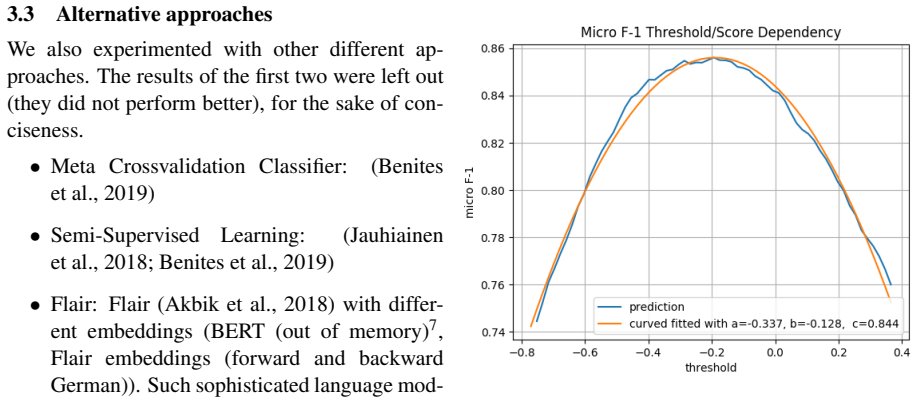
- The specific value -0.25 is probably not reusable; other datasets with different score distributions will need their own sweep, and the paper's own graph shows -0.2 and -0.25 performing similarly on development data.
- If the same threshold logic were applied to the logits or probabilities of neural classifiers, it might give deep models the same recall boost; the paper tested contextual embeddings only at the default threshold, so this is an untested extension.
- The paper notes that semi-supervised learning hurt because training and development sets appear drawn from the same distribution; a natural extension is to check whether threshold tuning also fails when the test distribution shifts.
- Because the winning margin in the hierarchical subtask came from the harmonic mean (the sum of recall and precision was nearly tied with the runner-up), a tiny threshold change decided the ranking; any comparison of multi-label systems should report threshold sensitivity.
Signed reviews
Editorial analysis
A structured set of objections, weighed in public.
Referee Report
Summary. This paper describes the TwistBytes system submitted to GermEval 2019 Task 1, a shared task on hierarchical multi-label classification of German book blurbs. The system uses a traditional NLP pipeline: multiple TF-IDF feature extractors (word and character n-grams, with and without stopword removal) feeding a linear SVM, with a local parent-node hierarchical classifier for subtask B. The main claimed contribution is a post-processing threshold t=-0.25 applied to SVM scores, which the authors argue improves recall without exceeding precision and is 'the key point' of the approach. The system achieved second place in the flat subtask A (micro F1 0.8634) and first place in the hierarchical subtask B (micro F1 0.6767). The paper also reports development-set experiments including comparisons of alternative thresholds, LCA-based thresholding, and several baseline/alternative methods.
Significance. The externally evaluated shared-task results are the strongest part of the paper: the first-place and second-place rankings are not in doubt, and the system is described in sufficient detail to be re-implemented. The release of an improved open-source hierarchical classification library (Hsklearn) is a practical contribution. If the explanatory claim about threshold post-processing is accepted, the paper provides evidence that a simple, lightweight feature-based pipeline can outperform deep learning on a mid-sized German text classification task, a finding of interest to the community. However, the central explanatory claim is underdetermined by the reported data: the development set does not clearly favor t=-0.25 over t=-0.2, no test-set ablation is provided, and no uncertainty estimates are given. The paper is best viewed as a system description with modest methodological novelty; its significance would be strengthened by a more honest and rigorous treatment of the threshold tuning evidence.
major comments (1)
- [§4.1] The sentence 'we could assume the same "distribution" of samples were in the training and development set (and so we concluded in the test set)' makes an unsupported distributional assumption that is load-bearing for the threshold tuning: if the test set differs from dev, the tuned threshold may not generalize. This concern is implicitly acknowledged in the choice of -0.25, but the paper should state the risk explicitly and discuss potential consequences (e.g., threshold sensitivity analysis on test-like data).
minor comments (6)
- [Abstract] The phrase 'increasing the recall but not surpassing the precision measure score' is confusing; the intended meaning is presumably 'increasing recall without exceeding precision.' Please rephrase.
- [Table 3] The column header reads 'true negative: tp, false negative: fn, false positive: fp, true positive: tp'; the first abbreviation should be 'tn' for true negative.
- [§3.2.3] The LCA formula is underspecified: the range of t, the definition of LCard, and the difference between 'labelwise' and 'global' versions are not fully defined. Also, the phrase 'we tested this method not for the label cardinality over all samples and labels but only labelwise' is ambiguous and should be clarified.
- [§3.2.2] There is a grammatical error: 'it does not conforms' should be 'it does not conform.'
- [§4.1] The sentence 'For the sake of conciseness, we will not discuss it here' and similar informal remarks (e.g., 'we did not have the time to implement it') are out of place in a formal paper; consider moving such details to a footnote or removing them.
- [Reference list] The reference to Read et al. (2009) is cited for the LCA method, but that paper is primarily about classifier chains; please verify whether the LCA description is correct or cite the original source more precisely.
Circularity Check
No circularity: the ranking rests on an external shared-task benchmark, and the threshold is a transparent hyperparameter choice, not a disguised input.
full rationale
The central claim, first place in GermEval 2019 subtask B and second in subtask A, is evaluated against a held-out test set with official rankings reported in Tables 5 and 6, so the result does not reduce to the paper's own assumptions. The post-processing threshold is presented as a tuned parameter: Section 4.1 reports development-set experiments, including that -0.2 achieved a slightly higher micro-F1 than -0.25 in subtask A (0.8557 vs 0.8540), and explains the choice of -0.25 by expected distribution shift and prior RCv1 experience rather than by claiming the dev data dictates it. The LCA method is attributed to Read et al. (2009), and the author's own prior work is cited only for framing and as background, not to supply the empirical result. There is no equation whose output is its input, no fitted value renamed as a prediction, and no uniqueness claim imported from the authors' own publications. The possible weakness that the exact -0.25 threshold is underdetermined is a generalizability and tuning concern, not a circularity concern.
Assumptions & free parameters
free parameters (4)
- Decision threshold t =
-0.25 (subtask A); -0.25 and -0.2 tested in subtask B
- SVM regularization C =
1.5
- Feature extraction max features =
100,000 (subtask A); 70,000 (subtask B)
- n-gram ranges =
word 1-7, word 1-3 with stopword removal, char 2-3
assumptions (3)
- domain assumption The hierarchy is a tree with each node having a single parent
- domain assumption The development and test sets are from the same distribution
- domain assumption Micro F1 is the evaluation measure of interest
Cite this review
Pith. "Pith review of TwistBytes -- Hierarchical Classification at GermEval 2019: walking the fine line (of recall and precision)." pith.science (2026). https://pith.science/paper/MEJ7WVV3
@misc{pith2026190806493,
  author       = {Pith},
  title        = {Pith review of: TwistBytes -- Hierarchical Classification at GermEval 2019: walking the fine line (of recall and precision)},
  year         = {2026},
  howpublished = {\url{https://pith.science/paper/MEJ7WVV3}},
  note         = {Machine review of arXiv:1908.06493}
}
read the original abstract
We present here our approach to the GermEval 2019 Task 1 - Shared Task on hierarchical classification of German blurbs. We achieved first place in the hierarchical subtask B and second place on the root node, flat classification subtask A. In subtask A, we applied a simple multi-feature TF-IDF extraction method using different n-gram range and stopword removal, on each feature extraction module. The classifier on top was a standard linear SVM. For the hierarchical classification, we used a local approach, which was more light-weighted but was similar to the one used in subtask A. The key point of our approach was the application of a post-processing to cope with the multi-label aspect of the task, increasing the recall but not surpassing the precision measure score.
Figures

Reference graph
Works this paper leans on
-
[1]
URL: " 'urlintro :=
ENTRY address author booktitle chapter edition editor howpublished institution journal key month note number organization pages publisher school series title type volume year eprint doi pubmed url lastchecked label extra.label sort.label short.list INTEGERS output.state before.all mid.sentence after.sentence after.block STRINGS urlintro eprinturl eprintpr...
-
[2]
write newline
" write newline "" before.all 'output.state := FUNCTION n.dashify 't := "" t empty not t #1 #1 substring "-" = t #1 #2 substring "--" = not "--" * t #2 global.max substring 't := t #1 #1 substring "-" = "-" * t #2 global.max substring 't := while if t #1 #1 substring * t #2 global.max substring 't := if while FUNCTION word.in bbl.in capitalize " " * FUNCT...
-
[3]
Alan Akbik, Duncan Blythe, and Roland Vollgraf. 2018. Contextual string embeddings for sequence labeling. In COLING 2018, 27th International Conference on Computational Linguistics , pages 1638--1649
2018
-
[4]
Fernando Benites. 2017. Multi-label Classification with Multiple Class Ontologies . Ph.D. thesis, University of Konstanz, Konstanz
work page 2017
-
[5]
Fernando Benites and Mark Cieliebak. 2017. Hierarchical classification for news articles. In SwissText 2017 : 2nd Swiss Text Analytics Conference
work page 2017
-
[6]
Fernando Benites, Pius von D \"a niken, and Mark Cieliebak. 2019. Twistbytes-identification of cuneiform languages and german dialects at vardial 2019. In Proceedings of the Sixth Workshop on NLP for Similar Languages, Varieties and Dialects, pages 194--201
work page 2019
-
[7]
Florian Brucker, Fernando Benites, and Elena Sapozhnikova. 2011. An empirical comparison of flat and hierarchical performance measures for multi-label classification with hierarchy extraction. In International Conference on Knowledge-Based and Intelligent Information and Engineering Systems, pages 579--589. Springer
work page 2011
-
[8]
Tommi Jauhiainen, Heidi Jauhiainen, and Krister Lind \'e n. 2018. HeLI-based experiments in Swiss German dialect identification . In Proceedings of the Fifth Workshop on NLP for Similar Languages, Varieties and Dialects (VarDial 2018), pages 254--262
work page 2018
Show all 16 references
-
[9]
Lewis, Yiming Yang, Tony G
David D. Lewis, Yiming Yang, Tony G. Rose, and Fan Li. 2004. Rcv1: A new benchmark collection for text categorization research. J. Mach. Learn. Res., 5:361--397
2004
-
[10]
Eneldo Loza Menc\' a and Johannes F \"u rnkranz. 2010. Efficient multilabel classification algorithms for large-scale problems in the legal domain. In Semantic Processing of Legal Texts, pages 192--215
2010
-
[11]
Bruno C Paes, Alexandre Plastino, and Alex Alves Freitas. 2014. Exploring attribute selection in hierarchical classification
2014
-
[12]
Ioannis Partalas, Aris Kosmopoulos, Nicolas Baskiotis, Thierry Artieres, George Paliouras, Eric Gaussier, Ion Androutsopoulos, Massih-Reza Amini, and Patrick Galinari. 2015. Lshtc: A benchmark for large-scale text classification. arXiv preprint arXiv:1503.08581
2015 arXiv
-
[13]
Jesse Read, Bernhard Pfahringer, Geoff Holmes, and Eibe Frank. 2009. Classifier chains for multi-label classification . In Joint European Conference on Machine Learning and Knowledge Discovery in Databases, pages 254--269. Springer
2009
-
[14]
Carlos N Silla and Alex A Freitas. 2011. A survey of hierarchical classification across different application domains. Data Mining and Knowledge Discovery, 22(1-2):31--72
2011
-
[15]
Grigorios Tsoumakas and Ioannis Katakis. 2007. Multi-label classification: An overview. Int J Data Warehousing and Mining, 2007:1--13
2007
-
[16]
Y. Yang. 1999. An evaluation of statistical approaches to text categorization . Information retrieval, 1(1):69--90
1999
Reviewed August 14, 2026 · model on record in the stance chip above.
Discussion (0). Continue with ORCID to comment.