REVIEW 2 major objections 45 references
Multi-cue mask refinement turns inconsistent 2D segments into coherent 3D instance labels for Gaussian Splatting scenes.
Reviewed by Pith at T0; open to challenge. T0 means a machine referee read the full paper against a public rubric. the ladder, T0–T4 →
T0 review · grok-4.3
2026-07-03 16:48 UTC pith:MEUFWGNU
load-bearing objection The paper outlines a multi-cue pipeline to reduce mask fragmentation when lifting 2D segments into 3D Gaussian Splatting, but the abstract supplies no metrics to show whether the gains are real. the 2 major comments →
Consistent Scene Understanding in 3D Gaussian Splatting via Multi-Cue Mask Refinement
The pith
A machine-rendered reading of the paper's core claim, the machinery that carries it, and where it could break.
Core claim
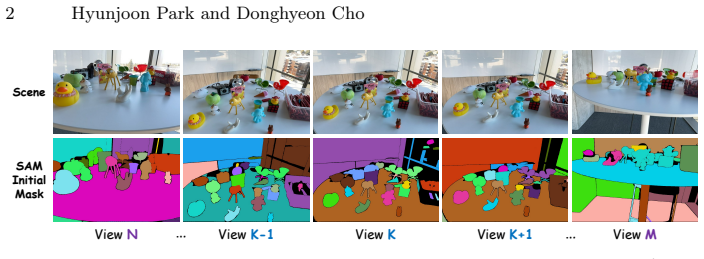
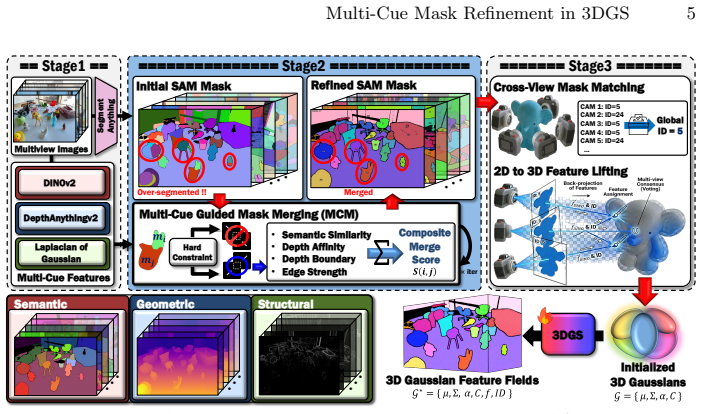
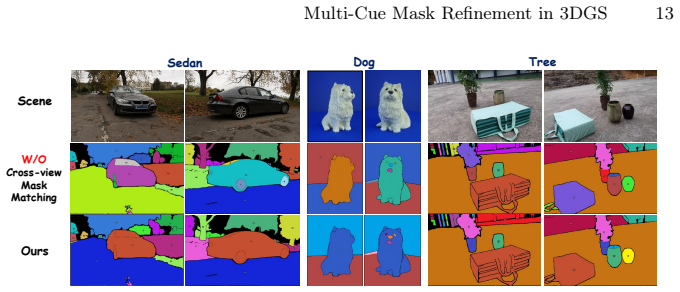
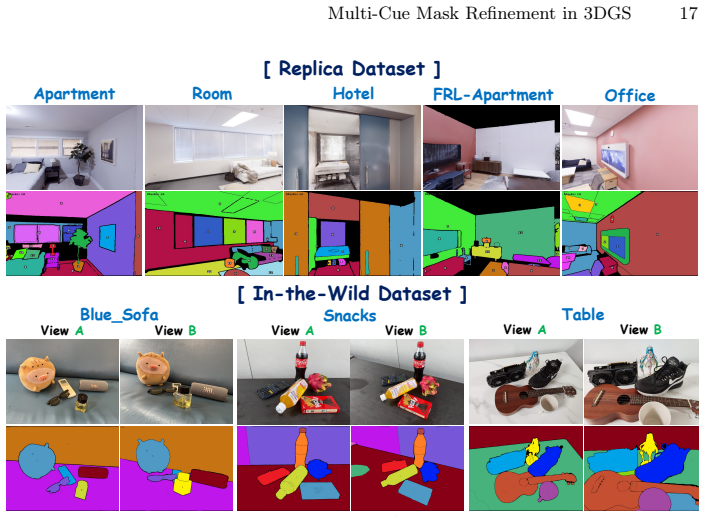
The central claim is that extracting synergistic semantic, geometric, and structural priors, consolidating fragmented masks through a composite merge score derived from semantic, depth, and edge cues, and performing cross-view mask matching to assign globally consistent identities together transform viewpoint-specific segments into coherent 3D primitives, thereby enabling stable 3D instance segmentation and effective downstream editing tasks in 3D Gaussian Splatting.
What carries the argument
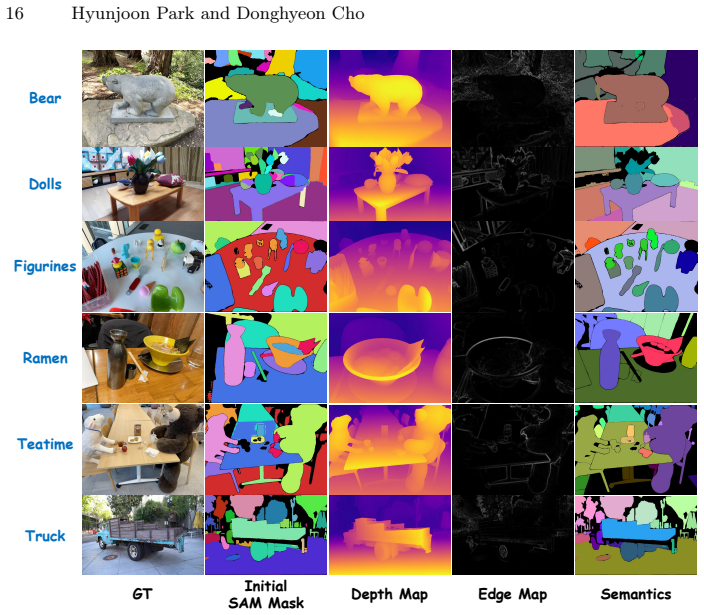
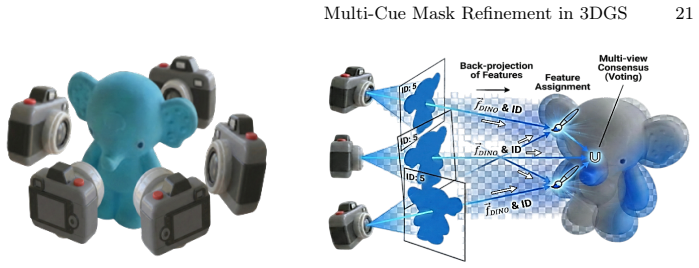
The multi-cue-guided mask merging process that consolidates fragmented masks using a composite merge score from semantic, depth, and edge cues, together with the cross-view mask matching step that establishes globally consistent identity assignments.
Load-bearing premise
That cues extracted from separate 2D foundation models can be fused into a single composite score and matched across views to produce consistent identities without creating new fragments or identity switches.
What would settle it
A quantitative evaluation on a held-out set of scenes in which the method records lower cross-view consistency scores or higher rates of identity switches than the raw 2D model outputs would show the refinement steps do not deliver the claimed improvement.
If this is right
- Stable 3D instance segmentation becomes available across multiple viewpoints.
- Downstream object-level editing tasks can operate on coherent 3D primitives rather than fragmented 2D masks.
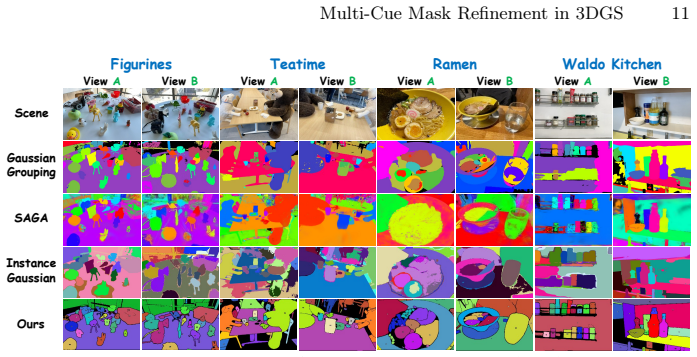
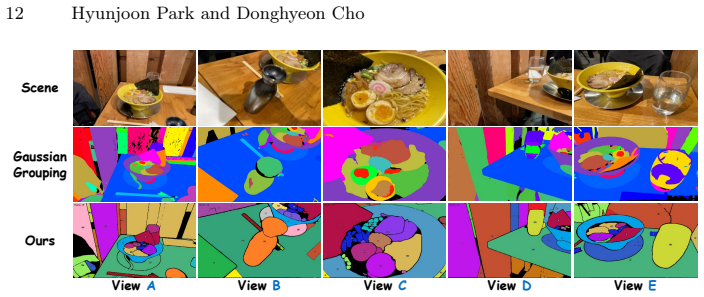
- Cross-view consistency and segmentation stability improve relative to baselines that use 2D masks directly.
- High-fidelity photometric reconstruction quality is preserved during the added segmentation steps.
Where Pith is reading between the lines
- The same cue-merging logic could be tested on other neural rendering backbones to check whether the consistency gains transfer beyond Gaussian Splatting.
- If the composite score generalizes, the pipeline might reduce the amount of manual mask cleanup needed in production 3D reconstruction workflows.
- Consistent 3D identities could support new tasks such as per-object material editing or physics simulation inside the reconstructed scene.
- The approach implicitly assumes static scenes; applying it to video with moving objects would require an additional temporal matching stage.
Editorial analysis
A structured set of objections, weighed in public.
Referee Report
Summary. The manuscript proposes a three-stage framework to produce consistent 2D instance masks that guide optimization of 3D Gaussian Splatting feature fields. Stage (1) performs Multi-Cue Extraction to obtain synergistic semantic, geometric, and structural priors from 2D foundation models on input images. Stage (2) applies Multi-Cue-Guided Mask Merging that consolidates fragmented masks via a composite merge score derived from semantic, depth, and edge cues. Stage (3) performs Cross-View Mask Matching to establish globally consistent identity assignments across viewpoints. The central claim is that this transforms viewpoint-specific segments into coherent 3D primitives, yielding stable 3D instance segmentation and effective downstream editing while preserving high-fidelity photometric reconstruction, with experiments showing significant gains in cross-view consistency and segmentation stability over baselines.
Significance. If the central claim holds with supporting evidence, the work would address a practical limitation in lifting inconsistent 2D segmentation priors to coherent 3D representations, which is relevant for object-level scene understanding and editing tasks in neural rendering pipelines. The multi-cue approach to merging and matching is a plausible direction for reducing fragmentation without new identity errors. However, the absence of any quantitative metrics, ablation studies, error analysis, or implementation details prevents assessment of whether the improvements are substantial, robust, or generalizable.
major comments (2)
- [Abstract] Abstract: the assertion that the method 'significantly improves cross-view consistency and segmentation stability over existing baselines' is load-bearing for the central claim yet is unsupported by any quantitative metrics, ablation studies, error analysis, or implementation details, making verification of the framework's effectiveness impossible from the supplied information.
- [Abstract] Abstract, stage (2): the composite merge score is presented as the mechanism for consolidating fragmented masks, but no formulation, weighting scheme, or matching procedure across views is supplied; this is central to the weakest assumption that synergistic priors can be merged without introducing new fragmentation or identity errors.
Simulated Author's Rebuttal
We thank the referee for the constructive feedback on the abstract. We agree that the central claims require clearer quantitative grounding and explicit method details to be verifiable. We will revise the abstract accordingly while preserving its concise nature.
read point-by-point responses
-
Referee: [Abstract] Abstract: the assertion that the method 'significantly improves cross-view consistency and segmentation stability over existing baselines' is load-bearing for the central claim yet is unsupported by any quantitative metrics, ablation studies, error analysis, or implementation details, making verification of the framework's effectiveness impossible from the supplied information.
Authors: We agree that the abstract claim would be stronger with direct quantitative support. In the revised manuscript we will incorporate specific metrics (e.g., cross-view consistency IoU gains and segmentation stability scores) into the abstract, together with a brief reference to the ablation and error analysis sections, so the improvement statement can be assessed from the abstract alone. revision: yes
-
Referee: [Abstract] Abstract, stage (2): the composite merge score is presented as the mechanism for consolidating fragmented masks, but no formulation, weighting scheme, or matching procedure across views is supplied; this is central to the weakest assumption that synergistic priors can be merged without introducing new fragmentation or identity errors.
Authors: We acknowledge that the abstract omits the mathematical formulation. We will revise the abstract to include a concise description of the composite merge score (weighted sum of semantic, depth, and edge terms) and note that the full weighting scheme and cross-view matching procedure appear in Section 3. This will make the merging mechanism explicit without exceeding abstract length limits. revision: partial
Circularity Check
No significant circularity; derivation is self-contained
full rationale
The paper presents a three-stage pipeline (multi-cue extraction, mask merging via composite score, cross-view matching) for lifting 2D segments to consistent 3D primitives in Gaussian Splatting. No equations, fitted parameters, or first-principles derivations appear in the abstract or described framework. The central claim rests on empirical merging and matching heuristics whose correctness is evaluated externally via consistency metrics and editing tasks, not by construction from the inputs themselves. No self-citation chains, ansatzes, or renamings reduce the output to the input. This is the normal case of an applied method paper whose load-bearing steps are algorithmic rather than tautological.
Axiom & Free-Parameter Ledger
read the original abstract
Reliable instance-level scene understanding is a fundamental prerequisite for object-level interactions and high-fidelity 3D representations. While current methods often leverage 2D foundation segmentation models to obtain these priors, their 2D-centric design typically yields fragmented masks and inconsistent predictions across different views. To address these issues, we propose a novel framework that produces consistent 2D instance masks to guide the optimization of 3D Gaussian Splatting (3DGS) feature fields. Our framework consists of three main stages. (1) Multi-Cue Extraction that generates synergistic semantic, geometric, and structural priors from input images. (2) Multi-Cue-Guided Mask Merging process that consolidates fragmented masks using a composite merge score derived from semantic, depth, and edge cues. (3) Cross-View Mask Matching that establishes globally consistent identity assignments across all viewpoints. By transforming viewpoint-specific segments into coherent 3D primitives, our approach enables stable 3D instance segmentation and effective downstream editing tasks. Experiments demonstrate that our method significantly improves cross-view consistency and segmentation stability over existing baselines while maintaining high-fidelity photometric reconstruction.
Figures
Reference graph
Works this paper leans on
- [1]
- [2]
-
[3]
Canny, J.: A computational approach to edge detection. TPAMI (6), 679–698 (1986) 16
work page 1986
- [4]
- [5]
-
[6]
Guo, J., Ma, X., Fan, Y., Liu, H., Li, Q.: Semantic gaussians: Open-vocabulary scene understanding with 3d gaussian splatting. arXiv (2024) 3
work page 2024
-
[7]
Hore, A., Ziou, D.: Image quality metrics: Psnr vs. ssim. In: ICPR. pp. 2366–2369. IEEE (2010) 9
work page 2010
- [8]
- [9]
- [10]
- [11]
- [12]
-
[14]
NeurIPS35, 23311–23330 (2022) 3
Kobayashi, S., Matsumoto, E., Sitzmann, V.: Decomposing nerf for editing via feature field distillation. NeurIPS35, 23311–23330 (2022) 3
work page 2022
-
[15]
Naval research logistics quarterly2(1-2), 83–97 (1955) 19
Kuhn, H.W.: The hungarian method for the assignment problem. Naval research logistics quarterly2(1-2), 83–97 (1955) 19
work page 1955
- [16]
-
[17]
Lee, H., Min, J., Park, J.: Cf3: Compact and fast 3d feature fields. ICCV (2025) 3, 10, 11
work page 2025
- [18]
-
[19]
Li, B., Weinberger, K.Q., Belongie, S., Koltun, V., Ranftl, R.: Language-driven semantic segmentation (2022), https://arxiv.org/abs/2201.03546 15
work page internal anchor Pith review Pith/arXiv arXiv 2022
- [20]
- [21]
- [22]
-
[23]
Lu, Y., Zhou, Y., Qiao, Y., Song, C., Liang, T., Ma, J., Wang, H., Yin, Y.: Segment then splat: Unified 3d open-vocabulary segmentation via gaussian splatting. In: NeurIPS 3
- [24]
-
[25]
Proceedings of the Royal Society of London
Marr, D., Hildreth, E.: Theory of edge detection. Proceedings of the Royal Society of London. Series B. Biological Sciences207(1167), 187–217 (1980) 4, 5, 12, 15
work page 1980
-
[26]
Commu- nications of the ACM65(1), 99–106 (2021) 1
Mildenhall, B., Srinivasan, P.P., Tancik, M., Barron, J.T., Ramamoorthi, R., Ng, R.: Nerf: Representing scenes as neural radiance fields for view synthesis. Commu- nications of the ACM65(1), 99–106 (2021) 1
work page 2021
-
[27]
Oquab, M., Darcet, T., Moutakanni, T., Vo, H., Szafraniec, M., Khalidov, V., Fernandez, P., Haziza, D., Massa, F., El-Nouby, A., et al.: Dinov2: Learning robust visual features without supervision. arXiv (2023) 2, 4, 12, 14, 15
work page 2023
-
[28]
Scholarpedia4(2), 1883 (2009) 9
Peterson, L.E.: K-nearest neighbor. Scholarpedia4(2), 1883 (2009) 9
work page 2009
- [29]
- [30]
- [31]
-
[32]
TPAMI44(3), 1623–1637 (2020) 15
Ranftl, R., Lasinger, K., Hafner, D., Schindler, K., Koltun, V.: Towards robust monocular depth estimation: Mixing datasets for zero-shot cross-dataset transfer. TPAMI44(3), 1623–1637 (2020) 15
work page 2020
- [33]
-
[34]
Presentation at Stanford Artificial Intelligence Project pp
Sobel, I., Feldman, G.: An isotropic 3x3 gradient operator for image processing. Presentation at Stanford Artificial Intelligence Project pp. 271–272 (1968) 16
work page 1968
-
[35]
Straub, J., Whelan, T., Ma, L., Chen, Y., Wijmans, E., Green, S., Engel, J.J., Mur-Artal, R., Ren, C., Verma, S., et al.: The replica dataset: A digital replica of indoor spaces. arXiv (2019) 3, 9, 18
work page 2019
-
[36]
Tschernezki, V., Laina, I., Larlus, D., Vedaldi, A.: Neural feature fusion fields: 3d distillation of self-supervised 2d image representations. In: 3DV. pp. 443–453. IEEE (2022) 3
work page 2022
-
[37]
Wang, N., Yan, X., Song, X., Wang, Z.: Semantic-guided gaussian splatting with deferred rendering. In: ICASSP. pp. 1–5. IEEE (2025) 3
work page 2025
-
[38]
NeurIPS37, 19114–19138 (2024) 3
Wu, Y., Meng, J., Li, H., Wu, C., Shi, Y., Cheng, X., Zhao, C., Feng, H., Ding, E., Wang, J., et al.: Opengaussian: Towards point-level 3d gaussian-based open vocabulary understanding. NeurIPS37, 19114–19138 (2024) 3
work page 2024
-
[39]
NeurIPS37, 21875–21911 (2024) 2, 4, 12, 15
Yang, L., Kang, B., Huang, Z., Zhao, Z., Xu, X., Feng, J., Zhao, H.: Depth anything v2. NeurIPS37, 21875–21911 (2024) 2, 4, 12, 15
work page 2024
- [40]
- [41]
- [42]
- [43]
- [44]
- [45]
-
[46]
Zuo, X., Samangouei, P., Zhou, Y., Di, Y., Li, M.: Fmgs: Foundation model em- bedded 3d gaussian splatting for holistic 3d scene understanding. IJCV133(2), 611–627 (2025) 3
work page 2025
discussion (0)
Sign in with ORCID, Apple, or X to comment. Anyone can read and Pith papers without signing in.