REVIEW 3 major objections 5 minor 1 cited by
Green's Function Approach to Josephson Dot Dynamics and Application to Quantum Mpemba Effects
T0 review · 3 major / 5 minor · reviewed 2026-08-10 · deepseek-v4-flash
Pith's one-line read A Green's-function derivation shows quantum Mpemba effects in phase-quenched Josephson dots.
desk verdict Solid GF-based rate derivation for Andreev levels, but the quantum Mpemba predictions rest on an unjustified sudden-quench initialization that ignores the rotation of the Andreev spinors. read the letter →
The pith
A machine-rendered reading of the paper's core claim, the machinery that carries it, and where it could break.
The reading
What carries the argument
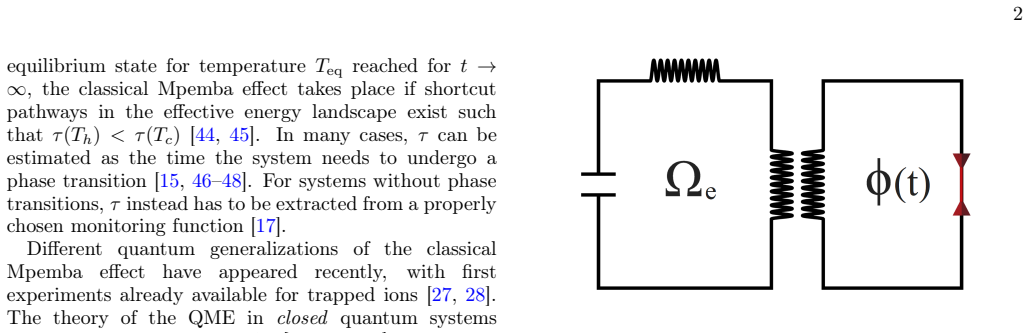
The central object is the retarded boundary Green's function of the BCS leads, $g^R(\omega) = -\pi\nu_F (\omega\tau_0 + \Delta\tau_x)/\zeta(\omega)$, which is used to integrate out the leads and obtain a time-nonlocal effective Schrödinger equation for the $4\ell$-component dot wavefunction. Transition rates follow from first-order perturbation theory in the phase fluctuation, yielding $\Gamma_{\lambda\to n} = 2\pi |I_{n\lambda}|^2 J(\omega) n_B(\omega)$ at $\omega = E_n - E_\lambda$, with current matrix elements $I_{n\lambda} = \eta_n^\dagger[\tau_z I(E_\lambda) - I(E_n)\tau_z]\eta_\lambda$. Rates to the continuum are obtained by resolving the spectral function into eigenstates $\xi_n(\omega)$, and the resulting expressions are consistent with earlier Bogoliubov–de Gennes calculations while avoiding explicit wavefunction matching in the leads. This machinery converts the nonequilibrium dynamics of Andreev levels into a Pauli master equation whose rates depend only on matrices in dot-level space.
What would settle it
Measure the relaxation time $\tau$ as a function of pre-quench phase $\phi_0^{(i)}$ for fixed post-quench phase $\phi_0^{(eq)}$ in a short, high-transparency junction with $T\approx 0.99$ and $T_{qp}>T_b$; the central claim predicts non-monotonic $\tau$ with local minima ('Mpemba arcs') and both QME types, so a flat, monotonic landscape in this regime would falsify it. Observing a QME at $T_{qp}=T_b$, where the paper predicts none, would also falsify it.
Extended reading notes
Core claim
The paper's central claim is that the low-energy Andreev sector of a Josephson dot obeys a Markovian Lindblad equation whose rates can be obtained from the poles and spectral eigenvectors of the retarded Green's function of the dot-lead system, and that these rates produce quantum Mpemba effects after a rapid phase quench. In the short-junction limit with high transparency, the steady-state Andreev populations become non-monotonic functions of the phase bias once the quasiparticle temperature exceeds the bath temperature, and this non-monotonicity is what lets a 'far' pre-quench phase relax faster than a 'close' one. The paper distinguishes type-I QME, where the far copy is closer to equilibrium for all times, from type-II QME, where the far copy crosses the close copy at a finite time, and shows both can be realized. In longer junctions with spin-orbit and Zeeman terms, the broken phase-reflection symmetry removes the mirror symmetry of the relaxation-time map, making type-II QME the dominant outcome. The authors identify 'Mpemba arcs' in the pre- versus post-quench phase plane, curves where stationary populations coincide, as necessary and sufficient for the effect.
Load-bearing premise
The continuum of BCS quasiparticles stays in a thermal Fermi distribution at an effective temperature $T_{qp}$, chosen independently of the bosonic bath and with $T_{qp}\ge T_b$; without that assumption the predicted Mpemba windows do not emerge.
Editorial extensions
If this is right
- For a short, high-transparency junction, both type-I and type-II quantum Mpemba effects can be produced by a rapid phase quench, with relaxation times set by the slowest eigenvalue of the Pauli master equation.
- The existence of at least one 'Mpemba arc' in the pre- versus post-quench phase plane is necessary and sufficient for a quantum Mpemba effect in this system.
- For an intermediate-length junction with spin-orbit coupling and a Zeeman field, the type-II effect dominates, because the broken $\phi_0\to 2\pi-\phi_0$ symmetry makes Mpemba arcs invisible in the initial distance but visible in relaxation time.
- The effect is robust to the shape of the environment spectral density: similar QME regimes appear for both Lorentzian microwave-resonator and Ohmic environments.
- The steady-state current-phase relation develops pronounced minima near the phase values where Andreev population components have extrema, providing an experimentally accessible indicator of the $T_{qp}>T_b$ regime.
Reading between the lines
- Editorial inference: the same Green's-function rate formulas apply to a dot with Coulomb interactions, and the paper states the formalism allows this but does not pursue it; an interacting Josephson dot is therefore a natural next place to search for QMEs.
- Editorial inference: because the relaxation-time map loses mirror symmetry when spin-orbit and Zeeman terms break $\phi_0\to 2\pi-\phi_0$, comparing quenches on the two sides of the phase interval would give a sharp test of the predicted type-II dominance.
- Editorial inference: the 'avoided QME' crossings visible in the authors' time traces suggest that experiments using only crossing times as a QME diagnostic could misclassify an avoided QME; a population-resolved measurement of the full distance function would be needed to confirm the type.
Editorial analysis
A structured set of objections, weighed in public.
Referee Report
Summary. The manuscript develops a Green's-function-based equation-of-motion approach for multi-level quantum dots coupled to superconducting leads and a bosonic environment, and uses it to derive Markovian transition rates for Andreev bound states interacting with phase fluctuations. It then applies the resulting Lindblad/Pauli dynamics to study quantum Mpemba effects after a sudden phase quench, claiming both type-I and type-II QMEs in short junctions and type-II-dominated QMEs in intermediate-length spin-orbit-coupled junctions. The central technical results are the rate formulas Eqs. (2.56), (2.77), and (2.79), and the central predictions are encoded in the phase-quench protocol of Sec. IIIA2 and the numerical maps of Figs. 5, 6, and 8.
Significance. If the results hold, the paper provides a useful simplification: transition rates that previously required explicit BdG wavefunction matching are obtained from dot-level matrices, and the explicit comparison with Refs. [9,10] lends credibility to the GF route. The application to QMEs is concrete and experimentally falsifiable in principle, since the trace distance in Eq. (3.22) is tied to microwave-spectroscopy measurements of ABS populations, and the paper is unusually explicit about its assumptions (Tqp, spectral-density forms, parameter choices). The numerical results are supported by a data-availability statement. However, the credibility of the QME predictions hinges on two load-bearing steps that are not fully justified: the mapping of pre-quench to post-quench populations under the phase quench, and the truncation of principal-value contributions in the ABS-continuum rate derivation.
major comments (3)
- [Sec. IIIA2, after Eq. (3.15)] The quench protocol initializes the post-quench Pauli master equation with the pre-quench stationary populations P^{(c,f)}_{r,stat}. This equates occupations in the old and new Andreev bases, but the ABS eigenspinors η_ν(ϕ0) in Eq. (2.34) depend on ϕ0, so a sudden change from ϕ0^(i) to ϕ0^(eq) rotates the quasiparticle basis. A density matrix that was diagonal in the old basis acquires coherences in the new basis, and the new occupations are not equal to the old ones: they are given by a projection involving overlaps such as |⟨η_n(ϕ_eq)|η_ν(ϕ_i)⟩|² in the occupation sector. This overlap is never computed or estimated. For the high-transparency case T=0.99 used in Figs. 5 and 6, the short-junction dispersion (3.4) spans from Δ down to about 0.1Δ, so the spinor rotation with ϕ0 is substantial and the approximation P(t=0)=P_{r,stat}(ϕ_i) is not obviously negligible. Since the Mpemba arcs and the type-I/type-II classification in Figs. 5, 6, and 8 are defined by relaxation times obtained from these initial conditions, the central QME claim is affected. Please compute the projection of the pre-quench stationary state onto the post-quench ABS basis, or provide a controlled argument for why the overlap correction can be dropped.
- [Sec. IIC3, Eq. (2.74)] The replacement G^R_{nk}(E) = -iπ δ_{nk} ρ_n(E) discards the principal-value integrals in Eq. (2.69) under the assumption that ρ_m(z) is smooth. Smoothness alone does not make a principal-value integral vanish: the integrand also contains the overlap factors ξ†_n(E)ξ_m(z), and the principal value generally gives a nonzero off-shell contribution whose magnitude depends on the model parameters. This step enters directly into the continuum rates Γ^out_λ and Γ^in_λ in Eqs. (2.77) and (2.79), and hence into every QME prediction in Sec. III. The agreement with the BdG-based rates of Refs. [9,10] is reassuring, but the derivation given here does not establish the truncation. The authors should either prove the cancellation for this model, or quantify the omitted principal-value terms by evaluating Eq. (2.69) numerically for the multi-level examples of Sec. IIIB.
- [Sec. IIB2 and Sec. IIIA1] The continuum of BCS quasiparticles is modeled by a global thermal Fermi function at an effective quasiparticle temperature Tqp, and the QME regimes shown in Figs. 3 and 4 appear only for Tqp > Tb (compare panels (a) with (b,c)). The parameter Tqp is introduced with a qualitative physical discussion (local cooling of the dot region, phonon-induced lead equilibration), but it is not derived from a microscopic calculation or tied to an experimentally controllable quantity. As a result, the central prediction is conditional on an unquantified free parameter. The authors should specify how Tqp is set in a concrete experimental protocol, or map the QME region in the (Tqp,Tb) plane and state how robust the type-I/type-II classification is to plausible Tqp variations.
minor comments (5)
- [Eqs. (2.51), (2.65), and (2.71)] The notation Q_T is overloaded: Eq. (2.65) states Q_T(E) = T Q_T(E) with Q_T defined in Eq. (2.51), but Eq. (2.71) is only correct for the redefined object. Please use a separate symbol, e.g., R_T(E) = T Q_T(E), and make the factor of T explicit in Eq. (2.65).
- [Figs. 3 and 4] The population curves are distinguished only by dashed/dot-dashed/dotted styles; in printed or grayscale versions these may be difficult to tell apart, especially where the curves cross. Adding markers or labels inside the panels would improve readability.
- [Sec. IIIA2, Eq. (3.22)] The sentence immediately after Eq. (3.22) notes that DM(P(t)) differs from DM(Pr(t)) because the second component of Pr is counted twice. It would be helpful to write the explicit relation to avoid confusion about the factor 1/2 in the definition.
- [Sec. IIIA3] The statement that the existence of at least one Mpemba arc is a necessary and sufficient condition for the QME is stronger than what is shown; the numerical evidence establishes sufficiency-type behavior for the studied parameters, but a proof or a more cautious wording would be appropriate.
- [Appendix, Eq. (A6)] The truncation of the infinite Hamiltonian matrix to eigenstates below an energy cutoff comparable to Δ is mentioned, but the convergence of the hybridization matrices (2.25) with respect to this cutoff is not discussed. A brief convergence test for the L=1.7ξ0 case would strengthen the numerical results in Sec. IIIB.
Circularity Check
No significant circularity: transition rates are derived in-paper from the Green's-function equations, and the quantum Mpemba label is applied via an adopted protocol rather than used to fit the rates.
full rationale
The paper's central derivation chain is self-contained: Eqs. (2.56), (2.77), and (2.79) follow from the EOM and perturbative Green's-function calculation in Secs. IIB-IIC, and the QME application in Sec. III solves the resulting Pauli master equation. The comparisons with BdG results in Refs. [9,10] are consistency checks, not inputs: the rates are derived before the comparison is invoked, and the agreement is not used to determine any parameter. The only prominent self-reference is the QME protocol of Ref. [38] by two of the present authors, adopted in Sec. IIIA2; however, the protocol is a definitional framework (trace-distance monitoring and the type-I/type-II distinction), not a fitted or imported result that forces the prediction. The effective quasiparticle temperature Tqp is an explicitly stated modeling assumption, not a parameter fitted to the predicted Mpemba arcs; the prediction is conditional on Tqp >= Tb, and the paper states this. A limitation worth noting is the sudden-quench initialization with pre-quench populations after the phase change (text after Eq. (3.15)); a rigorous treatment would require projecting the old ABS density matrix onto the new ABS basis. This is a physical approximation that could affect the quantitative predictions, but it is not a circular reduction of the output to the input. Overall, no load-bearing circular step is present; score 2 reflects only the minor self-citation of the QME protocol.
Assumptions & free parameters
free parameters (4)
- Tqp =
0.5 in main QME plots; 0.14-0.5 scanned
- epsilon_c =
1e-4
- environment spectral density parameters =
Lorentzian: Omega_e=0.01, eta=0.1, kappa=0.1; Ohmic: alpha_d=0.1, omega_c=1, with Delta=1
- junction transparency parameters =
T=0.99 (epsilon=0.46, Gamma=6.5), T=0.85 (epsilon=2.74), T=0.3 (epsilon=9.8); L=0.6 xi0 short, L=1.7 xi0 intermediate…
assumptions (6)
- domain assumption Phase fluctuations are small, so first-order expansion in phi_tilde is valid.
- domain assumption Continuum quasiparticles are in thermal quasi-equilibrium at temperature Tqp, are not entangled with ABSs, and Tqp >= Tb.
- ad hoc to paper The number of subgap Andreev solutions stays 2ell by continuity of root flow in Gamma-Delta parameter space.
- domain assumption Phonon-induced relaxation is negligible compared to phase-fluctuation relaxation.
- ad hoc to paper Principal-value parts in the ABS-continuum Green's function expansion are negligible because spectral functions are smooth.
- domain assumption The reduced dynamics of ABS populations is Markovian and obeys a Lindblad/Pauli master equation with decoupled coherences.
Cite this review
Pith. "Pith review of Green's Function Approach to Josephson Dot Dynamics and Application to Quantum Mpemba Effects." pith.science (2026). https://pith.science/paper/MF6HNEK7
@misc{pith2026250111609,
  author       = {Pith},
  title        = {Pith review of: Green's Function Approach to Josephson Dot Dynamics and Application to Quantum Mpemba Effects},
  year         = {2026},
  howpublished = {\url{https://pith.science/paper/MF6HNEK7}},
  note         = {Machine review of arXiv:2501.11609}
}
read the original abstract
We develop a Green's function approach for the nonequilibrium dynamics of multi-level quantum dots coupled to multiple fermionic reservoirs in the presence of a bosonic environment. Our theory is simpler than the Keldysh approach and goes beyond scattering state constructions. In concrete terms, we study Josephson junctions containing a quantum dot and coupled to an electromagnetic environment. In the dot region, spin-orbit interactions, a Zeeman field, and in principle also Coulomb interactions can be included. We then study quantum Mpemba effects, assuming that the average phase difference across the Josephson junction is subject to a rapid quench. For a short singlechannel junction, we show that both types of quantum Mpemba effects allowed in open quantum systems are possible. We also study an intermediate-length junction, where spin-orbit interactions and a Zeeman field are included. Again quantum Mpemba effects are predicted.
Figures


Figures from the paper (5 more)


Forward citations
Cited by 1 Pith paper
-
The quantum Mpemba effects
A review of the quantum Mpemba effect covering open and isolated quantum systems, key theories, experiments, and open questions.
Reference graph
Works this paper leans on
-
[1]
No fluctuations In the absence of phase fluctuations,˜ϕ = 0, the above equations simplify to [i∂t − h(i∂t)] γ(t) = 0, h (ω) = ϵτz + Λ(ω), (2.31) where h(i∂t) plays the role of an effective single-particle Hamiltonian. However, this operator is nonlocal in time since it can be expanded into an infinite series in∂t. In particular, we observe from Eqs. (2.20...
-
[2]
Phase fluctuation effects We now return to the full EOM (2.26) in the presence of phase fluctuations ˜ϕ. Since Eq. (2.26) is linear in the field operator γ(t), it is convenient to switch to a first-quantized framework for the fermionic part. In first quantization, ABS and continuum quasiparticles are representedbya 4ℓ-componentwavefunction Ψ(t), which obe...
-
[3]
Atomic limit Before tackling the full expression (2.41), it is instructive to first study the atomic limit, where substantial simplifications are possible. Taking∆ → ∞, see Eq. (2.32), we find GR(ω) = 2ℓX ν=1 " ηνη† ν ω − Eν + iδ+ + η¯νη† ¯ν ω + Eν + iδ+ # , (2.42) where we used the completeness of the ABSorthonormal basis. In this limit, the perturbation...
-
[4]
Transition rates between Andreev states Wereturntothescatteringproblem(2.39)with Ψ(1) λ (t) in Eq. (2.41), where we may write Ψ(1) λ (t) = X n∈{ν,¯ν} an(t)ηne−iEnt + ˜Ψ(t), η ¯ν = τxη∗ ν, (2.49) with ν ∈ {1, . . . ,2ℓ}. We recall that ˜Ψ(t) represents above-gap continuum states and that, in general,η† nηn′ ̸= 0 for n ̸= n′. For very long timest = T, an(t)...
-
[5]
However, they cannot be described by eigenstates ofh(ω) ̸= h†(ω) for |ω| > ∆
Transition rates between ABSs and continuum states Next, to compute transition rates connecting ABSs to the continuum sector, we first recall that after integratingoutthesuperconductingleads, thecontinuum quasiparticles are encoded in GR/A(ω). However, they cannot be described by eigenstates ofh(ω) ̸= h†(ω) for |ω| > ∆. To calculate the transition rates, ...
-
[6]
describing the dynamics of the ABS sector within the above approximations, see also Ref. [10]. In second- quantized notation and carefully taking into account double-counting effects, the reduced density matrixρA(t) describing the state dynamics in the ABS sector obeys the Lindblad equation ∂tρA = −i X λ Eλ[a† λaλ, ρA] + X λ,λ′ Γλ′→λ L h a† λaλ′ i ρA + + ...
-
[7]
We go beyond this restriction in Sec
Case Γ ≫ ∆ We first describe an analytical approach for identifying the QME for a single-level dot with large hybridization to the superconducting leads, Γ ≫ ∆. We go beyond this restriction in Sec. IIIA3 by performing numerical calculations. For Γ ≫ ∆, the quantum dot model in Sec. IIA implies the well-known ABS dispersion relation [1, 54, 55] E1(ϕ0) ≃ ∆...
-
[8]
QME protocol Following Ref. [38], see also Sec. I, the protocol for detecting the QME consists of comparing two copies of the system prepared at time t < 0 in the pre-quench stationary states P(c) r,stat and P(f ) r,stat corresponding to the phase differences ϕ(c) 0 and ϕ(f ) 0 , respectively, with all other model parameters kept identical. At time t = 0,...
Show all 71 references
-
[9]
Mpemba arcs
Arbitrary Γ/∆ If the condition Γ ≫ ∆ is not satisfied, instead of Eq. (3.4), one needs to employ the numerically exact ABS dispersion obtained by solving Eq. (2.34). Similarly, one then has to numerically evaluate the transition rates in Eq. (3.3) from the corresponding genera...
2004
-
[10]
Y. V. Nazarov and Y. M. Blanter,Quantum transport: Introduction to Nanoscience (Cambridge University Press, Cambridge, 2009)
2009
-
[11]
Breuer and F
H.-P. Breuer and F. Petruccione,The Theory of Open Quantum Systems (Oxford University Press, Oxford,
-
[12]
Giuliano and I
D. Giuliano and I. Affleck, The Josephson current through a long quantum wire, Journal of Statistical Mechanics: Theory and Experiment 2013, P02034 (2013)
2013
-
[13]
Giuliano and I
D. Giuliano and I. Affleck, dc Josephson current in a long multichannel quantum wire, Phys. Rev. B 90, 045133 (2014)
2014
-
[14]
Zazunov, A
A. Zazunov, A. Brunetti, A. L. Yeyati, and R. Egger, Quasiparticle trapping, Andreev level population dynamics, and charge imbalance in superconducting weak links, Phys. Rev. B90, 104508 (2014)
2014
-
[15]
Campagnano, P
G. Campagnano, P. Lucignano, D. Giuliano, and A. Tagliacozzo, Spin-orbit coupling and anomalous Josephson effect in nanowires, Journal of Physics: Condensed Matter27, 205301 (2015)
2015
-
[16]
Park and A
S. Park and A. L. Yeyati, Andreev spin qubits in multichannel Rashba nanowires, Phys. Rev. B96, 125416 (2017)
2017
-
[17]
Minutillo, D
M. Minutillo, D. Giuliano, P. Lucignano, A. Tagliacozzo, and G. Campagnano, Anomalous Josephson effect in S/SO/F/S heterostructures, Phys. Rev. B 98, 144510 (2018)
2018
-
[18]
Ackermann, A
N. Ackermann, A. Zazunov, S. Park, R. Egger, and A. L. Yeyati, Dynamical parity selection in superconducting weak links, Phys. Rev. B107, 214515 (2023)
2023
-
[19]
Zatsarynna, A
K. Zatsarynna, A. Nava, A. Zazunov, and R. Egger, Many-body quantum dynamics of spin-orbit coupled Andreev states in a Zeeman field, Phys. Rev. B 109, 214505 (2024)
2024
-
[20]
Fauvel, J
Y. Fauvel, J. S. Meyer, and M. Houzet, Opportunities for the direct manipulation of a phase-driven Andreev spin qubit, Phys. Rev. B109, 184515 (2024)
2024
-
[21]
Lidal and J
J. Lidal and J. Danon, Andreev bound states and supercurrent in disordered spin-orbit-coupled nanowire superconductor-normal-superconductor junctions, Phys. Rev. B111, 064516 (2025)
2025
-
[22]
Weiss, Quantum Dissipative Systems , 4th ed
U. Weiss, Quantum Dissipative Systems , 4th ed. (World Scientific, Singapore, 2012) https://www.worldscientific.com/doi/pdf/10.1142/8334
2012 doi
-
[23]
M. Z. Hasan and C. L. Kane, Colloquium: Topological insulators, Rev. Mod. Phys.82, 3045 (2010)
2010
-
[24]
E. B. Mpemba and D. G. Osborne, Cool?, Physics Education 4, 172 (1969)
1969
-
[25]
Jeng, The Mpemba effect: When can hot water freeze faster than cold?, American Journal of Physics74, 514 (2006)
M. Jeng, The Mpemba effect: When can hot water freeze faster than cold?, American Journal of Physics74, 514 (2006)
2006
-
[26]
Lu and O
Z. Lu and O. Raz, Nonequilibrium thermodynamics of the Markovian Mpemba effect and its inverse, Proceedings of the National Academy of Sciences114, 5083 (2017)
2017
-
[27]
Lasanta, F
A. Lasanta, F. Vega Reyes, A. Prados, and A. Santos, When the Hotter Cools More Quickly: Mpemba Effect in Granular Fluids, Phys. Rev. Lett.119, 148001 (2017)
2017
-
[28]
Baity-Jesi, E
M. Baity-Jesi, E. Calore, A. Cruz, L. A. Fernandez, J. M. Gil-Narvión, A. Gordillo-Guerrero, D. Iñiguez, A. Lasanta, A. Maiorano, E. Marinari, V. Martin- Mayor, J. Moreno-Gordo, A. Muñoz Sudupe, D. Navarro, G. Parisi, S. Perez-Gaviro, F. Ricci-Tersenghi, J. J. Ruiz-Lorenzo, S....
2019
-
[29]
Torrente, M
A. Torrente, M. A. López-Castaño, A. Lasanta, F. V. Reyes, A. Prados, and A. Santos, Large Mpemba-like effect in a gas of inelastic rough hard spheres, Phys. Rev. E 99, 060901 (2019)
2019
-
[30]
Santos and A
A. Santos and A. Prados, Mpemba effect in molecular gases under nonlinear drag, Physics of Fluids32, 072010 (2020)
2020
-
[31]
Megías, A
A. Megías, A. Santos, and A. Prados, Thermal versus entropic Mpemba effect in molecular gases with nonlinear drag, Phys. Rev. E105, 054140 (2022)
2022
-
[32]
Chétrite, A
R. Chétrite, A. Kumar, and J. Bechhoefer, The Metastable Mpemba Effect Corresponds to a Non- monotonic Temperature Dependence of Extractable Work, Frontiers in Physics9, 654271 (2021)
2021
-
[33]
M. R. Walker and M. Vucelja, Mpemba effect in terms of mean first passage time (2023), arXiv:2212.07496 [cond- mat.stat-mech]
2023 arXiv
-
[34]
Murciano, F
S. Murciano, F. Ares, I. Klich, and P. Calabrese, Entanglement asymmetry and quantum Mpemba effect in the XY spin chain, Journal of Statistical Mechanics: Theory and Experiment2024, 013103 (2024)
2024
-
[35]
Rylands, K
C. Rylands, K. Klobas, F. Ares, P. Calabrese, S. Murciano, and B. Bertini, Microscopic Origin of the Quantum Mpemba Effect in Integrable Systems, Phys. Rev. Lett.133, 010401 (2024)
2024
-
[36]
Aharony Shapira, Y
S. Aharony Shapira, Y. Shapira, J. Markov, G. Teza, N. Akerman, O. Raz, and R. Ozeri, Inverse Mpemba Effect Demonstrated on a Single Trapped Ion Qubit, 21 Phys. Rev. Lett.133, 010403 (2024)
2024
-
[37]
L. K. Joshi, J. Franke, A. Rath, F. Ares, S. Murciano, F. Kranzl, R. Blatt, P. Zoller, B. Vermersch, P. Calabrese, C. F. Roos, and M. K. Joshi, Observing the Quantum Mpemba Effect in Quantum Simulations, Phys. Rev. Lett.133, 010402 (2024)
2024
-
[38]
A. K. Chatterjee, S. Takada, and H. Hayakawa, Quantum Mpemba Effect in a Quantum Dot with Reservoirs, Phys. Rev. Lett.131, 080402 (2023)
2023
-
[39]
A. K. Chatterjee, S. Takada, and H. Hayakawa, Multiple quantum Mpemba effect: Exceptional points and oscillations, Phys. Rev. A110, 022213 (2024)
2024
-
[40]
Wang and J
X. Wang and J. Wang, Mpemba effects in nonequilibrium openquantumsystems,Phys.Rev.Res. 6,033330(2024)
2024
-
[41]
D. J. Strachan, A. Purkayastha, and S. R. Clark, Non-Markovian Quantum Mpemba effect (2024), arXiv:2402.05756 [quant-ph]
2024
-
[42]
Liu, H.-K
S. Liu, H.-K. Zhang, S. Yin, and S.-X. Zhang, Symmetry Restoration and Quantum Mpemba Effect in Symmetric Random Circuits, Phys. Rev. Lett.133, 140405 (2024)
2024
-
[43]
Turkeshi, P
X. Turkeshi, P. Calabrese, and A. D. Luca, Quantum Mpemba Effect in Random Circuits (2024), arXiv:2405.14514 [quant-ph]
2024 arXiv
-
[44]
Kochsiek, F
S. Kochsiek, F. Carollo, and I. Lesanovsky, Accelerating the approach of dissipative quantum spin systems towards stationarity through global spin rotations, Phys. Rev. A106, 012207 (2022)
2022
-
[45]
Klich, O
I. Klich, O. Raz, O. Hirschberg, and M. Vucelja, Mpemba Index and Anomalous Relaxation, Phys. Rev. X 9, 021060 (2019)
2019
-
[46]
F. Ares, V. Vitale, and S. Murciano, The quantum Mpemba effect in free-fermionic mixed states (2024), arXiv:2405.08913 [cond-mat.stat-mech]
2024 arXiv
-
[47]
Nava and R
A. Nava and R. Egger, Mpemba Effects in Open NonequilibriumQuantumSystems,Phys.Rev.Lett. 133, 136302 (2024)
2024
-
[48]
X. Wang, J. Su, and J. Wang, Mpemba Meets Quantum Chaos: Anomalous Relaxation and Mpemba Crossings in Dissipative Sachdev-Ye-Kitaev Models (2024), arXiv:2410.06669 [quant-ph]
2024
-
[49]
J. W. Dong, H. F. Mu, M. Qin, and H. T. Cui, Quantum Mpemba effect of Localization in the dissipative Mosaic model (2024), arXiv:2411.03734 [quant-ph]
2024 arXiv
-
[50]
D. Qian, H. Wang, and J. Wang, Intrinsic Quantum Mpemba Effect in Markovian Systems and Quantum Circuits (2024), arXiv:2411.18417 [quant-ph]
2024
-
[51]
F. Ares, P. Calabrese, and S. Murciano, The quantum Mpemba effects (2025), arXiv:2502.08087 [cond-mat.stat-mech]
2025 arXiv
-
[52]
G. Teza, J. Bechhoefer, A. Lasanta, O. Raz, and M. Vucelja, Speedups in nonequilibrium thermal relaxation: Mpemba and related effects (2025), arXiv:2502.01758 [cond-mat.stat-mech]
2025
-
[53]
Ibáñez, C
M. Ibáñez, C. Dieball, A. Lasanta, A. Godec, and R. A. Rica, Heating and cooling are fundamentally asymmetric and evolve along distinct pathways, Nature Physics20, 135 (2024)
2024
-
[54]
I. G.-A. Pemartín, E. Mompó, A. Lasanta, V. Martín- Mayor, and J. Salas, Shortcuts of Freely Relaxing Systems Using Equilibrium Physical Observables, Phys. Rev. Lett.132, 117102 (2024)
2024
-
[55]
Nava and M
A. Nava and M. Fabrizio, Lindblad dissipative dynamics in the presence of phase coexistence, Phys. Rev. B100, 125102 (2019)
2019
-
[56]
N.VadakkayilandS.K.Das,Shouldahotterparamagnet transform quicker to a ferromagnet? Monte Carlo simulation results for Ising model, Phys. Chem. Chem. Phys. 23, 11186 (2021)
2021
-
[57]
González-Adalid Pemartín, E
I. González-Adalid Pemartín, E. Mompó, A. Lasanta, V. Martín-Mayor, and J. Salas, Slow growth of magnetic domainshelpsfastevolutionroutesforout-of-equilibrium dynamics, Phys. Rev. E104, 044114 (2021)
2021
-
[58]
M. A. Nielsen and I. L. Chuang,Quantum Computation and Quantum Information(Cambridge University Press, Cambridge, UK, 2000)
2000
-
[59]
Wang and S
X. Wang and S. G. Schirmer, Contractivity of the Hilbert-Schmidt distance under open-system dynamics, Phys. Rev. A79, 052326 (2009)
2009
-
[60]
Martín-Rodero and A
A. Martín-Rodero and A. L. Yeyati, Josephson and Andreev transport through quantum dots, Advances in Physics 60, 899 (2011)
2011
-
[61]
S. B. Kaplan, C. C. Chi, D. N. Langenberg, J. J. Chang, S.Jafarey,andD. J.Scalapino,Quasiparticleand phonon lifetimes in superconductors, Phys. Rev. B 14, 4854 (1976)
1976
-
[62]
Zazunov, V
A. Zazunov, V. S. Shumeiko, G. Wendin, and E. N. Bratus’, Dynamics and phonon-induced decoherence of andreev level qubit, Phys. Rev. B71, 214505 (2005)
2005
-
[63]
C. W. J. Beenakker and H. van Houten, Josephson current through a superconducting quantum point contact shorter than the coherence length, Phys. Rev. Lett. 66, 3056 (1991)
1991
-
[64]
Furusaki and M
A. Furusaki and M. Tsukada, Current-carrying states in Josephson junctions, Phys. Rev. B43, 10164 (1991)
1991
-
[65]
J. Barr, G. Zicari, A. Ferraro, and M. Paternostro, Spectral density classification for environment spectroscopy, Machine Learning: Science and Technology 5, 015043 (2024)
2024
-
[66]
R. A. Horn and C. R. Johnson, Matrix analysis (Cambridge University Press, Cambridge, UK, 2012)
2012
-
[67]
Janvier, L
C. Janvier, L. Tosi, L. Bretheau, Ç. Ö. Girit, M. Stern, P. Bertet, P. Joyez, D. Vion, D. Esteve, M. F. Goffman, H. Pothier, and C. Urbina, Coherent manipulation of Andreev states in superconducting atomic contacts, Science 349, 1199 (2015)
2015
-
[68]
J. J. Wesdorp, L. Grünhaupt, A. Vaartjes, M. Pita-Vidal, A. Bargerbos, L. J. Splitthoff, P. Krogstrup, B. van Heck, and G. de Lange, Dynamical Polarization of the Fermion Parity in a Nanowire Josephson Junction, Phys. Rev. Lett. 131, 117001 (2023)
2023
-
[69]
J. J. Wesdorp, F. J. Matute-Cañadas, A. Vaartjes, L. Grünhaupt, T. Laeven, S. Roelofs, L. J. Splitthoff, M. Pita-Vidal, A. Bargerbos, D. J. van Woerkom, P. Krogstrup, L. P. Kouwenhoven, C. K. Andersen, A. L. Yeyati, B. van Heck, and G. de Lange, Microwave spectroscopy of inter...
2024
-
[70]
Carollo, A
F. Carollo, A. Lasanta, and I. Lesanovsky, Exponentially AcceleratedApproachtoStationarityinMarkovianOpen Quantum Systems through the Mpemba Effect, Phys. Rev. Lett.127, 060401 (2021)
2021
-
[71]
Zatsarynna, A
K. Zatsarynna, A. Nava, R. Egger, and A. Zazunov, Green’s Function Approach to Josephson Dot Dynamics and Application to Quantum Mpemba Effects, 10.5281/zenodo.14937796 (2025)
2025 doi
Reviewed August 10, 2026 · model on record in the stance chip above.
Discussion (0). Continue with ORCID to comment.