REVIEW 5 major objections 6 minor 1 cited by
Exploring Criteria of Loss Reweighting to Enhance LLM Unlearning
T0 review · 5 major / 6 minor · reviewed 2026-08-15 · deepseek-v4-flash
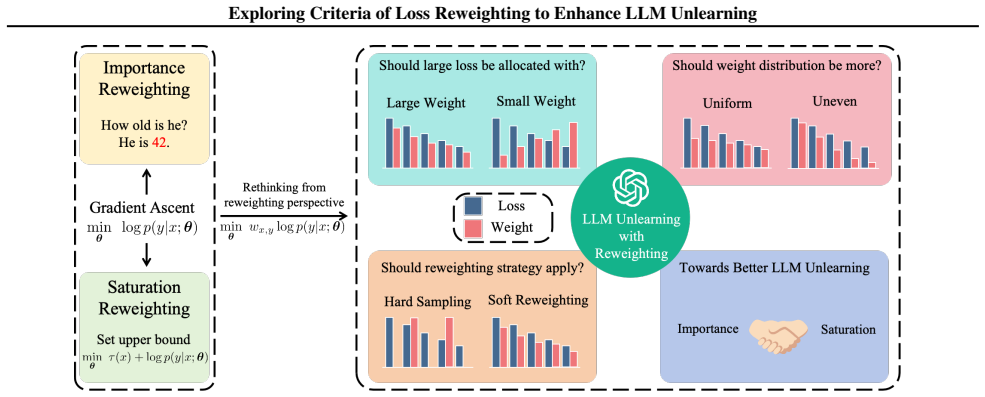
Pith's one-line read The paper claims that loss reweighting for LLM unlearning has two complementary goals—saturation and importance—and that a simple product of the two, SatImp, improves the forget-retain trade-off over existing reweighting methods.
desk verdict A thorough empirical study of reweighting for LLM unlearning whose SatImp method is likely just a re-tuned saturation baseline; the importance component's contribution is not demonstrated. read the letter →
The pith
A machine-rendered reading of the paper's core claim, the machinery that carries it, and where it could break.
The reading
What carries the argument
The load-bearing object is the SatImp per-token weight $w_{x,y,k}^{\mathrm{satimp}}=p(y_k|y_{<k},x;\theta)^{\beta_1}(1-p(y_k|y_{<k},x;\theta))^{\beta_2}$, where $p(y_k|y_{<k},x;\theta)$ is the model's probability of the next token during unlearning. With $\beta_2=0$ it reduces to WGA's saturation weight; with $\beta_1=0$ it becomes the simplified importance weight; with both positive it concentrates weight on tokens of intermediate likelihood. Because the weight is token-wise, recomputed from the evolving model, and soft rather than a hard sample, it acts as a smooth, adaptive reweighting of the gradient-ascent objective; the ratio between $\beta_1$ and $\beta_2$ sets the direction of the weight-loss correlation, and their scale sets the distribution's peakedness, which the paper shows controls the unlearn-retain trade-off.
What would settle it
A concrete experiment is to rerun SatImp and WGA under the forget-only objective on TOFU 5% and 10% and compare ES Retain and MU; the paper reports both methods collapse to zero there, so a rerun that finds nonzero retention would show the collapse is not intrinsic to token-level reweighting, while a rerun that reproduces it confirms the regularization-dependence of the central claim.
Extended reading notes
Core claim
The central claim is that the apparent chaos of reweighting objectives for LLM unlearning reduces to two complementary criteria. Saturation-based reweighting—weights proportional to current token probability—targets tokens that have not been sufficiently unlearned; importance-based reweighting—weights proportional to one minus probability—targets low-likelihood tokens that carry key information. The paper shows these two criteria assign opposite weights to the same tokens, behave differently on unlearning versus retention, and can be combined multiplicatively. SatImp is that combination, $w_{x,y,k}=p^{\beta_1}(1-p)^{\beta_2}$, which shifts emphasis toward middle-loss tokens and lets the two exponents tune smoothness and the relative pull of saturation versus importance. With $\beta_1=5, \beta_2=1$ under the retain-regularized gradient-difference objective, the method reports the best retain-side extraction strength and model utility on TOFU while matching the strongest forget-side numbers, and it transfers to WMDP and MUSE better than or comparably with the baselines.
Load-bearing premise
The advertised SatImp advantage assumes the retain-regularized gradient-difference objective; the paper's own Appendix Table 4 shows that in forget-only runs at 5% and 10% TOFU, SatImp's retain score and model utility fall to zero.
Editorial extensions
If this is right
- If SatImp's results hold, future unlearning objectives can be designed by specifying two numbers—how strongly to emphasize high-probability residual knowledge and how strongly to emphasize low-probability key tokens—rather than by ad hoc loss functions.
- The paper's comparisons imply that soft token-level reweighting is preferable to hard TopK/BottomK sampling and to instance- or batch-level weights for unlearning.
- The empirical distinction between saturation and importance gives a diagnostic: plotting weight against token loss reveals which objective a method actually implements, which can be used to audit existing unlearning methods.
- Because SatImp's gains are demonstrated under retain-regularized gradient difference, the method's practical use will require a retention set; in forget-only deployments, larger forget fractions over-forget, as the paper's Appendix Table 4 shows.
Reading between the lines
- I would expect the saturation/importance dichotomy to transfer to other data-weighting problems, such as noisy-label learning or preference optimization, where 'hard examples' and 'influential examples' are usually treated as the same thing; SatImp suggests they should be separate coordinates of the weight function.
- A direct extension the paper does not explore is automating the importance labels: the KTL index, which ranks a key token's likelihood within its sample, could serve as a training signal for a weight predictor, removing the manual annotation bottleneck.
- The middle-loss emphasis of SatImp hints at a principled curriculum: anneal $\beta_1$ and $\beta_2$ over training so the objective starts saturation-heavy and shifts importance-heavy, which could reduce the reported parameter sensitivity.
- The paper's WMDP retain-regularization numbers use TOFU-tuned hyperparameters; a per-benchmark sweep would be the natural stress test of whether SatImp's advantage is a property of the weight shape or of the particular $\beta$ values chosen.
Signed reviews
Editorial analysis
A structured set of objections, weighed in public.
Referee Report
Summary. This paper studies loss reweighting in LLM unlearning and proposes a taxonomy of two goals: saturation (emphasizing tokens that are not yet sufficiently unlearned) and importance (emphasizing critical tokens). It introduces a manually labeled importance weighting on TOFU, a saturation weight in Eq. (9), simplified versions SimSat and SimImp in Eq. (11), and proposes SatImp in Eq. (12) as a product of saturation and importance weights. The main empirical claim is that SatImp outperforms advanced baselines such as NPO, SimNPO, and WGA on TOFU with retain regularization (Table 2), with additional experiments on WMDP and MUSE. The paper also studies how smoothness, granularity, and hard sampling affect unlearning performance. The central claim is plausible but currently rests on single-run comparisons, a specific retain-regularized setting, and a missing control that isolates the importance component.
Significance. If the central claim were robust, the paper would make a useful conceptual contribution by organizing existing reweighting methods into saturation and importance categories and by offering SatImp as a simple, tunable baseline. The manuscript has concrete strengths: the code is released, the experimental setup is documented in detail, the manual token-level annotation effort on TOFU is considerable, and the appendix covers TOFU, WMDP, and MUSE with multiple metrics. The paper also includes a self-aware limitations section (Appendix A) that concedes parameter sensitivity. However, the significance is currently limited by evidence quality: the favorable TOFU results require retain regularization, there are no repeated-seed statistics, and the importance component of SatImp is not isolated by an ablation. One stress-test concern from the accompanying note does not land on inspection: in the forget-only WMDP setting (Table 3), SatImp matches or improves on RMU's unlearn accuracy while retaining comparable MMLU, so the WMDP evidence is not the weak point.
major comments (5)
- [Section 5, Eq. (12), Table 2] The reported SatImp configuration does not implement the stated importance behavior. With the hyperparameters used in Table 2, β1=5 and β2=1, the weight p^5(1-p) is increasing on [0, 5/6] and maximized at p=5/6, so it assigns the largest weights to high-likelihood tokens. The importance motivation in Eq. (11) is precisely the opposite: it assigns larger weights to low-likelihood tokens. The paper's own Figure 5(a), which illustrates 'middle-loss' emphasis, uses β1=β2=1 and not the evaluated configuration. Table 2 also lacks a β2=0 control with the same β1=5, so the reported gains over WGA cannot be attributed to the importance factor; they may simply reflect a differently tuned saturation-style weighting. Please add an ablation over (β1,β2), including at least β2=0 with matched β1, and state explicitly which configurations are selected and whether the importance term contributes.
- [Appendix Table 4, Appendix E, Section 1] The claim of SatImp's superiority is scoped in a way that is not stated in the abstract or introduction. In the forget-only TOFU setting (Eq. (1)), Table 4 shows that SatImp collapses on 5% and 10% forget sets for both Phi-1.5 and LLaMA-2-7B, with ES Retain, ES Unlearn, and MU all at zero, and LLaMA-2-7B at 5% has ES Retain 0.0080 and ES Unlearn 0.0057. Appendix A itself concedes that SatImp remains parameter-sensitive. The favorable claims in Section 1 and in the analysis of Table 2 therefore hold only with retain regularization (Eq. (2)) and the TOFU-specific λ values. Please either explicitly scope the claim to the gradient-difference setting, or provide a calibration mechanism, such as the early-stopping procedure discussed in Appendix C.2, and show that it restores acceptable behavior in forget-only settings.
- [Tables 2-6 and Figures 2-4] All experimental results appear to be single runs: there are no error bars, no repeated seeds, and no significance tests. This matters because the reported margins in Table 2 are small in several cases, for example the ES Retain differences between SatImp and WGA on Phi-1.5 5% (0.5410 vs. 0.5219) and on Phi-1.5 10% (0.4706 vs. 0.4655). Without variance information, the statement in Section 1 that 'the results clearly demonstrate the superiority of our SatImp' is not supported. Please report mean and standard deviation over at least three seeds for the main TOFU comparisons, and describe the checkpoint selection rule used for Tables 2 and 4.
- [Section 4.1, Eq. (9), Eq. (11), Figure 2(h)] One of the paper's stated findings is true by construction rather than by empirical observation. The saturation weights in Eq. (9), p/(p+τ), and in Eq. (11), p^β, are monotonically increasing functions of token probability and therefore monotonically decreasing functions of negative log-likelihood. Figure 2(h) and the accompanying text report that saturation assigns smaller weights to lower-likelihood tokens, but this is a property of the definition, not an empirical discovery about reweighting behavior. The authors should rephrase this as a design property and provide evidence that the saturation mechanism itself, rather than the monotone weighting, is what improves unlearning performance.
- [Section 3.1 and Section 4.1] The importance-based reweighting relies on manual binary labels that were produced by four team members with a 'half agreement' threshold, but no inter-annotator agreement metric (e.g., Cohen's kappa or Fleiss' kappa) is reported, and no label-quality statistics are provided. The subsequent simplification to (1-p)^β in Eq. (11) assumes that the correlation between manually labeled key tokens and low likelihood, as illustrated in Figure 2(g), is stable across domains and models. Given that the importance component is one of the two pillars of SatImp, the authors should either report label reliability and validate the proxy on at least one additional benchmark, or explicitly frame SimImp as a heuristic rather than a validated importance measure.
minor comments (6)
- [Section 4.1 heading] The heading contains a typo: 'Comparsion' should be 'Comparison'.
- [Appendix B.2 and B.3] There are several typos in the setup text: 'learning rete', 'differnt', and 'tow hyper-parameters' should be corrected to 'learning rate', 'different', and 'two hyper-parameters'.
- [Figure 2 caption] The caption for Figure 2 refers to subfigures (e)-(h) as 'Imp. & Sat. Detail' and 'SimNPO & NPO Detail', but the labels inside the subfigures are not consistently defined; adding explicit panel labels would improve readability.
- [Appendix B.1.1, Eq. (13)] The definition of ES in Eq. (13) uses the notation f(y_<k|x; θ) = y_>k, but the subscript on the right-hand side is visually ambiguous and could be confused with the metric under discussion; please use an explicit suffix notation such as y_{>k}.
- [Appendix Table 4] In the Phi-1.5 rows of Table 4, several entries are exactly 0.0000 across ES Retain, ES Unlearn, and MU for the 5% and 10% settings; a footnote explaining that these are collapsed runs, rather than missing or zero-due-to-rounding values, would help the reader interpret the failure mode.
- [Appendix C.2] The three-stage description (unlearning, stabilization, collapse) is interesting but is presented as purely descriptive; if it is meant to guide early stopping, the paper should provide a concrete rule for detecting the stabilization stage at inference time.
Circularity Check
Two 'findings' about weight–likelihood polarity are true by construction; the SatImp performance claim is empirical.
-
self definitional
[Section 4.1, 'Simplification of Reweighting' and Eq. (11)]
"Overall, we observe that importance-based reweighting tends to associate key annotations with low-likelihood tokens, whereas saturation-based reweighting generally allocates smaller weights to them. ... Specifically, we suggest allocating large weights to low-likelihood tokens for importance-based reweighting and small weights to low-likelihood tokens for saturation-based reweighting, which lead to Simple Importance (SimImp) and Simple Saturation (SimSat): wsimsat_{x,y,k}=p(y_k|y_{<k},x;θ)^β, wsimimp_{x,y,k}=(1-p(y_k|y_{<k},x;θ))^β."
By Eq. (11), p is the token likelihood. The function p^β is strictly increasing in p, so it necessarily assigns smaller weights to lower-likelihood tokens; (1-p)^β is strictly decreasing in p, so it necessarily assigns larger weights to lower-likelihood tokens. The paper's 'observation' is therefore the derivative of its own proposed formulas, not an empirical discovery. Any scatter plot of these weights against negative log-likelihood will show exactly that monotone polarity by construction, so the reported correlation is definitional rather than independent evidence.
-
self definitional
[Section 3.2, Eq. (9) and Figure 2(h)]
"Following (Sablayrolles et al., 2019)... we adopt the reweighting strategy as follows: wsat_{x,y,k}=p(y_k|y_{<k},x;θ)/(p(y_k|y_{<k},x;θ)+τ). ... The result, shown in Figure 2(h), clearly highlights the strict inverse correlation between losses and weights, supporting our assumption again."
With p denoting token likelihood and the loss being -log p, the saturation weight w_sat=p/(p+τ) has derivative d w_sat/d(-log p) = -τ p/(p+τ)^2, which is strictly negative for every p>0. Thus the 'strict inverse correlation between losses and weights' displayed in Figure 2(h) is a mathematical property of Eq. (9), true for every token at every training step, rather than an empirical regularity that could support or falsify the saturation hypothesis.
full rationale
The self-definitional steps are localized to the paper's descriptive 'observations' about how its own weight formulas behave with respect to token likelihood. The central claim—that SatImp improves the forget-retain trade-off—is an empirical benchmark comparison against TOFU, WMDP, and MUSE, and it does not reduce to Eq. (11) or Eq. (12). The paper is self-contained against external benchmarks, and I found no load-bearing self-citation chain, no imported uniqueness theorem, and no fitted parameter renamed as a prediction. Several concerns raised in the skeptical reading are experimental rather than circular: the absence of a β2=0 ablation isolating the importance factor, single-run comparisons without error bars, and the documented collapse under forget-only regularization in Appendix Table 4. These are correctness risks, not derivation-circularity. The score of 3 reflects that two claimed empirical findings are in fact definitional, while the main method's performance claim remains independently testable.
Assumptions & free parameters
free parameters (5)
- beta1 (SatImp) =
5
- beta2 (SatImp) =
1
- tau (saturation) =
1
- p (importance) =
0.3 (and 0.4 for combination)
- lambda (GD regularization) =
1 for GA/WGA; searched [0.2,0.5] for NPO
assumptions (5)
- domain assumption Gradient ascent on the unlearn set reduces the model's ability to reproduce target data.
- domain assumption The Extraction Strength (ES) metric (from the authors' prior work) is a reliable measure of unlearning and retention.
- ad hoc to paper Manual binary labels of important tokens in TOFU are accurate, and the correlation between importance and low token likelihood justifies replacing manual labels with (1-p)^beta.
- domain assumption Token-wise reweighting is more effective than instance-wise, as assumed from prior work and extended here.
- domain assumption The benchmark settings and hyperparameter choices (beta1=5, beta2=1) generalize beyond the tuning set.
Cite this review
Pith. "Pith review of Exploring Criteria of Loss Reweighting to Enhance LLM Unlearning." pith.science (2026). https://pith.science/paper/MFHB3CRX
@misc{pith2026250511953,
  author       = {Pith},
  title        = {Pith review of: Exploring Criteria of Loss Reweighting to Enhance LLM Unlearning},
  year         = {2026},
  howpublished = {\url{https://pith.science/paper/MFHB3CRX}},
  note         = {Machine review of arXiv:2505.11953}
}
read the original abstract
Loss reweighting has shown significant benefits for machine unlearning with large language models (LLMs). However, their exact functionalities are left unclear and the optimal strategy remains an open question, thus impeding the understanding and improvement of existing methodologies. In this paper, we identify two distinct goals of loss reweighting, namely, Saturation and Importance -- the former indicates that those insufficiently optimized data should be emphasized, while the latter stresses some critical data that are most influential for loss minimization. To study their usefulness, we design specific reweighting strategies for each goal and evaluate their respective effects on unlearning. We conduct extensive empirical analyses on well-established benchmarks, and summarize some important observations as follows: (i) Saturation enhances efficacy more than importance-based reweighting, and their combination can yield additional improvements. (ii) Saturation typically allocates lower weights to data with lower likelihoods, whereas importance-based reweighting does the opposite. (iii) The efficacy of unlearning is also largely influenced by the smoothness and granularity of the weight distributions. Based on these findings, we propose SatImp, a simple reweighting method that combines the advantages of both saturation and importance. Empirical results on extensive datasets validate the efficacy of our method, potentially bridging existing research gaps and indicating directions for future research. Our code is available at https://github.com/tmlr-group/SatImp.
Figures


Figures from the paper (15 more)


Forward citations
Cited by 1 Pith paper
-
A Mechanistic Perspective and Circuit-Guided Difficulty Metric for Unlearning
A circuit-similarity score predicts which samples an LLM unlearning method will fail to erase, with hard samples relying on deeper, output-facing pathways.
Reference graph
Works this paper leans on
-
[1]
L., Almeida, D., Altenschmidt, J., Altman, S., Anadkat, S., et al
Achiam, J., Adler, S., Agarwal, S., Ahmad, L., Akkaya, I., Aleman, F. L., Almeida, D., Altenschmidt, J., Altman, S., Anadkat, S., et al. Gpt-4 technical report. arXiv preprint arXiv:2303.08774, 2023
arXiv 2023
-
[2]
The cringe loss: Learning what language not to model
Adolphs, L., Gao, T., Xu, J., Shuster, K., Sukhbaatar, S., and Weston, J. The cringe loss: Learning what language not to model. arXiv preprint arXiv:2211.05826, 2022
arXiv 2022
-
[3]
P., Narang, N., Rivers, J., Maksey, R., Guan, L., Barrere, L
Bao, Y., Shah, A. P., Narang, N., Rivers, J., Maksey, R., Guan, L., Barrere, L. N., Evenson, S., Basole, R., Miao, C., et al. Harnessing business and media insights with large language models. arXiv preprint arXiv:2406.06559, 2024
arXiv 2024
-
[4]
R., Christodorescu, M., Datta, A., Feizi, S., et al
Barrett, C., Boyd, B., Bursztein, E., Carlini, N., Chen, B., Choi, J., Chowdhury, A. R., Christodorescu, M., Datta, A., Feizi, S., et al. Identifying and mitigating the security risks of generative ai. Foundations and Trends in Privacy and Security , 6 0 (1): 0 1--52, 2023
2023
-
[5]
Soft prompting for unlearning in large language models
Bhaila, K., Van, M.-H., and Wu, X. Soft prompting for unlearning in large language models. arXiv preprint arXiv:2406.12038, 2024
arXiv 2024
-
[6]
A., Jia, H., Travers, A., Zhang, B., Lie, D., and Papernot, N
Bourtoule, L., Chandrasekaran, V., Choquette-Choo, C. A., Jia, H., Travers, A., Zhang, B., Lie, D., and Papernot, N. Machine unlearning. In 2021 IEEE Symposium on Security and Privacy (SP), pp.\ 141--159. IEEE, 2021
2021
-
[7]
Byrd, J. and Lipton, Z. What is the effect of importance weighting in deep learning? In International conference on machine learning, pp.\ 872--881. PMLR, 2019
work page 2019
-
[8]
Chen, J. and Yang, D. Unlearn what you want to forget: Efficient unlearning for llms. arXiv preprint arXiv:2310.20150, 2023
arXiv 2023
Show all 82 references
-
[9]
Snap: Unlearning selective knowledge in large language models with negative instructions
Choi, M., Rim, D., Lee, D., and Choo, J. Snap: Unlearning selective knowledge in large language models with negative instructions. arXiv preprint arXiv:2406.12329, 2024
2024 arXiv
-
[10]
Label smoothing improves machine unlearning
Di, Z., Zhu, Z., Jia, J., Liu, J., Takhirov, Z., Jiang, B., Yao, Y., Liu, S., and Liu, Y. Label smoothing improves machine unlearning. arXiv preprint arXiv:2406.07698, 2024
2024 arXiv
-
[11]
R., Lin, H., Belkin, M., Huerta, R., and Vuli \'c , I
Dong, Y. R., Lin, H., Belkin, M., Huerta, R., and Vuli \'c , I. Undial: Self-distillation with adjusted logits for robust unlearning in large language models. arXiv preprint arXiv:2402.10052, 2024
2024 arXiv
-
[12]
and Russinovich, M
Eldan, R. and Russinovich, M. Who's harry potter? approximate unlearning in llms. arXiv preprint arXiv:2310.02238, 2023
2023 arXiv
-
[13]
Kto: Model alignment as prospect theoretic optimization
Ethayarajh, K., Xu, W., Muennighoff, N., Jurafsky, D., and Kiela, D. Kto: Model alignment as prospect theoretic optimization. arXiv preprint arXiv:2402.01306, 2024
2024 arXiv
-
[14]
Salun: Empowering machine unlearning via gradient-based weight saliency in both image classification and generation
Fan, C., Liu, J., Zhang, Y., Wong, E., Wei, D., and Liu, S. Salun: Empowering machine unlearning via gradient-based weight saliency in both image classification and generation. arXiv preprint arXiv:2310.12508, 2023
2023 arXiv
-
[15]
Simplicity prevails: Rethinking negative preference optimization for llm unlearning
Fan, C., Liu, J., Lin, L., Jia, J., Zhang, R., Mei, S., and Liu, S. Simplicity prevails: Rethinking negative preference optimization for llm unlearning. arXiv preprint arXiv:2410.07163, 2024
2024
-
[16]
Challenging forgets: Unveiling the worst-case forget sets in machine unlearning
Fan, C., Liu, J., Hero, A., and Liu, S. Challenging forgets: Unveiling the worst-case forget sets in machine unlearning. In European Conference on Computer Vision, pp.\ 278--297. Springer, 2025
2025
-
[17]
Practical unlearning for large language models
Gao, C., Wang, L., Weng, C., Wang, X., and Zhu, Q. Practical unlearning for large language models. arXiv preprint arXiv:2407.10223, 2024
2024 arXiv
-
[18]
General data protection regulation
GDPR, G. General data protection regulation. Regulation (EU), 679, 2016
2016
-
[19]
Eternal sunshine of the spotless net: Selective forgetting in deep networks
Golatkar, A., Achille, A., and Soatto, S. Eternal sunshine of the spotless net: Selective forgetting in deep networks. In Proceedings of the IEEE/CVF Conference on Computer Vision and Pattern Recognition, pp.\ 9304--9312, 2020
2020
-
[20]
Amnesiac machine learning
Graves, L., Nagisetty, V., and Ganesh, V. Amnesiac machine learning. 35 0 (13): 0 11516--11524, 2021
2021
-
[21]
Meow: Memory supervised llm unlearning via inverted facts
Gu, T., Huang, K., Luo, R., Yao, Y., Yang, Y., Teng, Y., and Wang, Y. Meow: Memory supervised llm unlearning via inverted facts. arXiv preprint arXiv:2409.11844, 2024
2024 arXiv
-
[22]
Aligning ai with shared human values
Hendrycks, D., Burns, C., Basart, S., Critch, A., Li, J., Song, D., and Steinhardt, J. Aligning ai with shared human values. Proceedings of the International Conference on Learning Representations (ICLR), 2021 a
2021
-
[23]
Measuring massive multitask language understanding
Hendrycks, D., Burns, C., Basart, S., Zou, A., Mazeika, M., Song, D., and Steinhardt, J. Measuring massive multitask language understanding. Proceedings of the International Conference on Learning Representations (ICLR), 2021 b
2021
-
[24]
Y., Zhou, W., Wang, F., Morstatter, F., Zhang, S., Poon, H., and Chen, M
Huang, J. Y., Zhou, W., Wang, F., Morstatter, F., Zhang, S., Poon, H., and Chen, M. Offset unlearning for large language models. arXiv preprint arXiv:2404.11045, 2024 a
2024 arXiv
-
[25]
Trustllm: Trustworthiness in large language models
Huang, Y., Sun, L., Wang, H., Wu, S., Zhang, Q., Li, Y., Gao, C., Huang, Y., Lyu, W., Zhang, Y., et al. Trustllm: Trustworthiness in large language models. arXiv preprint arXiv:2401.05561, 2024 b
2024 arXiv
-
[26]
Robust generalization against photon-limited corruptions via worst-case sharpness minimization
Huang, Z., Zhu, M., Xia, X., Shen, L., Yu, J., Gong, C., Han, B., Du, B., and Liu, T. Robust generalization against photon-limited corruptions via worst-case sharpness minimization. In Proceedings of the IEEE/CVF Conference on Computer Vision and Pattern Recognition, pp.\ 1617...
2023
-
[27]
T., Wortsman, M., Gururangan, S., Schmidt, L., Hajishirzi, H., and Farhadi, A
Ilharco, G., Ribeiro, M. T., Wortsman, M., Gururangan, S., Schmidt, L., Hajishirzi, H., and Farhadi, A. Editing models with task arithmetic. arXiv preprint arXiv:2212.04089, 2022
2022 arXiv
-
[28]
A., Chaudhuri, K., and Zou, J
Izzo, Z., Smart, M. A., Chaudhuri, K., and Zou, J. Approximate data deletion from machine learning models. In International Conference on Artificial Intelligence and Statistics, pp.\ 2008--2016. PMLR, 2021
2008
-
[29]
Knowledge unlearning for mitigating privacy risks in language models
Jang, J., Yoon, D., Yang, S., Cha, S., Lee, M., Logeswaran, L., and Seo, M. Knowledge unlearning for mitigating privacy risks in language models. arXiv preprint arXiv:2210.01504, 2022
2022 arXiv
-
[30]
R., Liu, S., and Chang, S
Ji, J., Liu, Y., Zhang, Y., Liu, G., Kompella, R. R., Liu, S., and Chang, S. Reversing the forget-retain objectives: An efficient llm unlearning framework from logit difference. arXiv preprint arXiv:2406.08607, 2024
2024 arXiv
-
[31]
Soul: Unlocking the power of second-order optimization for llm unlearning
Jia, J., Zhang, Y., Zhang, Y., Liu, J., Runwal, B., Diffenderfer, J., Kailkhura, B., and Liu, S. Soul: Unlocking the power of second-order optimization for llm unlearning. arXiv preprint arXiv:2404.18239, 2024
2024 arXiv
-
[32]
Q., Sablayrolles, A., Mensch, A., Bamford, C., Chaplot, D
Jiang, A. Q., Sablayrolles, A., Mensch, A., Bamford, C., Chaplot, D. S., Casas, D. d. l., Bressand, F., Lengyel, G., Lample, G., Saulnier, L., et al. Mistral 7b. arXiv preprint arXiv:2310.06825, 2023
2023 arXiv
-
[33]
Copyright violations and large language models
Karamolegkou, A., Li, J., Zhou, L., and S gaard, A. Copyright violations and large language models. arXiv preprint arXiv:2310.13771, 2023
2023 arXiv
-
[34]
D., Dombrowski, A.-K., Goel, S., Phan, L., et al
Li, N., Pan, A., Gopal, A., Yue, S., Berrios, D., Gatti, A., Li, J. D., Dombrowski, A.-K., Goel, S., Phan, L., et al. The wmdp benchmark: Measuring and reducing malicious use with unlearning. arXiv preprint arXiv:2403.03218, 2024
2024 arXiv
-
[35]
Deepinception: Hypnotize large language model to be jailbreaker
Li, X., Zhou, Z., Zhu, J., Yao, J., Liu, T., and Han, B. Deepinception: Hypnotize large language model to be jailbreaker. arXiv preprint arXiv:2311.03191, 2023 a
2023 arXiv
-
[36]
Li, Y., Bubeck, S., Eldan, R., Del Giorno, A., Gunasekar, S., and Lee, Y. T. Textbooks are all you need ii: phi-1.5 technical report. arXiv preprint arXiv:2309.05463, 2023 b
2023 arXiv
-
[37]
Y., Wang, Y., Flanigan, J., and Liu, Y
Liu, C. Y., Wang, Y., Flanigan, J., and Liu, Y. Large language model unlearning via embedding-corrupted prompts. arXiv preprint arXiv:2406.07933, 2024 a
2024 arXiv
-
[38]
Model sparsity can simplify machine unlearning
Liu, J., Ram, P., Yao, Y., Liu, G., Liu, Y., SHARMA, P., Liu, S., et al. Model sparsity can simplify machine unlearning. Advances in Neural Information Processing Systems, 36, 2024 b
2024
-
[39]
Do humans and machines have the same eyes? human-machine perceptual differences on image classification
Liu, M., Wei, J., Liu, Y., and Davis, J. Do humans and machines have the same eyes? human-machine perceptual differences on image classification. arXiv preprint arXiv:2304.08733, 2023
2023 arXiv
-
[40]
Automatic dataset construction (adc): Sample collection, data curation, and beyond
Liu, M., Di, Z., Wei, J., Wang, Z., Zhang, H., Xiao, R., Wang, H., Pang, J., Chen, H., Shah, A., et al. Automatic dataset construction (adc): Sample collection, data curation, and beyond. arXiv preprint arXiv:2408.11338, 2024 c
2024 arXiv
-
[41]
Y., Xu, X., Li, H., et al
Liu, S., Yao, Y., Jia, J., Casper, S., Baracaldo, N., Hase, P., Yao, Y., Liu, C. Y., Xu, X., Li, H., et al. Rethinking machine unlearning for large language models. arXiv preprint arXiv:2402.08787, 2024 d
2024 arXiv
-
[42]
and Guo, H
Liu, Y. and Guo, H. Peer loss functions: Learning from noisy labels without knowing noise rates. In International conference on machine learning, pp.\ 6226--6236. PMLR, 2020
2020
-
[43]
C., and Kolter, J
Maini, P., Feng, Z., Schwarzschild, A., Lipton, Z. C., and Kolter, J. Z. Tofu: A task of fictitious unlearning for llms. In ICLR 2024 Workshop on Navigating and Addressing Data Problems for Foundation Models, 2024
2024
-
[44]
Alternate preference optimization for unlearning factual knowledge in large language models
Mekala, A., Dorna, V., Dubey, S., Lalwani, A., Koleczek, D., Rungta, M., Hasan, S., and Lobo, E. Alternate preference optimization for unlearning factual knowledge in large language models. arXiv preprint arXiv:2409.13474, 2024
2024 arXiv
-
[45]
More human than human: measuring chatgpt political bias
Motoki, F., Pinho Neto, V., and Rodrigues, V. More human than human: measuring chatgpt political bias. Public Choice, 198 0 (1): 0 3--23, 2024
2024
-
[46]
K., Shokri, R., and Theodorakopoulos, G
Murakonda, S. K., Shokri, R., and Theodorakopoulos, G. Quantifying the privacy risks of learning high-dimensional graphical models. In International Conference on Artificial Intelligence and Statistics, pp.\ 2287--2295. PMLR, 2021
2021
-
[47]
R., and Papernot, N
Muresanu, A., Thudi, A., Zhang, M. R., and Papernot, N. Unlearnable algorithms for in-context learning. arXiv preprint arXiv:2402.00751, 2024
2024
-
[48]
Pardau, S. L. The california consumer privacy act: Towards a european-style privacy regime in the united states. J. Tech. L. & Pol'y, 23: 0 68, 2018
2018
-
[49]
Can sensitive information be deleted from llms? objectives for defending against extraction attacks
Patil, V., Hase, P., and Bansal, M. Can sensitive information be deleted from llms? objectives for defending against extraction attacks. arXiv preprint arXiv:2309.17410, 2023
2023 arXiv
-
[50]
In-context unlearning: Language models as few shot unlearners
Pawelczyk, M., Neel, S., and Lakkaraju, H. In-context unlearning: Language models as few shot unlearners. arXiv preprint arXiv:2310.07579, 2023
2023 arXiv
-
[51]
Safety alignment should be made more than just a few tokens deep
Qi, X., Panda, A., Lyu, K., Ma, X., Roy, S., Beirami, A., Mittal, P., and Henderson, P. Safety alignment should be made more than just a few tokens deep. In The Thirteenth International Conference on Learning Representations, 2025
2025
-
[52]
D., Ermon, S., and Finn, C
Rafailov, R., Sharma, A., Mitchell, E., Manning, C. D., Ermon, S., and Finn, C. Direct preference optimization: Your language model is secretly a reward model. Advances in Neural Information Processing Systems, 36, 2024
2024
-
[53]
White-box vs black-box: Bayes optimal strategies for membership inference
Sablayrolles, A., Douze, M., Ollivier, Y., Schmid, C., and J \'e gou, H. White-box vs black-box: Bayes optimal strategies for membership inference. ICML, 2019
2019
-
[54]
Detecting pretraining data from large language models
Shi, W., Ajith, A., Xia, M., Huang, Y., Liu, D., Blevins, T., Chen, D., and Zettlemoyer, L. Detecting pretraining data from large language models. arXiv preprint arXiv:2310.16789, 2023
2023 arXiv
-
[55]
A., and Zhang, C
Shi, W., Lee, J., Huang, Y., Malladi, S., Zhao, J., Holtzman, A., Liu, D., Zettlemoyer, L., Smith, N. A., and Zhang, C. Muse: Machine unlearning six-way evaluation for language models. arXiv preprint arXiv:2407.06460, 2024
2024 arXiv
-
[56]
Membership inference attacks against machine learning models
Shokri, R., Stronati, M., Song, C., and Shmatikov, V. Membership inference attacks against machine learning models. In SP, 2017
2017
-
[57]
S., and Smith, V
Thaker, P., Maurya, Y., Hu, S., Wu, Z. S., and Smith, V. Guardrail baselines for unlearning in llms. arXiv preprint arXiv:2403.03329, 2024
2024 arXiv
-
[58]
Unrolling sgd: Understanding factors influencing machine unlearning
Thudi, A., Deza, G., Chandrasekaran, V., and Papernot, N. Unrolling sgd: Understanding factors influencing machine unlearning. In 2022 IEEE 7th European Symposium on Security and Privacy (EuroS&P), pp.\ 303--319. IEEE, 2022
2022
-
[59]
Llama 2: Open foundation and fine-tuned chat models
Touvron, H., Martin, L., Stone, K., Albert, P., Almahairi, A., Babaei, Y., Bashlykov, N., Batra, S., Bhargava, P., Bhosale, S., et al. Llama 2: Open foundation and fine-tuned chat models. arXiv preprint arXiv:2307.09288, 2023
2023 arXiv
-
[60]
Kga: A general machine unlearning framework based on knowledge gap alignment
Wang, L., Chen, T., Yuan, W., Zeng, X., Wong, K.-F., and Yin, H. Kga: A general machine unlearning framework based on knowledge gap alignment. arXiv preprint arXiv:2305.06535, 2023 a
2023 arXiv
-
[61]
Learning to augment distributions for out-of-distribution detection
Wang, Q., Fang, Z., Zhang, Y., Liu, F., Li, Y., and Han, B. Learning to augment distributions for out-of-distribution detection. In Advances in Neural Information Processing Systems, 2023 b
2023
-
[62]
A sober look at the robustness of clips to spurious features
Wang, Q., Lin, Y., Chen, Y., Schmidt, L., Han, B., and Zhang, T. A sober look at the robustness of clips to spurious features. In Advances in Neural Information Processing Systems, 2024 a
2024
-
[63]
Towards effective evaluations and comparison for llm unlearning methods
Wang, Q., Han, B., Yang, P., Zhu, J., Liu, T., and Sugiyama, M. Towards effective evaluations and comparison for llm unlearning methods. In International Conference on Learning Representations, 2025 a
2025
-
[64]
P., Zhou, Z., Shin, S., Han, B., and Weinberger, K
Wang, Q., Zhou, J. P., Zhou, Z., Shin, S., Han, B., and Weinberger, K. Q. Rethinking llm unlearning objectives: A gradient perspective and go beyond. In International Conference on Learning Representations, 2025 b
2025
-
[65]
A., Khashabi, D., and Hajishirzi, H
Wang, Y., Kordi, Y., Mishra, S., Liu, A., Smith, N. A., Khashabi, D., and Hajishirzi, H. Self-instruct: Aligning language models with self-generated instructions. arXiv preprint arXiv:2212.10560, 2022
2022 arXiv
-
[66]
Y., Pang, J., Liu, Q., Shah, A
Wang, Y., Wei, J., Liu, C. Y., Pang, J., Liu, Q., Shah, A. P., Bao, Y., Liu, Y., and Wei, W. Llm unlearning via loss adjustment with only forget data. arXiv preprint arXiv:2410.11143, 2024 b
2024 arXiv
-
[67]
Gru: Mitigating the trade-off between unlearning and retention for large language models
Wang, Y., Wang, Q., Liu, F., Huang, W., Du, Y., Du, X., and Han, B. Gru: Mitigating the trade-off between unlearning and retention for large language models. In International Conference on Machine Learning, 2025 c
2025
-
[68]
Learning with noisy labels revisited: A study using real-world human annotations
Wei, J., Zhu, Z., Cheng, H., Liu, T., Niu, G., and Liu, Y. Learning with noisy labels revisited: A study using real-world human annotations. arXiv preprint arXiv:2110.12088, 2021
2021 arXiv
-
[69]
V., Zhou, D., et al
Wei, J., Wang, X., Schuurmans, D., Bosma, M., Xia, F., Chi, E., Le, Q. V., Zhou, D., et al. Chain-of-thought prompting elicits reasoning in large language models. Advances in neural information processing systems, 35: 0 24824--24837, 2022
2022
-
[70]
Trustworthy graph learning: Reliability, explainability, and privacy protection
Wu, B., Bian, Y., Zhang, H., Li, J., Yu, J., Chen, L., Chen, C., and Huang, J. Trustworthy graph learning: Reliability, explainability, and privacy protection. In Proceedings of the 28th ACM SIGKDD conference on knowledge discovery and data mining, pp.\ 4838--4839, 2022
2022
-
[71]
Adaptive localization of knowledge negation for continual llm unlearning
Wuerkaixi, A., Wang, Q., Cui, S., Xu, W., Han, B., Niu, G., Sugiyama, M., and Zhang, C. Adaptive localization of knowledge negation for continual llm unlearning. In International Conference on Machine Learning, 2025
2025
-
[72]
Large language model unlearning
Yao, Y., Xu, X., and Liu, Y. Large language model unlearning. arXiv preprint arXiv:2310.10683, 2023
2023 arXiv
-
[73]
K., Bindschaedler, V., and Shokri, R
Ye, J., Maddi, A., Murakonda, S. K., Bindschaedler, V., and Shokri, R. Enhanced membership inference attacks against machine learning models. In Proceedings of the 2022 ACM SIGSAC Conference on Computer and Communications Security, pp.\ 3093--3106, 2022
2022
-
[74]
Towards safe machine unlearning: a paradigm that mitigates performance degradation
Ye, S., Lu, J., and Zhang, G. Towards safe machine unlearning: a paradigm that mitigates performance degradation. In THE WEB CONFERENCE 2025, 2025
2025
-
[75]
Unlearning bias in language models by partitioning gradients
Yu, C., Jeoung, S., Kasi, A., Yu, P., and Ji, H. Unlearning bias in language models by partitioning gradients. In Findings of the Association for Computational Linguistics: ACL 2023, pp.\ 6032--6048, 2023 a
2023
-
[76]
Mind the label shift of augmentation-based graph ood generalization
Yu, J., Liang, J., and He, R. Mind the label shift of augmentation-based graph ood generalization. In Proceedings of the IEEE/CVF Conference on Computer Vision and Pattern Recognition, pp.\ 11620--11630, 2023 b
2023
-
[77]
Thought propagation: An analogical approach to complex reasoning with large language models
Yu, J., He, R., and Ying, R. Thought propagation: An analogical approach to complex reasoning with large language models. In International Conference on Learning Representations, 2024
2024
-
[78]
Negative preference optimization: From catastrophic collapse to effective unlearning
Zhang, R., Lin, L., Bai, Y., and Mei, S. Negative preference optimization: From catastrophic collapse to effective unlearning. arXiv preprint arXiv:2404.05868, 2024
2024 arXiv
-
[79]
Can language models perform robust reasoning in chain-of-thought prompting with noisy rationales? In NeurIPS, 2024
Zhou, Z., Tao, R., Zhu, J., Luo, Y., Wang, Z., and Han, B. Can language models perform robust reasoning in chain-of-thought prompting with noisy rationales? In NeurIPS, 2024
2024
-
[80]
Landscape of thoughts: Visualizing the reasoning process of large language models
Zhou, Z., Zhu, Z., Li, X., Galkin, M., Feng, X., Koyejo, S., Tang, J., and Han, B. Landscape of thoughts: Visualizing the reasoning process of large language models. arXiv preprint arXiv:2503.22165, 2025
2025
-
[81]
Unmasking and improving data credibility: A study with datasets for training harmless language models
Zhu, Z., Wang, J., Cheng, H., and Liu, Y. Unmasking and improving data credibility: A study with datasets for training harmless language models. arXiv preprint arXiv:2311.11202, 2023
2023 arXiv
-
[82]
write newline
" write newline "" before.all 'output.state := FUNCTION n.dashify 't := "" t empty not t #1 #1 substring "-" = t #1 #2 substring "--" = not "--" * t #2 global.max substring 't := t #1 #1 substring "-" = "-" * t #2 global.max substring 't := while if t #1 #1 substring * t #2 gl...
Reviewed August 15, 2026 · model on record in the stance chip above.
Discussion (0). Continue with ORCID to comment.