REVIEW 3 major objections 4 minor 51 references
Spin-reorientation critical dynamics in the two-dimensional XY model with a domain wall
T0 review · 3 major / 4 minor · reviewed 2026-08-14 · deepseek-v4-flash
Pith's one-line read At the Kosterlitz-Thouless transition, a near-π domain wall makes the horizontal magnetization inside the interface grow as $M_\parallel(t,x) \sim t^{0.0568}$, an exponent the paper identifies with $\eta/2z$.
desk verdict Genuinely new empirical exponent in 2D XY domain-wall dynamics, but the analytic derivation of ψ=η/2z is circular and unsupported; the empirical half might survive a revision. read the letter →
The pith
A machine-rendered reading of the paper's core claim, the machinery that carries it, and where it could break.
The reading
What carries the argument
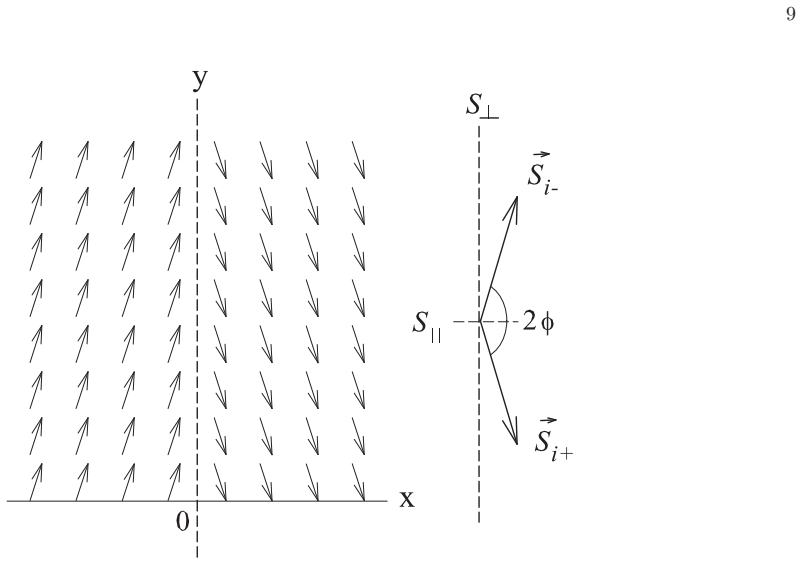
The central object is the two-component magnetization $(M_\parallel, M_\perp)$ of a semi-ordered initial state with a single domain wall, measured as a function of position $x$ and time $t$. The argument is carried by the Langevin equation for spin-wave modes in the long-wavelength approximation, together with a 'correction to the long-wavelength approximation' for near-$\pi$ domain walls in which the interface Hamiltonian is rewritten with a shifted spin variable so that the stiffness changes sign. From this signed Hamiltonian the paper derives $\langle F'^2(R,t)\rangle = -\frac{T}{4\pi}\ln t + C_4$ and $G'(s) = \frac{2i\varphi}{\sqrt{\pi}}\int_0^s ds'\, e^{s'^2}$, leading to the interface growth $M_\parallel(t,x) \propto t^{\eta/2z} \exp(-\varphi\sqrt{2\eta}\,x/t^{1/z})$ and the identity $\psi = \eta/2z$. The two-time correlation function, with decay exponents $\lambda_b = d + \eta/2$ and $\lambda_s = \eta_0/2 - z\psi$, and the logarithmic correction to the correlation length $\xi(t)$ complete the scaling description.
What would settle it
Directly solve the linear Langevin equation obtained from the sign-flipped domain-wall Hamiltonian in Eq. (40): with a negative spring constant the variance $\langle \theta(k,t)^2\rangle$ grows exponentially in time, not as $-(T/4\pi)\ln t + C_4$, so a direct computation of $\langle F'^2(R,t)\rangle$ would test whether the analytic route to $\psi = \eta/2z$ is self-consistent.
Extended reading notes
Core claim
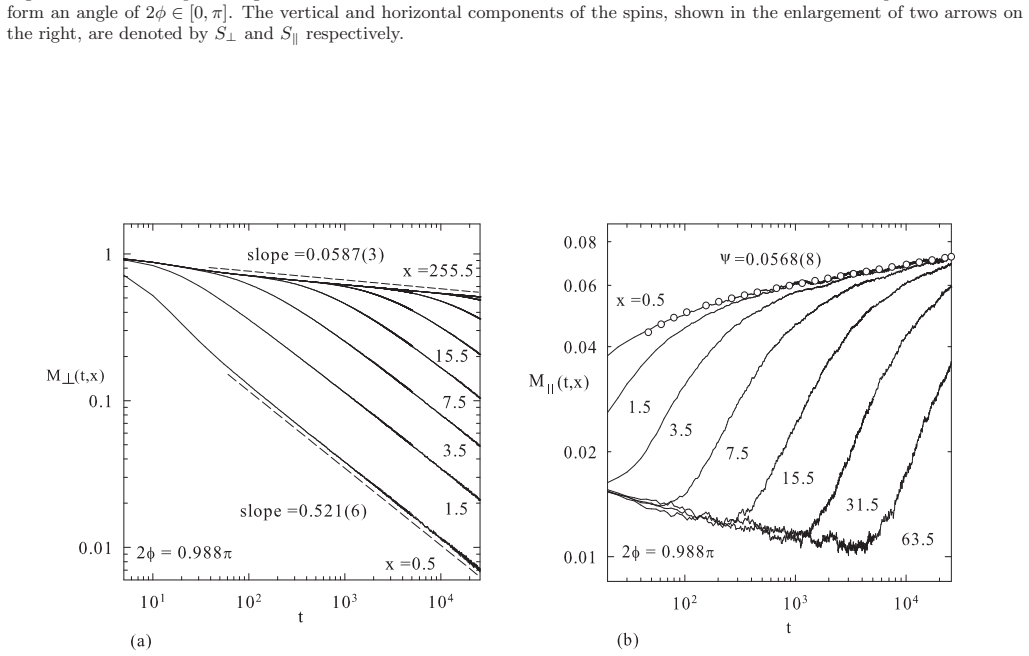
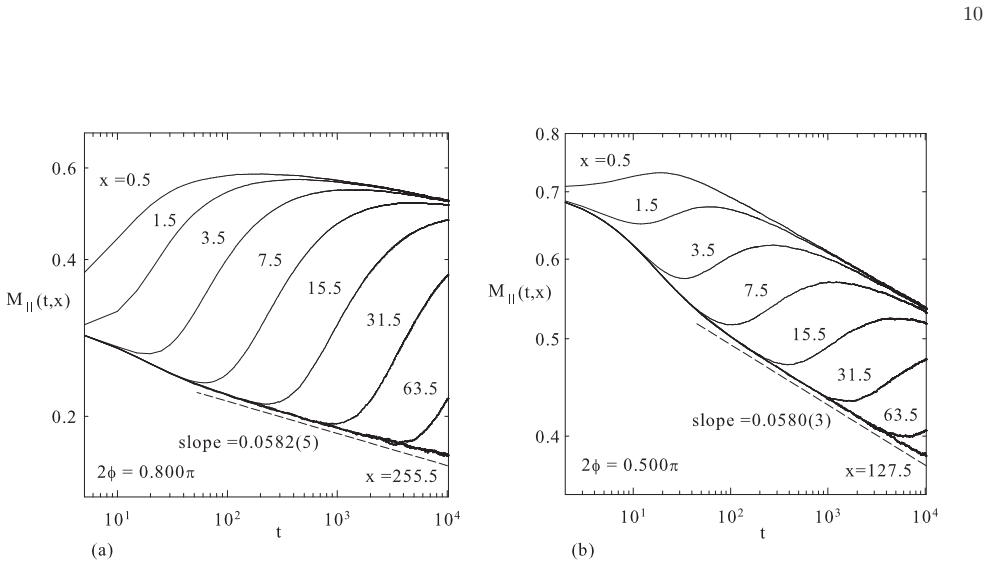
The central claim is that at criticality, a near-$\pi$ domain wall in the two-dimensional XY model produces an anomalous power-law growth of the horizontal magnetization in the interface, $M_\parallel(t,x) \propto t^\psi$ when the initial angle $2\varphi$ is slightly below $\pi$, with $\psi = 0.0568(8)$. The same component decays as $t^{-\eta/2z}$ in the bulk, and for $2\varphi$ far from $\pi$ it decays everywhere. The paper analyzes the interface dynamics through the Langevin equation in the long-wavelength approximation; after a sign-changing shift of the domain-wall Hamiltonian it obtains $M_\parallel(t,x) \propto t^{\eta/2z} \exp(-\varphi\sqrt{2\eta}\,x/t^{1/z})$, so that $\psi = \eta/2z$. Monte Carlo simulations at $T = 0.89$ with lattice size $L = 512$ support this value, and the scaling forms of the magnetization and of the two-time correlation function are consistent with the same exponents.
Load-bearing premise
The analytic derivation of $\psi = \eta/2z$ depends on a step in which the near-$\pi$ domain-wall Hamiltonian is rewritten so that its stiffness changes sign, and the variance that determines the magnetization then becomes a negative logarithm; the growth law follows only from that replacement.
Editorial extensions
If this is right
- If $\psi = \eta/2z$ holds, the horizontal interface magnetization becomes a direct readout of the ratio $\eta/z$; measuring its growth in a single near-$\pi$ domain wall could determine critical exponents without bulk finite-size scaling.
- The near-$\pi$ domain wall provides a new short-time scaling initial condition: the interface component carries scaling dimension $\psi z = \eta/2$, complementing the bulk magnetization decay and the two-time correlation exponents measured in the same runs.
- Because the same component decays as $t^{-\eta/2z}$ for $2\varphi \ll \pi$ and grows as $t^{\psi}$ for $2\varphi \to \pi^{-}$, the crossover between decay and growth is a sensitive function of the domain-wall angle and could be used to calibrate the initial spin configuration.
- The measured value $\psi = 0.0568(8)$ is consistent with $\eta/2z \approx 0.0585$ from literature values $\eta = 0.234$ and $z = 2$, so the identity also provides a cross-check that the dynamic exponent $z$ remains 2 in this non-equilibrium setting.
Reading between the lines
- Taken literally, the sign-flipped Hamiltonian in Sec. IV C has an unstable linear mode, so the negative-log variance used there cannot be the full story; the same growth exponent may instead emerge from the nonlinear saturation of that instability, and a renormalized treatment could shift the numerical value away from $\eta/2z$.
- If the identity is universal to the Kosterlitz-Thouless universality class, the same near-$\pi$ interface growth should appear in other 2D systems with a KT transition, such as the 2D Coulomb gas or a 2D superfluid, whenever an interface initial condition can be prepared.
- The paper leaves open the relation between this interface growth exponent $\psi$ and the initial-slip exponent $\theta$ measured from disordered initial states; comparing the two could expose how the initial domain structure selects the scaling dimension of the growing mode.
Signed reviews
Editorial analysis
A structured set of objections, weighed in public.
Referee Report
Summary. The manuscript studies spin-reorientation critical dynamics in the two-dimensional XY model at the Kosterlitz-Thouless transition, starting from a semi-ordered initial state with a domain wall whose adjacent-domain angle 2φ is slightly less than π. Using Monte Carlo simulations, it measures an anomalous power-law growth of the horizontal magnetization inside the interface, ψ = 0.0568(8), and also analyzes the vertical magnetization and two-time correlation functions. The central theoretical claim, stated in the abstract and Sec. V, is that ψ = η/2z can be analytically deduced from the Langevin dynamics in the long-wavelength approximation, with the "correction" in Sec. IV C providing the growing contribution. The paper presents the resulting curves in Fig. 5 and concludes that the relation is "well consistent" with simulations.
Significance. If the analytic relation ψ = η/2z were valid, it would constitute a new scaling identity linking an interface-growth exponent to the static exponent η and dynamic exponent z at the Kosterlitz-Thouless transition, and the Monte Carlo study of this interface-driven growth would be of considerable interest. The numerical measurements appear careful: the exponent ψ is extracted with a correction-to-scaling fit, data collapse in Fig. 4 is demonstrated, and the two-time correlation decay exponents are reported with uncertainties. However, the analytic derivation that is the central advertised result is not sound, and the apparent agreement in Fig. 5(b) is obtained by feeding in the measured η/2z, not by the derived formula. The empirical finding may be of interest on its own, but as presented the paper's main theoretical claim is not established.
major comments (3)
- [Sec. IV C, Eq. (41)] The derivation of the central result ψ = η/2z is invalid because Eq. (41) assigns a negative variance, ⟨F′²(R,t)⟩ = −(T/4π) ln t + C4, to a Gaussian fluctuation field. A Gaussian average with negative variance is mathematically undefined; the subsequent use of exp(−⟨F′²⟩/2) in Eq. (42) has no probabilistic meaning. Moreover, the correct solution of the linear Langevin equation with the inverted-stiffness Hamiltonian of Eq. (40) produces an exponentially growing variance, ∼(T/a²k²)(e^{2a²k²t/T} − 1), not a logarithmic one. This unphysical step is precisely what converts the decaying factor in Eq. (34) into the claimed growing factor, so the analytic deduction of ψ = η/2z is not established.
- [Sec. IV C, Eq. (42) and Fig. 5(b)] Even if Eq. (42) were accepted formally, the exponent it yields is T/(8π) ≈ 0.0354 at T = 0.89, which disagrees with the measured ψ = 0.0568(8). The manuscript identifies t^{T/8π} with t^{η/2z} by using the low-temperature spin-wave value η = T/(2π) with z = 2. This is inconsistent with the quoted measured value η = 0.234, which would give η/2z = 0.0585. The theoretical curves in Fig. 5(b) are generated with input η/2z = 0.0587 and η = 0.234, i.e., the measured exponents, not with the derived T/(8π). Consequently, the reported agreement of the slope 0.0565 with ψ is an input rather than a prediction, and the abstract's claim that the relation is "analytically deduced... well consistent with numerical results" is not supported.
- [Sec. IV B, Eq. (34)] The paper itself admits at the end of Sec. IV B that the long-wavelength approximation "fails" when 2φ ≈ π, and Sec. IV C introduces a transformation that changes the sign of the stiffness in Eq. (40). This transformation is not derived from the original lattice Hamiltonian in any controlled approximation; it is an ad hoc sign flip. The derivation therefore does not connect to the XY model in a systematic way, and the use of the two free coefficients A1 and A2 in Eq. (43) further weakens the predictive content of the theory. A correct analytic treatment would need to address the full nonlinear dynamics of the interface without encountering negative variances or sign-flipped Hamiltonians.
minor comments (4)
- [Fig. 4 caption] The caption states 2φ = 0.998π, while the text and Fig. 2 use 2φ = 0.988π; one of these is a typo.
- [Throughout] There are several typographical errors, e.g., "pow-law" for "power-law," "Theroy" in Ref. [49], and "ang les" in the Fig. 4 caption.
- [Eq. (2)] The definition of M^(k) has L^k in the denominator, but for k = 1, 2 the normalization should presumably be L only; please check whether the exponent is intended.
- [Sec. II, Eq. (12) and Sec. III, Fig. 4] The correction form for the correlation length in Eq. (12) is fitted with c1 = 5.45 and c2 = −9.1; the sensitivity of the extracted exponents (especially ψ and η0/2) to these choices is not discussed.
Circularity Check
The 'analytic deduction' of ψ=η/2z relabels measured η/2z as a theoretical prediction; Fig. 5(b) is generated using η/2z=0.0587 as input, so the claimed agreement is by construction.
-
fitted input called prediction
[Sec. IV C, Eq. (42); Sec. IV C, Fig. 5(b) discussion]
"M‖(t,x ) ∝tT/ 8π exp ( i 2iφ√πs ) ∝tη/2z exp ( −φ√ 2η x t1/z ) ... with the parameters A1 = 0.05,A 2 = 0.01,η/ 2z = 0.0587 and η = 0.234 as input. The theoretical results agree characteristically with Monte Carlo results in Fig. 2(b). In particular, the slope 0 .0565 is measured from the increase of M‖(t,x = 0 .5), consistent with ψ = 0.0568(8), further supporting the relation ψ =η/2z."
The Langevin calculation first produces the prefactor t^{T/8π}; Eq. (42) then rewrites it as t^{η/2z}. At T=0.89 and z=2, T/8π=0.0354, whereas the η/2z used in the paper is 0.0587, so the equality with the measured exponent is not a consequence of the calculation. The theoretical M∥ curves in Fig. 5(b) are explicitly generated with η/2z=0.0587 and η=0.234 as inputs, and the slope 0.0565 read off those curves is then cited as independent confirmation of ψ=0.0568(8). The predicted exponent is therefore the measured input value, not a derived quantity.
full rationale
The Monte Carlo measurement of ψ is a legitimate empirical result, and a separate determination of η/2z could in principle test the equality. The circularity is confined to the claim that ψ=η/2z is analytically deduced from the Langevin dynamics. In Eq. (42) the derived prefactor t^{T/8π} is relabeled as t^{η/2z}; this is only an identity if the spin-wave value η=T/2π is used, which gives 0.0354 at T=0.89, not the measured 0.0587. To obtain the displayed numerical agreement the paper feeds the measured values η/2z=0.0587 and η=0.234 into the 'theoretical' expression (Eq. (43), Fig. 5(b)), so the agreement is an input rather than a prediction. There is also an independent mathematical problem: Eq. (41) assigns the negative variance ⟨F'^2(R,t)⟩=−T/(4π) ln t + C4 to a Gaussian field, and the Gaussian average used for Eq. (42) is therefore undefined; a proper Langevin solution for the inverted-stiffness Hamiltonian would produce an exponentially growing positive variance. This removes any independent analytic support for the exponent. Self-citations to Refs. [40,41,47] supply some exponents but are not the main circular link; the decisive reduction is the relabeling of fitted η/2z as a theoretical prediction. Score is 7 rather than 8 because the raw measurement of ψ is independent empirical work; only the derived-identity claim reduces by construction.
Assumptions & free parameters
free parameters (5)
- c1 =
5.45
- c2 =
-9.1
- A1 =
0.05
- A2 =
0.01
- η/2z =
0.0587
assumptions (4)
- standard math The 2D XY model Hamiltonian and its spin-wave expansion around a uniformly ordered state (Eq. (13)) is valid for the low-temperature phase.
- standard math Dynamics are described by the Langevin equation with Gaussian white noise satisfying the fluctuation-dissipation theorem (Eq. (16)).
- domain assumption Vortex effects are suppressed for ordered and semi-ordered initial states, so spin-wave (long-wavelength) analysis applies at the KT transition.
- ad hoc to paper For 2φ ≈ π, the domain-interface Hamiltonian can be rewritten with inverted stiffness using the transformation in Eq. (39), allowing the sign-flipped Gaussian analysis in Sec. IV C.
Cite this review
Pith. "Pith review of Spin-reorientation critical dynamics in the two-dimensional XY model with a domain wall." pith.science (2026). https://pith.science/paper/MFSUZARD
@misc{pith2026190809247,
  author       = {Pith},
  title        = {Pith review of: Spin-reorientation critical dynamics in the two-dimensional XY model with a domain wall},
  year         = {2026},
  howpublished = {\url{https://pith.science/paper/MFSUZARD}},
  note         = {Machine review of arXiv:1908.09247}
}
abstract
In recent years, static and dynamic properties of non-$180^\circ$ domain walls in magnetic materials have attracted a great deal of interest. In this paper, spin-reorientation critical dynamics in the two-dimensional XY model is investigated with Monte Carlo simulations and theoretical analyses based on the Langevin equation. At the Kosterlitz-Thouless phase transition, dynamic scaling behaviors of the magnetization and the two-time correlation function are carefully analyzed, and critical exponents are accurately determined. When the initial value of the angle between adjacent domains is slightly lower than $\pi$, a critical exponent is introduced to characterize the abnormal power-law increase of the magnetization in the horizontal direction inside the domain interface, which is measured to be $\psi=0.0568(8)$. Besides, the relation $\psi=\eta/2z$ is analytically deduced from the Langevin dynamics in the long-wavelength approximation, well consistent with numerical results.
Figures
Figures from the paper (2 more)


Reference graph
Works this paper leans on
-
[1]
(13), nothing is changed except for the sign of the first term on the right-hand side
(40) Comparing with Eq. (13), nothing is changed except for the sign of the first term on the right-hand side. With the Langevin equation in Eq. (16) and the revised Hamil- tonian, the dynamics of the domain interface is carefully investigated. Similar with Eqs. (23) and (33), one can deduce ⟨F ′2(R,t )⟩ = −T 4π lnt +C4, G′(s) = 2iφ√π ∫ s 0 ds′es′2 , (41) ...
-
[2]
S. Lemerle, J. Ferr´ e, C. Chappert, V. Ma- thet, T. Giamarchi, and P. Le Doussal, Phys. Rev. Lett. 80, 849 (1998)
work page 1998
-
[3]
T. J. Yang, V. Gopalan, P. J. Swart, and U. Mohideen, Phys. Rev. Lett. 82, 4106 (1999)
work page 1999
-
[4]
C. S. Ganpule, A. L. Roytburd, V. Nagarajan, et al. , Phys. Rev. B 65, 014101 (2001)
work page 2001
-
[5]
Chauve, T
P. Chauve, T. Giamarchi, and P. Le Doussal, Phys. Rev. B 62, 6241 (2000)
2000
- [6]
-
[7]
M. Yamanouchi, J. Ieda, F. Matsukura, S. E. Barnes, S. Maekawa, and H. Ohno, Science 317, 1726 (2007)
work page 2007
-
[8]
Kleemann, Annual Review of Materials Research 37, 415 (2007)
W. Kleemann, Annual Review of Materials Research 37, 415 (2007)
work page 2007
Show all 51 references
-
[9]
Catalan, J
G. Catalan, J. Seidel, R. Ramesh, and J. F. Scott, Rev. Mod. Phys. 84, 119 (2012)
2012
-
[10]
D. A. Allwood, G. Xiong, M. D. Cooke, C. C. Faulkner, D. Atkinson, N. Vernier, and R. P. Cowburn, Science 296, 2003 (2002)
2002
-
[11]
D. A. Allwood, G. Xiong, C. C. Faulkner, D. Atkinson, D. Petit, and R. P. Cowburn, Science 309, 1688 (2005)
2005
-
[12]
S. S. P. Parkin, M. Hayashi, and L. Thomas, Science 320, 190 (2008)
2008
-
[13]
Hayashi, L
M. Hayashi, L. Thomas, R. Moriya, C. Rettner, and S. S. P. Parkin, Science 320, 209 (2008)
2008
-
[14]
A. B. Kolton, A. Rosso, and T. Giamarchi, Phys. Rev. Lett. 94, 047002 (2005)
2005
-
[15]
Duemmer and W
O. Duemmer and W. Krauth, Phys. Rev. E 71, 061601 (2005)
2005
-
[16]
Nowak and K
U. Nowak and K. D. Usadel, Europhys. Lett. 44, 634 (1998)
1998
-
[17]
E. T. Sepp¨ al¨ a and M. J. Alava, Phys. Rev. E 63, 066109 (2001)
2001
-
[18]
B. Xi, M. B. Luo, V. M. Vinokur, and X. Hu, Sci. Rep. 5, 14062 (2005)
2005
-
[19]
N. J. Zhou, B. Zheng, and Y. Y. He, Phys. Rev. B 80, 134425 (2009)
2009
-
[20]
Ohe and B
J.-i. Ohe and B. Kramer, Phys. Rev. Lett. 96, 027204 (2006)
2006
-
[21]
Goussev, J
A. Goussev, J. M. Robbins, and V. Slastikov, Phys. Rev. Lett. 104, 147202 (2010)
2010
-
[22]
Moretti, M
S. Moretti, M. Voto, and E. Martinez, Phys. Rev. B 96, 054433 (2017)
2017
-
[23]
Xiong, B
L. Xiong, B. Zheng, J. M. H., L. Wang, and N. J. Zhou, New J. Phys. 20, 023027 (2018)
2018
-
[24]
E. E. Ferrero, S. Bustingorry, and A. B. Kolton, Phys. Rev. E 87, 032122 (2013)
2013
-
[25]
L. S. Si, X. Y. Liao, and N. J. Zhou, Comput. Phys. Commun. 209, 34 (2016)
2016
-
[26]
N. J. Zhou and B. Zheng, Phys. Rev. E 90, 012104 (2014)
2014
-
[27]
L. D. Geng and Y. M. Jin, Europhys. Lett. 116, 36002 (2016). 8
2016
-
[28]
Diaz Pardo, W
R. Diaz Pardo, W. Savero Torres, A. B. Kolton, S. Bustingorry, and V. Jeudy, Phys. Rev. B 95, 184434 (2017)
2017
-
[29]
M. H. Jin, B. Zheng, L. Xiong, N. J. Zhou, and L. Wang, Phys. Rev. E 98, 022126 (2018)
2018
-
[30]
Braun, W
T. Braun, W. Kleemann, J. Dec, and P. A. Thomas, Phys. Rev. Lett. 94, 117601 (2005)
2005
-
[31]
N. J. Zhou, B. Zheng, and D. P. Landau, Europhys. Lett. 92, 36001 (2010)
2010
-
[32]
Logoboy, B
N. Logoboy, B. Y. Shapiro, and E. B. Sonin, Phys. Rev. B 82, 094419 (2010)
2010
-
[33]
X. S. Wang, P. Yan, Y. H. Shen, G. E. W. Bauer, and X. R. Wang, Phys. Rev. Lett. 109, 167209 (2012)
2012
-
[34]
Meckler, N
S. Meckler, N. Mikuszeit, A. Preßler, E. Y. Vedmedenko, O. Pietzsch, and R. Wiesendanger, Phys. Rev. Lett. 103, 157201 (2009)
2009
-
[35]
G. Chen, T. P. Ma, A. T. NDiaye, H. Kwon, C. Won, Y. Wu, and A. K. Schmid, Nat. Commun. 4, 2671 (2013)
2013
-
[36]
J. P. Tetienne, T. Hingant, L. J. Mart ´ ınez, et al. , Nat. Commun. 6, 6733 (2015)
2015
-
[37]
C. T. Nelson, B. Winchester, Y. Zhang, et al. , Nano Lett. 11, 828 (2011)
2011
-
[38]
Goolaup, M
S. Goolaup, M. Ramu, C. Murapaka, and W. S. Lew, Sci. Rep. 5, 9603 (2015)
2015
-
[39]
Tr¨ utzschler, K
J. Tr¨ utzschler, K. Sentosun, B. Mozooni, R. Mattheis, and J. McCord, Sci. Rep. 6, 30761 (2016)
2016
-
[40]
Seifert, L
M. Seifert, L. Schultz, R. Sch¨ afer, S. Hanke- meier, R. Fr¨ omter, H. P. Oepen, and V. Neu, New J. Phys. 19, 033002 (2017)
2017
-
[41]
N. J. Zhou and B. Zheng, Phys. Rev. E 77, 051104 (2008)
2008
-
[42]
Y. Y. He, B. Zheng, and N. J. Zhou, Phys. Rev. E 79, 021107 (2009)
2009
-
[43]
Kim and S
B. Kim and S. J. Lee, Phys. Rev. Lett. 78, 3709 (1997)
1997
-
[44]
Berthier, P
L. Berthier, P. C. W. Holdsworth, and M. Sellitto, Journal of Physics A: Mathematical and General 34, 1805 (2001)
2001
-
[45]
Kapikranian, B
O. Kapikranian, B. Berche, and Y. Holovatch, J. Phys. A-Math. Theor. 40, 3741 (2007)
2007
-
[46]
Tomita and Y
Y. Tomita and Y. Okabe, Phys. Rev. B 65, 184405 (2002)
2002
-
[47]
A. J. Bray, A. J. Briant, and D. K. Jervis, Phys. Rev. Lett. 84, 1503 (2000)
2000
-
[48]
Zheng, F
B. Zheng, F. Ren, and H. Ren, Phys. Rev. E 68, 046120 (2003)
2003
-
[49]
X. W. Lei and B. Zheng, Phys. Rev. E 75, 040104 (2007)
2007
-
[50]
Jelic and L
A. Jelic and L. F. Cugliandolo, J. Stat. Mech-Tehory E. 2011, P02032 (2011)
2011
-
[51]
Kosterlit and D
J. Kosterlit and D. J. Thouless, J. Phys. C: Solid State Phys., 6, 1181 (1973). 9 Figure 1. The initial spin configuration of a semi-ordered st ate is shown for the two-dimensional XY model. Spins of both s ides form an angle of 2 φ ∈ [0,π ]. The vertical and horizontal compone...
1973
Reviewed August 14, 2026 · model on record in the stance chip above.
Discussion (0). Continue with ORCID to comment.