REVIEW 5 minor 34 references
Soft-photon factors that keep the exact phase recover nonlinear Compton spectra to O(ω/ε)
Reviewed by Pith at T0; open to challenge. T0 means a machine referee read the full paper against a public rubric. the ladder, T0–T4 →
T0 review · grok-4.5
2026-07-14 06:34 UTC pith:MFTKCG5N
load-bearing objection Solid, usable soft-photon toolkit for multi-photon Compton in plane waves; single-Compton benchmark is clean and the N-photon factors are genuinely new.
Soft photon approximation in a laser field: applications
The pith
A machine-rendered reading of the paper's core claim, the machinery that carries it, and where it could break.
Core claim
Keeping the recoil-shifted phase exactly while approximating only pre-exponential factors yields a soft-photon approximation whose single-Compton spectrum agrees with exact QED to O(ω/ε) and whose multi-photon amplitudes remain compact and numerically tractable.
What carries the argument
The emission factors F(±)p(φ) and G(±)p(φ) that replace a Volkov state by a recoiled Volkov state carrying four-momentum Pμ(p,±k); these factors compose under successive soft emissions and convert any hard amplitude into the corresponding soft-photon-dressed amplitude while preserving the exact phase.
Load-bearing premise
Radiation from intermediate electron lines is dropped entirely; only emission from external legs is retained.
What would settle it
Compute the exact double-Compton differential probability (including intermediate-line diagrams) for the same head-on pulse used in the paper at ω₁,ω₂ ≈ 0.1 ε and compare with the soft-photon formula; a relative discrepancy larger than O(ω/ε) would falsify the neglect of intermediate radiation.
If this is right
- Differential multi-photon Compton spectra reduce to products of one-dimensional oscillatory integrals instead of full multi-dimensional exact amplitudes.
- Cascade emission in a laser pulse can be treated coherently, retaining interference among different photon orderings rather than as an incoherent product of single-photon rates.
- Soft real and virtual radiative corrections to any hard laser-QED process follow by attaching the same emission factors.
- N-photon probabilities evaluate in linear time in the grid size, making Monte-Carlo integration over angles practical.
Where Pith is reading between the lines
- The same factors apply at once to soft-photon corrections of nonlinear Breit-Wheeler pair production and trident processes.
- Because intermediate-line radiation is omitted, rates may be systematically underestimated whenever a hard subprocess itself radiates soft photons inside the pulse.
- The O(N_grid) form is already structured for insertion into event generators used by planned high-intensity laser experiments.
Editorial analysis
A structured set of objections, weighed in public.
Referee Report
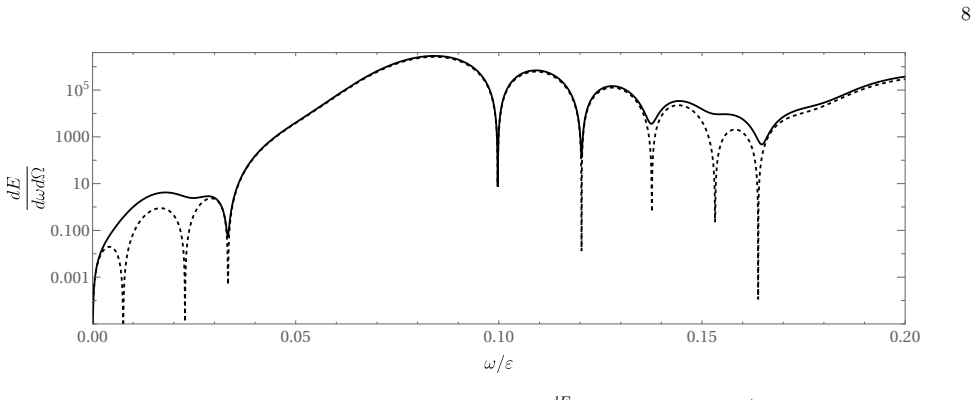
Summary. The paper develops and applies a soft-photon approximation for QED processes in a strong plane-wave laser field, building on prior work. New compact emission factors F^(\pm)_p and G^(\pm)_p are derived that keep the exact phase (including quantum recoil) while approximating only prefactors; these factors iterate cleanly to multi-photon emission. The method is applied to nonlinear single, double, and N-photon Compton scattering. For single Compton the soft-photon spectrum is shown to reproduce the exact result to O(\omega/\epsilon) and to outperform classical radiation theory (which fails beyond \omega/\epsilon \lesssim 0.01). Analytical differential probabilities are obtained for double Compton in the fully soft and one-soft/one-hard regimes, and a compact sum-over-permutations expression is given for the N-photon amplitude. Ancillary Mathematica notebooks implement the single- and double-Compton formulae.
Significance. The work supplies a practical, systematically improvable analytic tool for multi-photon emission in strong-field QED, a regime of direct relevance to LUXE, E-320 and ELI-NP. The quantitative single-Compton benchmark (exact phase retained, prefactors expanded) is clean and demonstrates a clear improvement over classical radiation. The iterated emission factors and the O(N_grid) numerical scheme for the resulting multi-dimensional integrals make N-photon probabilities tractable, including interference among emission orderings. Provision of reproducible Mathematica code further strengthens the contribution.
minor comments (5)
- Sec. III A, after Eq. (21): the special point \theta_pk = 0 where the soft-photon and exact spectra differ strongly is correctly identified as measure-zero for the angle-integrated spectrum; a short remark that the relative error remains O(\omega/\epsilon) after angular integration would make this fully explicit for the reader.
- Sec. III B, Eqs. (28) and (30): the four-dimensional integrals are stated to factor into products of the two-dimensional f_ij, g_ij; it would help to display the explicit bilinear form once, so that the O(N_grid) reduction is immediately visible without consulting the notebooks.
- Sec. III C, after Eq. (35): the validity condition is written as each \omega_i \ll \epsilon and also \sum\omega_i \ll \epsilon; a single sentence clarifying that the second condition is the controlling one for large N would prevent misapplication.
- Figs. 3–5 and 7–10: the relative-difference insets are useful; adding the classical curve to the double-Compton angle-integrated plots (where it is already available by the same replacement) would complete the comparison already performed for single Compton.
- Appendix, Volkov states (54): the lower integration limit is chosen as 0 rather than -\infty; the accompanying remark that the constant phase cancels in |S|^2 is correct, but a cross-reference to the standard convention would aid readers coming from the older literature.
Circularity Check
No significant circularity: soft-photon factors are rewritten from prior work but single-Compton accuracy claim is re-derived and externally benchmarked against independent exact QED.
full rationale
The derivation chain begins from Volkov states and the soft-photon pole approximation on external legs (explicitly neglecting intermediate radiation). New compact emission factors F(±), G(±) (Eqs. 4) are obtained by algebraic rewrite of expressions from the authors’ prior paper [11]; the rewrite itself is shown in the text and is not a definitional loop. For the strongest claim (single nonlinear Compton), the soft spectrum (19)–(20) is re-obtained from scratch by inserting the identity operator (15) into the exact matrix element and applying the soft factor, then shown analytically to coincide with the known exact result of Ref. [24] to O(ω/ε) in prefactors while retaining the exact phase; numerical comparison (Figs. 3–5) against that independent exact formula and against classical radiation confirms the stated accuracy. No parameters are fitted to data, no uniqueness theorem is imported, and no ansatz is smuggled. Double- and N-photon expressions are pure iterative applications of the same factors (Eqs. 25, 31–35) with no external claims that reduce to their inputs by construction. The self-citation to [11] is therefore not load-bearing for the accuracy or novelty claims, which rest on external benchmarks and first-principles iteration within the stated approximation.
Axiom & Free-Parameter Ledger
axioms (4)
- domain assumption Laser field is an external classical plane wave; electron states are Volkov solutions.
- domain assumption Soft-photon emission occurs only from external electron/positron lines; intermediate-line radiation is neglected.
- ad hoc to paper Phase factors are kept exact while prefactors are expanded to leading order in ω/ε.
- domain assumption For N-photon emission the total soft energy remains ≪ ε.
read the original abstract
We apply the soft photon approximation to QED processes in a strong plane-wave laser field. New compact expressions for the emission factors are presented, which simplify the generalization to multiple soft photon emission. The method is applied to nonlinear single, double, and $N$-photon Compton scattering. For single Compton scattering, we show that the soft photon approximation reproduces the exact spectrum with accuracy $\mathcal{O}(\omega/\varepsilon)$, significantly outperforming the classical radiation theory. For double Compton scattering, we derive analytical expressions for the differential probability in two kinematic regimes: when both photons are soft, and when one photon is soft while the other has arbitrary energy. We present a compact analytical expression for the amplitude of $N$-photon emission within the soft photon approximation. A numerical implementation in Wolfram Mathematica for single and double Compton scattering is provided.
Figures




Reference graph
Works this paper leans on
-
[1]
This result can be used in the case where one photon is soft, while the second photon is hard
¯UP(p ′,k2)(x)eik1X ˆe1 ∗Up(x), S2 =−i Z d4x ¯Up′(x)eik1X ˆe1 ∗ Z ϕ −∞ dφ p− e i R φ 0 dφ′ P− (p,−k2 ) (πp(φ′)k2) (πp(φ)e∗ 2)UP(p,−k 2)(x).(24) Thus, both matrix elements can be expressed through the matrix element of nonlinear Compton scattering, but with different initial and final momenta. This result can be used in the case where one photon is soft, w...
-
[2]
Büßer,et al., Letter of intent for the luxe experiment, arXiv preprint arXiv:1909.00860 (2019)
H.Abramowicz, M.Altarelli, R.Aßmann, T.Behnke, Y.Benhammou, O.Borysov, M.Borysova, R.Brinkmann, F.Burkart, K. Büßer,et al., Letter of intent for the luxe experiment, arXiv preprint arXiv:1909.00860 (2019). 21
Pith/arXiv arXiv 1909
-
[3]
Yakimenko, L
V. Yakimenko, L. Alsberg, E. Bong, G. Bouchard, C. Clarke, C. Emma, S. Green, C. Hast, M. Hogan, J. Seabury,et al., Facet-ii facility for advanced accelerator experimental tests, Physical Review Accelerators and Beams22, 101301 (2019)
2019
-
[4]
Gales, K
S. Gales, K. Tanaka, D. Balabanski, F. Negoita, D. Stutman, O. Tesileanu, C. Ur, D. Ursescu, I. Andrei, S. Ataman,et al., The extreme light infrastructure—nuclear physics (eli-np) facility: new horizons in physics with 10 pw ultra-intense lasers and 20 mev brilliant gamma beams, Reports on Progress in Physics81, 094301 (2018)
2018
-
[5]
Mitter, Quantum Electrodynamics in Laser Fields, Acta Phys
H. Mitter, Quantum Electrodynamics in Laser Fields, Acta Phys. Austriaca Suppl.14, 397 (1975)
1975
-
[6]
V. I. Ritus, Quantum effects of the interaction of elementary particles with an intense electromagnetic field, Journal of Soviet Laser Research6, 10.1007/BF01120220 (1985)
-
[7]
V. N. Baier, V. M. Katkov, and V. M. Strakhovenko,Electromagnetic processes at high energies in oriented single crystals (World Scientific, 1998)
1998
-
[8]
Ehlotzky, K
F. Ehlotzky, K. Krajewska, and J. Z. Kamiński, Fundamental processes of quantum electrodynamics in laser fields of relativistic power, Reports on Progress in Physics72, 046401 (2009)
2009
-
[9]
A.DiPiazza, C.Muller, K.Z.Hatsagortsyan,andC.H.Keitel,Extremelyhigh-intensitylaserinteractionswithfundamental quantum systems, Rev. Mod. Phys.84, 1177 (2012), arXiv:1111.3886 [hep-ph]
Pith/arXiv arXiv 2012
-
[10]
A. Fedotov, A. Ilderton, F. Karbstein, B. King, D. Seipt, H. Taya, and G. Torgrimsson, Advances in qed with intense background fields 10.1016/j.physrep.2023.01.003, 2203.00019v2
-
[11]
L. P. V.B. Berestetski, E.M. Lifshits,Quantum Electrodynamics(Pergamon, Oxford, 1982)
1982
-
[12]
P. A. Krachkov, Soft photon approximation in a laser field, Phys. Rev. D109, 076002 (2024)
2024
-
[13]
L. D. Landau and E. M. Lifshitz,The Classical Theory of Fields: Volume 2, Vol. 2 (Butterworth-Heinemann, 1975)
1975
-
[14]
Dinu and G
V. Dinu and G. Torgrimsson, Single and double nonlinear compton scattering, Phys. Rev. D99, 096018 (2019)
2019
-
[15]
Baier and V
V. Baier and V. Katkov, Concept of formation length in radiation theory, Physics Reports409, 261 (2005)
2005
-
[16]
Signatures of High-Intensity Compton Scattering
C. Harvey, T. Heinzl, and A. Ilderton, Signatures of high-intensity compton scattering 10.1103/PhysRevA.79.063407, 0903.4151v1
work page internal anchor Pith review Pith/arXiv arXiv doi:10.1103/physreva.79.063407
-
[17]
M. F. N.B. Narozhnyi, Photon emission by an electron in a collision with a short focused laser pulse, JETP83, 14 (1996)
1996
-
[18]
L. S. Brown and T. W. B. Kibble, Interaction of intense laser beams with electrons, Phys. Rev.133, A705 (1964)
1964
-
[19]
Single and double nonlinear Compton scattering
V. Dinu and G. Torgrimsson, Single and double nonlinear compton scattering 10.1103/PhysRevD.99.096018, 1811.00451v2
work page internal anchor Pith review Pith/arXiv arXiv doi:10.1103/physrevd.99.096018
-
[20]
D. Seipt and B. Kampfer, Non-linear compton scattering of ultrahigh-intensity laser pulses, 1111.0188v1
-
[21]
D. Y. Ivanov, G. L. Kotkin, and V. G. Serbo, Complete description of polarization effects in the nonlinear compton scattering. i. circularly polarized laser photons, (), hep-ph/0310325v1
-
[22]
D. Y. Ivanov, G. L. Kotkin, and V. G. Serbo, Complete description of polarization effects in the nonlinear compton scattering. ii. linearly polarized laser photons, (), hep-ph/0311222v2
-
[23]
Zel’dovich, Soviet Physics Uspekhi18, 79 (1975)
Y. Zel’dovich, Soviet Physics Uspekhi18, 79 (1975)
1975
-
[24]
Nikishov and V
A. Nikishov and V. Ritus, Quantum processes in the field of a plane electromagnetic wave and in a constant field. i, Zh. Eksp. Teor. Fiz.46, 776 (1964)
1964
-
[25]
Mackenroth and A
F. Mackenroth and A. Di Piazza, Nonlinear compton scattering in ultrashort laser pulses, Phys. Rev. A83, 032106 (2011)
2011
-
[26]
I. I. Goldman and V. A. Khoze, On polarization effects in compton scattering on relativistic electrons, Phys. Lett. B29, 426 (1969)
1969
-
[27]
D. L. Burke, R. C. Field, G. Horton-Smith, J. E. Spencer, D. Walz, S. C. Berridge, W. M. Bugg, K. Shmakov, A. W. Weidemann, C. Bula, K. T. McDonald, E. J. Prebys, C. Bamber, S. J. Boege, T. Koffas, T. Kotseroglou, A. C. Melissinos, D. D. Meyerhofer, D. A. Reis, and W. Ragg, Positron production in multiphoton light-by-light scattering, Phys. Rev. Lett. 79,...
1997
-
[28]
Mackenroth and A
F. Mackenroth and A. Di Piazza, Nonlinear double compton scattering in the ultrarelativistic quantum regime, Physical review letters110, 070402 (2013)
2013
-
[29]
Seipt and B
D. Seipt and B. Kämpfer, Two-photon compton process in pulsed intense laser fields, Physical Review D—Particles, Fields, Gravitation, and Cosmology85, 101701 (2012)
2012
-
[30]
De Vos, J
T. De Vos, J. Postema, B. Schaap, A. Di Piazza, and O. Luiten, Production of entangled x rays through nonlinear double compton scattering, Physical Review A110, 043702 (2024)
2024
-
[31]
Levin, Procedures for computing one-and two-dimensional integrals of functions with rapid irregular oscillations, Math- ematics of Computation38, 531 (1982)
D. Levin, Procedures for computing one-and two-dimensional integrals of functions with rapid irregular oscillations, Math- ematics of Computation38, 531 (1982)
1982
-
[32]
Levin, Fast integration of rapidly oscillatory functions, Journal of Computational and Applied Mathematics67, 95 (1996)
D. Levin, Fast integration of rapidly oscillatory functions, Journal of Computational and Applied Mathematics67, 95 (1996)
1996
-
[33]
Iserles and S
A. Iserles and S. P. Nørsett, On quadrature methods for highly oscillatory integrals and their implementation, BIT Nu- merical Mathematics44, 755 (2004)
2004
-
[34]
L. N. Trefethen and J. Weideman, The exponentially convergent trapezoidal rule, SIAM review56, 385 (2014)
2014
discussion (0)
Sign in with ORCID, Apple, or X to comment. Anyone can read and Pith papers without signing in.