REVIEW 3 major objections 5 minor 36 references
SR-Agent automates the closed loop from bad-case detection to bounded, verified post-ranking strategy updates, and a one-month A/B test reports higher orders, deeper browsing, and more diverse clicks.
Reviewed by Pith at T0; open to challenge. T0 means a machine referee read the full paper against a public rubric. the ladder, T0–T4 →
T0 review · deepseek-v4-flash
2026-08-01 17:10 UTC pith:MFUO3JUO
load-bearing objection Credible system design with a suggestive but not yet rigorous online A/B claim — worth engaging, but don't quote the effect sizes. the 3 major comments →
SR-Agent: An Experience-Driven Agentic Framework for Post-Ranking Strategy Refinement in E-Commerce Recommendation
The pith
A machine-rendered reading of the paper's core claim, the machinery that carries it, and where it could break.
Core claim
The paper claims that the full cycle of experience inspection, diagnosis, bounded strategy refinement, and guarded validation can be closed by LLM-based agents without changing the base ranking model, and that doing so in production yields consistent gains in both user experience and business metrics. In a one-month A/B test on 2.5% of traffic covering roughly 60 million users, the framework improved clicked categories per user by 0.425–0.482%, browsing depth by 0.342%, total clicks by 0.554%, order volume by 0.707%, and GMV by 0.461%. The system also detected 142 bad cases in 500 sampled recommendation cases with a 95% human validation rate, versus 36 cases found by manual inspection, and i
What carries the argument
The central mechanism is the constrained Strategy Refinement Harness: a fixed, pre-authorized action space of four typed updates—relation-threshold adjustment, redundancy-suppression adjustment, exposure-limit adjustment, and authorized taxonomy correction—each with bounded parameters (e.g., threshold shifts between −0.15 and +0.15 in steps of 0.01). The harness maps diagnoses from an Analysis agent into candidate updates, filters them with a deterministic validator, and admits them only after a four-stage reward pipeline: retesting on labeled bad cases, replay on historical traffic, human verification, and online A/B validation, with rollback on guardrail violations. This decomposition make
Load-bearing premise
The one-month A/B comparison assumes the 2.5% treatment traffic differs from control only in the agent-generated strategy updates; if day-of-week effects, item-supply shifts, or interference between control and treatment users are not balanced, the reported gains could be artifacts rather than causal effects.
What would settle it
Re-analyze the logged one-month experiment with a difference-in-differences or synthetic-control design that adjusts for daily item supply, user composition, and calendar effects; if the point estimates for order volume and browsing depth shrink to near zero or change sign, the central deployment claim is not established.
If this is right
- Post-ranking strategies can remain aligned with a drifting item and user environment automatically, without retraining the base ranker.
- Human experts shift from case-by-case debugging to auditing a small sample of generated bad cases and diagnoses and approving candidate updates.
- The refinement cycle shortens from 2–3 weeks to 3–5 elapsed days, allowing faster response to experience regressions.
- Because each update is bounded and reversible, the framework can serve as a low-risk maintenance layer for always-on production recommenders.
- The paper states the same guarded loop can be extended to other configurable components, such as cold-start boosting and multi-channel retrieval quotas.
Where Pith is reading between the lines
- The numeric gains are likely environment-specific; the transferable contribution is the closed-loop architecture, and its robustness could be tested by applying the same harness to a different e-commerce platform or domain.
- The framework's effectiveness hinges on the LLM-based inspector detecting defects that match real user perception; a blind comparison of UserSim's flags against self-reported user satisfaction on a held-out set would sharpen that link.
- With unbounded runtime, the strategy configuration may drift among locally optimal settings; tracking rollback frequency and update-to-update variance could reveal whether the loop stabilizes or oscillates over months.
- Because the harness leaves the ranker untouched, it could be paired with any black-box base model, making it a candidate for a standardized post-ranking maintenance service.
Editorial analysis
A structured set of objections, weighed in public.
Referee Report
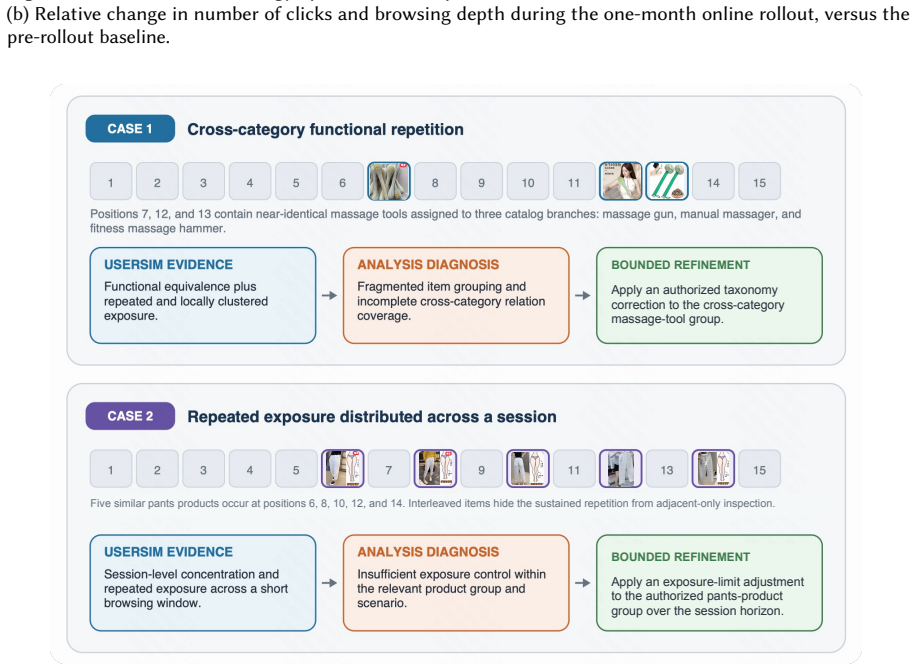
Summary. SR-Agent addresses the operational problem of maintaining rule-based post-ranking strategies in a large-scale e-commerce recommender. The paper describes a deployed multi-agent loop: a UserSim agent inspects displayed lists and produces structured bad cases; an Analysis agent consolidates them into diagnoses; a Strategy Refinement Harness maps diagnoses to a typed, bounded action space and admits updates only after bad-case retesting, historical replay, human review, and online A/B validation, with rollback. The empirical section reports a one-month online A/B test on Kuaishou with 2.5% treatment traffic, claiming relative gains of +0.707% order volume, +0.342% browsing depth, +0.554% clicks, +0.461% GMV, and +0.482% 7-day clicked categories, plus a 2–3 week to 3–5 day cycle compression and a ten-update trend in bad-case resolution from 49.2% to 83.1%.
Significance. If the empirical claims withstand scrutiny, the paper would be a meaningful industrial contribution: it is one of the few full closed-loop agentic systems for strategy maintenance, with explicit safety mechanisms (bounded actions, deterministic validation, staged reward pipeline, rollback) and reusable memory. The decomposition of bad-case detection, diagnosis, and bounded refinement is sensible, and the deployment details are concrete. The strongest contribution is the system design and the demonstration that a constrained agent loop can be operated in production. However, the headline quantitative claims are not yet established because the A/B test is reported without confidence intervals, correction for sequential decisions, or details on the adaptive candidate-selection process; and the RQ4 resolution metric is partly circular.
major comments (3)
- [§4.1, Table 2; Algorithm 1, §3.5] Table 2 reports one-month relative changes without confidence intervals, p-values, or pre-registered metrics. This is not a fixed-treatment A/B contrast: Algorithm 1 and §3.5 describe a continuously adapting loop in which candidate updates are generated from interim bad-case diagnoses, pass online A/B validation (r_online in Eq. 5) before deployment, and can be rolled back. If only candidates with positive interim effects are kept, the aggregate estimates inherit winner's-curse/selection bias. The paper gives no number of candidates generated, tested, deployed, or rolled back, and no correction for sequential decisions. Please report these counts and provide interval estimates or an alternative design; otherwise the headline 0.707% order-volume and 0.342% browsing-depth gains cannot be distinguished from noise.
- [§4.4, Fig. 3(a); §3.3–3.4] The bad-case resolution rate is computed by retesting the targeted bad cases with the same harness and UserSim experience evaluator that produced the labels. Since the defect definition is endogenous, improvement in this metric need not correspond to user-perceived improvement. §3.4 states that human reviewers randomly audit about 1% of bad cases and diagnoses, so the ground-truth check is sparse. RQ4 should report resolution on an independent, human-labeled hold-out set and give audit coverage of the retested cases.
- [§4.2, Table 3] Table 3 reports detected cases and validation rates on 500 recommendation cases but gives no sampling details, inter-annotator agreement, confidence intervals, or false-negative rate. The validation rate apparently is the fraction of detected cases confirmed by humans, not the fraction of actual bad cases found. Manual inspection detects 36 cases while UserSim detects 142 at 95% validation, but without a recall estimate relative to a complete label set, 'broader coverage' is not established. Please clarify the annotation protocol and report error bars.
minor comments (5)
- [Abstract and §2.3] The claim that SR-Agent is 'the first agentic framework deployed to refine post-ranking strategies in industrial RS' is based on recent preprints and cannot be conclusively verified; consider softening to 'to our knowledge' or adding a more precise prior-art sweep.
- [§3.3, Eq. (1)] The symbol u is used both for the user and for 'current intent' in the formal definition. Clarify the notation to avoid ambiguity in Eq. (1).
- [§3.5, Table 1] The admissible domains for exposure-limit and taxonomy-correction actions are given only as abstract sets (C_cfg and C_auth_tax). Give representative examples or explicit bounds so readers can assess the actual boundedness claim.
- [§4.3, Table 4] The end-to-end iteration times are reported as single numbers without variance or a defined measurement protocol. Report how many loops were measured and the range.
- [§4.4, Figure 3] Figure 3(b) shows a trend over time without CI bands or any indication of traffic-composition adjustments. State whether the daily values are raw or debiased and add interval estimates.
Circularity Check
No significant circularity; the central A/B result is grounded in an external control-group comparison, and the bounded action space is predefined rather than fitted.
full rationale
The paper's central claim (Section 4.1, Table 2) rests on a one-month online A/B test against a control group that retains the existing manually configured post-ranking strategies, with the base ranking model fixed. The treatment arm applies only typed, bounded strategy updates generated through the predefined action space in Section 3.5/Table 1 and gated by a four-stage validation pipeline. The reported metric gains are measured in live traffic and are not derived algebraically from the model's own labels or from fitted parameters. No load-bearing self-citation or uniqueness-import chain appears in Sections 3-4: the cited prior systems are positioned as context, and the framework's components are described and defined within this paper. The only potentially self-referential element is RQ4's bad-case resolution rate (Section 4.4, Figure 3a), which is defined against UserSim-generated cases and the system's own retesting procedure. However, this is a secondary, internally defined efficiency metric, not the paper's primary evidence; the external online trend and the A/B table provide independent support. The paper also discloses that only approximately 1% of bad cases and diagnoses receive human audit, which is a limitation on internal evaluation quality rather than a circularity in the derivation. The absence of confidence intervals or p-values is a statistical robustness concern, not evidence of circularity. Overall, the central derivation is self-contained and externally benchmarked.
Axiom & Free-Parameter Ledger
free parameters (3)
- Bad-case confidence threshold for storing UserSim outputs
- Bounded action-space parameters in Table 1
- Human audit rate of ~1% =
1%
axioms (4)
- domain assumption LLM-based UserSim experience judgments approximate real user experience well enough to guide production changes.
- domain assumption Historical traffic replay predicts online safety and effectiveness of candidate strategy updates.
- domain assumption The one-month A/B treatment-control comparison is free of interference, seasonality, and selection effects.
- domain assumption Post-ranking strategies degrade over time and require continuous refinement.
read the original abstract
User experience is a first-class objective in industrial e-commerce recommender systems (RS). Post-ranking strategies, which govern diversity, similarity, and exposure over a ranked list, are widely deployed in industrial RS for their simplicity and low serving cost. However, as the online recommendation environment evolves continuously, these statically configured strategies gradually become stale, thereby degrading the user experience. Refining them typically relies on manual inspection, diagnosis, and updates, making it slow, costly, and difficult to scale or reuse. Although recent LLM-based agents (e.g., RecUserSim, SimUSER, and Self-EvolveRec) offer promising directions, none of them close the full loop of automated, self-evolving strategy refinement. To bridge this gap, we introduce SR-Agent, which, to the best of our knowledge, is the first agentic framework deployed to refine post-ranking strategies in industrial RS. SR-Agent unifies three components: (i) a UserSim agent that applies inspection skills to surface user-perceived bad cases; (ii) an Analysis agent that consolidates recurring bad cases into structured, reusable diagnoses; and (iii) a constrained Strategy Refinement Harness that maps diagnoses to typed and bounded actions, gated by a four-stage reward pipeline with reversible rollback. Deployed on the Kuaishou e-commerce platform, SR-Agent continuously runs this refinement loop and, in a one-month online A/B test, increases order volume by 0.71%, browsing depth by 0.34%, and clicked-category diversity by 0.48%, while markedly shortening the refinement cycle and lowering operational cost.
Figures


Reference graph
Works this paper leans on
-
[1]
Q. Peng, H. Liu, H. Huang, Q. Yang, M. Shao, A survey on llm-powered agents for recommender systems, arXiv preprint arXiv:2502.10050 (2025)
Pith/arXiv arXiv 2025
-
[2]
I. Adaji, Towards improving e-commerce users experience using personalization & persuasive tech- nology, in: Proceedings of the 25th Conference on User Modeling, Adaptation and Personalization, 2017, pp. 318–321
2017
-
[3]
X. Song, User-centric internal tools in e-commerce: Enhancing operational efficiency through ai integration, in: Proceedings of the 2025 International Conference on Economic Management and Big Data Application, 2025, pp. 702–706
2025
-
[4]
P. Pu, L. Chen, R. Hu, Evaluating recommender systems from the user’s perspective: survey of the state of the art, User Modeling and User-Adapted Interaction 22 (2012) 317–355
2012
-
[5]
Duricic, D
T. Duricic, D. Kowald, E. Lacic, E. Lex, Beyond-accuracy: a review on diversity, serendipity, and fairness in recommender systems based on graph neural networks, Frontiers in big data 6 (2023) 1251072
2023
-
[6]
S. M. McNee, J. Riedl, J. A. Konstan, Being accurate is not enough: how accuracy metrics have hurt recommender systems, in: CHI’06 extended abstracts on Human factors in computing systems, 2006, pp. 1097–1101
2006
-
[7]
Ziegler, S
C.-N. Ziegler, S. M. McNee, J. A. Konstan, G. Lausen, Improving recommendation lists through topic diversification, in: Proceedings of the 14th international conference on World Wide Web, 2005, pp. 22–32
2005
-
[8]
Kunaver, T
M. Kunaver, T. Požrl, Diversity in recommender systems–a survey, Knowledge-based systems 123 (2017) 154–162
2017
-
[9]
Lathia, S
N. Lathia, S. Hailes, L. Capra, X. Amatriain, Temporal diversity in recommender systems, in: Proceedings of the 33rd international ACM SIGIR conference on Research and development in information retrieval, 2010, pp. 210–217
2010
-
[10]
L. Chen, G. Zhang, E. Zhou, Fast greedy map inference for determinantal point process to improve recommendation diversity, Advances in neural information processing systems 31 (2018)
2018
-
[11]
M. Chen, A. Beutel, P. Covington, S. Jain, F. Belletti, E. H. Chi, Top-k off-policy correction for a reinforce recommender system, in: Proceedings of the twelfth ACM international conference on web search and data mining, 2019, pp. 456–464
2019
-
[12]
S. Wang, L. Cao, Y. Wang, Q. Z. Sheng, M. A. Orgun, D. Lian, A survey on session-based recom- mender systems, ACM Computing Surveys (CSUR) 54 (2021) 1–38
2021
-
[13]
Y. Liu, D. Iter, Y. Xu, S. Wang, R. Xu, C. Zhu, G-eval: Nlg evaluation using gpt-4 with better human alignment, in: Proceedings of the 2023 conference on empirical methods in natural language processing, 2023, pp. 2511–2522
2023
-
[14]
Zheng, W.-L
L. Zheng, W.-L. Chiang, Y. Sheng, S. Zhuang, Z. Wu, Y. Zhuang, Z. Lin, Z. Li, D. Li, E. Xing, et al., Judging llm-as-a-judge with mt-bench and chatbot arena, Advances in neural information processing systems 36 (2023) 46595–46623
2023
-
[15]
Zhang, Y
A. Zhang, Y. Chen, L. Sheng, X. Wang, T.-S. Chua, On generative agents in recommendation, in: Proceedings of the 47th international ACM SIGIR conference on research and development in Information Retrieval, 2024, pp. 1807–1817
2024
-
[16]
S.-e. Yoon, Z. He, J. Echterhoff, J. McAuley, Evaluating large language models as generative user simulators for conversational recommendation, in: Proceedings of the 2024 Conference of the North American Chapter of the Association for Computational Linguistics: Human Language Technologies (Volume 1: Long Papers), 2024, pp. 1490–1504
2024
-
[17]
Bougie, N
N. Bougie, N. Watanabe, Simuser: Simulating user behavior with large language models for recommender system evaluation, in: Proceedings of the 63rd Annual Meeting of the Association for Computational Linguistics (Volume 6: Industry Track), 2025, pp. 43–60
2025
-
[18]
Wanyan, D
X. Wanyan, D. Hettiachchi, C. Ma, Z. Xu, J. Chan, Temporal-aware user behaviour simulation with large language models for recommender systems, in: Proceedings of the 34th ACM International Conference on Information and Knowledge Management, 2025, pp. 5335–5339
2025
-
[19]
L. Shi, C. Ma, W. Liang, X. Diao, W. Ma, S. Vosoughi, Judging the judges: A systematic study of position bias in llm-as-a-judge, in: Proceedings of the 14th International Joint Conference on Natural Language Processing and the 4th Conference of the Asia-Pacific Chapter of the Association for Computational Linguistics, 2025, pp. 292–314
2025
-
[20]
S. Kim, S. Park, H. Kang, W. Kim, J. Seo, Y. In, K. Yoon, C. Park, Self-evolverec: Self-evolving recommender systems with llm-based directional feedback, arXiv preprint arXiv:2602.12612 (2026)
Pith/arXiv arXiv 2026
-
[21]
H. Wang, Y. Wu, D. Chang, L. Wei, L. Heldt, Self-evolving recommendation system: End-to-end autonomous model optimization with llm agents, arXiv preprint arXiv:2602.10226 (2026)
Pith/arXiv arXiv 2026
-
[22]
C. Lao, F. Pan, G. Ma, H. Li, H. Lin, J. Shi, K. Zhao, K. Gai, M. Zhou, Q. Zhou, et al., Agentx: Towards agent-driven self-iteration of industrial recommender systems, arXiv preprint arXiv:2606.26859 (2026)
Pith/arXiv arXiv 2026
-
[23]
J. Mao, L. Li, Y. Gao, Z. Peng, S. He, C. Zhang, S. Qin, S. Khalid, Q. Lin, S. Rajmohan, et al., Stepfly: Agentic troubleshooting guide automation for incident diagnosis, Proceedings of the ACM on Software Engineering 3 (2026) 3070–3092
2026
-
[24]
P. Pu, L. Chen, R. Hu, A user-centric evaluation framework for recommender systems, in: Proceedings of the fifth ACM conference on Recommender systems, 2011, pp. 157–164
2011
-
[25]
Adamopoulos, A
P. Adamopoulos, A. Tuzhilin, On unexpectedness in recommender systems: Or how to better expect the unexpected, ACM Transactions on Intelligent Systems and Technology (TIST) 5 (2014) 1–32
2014
-
[26]
Carbonell, J
J. Carbonell, J. Goldstein, The use of mmr, diversity-based reranking for reordering documents and producing summaries, in: Proceedings of the 21st annual international ACM SIGIR conference on Research and development in information retrieval, 1998, pp. 335–336
1998
-
[27]
Y. Liu, C. Walder, L. Xie, Determinantal point process likelihoods for sequential recommendation, in: Proceedings of the 45th international ACM SIGIR conference on research and development in information retrieval, 2022, pp. 1653–1663
2022
-
[28]
Wilhelm, A
M. Wilhelm, A. Ramanathan, A. Bonomo, S. Jain, E. H. Chi, J. Gillenwater, Practical diversified recommendations on youtube with determinantal point processes, in: Proceedings of the 27th ACM International Conference on Information and Knowledge Management, 2018, pp. 2165–2173
2018
-
[29]
Zhang, S
Z. Zhang, S. Liu, Z. Liu, R. Zhong, Q. Cai, X. Zhao, C. Zhang, Q. Liu, P. Jiang, Llm-powered user simulator for recommender system, in: Proceedings of the AAAI Conference on Artificial Intelligence, volume 39, 2025, pp. 13339–13347
2025
-
[30]
L. Chen, Q. Dai, Z. Zhang, X. Feng, M. Zhang, P. Tang, X. Chen, Y. Zhu, Z. Dong, Recusersim: A realistic and diverse user simulator for evaluating conversational recommender systems, in: Companion Proceedings of the ACM on Web Conference 2025, 2025, pp. 133–142
2025
-
[31]
Huang, J
X. Huang, J. Lian, Y. Lei, J. Yao, D. Lian, X. Xie, Recommender ai agent: Integrating large language models for interactive recommendations, ACM Transactions on Information Systems 43 (2025) 1–33
2025
-
[32]
Zhang, Y
J. Zhang, Y. Hou, R. Xie, W. Sun, J. McAuley, W. X. Zhao, L. Lin, J.-R. Wen, Agentcf: Collaborative learning with autonomous language agents for recommender systems, in: Proceedings of the ACM Web Conference 2024, 2024, pp. 3679–3689
2024
-
[33]
Y. Wang, Z. Jiang, Z. Chen, F. Yang, Y. Zhou, E. Cho, X. Fan, Y. Lu, X. Huang, Y. Yang, Recmind: Large language model powered agent for recommendation, in: Findings of the Association for Computational Linguistics: NAACL 2024, 2024, pp. 4351–4364
2024
-
[34]
B. Ma, H. Li, Z. Hu, X. Gui, L. Liu, S. Lau, Agentrec: Next-generation llm-powered multi-agent collaborative recommendation with adaptive intelligence, arXiv preprint arXiv:2510.01609 (2025)
arXiv 2025
-
[35]
J. Park, M. Kim, Madrec: A multi-aspect driven llm agent for explainable and adaptive recommen- dation, arXiv preprint arXiv:2510.13371 (2025)
arXiv 2025
-
[36]
X. Lin, Y. Deldjoo, S. Dai, H. Bao, X. Ye, F. Nazary, W. Wang, T. Di Noia, J. Xu, T.-S. Chua, Autonomous information seeking: A roadmap for agentic recommender systems, arXiv preprint arXiv:2607.04433 (2026)
Pith/arXiv arXiv 2026
discussion (0)
Sign in with ORCID, Apple, or X to comment. Anyone can read and Pith papers without signing in.