REVIEW 4 major objections 5 minor 30 references
HandCept: A Visual-Inertial Fusion Framework for Accurate Proprioception in Dexterous Hands
T0 review · 4 major / 5 minor · reviewed 2026-08-15 · deepseek-v4-flash
Pith's one-line read A wrist-mounted RGB-D camera fused with miniature inertial sensors can keep a dexterous hand's joint angles accurate to within 2–4 degrees without drift.
desk verdict Promising hardware and pipeline, but the headline accuracy claim is unsupported by the paper's own experiments and appears contradicted by its drift table. read the letter →
The pith
A machine-rendered reading of the paper's core claim, the machinery that carries it, and where it could break.
The reading
What carries the argument
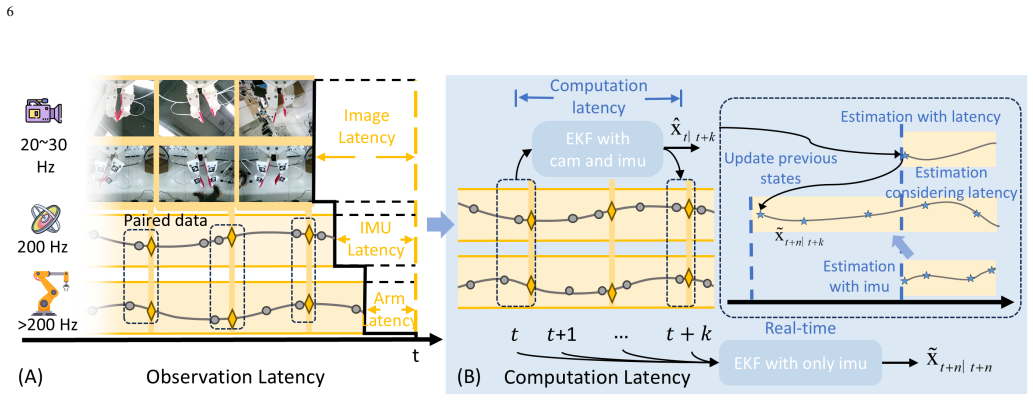
The load-bearing mechanism is a latency-free Extended Kalman Filter whose state is each link's unit quaternion plus a gyro bias term. IMU data drives a real-time random-walk prediction; when a delayed camera pose estimate arrives, the filter rewinds and re-propagates the state across the latency window, so slow visual corrections reach the current estimate without stalling the output. Two supporting pieces carry the accuracy: a kinematic-constraint step that removes spurious rotations from raw visual estimates using the known revolute-joint chain, and a continuity-based Euler-angle solver that chooses the configuration-space solution closest to the previous timestep to avoid dual solutions.
What would settle it
Repeat the system's uniformity test with four motion sensors mounted near the actuation motors of the hand and power the motors during measurement; if the between-sensor orientation variance grows beyond the roughly 3-degree standard deviation already seen in the paper's Table I, or if joint-angle error exceeds 4 degrees on any axis, then the common-calibration-frame assumption is not reliable enough for the claimed accuracy.
Extended reading notes
Core claim
The central discovery claimed is that proprioception for a rigid-link dexterous hand can be recovered from sensing mounted on the wrist and links rather than from joint hardware: per-link orientations come from small 9-axis IMUs, per-link full poses come from an RGB-D camera, and the two are combined in a modified extended Kalman filter that retroactively corrects the inertial trajectory whenever a delayed visual measurement arrives. On a dexterous hand with no onboard joint estimation system, the fused estimates stay within 2 to 4 degrees of ground truth during random teleoperated motion, while either modality alone is less accurate or drifts over time. The paper further claims that the IMU modules are small and stable enough that a common base frame across all modules is justified, which makes multi-sensor calibration simple.
Load-bearing premise
The magnetic field around the hand is uniform enough that all of the hand's tiny inertial motion sensors can share a single calibration frame; if motors, wiring, or nearby metal distort that field, the relative biases that appear in the sensor orientations will show up directly as joint-angle errors.
Editorial extensions
If this is right
- A dexterous hand built without joint encoders can still close the loop on manipulation, provided it carries a wrist RGB-D camera and miniature inertial sensors.
- Because the IMU stream updates at 200 Hz or more, the latency-compensated filter can produce real-time joint feedback while the slower camera refines the history.
- If the common-base-frame calibration holds across a hand, adding more fingers or links does not require per-module alignment, lowering the cost of scaling to five-fingered hands.
- The fully synthetic training pipeline implies that new hand geometries can get visual pose estimators without collecting real ground-truth poses.
- Sustained errors of 2 to 4 degrees over long random motion imply the estimate is stable enough to serve as feedback for higher-level manipulation policies.
Reading between the lines
- The paper's own uniformity data show between-chip angular variances up to 8.21 square degrees, roughly 3 degrees of standard deviation; in a real hand with motors and wiring nearby, that floor may set the practical accuracy limit, so the 2-degree headline likely assumes a benign magnetic environment.
- The same sensor stack could transfer to prosthetic hands or teleoperation gloves, where encoders are hard to fit; the main required change would be retraining the visual estimator on the new link shapes.
- Because the paper notes that real images are cluttered and noisy while no noise was added during synthetic training, the zero-shot result is likely to degrade under occlusion or strong lighting changes; injecting synthetic noise or fine-tuning on a small set of real images is a direct test.
- A natural extension noted in the paper is adding torque, compliance, and tactile signals; the same EKF state could be expanded from geometry to full interaction states.
Signed reviews
Editorial analysis
A structured set of objections, weighed in public.
Referee Report
Summary. The paper proposes HandCept, a visual-inertial fusion framework for estimating joint angles of dexterous robotic hands without joint encoders. A wrist-mounted RGB-D camera provides zero-shot 6D pose estimates for each link using a synthetic-data-trained FFB6D network, while multiple miniature 9-axis IMUs provide orientation estimates. The two modalities are fused in a latency-compensated Extended Kalman Filter, and joint angles are recovered from the fused rotation matrices by solving a kinematics-constrained equation. The authors claim joint-angle errors between 2 and 4 degrees without observable drift, outperform visual-only and inertial-only methods, and validate that the IMU system is stable and uniform enough to share a common base frame. They also open-source a Blender-based rendering pipeline for sim-to-real training.
Significance. If the central accuracy and drift-free claims were quantitatively established, HandCept would be a useful contribution to encoder-free proprioception for dexterous hands: the compact 12 mm × 15 mm IMU module, the open-source rendering pipeline, and the real-hardware demonstration with ArUco ground truth are all strengths. The paper also makes a falsifiable architectural claim, namely that a common base frame across IMUs is justified by field uniformity. However, the significance is currently limited by the absence of any numeric joint-angle error evaluation, by internal inconsistencies in Table I that bear directly on the drift and uniformity assumptions, and by unreported EKF noise parameters. As submitted, the headline 2–4 degree accuracy cannot be checked or reproduced from the reported evidence.
major comments (4)
- [Section VI.B, Fig. 7C] The paper's central claim of 2–4 degree joint-angle error without observable drift has no quantitative support. Figure 7C is a qualitative time-series plot with no error bars, no per-joint numerical errors, no peak errors, no drift statistics, and no stated number of trials. The abstract and conclusion make a specific accuracy claim, but the reader cannot verify it from any table or error metric. Please report per-joint MAE/RMSE, peak error, drift rate, and standard deviations for joints 1–6, with the number of trials.
- [Table I, Section VI.A] Table I reports first-order drift in units of 10^-4 deg/s, with entries up to 36×10^-4 deg/s (Pose #2, Yaw). Over a two-hour static test, a constant drift at that rate accumulates to roughly 26 degrees, which is incompatible with the statements in Section VI.A that drift is 'minimal' and with the abstract's claim of 'without observable drift.' Please clarify whether these values are temporal slopes after Kalman filtering and report the accumulated orientation error over the full two-hour window.
- [Table I, Section IV.A] The uniformity claim rests on the assertion that the angular variance in Table I is 'very small,' but variances up to 8.21 deg^2 correspond to a standard deviation of about 2.9 degrees, which is the same order as the claimed 2–4 degree joint-angle accuracy. If the variance is across the four IMU chips, the common-base assumption leaves per-chip orientation residuals that propagate through Eq. (22) into joint angles; if the variance is temporal, it contradicts the no-drift claim. The paper must state which interpretation applies and provide per-chip residuals.
- [Section V.A, Eqs. (7), (14), (15)] The EKF fusion depends on process noise covariances Q_q and Q_b and measurement noise covariances R_cam and R_imu, as well as on the settings of the IMU orientation Kalman filter, but none of these values are reported. Without these parameters the fusion result is not reproducible and the claimed robustness cannot be assessed. Please provide the numerical values or a sensitivity analysis showing that the headline accuracy does not depend on fine-tuning them.
minor comments (5)
- [Section IV.B] There are typos that should be corrected: 'quanlified' should be 'quantified', 'Kinematics Constrains' should be 'Kinematics Constraints', and 'Appilying' should be 'Applying.'
- [Eq. (1)] The notation for homogeneous transformations is ambiguous: 'aTb' is defined as the transformation from frame a to frame b, but Eq. (1) then writes products such as 'IMU_i \hat{T}_ee = IMU_i \hat{T}_{IMU_b} ...' without making the source and target frames explicit in the superscripts. Please clarify the convention and verify the chain of products.
- [Abstract and Section VII] The accuracy claim is stated inconsistently: the abstract says 'errors between 2 and 4 degrees,' while the introduction says 'errors up to 2 degrees.' Please harmonize these statements.
- [Fig. 7C] Figure 7C lacks axis labels and a clear legend identifying the ground truth, visual-only, inertial-only, and HandCept traces; adding these would make the comparative claim easier to interpret.
- [Section V.B] The latency-compensation equations contain undefined or inconsistent indices and superscripts (e.g., \tilde{H}^T_t and the treatment of \tilde{P}_{t+1|t+k}); please rewrite this section with consistent subscripts and define every symbol.
Circularity Check
No significant circularity; the joint-angle estimate is obtained from independently measured IMU and camera poses, not from parameters fitted to the target angles.
full rationale
The derivation chain does not reduce to its inputs by construction. Joint angles are solved from fused link poses via Eq. (22) after IMU orientation estimation (Eq. 1) and FFB6D-based visual pose estimation are combined in an EKF (Eqs. 15, 19, 21); none of these stages fits a parameter to the ground-truth joint angles used for evaluation. The self-citation to the DexCo hand [8] supplies the testbed only and does not justify the estimation result. The visual estimator is an external method (FFB6D), and the kinematic-constraint and Euler-angle extraction steps are standard transformations with stated assumptions. The uniformity variance in Table I and the absence of a numeric joint-angle error table are evidence-strength concerns about the headline accuracy, not instances where a prediction equals its input by definition. Reported noise covariances are not a fitted input that the paper calls a prediction. Therefore no circular step meeting the quoted-evidence bar was found.
Assumptions & free parameters
free parameters (3)
- Process noise covariances Q_q, Q_b in EKF =
not reported
- Measurement noise covariances R_cam, R_imu =
not reported
- IMU orientation Kalman filter settings =
not reported
assumptions (6)
- domain assumption Revolute joint chain topology with rigid links
- domain assumption Uniform magnetic field across all IMUs, allowing a common base frame
- domain assumption Zero-shot transfer from Blender synthetic images works without added noise
- standard math Small quaternion increments and Gaussian noise linearization
- domain assumption ArUco marker measurements provide ground truth
- standard math Temporal continuity for Euler angle disambiguation
Cite this review
Pith. "Pith review of HandCept: A Visual-Inertial Fusion Framework for Accurate Proprioception in Dexterous Hands." pith.science (2026). https://pith.science/paper/MG32ECJT
@misc{pith2026250508213,
  author       = {Pith},
  title        = {Pith review of: HandCept: A Visual-Inertial Fusion Framework for Accurate Proprioception in Dexterous Hands},
  year         = {2026},
  howpublished = {\url{https://pith.science/paper/MG32ECJT}},
  note         = {Machine review of arXiv:2505.08213}
}
abstract
As robotics progresses toward general manipulation, dexterous hands are becoming increasingly critical. However, proprioception in dexterous hands remains a bottleneck due to limitations in volume and generality. In this work, we present HandCept, the first visual-inertial proprioception framework designed to overcome the challenges of traditional joint angle estimation methods for dexterous hands. HandCept addresses the difficulty of achieving accurate and robust joint angle estimation in dynamic environments where both visual and inertial measurements are prone to noise and drift. It leverages a zero-shot learning approach using a wrist-mounted RGB-D camera and 9-axis IMUs, fused in real time via a latency-free Extended Kalman Filter (EKF). Our results show that HandCept achieves joint angle estimation errors generally between $2^{\circ}$ and $4^{\circ}$ without observable drift, outperforming visual-only and inertial-only methods. Furthermore, we validate the stability and uniformity of the IMU system, demonstrating that a common base frame across IMUs simplifies system calibration. To support sim-to-real transfer, we also open-source our high-fidelity rendering pipeline, which is essential for training without real-world ground truth. This work offers a robust, generalizable solution for proprioception in dexterous hands, with significant implications for robotic manipulation and human-robot interaction. https://github.com/huangjund/blenderYCB
Figures


Figures from the paper (4 more)



Reference graph
Works this paper leans on
-
[1]
Large language models for robotics: A survey,
F. Zeng, W. Gan, Y . Wang, N. Liu, and P. S. Yu, “Large language models for robotics: A survey,” arXiv preprint arXiv:2311.07226 , 2023
arXiv 2023
-
[2]
Soft robotics: Technologies and systems pushing the boundaries of robot abilities,
C. Laschi, B. Mazzolai, and M. Cianchetti, “Soft robotics: Technologies and systems pushing the boundaries of robot abilities,” Science robotics, vol. 1, no. 1, p. eaah3690, 2016
work page 2016
-
[3]
M. T. Mason, “Toward robotic manipulation,” Annual Review of Control, Robotics, and Autonomous Systems , vol. 1, no. 1, pp. 1–28, 2018
work page 2018
-
[4]
Trends and challenges in robot manipulation,
A. Billard and D. Kragic, “Trends and challenges in robot manipulation,” Science, vol. 364, no. 6446, p. eaat8414, 2019
2019
-
[5]
Toward next-generation learned robot manipula- tion,
J. Cui and J. Trinkle, “Toward next-generation learned robot manipula- tion,” Science robotics, vol. 6, no. 54, p. eabd9461, 2021
work page 2021
-
[6]
Special issue on the mechanics and design of robotic hands,
A. M. Dollar, A. Bicchi, M. R. Cutkosky, and R. D. Howe, “Special issue on the mechanics and design of robotic hands,” pp. 675–676, 2014
work page 2014
-
[7]
Universal manipulation interface: In-the-wild robot teach- ing without in-the-wild robots,
C. Chi, Z. Xu, C. Pan, E. Cousineau, B. Burchfiel, S. Feng, R. Tedrake, and S. Song, “Universal manipulation interface: In-the-wild robot teach- ing without in-the-wild robots,” arXiv preprint arXiv:2402.10329, 2024
arXiv 2024
-
[8]
J. Zhou, J. Huang, Q. Dou, P. Abeel, and Y . Liu, “A dexterous and compliant (dexco) hand based on soft hydraulic actuation for human inspired fine in-hand manipulation,” IEEE Transactions on Robotics , 2024
work page 2024
Show all 30 references
-
[9]
Adaptive variable stiffness particle phalange for robust and durable robotic grasping,
J. Zhou, Y . Chen, Y . Hu, Z. Wang, Y . Li, G. Gu, and Y . Liu, “Adaptive variable stiffness particle phalange for robust and durable robotic grasping,” Soft Robotics, vol. 7, no. 6, pp. 743–757, 2020
2020
-
[10]
A soft-robotic approach to anthropomorphic robotic hand dexterity,
J. Zhou, X. Chen, U. Chang, J. T. Lu, C. C. Y . Leung, Y . Chen, and Z. Wang, “A soft-robotic approach to anthropomorphic robotic hand dexterity,” IEEE Access, vol. 7, pp. 101 483–101 495, 2019
2019
-
[11]
Design of a roller-based dexterous hand for object grasping and within-hand manipulation,
S. Yuan, A. D. Epps, J. B. Nowak, and J. K. Salisbury, “Design of a roller-based dexterous hand for object grasping and within-hand manipulation,” in 2020 IEEE International Conference on Robotics and Automation (ICRA). IEEE, 2020, pp. 8870–8876. 8 TABLE II SUMMARY OF EULER AN...
2020
-
[12]
A com- pliant, underactuated hand for robust manipulation,
L. U. Odhner, L. P. Jentoft, M. R. Claffee, N. Corson, Y . Tenzer, R. R. Ma, M. Buehler, R. Kohout, R. D. Howe, and A. M. Dollar, “A com- pliant, underactuated hand for robust manipulation,” The International Journal of Robotics Research , vol. 33, no. 5, pp. 736–752, 2014
2014
-
[13]
Leap hand: Low-cost, effi- cient, and anthropomorphic hand for robot learning,
K. Shaw, A. Agarwal, and D. Pathak, “Leap hand: Low-cost, effi- cient, and anthropomorphic hand for robot learning,” arXiv preprint arXiv:2309.06440, 2023
2023 arXiv
-
[14]
Visual dexterity: In-hand dexterous manipulation from depth,
T. Chen, M. Tippur, S. Wu, V . Kumar, E. Adelson, and P. Agrawal, “Visual dexterity: In-hand dexterous manipulation from depth,” in Icml workshop on new frontiers in learning, control, and dynamical systems , 2023
2023
-
[15]
Mechatronic design of an integrated robotic hand,
M. Quigley, C. Salisbury, A. Y . Ng, and J. K. Salisbury, “Mechatronic design of an integrated robotic hand,” The International Journal of Robotics Research, vol. 33, no. 5, pp. 706–720, 2014
2014
-
[16]
The velo gripper: A versatile single-actuator design for enveloping, parallel and fingertip grasps,
M. Ciocarlie, F. M. Hicks, R. Holmberg, J. Hawke, M. Schlicht, J. Gee, S. Stanford, and R. Bahadur, “The velo gripper: A versatile single-actuator design for enveloping, parallel and fingertip grasps,” The International Journal of Robotics Research, vol. 33, no. 5, pp. 753–767, 2014
2014
-
[17]
Fbg sensors for environmental and biochemical applications—a review,
M. A. Riza, Y . I. Go, S. W. Harun, and R. R. Maier, “Fbg sensors for environmental and biochemical applications—a review,” IEEE sensors journal, vol. 20, no. 14, pp. 7614–7627, 2020
2020
-
[18]
Soft bending actuator with fiber-jamming variable stiffness and fiber-optic proprioception,
J. Kang, S. Lee, and Y .-L. Park, “Soft bending actuator with fiber-jamming variable stiffness and fiber-optic proprioception,” IEEE Robotics and Automation Letters , vol. 8, no. 11, pp. 7344–7351, 2023
2023
-
[19]
Modular origami soft robot with the perception of interaction force and body configuration,
J. Huang, J. Zhou, Z. Wang, J. Law, H. Cao, Y . Li, H. Wang, and Y . Liu, “Modular origami soft robot with the perception of interaction force and body configuration,” Advanced Intelligent Systems , vol. 4, no. 9, p. 2200081, 2022
2022
-
[20]
Silicone- based capacitive e-skin for exteroception and proprioception,
A. B. Dawood, H. Godaba, A. Ataka, and K. Althoefer, “Silicone- based capacitive e-skin for exteroception and proprioception,” in 2020 IEEE/RSJ International Conference on Intelligent Robots and Systems (IROS). IEEE, 2020, pp. 8951–8956
2020
-
[21]
Fast probabilistic 3-d curvature proprioception with a magnetic soft sensor,
M. D. Mitchell, F. E. Hurley, and C. D. Onal, “Fast probabilistic 3-d curvature proprioception with a magnetic soft sensor,” in 2021 IEEE 17th International Conference on Automation Science and Engineering (CASE). IEEE, 2021, pp. 215–220
2021
-
[22]
Reinforcement learning with vision-proprioception model for robot planar pushing,
L. Cong, H. Liang, P. Ruppel, Y . Shi, M. G ¨orner, N. Hendrich, and J. Zhang, “Reinforcement learning with vision-proprioception model for robot planar pushing,” Frontiers in Neurorobotics, vol. 16, p. 829437, 2022
2022
-
[23]
Proprioceptive flexible fluidic actuators using conductive working fluids,
T. Helps and J. Rossiter, “Proprioceptive flexible fluidic actuators using conductive working fluids,” Soft robotics , vol. 5, no. 2, pp. 175–189, 2018
2018
-
[24]
Continuum robot propriocep- tion: the ionic liquid approach,
D. Alatorre, D. Axinte, and A. Rabani, “Continuum robot propriocep- tion: the ionic liquid approach,” IEEE Transactions on Robotics, vol. 38, no. 1, pp. 526–535, 2021
2021
-
[25]
Vi-rpe: Visual-inertial relative pose estimation for aerial vehicles,
L. Teixeira, F. Maffra, M. Moos, and M. Chli, “Vi-rpe: Visual-inertial relative pose estimation for aerial vehicles,” IEEE Robotics and Automa- tion Letters, vol. 3, no. 4, pp. 2770–2777, 2018
2018
-
[26]
Stereo visual iner- tial pose estimation based on feedforward and feedbacks,
S. Chen, Y . Feng, C.-Y . Wen, Y . Zou, and W. Chen, “Stereo visual iner- tial pose estimation based on feedforward and feedbacks,” IEEE/ASME Transactions on Mechatronics, vol. 28, no. 6, pp. 3562–3572, 2023
2023
-
[27]
Finger movements tracking of the human hand using the smart camera to control the allegro hand robot,
N. Guedri and R. Gharbi, “Finger movements tracking of the human hand using the smart camera to control the allegro hand robot,” in 2021 IEEE 2nd International Conference on Signal, Control and Communi- cation (SCC). IEEE, 2021, pp. 320–324
2021
-
[28]
Visual–inertial fusion-based human pose estimation: A review,
T. Li and H. Yu, “Visual–inertial fusion-based human pose estimation: A review,” IEEE Transactions on Instrumentation and Measurement , vol. 72, pp. 1–16, 2023
2023
-
[29]
Ffb6d: A full flow bidirectional fusion network for 6d pose estimation,
Y . He, H. Huang, H. Fan, Q. Chen, and J. Sun, “Ffb6d: A full flow bidirectional fusion network for 6d pose estimation,” in Proceedings of the IEEE/CVF conference on computer vision and pattern recognition , 2021, pp. 3003–3013
2021
-
[30]
Computing euler angles from a rotation matrix,
G. G. Slabaugh, “Computing euler angles from a rotation matrix,” Retrieved on August , vol. 6, no. 2000, pp. 39–63, 1999
2000
Reviewed August 15, 2026 · model on record in the stance chip above.
Discussion (0). Continue with ORCID to comment.