REVIEW 4 major objections 5 minor 16 references
Field-Aware RankMixer with Dual-Stream Bilinear Fusion for the Tencent UNI-REC Challenge
T0 review · 4 major / 5 minor · reviewed 2026-08-01 · deepseek-v4-flash
Pith's one-line read The paper claims that a competition pCVR architecture combining target-aware DIN, RankMixer token mixing, and dual-stream bilinear fusion achieves a test AUC of 0.828814, ranking ninth on the Tencent UNI-REC leaderboard.
desk verdict Competent competition write-up with a real leaderboard result, but the per-component claims rest on test-set-selected point estimates and an undescribed delayed-feedback audit. read the letter →
The pith
A machine-rendered reading of the paper's core claim, the machinery that carries it, and where it could break.
The reading
What carries the argument
Field-aware semantic tokenization: each dense field or small group of dense fields, plus each sparse block and behavior domain, is projected separately to a slice of tokens, so field identity is preserved inside the RankMixer. RankMixer blocks perform parameter-free token mixing—each output token concatenates the corresponding partition of all input tokens—followed by token-specific pSwiGLU feed-forward networks with RMSNorm. The dual-stream design combines the deep RankMixer representation with a shallow MLP through group-wise bilinear matrices initialized to zero, so the interaction starts as a residual over the two-stream logits. The other key mechanism is target-aware DIN pooling: the ta
What would settle it
A re-labeling experiment: take clicks from the final hours of the training window, wait beyond the 99th-percentile conversion delay (about 66.8 hours), and check whether any positive conversions were originally labeled negative. A non-negligible false-negative rate would mean the training labels are corrupted, invalidating the reported 0.828814 AUC and the component ablation gains.
Extended reading notes
Core claim
The central discovery is that a unified pCVR model can improve accuracy by converting the post-SENET feature vector into 24 semantic tokens—five user tokens, three target-ad tokens, four behavior-domain tokens, and twelve dense-field tokens—and processing them with two RankMixer blocks that use RMSNorm, token-specific pSwiGLU feed-forward networks, and parameter-free token mixing. Adding a shallow MLP stream and an eight-group bilinear fusion, along with weighted binary cross-entropy (positive weight 2.0), SWA, and a Muon/AdamW/Adagrad optimization scheme, yields the reported Test AUC of 0.828814. The paper also claims that width-only scaling from 384 to 1152 does not monotonically improve A
Load-bearing premise
The assumption that delayed feedback does not corrupt labels—'our audit finds no evidence of systematic false negatives caused by delayed feedback' (Section 4.1)—is load-bearing, but the audit procedure is not described; if false, every reported AUC comparison is biased.
Editorial extensions
If this is right
- If the reported Test AUC of 0.828814 is reproducible, the combination of parameter-free token mixing, per-field tokenization, and group-wise bilinear fusion is a viable architecture for large-scale pCVR prediction.
- The scaling result implies that adding tokens with field-aware granularity is more effective than widening a fixed-token model; capacity organization matters as much as model size.
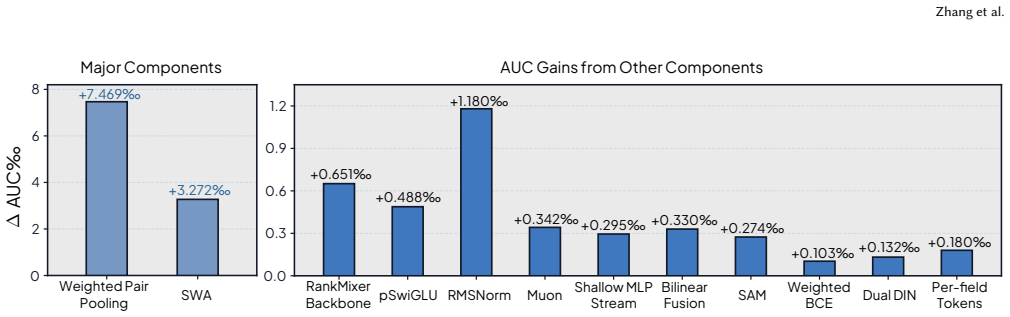
- The ablations attribute the largest gains to weighted pair pooling (+7.469‰) and SWA (+3.272‰), suggesting that input-strength-weighted pooling and weight averaging deserve attention before more complex architectural changes.
- The positive class weight of 2.0 in the loss indicates that addressing label sparsity (7.89% positive rate) is a significant lever on this task.
Reading between the lines
- The delayed-feedback audit is asserted in one sentence; if conversions beyond the 99th-percentile delay are systematically labeled negative, the reported component gains—especially weighted BCE and SWA—could partly reflect tolerance to that bias rather than true conversion modeling. A follow-up with oracle labels would separate these effects.
- The 601M-parameter model carries substantial deployment cost, so the architecture's practical value depends on distillation or sparse inference, which the paper names as future work but does not test.
- The claim that finer-grained tokens outperform width suggests a testable scaling law: token granularity may be an axis orthogonal to model width. One could measure AUC versus number of tokens at fixed FLOPs to see if the benefit is monotonic.
- Because validation is a random row-group split rather than a temporal split, the reported AUC may overstate performance under genuine time drift; a temporal split would clarify robustness.
Signed reviews
Editorial analysis
A structured set of objections, weighed in public.
Referee Report
Summary. The paper describes FA-RankMixer, a pCVR architecture for the Tencent UNI-REC Challenge. It combines target-aware DIN modules over multi-domain behavior sequences, field-aware semantic tokenization, RankMixer blocks, a shallow MLP stream, and group-wise bilinear fusion. The authors report an official test AUC of 0.828814 (ninth place) and present an incremental ablation showing total improvement of 14.716‰ over an unreported baseline. They also report scaling experiments and release code.
Significance. If the reported result is taken at face value, the paper demonstrates a competitive industrial pCVR architecture and provides a useful ablation of its components. Concrete strengths include the released code, detailed hyperparameters, and the use of a genuinely held-out official test set. The paper is honest in Section 5 that evidence is limited to one dataset and that the 601M-parameter model has substantial deployment cost. The main risk is not circular reasoning — there is no derivation that reduces to a fitted input — but measurement validity: the delayed-feedback assertion is unsupported, and the ablation relies on very small point estimates selected after repeated evaluation on the official test set.
major comments (4)
- [§4.1] The claim that "our audit finds no evidence of systematic false negatives caused by delayed feedback" is load-bearing but no audit procedure, statistic, or confidence interval is given. Training spans 10 days, the test set is the following 2 days, and the 99th percentile of conversion delay is 66.823 hours. If labels are generated with a fixed observation cutoff, recent clicks have less time to convert and can be systematically mislabeled; even a small false-negative rate can move AUC at the 0.1‰ scale on which the reported gains and final rank are compared. Please describe the audit, provide a quantitative check (e.g., conversion rate versus time-to-cutoff after conditioning on features, or a robustness analysis excluding near-cutoff clicks), or explicitly state the limitation and temper the leaderboard claim.
- [§4.2, Figure 3] The incremental ablation reports gains from 0.103‰ to 7.469‰ as single point estimates on the official test set, with no error bars, confidence intervals, or significance tests. Moreover, components were evidently selected after repeated evaluation on the official test set, which introduces selection bias and makes the smaller gains unreliable. This is not circular reasoning, but it does undermine the claim that every component contributes positively. Please either perform component selection on the reserved development set and report bootstrap/CI on a fresh split, or explicitly downgrade the small-gain claims to exploratory.
- [§4.2, first sentence] The incremental ablation says "Starting from the baseline," but the baseline configuration is never defined. Without knowing which components are already present in the baseline, the total gain of 14.716‰ and the individual increments are not interpretable by a reader. Specify the baseline architecture, feature set, and optimization settings, or provide the code path to reproduce it.
- [§4.3, Figure 4] The scaling analysis uses only four configurations (16t-384, 16t-768, 16t-1152, 24t-1152), each apparently a single run. The conclusion that width-only scaling is non-monotonic and that adding per-field tokens is more effective than further widening is a point-estimate claim without uncertainty quantification. Given the small differences involved, this conclusion should be framed more cautiously or supported by repeated runs.
minor comments (5)
- [Abstract] There is a typo: "ranksninthon" should be "ranks ninth on". The URL rendering "available at/githubPixelCookie..." is also garbled; please fix the link display.
- [§3.3 vs §4.1] Section 3.3 says the 24 tokens consist of "nine user-dense tokens, and three item-dense tokens," while Section 4.1 says "twelve dense-field tokens." These are consistent if the latter includes both groups, but the wording should be aligned to avoid confusion.
- [Figure 3] The figure uses two panels with different vertical scales; this makes the small gains in the right panel look comparable to the large ones in the left panel. Consider using a single scale or clearly annotating the break, and specify that the units are milli-AUC (‰).
- [§4.1] The validation protocol says the development set is "close to a random sample" over the training period, but it is not a temporal split and may not reflect the test period. This is acceptable for tuning, but it should be stated as a limitation, especially in view of the delayed-feedback concern.
- [§4.2] The phrase "consistent improvements" overstates the evidence for components with gains below 0.5‰, given that no significance testing is reported.
Circularity Check
No significant circularity: the central claim is a direct empirical result on the official test set, with no fitted-input-as-prediction or load-bearing self-citation.
full rationale
All load-bearing claims in this paper are direct empirical measurements on the official test set, e.g., 'Our final 24-token per-field FA-RankMixer achieves a Test AUC of 0.828814 and ranks ninth on the official leaderboard.' The architecture is assembled from externally cited components (DIN, RankMixer, SENET, Muon, SWA, etc.), and there is no self-citation chain that supplies the central result. No equation reduces to its own input, and no fitted parameter is renamed as a prediction. The delayed-feedback audit in Section 4.1 ('our audit finds no evidence of systematic false negatives caused by delayed feedback') is asserted without a described procedure, but this is an unverified measurement premise, not a circular reduction. Likewise, selecting components by official Test AUC is a selection-bias risk, not definitional circularity. The paper's claims are empirical and externally benchmarked, so the appropriate finding is no significant circularity.
Assumptions & free parameters
free parameters (7)
- Positive-class weight lambda in weighted BCE =
2.0
- Semantic token layout =
24 tokens (5 user, 3 target-ad, 4 behavior-domain, 9 user-dense, 3 item-dense)
- Token count and model width =
T=24, D=1152, 2 RankMixer blocks, 24 heads
- Sequence limits and recent/earlier split =
256, 256, 512, 1024; half split for longest domain
- Stream/MLP/bilinear sizes =
SENET [1024,256]; deep [1024,512,256,128]; shallow [512,128]; K=8 groups
- Optimization recipe =
Muon lr 5e-4, AdamW 1e-4, Adagrad 0.05, SAM rho 0.05, SWA from epoch 2, batch 1024x6
- log1p preprocessing fields =
unspecified 'selected long-tailed dense fields'
assumptions (3)
- domain assumption Delayed feedback does not cause systematic false negatives in the labels
- domain assumption Development row-group split is near-random over time
- domain assumption Official test AUC is a valid metric for pCVR ranking quality
Cite this review
Pith. "Pith review of Field-Aware RankMixer with Dual-Stream Bilinear Fusion for the Tencent UNI-REC Challenge." pith.science (2026). https://pith.science/paper/MGXEWRVT
@misc{pith2026260715590,
  author       = {Pith},
  title        = {Pith review of: Field-Aware RankMixer with Dual-Stream Bilinear Fusion for the Tencent UNI-REC Challenge},
  year         = {2026},
  howpublished = {\url{https://pith.science/paper/MGXEWRVT}},
  note         = {Machine review of arXiv:2607.15590}
}
read the original abstract
This paper presents our solution to the KDD Cup 2026 Tencent UNIREC Challenge. The task requires joint modeling of multi-domain user behavior sequences and non-sequential multi-field features for target-ad pCVR prediction. We develop a Field-Aware RankMixer (FA-RankMixer) with dual-stream bilinear fusion. The model first applies target-aware DIN modules to extract user interests from multiple behavior domains. It also models recent and earlier interests separately for the longest behavior sequence. The model then forms semantic tokens based on feature fields and behavior domains and uses RankMixer blocks for cross-token interaction. A shallow MLP stream complements the deep RankMixer stream, and a group-wise bilinear module fuses their representations. Our final solution ranks ninth on the official leaderboard. Our code is available at https://github.com/PixelCookie-zyf/TAAC-2026-SeRankMixer.
Figures


Figures from the paper (1 more)

Reference graph
Works this paper leans on
-
[1]
John Duchi, Elad Hazan, and Yoram Singer. 2011. Adaptive Subgradient Methods for Online Learning and Stochastic Optimization.Journal of Machine Learning Research12 (2011), 2121–2159
2011
-
[2]
Pierre Foret, Ariel Kleiner, Hossein Mobahi, and Behnam Neyshabur. 2021. Sharpness-Aware Minimization for Efficiently Improving Generalization. In9th International Conference on Learning Representations. Virtual Event, Austria
2021
-
[3]
Mingming Ha, Guanchen Wang, Linxun Chen, Xuan Rao, Yuexin Shi, Tianbao Ma, Zhaojie Liu, Yunqian Fan, Zilong Lu, Yanan Niu, et al . 2026. UniMixer: A Unified Architecture for Scaling Laws in Recommendation Systems.arXiv preprint arXiv:2604.00590(2026)
arXiv 2026
-
[4]
Jie Hu, Li Shen, and Gang Sun. 2018. Squeeze-and-Excitation Networks. In Proceedings of the IEEE Conference on Computer Vision and Pattern Recognition. Salt Lake City, UT, USA, 7132–7141
2018
-
[5]
Xu Huang, Hao Zhang, Zhifang Fan, Yunwen Huang, Zhuoxing Wei, Zheng Chai, Jinan Ni, Yuchao Zheng, and Qiwei Chen. 2026. MixFormer: Co-Scaling Up Dense and Sequence in Industrial Recommenders.arXiv preprint arXiv:2602.14110 (2026)
arXiv 2026
-
[6]
Yunwen Huang, Shiyong Hong, Xijun Xiao, Jinqiu Jin, Xuanyuan Luo, Zhe Wang, Zheng Chai, Shikang Wu, Yuchao Zheng, and Jingjian Lin. 2026. HyFormer: Revisiting the Roles of Sequence Modeling and Feature Interaction in CTR Prediction.arXiv preprint arXiv:2601.12681(2026)
arXiv 2026
-
[7]
Pavel Izmailov, Dmitrii Podoprikhin, Timur Garipov, Dmitry Vetrov, and An- drew Gordon Wilson. 2018. Averaging Weights Leads to Wider Optima and Better Generalization. InProceedings of the Thirty-Fourth Conference on Uncertainty in Artificial Intelligence. 876–885
2018
-
[8]
Yuchen Jiang, Jie Zhu, Xintian Han, Hui Lu, Kunmin Bai, Mingyu Yang, Shikang Wu, Ruihao Zhang, Wenlin Zhao, Shipeng Bai, et al. 2026. TokenMixer-Large: Scaling Up Large Ranking Models in Industrial Recommenders.arXiv preprint arXiv:2602.06563(2026)
arXiv 2026
Show all 16 references
-
[9]
Jingyuan Liu, Jianlin Su, Xingcheng Yao, Zhejun Jiang, Guokun Lai, Yulun Du, Yidao Qin, Weixin Xu, Enzhe Lu, Junjie Yan, et al. 2025. Muon is Scalable for LLM Training.arXiv preprint arXiv:2502.16982(2025)
2025 arXiv
-
[10]
Ilya Loshchilov and Frank Hutter. 2019. Decoupled Weight Decay Regularization. In7th International Conference on Learning Representations. New Orleans, LA, USA
2019
-
[11]
Ruoxi Wang, Rakesh Shivanna, Derek Cheng, Sagar Jain, Dong Lin, Lichan Hong, and Ed Chi. 2021. Dcn v2: Improved deep & cross network and practical lessons for web-scale learning to rank systems. InProceedings of the web conference 2021. Ljubljana, Slovenia, 1785–1797
2021
-
[12]
Zhichen Zeng, Xiaolong Liu, Mengyue Hang, Xiaoyi Liu, Qinghai Zhou, Chaofei Yang, Yiqun Liu, Yichen Ruan, Laming Chen, Yuxin Chen, et al. 2025. InterFormer: Effective Heterogeneous Interaction Learning for Click-Through Rate Prediction. InProceedings of the 34th ACM Internatio...
2025
-
[13]
Zhaoqi Zhang, Haolei Pei, Jun Guo, Tianyu Wang, Yufei Feng, Hui Sun, Shaowei Liu, and Aixin Sun. 2026. OneTrans: Unified Feature Interaction and Sequence Modeling with One Transformer in Industrial Recommender. InProceedings of the ACM Web Conference 2026. Dubai, United Arab E...
2026
-
[14]
Guorui Zhou, Na Mou, Ying Fan, Qi Pi, Weijie Bian, Chang Zhou, Xiaoqiang Zhu, and Kun Gai. 2019. Deep interest evolution network for click-through rate prediction. InProceedings of the AAAI conference on artificial intelligence, Vol. 33. Honolulu, Hawaii, USA, 5941–5948
2019
-
[15]
Yifeng Zhou, Yuehong Hu, Zhixiang Feng, Junwei Pan, Kaihui Wu, Hanyong Li, Shangyu Zhang, Shudong Huang, Zhangbin Zhu, Chengguo Yin, et al. 2026. TokenFormer: Unify the Multi-Field and Sequential Recommendation Worlds. arXiv preprint arXiv:2604.13737(2026)
2026 arXiv
-
[16]
Jie Zhu, Zhifang Fan, Xiaoxie Zhu, Yuchen Jiang, Hangyu Wang, Xintian Han, Haoran Ding, Xinmin Wang, Wenlin Zhao, Zhen Gong, et al. 2025. RankMixer: Scaling Up Ranking Models in Industrial Recommenders. InProceedings of the 34th ACM International Conference on Information and ...
2025
Reviewed August 1, 2026 · model on record in the stance chip above.
Discussion (0). Continue with ORCID to comment.