REVIEW 3 major objections 7 minor 32 references
HARMONI: Haptic-Guided Assistance for Unified Robotic Tele-Manipulation and Tele-Navigation
T0 review · 3 major / 7 minor · reviewed 2026-08-07 · deepseek-v4-flash
Pith's one-line read A single haptic-guided leader arm can steer both a mobile robot and its manipulator, and users perform better with it.
desk verdict Useful integration and real-robot study, but the main accuracy metric is partly self-referential and the cognitive-load claim outruns the data. read the letter →
The pith
A machine-rendered reading of the paper's core claim, the machinery that carries it, and where it could break.
The reading
What carries the argument
The central mechanism is a unified leader-follower control law with a binary mode switch: equation 1 selects torque contributions from either the follower arm (manipulation) or the mobile robot (navigation), with null-space damping for safety. Navigation uses a velocity mapping from leader end-effector displacement, and haptic force is generated by a virtual fixture pulling the leader toward the DWA-planned reference pose (equation 6); manipulation uses PD torque mirroring of joint positions. This lets one 7-DoF arm provide both 2-DoF navigation guidance and 6-DoF manipulation guidance with autonomous mode switching.
What would settle it
Compare haptic guidance against a condition that shows the same reference trajectory on screen as a visual path but gives no force feedback; if visual-only guidance produces the same reduction in deviation and task time, the haptic channel is not the cause. Alternatively, measure an outcome independent of the reference, such as grasp success rate or placement accuracy, and see whether haptic guidance improves it.
Extended reading notes
Core claim
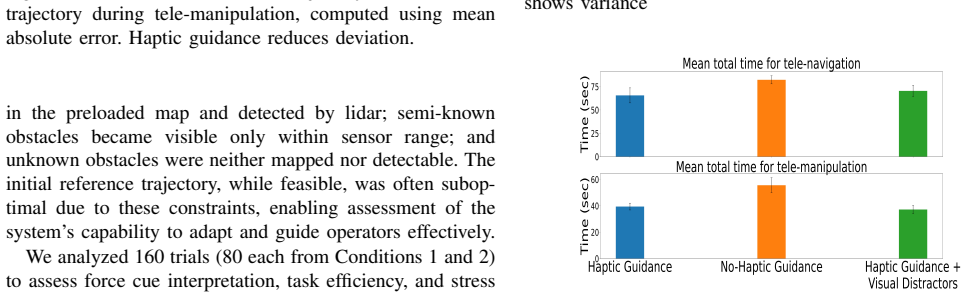
The central claim is that haptic-guided shared control, delivered through one leader arm kinematically similar to the follower arm, improves operator accuracy and efficiency during tele-manipulation of a mobile manipulator while not increasing cognitive load. The system computes haptic forces from the DWA planner's reference trajectory for navigation and uses impedance control to guide the operator's hand; when the object becomes graspable, control switches automatically to manipulation, with the follower arm mirroring the leader's joint positions. In a 20-participant study with audio and visual distractions, haptic guidance significantly reduced y-axis deviation during tele-manipulation (p < 0.05) and decreased task duration (p < 0.05), and 13 of 20 participants had lower heart rates, indicating reduced stress.
Load-bearing premise
The measure of accuracy is deviation from a reference trajectory that the paper itself calls "often suboptimal," so lower deviation may show that operators follow haptic cues rather than that the task is done better.
Editorial extensions
If this is right
- Teleoperators of mobile manipulators could use a single leader arm instead of separate joystick and arm controllers, reducing equipment and training overhead.
- Haptic cues are most beneficial for precise manipulation subtasks, where they cut errors and time; navigation benefits less significantly.
- The system's autonomous navigation-to-manipulation switch offloads graspability decisions from the operator, letting them focus on alignment.
- Guidance helps operators maintain smoother trajectories even under visual distraction and reduces physiological stress for most users.
- The framework is usable by operators with diverse mental-rotation abilities, suggesting it does not require strong spatial skills.
Reading between the lines
- The accuracy metric is coupled to the guidance law, so the reported improvement may partly measure compliance with the planner rather than task success; an outcome-based metric would separate these.
- The single-leader design may trade off simultaneous control, since the operator cannot adjust the base and the arm at the same time, which could matter for tasks needing coordinated motion.
- The benefit might generalize to other leader devices and dynamic environments, but the static-map setup means the results do not yet establish that.
- A direct comparison against dual-device control (joystick plus arm) would quantify how much of the gain comes from unification versus haptic guidance alone.
Signed reviews
Editorial analysis
A structured set of objections, weighed in public.
Referee Report
Summary. The paper presents HARMONI, a teleoperation framework in which a single 7-DoF leader arm (Franka Panda) controls both a mobile base (Hunter 2.0) and a follower arm mounted on it, with haptic guidance derived from DWA-planned reference trajectories. The system unifies tele-navigation and tele-manipulation with autonomous mode switching, and the authors report a user study with 20 participants under real-world conditions including known, semi-known, and unknown obstacles and visual/audio distractors. The central claims are that haptic guidance significantly improves task accuracy (reduced y-deviation) and efficiency (reduced manipulation time) without increasing cognitive load. The paper also reports heart-rate measurements and a mental-rotation correlation analysis.
Significance. The engineering contribution is substantial: integrating navigation and manipulation control through a single leader arm with haptic feedback addresses a real operational bottleneck in mobile manipulation teleoperation, and the real-robot user study with distractors goes beyond simulation-only evaluations. If the evaluation were supported by independent task-outcome metrics and a validated workload measure, the paper would be a useful addition to the shared-control literature. The current evidence, however, is weakened by the coupling between the guidance law and the primary accuracy metric, and by the absence of any direct workload assessment.
major comments (3)
- [Section V, Force Cue Processing; Eq. (6)] The primary accuracy metric is deviation from the DWA reference trajectory, but the haptic force in Eq. (6) is computed from that same reference trajectory: F_fmr = K_fmr(P_fmr^(t+40) - P_fmr). The paper itself states that the initial reference trajectory is "often suboptimal" (Section V, Experiment Design). Reduced deviation therefore likely reflects operator compliance with the haptic cue rather than improved task accuracy. No independent task outcome is reported (no grasp success rate, collision count, end-effector placement error, or final object placement error). The abstract's claim that the framework "significantly improves task accuracy" is thus not supported by the presented evidence. Please report task-level outcome metrics or reframe the claim as improved trajectory adherence to the planner's guidance.
- [Abstract; Section V, Stress Response] The abstract claims the framework improves performance "without increasing cognitive load," but no validated workload measure (e.g., NASA-TLX or equivalent) is used. Heart rate (HR) is a physiological stress indicator, not a direct cognitive-load measure, and the mental-rotation correlation rs(18) = -0.055 is unrelated to workload. The conclusion's more modest wording "without increasing operator stress" is better supported, but even that rests only on HR. Either add a validated workload assessment or remove the cognitive-load claim from the abstract.
- [Section V, Results; Table I] The statistical reporting is incomplete and internally inconsistent. No descriptive statistics (means, standard deviations) or effect sizes are given for the main significant results; the text reports only p-values and z-values. Table I is hard to interpret: the columns are labeled "Condition 1" and "Condition 2" while the text says the test compares Condition 3 (haptic guidance) against Condition 2 (no haptic guidance), and several cells contain only p-values without indicating which condition favored. Additionally, the text reports "Analysis of 236 trials" and "11 of 18 participants" for Condition 3, which does not reconcile with the stated 20 participants and four trials per condition. These issues make it difficult to assess the reliability and generality of the reported effects.
minor comments (7)
- [Eq. (1)] The term τT appears in Eq. (1) but is never defined; please clarify its meaning.
- [Eq. (2)] The PD control law in Eq. (2) uses +Kd·qfra_dot, which is an unusual sign for a damping term; verify it is not a typo and describe how the derivative term is computed.
- [Section V, Task Setup] The sentence "Participants operated the LRA using only visual feedback from provided screens, without direct line of sight to" is incomplete and should be finished.
- [Section IV] The sentence "This study, approved by the University of Lincoln's ethics committee 1" is a sentence fragment; please integrate the ethics reference into a complete sentence.
- [Section III] The notation states "All poses P ∈ R6" but Eq. (6) uses γ for orientation; please define the orientation representation consistently throughout.
- [Table I] The layout and column headings of Table I should be redesigned to make clear which conditions are being compared and what each p-value refers to; the current presentation is confusing.
- [Section V, Force Cue Processing] The haptic force in Eq. (6) has nonzero components only along x and γ, yet the reported significant improvement is in y-deviation; the causal mechanism by which the x/γ force reduces lateral deviation should be explained in the text.
Circularity Check
Primary accuracy metric is self-referential: Eq. 6 haptic force and the deviation metric both use the DWA reference trajectory, so reduced deviation confirms guidance compliance rather than task accuracy.
-
self definitional
[Section III, Eq. (6); Section V, 'Force Cue Processing' and 'Experiment Design']
"Ffmr = Kfmr(Pfmr^(t+40) − Pfmr) (6) ... Haptic force cues, based on the target kinematic navigation trajectory, are generated using the DWA planner ... Participant responses to haptic guidance were quantified by measuring deviation from the reference trajectory. ... The initial reference trajectory, while feasible, was often suboptimal due to these constraints."
The haptic force in Eq. 6 is computed from the DWA target trajectory, and the paper's primary accuracy result is reduced deviation from exactly that reference trajectory. The force pushes the operator toward the reference (via x and gamma components, shaping the path), so a measured reduction in deviation largely verifies that the guidance force was applied, not that the task was executed more accurately. The paper itself admits the reference is 'often suboptimal', so convergence to it cannot be equated with task accuracy. No independent task-outcome metric is reported: no grasp success rate, collision count, or end-effector placement error.
full rationale
The central circular step is the pairing of Eq. 6 with the deviation-from-reference accuracy metric: the same DWA reference trajectory is both the source of the haptic guidance force and the benchmark against which 'accuracy' is measured. This makes the main accuracy improvement partially self-referential and explains why the result is essentially a check that the haptic channel influenced the operator. The paper's secondary results are independent: task completion time (efficiency) and heart-rate measures do not share this construction, and no fitted parameters are renamed as predictions. There is also self-citation in the related work and system design (e.g., Refs. [7]–[9], [12], [13]), but these citations are not load-bearing for the paper's own user-study claims and do not constitute circularity. Because the core accuracy claim reduces by construction to the guidance objective while efficiency and stress claims remain independent, a partial circularity score of 6 is appropriate rather than a higher score.
Assumptions & free parameters
free parameters (5)
- Kv (linear velocity scaling) =
0.5 (no obstacles), 0.2 (obstacles)
- Kr (angular velocity scaling) =
-1
- Kfmr (haptic force gain) =
Not specified
- Kp, Kd (PD gains for follower mirroring) =
Not specified
- alpha, beta (null-space stiffness and damping) =
alpha unspecified; beta = 2*sqrt(alpha)
assumptions (4)
- domain assumption Operators can interpret the 2-DoF navigation and 6-DoF manipulation haptic cues and convert them into appropriate motions.
- domain assumption Network latency between the leader arm and follower robots is negligible and does not affect teleoperation stability.
- domain assumption The DWA planner's reference trajectory is a valid baseline for task accuracy.
- domain assumption Heart rate variation is a valid proxy for cognitive load/stress in this task.
Cite this review
Pith. "Pith review of HARMONI: Haptic-Guided Assistance for Unified Robotic Tele-Manipulation and Tele-Navigation." pith.science (2026). https://pith.science/paper/MHQHUT5Q
@misc{pith2026250613704,
  author       = {Pith},
  title        = {Pith review of: HARMONI: Haptic-Guided Assistance for Unified Robotic Tele-Manipulation and Tele-Navigation},
  year         = {2026},
  howpublished = {\url{https://pith.science/paper/MHQHUT5Q}},
  note         = {Machine review of arXiv:2506.13704}
}
read the original abstract
Shared control, which combines human expertise with autonomous assistance, is critical for effective teleoperation in complex environments. While recent advances in haptic-guided teleoperation have shown promise, they are often limited to simplified tasks involving 6- or 7-DoF manipulators and rely on separate control strategies for navigation and manipulation. This increases both cognitive load and operational overhead. In this paper, we present a unified tele-mobile manipulation framework that leverages haptic-guided shared control. The system integrates a 9-DoF follower mobile manipulator and a 7-DoF leader robotic arm, enabling seamless transitions between tele-navigation and tele-manipulation through real-time haptic feedback. A user study with 20 participants under real-world conditions demonstrates that our framework significantly improves task accuracy and efficiency without increasing cognitive load. These findings highlight the potential of haptic-guided shared control for enhancing operator performance in demanding teleoperation scenarios.
Figures



Figures from the paper (4 more)



Reference graph
Works this paper leans on
-
[1]
Ecological interfaces for improving mobile robot teleoperation,
C. Nielsen and et al., “Ecological interfaces for improving mobile robot teleoperation,” IEEE Transactions on Robotics , vol. 23, no. 5, pp. 927–941, 2007
work page 2007
-
[2]
A teleoperation framework for mobile robots based on shared control,
J. Luo and et al., “A teleoperation framework for mobile robots based on shared control,” IEEE Robotics and Automation Letters , vol. 5, no. 2, pp. 377–384, 2019
work page 2019
-
[3]
Tactile sensing—from humans to humanoids,
R. S. Dahiya and et al., “Tactile sensing—from humans to humanoids,” IEEE transactions on robotics , vol. 26, no. 1, pp. 1–20, 2009
work page 2009
-
[4]
Acoustic soft tactile skin (ast skin),
R. S. Vishnu and et al., “Acoustic soft tactile skin (ast skin),” in 2024 IEEE International Conference on Robotics and Automation (ICRA) . IEEE, 2024, pp. 4105–4111
work page 2024
-
[5]
Single and bi-layered 2-d acoustic soft tactile skin,
R. Vishnu, “Single and bi-layered 2-d acoustic soft tactile skin,” in 2024 IEEE 7th international conference on soft robotics (RoboSoft) . IEEE, 2024, pp. 133–138
work page 2024
-
[6]
Grasp that optimises objectives along post-grasp tra- jectories,
N. Mavrakis, “Grasp that optimises objectives along post-grasp tra- jectories,” in 2017 5th RSI International Conference on Robotics and Mechatronics (ICRoM). IEEE, 2017, pp. 51–56
work page 2017
-
[7]
Haptic-guided grasping to minimise torque effort during robotic telemanipulation,
R. Rahal and et al., “Haptic-guided grasping to minimise torque effort during robotic telemanipulation,” Autonomous Robots, pp. 1–19, 2023
work page 2023
-
[8]
A. Ghalamzan and et al., “Human-in-the-loop optimisation: Mixed initiative grasping for optimally facilitating post-grasp manipulative actions,” in 2017 IEEE/RSJ International Conference on Intelligent Robots and Systems (IROS) . IEEE, 2017, pp. 3386–3393
work page 2017
Show all 32 references
-
[9]
Haptic-guided shared control grasping: collision- free manipulation,
S. Parsa and et al., “Haptic-guided shared control grasping: collision- free manipulation,” in 2020 IEEE 16th International Conference on Automation Science and Engineering (CASE) , 2020, pp. 1552–1557
2020
-
[10]
Choosing grasps to enable collision-free post-grasp manipulations,
T. Pardi and et al., “Choosing grasps to enable collision-free post-grasp manipulations,” in 2018 IEEE-RAS 18th International Conference on Humanoid Robots (Humanoids) . IEEE, 2018, pp. 299–305
2018
-
[11]
The impact of motion scaling and haptic guidance on operators’ workload and performance in teleoperation,
S. Parsa and et al., “The impact of motion scaling and haptic guidance on operators’ workload and performance in teleoperation,” in CHI Conference on Human Factors in Computing Systems Extended Abstracts, 2022, pp. 1–7
2022
-
[12]
An assisted telemanipulation approach: combining autonomous grasp planning with haptic cues,
M. Adjigble and et al., “An assisted telemanipulation approach: combining autonomous grasp planning with haptic cues,” in 2019 IEEE/RSJ International Conference on Intelligent Robots and Systems (IROS). IEEE, 2019, pp. 3164–3171
2019
-
[13]
Haptic-guided assisted telemanipulation approach for grasping desired objects from heaps,
——, “Haptic-guided assisted telemanipulation approach for grasping desired objects from heaps,” arXiv preprint arXiv:2307.07053 , 2023
2023 arXiv
-
[14]
Towards advanced robotic manipulation for nuclear decommissioning: A pilot study on tele-operation and auton- omy,
N. Marturi and et al., “Towards advanced robotic manipulation for nuclear decommissioning: A pilot study on tele-operation and auton- omy,” in 2016 International Conference on Robotics and Automation for Humanitarian Applications (RAHA) . IEEE, 2016, pp. 1–8
2016
-
[15]
Haptic shared-control methods for robotic cutting under nonholonomic con- straints,
R. Rahal, F. Abi-Farraj, P. R. Giordano, and C. Pacchierotti, “Haptic shared-control methods for robotic cutting under nonholonomic con- straints,” in 2019 IEEE/RSJ International Conference on Intelligent Robots and Systems (IROS) . IEEE, 2019, pp. 8151–8157
2019
-
[16]
A haptic shared-control architecture for guided multi-target robotic grasping,
F. Abi-Farraj and et al., “A haptic shared-control architecture for guided multi-target robotic grasping,” IEEE transactions on haptics , vol. 13, no. 2, pp. 270–285, 2019
2019
-
[17]
Haptic- guided shared control for needle grasping optimization in minimally invasive robotic surgery,
M. Selvaggio, R. Moccia, F. Ficuciello, B. Siciliano et al. , “Haptic- guided shared control for needle grasping optimization in minimally invasive robotic surgery,” in 2019 IEEE/RSJ International Conference on Intelligent Robots and Systems (IROS) . IEEE, 2019, pp. 3617– 3623
2019
-
[18]
Shared-control concepts for large vehicle- manipulators,
B. Varga and et al., “Shared-control concepts for large vehicle- manipulators,” in 2020 IEEE 29th International Symposium on In- dustrial Electronics (ISIE) . IEEE, 2020, pp. 197–203
2020
-
[19]
Cooperative aerial tele-manipulation with haptic feedback,
M. Mohammadi and et al., “Cooperative aerial tele-manipulation with haptic feedback,” in 2016 IEEE/RSJ International Conference on Intelligent Robots and Systems (IROS) . IEEE, 2016, pp. 5092–5098
2016
-
[20]
An automatic switching approach to teleopera- tion of mobile-manipulator systems using virtual fixtures,
M. Wrock and et al., “An automatic switching approach to teleopera- tion of mobile-manipulator systems using virtual fixtures,” Robotica, vol. 35, no. 8, pp. 1773–1792, 2017
2017
-
[21]
Enhancing bilateral teleoperation using camera-based online virtual fixtures generation,
M. Selvaggio and et al., “Enhancing bilateral teleoperation using camera-based online virtual fixtures generation,” in 2016 IEEE/RSJ International Conference on Intelligent Robots and Systems (IROS) . IEEE, 2016, pp. 1483–1488
2016
-
[22]
Human-supervised semi-autonomous mo- bile manipulators for safely and efficiently executing machine tending tasks,
S. Al-Hussaini and et al., “Human-supervised semi-autonomous mo- bile manipulators for safely and efficiently executing machine tending tasks,” arXiv preprint arXiv:2010.04899 , 2020
2010 arXiv
-
[23]
Development of a six dof haptic master for teleoperation of a mobile manipulator,
D. Ryu and et al., “Development of a six dof haptic master for teleoperation of a mobile manipulator,” Mechatronics, vol. 20, no. 2, pp. 181–191, 2010. [Online]. Available: https://www.sciencedirect.com/science/article/pii/S0957415809001895
2010
-
[24]
Collaborative teleoperation with haptic feedback for collision-free navigation of ground robots,
M. Coffey and et al., “Collaborative teleoperation with haptic feedback for collision-free navigation of ground robots,” in 2022 IEEE/RSJ International Conference on Intelligent Robots and Systems (IROS) , 2022, pp. 8141–8148
2022
-
[25]
A visual-based shared control architecture for remote telemanipulation,
F. Abi-Farraj and et al., “A visual-based shared control architecture for remote telemanipulation,” in 2016 IEEE/RSJ International Conference on Intelligent Robots and Systems (IROS) . IEEE, 2016, pp. 4266– 4273
2016
-
[26]
Haptic-based shared-control methods for a dual-arm system,
M. Selvaggio and et al., “Haptic-based shared-control methods for a dual-arm system,” IEEE Robotics and Automation Letters , vol. 3, no. 4, pp. 4249–4256, 2018
2018
-
[27]
Visual-based shared control for remote telemanipulation with integral haptic feedback,
N. Pedemonte and et al., “Visual-based shared control for remote telemanipulation with integral haptic feedback,” in 2017 IEEE Interna- tional Conference on Robotics and Automation (ICRA) . IEEE, 2017, pp. 5342–5349
2017
-
[28]
Shared planning and control for mobile robots with integral haptic feedback,
C. Masone and et al., “Shared planning and control for mobile robots with integral haptic feedback,” The International Journal of Robotics Research, vol. 37, no. 11, pp. 1395–1420, 2018
2018
-
[29]
First-person view semi-autonomous teleoperation of cooperative wheeled mobile robots with visuo-haptic feedback,
K. Y . Lui and et al., “First-person view semi-autonomous teleoperation of cooperative wheeled mobile robots with visuo-haptic feedback,”The International Journal of Robotics Research , vol. 36, no. 5-7, pp. 840– 860, 2017
2017
-
[30]
Haptic-guided teleoperation of a 7-dof collabo- rative robot arm with an identical twin master,
J. Singh and et al., “Haptic-guided teleoperation of a 7-dof collabo- rative robot arm with an identical twin master,” IEEE transactions on haptics, vol. 13, no. 1, pp. 246–252, 2020
2020
-
[31]
Dual-user haptic teleoperation of complementary motions of a redundant wheeled mobile manipulator considering task priority,
H. Xing and et al., “Dual-user haptic teleoperation of complementary motions of a redundant wheeled mobile manipulator considering task priority,” IEEE Transactions on Systems, Man, and Cybernetics: Systems, vol. 52, no. 10, pp. 6283–6295, 2022
2022
-
[32]
Relaxing music prevents stress-induced in- creases in subjective anxiety, systolic blood pressure, and heart rate in healthy males and females,
W. Knight and et al., “Relaxing music prevents stress-induced in- creases in subjective anxiety, systolic blood pressure, and heart rate in healthy males and females,” Journal of music therapy , vol. 38, no. 4, pp. 254–272, 2001
2001
Reviewed August 7, 2026 · model on record in the stance chip above.
Discussion (0). Continue with ORCID to comment.