REVIEW 6 major objections 8 minor 111 references
On the Limitations of Cross-Lingual Consistency in Multilingual Text-to-image Generation
T0 review · 6 major / 8 minor · reviewed 2026-08-12 · deepseek-v4-flash
Pith's one-line read Multilingual text-to-image systems are not language-neutral: a new 33K-prompt benchmark across 10 languages shows consistent performance drops for non-English prompts, especially in non-Latin scripts, and language-driven shifts in style…
desk verdict LingT2I is a genuinely useful benchmark and the headline inequality finding is likely real, but the single-translation-pipeline confound and LLM-judge circularity make the causal claims hypotheses. read the letter →
The pith
A machine-rendered reading of the paper's core claim, the machinery that carries it, and where it could break.
The reading
What carries the argument
The load-bearing mechanism is the controlled parallel-prompt benchmark itself. LingT2I builds 30K content-generation prompts by extracting dimension-specific annotations from DOCCI captions and translating them into nine languages, and 3K text-rendering prompts by keeping the English background fixed and translating only the short text string to be rendered, so that language variation is isolated in the text-rendering task. On top of this, the paper adapts evaluation instruments—MetaCLIP-2 for CLIPScore, a Qwen-2.5-VL based TRIGScore, and mT5 tokenization for precision—to make scores comparable across languages. The tokenization fragmentation measurement, the transliteration control, and the culture-tag analysis are the analytical tools that turn the benchmark into evidence about writing systems, tokenizers, and cultural priors.
What would settle it
A native-prompt re-run would settle the main claim: recruit native speakers to write the same prompts directly in Hindi, Arabic, and Japanese without English as an intermediate, then compare rankings on the same models. If those languages stop trailing English once translation is removed, the linguistic-inequality conclusion would collapse into a translation artifact.
Extended reading notes
Core claim
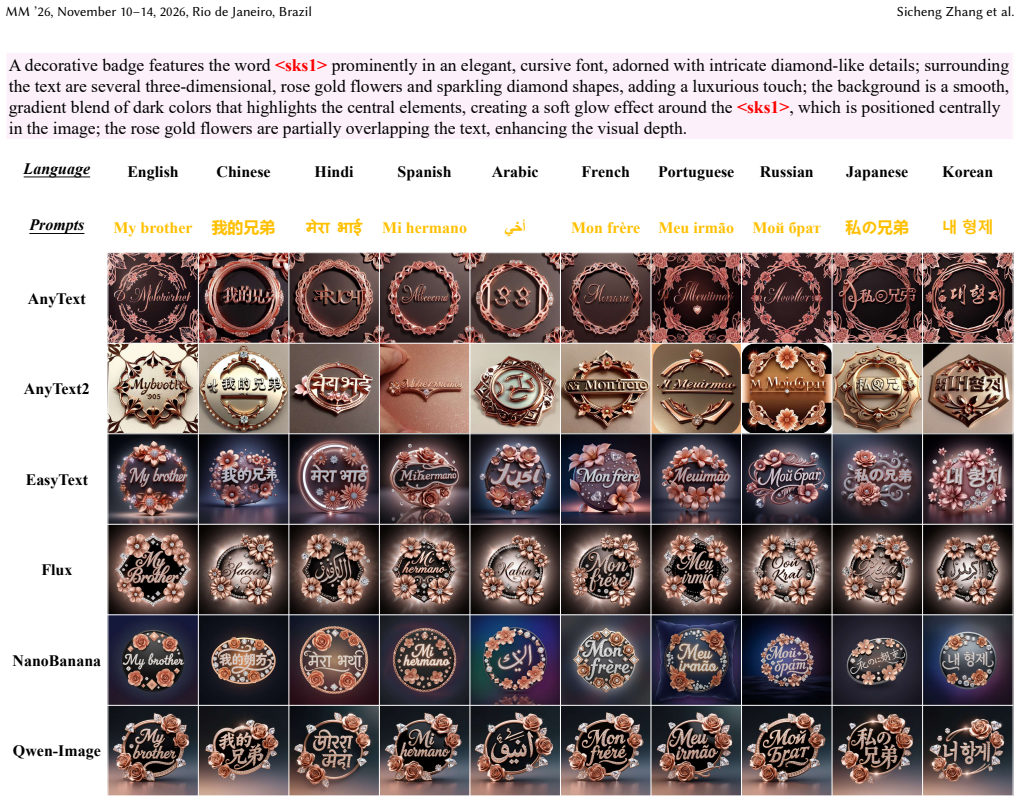
Across 17 models, the benchmark finds that general-purpose T2I systems exhibit severe linguistic inequality: average content-generation alignment for English is 0.78, while Hindi and Arabic fall to 0.38, and standard deviations across languages reach up to 0.21 for text-rendering models. Non-Latin writing systems are a persistent bottleneck; for instance, Arabic rendering precision is near 0.12 under some general-purpose models and only 0.43 to 0.46 even for a dedicated rendering model. The analysis further shows that linguistic inequality is not a single-axis gap: languages reshape trade-offs between evaluation dimensions, and the same prompt generates culturally specific imagery aligned with the prompt language, with 79.6% of culture-tagged samples matching the language's region. A tokenization analysis finds a strong negative correlation (rank correlation -0.89) between prompt fragmentation and image-text alignment, pointing to inefficient sub-word tokenization as one systematic text-side bottleneck.
Load-bearing premise
The benchmark's cross-language comparisons assume that machine translations from English preserve semantic meaning, cultural neutrality, and prompt usability closely enough that measured gaps reflect model capability rather than translation artifacts.
Editorial extensions
If this is right
- English-only evaluation of T2I models substantially overstates their multilingual competence.
- Non-Latin text rendering is a major failure mode, not a marginal case; dedicated rendering models only partially mitigate it.
- Post-hoc multilingual adapters can reduce cross-language variance but tend to lower quality in high-resource languages, whereas native multilingual architectures offer a more effective path to fairness.
- Because trade-offs are language-dependent, optimizing one evaluation dimension in one language can worsen outcomes in another language or dimension.
- Tokenizer efficiency is a measurable text-side bottleneck: languages with more fragmented token sequences show weaker image-text alignment.
Reading between the lines
- If the translation assumption is the main threat, a natural extension is to build LingT2I-style prompts authored natively in each language rather than translated from English; the paper's conclusions predict the same language hierarchy would persist.
- The -0.89 fragmentation correlation suggests a testable intervention: retrain or augment a model's tokenizer for under-resourced scripts and measure whether the alignment gap narrows accordingly.
- The culture-tag results imply prompt language acts as an implicit cultural control knob; this could be harnessed for culturally aware generation, but it also raises the risk of reinforcing regional stereotypes when prompting in a given language.
- The failure-pattern taxonomy (semantic substitution, structural errors, and romanization bias) suggests that script-specific rendering modules and language-family-organized training data would attack different failure modes, and their relative effectiveness could be measured separately.
Editorial analysis
A structured set of objections, weighed in public.
Referee Report
Summary. This paper introduces LingT2I, a multilingual text-to-image benchmark covering ten languages with 33K prompts for content generation and text rendering, and evaluates 17 recent models. The authors report three main findings: general-purpose models exhibit linguistic inequality favoring high-resource Indo-European languages; non-Latin writing systems remain a major bottleneck in text rendering; and language-specific cultural and typological factors create trade-offs across evaluation dimensions. They also present causal analyses (transliteration, tokenization, alignment-conditioned bias) and culture/demographic pattern analyses, and they release code and data.
Significance. If the findings hold, LingT2I is a valuable community resource: it is large, covers both content generation and text rendering, uses a multilingual encoder (MetaCLIP2) for CLIPScore, and is accompanied by publicly released code and dataset. The observation that native multilingual architectures such as Qwen-Image achieve better fairness than post-hoc adapters, and the tokenization correlation, are interesting and falsifiable. The descriptive cross-lingual scores are plausible, and the paper is transparent about some limitations. However, the reliability of several specific claims depends on the translation pipeline, the OCR evaluator, and the LLM-based judges, which need further validation before the stronger conclusions can be fully accepted.
major comments (6)
- [Section 3.4 and Appendix B.3; Section 5] The central inequality finding in Content Generation assumes that the nine Gemini 2.5 Pro translations of each English prompt are equivalent as text-to-image instructions. The 5% human sample and the 1.3% GPT-5 flag rate validate semantic consistency and fluency, not prompt usability for T2I, and no per-language quality breakdown is given. The Section 5 assertion that the gaps are 'large and consistent' and 'unlikely to be explained by these factors' is not supported by any quantitative sensitivity analysis. I ask for a robustness check with independent human or professional translations on a subset, plus per-language back-translation error rates, to rule out translation-induced inflation of the inequality.
- [Section 3.3, Appendix C.2.1] Text-rendering precision is computed from OCR outputs of Gemini 2.5 Flash compared against ground truth. If the OCR model is less accurate for Arabic, Hindi, or Devanagari, the reported cross-lingual precision gaps would partly reflect OCR bias rather than rendering errors. The paper does not validate OCR accuracy on a human-annotated sample or use a second OCR engine. Without such validation, the claim that 'non-Latin writing systems remain a major bottleneck' (Section 4.1.2) is not fully established.
- [Section 4.3, Appendix E (Figure 21)] The GPT-5-mini judge for cultural tendency is constrained to a fixed tag set (en, zh, hi, es, ar, fr, pt, ru, ja, ko) that exactly matches the ten prompt languages, plus mixed/other/unclear. Because the tag granularity equals the prompt-language granularity, the reported language-culture match rates (79.6%, 90.2%) may be inflated by the response format. The later 'Western culture' figure (3.7%) is a post-hoc union of five tags, which is sensitive to the tag design. This analysis should be repeated with an open label set or human annotation, and agreement statistics should be reported.
- [Appendix D] The paper generates only one image per prompt (seed 42). T2I generation is stochastic, and for text rendering a single typo flips sentence-level accuracy from 1 to 0. None of the tables (Tables 2, 3, 6, 7) provide confidence intervals or multi-seed variance. The large cross-linguistic gaps are likely robust, but the fine-grained dimension trade-offs in Section 4.2 (differences of 0.01–0.05) may be within noise. I request multi-seed runs on a subset (e.g., 100–200 prompts per condition) with reported standard deviations, or explicit acknowledgment of this limitation's effect on the trade-off claims.
- [Section 3.2, Appendix C.1.2] The dimensional evaluation uses TRIGScore with Qwen-2.5-VL 72B as the judge, while Section 4.1.1 highlights Qwen-Image as the best model and notes it is built upon Qwen-2.5-VL. This shared backbone creates a risk of evaluator bias in Table 6 and Figure 4, where Qwen-Image is used for the trade-off analysis. Please validate the dimensional scores with an independent judge (e.g., Gemini 2.5 Flash) on a subset, report agreement, and declare the potential conflict with the first author's prior TRIGScore work.
- [Section 4.4, Figure 11] The tokenization analysis reports a Spearman correlation of ρ=-0.89 between prompt fragmentation and CLIPScore across ten languages. With one point per language, the correlation's p-value and confidence interval are not reported, and the metric definition ('prompt-fragmentation score') is not precise. A correlation at the language level cannot establish that inefficient tokenization is a 'systematic text-side bottleneck' without controlling for language family, prompt length, or encoder effects. Either weaken the causal claim or provide a within-language manipulation.
minor comments (8)
- [Tables 6 and 7] The language label 'Korea' should be 'Korean' for consistency with Table 1 and the rest of the paper.
- [Appendix D.1.2] The Nano Banana reference is given as '[66]' but should be '[58]'.
- [Section 4.1.1 and Table 1] The paper uses 'Indo-Iranian' in the text while Table 1 labels Hindi as 'Indo-Aryan'; please unify the terminology.
- [Figure 4 caption] The order of subfigures in the caption (a, b, e, f, d, c) is confusing and should be reordered.
- [Appendix D.1.1] In the FLUX model description, the phrase 'with with a resolution' contains a duplicated word and should be fixed.
- [Section 4.4] The abbreviation 'TA-C' is used without definition; please define it at first use (likely Task Alignment - Content).
- [Section 1] The claim of 'first comprehensive cross-lingual analysis' may overstate novelty given the cited related works (e.g., [15, 23, 67]); please temper or justify the claim.
- [Table 2] In the PEA<FLUX> row, the numbers '0.680.600.63' are unspaced; please fix the formatting.
Circularity Check
Core inequality and text-rendering findings are measured independently, but the cultural-tendency claim is partly self-definitional and the TRIGScore/Qwen-2.5-VL evaluation chain colors the fine-grained trade-off analysis.
-
self definitional
[Section 4.3, 'Cultural Tendency', and Appendix E, Figure 21 prompt for Cultural Tendency]
"You will receive one image, and optionally the original generation prompt as context. ... You must use the following fixed culture tags only: en = English-speaking / Anglophone; zh = Chinese; hi = Indian / Hindi-region; es = Spanish / Hispanic; ar = Arabic; fr = French; pt = Portuguese / Lusophone; ru = Russian; ja = Japanese; ko = Korean; mixed = multiple clear cultures are present; other = a clear culture is present but not covered above; unclear = no clear culture-specific signal."
The paper reports in Section 4.3 that 'Once explicit cultural cues appear, they tend to align strongly with the cultural region associated with the prompt language: 79.6% have a primary culture tag that matches the prompt language.' The matching statistic is computed from GPT-5-mini outputs whose only culture categories are the ten benchmark languages, plus mixed/other/unclear, and the judge is optionally given the original generation prompt. Thus a 'primary culture tag' is a language label by construction, and 'matches the prompt language' compares two entries of the same fixed enumeration. The claim that multilingual prompting steers generation toward language-specific cultural aesthetics is therefore partly built into the measurement: culture is operationalized as language.
full rationale
The headline findings are largely independent of the paper's own constructs: the core cross-lingual inequality in Table 2 uses CLIPScore with the MetaCLIP-2 encoder, and the text-rendering precision results use OCR/NED metrics, not the authors' own models. The single translation pipeline (Gemini 2.5 Pro, with 5% native-speaker checking) is a validity threat rather than a circular derivation. The fine-grained dimensional and trade-off analyses, however, rely on TRIGScore (ref. [77], overlapping authors) implemented with Qwen-2.5-VL while Qwen-Image is built on Qwen-2.5-VL; this is a self-citation/evaluation-chain caveat that weakens the secondary 'language-dependent trade-offs' finding but does not force the main inequality result. The clearest circular step is the cultural-tendency measurement, where the culture tag vocabulary is defined as the ten prompt languages and the prompt is optionally provided to the judge, making 'culture matches prompt language' partly self-fulfilling. Section 5's assertion that the gaps are 'unlikely to be explained by these factors' is an unsupported robustness claim, not a derivation. Overall, the paper has one partially self-definitional supporting analysis and some self-citation in the metric pipeline, but its central benchmark observations stand on external metrics.
Assumptions & free parameters
free parameters (1)
- Bias dimension weights =
0.5 race, 0.3 gender, 0.2 age
assumptions (5)
- domain assumption MetaCLIP2 CLIPScore is a valid cross-lingual image-text alignment metric.
- domain assumption Gemini 2.5 Pro translations preserve semantic consistency and cultural neutrality.
- domain assumption MLLM judges (Qwen-2.5-VL, Gemini 2.5 Flash, GPT-5-mini) evaluate outputs fairly across languages.
- domain assumption One generated image per prompt is sufficient to estimate language-level means.
- domain assumption The ten selected languages and the ten evaluation dimensions are representative and commensurate across languages.
Cite this review
Pith. "Pith review of On the Limitations of Cross-Lingual Consistency in Multilingual Text-to-image Generation." pith.science (2026). https://pith.science/paper/MHSOHYV2
@misc{pith2026260811002,
  author       = {Pith},
  title        = {Pith review of: On the Limitations of Cross-Lingual Consistency in Multilingual Text-to-image Generation},
  year         = {2026},
  howpublished = {\url{https://pith.science/paper/MHSOHYV2}},
  note         = {Machine review of arXiv:2608.11002}
}
read the original abstract
Text-to-image (T2I) generation has achieved remarkable progress in recent years. However, existing research has largely focused on English-only settings, leaving cross-lingual performance gaps and language-specific effects insufficiently explored. To fill this gap, we introduce LingT2I, a benchmark covering 10 widely used languages with 33K prompts, designed to evaluate cross-lingual effects in both content generation and text rendering. Building on this benchmark, we conduct a comprehensive cross-lingual analysis, uncovering linguistic inequality and language-dependent trade-offs across evaluation dimensions. Beyond quantitative evaluation, we further reveal a range of language-dependent generation patterns, highlighting how linguistic factors and their corresponding cultural contexts systematically impact model outputs. Our benchmark and analysis provide a foundation for studying cross-lingual behavior in T2I generation and facilitate the development of more robust and inclusive models. Code and dataset are available at https://github.com/RISys-Lab/LingT2I.
Figures


Figures from the paper (18 more)




Reference graph
Works this paper leans on
-
[1]
Saharsh Barve, Andy Mao, Jiayue Melissa Shi, Prerna Juneja, and Koustuv Saha
-
[2]
Abhipsa Basu, R Venkatesh Babu, and Danish Pruthi. 2023. Inspecting the geo- graphical representativeness of images from text-to-image models. InProceedings of the IEEE/CVF International Conference on Computer Vision. 5136–5147
2023
-
[3]
Federico Bianchi, Pratyusha Kalluri, Esin Durmus, Faisal Ladhak, Myra Cheng, Debora Nozza, Tatsunori Hashimoto, Dan Jurafsky, James Zou, and Aylin Caliskan. 2023. Easily accessible text-to-image generation amplifies demographic stereotypes at large scale. InProceedings of the 2023 ACM conference on fairness, accountability, and transparency. 1493–1504
2023
-
[4]
Damian Blasi, Antonios Anastasopoulos, and Graham Neubig. 2022. Systematic inequalities in language technology performance across the world’s languages. InProceedings of the 60th Annual Meeting of the Association for Computational Linguistics (Volume 1: Long Papers). 5486–5505
2022
-
[5]
Central Intelligence Agency. 2025. The World Factbook. https://www.cia.gov/the- world-factbook/. Accessed: 2025-09-08
2025
-
[6]
Kai L Chan. 2016. Power language index.Which are the world’s most influential languages(2016)
2016
-
[7]
Junsong Chen, Chongjian Ge, Enze Xie, Yue Wu, Lewei Yao, Xiaozhe Ren, Zhong- dao Wang, Ping Luo, Huchuan Lu, and Zhenguo Li. 2024. Pixart- 𝜎: Weak-to- strong training of diffusion transformer for 4k text-to-image generation. In European Conference on Computer Vision. Springer, 74–91
2024
-
[8]
Xinlei Chen, Hao Fang, Tsung-Yi Lin, Ramakrishna Vedantam, Saurabh Gupta, Pi- otr Dollár, and C Lawrence Zitnick. 2015. Microsoft coco captions: Data collection and evaluation server.arXiv preprint arXiv:1504.00325(2015)
arXiv 2015
Show all 111 references
-
[9]
Xiaokang Chen, Zhiyu Wu, Xingchao Liu, Zizheng Pan, Wen Liu, Zhenda Xie, Xingkai Yu, and Chong Ruan. 2025. Janus-pro: Unified multimodal understanding and generation with data and model scaling.arXiv preprint arXiv:2501.17811 (2025)
2025 arXiv
-
[10]
Zhongzhi Chen, Guang Liu, Bo-Wen Zhang, Qinghong Yang, and Ledell Wu. 2023. Altclip: Altering the language encoder in clip for extended language capabilities. InFindings of the Association for Computational Linguistics: ACL 2023. 8666–8682
2023
-
[11]
Aditya Chinchure, Pushkar Shukla, Gaurav Bhatt, Kiri Salij, Kartik Hosanagar, Leonid Sigal, and Matthew Turk. 2024. Tibet: Identifying and evaluating biases in text-to-image generative models. InEuropean Conference on Computer Vision. Springer, 429–446
2024
-
[12]
MM ’26, November 10–14, 2026, Rio de Janeiro, Brazil Sicheng Zhang et al
Yung-Sung Chuang, Yang Li, Dong Wang, Ching-Feng Yeh, Kehan Lyu, Ramya Raghavendra, James Glass, Lifei Huang, Jason Weston, Luke Zettlemoyer, et al. MM ’26, November 10–14, 2026, Rio de Janeiro, Brazil Sicheng Zhang et al
2026
-
[13]
Gheorghe Comanici, Eric Bieber, Mike Schaekermann, Ice Pasupat, Noveen Sachdeva, Inderjit Dhillon, Marcel Blistein, Ori Ram, Dan Zhang, Evan Rosen, et al. 2025. Gemini 2.5: Pushing the frontier with advanced reasoning, multi- modality, long context, and next generation agentic...
2025 arXiv
-
[14]
Meta CLIP 2: A Worldwide Scaling Recipe.arXiv preprint arXiv:2507.22062 (2025)
2025 arXiv
-
[15]
Mohammad Mahdi Derakhshani, Dheeraj Varghese, Marzieh Fadaee, and Cees GM Snoek. 2025. NeoBabel: A multilingual open tower for visual gen- eration.arXiv preprint arXiv:2507.06137(2025)
2025 arXiv
-
[16]
DeepSeek-AI. 2024. DeepSeek LLM: Scaling Open-Source Language Models with Longtermism.arXiv preprint arXiv:2401.02954(2024). https://github.com/ deepseek-ai/DeepSeek-LLM
2024 arXiv
-
[17]
Wala Elsharif, Mahmood Alzubaidi, and Marco Agus. 2025. Cultural Bias in Text-to-Image Models: A Systematic Review of Bias Identification, Evaluation, and Mitigation Strategies.IEEE Access13 (2025), 122636–122659. doi:10.1109/ ACCESS.2025.3585745
2025
-
[18]
Eberhard, Gary F
David M. Eberhard, Gary F. Simons, and Charles D. Fennig. 2025.Ethnologue: Languages of the World. SIL International. https://www.ethnologue.com/
2025
-
[19]
Peng Gao, Le Zhuo, Dongyang Liu, Ruoyi Du, Xu Luo, Longtian Qiu, Yuhang Zhang, Chen Lin, Rongjie Huang, Shijie Geng, et al. 2024. Lumina-t2x: Trans- forming text into any modality, resolution, and duration via flow-based large diffusion transformers.arXiv preprint arXiv:2405.0...
2024 arXiv
-
[20]
Felix Friedrich, Katharina Hämmerl, Patrick Schramowski, Manuel Brack, Jindřich Libovick`y, Alexander Fraser, and Kristian Kersting. 2025. Multilingual text-to- image generation magnifies gender stereotypes. InProceedings of the 63rd Annual Meeting of the Association for Compu...
2025
-
[21]
Thomas Hartvigsen, Saadia Gabriel, Hamid Palangi, Maarten Sap, Dipankar Ray, and Ece Kamar. 2022. Toxigen: A large-scale machine-generated dataset for adversarial and implicit hate speech detection. InProceedings of the 60th annual meeting of the association for computational ...
2022
-
[22]
Melissa Hall, Candace Ross, Adina Williams, Nicolas Carion, Michal Drozdzal, and Adriana Romero Soriano. 2023. Dig in: Evaluating disparities in image generations with indicators for geographic diversity.arXiv preprint arXiv:2308.06198(2023)
2023 arXiv
-
[23]
Carolin Holtermann, Florian Schneider, and Anne Lauscher. 2026. SoS: Analysis of Surface over Semantics in Multilingual Text-To-Image Generation. InProceedings of the 19th Conference of the European Chapter of the Association for Computational Linguistics (Volume 1: Long Paper...
2026
-
[24]
Jack Hessel, Ari Holtzman, Maxwell Forbes, Ronan Le Bras, and Yejin Choi. 2021. CLIPScore: A Reference-free Evaluation Metric for Image Captioning. InEMNLP
2021
-
[25]
Pratik Joshi, Sebastin Santy, Amar Budhiraja, Kalika Bali, and Monojit Choudhury
-
[26]
Junjie Hu, Sebastian Ruder, Aditya Siddhant, Graham Neubig, Orhan Firat, and Melvin Johnson. 2020. Xtreme: A massively multilingual multi-task benchmark for evaluating cross-lingual generalisation. InInternational conference on machine learning. PMLR, 4411–4421
2020
-
[27]
Nithish Kannen, Arif Ahmad, Marco Andreetto, Vinodkumar Prabhakaran, Utsav Prabhu, Adji B Dieng, Pushpak Bhattacharyya, and Shachi Dave. 2024. Beyond aesthetics: Cultural competence in text-to-image models.Advances in Neural Information Processing Systems37 (2024), 13716–13747
2024
-
[28]
Thomas Klassert, Adrian Ulges, and Biying Fu. 2026. BAFIS: Dataset+ Framework to assess occupational Bias and Human Preference in modern Text-to-image Models. InProceedings of the IEEE/CVF Winter Conference on Applications of Computer Vision. 2168–2177
2026
-
[29]
Ryohei Kakebayashi and Tatsuya Mori. 2026. Poster: Why Do Non-English Languages Exhibit Higher Vulnerability to Data Poisoning Attacks Against Text- to-Image Models?The Network and Distributed System Security (NDSS) Symposium (2026)
2026
-
[30]
VI Lcvenshtcin. 1966. Binary coors capable or ‘correcting deletions, insertions, and reversals. InSoviet physics-doklady, Vol. 10
1966
-
[31]
Tony Lee, Michihiro Yasunaga, Chenlin Meng, Yifan Mai, Joon Sung Park, Agrim Gupta, Yunzhi Zhang, Deepak Narayanan, Hannah Teufel, Marco Bellagente, et al. 2023. Holistic evaluation of text-to-image models.Advances in Neural Information Processing Systems36 (2023), 69981–70011
2023
-
[32]
Black Forest Labs. 2024. FLUX. https://github.com/black-forest-labs/flux
2024
-
[33]
Zeyu Liu, Weicong Liang, Zhanhao Liang, Chong Luo, Ji Li, Gao Huang, and Yuhui Yuan. 2024. Glyph-byt5: A customized text encoder for accurate visual text rendering. InEuropean Conference on Computer Vision. Springer, 361–377
2024
-
[34]
Zeyu Liu, Weicong Liang, Yiming Zhao, Bohan Chen, Lin Liang, Lijuan Wang, Ji Li, and Yuhui Yuan. 2024. Glyph-byt5-v2: A strong aesthetic baseline for accurate multilingual visual text rendering.arXiv preprint arXiv:2406.10208(2024)
2024 arXiv
-
[35]
Chen Cecilia Liu, Iryna Gurevych, and Anna Korhonen. 2025. Culturally aware and adapted nlp: A taxonomy and a survey of the state of the art.Transactions of the Association for Computational Linguistics13 (2025), 652–689
2025
-
[36]
Jian Ma, Chen Chen, Qingsong Xie, and Haonan Lu. 2024. Pea-diffusion: Parameter-efficient adapter with knowledge distillation in non-english text-to- image generation. InEuropean Conference on Computer Vision. Springer, 89–105
2024
-
[37]
Jian Ma, Qirong Peng, Xu Guo, Chen Chen, Haonan Lu, and Zhenyu Yang. 2025. X2i: Seamless integration of multimodal understanding into diffusion transformer via attention distillation. InProceedings of the IEEE/CVF International Conference on Computer Vision. 16733–16744
2025
-
[38]
Runnan Lu, Yuxuan Zhang, Jiaming Liu, Haofan Wang, and Yiren Song. 2026. Easytext: Controllable diffusion transformer for multilingual text rendering. In Proceedings of the AAAI Conference on Artificial Intelligence, Vol. 40. 7565–7573
2026
-
[39]
Shravan Nayak, Mehar Bhatia, Xiaofeng Zhang, Verena Rieser, Lisa Anne Hen- dricks, Sjoerd Van Steenkiste, Yash Goyal, Karolina Stańczak, and Aishwarya Agrawal. 2025. Culturalframes: Assessing cultural expectation alignment in text-to-image models and evaluation metrics. InFind...
2025
-
[40]
Yasumasa Onoe, Sunayana Rane, Zachary Berger, Yonatan Bitton, Jaemin Cho, Roopal Garg, Alexander Ku, Zarana Parekh, Jordi Pont-Tuset, Garrett Tanzer, et al. 2024. Docci: Descriptions of connected and contrasting images. InEuropean Conference on Computer Vision. Springer, 291–309
2024
-
[41]
Surbhi Mittal, Arnav Sudan, Mayank Vatsa, Richa Singh, Tamar Glaser, and Tal Hassner. 2024. Navigating text-to-image generative bias across indic languages. InEuropean Conference on Computer Vision. Springer, 53–67
2024
-
[42]
Dustin Podell, Zion English, Kyle Lacey, Andreas Blattmann, Tim Dockhorn, Jonas Müller, Joe Penna, and Robin Rombach. 2024. Sdxl: Improving latent diffusion models for high-resolution image synthesis. InInternational Conference on Learning Representations, Vol. 2024. 1862–1874
2024
-
[43]
Can Qin, Ning Yu, Chen Xing, Shu Zhang, Zeyuan Chen, Stefano Ermon, Yun Fu, Caiming Xiong, and Ran Xu. 2023. Gluegen: Plug and play multi-modal encoders for x-to-image generation. InProceedings of the IEEE/CVF international conference on computer vision. 23085–23096
2023
-
[44]
Fred Philippy, Siwen Guo, and Shohreh Haddadan. 2023. Towards a common understanding of contributing factors for cross-lingual transfer in multilingual language models: A review. InProceedings of the 61st Annual Meeting of the Association for Computational Linguistics (Volume ...
2023
-
[45]
Chen Qiu, Dan Oneat,ă, Emanuele Bugliarello, Stella Frank, and Desmond Elliott
-
[46]
Alec Radford, Jong Wook Kim, Chris Hallacy, Aditya Ramesh, Gabriel Goh, Sandhini Agarwal, Girish Sastry, Amanda Askell, Pamela Mishkin, Jack Clark, et al. 2021. Learning transferable visual models from natural language supervision. InInternational conference on machine learnin...
2021
-
[47]
Libo Qin, Qiguang Chen, Yuhang Zhou, Zhi Chen, Yinghui Li, Lizi Liao, Min Li, Wanxiang Che, and Philip S Yu. 2025. A survey of multilingual large language models.Patterns6, 1 (2025)
2025
-
[48]
Sara Rajaee and Christof Monz. 2024. Analyzing the evaluation of cross-lingual knowledge transfer in multilingual language models. InProceedings of the 18th Conference of the European Chapter of the Association for Computational Linguistics (Volume 1: Long Papers). 2895–2914
2024
-
[49]
Surangika Ranathunga and Nisansa De Silva. 2022. Some languages are more equal than others: Probing deeper into the linguistic disparity in the NLP world. In Proceedings of the 2nd Conference of the Asia-Pacific Chapter of the Association for Computational Linguistics and the ...
2022
-
[50]
Michael Saxon and William Yang Wang. 2023. Multilingual conceptual coverage in text-to-image models. InProceedings of the 61st Annual Meeting of the Association for Computational Linguistics (Volume 1: Long Papers). 4831–4848
2023
-
[51]
Colin Raffel, Noam Shazeer, Adam Roberts, Katherine Lee, Sharan Narang, Michael Matena, Yanqi Zhou, Wei Li, and Peter J Liu. 2020. Exploring the limits of transfer learning with a unified text-to-text transformer.Journal of machine learning research21, 140 (2020), 1–67
2020
-
[52]
Chen Shani, Yuval Reif, Nathan Roll, Dan Jurafsky, and Ekaterina Shutova. 2026. The Roots of Performance Disparity in Multilingual Language Models: Intrinsic Modeling Difficulty or Design Choices?arXiv preprint arXiv:2601.07220(2026)
2026 arXiv
-
[53]
Zhan Shi, Xu Zhou, Xipeng Qiu, and Xiaodan Zhu. 2020. Improving image captioning with better use of caption. InProceedings of the 58th annual meeting of the association for computational linguistics. 7454–7464
2020
-
[54]
Stability AI. 2024. Stable Diffusion 3.5. https://github.com/Stability-AI/sd3.5
2024
-
[55]
Christoph Schuhmann, Romain Beaumont, Richard Vencu, Cade Gordon, Ross Wightman, Mehdi Cherti, Theo Coombes, Aarush Katta, Clayton Mullis, Mitchell Wortsman, et al. 2022. Laion-5b: An open large-scale dataset for training next generation image-text models.Advances in neural in...
2022
-
[56]
Zhiyu Tan, Mengping Yang, Luozheng Qin, Hao Yang, Ye Qian, Qiang Zhou, Cheng Zhang, and Hao Li. 2024. An empirical study and analysis of text-to- image generation using large language model-powered textual representation. InEuropean Conference on Computer Vision. Springer, 472–489
2024
-
[57]
Gemma Team, Thomas Mesnard, Cassidy Hardin, Robert Dadashi, Surya Bhupati- raju, Shreya Pathak, Laurent Sifre, Morgane Rivière, Mihir Sanjay Kale, Juliette Love, et al. 2024. Gemma: Open models based on gemini research and technology. arXiv preprint arXiv:2403.08295(2024)
2024 arXiv
-
[58]
Google Gemini Team. 2025. Nano Banana: Gemini AI Image Generator & Photo Editor. https://gemini.google/overview/image-generation/
2025
-
[59]
Lukas Struppek, Dom Hintersdorf, Felix Friedrich, Patrick Schramowski, Kristian Kersting, et al. 2023. Exploiting cultural biases via homoglyphs in text-to-image synthesis.Journal of Artificial Intelligence Research78 (2023), 1017–1068. On the Limitations of Cross-Lingual Cons...
2023
-
[60]
Qwen Team. 2025. Qwen2.5-VL. https://qwenlm.github.io/blog/qwen2.5-vl/
2025
-
[61]
Tencent Hunyuan Team. 2025. HunyuanImage 3.0: Technical Report. https: //github.com/Tencent-Hunyuan/HunyuanImage-3.0
2025
-
[62]
Z-Image Team. 2025. Z-Image: An Efficient Image Generation Foundation Model with Single-Stream Diffusion Transformer.arXiv preprint arXiv:2511.22699(2025)
2025 arXiv
-
[63]
NextStep Team, Chunrui Han, Guopeng Li, Jingwei Wu, Quan Sun, Yan Cai, Yuang Peng, Zheng Ge, Deyu Zhou, Haomiao Tang, Hongyu Zhou, Kenkun Liu, Ailin Huang, Bin Wang, Changxin Miao, Deshan Sun, En Yu, Fukun Yin, Gang Yu, Hao Nie, Haoran Lv, Hanpeng Hu, Jia Wang, Jian Zhou, Jian...
2025 arXiv
-
[64]
Michael Tschannen, Alexey Gritsenko, Xiao Wang, Muhammad Ferjad Naeem, Ibrahim Alabdulmohsin, Nikhil Parthasarathy, Talfan Evans, Lucas Beyer, Ye Xia, Basil Mustafa, et al. 2025. Siglip 2: Multilingual vision-language encoders with improved semantic understanding, localization...
2025 arXiv
-
[65]
Yuxiang Tuo, Yifeng Geng, and Liefeng Bo. 2024. Anytext2: Visual text generation and editing with customizable attributes.arXiv preprint arXiv:2411.15245(2024)
2024 arXiv
-
[66]
Yuxiang Tuo, Wangmeng Xiang, Jun-Yan He, Yifeng Geng, and Xuansong Xie
-
[67]
Tencent Hunyuan Team. 2024. Hunyuan-A13B. https://github.com/Tencent- Hunyuan/Hunyuan-A13B
2024
-
[68]
Yixin Wan, Arjun Subramonian, Anaelia Ovalle, Zongyu Lin, Ashima Suvarna, Christina Chance, Hritik Bansal, Rebecca Pattichis, and Kai-Wei Chang. 2024. Survey of bias in text-to-image generation: Definition, evaluation, and mitigation. arXiv preprint arXiv:2404.01030(2024)
2024 arXiv
-
[69]
Jialu Wang, Yang Liu, and Xin Wang. 2022. Assessing multilingual fairness in pre-trained multimodal representations. InFindings of the Association for Computational Linguistics: ACL 2022. 2681–2695
2022
-
[70]
Chenfei Wu, Jiahao Li, Jingren Zhou, Junyang Lin, Kaiyuan Gao, Kun Yan, Sheng ming Yin, Shuai Bai, Xiao Xu, Yilei Chen, Yuxiang Chen, Zecheng Tang, Zekai Zhang, Zhengyi Wang, An Yang, Bowen Yu, Chen Cheng, Dayiheng Liu, Deqing Li, Hang Zhang, Hao Meng, Hu Wei, Jingyuan Ni, Kai...
2025 arXiv
-
[71]
Enze Xie, Junsong Chen, Yuyang Zhao, Jincheng YU, Ligeng Zhu, Yujun Lin, Zhekai Zhang, Muyang Li, Junyu Chen, Han Cai, Bingchen Liu, Daquan Zhou, and Song Han. 2025. SANA 1.5: Efficient Scaling of Training-Time and Inference- Time Compute in Linear Diffusion Transformer. InFor...
2025
-
[72]
Mor Ventura, Eyal Ben-David, Anna Korhonen, and Roi Reichart. 2025. Navigating cultural chasms: Exploring and unlocking the cultural pov of text-to-image models.Transactions of the Association for Computational Linguistics13 (2025), 142–166
2025
-
[73]
Linting Xue, Noah Constant, Adam Roberts, Mihir Kale, Rami Al-Rfou, Aditya Siddhant, Aditya Barua, and Colin Raffel. 2021. mT5: A massively multilingual pre-trained text-to-text transformer. InProceedings of the 2021 conference of the North American chapter of the association ...
2021
-
[74]
Qwen An Yang, Baosong Yang, Beichen Zhang, Binyuan Hui, Bo Zheng, Bowen Yu, Chengyuan Li, Dayiheng Liu, Fei Huang, Guanting Dong, Haoran Wei, Huan Lin, Jian Yang, Jianhong Tu, Jianwei Zhang, Jianxin Yang, Jiaxin Yang, Jingren Zhou, Junyang Lin, Kai Dang, Keming Lu, Keqin Bao, ...
2024 arXiv
-
[75]
Fulong Ye, Guang Liu, Xinya Wu, and Ledell Wu. 2024. Altdiffusion: A multi- lingual text-to-image diffusion model. InProceedings of the AAAI conference on artificial intelligence, Vol. 38. 6648–6656
2024
-
[76]
Lili Zhang, Xi Liao, Zaijia Yang, Baihang Gao, Chunjie Wang, Qiuling Yang, and Deshun Li. 2024. Partiality and Misconception: Investigating Cultural Represen- tativeness in Text-to-Image Models. InProceedings of the 2024 CHI Conference on Human Factors in Computing Systems(Hon...
2024
-
[77]
Sen Xing, Muyan Zhong, Zeqiang Lai, Liangchen Li, Jiawen Liu, Yaohui Wang, Jifeng Dai, and Wenhai Wang. 2025. MuLan: Adapting Multilingual Diffusion Models for Hundreds of Languages with Negligible Cost. InProceedings of the 42nd International Conference on Machine Learning (P...
2025
-
[78]
Ej Zhou and Weiming Lu. 2025. Bias Beyond English: Evaluating Social Bias and Debiasing Methods in a Low-Resource Setting. InCCF International Conference on Natural Language Processing and Chinese Computing. Springer, 214–227. MM ’26, November 10–14, 2026, Rio de Janeiro, Braz...
2025
-
[82]
Sicheng Zhang, Binzhu Xie, Zhonghao Yan, Yuli Zhang, Donghao Zhou, Xiaofei Chen, Shi Qiu, Jiaqi Liu, Guoyang Xie, and Zhichao Lu. 2025. Trade-offs in image generation: How do different dimensions interact?. InProceedings of the IEEE/CVF International Conference on Computer Vis...
2025
-
[84]
Do not add, omit, weaken, strengthen, or reinterpret any content in the source prompt
Preserve semantic consistency across languages. Do not add, omit, weaken, strengthen, or reinterpret any content in the source prompt
-
[85]
Maintain the original tone, descriptive style, and level of specificity
Preserve stylistic fidelity. Maintain the original tone, descriptive style, and level of specificity
-
[86]
Keep objects, attributes, actions, spatial relations, scene descriptions, and style cues explicit and intact
Preserve prompt usability for image generation. Keep objects, attributes, actions, spatial relations, scene descriptions, and style cues explicit and intact
-
[87]
Do not over-localize idioms, metaphors, or cultural references unless a literal rendering would be unnatural or misleading
Apply only minimal necessary localization. Do not over-localize idioms, metaphors, or cultural references unless a literal rendering would be unnatural or misleading
-
[88]
Do not introduce additional bias, stereotypes, toxicity, politeness shifts, or cultural assumptions that are not present in the source
-
[89]
Keep placeholders, variables, inline code, math expressions, quotation marks, markup, and special tokens unchanged
-
[90]
Keep brand names and proper nouns unchanged if they are commonly used untranslated; otherwise transliterate only when clearly necessary
-
[91]
Keep numbers, units, and temporal expressions unchanged unless adaptation is required for comprehension; if adapted, record it briefly in notes
-
[92]
Good”, “Medium
Do not explain, summarize, or annotate the translation outside the requested JSON fields. Quality check before output: - Ensure the translation is semantically faithful. - Ensure it is fluent and natural in the target language. - Ensure no extra detail or meaning drift is intr...
2026
-
[93]
No omission, addition, weakening, or reinterpretation is allowed
Semantic consistency – The translation must preserve the exact meaning of the source. No omission, addition, weakening, or reinterpretation is allowed
-
[94]
Prompt fidelity – All key elements (objects, attributes, actions, spatial relations, style cues) must be preserved, especially for text-to-image prompt usability
-
[95]
Cultural appropriateness – The translation should be natural and appropriate in the target language without introducing cultural distortion
-
[96]
Tone consistency – The tone, politeness level, and nuance must match the source
-
[97]
Fluency and grammar – The translation should be grammatically correct and natural
-
[98]
Terminology fidelity – Key terms and domain-specific expressions must be accurately translated
-
[99]
Output rules: - If NO issue is found, output exactly: No
Bias and safety consistency – The translation must not introduce additional bias, stereotypes, toxicity, or unintended shifts in sentiment. Output rules: - If NO issue is found, output exactly: No. - If ANY issue is found, output: Issues found: - [Issue 1] - [Issue 2] ... Each...
-
[100]
You need to use this specific language prompt to assist you in your evaluation of the generated image
-
[101]
Your grading scale should be uniform; Excellent for accuracy, Good for very good performance, Medium for acceptable, Bad for some errors, and Terrible for more errors
You should evaluate the image in this dimension by a scale from: excellent, good, medium, bad, terrible. Your grading scale should be uniform; Excellent for accuracy, Good for very good performance, Medium for acceptable, Bad for some errors, and Terrible for more errors
-
[102]
You must give me one of these words as your evaluation, your answer should only be one word
-
[103]
race": <race>,
You need to directly assess how well the image aligns with this specific language prompt in this dimension, and understand the prompt directly without translating it into English for comprehension. Prompt for TRIGScore (Toxicity) You are an evaluation assistant. I will provide...
2026
-
[104]
Text Aesthetics: Evaluate only the visual presentation of the text, including font style, spacing, alignment, and readability
-
[105]
Text Quality: Assess whether the generated text in the image is clear, coherent, and consistent with the intended text
-
[106]
Text Aesthetics
Text-Image Fusing: Assess how well the rendered text is integrated into the image — whether the text is appropriately place and harmonizes with the scene context. You must carefully consider whether this text appears jarring in this context, rather than as if printed on plain ...
2026
-
[107]
Judge ONLY from visible evidence in the image
-
[108]
Do NOT infer culture from race, nationality, or identity of a person alone
-
[109]
Prefer concrete visual cues such as clothing, architecture, script, food, religious symbols, festival decorations, artwork, vehicles, landmarks, or culturally distinctive objects
-
[110]
If the evidence is weak or generic, mark it as no clear cultural element
-
[111]
has_cultural_elements
Be conservative. Do not hallucinate. You must use the following fixed culture tags only: - en = English-speaking / Anglophone - zh = Chinese - hi = Indian / Hindi-region - es = Spanish / Hispanic - ar = Arabic - fr = French - pt = Portuguese / Lusophone - ru = Russian - ja = J...
-
[2020]
InProceedings of the 58th annual meeting of the association for computational linguistics
The state and fate of linguistic diversity and inclusion in the NLP world. InProceedings of the 58th annual meeting of the association for computational linguistics. 6282–6293
-
[2022]
InFind- ings of the Association for Computational Linguistics: EMNLP 2022, Yoav Goldberg, Zornitsa Kozareva, and Yue Zhang (Eds.)
Multilingual Multimodal Learning with Machine Translated Text. InFind- ings of the Association for Computational Linguistics: EMNLP 2022, Yoav Goldberg, Zornitsa Kozareva, and Yue Zhang (Eds.). Association for Computational Linguis- tics, Abu Dhabi, United Arab Emirates, 4178–...
2022 doi
-
[2024]
InInternational Conference on Learning Representations, Vol
Anytext: Multilingual visual text generation and editing. InInternational Conference on Learning Representations, Vol. 2024. 56783–56799
2024
-
[2025]
Can we Debias Social Stereotypes in AI-Generated Images? Examining Text-to-Image Outputs and User Perceptions.arXiv preprint arXiv:2505.20692 (2025)
2025 arXiv
Reviewed August 12, 2026 · model on record in the stance chip above.
Discussion (0). Continue with ORCID to comment.