REVIEW 5 major objections 5 minor 33 references
Foresee and Act Ahead: Task Prediction and Pre-Scheduling Enabled Efficient Robotic Warehousing
T0 review · 5 major / 5 minor · reviewed 2026-08-11 · deepseek-v4-flash
Pith's one-line read By predicting where warehouse orders will appear and sending robots toward those spots before tasks are published, this paper claims to cut empty running rates by more than half and mean pickup times by up to 55.8%.
desk verdict Genuine system integration with a useful prediction-plus-allocation idea, but the headline '>50% ERR reduction' is overstated and the tables contain a swap; the framework deserves a serious referee, not a desk reject. read the letter →
The pith
A machine-rendered reading of the paper's core claim, the machinery that carries it, and where it could break.
The reading
What carries the argument
The argument is carried by two objects. TDTGCN (Temporal Decoupled Tri-Spatial Graph Convolutional Network) is the predictor: it embeds sparse sector-level task histories into a denser representation using Gaussian kernels, decomposes the time series with FFT and wavelet transforms to isolate periodic and abrupt demand components, and then runs three graph convolution operators—diffusion convolution over directed sector adjacency, hypergraph convolution over sector-road incidence, and heterogeneous convolution over typed sector relations—to produce future sector-level task counts. Hybrid-KM is the allocator: a Hungarian-method-based heuristic whose cost function mixes task urgency, robot-task distance, prediction uncertainty, and the current completion rate of the task's sector, so that predicted tasks are matched and re-matched in each prediction round.
What would settle it
Run the pre-scheduling framework in a warehouse where tasks are generated without periodic structure—for example, a Poisson arrival process with randomly chosen sectors—and compare empty running rate and pickup time against classic online allocation. If the empty-running reduction falls well below 50% or the misguided trip ratio climbs far above the reported 1.25%, the central claim is confined to predictable order flows rather than general robotic warehousing.
Extended reading notes
Core claim
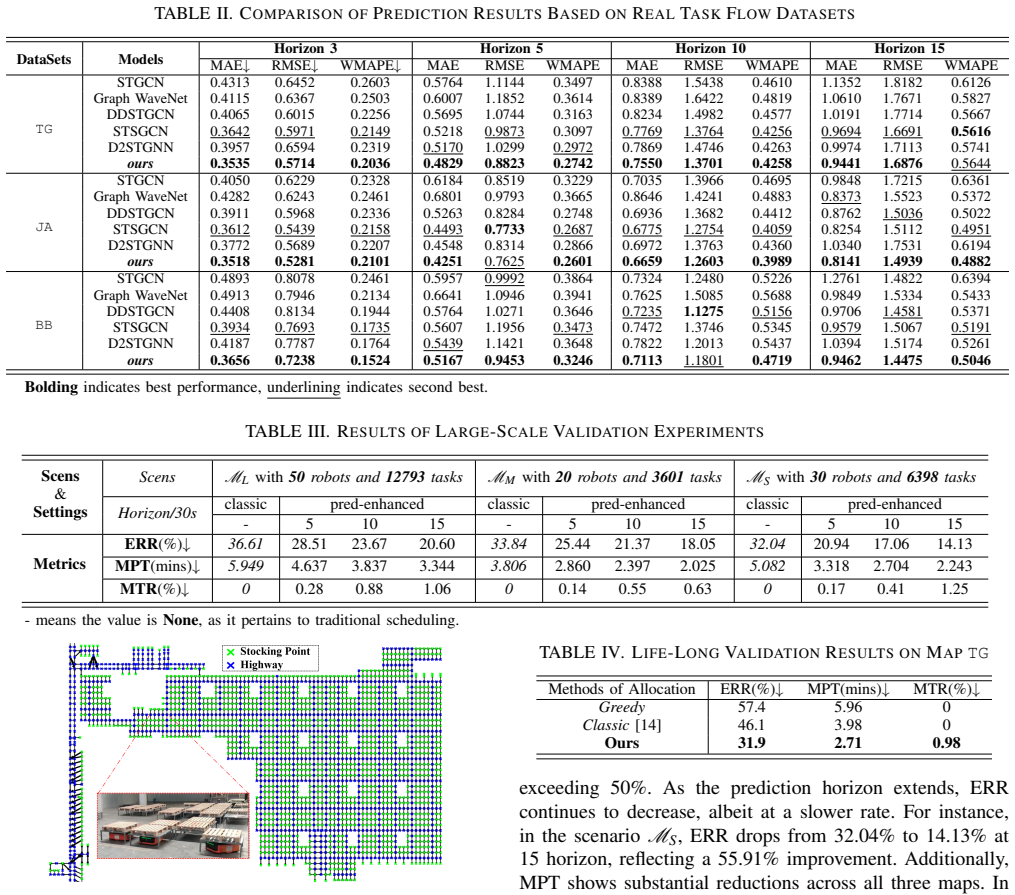
The central discovery is that aggregated, sector-level warehouse task flow is predictable enough to act on, and that acting on it pays off. The paper treats task flow as a spatio-temporal tensor over warehouse sectors and predicts the next 5 to 15 half-minute frames from the past 12 frames using a network called TDTGCN, which decouples periodic demand patterns from local anomalies and extracts spatial dependencies through three fused graph structures. These forecasts enter a Hungarian-based allocator as candidate tasks, with costs that include prediction uncertainty and sector-level completion rates. The paper's headline results are reductions in empty running rate exceeding 50% (for example, from 32.04% to 14.13% in the largest simulated scenario at horizon 15) and reductions in mean pickup time up to 55.8%, with a misguided trip ratio no larger than about 1.25% in the tested scenarios.
Load-bearing premise
The load-bearing premise is that aggregated warehouse order flow is sufficiently periodic and predictable from the most recent 12 half-minute frames that 5 to 15-step forecasts are accurate enough to act on; if order arrivals are irregular or non-stationary, pre-positioned robots will be misled more often and the reported efficiency gains may shrink.
Editorial extensions
If this is right
- Robots can be pre-positioned toward sectors where work is predicted, so idle time becomes productive repositioning rather than waiting for published orders.
- Longer prediction horizons (5, 10, 15) yield monotonically better empty running and pickup times, though with diminishing returns, giving operators a tunable trade-off against misprediction risk.
- Because the misguided trip ratio stays low (about 1.25% or less), most pre-scheduled movement lands near real work, so the cost of acting on forecasts is small relative to the labor saved.
- The framework is modular: the prediction network and the allocation heuristic can be swapped independently, so improvements in either component should compound rather than conflict.
Reading between the lines
- The reported gains are measured on order flows aggregated at half-minute intervals; a natural stress test is to run the same framework under Poisson or bursty order arrivals, where the periodicity assumption is weak.
- The paper does not decompose how much of the empty-running and pickup-time improvement comes from prediction accuracy versus the allocation heuristic; ablating Hybrid-KM with an oracle predictor and with a random predictor would isolate the source.
- Sector-level prediction treats each sector as a unit, so a harder variant is fine-grained node-level prediction; moving from 6-29 sectors to hundreds of nodes would show whether the graph architecture scales beyond coarse aggregation.
- The misguided-trip metric counts extra distance from mispredicted trips; a fuller cost model would also charge the opportunity cost of a robot being far from genuinely future tasks when the forecast is wrong.
Signed reviews
Editorial analysis
A structured set of objections, weighed in public.
Referee Report
Summary. This paper proposes a pre-scheduling framework for robotic warehousing in which a spatio-temporal task-flow predictor (TDTGCN) forecasts future task distributions and a hybrid allocator assigns both real and predicted tasks to robots. The predictor is evaluated on three real factory datasets against five baselines, and the full system is tested in large-scale simulations on three maps at horizons 5, 10, and 15, plus a months-long real-world deployment. The central claim is that the framework reduces empty running rate (ERR) and mean pickup time (MPT) by more than 50%.
Significance. If the reported results hold, the paper makes a useful practical contribution by coupling spatio-temporal prediction with task allocation in warehousing robotics, and the real-world deployment with a months-long trial is a notable strength. The prediction study uses real factory data and compares against several established baselines, and the allocation experiments include a classic Hungarian-method baseline. However, the significance is currently undercut by an overstated headline claim, an apparent inconsistency between two tables, missing parameter values for the allocator, and the absence of uncertainty quantification; these issues must be resolved before the quantitative conclusions can be accepted.
major comments (5)
- [Abstract and Section VII] The claim that ERR is reduced by more than 50% is not supported by the reported numbers. Recomputing from Table III, ERR reductions relative to the classic baseline are 22.1%, 35.3%, and 43.7% for ML at horizons 5, 10, and 15; 24.8%, 36.9%, and 46.7% for MM; and 34.6%, 46.7%, and 55.9% for MS. Only the MS horizon-15 cell exceeds 50%. The lifelong validation in Table IV gives a reduction from 46.1% to 31.9%, i.e., 30.8%. The abstract and Section VII should report per-cell reductions and rephrase the headline claim accordingly, for example as 'up to 55.9% in one tested map/horizon'.
- [Table I and Table III] Table III labels the middle map as 'MM with 20 robots and 3601 tasks' and the small map as 'MS with 30 robots and 6398 tasks', but Table I states that MM has 6398 tasks and MS has 3601 tasks. This apparent swap affects the interpretation of every row of Table III and also contradicts Section VII's description of MM as the 'smallest and simplest map'. The authors should correct the labels or explicitly explain the discrepancy.
- [Eq. (8) and Section IV.B] The heuristic cost matrix in Eq. (8) depends on normalization factors α, β, and σ, and the uncertainty term u(Ti) depends on an unspecified weight μ and an entropy score EnScore(·) that is not defined in the paper. No values or ranges for these parameters are reported anywhere, so the allocator is not reproducible and the sensitivity of the results to these weights cannot be assessed. Please provide the parameter settings or an ablation study.
- [Section V.D and Table III] Section V.D states that five scenarios are generated for each map and executed five times, but Table III reports only point estimates for ERR, MPT, and MTR, with no standard deviations, confidence intervals, or significance tests. The conclusion that the improvements are significant is therefore not statistically substantiated. Please report the distribution across runs or justify why a single value is representative.
- [Section IV.A and Section VII] Because the allocator acts on predicted tasks, the benefit of pre-scheduling depends on prediction accuracy. The paper reports MTR as a byproduct, but it does not quantify how prediction error degrades the ERR/MPT gains, nor does it test a regime with random or non-stationary task arrivals. The Section VII claim that longer horizons produce better results may fail if predictions become unreliable; an ablation or sensitivity analysis with respect to prediction noise is needed to make the central claim load-bearing.
minor comments (5)
- [Abstract] The abstract contains a typo: 'compelte' should be 'complete'.
- [Eq. (9)] The notation in Eq. (9) is inconsistent: the summation uses t^j_{p,i} and t^j_{d,i}, while the following sentence defines t_{p,j} and t_{d,i}; please unify the subscripts.
- [Section VII] The text says MTR 'stays at or below about 1%', but Table III reports MTR = 1.25% for MS at horizon 15; this should be corrected.
- [Section II.B] The model name is written as 'Graph WaveNet' in the text and 'Graph-WaveNet' in the table; please use a consistent spelling.
- [Section IV.B] There is a typo in 'funtion' (should be 'function') in the sentence introducing the objective of MR-HTA.
Circularity Check
No circular derivation: the prediction model is trained and evaluated against external baselines on real data, and the scheduling gains are produced by acting on predicted future tasks rather than by fitting the evaluation metrics.
full rationale
The paper's derivation chain is not circular. The task-flow predictor TDTGCN is trained with a standard MAE/RMSE/WMAPE objective on real factory datasets and compared with external baselines (STGCN, Graph WaveNet, DDSTGCN, STSGCN, D2STGNN), so the prediction results are not constructed from the downstream ERR/MPT metrics. The hybrid allocator (Section IV.B) consumes predicted tasks and their confidence only as inputs to a Hungarian-type matching cost; the reported ERR, MPT, and MTR are measured from simulated/real robot trajectories, not defined as optima of the cost function. The 'domain transfer' embedding and graph convolutions are standard spatio-temporal techniques with external citations, and no equation in the paper defines its output in terms of the evaluation target. Self-citations are present ([9], [19]) but only for metric definitions and related work; they are not load-bearing. The abstract's 'more than 50%' ERR reduction is numerically supported by only one of the nine scenario-horizon cells in Table III and is not matched by the lifelong validation in Table IV (46.1% to 31.9%, about a 30.8% reduction); additionally, Table III and Table I appear to swap the task counts for MM and MS. These are correctness/reporting concerns, not circularity. The allocator's use of model confidence as a cost signal is an internal feedback loop, but it is not a fitted input masquerading as a prediction, and MTR explicitly measures the cost of mispredictions. Overall, no circular step was identified.
Assumptions & free parameters
free parameters (4)
- epsilon and sigma in adjacency matrix (Eq 1) =
not reported
- alpha, beta, sigma in cost function (Eq 8) =
not reported
- mu in uncertainty function u(Ti) =
not reported
- TDTGCN blocks and dilation factors =
4 blocks; dilation 1 and 2 alternating
assumptions (4)
- domain assumption Warehouse task flow is sufficiently periodic and stationary for FFT-based periodicity extraction and 12-step history to generalize to 3-15 step future horizons.
- domain assumption Tasks and predicted tasks can be modeled at sector level, with each predicted task attached to a sector center.
- domain assumption The allocation cost is a linear combination of distance, prediction uncertainty, and sector completion rate, and the Hungarian algorithm can assign hybrid tasks optimally under this cost.
- ad hoc to paper Gaussian-kernel embedding and reverse reconstruction (Eqs 3-4) preserve task-flow information needed for prediction.
invented entities (1)
-
predicted task entry
independent evidence
Cite this review
Pith. "Pith review of Foresee and Act Ahead: Task Prediction and Pre-Scheduling Enabled Efficient Robotic Warehousing." pith.science (2026). https://pith.science/paper/MHWURNFL
@misc{pith2026241206425,
  author       = {Pith},
  title        = {Pith review of: Foresee and Act Ahead: Task Prediction and Pre-Scheduling Enabled Efficient Robotic Warehousing},
  year         = {2026},
  howpublished = {\url{https://pith.science/paper/MHWURNFL}},
  note         = {Machine review of arXiv:2412.06425}
}
read the original abstract
In warehousing systems, to enhance logistical efficiency amid surging demand volumes, much focus is placed on how to reasonably allocate tasks to robots. However, the robots labor is still inevitably wasted to some extent. In response to this, we propose a pre-scheduling enhanced warehousing framework that predicts task flow and acts in advance. It consists of task flow prediction and hybrid tasks allocation. For task prediction, we notice that it is possible to provide a spatio-temporal representation of task flow, so we introduce a periodicity-decoupled mechanism tailored for the generation patterns of aggregated orders, and then further extract spatial features of task distribution with novel combination of graph structures. In hybrid tasks allocation, we consider the known tasks and predicted future tasks simultaneously and optimize the allocation dynamically. In addition, we consider factors such as predicted task uncertainty and sector-level efficiency evaluation in warehousing to realize more balanced and rational allocations. We validate our task prediction model across actual datasets derived from real factories, achieving SOTA performance. Furthermore, we implement our compelte scheduling system in a real-world robotic warehouse for months of lifelong validation, demonstrating large improvements in key metrics of warehousing, such as empty running rate, by more than 50%.
Figures


Figures from the paper (2 more)

Reference graph
Works this paper leans on
-
[1]
Traffic flow prediction for road transportation networks with limited traffic data
Afshin Abadi, Tooraj Rajabioun, and Petros A Ioannou. Traffic flow prediction for road transportation networks with limited traffic data. IEEE Transactions on Intelligent Transportation Systems , 16(2):653– 662, 2014
work page 2014
-
[2]
Optimization techniques for multi-robot task allocation problems: Review on the state-of-the-art
Hamza Chakraa, Franc ¸ois Gu ´erin, Edouard Leclercq, and Dimitri Lefebvre. Optimization techniques for multi-robot task allocation problems: Review on the state-of-the-art. Robotics and Autonomous Systems, page 104492, 2023
2023
-
[3]
A distributed method for dynamic multi-robot task allocation problems with critical time constraints
Xinye Chen, Ping Zhang, Guanglong Du, and Fang Li. A distributed method for dynamic multi-robot task allocation problems with critical time constraints. Robotics and Autonomous Systems, 118:31–46, 2019
work page 2019
-
[4]
Periodicity decoupling framework for long-term series forecasting
Tao Dai, Beiliang Wu, Peiyuan Liu, Naiqi Li, Jigang Bao, Yong Jiang, and Shu-Tao Xia. Periodicity decoupling framework for long-term series forecasting. In The 12th International Conference on Learning Representations, 2024
work page 2024
-
[5]
Decentral task allocation for industrial agv-systems with routing constraints
Matthias De Ryck, Davy Pissoort, Tom Holvoet, and Eric Demeester. Decentral task allocation for industrial agv-systems with routing constraints. Journal of Manufacturing Systems , 62:135–144, 2022
work page 2022
-
[6]
Yifan Feng, Haoxuan You, Zizhao Zhang, Rongrong Ji, and Yue Gao. Hypergraph neural networks. In AAAI Conference on Artificial Intelligence, volume 33, pages 3558–3565, 2019
work page 2019
-
[7]
Attention based spatial-temporal graph convolutional networks for traffic flow forecasting
Shengnan Guo, Youfang Lin, Ning Feng, Chao Song, and Huaiyu Wan. Attention based spatial-temporal graph convolutional networks for traffic flow forecasting. In The AAAI conference on artificial intelligence, volume 33, pages 922–929, 2019
work page 2019
-
[8]
Hamilton, Rex Ying, and Jure Leskovec
William L. Hamilton, Rex Ying, and Jure Leskovec. Inductive representation learning on large graphs. In The 31st Conference on Neural Information Processing Systems , 2017
work page 2017
Show all 33 references
-
[9]
Traffic flow learning enhanced large-scale multi-robot cooperative path planning under uncertainties
Xingyao Han, Siyuan Chen, Xinye Xiong, Qiming Liu, Shunbo Zhou, Heng Zhang, and Zhe Liu. Traffic flow learning enhanced large-scale multi-robot cooperative path planning under uncertainties. In IEEE International Conference on Robotics and Automation , pages 16581– 16587. IEEE, 2024
2024
-
[10]
A spatiotemporal bidirectional attention-based ride-hailing demand pre- diction model: A case study in beijing during covid-19
Ziheng Huang, Dujuan Wang, Yunqiang Yin, and Xiang Li. A spatiotemporal bidirectional attention-based ride-hailing demand pre- diction model: A case study in beijing during covid-19. IEEE Transactions on Intelligent Transportation Systems , 23(12):25115– 25126, 2022
2022
-
[11]
Urban ride-hailing demand prediction with multiple spatio-temporal information fusion network
Guangyin Jin, Yan Cui, Liang Zeng, Hanbo Tang, Yanghe Feng, and Jincai Huang. Urban ride-hailing demand prediction with multiple spatio-temporal information fusion network. Transportation Research Part C: Emerging Technologies, 117:102665, 2020
2020
-
[12]
Spatio-temporal graph neural networks for predictive learning in urban computing: A survey
Guangyin Jin, Yuxuan Liang, Yuchen Fang, Zezhi Shao, Jincai Huang, Junbo Zhang, and Yu Zheng. Spatio-temporal graph neural networks for predictive learning in urban computing: A survey. IEEE Transac- tions on Knowledge and Data Engineering , pages 1–20, 2023
2023
-
[13]
Multi-robot task allocation: A review of the state-of-the-art
Alaa Khamis, Ahmed Hussein, and Ahmed Elmogy. Multi-robot task allocation: A review of the state-of-the-art. Cooperative Robots and Sensor Networks, pages 31–51, 2015
2015
-
[14]
The hungarian method for the assignment problem
Harold W Kuhn. The hungarian method for the assignment problem. Naval research logistics quarterly , 2(1-2):83–97, 1955
1955
-
[15]
Diffusion convolutional recurrent neural network: Data-driven traffic forecasting
Yaguang Li, Rose Yu, Cyrus Shahabi, and Yan Liu. Diffusion convolutional recurrent neural network: Data-driven traffic forecasting. arXiv preprint arXiv:1707.01926 , 2017
2017 arXiv
-
[16]
Diffusion convolutional recurrent neural network: Data-driven traffic forecasting
Yaguang Li, Rose Yu, Cyrus Shahabi, and Yan Liu. Diffusion convolutional recurrent neural network: Data-driven traffic forecasting. In International Conference on Learning Representations , 2017
2017
-
[17]
Traffic prediction in a bike-sharing system
Yexin Li, Yu Zheng, Huichu Zhang, and Lei Chen. Traffic prediction in a bike-sharing system. In International Conference on Advances in Geographic Information Systems . Association for Computing Ma- chinery, 2015
2015
-
[18]
Taxi booking mobile app order demand prediction based on short-term traffic forecasting
Yunxuan Li, Jian Lu, Lin Zhang, and Yi Zhao. Taxi booking mobile app order demand prediction based on short-term traffic forecasting. Transportation Research Record, 2634(1):57–68, 2017
2017
-
[19]
Prediction, planning, and coordination of thousand-warehousing- robot networks with motion and communication uncertainties
Zhe Liu, Hesheng Wang, Huanshu Wei, Ming Liu, and Yun-Hui Liu. Prediction, planning, and coordination of thousand-warehousing- robot networks with motion and communication uncertainties. IEEE Transactions on Automation Science and Engineering , pages 1705– 1717, 2020
2020
-
[20]
Review on state-of-the-art dynamic task allocation strategies for multiple-robot systems
N Seenu, Kuppan Chetty RM, MM Ramya, and Mukund Nilakantan Janardhanan. Review on state-of-the-art dynamic task allocation strategies for multiple-robot systems. The international journal of Robotics Research and Application , 47(6):929–942, 2020
2020
-
[21]
Zezhi Shao, Zhao Zhang, Wei Wei, Fei Wang, Yongjun Xu, Xin Cao, and Christian S. Jensen. Decoupled dynamic spatial- temporal graph neural network for traffic forecasting. arXiv preprint arXiv:2206.09112, 2022
2022 arXiv
-
[22]
Spatial- temporal synchronous graph convolutional networks: A new frame- work for spatial-temporal network data forecasting
Chao Song, Youfang Lin, Shengnan Guo, and Huaiyu Wan. Spatial- temporal synchronous graph convolutional networks: A new frame- work for spatial-temporal network data forecasting. In AAAI Confer- ence on Artificial Intelligence , volume 34, pages 914–921, 2020
2020
-
[23]
Dual dynamic spatial- temporal graph convolution network for traffic prediction
Yanfeng Sun, Xiangheng Jiang, Yongli Hu, Fuqing Duan, Kan Guo, Boyue Wang, Junbin Gao, and Baocai Yin. Dual dynamic spatial- temporal graph convolution network for traffic prediction. IEEE Transactions on Intelligent Transportation Systems , 23(12):23680– 23693, 2022
2022
-
[24]
Deep learning for spatio-temporal data mining: A survey
Senzhang Wang, Jiannong Cao, and S Yu Philip. Deep learning for spatio-temporal data mining: A survey. IEEE Transactions on Knowledge and Data Engineering , 34(8):3681–3700, 2020
2020
-
[25]
Traffic flow prediction via spatial temporal graph neural network
Xiaoyang Wang, Yao Ma, Yiqi Wang, Wei Jin, Xin Wang, Jiliang Tang, Caiyan Jia, and Jian Yu. Traffic flow prediction via spatial temporal graph neural network. In The Web Conference , pages 1082–1092, 2020
2020
-
[26]
Dynamic task allocation for multi-robot search and retrieval tasks
Changyun Wei, Koen V Hindriks, and Catholijn M Jonker. Dynamic task allocation for multi-robot search and retrieval tasks. Applied Intelligence, 45:383–401, 2016
2016
-
[27]
Barry Brian Werger and Maja J. Mataric. Broadcast of local eligibility: Behavior-based control for strongly cooperative robot teams. In The Fourth International Conference on Autonomous Agents, pages 21–22, 2000
2000
-
[28]
Timesnet: Temporal 2d-variation modeling for general time series analysis
Haixu Wu, Tengge Hu, Yong Liu, Hang Zhou, Jianmin Wang, and Mingsheng Long. Timesnet: Temporal 2d-variation modeling for general time series analysis. arXiv preprint arXiv:2210.02186 , 2022
2022 arXiv
-
[29]
Graph wavenet for deep spatial-temporal graph modeling
Z Wu, S Pan, G Long, J Jiang, and C Zhang. Graph wavenet for deep spatial-temporal graph modeling. In The 28th International Joint Conference on Artificial Intelligence . International Joint Conferences on Artificial Intelligence, 2019
2019
-
[30]
Spatio-temporal graph con- volutional networks: A deep learning framework for traffic forecasting
Bing Yu, Haoteng Yin, and Zhanxing Zhu. Spatio-temporal graph con- volutional networks: A deep learning framework for traffic forecasting. arXiv preprint arXiv:1709.04875 , 2017
2017 arXiv
-
[31]
Spa- tiotemporal residual graph attention network for traffic flow forecast- ing
Qingyong Zhang, Changwu Li, Fuwen Su, and Yuanzheng Li. Spa- tiotemporal residual graph attention network for traffic flow forecast- ing. IEEE Internet of Things Journal , 10(13):11518–11532, 2023
2023
-
[32]
Heterogeneous-temporal graph convolutional networks: Make the community detection much better
Yaping Zheng, Shiyi Chen, Xinni Zhang, Xiaofeng Zhang, Xiaofei Yang, and Di Wang. Heterogeneous-temporal graph convolutional networks: Make the community detection much better. arXiv preprint arXiv:1909.10248, 2019
1909 arXiv
-
[33]
Ast-gcn: Attribute-augmented spatiotemporal graph convolutional network for traffic forecasting
Jiawei Zhu, Qiongjie Wang, Chao Tao, Hanhan Deng, Ling Zhao, and Haifeng Li. Ast-gcn: Attribute-augmented spatiotemporal graph convolutional network for traffic forecasting. IEEE Access, 9:35973– 35983, 2021
2021
Reviewed August 11, 2026 · model on record in the stance chip above.
Discussion (0). Continue with ORCID to comment.