The effect of near-core mixing on rejuvenation and the asteroseismic properties of massive accretors
Pith reviewed 2026-06-27 05:32 UTC · model grok-4.3
The pith
Convective boundary mixing, not semiconvection, sets the asteroseismic imprint of mass accretion in massive stars.
A machine-rendered reading of the paper's core claim, the machinery that carries it, and where it could break.
Core claim
The central claim is that the asteroseismic imprint of accretion is robust against changes in semiconvective mixing efficiency but changes drastically when convective boundary mixing is omitted. Post-accretion thermal relaxation determines the final near-core structure and the resulting seismic signal. Fourier transforms of period spacing patterns quantify how different near-core mixing and accretion-rate assumptions affect the signals.
What carries the argument
Near-core mixing region outside convective cores, controlled by convective boundary mixing and post-accretion thermal relaxation, which determines the shape of period spacing patterns.
If this is right
- Semiconvective mixing efficiency variations leave the recovered seismic imprint of accretion largely unchanged.
- Absence of convective boundary mixing produces markedly different asteroseismic properties after accretion.
- Thermal relaxation after mass transfer fixes the near-core structure that asteroseismology later probes.
- Fourier analysis of period spacing patterns can distinguish mixing and accretion-rate scenarios in observations.
Where Pith is reading between the lines
- Binary evolution calculations that omit convective boundary mixing may systematically misestimate the ages and core structures of accreted stars.
- Multi-dimensional simulations of the post-accretion phase could test whether the 1D thermal relaxation picture holds.
- Targeted asteroseismic surveys of known post-mass-transfer binaries could place empirical bounds on accretion rates once boundary mixing is included.
Load-bearing premise
One-dimensional stellar evolution models with the chosen mixing and accretion prescriptions accurately capture the near-core structure and thermal relaxation that occur in real mass-accreting stars.
What would settle it
A confirmed mass-accreting star whose observed period spacing pattern matches the predictions of models that omit convective boundary mixing would contradict the claim that boundary mixing dominates the imprint.
Figures
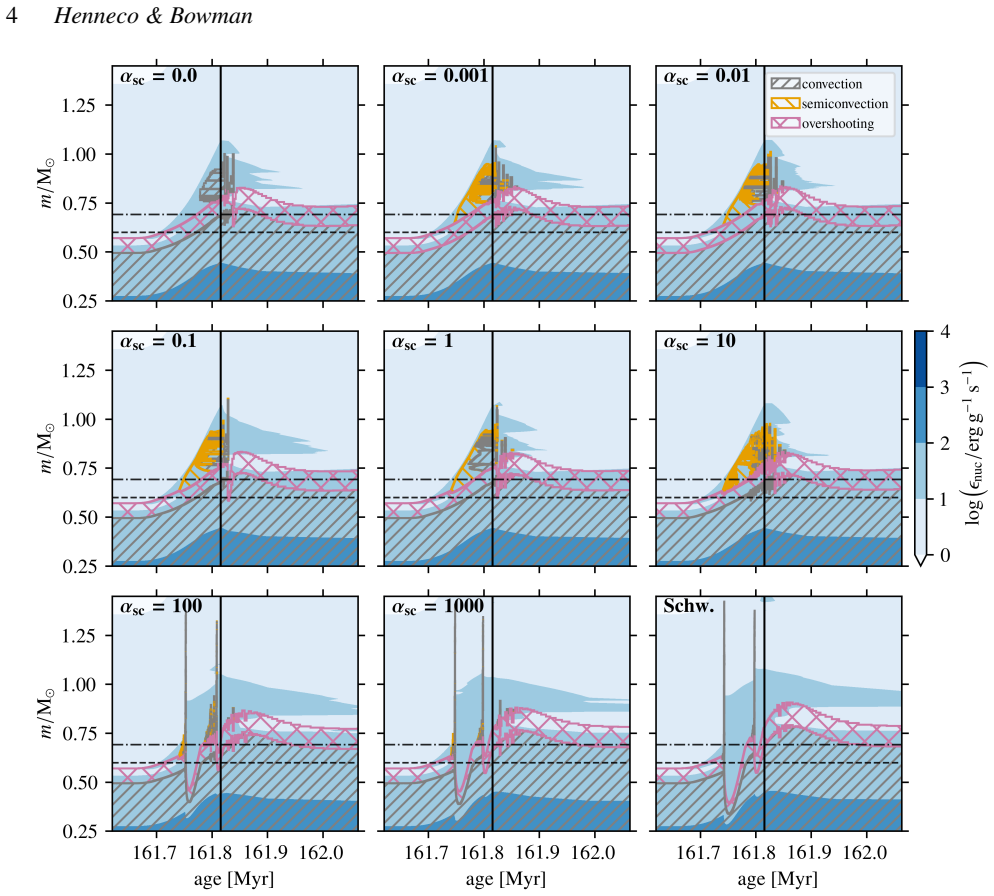
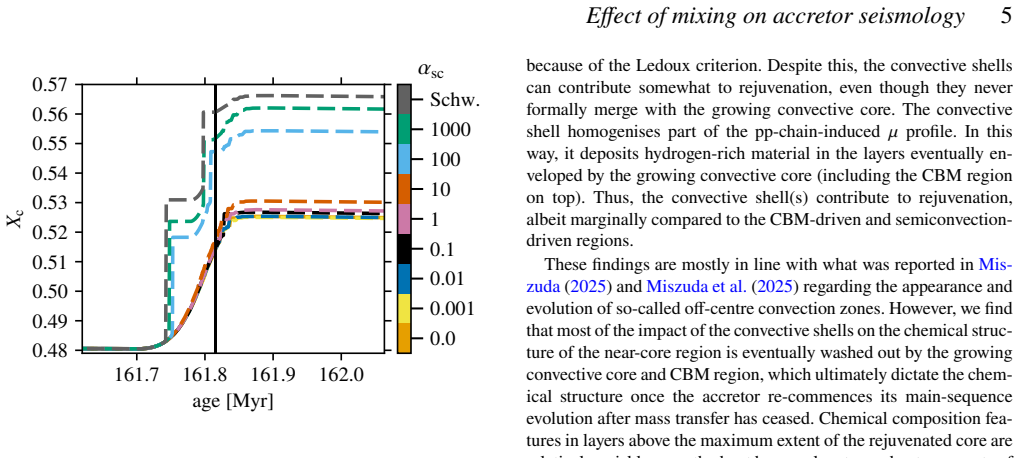
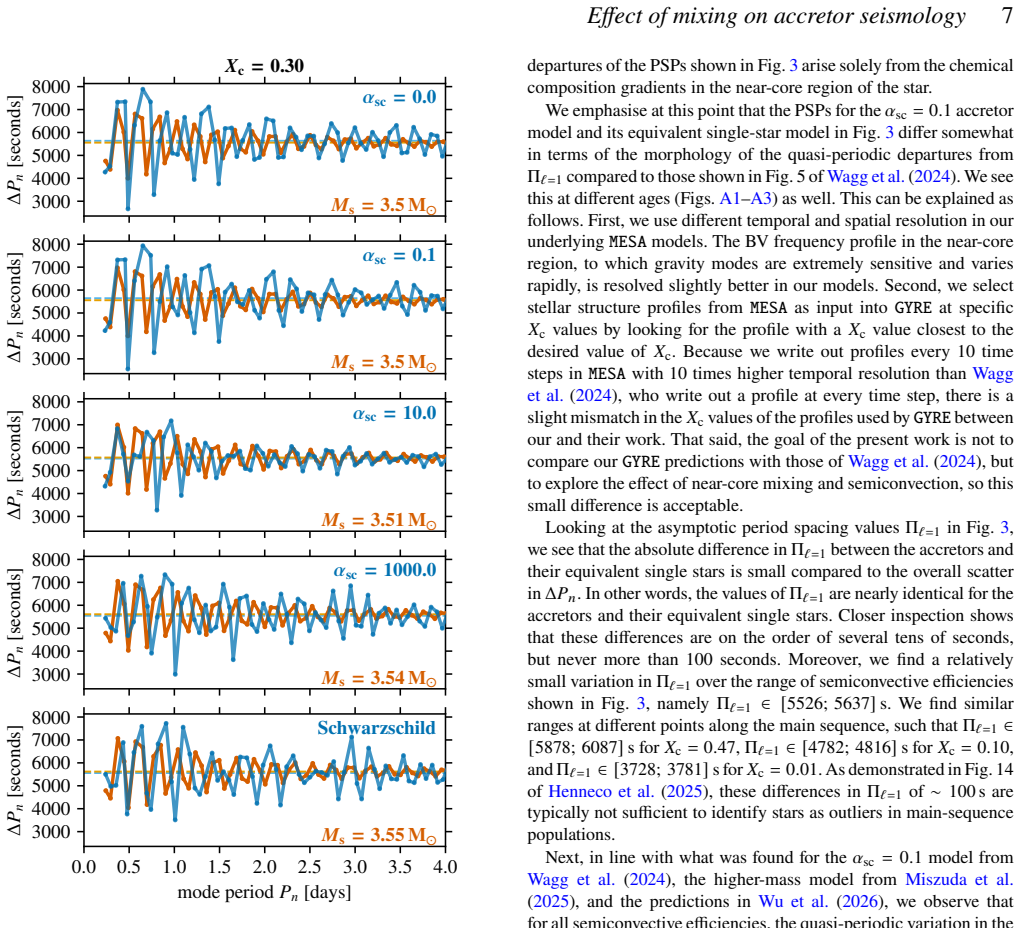
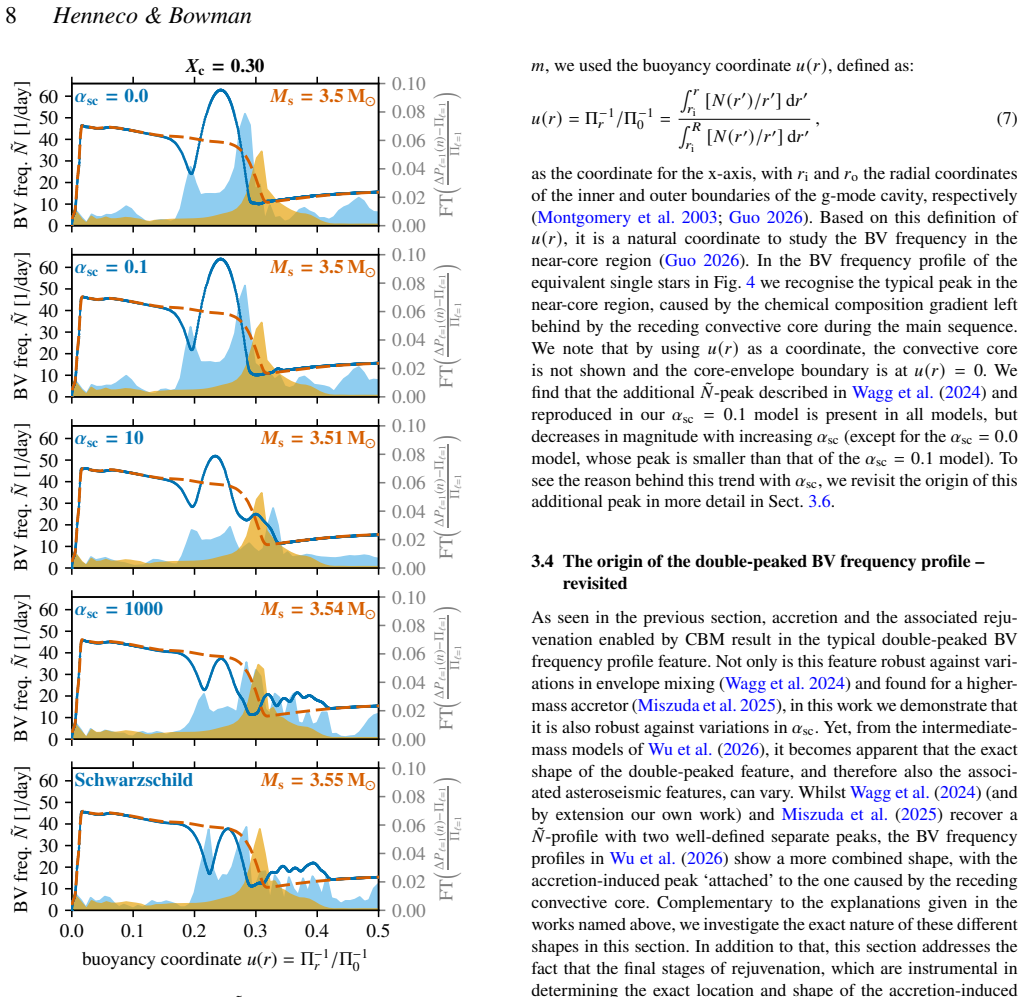
read the original abstract
The relatively recent revelation of the high occurrence rate of binary interactions, especially in intermediate- and high-mass systems, has prompted multiple investigations into their asteroseismic imprints. The near-core region just outside the convective cores of mass-accreting early-type main-sequence stars in binaries has been theorised to be sensitive to assumptions about mixing (notably semiconvection) and accretion physics. In turn, the predicted asteroseismic properties depend strongly on the physical properties of this near-core region. We explore how robust the previously identified asteroseismic imprints of mass accretion are to changes in semiconvective mixing. Using one-dimensional stellar structure and evolution models, this parameter study shows the dominant effect of convective boundary mixing on rejuvenation and the post-accretion asteroseismic properties. The recovered seismic imprint, largely robust to variations in semiconvective mixing efficiency, changes drastically when convective boundary mixing is not included in the models. We find that the post-accretion thermal relaxation is key in determining the final near-core structure and the asteroseismic imprint of accretion. We reaffirm the potential of Fourier transforms of period spacing patterns to quantify the effects of different near-core mixing and accretion-rate assumptions on asteroseismic signals. Overall, this work highlights the sensitivity of the asteroseismic imprint of accretion not only on stellar structure and evolution modelling assumptions, but also on the accretion physics. The logical next step is to arrive at a more general picture of the asteroseismic imprint of mass transfer by exploring its properties in a multi-dimensional parameter study including single- and binary-star assumptions.
Editorial analysis
A structured set of objections, weighed in public.
Referee Report
Summary. The paper conducts a parameter study with one-dimensional stellar evolution models to assess the impact of near-core mixing (semiconvective efficiency and convective boundary mixing) on rejuvenation and asteroseismic properties of massive main-sequence accretors in binaries. It reports that the asteroseismic imprint is largely robust to variations in semiconvective mixing efficiency but changes drastically in the absence of convective boundary mixing, attributes this to the role of post-accretion thermal relaxation in setting the final near-core structure, and reaffirms the utility of Fourier transforms of period spacing patterns as a diagnostic while calling for future multi-dimensional explorations.
Significance. If the modeled trends hold, the work isolates convective boundary mixing as the dominant control on post-accretion near-core profiles and asteroseismic signals, providing concrete guidance for interpreting g-mode pulsations in binary products. The explicit parameter variation and emphasis on thermal relaxation timescales constitute a clear, falsifiable contribution within the 1D framework; the methodological suggestion regarding Fourier analysis of period spacings is a reusable diagnostic strength.
major comments (2)
- [Abstract and parameter-study results section] Abstract and the parameter-study results section: the central claim that the seismic imprint 'changes drastically' without convective boundary mixing is load-bearing for the conclusion that CBM dominates over semiconvection. No quantitative metric (e.g., shift in the dominant Fourier frequency, change in peak amplitude, or fractional change in the period-spacing slope) is supplied to substantiate the adverb 'drastically,' preventing assessment of whether the effect exceeds the numerical or physical uncertainties of the 1D implementation.
- [post-accretion thermal relaxation section] The section discussing post-accretion thermal relaxation: the assertion that thermal relaxation is 'key' in determining the final near-core structure rests on the 1D model's treatment of the thermal adjustment timescale. No explicit comparison is shown between the relaxation timescale with and without CBM, nor is a test provided against the expected multi-dimensional flow timescales, leaving open whether the reported sensitivity is an artifact of the chosen 1D mixing-length and boundary prescriptions.
minor comments (2)
- [Methods section] Methods section: the definitions and numerical values adopted for the semiconvective mixing efficiency and the CBM diffusion coefficient should be tabulated for each model sequence to allow direct reproduction.
- [Figure captions] Figure captions: captions for the period-spacing and Fourier-transform figures should list the exact accretion rate, initial mass, and mixing parameters used in each panel rather than referring only to 'standard' or 'no-CBM' cases.
Simulated Author's Rebuttal
We thank the referee for the constructive comments on our manuscript. We respond point-by-point to the major comments below, indicating planned revisions where appropriate.
read point-by-point responses
-
Referee: [Abstract and parameter-study results section] Abstract and the parameter-study results section: the central claim that the seismic imprint 'changes drastically' without convective boundary mixing is load-bearing for the conclusion that CBM dominates over semiconvection. No quantitative metric (e.g., shift in the dominant Fourier frequency, change in peak amplitude, or fractional change in the period-spacing slope) is supplied to substantiate the adverb 'drastically,' preventing assessment of whether the effect exceeds the numerical or physical uncertainties of the 1D implementation.
Authors: We agree that the adverb 'drastically' would benefit from quantitative support to allow readers to judge its magnitude relative to model uncertainties. In the revised manuscript we will add explicit metrics, including the shift in the dominant Fourier frequency of the period-spacing pattern and the fractional change in the period-spacing slope, for the cases with and without convective boundary mixing. These will be reported in the parameter-study results section alongside the existing figures. revision: yes
-
Referee: [post-accretion thermal relaxation section] The section discussing post-accretion thermal relaxation: the assertion that thermal relaxation is 'key' in determining the final near-core structure rests on the 1D model's treatment of the thermal adjustment timescale. No explicit comparison is shown between the relaxation timescale with and without CBM, nor is a test provided against the expected multi-dimensional flow timescales, leaving open whether the reported sensitivity is an artifact of the chosen 1D mixing-length and boundary prescriptions.
Authors: We will add explicit comparisons of the post-accretion thermal relaxation timescales between models that include and exclude convective boundary mixing, derived directly from the 1D evolutionary sequences. A quantitative test against multi-dimensional flow timescales lies outside the scope of the present 1D study; the manuscript already identifies multi-dimensional explorations as the logical next step. revision: partial
- Direct comparison of 1D thermal relaxation timescales against multi-dimensional hydrodynamic simulations.
Circularity Check
No circularity: results from direct parameter variation in 1D models
full rationale
The paper performs a numerical parameter study in one-dimensional stellar evolution models, varying semiconvective mixing efficiency and the inclusion of convective boundary mixing to observe effects on rejuvenation, near-core structure, and asteroseismic properties. All load-bearing claims (robustness to semiconvection, drastic change without boundary mixing, role of post-accretion thermal relaxation) are direct outputs of these simulations rather than reductions of any equation or fitted parameter to itself. No self-citations are invoked as load-bearing uniqueness theorems or ansatzes; the work explicitly builds on prior identifications but derives its new findings from the present model grid. The derivation chain is therefore self-contained against the stated modeling assumptions.
Axiom & Free-Parameter Ledger
free parameters (2)
- semiconvective mixing efficiency
- convective boundary mixing inclusion
axioms (2)
- domain assumption One-dimensional stellar structure and evolution equations accurately represent near-core mixing and thermal relaxation in main-sequence accretors
- domain assumption Accretion can be parameterized with specific rates and physics that affect post-accretion structure
Forward citations
Cited by 1 Pith paper
-
A grid of fast-rotating, chemically-homogeneous, supernova and/or long-GRB progenitors
Presents a grid of 113 fast-rotating, chemically-homogeneous massive star models at Z=0.001 reaching core collapse with high angular momentum for use as supernova and GRB progenitors.
Reference graph
Works this paper leans on
-
[1]
Modules for Experiments in Stellar Astrophysics (MESA): Time-dependent Convection, Energy Conservation, Automatic Differentiation, and Infrastructure. , keywords =. doi:10.3847/1538-4365/acae8d , archivePrefix =. 2208.03651 , primaryClass =
-
[2]
Towards a systematic treatment of observational uncertainties in forward asteroseismic modelling of gravity-mode pulsators. , keywords =. doi:10.1051/0004-6361/202141726 , archivePrefix =. 2109.10776 , primaryClass =
-
[3]
arXiv , author =:2005.09658 , journal =
doi:10.1051/0004-6361/202037700 , eid =. arXiv , author =:2005.09658 , journal =
-
[4]
Thirty systems with space-based light curves
, keywords =. doi:10.1111/j.1365-2966.2011.18311.x , eprint =
-
[5]
doi:10.1146/annurev-astro-052722-105936 , eprint =
, keywords =. doi:10.1146/annurev-astro-052722-105936 , eprint =
-
[6]
doi:10.3847/1538-4365/aa6fb6 , eid =. arXiv , author =:1606.05347 , journal =
work page internal anchor Pith review Pith/arXiv arXiv doi:10.3847/1538-4365/aa6fb6
-
[7]
The Origin and Evolution of Multiple Star Systems
Protostars and Planets VII , date-added =. doi:10.48550/arXiv.2203.10066 , editor =. arXiv , author =:2203.10066 , keywords =
work page internal anchor Pith review Pith/arXiv arXiv doi:10.48550/arxiv.2203.10066
-
[8]
arXiv , author =:2506.19948 , journal =
doi:10.1051/0004-6361/202452885 , eid =. arXiv , author =:2506.19948 , journal =
-
[9]
doi:10.1146/annurev-astro-082812-140938 , eprint =
, month = aug, pages =. doi:10.1146/annurev-astro-082812-140938 , eprint =
-
[10]
Journal of Astronomical Telescopes, Instruments, and Systems , year = 2015, month = jan, volume =
Journal of Astronomical Telescopes, Instruments, and Systems , month = jan, number = 1, pages =. doi:10.1117/1.JATIS.1.1.014003 , eid =
work page internal anchor Pith review doi:10.1117/1.jatis.1.1.014003
-
[11]
, keywords =
The HIPPARCOS mission: photometric data. , keywords =
-
[12]
The physical origin of macroturbulence
The ESO UVES/FEROS Large Programs of TESS OB pulsators: II. The physical origin of macroturbulence. , keywords =. doi:10.1051/0004-6361/202451581 , archivePrefix =. 2408.15888 , primaryClass =
-
[13]
Consequences for mixing, transport, magnetism, and convective penetration
Rossby numbers and stiffness values inferred from gravity-mode asteroseismology of rotating F- and B-type dwarfs. Consequences for mixing, transport, magnetism, and convective penetration. , keywords =. doi:10.1051/0004-6361/202142151 , archivePrefix =. 2110.06220 , primaryClass =
-
[14]
E pur si muove: Galilean-invariant cosmological hydrodynamical simulations on a moving mesh. , keywords =. doi:10.1111/j.1365-2966.2009.15715.x , archivePrefix =. 0901.4107 , primaryClass =
-
[15]
Thirty systems with space-based light curves
Magnetohydrodynamics on an unstructured moving grid. , keywords =. doi:10.1111/j.1365-2966.2011.19591.x , archivePrefix =. 1108.1792 , primaryClass =
-
[16]
Detectability of Axisymmetric Magnetic Fields from the Core to the Surface of Oscillating Post-main-sequence Stars. , keywords =. doi:10.3847/1538-4357/ad4708 , archivePrefix =. 2404.17167 , primaryClass =
-
[17]
KIC 10526294: a slowly rotating B star with rotationally split, quasi-equally spaced gravity modes
KIC 10526294: a slowly rotating B star with rotationally split, quasi-equally spaced gravity modes. , keywords =. doi:10.1051/0004-6361/201424094 , archivePrefix =. 1407.2986 , primaryClass =
work page internal anchor Pith review Pith/arXiv arXiv doi:10.1051/0004-6361/201424094
-
[18]
Asteroseismic fingerprints of rotation and mixing in the slowly pulsating B8 V star KIC 7760680
Asteroseismic Fingerprints of Rotation and Mixing in the Slowly Pulsating B8 V Star KIC 7760680. , keywords =. doi:10.1088/2041-8205/803/2/L25 , archivePrefix =. 1504.00496 , primaryClass =
work page internal anchor Pith review Pith/arXiv arXiv doi:10.1088/2041-8205/803/2/l25 2041
-
[19]
Signatures of internal rotation discovered in the Kepler data of five slowly pulsating B stars
Signatures of internal rotation discovered in the Kepler data of five slowly pulsating B stars. , keywords =. doi:10.1051/0004-6361/201629814 , archivePrefix =. 1611.06955 , primaryClass =
work page internal anchor Pith review Pith/arXiv arXiv doi:10.1051/0004-6361/201629814
-
[20]
Sub-inertial Gravity Modes in the B8V Star KIC 7760680 Reveal Moderate Core Overshooting and Low Vertical Diffusive Mixing. , keywords =. doi:10.3847/0004-637X/823/2/130 , archivePrefix =. 1604.02680 , primaryClass =
work page internal anchor Pith review Pith/arXiv arXiv doi:10.3847/0004-637x/823/2/130
-
[21]
Probing the physics in the core boundary layers of the double-lined B-type binary KIC 4930889 from its gravito-inertial modes. , keywords =. doi:10.1051/0004-6361/202244192 , archivePrefix =. 2309.13123 , primaryClass =
-
[22]
Interpretation of the BRITE oscillation data of the hybrid pulsator Eridani: a call for the modification of stellar opacities. , keywords =. doi:10.1093/mnras/stw3315 , archivePrefix =. 1612.05820 , primaryClass =
work page internal anchor Pith review Pith/arXiv arXiv doi:10.1093/mnras/stw3315
-
[23]
Scaling laws for the mode amplitudes
Stochastic excitation of waves in magnetic stars: I. Scaling laws for the mode amplitudes. , keywords =. doi:10.1051/0004-6361/202450802 , archivePrefix =. 2407.06987 , primaryClass =
-
[24]
1994 , month = oct, pages =
, title =. 1994 , month = oct, pages =
1994
-
[25]
, title =. 2001 , month = apr, pages =. arXiv , doi =:astro-ph/0102244 , file =
Pith/arXiv arXiv 2001
-
[26]
, title =. 2007 , month = jun, number =. arXiv , doi =:astro-ph/0703480 , file =
Pith/arXiv arXiv 2007
-
[27]
Menon, Athira and Langer, Norbert and de Mink, Selma E. and Justham, Stephen and Sen, Koushik and Szécsi, Dorottya and de Koter, Alex and Abdul-Masih, Michael and Sana, Hugues and Mahy, Laurent and Marchant, Pablo , journal =. Detailed evolutionary models of massive contact binaries -. 2021 , issn =. doi:10.1093/mnras/stab2276 , file =
-
[28]
, title =. 2016 , month = apr, pages =. arXiv , doi =:1601.03718 , file =
Pith/arXiv arXiv 2016
-
[29]
A comparison between observed Algol-type double stars in the solar neighborhood and evolutionary computations of galactic case A binaries with a B-type primary at birth. , keywords =. doi:10.1051/0004-6361/201630131 , archivePrefix =. 1611.08398 , primaryClass =
work page internal anchor Pith review Pith/arXiv arXiv doi:10.1051/0004-6361/201630131
-
[30]
Tight asteroseismic constraints on core overshooting and diffusive mixing in the slowly rotating pulsating B8.3V star KIC 10526294. , keywords =. doi:10.1051/0004-6361/201425290 , archivePrefix =. 1505.06902 , primaryClass =
work page internal anchor Pith review Pith/arXiv arXiv doi:10.1051/0004-6361/201425290
-
[31]
The Impact of Enhanced Iron Opacity on Massive Star Pulsations: Updated Instability Strips
The impact of enhanced iron opacity on massive star pulsations: updated instability strips. , keywords =. doi:10.1093/mnrasl/slv142 , archivePrefix =. 1509.08652 , primaryClass =
work page internal anchor Pith review Pith/arXiv arXiv doi:10.1093/mnrasl/slv142
-
[32]
The PLATO Mission. arXiv e-prints , keywords =. doi:10.48550/arXiv.2406.05447 , archivePrefix =. 2406.05447 , primaryClass =
-
[33]
The PLATO 2.0 mission. Experimental Astronomy , keywords =. doi:10.1007/s10686-014-9383-4 , archivePrefix =. 1310.0696 , primaryClass =
work page internal anchor Pith review Pith/arXiv arXiv doi:10.1007/s10686-014-9383-4
-
[34]
Frontiers in Astronomy and Space Sciences , keywords =
Asteroseismology of high-mass stars: new insights of stellar interiors with space telescopes. Frontiers in Astronomy and Space Sciences , keywords =. doi:10.3389/fspas.2020.578584 , archivePrefix =. 2008.11162 , primaryClass =
-
[35]
Collisions and close encounters involving massive main-sequence stars. , keywords =. doi:10.1111/j.1365-2966.2005.09937.x , archivePrefix =. astro-ph/0602042 , primaryClass =
-
[36]
A comprehensive set of simulations of high-velocity collisions between main-sequence stars. , keywords =. doi:10.1111/j.1365-2966.2005.08770.x , archivePrefix =. astro-ph/0403621 , primaryClass =
-
[37]
Formation of black holes in the pair-instability mass gap: hydrodynamical simulations of a head-on massive star collision. , keywords =. doi:10.1093/mnras/stac3752 , archivePrefix =. 2204.03493 , primaryClass =
-
[38]
Evolution of Stellar Collision Products in Globular Clusters. II. Off-Axis Collisions. , keywords =. doi:10.1086/318689 , archivePrefix =. astro-ph/0008254 , primaryClass =
work page internal anchor Pith review Pith/arXiv arXiv doi:10.1086/318689
-
[39]
Composition Mixing during Blue Straggler Formation and Evolution
Composition Mixing during Blue Straggler Formation and Evolution. , keywords =. doi:10.1086/303709 , archivePrefix =. astro-ph/9609172 , primaryClass =
work page internal anchor Pith review Pith/arXiv arXiv doi:10.1086/303709
-
[40]
Collisions of Main-Sequence Stars and the Formation of Blue Stragglers in Globular Clusters
Collisions of Main-Sequence Stars and the Formation of Blue Stragglers in Globular Clusters. , keywords =. doi:10.1086/177736 , archivePrefix =. astro-ph/9511074 , primaryClass =
work page internal anchor Pith review Pith/arXiv arXiv doi:10.1086/177736
-
[41]
Giant star seismology. , keywords =. doi:10.1007/s00159-017-0101-x , archivePrefix =. 1609.07487 , primaryClass =
work page internal anchor Pith review Pith/arXiv arXiv doi:10.1007/s00159-017-0101-x
-
[42]
Mass-loss predictions for O and B stars as a function of metallicity
Mass-loss predictions for O and B stars as a function of metallicity. , keywords =. doi:10.1051/0004-6361:20010127 , archivePrefix =. astro-ph/0101509 , primaryClass =
work page internal anchor Pith review Pith/arXiv arXiv doi:10.1051/0004-6361:20010127
-
[43]
Asteroseismic predictions for a massive main-sequence merger product. , keywords =. doi:10.1051/0004-6361/202453533 , archivePrefix =. 2504.08683 , primaryClass =
-
[44]
Merger seismology: Distinguishing massive merger products from genuine single stars using asteroseismology. , keywords =. doi:10.1051/0004-6361/202450508 , adsurl =
-
[45]
Variability of newly identified B-type stars observed by Kepler. , keywords =. doi:10.1093/mnras/stab683 , archivePrefix =. 2103.06146 , primaryClass =
-
[46]
KIC 3240411 - the hottest known SPB star with the asymptotic g-mode period spacing
KIC 3240411 - the hottest known SPB star with the asymptotic g-mode period spacing. , keywords =. doi:10.1093/mnras/sty1126 , archivePrefix =. 1805.07100 , primaryClass =
work page internal anchor Pith review Pith/arXiv arXiv doi:10.1093/mnras/sty1126
-
[47]
Domains of pulsational instability of low-frequency modes in rotating upper main-sequence stars
Domains of pulsational instability of low-frequency modes in rotating upper main sequence stars. , keywords =. doi:10.1093/mnras/stx738 , archivePrefix =. 1703.08075 , primaryClass =
work page internal anchor Pith review Pith/arXiv arXiv doi:10.1093/mnras/stx738
-
[48]
Buoyancy glitches in pulsating stars revisited. , keywords =. doi:10.1051/0004-6361/202348681 , archivePrefix =. 2404.12992 , primaryClass =
-
[49]
Dynamics of the Sun and Stars; Honoring the Life and Work of Michael J
Diagnostics from Solar and Stellar Glitches. Dynamics of the Sun and Stars; Honoring the Life and Work of Michael J. Thompson , year = 2020, editor =. doi:10.1007/978-3-030-55336-4_26 , archivePrefix =. 2109.03674 , primaryClass =
-
[50]
Analytical modelling of period spacings across the HR diagram. , keywords =. doi:10.1093/mnras/stz2582 , archivePrefix =. 1909.04966 , primaryClass =
-
[51]
The VLT-FLAMES Tarantula Survey. XXX. Red stragglers in the clusters Hodge 301 and SL 639. , keywords =. doi:10.1051/0004-6361/201834564 , archivePrefix =. 1902.09891 , primaryClass =
work page internal anchor Pith review Pith/arXiv arXiv doi:10.1051/0004-6361/201834564 1902
-
[52]
The impact of asteroseismically calibrated internal mixing on nucleosynthetic wind yields of massive stars. arXiv e-prints , keywords =. doi:10.48550/arXiv.2406.02404 , archivePrefix =. 2406.02404 , primaryClass =
-
[53]
Convective-core overshooting and the final fate of massive stars. , keywords =. doi:10.1051/0004-6361/202347434 , archivePrefix =. 2311.05701 , primaryClass =
-
[54]
A case study of a binary mass-gainer in the SPB instability strip
The asteroseismic imprints of mass transfer. A case study of a binary mass-gainer in the SPB instability strip. , keywords =. doi:10.1051/0004-6361/202449912 , archivePrefix =. 2403.05627 , primaryClass =
-
[55]
Asteroseismology of the nearby SN-II Progenitor: Rigel. I. The MOST High-precision Photometry and Radial Velocity Monitoring. , keywords =. doi:10.1088/0004-637X/747/2/108 , archivePrefix =. 1201.0843 , primaryClass =
work page internal anchor Pith review Pith/arXiv arXiv doi:10.1088/0004-637x/747/2/108
-
[56]
, keywords =
Periods, period changes and the nature of the microvariations of Luminous Blue Variables. , keywords =
-
[57]
Asteroseismology of the nearby SN II Progenitor Rigel. II. epsilon-mechanism Triggering Gravity-mode Pulsations?. , keywords =. doi:10.1088/0004-637X/749/1/74 , archivePrefix =. 1202.1836 , primaryClass =
work page internal anchor Pith review Pith/arXiv arXiv doi:10.1088/0004-637x/749/1/74
-
[58]
, year = 2022, month = aug, volume =
Asteroseismology Across the Hertzsprung-Russell Diagram. , year = 2022, month = aug, volume =. doi:10.1146/annurev-astro-052920-094232 , adsurl =
-
[59]
Statistical properties of a sample of periodically variable B-type supergiants. Evidence for opacity-driven gravity-mode oscillations. , keywords =. doi:10.1051/0004-6361:20066038 , archivePrefix =. astro-ph/0611484 , primaryClass =
work page internal anchor Pith review Pith/arXiv arXiv doi:10.1051/0004-6361:20066038
-
[60]
Low-amplitude rotational modulation rather than pulsations in the CoRoT B-type supergiant HD 46769
Low-amplitude rotational modulation rather than pulsations in the CoRoT B-type supergiant HD 46769. , keywords =. doi:10.1051/0004-6361/201322097 , archivePrefix =. 1307.5791 , primaryClass =
work page internal anchor Pith review Pith/arXiv arXiv doi:10.1051/0004-6361/201322097
-
[61]
Asteroseismology of HD 129929: Core Overshooting and Nonrigid Rotation. Science , keywords =. doi:10.1126/science.1084993 , adsurl =
-
[62]
Asteroseismology of the Cep star HD 129929. I. Observations, oscillation frequencies and stellar parameters. , keywords =. doi:10.1051/0004-6361:20034142 , adsurl =
-
[63]
Discovery of post-mass-transfer helium-burning red giants using asteroseismology. Nature Astronomy , keywords =. doi:10.1038/s41550-022-01648-5 , archivePrefix =. 2204.06203 , primaryClass =
-
[64]
The impact of radiative levitation on mode excitation of main-sequence B-type pulsators. , keywords =. doi:10.1051/0004-6361/202449624 , archivePrefix =. 2405.08864 , primaryClass =
-
[65]
doi:10.1111/j.1745-3933.2007.00350.x , eprint =
Mixing in massive stellar mergers. , keywords =. doi:10.1111/j.1745-3933.2007.00399.x , archivePrefix =. 0707.3021 , primaryClass =
-
[66]
Structure and evolution of high-mass stellar mergers
Structure and evolution of high-mass stellar mergers. , keywords =. doi:10.1093/mnras/stt1268 , archivePrefix =. 1307.2445 , primaryClass =
work page internal anchor Pith review Pith/arXiv arXiv doi:10.1093/mnras/stt1268
-
[67]
Stellar Collisions and the Interior Structure of Blue Stragglers
Stellar Collisions and the Interior Structure of Blue Stragglers. , keywords =. doi:10.1086/339060 , archivePrefix =. astro-ph/0107388 , primaryClass =
work page internal anchor Pith review Pith/arXiv arXiv doi:10.1086/339060
-
[68]
The traditional approximation of rotation for rapidly rotating stars and planets. I. The impact of strong deformation. , keywords =. doi:10.1051/0004-6361/202140615 , archivePrefix =. 2104.09302 , primaryClass =
-
[69]
Detecting deep axisymmetric toroidal magnetic fields in stars. The traditional approximation of rotation for differentially rotating deep spherical shells with a general azimuthal magnetic field. , keywords =. doi:10.1051/0004-6361/202142956 , archivePrefix =. 2202.10026 , primaryClass =
-
[70]
Asteroseismic g-mode period spacings in strongly magnetic rotating stars. , keywords =. doi:10.1093/mnras/stad3461 , archivePrefix =. 2310.19873 , primaryClass =
-
[71]
Forward Asteroseismic Modeling of Stars with a Convective Core from Gravity-mode Oscillations: Parameter Estimation and Stellar Model Selection. , keywords =. doi:10.3847/1538-4365/aaccfb , archivePrefix =. 1806.06869 , primaryClass =
work page internal anchor Pith review Pith/arXiv arXiv doi:10.3847/1538-4365/aaccfb
-
[72]
Confronting sparse Gaia DR3 photometry with TESS for a sample of around 60 000 OBAF-type pulsators. , keywords =. doi:10.1051/0004-6361/202450489 , archivePrefix =. 2405.01539 , primaryClass =
-
[73]
The Transiting Exoplanet Survey Satellite. Space Telescopes and Instrumentation 2016: Optical, Infrared, and Millimeter Wave , year = 2016, editor =. doi:10.1117/12.2232071 , adsurl =
-
[74]
David G. Koch and William J. Borucki and Gibor Basri and Natalie M. Batalha and Timothy M. Brown and Douglas Caldwell and Jørgen Christensen-Dalsgaard and William D. Cochran and Edna DeVore and Edward W. Dunham and Thomas N. Gautier and John C. Geary and Ronald L. Gilliland and Alan Gould and Jon Jenkins and Yoji Kondo and David W. Latham and Jack J. Liss...
-
[75]
The CoRoT satellite in flight : description and performance
The CoRoT satellite in flight: description and performance. , keywords =. doi:10.1051/0004-6361/200810860 , archivePrefix =. 0901.2206 , primaryClass =
work page internal anchor Pith review Pith/arXiv arXiv doi:10.1051/0004-6361/200810860
-
[76]
Unveiling the Evolutionary State of Three B Supergiant Stars: PU Gem, ϵ CMa, and CMa. Galaxies , keywords =. doi:10.3390/galaxies11050093 , archivePrefix =. 2308.12745 , primaryClass =
-
[77]
Searching for links between magnetic fields and stellar evolution. III. Measurement of magnetic fields in open cluster Ap stars with ESPaDOnS. , keywords =. doi:10.1051/0004-6361:20078884 , archivePrefix =. 0803.0877 , primaryClass =
work page internal anchor Pith review Pith/arXiv arXiv doi:10.1051/0004-6361:20078884
-
[78]
Searching for links between magnetic fields and stellar evolution: II. The evolution of magnetic fields as revealed by observations of Ap stars in open clusters and associations. , keywords =. doi:10.1051/0004-6361:20077343 , archivePrefix =. 0706.0330 , primaryClass =
work page internal anchor Pith review Pith/arXiv arXiv doi:10.1051/0004-6361:20077343
-
[79]
Evidence of magnetic field decay in massive main-sequence stars
Evidence of magnetic field decay in massive main-sequence stars. , keywords =. doi:10.1051/0004-6361/201628259 , archivePrefix =. 1606.07599 , primaryClass =
work page internal anchor Pith review Pith/arXiv arXiv doi:10.1051/0004-6361/201628259
-
[80]
K2 photometry and HERMES spectroscopy of the blue supergiant Leo: rotational wind modulation and low-frequency waves. , keywords =. doi:10.1093/mnras/sty308 , archivePrefix =. 1802.00621 , primaryClass =
work page internal anchor Pith review Pith/arXiv arXiv doi:10.1093/mnras/sty308
discussion (0)
Sign in with ORCID, Apple, or X to comment. Anyone can read and Pith papers without signing in.