REVIEW 3 major objections 64 references
LCPNet: Latent Consistent Proximal Unfolding Network for Infrared Small Target Detection
T0 review · 3 major / 0 minor · reviewed 2026-07-11 · grok-4.5
Pith's one-line read Infrared small-target detection works better when low-rank/sparse unfolding is done in latent space with consistent proximal updates and shared stage memory.
desk verdict Solid RPCANet-line engineering: latent proximal updates + shared memory cut false alarms hard; SOTA claim is real but single-run and conservative on Pd. read the letter →
The pith
A machine-rendered reading of the paper's core claim, the machinery that carries it, and where it could break.
The reading
What carries the argument
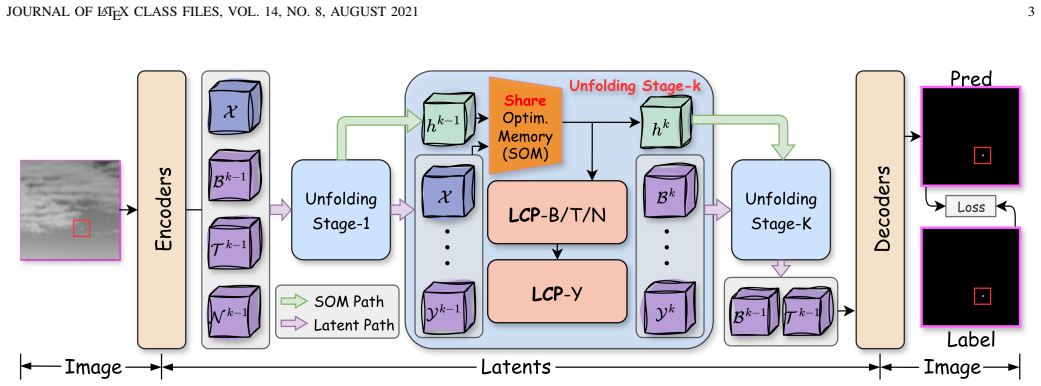
Latent Consistent Proximal (LCP) unfolding: after verifying the low-rank prior in latent features, ADMM-style stages run in that space; each variable is updated from its previous state via a learnable proximal surrogate (with group and spectral normalization), while Shared Optimization Memory supplies a single gated historical state to all branches.
What would settle it
If, on held-out infrared scenes, the latent tensors after the paper's encoders do not show rapidly decaying singular values (or Tucker rank), or if forcing the latent decomposition constraint measurably raises false-alarm rate versus an identical architecture without that constraint, the central physical-prior claim fails.
Extended reading notes
Core claim
The authors establish that low-rank/sparse decomposition remains valid in a learned latent space, and that a deep-unfolding network built on a Latent Consistent Proximal solver plus Shared Optimization Memory yields more accurate, lower-false-alarm infrared small-target detection than prior HVS, optimization, deep, and deep-unfolding methods on four public benchmarks.
Load-bearing premise
The claim rests on the premise that after a learned image-to-latent map, the background is still meaningfully low-rank and the target still sparse in that latent space, so the imposed decomposition constraint still encodes real scene structure rather than an encoder artifact.
Signed reviews
Editorial analysis
A structured set of objections, weighed in public.
Referee Report
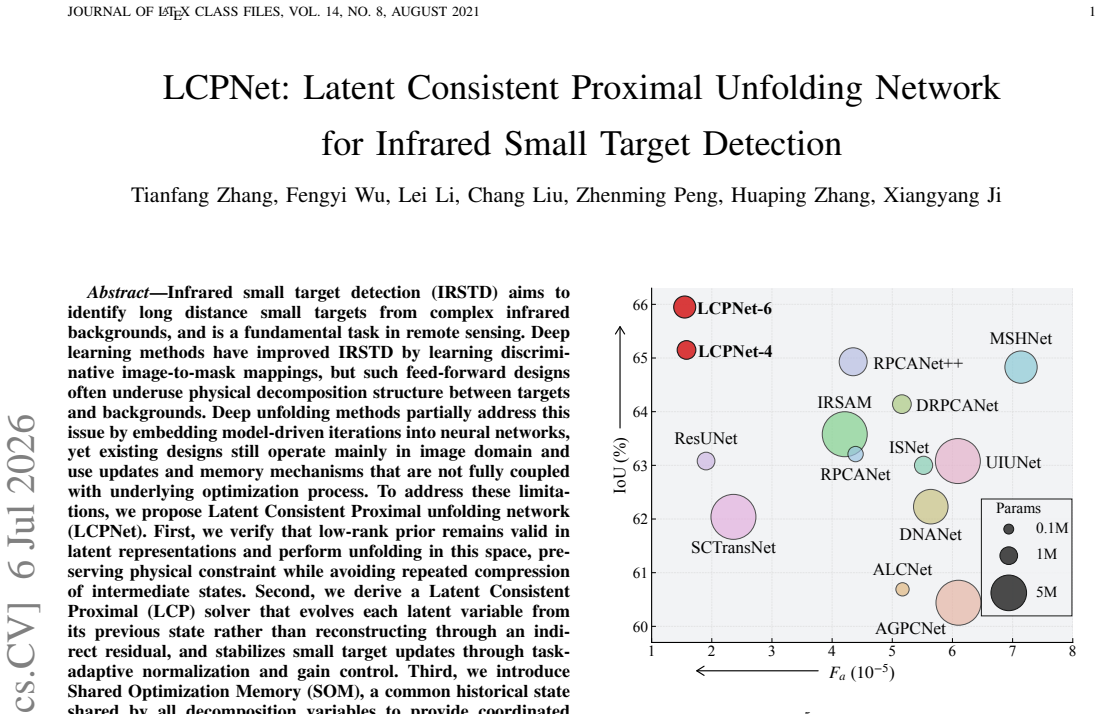
Summary. The paper proposes LCPNet, a deep-unfolding IRSTD method that lifts low-rank/sparse decomposition from the image domain into a multi-channel latent space (Eqs. 2–3), derives a Latent Consistent Proximal (LCP) solver that updates each variable from its previous state via a Lipschitz majorization of an unknown regularizer (Eqs. 9–17, Appendices A–B), and introduces Shared Optimization Memory (SOM) as a gated recurrent state shared by all decomposition variables (Eqs. 18–20, Appendix C). After K latent ADMM-style stages, the target latent is decoded to a detection mask. On NUDT-SIRST, IRSTD-1K, SIRST, and SIRST-Aug, LCPNet-4/6 report best or near-best IoU/F1, the lowest Fa, competitive AUC/ROC, and moderate params/FLOPs/latency versus HVS, optimization, deep, and prior unfolding baselines (Tables I–II, Figs. 6–11), with ablations on domain, solver style, updater regularization, memory type, and stage count (Tables III–V).
Significance. If the empirical gains hold under stronger evaluation, the work is a solid incremental contribution to interpretable IRSTD: it couples a latent-domain physical constraint with a proximal-style update and system-level memory, and it ships code plus detailed ADMM/majorization/SOM derivations. The combination of latent unfolding, GN+SN updater design, and shared memory is practically useful for false-alarm-sensitive remote sensing, and the multi-benchmark comparison against RPCANet-family and strong non-unfolding nets is valuable even if the absolute novelty over prior deep RPCA is moderate.
major comments (3)
- Abstract / §IV-B / Table I: the unqualified claim that LCPNet “outperforms state-of-the-art methods” is not fully supported by the reported metrics. On IRSTD-1K, LCPNet-6 IoU/F1 are best, but Pd (87.63%) is below DRPCANet (92.09%), DNANet (92.44%), and MSHNet (92.78%); on SIRST, Pd is 96.33% vs RPCANet++ 100% and DRPCANet 99.08%, while Fa is driven near zero. The operating point is therefore more conservative than uniformly superior. Please restate claims in terms of the IoU–Fa tradeoff (and/or fixed-Pd Fa), report multi-seed means±std or at least repeated runs for the headline margins, and avoid “outperforms SOTA” language where Pd is materially lower.
- §III-A / Eqs. 2–3 / Fig. 2 / Appendix D: the load-bearing premise that the low-rank prior “remains valid” after the learned lift is only partially evidenced. Rapid singular-value / Tucker-rank decay shows compressibility of the latent tensor, not that the learned encoders preserve a physically meaningful background–target–noise split under X=B+T+N. Without controls that freeze or ablate the encoders, or that measure reconstruction fidelity of B/T/N under the latent constraint, the model-driven interpretation of the unfolded stages remains partly circular. A short encoder-control experiment or quantitative latent-rank vs. image-rank comparison under fixed encoders would substantially strengthen this claim.
- Table V / §IV-C5: stage-depth behavior is non-monotonic (NUDT IoU peaks at K=5 then drops at K=6; Fa fluctuates 0.011–0.092), yet LCPNet-4 and LCPNet-6 are presented as primary models without a selection protocol, validation criterion, or uncertainty. Because K is a free hyperparameter that changes both accuracy and cost, the paper should either fix K a priori, select it on a held-out split with a stated rule, or report the full K-curve with variance so the SOTA numbers are not depth-tuned post hoc.
Circularity Check
No significant circularity: architecture is optimization-motivated with learnable surrogates; SOTA claims are external-benchmark evaluations, not results forced by definition or self-citation.
full rationale
LCPNet’s load-bearing claims are empirical (Table I IoU/F1/Pd/Fa and ROC/AUC on four public IRSTD benchmarks against independent and prior methods) and architectural (latent ADMM-style unfolding, LCP proximal surrogate, SOM). The LCP “derivation” (Eqs. 6–17, Appendices A–B) starts from a standard ADMM Lagrangian, assumes an unknown Lipschitz regularizer, majorizes it, and obtains a proximal-style update form; the ideal direction is then replaced by a learnable network Ψ, so the solver is not a closed prediction that equals its inputs by construction. Low-rank validity in latent space is an empirical design premise (Fig. 2, Appendix D), not a tautology that forces the reported metrics. Self-citations to RPCANet/RPCANet++/DRPCANet supply motivation and baselines, not uniqueness theorems or fitted quantities renamed as predictions. Training is ordinary supervised SoftIoU learning on held-out splits; nothing in the chain reduces Eq. X to Eq. Y by definition or fits a parameter then “predicts” a statistically forced sibling quantity. Score 0 is appropriate.
Assumptions & free parameters
free parameters (5)
- Unfolding stage count K =
4 or 6 (main models)
- Latent channel width C and encoder/decoder architecture
- Group count g in GroupNorm and spectral-normalized conv gains
- Training hyperparameters (lr=1e-4, poly power 0.9, batch=8, epochs 400/800, SoftIoU) =
lr 1e-4; SoftIoU; 800/400 epochs
- ADMM penalty / step-size related coefficients (μ, η via L+μ)
assumptions (4)
- domain assumption Infrared observations admit a low-rank background + sparse target + noise decomposition (image and, after encoding, latent).
- standard math Unknown latent regularizers have Lipschitz-continuous gradients, enabling the quadratic majorization used to derive the LCP closed form.
- domain assumption ADMM alternating updates in latent space remain a valid algorithmic skeleton once analytical proximal maps are replaced by neural surrogates.
- domain assumption Public single-frame IRSTD splits (NUDT-SIRST 1:1, IRSTD-1K, SIRST, SIRST-Aug) are adequate proxies for real long-range detection performance.
invented entities (3)
-
Latent Consistent Proximal (LCP) solver
-
Shared Optimization Memory (SOM)
-
Latent-space IRSTD unfolding formulation (X=B+T+N in R^{H×W×C})
Cite this review
Pith. "Pith review of LCPNet: Latent Consistent Proximal Unfolding Network for Infrared Small Target Detection." pith.science (2026). https://pith.science/paper/MIQ4NXPU
@misc{pith2026260704603,
  author       = {Pith},
  title        = {Pith review of: LCPNet: Latent Consistent Proximal Unfolding Network for Infrared Small Target Detection},
  year         = {2026},
  howpublished = {\url{https://pith.science/paper/MIQ4NXPU}},
  note         = {Machine review of arXiv:2607.04603}
}
read the original abstract
Infrared small target detection (IRSTD) aims to identify long distance small targets from complex infrared backgrounds, and is a fundamental task in remote sensing. Deep learning methods have improved IRSTD by learning discriminative image-to-mask mappings, but such feed-forward designs often underuse physical decomposition structure between targets and backgrounds. Deep unfolding methods partially address this issue by embedding model-driven iterations into neural networks, yet existing designs still operate mainly in image domain and use updates and memory mechanisms that are not fully coupled with underlying optimization process. To address these limitations, we propose Latent Consistent Proximal unfolding network (LCPNet). First, we verify that low-rank prior remains valid in latent representations and perform unfolding in this space, preserving physical constraint while avoiding repeated compression of intermediate states. Second, we derive a Latent Consistent Proximal (LCP) solver that evolves each latent variable from its previous state rather than reconstructing through an indirect residual, and stabilizes small target updates through task-adaptive normalization and gain control. Third, we introduce Shared Optimization Memory (SOM), a common historical state shared by all decomposition variables to provide coordinated guidance across unfolding stages. Extensive experiments on four public benchmarks demonstrate that LCPNet outperforms state-of-the-art methods while achieving accurate and robust detection with low false alarms and competitive efficiency. Model and code are available at https://github.com/Tianfang-Zhang/LCPNet.
Figures

Figures from the paper (12 more)


Reference graph
Works this paper leans on
-
[1]
Single-frame infrared small-target detection: A survey,
M. Zhao, W. Li, L. Li, J. Hu, P. Ma, and R. Tao, “Single-frame infrared small-target detection: A survey,”IEEE Geoscience and Remote Sensing Magazine, vol. 10, no. 2, pp. 87–119, 2022
2022
-
[2]
Infrared small target segmentation networks: A survey,
R. Kou, C. Wang, Z. Peng, Z. Zhao, Y . Chen, J. Han, F. Huang, Y . Yu, and Q. Fu, “Infrared small target segmentation networks: A survey,” Pattern Recognition, vol. 143, p. 109788, 2023
2023
-
[3]
Miss detection vs. false alarm: Adversarial learning for small object segmentation in infrared images,
H. Wang, L. Zhou, and L. Wang, “Miss detection vs. false alarm: Adversarial learning for small object segmentation in infrared images,” inProceedings of the IEEE/CVF International Conference on Computer Vision, 2019, pp. 8509–8518
2019
-
[4]
A local contrast method for small infrared target detection,
C. P. Chen, H. Li, Y . Wei, T. Xia, and Y . Y . Tang, “A local contrast method for small infrared target detection,”IEEE Transactions on Geoscience and Remote Sensing, vol. 52, no. 1, pp. 574–581, 2013
2013
-
[5]
Infrared patch-image model for small target detection in a single image,
C. Gao, D. Meng, Y . Yang, Y . Wang, X. Zhou, and A. G. Hauptmann, “Infrared patch-image model for small target detection in a single image,”IEEE Transactions on Image Processing, vol. 22, no. 12, pp. 4996–5009, 2013
2013
-
[6]
Attentional local contrast networks for infrared small target detection,
Y . Dai, Y . Wu, F. Zhou, and K. Barnard, “Attentional local contrast networks for infrared small target detection,”IEEE transactions on geoscience and remote sensing, vol. 59, no. 11, pp. 9813–9824, 2021
2021
-
[7]
Isnet: Shape matters for infrared small target detection,
M. Zhang, R. Zhang, Y . Yang, H. Bai, J. Zhang, and J. Guo, “Isnet: Shape matters for infrared small target detection,” inProceedings of the IEEE/CVF conference on computer vision and pattern recognition, 2022, pp. 877–886
2022
-
[8]
Asymmetric contextual modulation for infrared small target detection,
Y . Dai, Y . Wu, F. Zhou, and K. Barnard, “Asymmetric contextual modulation for infrared small target detection,” inProceedings of the IEEE/CVF Winter Conference on Applications of Computer Vision, 2021, pp. 950–959
2021
Show all 64 references
-
[9]
Dense nested attention network for infrared small target detection,
B. Li, C. Xiao, L. Wang, Y . Wang, Z. Lin, M. Li, W. An, and Y . Guo, “Dense nested attention network for infrared small target detection,” IEEE Transactions on Image Processing, vol. 32, pp. 1745–1758, 2022
2022
-
[10]
Uiu-net: U-net in u-net for infrared small object detection,
X. Wu, D. Hong, and J. Chanussot, “Uiu-net: U-net in u-net for infrared small object detection,”IEEE Transactions on Image Processing, vol. 32, pp. 364–376, 2022
2022
-
[11]
Attention-guided pyramid context networks for detecting infrared small target under complex background,
T. Zhang, L. Li, S. Cao, T. Pu, and Z. Peng, “Attention-guided pyramid context networks for detecting infrared small target under complex background,”IEEE Transactions on Aerospace and Electronic Systems, vol. 59, no. 4, pp. 4250–4261, 2023
2023
-
[12]
Infrared small target detection with scale and location sensitivity,
Q. Liu, R. Liu, B. Zheng, H. Wang, and Y . Fu, “Infrared small target detection with scale and location sensitivity,” inProceedings of the IEEE/CVF Conference on Computer Vision and Pattern Recognition, 2024, pp. 17 490–17 499
2024
-
[13]
Robust principal component analysis?
E. J. Cand `es, X. Li, Y . Ma, and J. Wright, “Robust principal component analysis?”Journal of the ACM, vol. 58, no. 3, pp. 1–37, 2011
2011
-
[14]
Infrared small target detection via non-convex rank approximation minimization joint l 2, 1 norm,
L. Zhang, L. Peng, T. Zhang, S. Cao, and Z. Peng, “Infrared small target detection via non-convex rank approximation minimization joint l 2, 1 norm,”Remote Sensing, vol. 10, no. 11, p. 1821, 2018
2018
-
[15]
Reweighted infrared patch-tensor model with both nonlocal and local priors for single-frame small target detection,
Y . Dai and Y . Wu, “Reweighted infrared patch-tensor model with both nonlocal and local priors for single-frame small target detection,”IEEE journal of selected topics in applied earth observations and remote sensing, vol. 10, no. 8, pp. 3752–3767, 2017
2017
-
[16]
Algorithm unrolling: Interpretable, efficient deep learning for signal and image processing,
V . Monga, Y . Li, and Y . C. Eldar, “Algorithm unrolling: Interpretable, efficient deep learning for signal and image processing,”IEEE Signal Processing Magazine, vol. 38, no. 2, pp. 18–44, 2021
2021
-
[17]
Rpcanet: Deep unfolding rpca based infrared small target detection,
F. Wu, T. Zhang, L. Li, Y . Huang, and Z. Peng, “Rpcanet: Deep unfolding rpca based infrared small target detection,” inProceedings of the IEEE/CVF Winter Conference on Applications of Computer Vision, 2024, pp. 4809–4818
2024
-
[18]
Rpcanet++: Deep interpretable robust pca for sparse object segmenta- tion,
F. Wu, Y . Dai, T. Zhang, Y . Ding, J. Yang, M.-M. Cheng, and Z. Peng, “Rpcanet++: Deep interpretable robust pca for sparse object segmenta- tion,”arXiv preprint arXiv:2508.04190, 2025
2025 arXiv
-
[19]
Batch normalization: Accelerating deep network training by reducing internal covariate shift,
S. Ioffe and C. Szegedy, “Batch normalization: Accelerating deep network training by reducing internal covariate shift,” inInternational conference on machine learning. pmlr, 2015, pp. 448–456
2015
-
[20]
Group normalization,
Y . Wu and K. He, “Group normalization,” inProceedings of the European conference on computer vision (ECCV), 2018, pp. 3–19
2018
-
[21]
Parseval networks: Improving robustness to adversarial examples,
M. Cisse, P. Bojanowski, E. Grave, Y . Dauphin, and N. Usunier, “Parseval networks: Improving robustness to adversarial examples,” in International conference on machine learning. PMLR, 2017, pp. 854– 863
2017
-
[22]
Spectral normalization for generative adversarial networks,
T. Miyato, T. Kataoka, M. Koyama, and Y . Yoshida, “Spectral normalization for generative adversarial networks,”arXiv preprint arXiv:1802.05957, 2018
2018 arXiv
-
[23]
Convolutional lstm network: A machine learning approach for precipitation nowcasting,
X. Shi, Z. Chen, H. Wang, D.-Y . Yeung, W.-K. Wong, and W.-C. Woo, “Convolutional lstm network: A machine learning approach for precipitation nowcasting,” inAdvances in Neural Information Processing Systems, vol. 28, 2015, pp. 802–810
2015
-
[24]
Infrared small-target detection based on multi-directional multi-scale high-boost response,
L. Peng, T. Zhang, S. Huang, T. Pu, Y . Liu, Y . Lv, Y . Zheng, and Z. Peng, “Infrared small-target detection based on multi-directional multi-scale high-boost response,”Optical Review, vol. 26, no. 6, pp. 568–582, 2019
2019
-
[25]
Morphology-based algorithm for point target detection in infrared backgrounds,
V . T. Tom, T. Peli, M. Leung, and J. E. Bondaryk, “Morphology-based algorithm for point target detection in infrared backgrounds,” inSignal and Data Processing of Small Targets 1993, vol. 1954. International Society for Optics and Photonics, 1993, pp. 2–11
1993
-
[26]
Max- mean and max-median filters for detection of small targets,
S. D. Deshpande, M. H. Er, R. Venkateswarlu, and P. Chan, “Max- mean and max-median filters for detection of small targets,” inSignal and Data Processing of Small Targets 1999, vol. 3809. International Society for Optics and Photonics, 1999, pp. 74–83
1999
-
[27]
Multiscale patch-based contrast measure for small infrared target detection,
Y . Wei, X. You, and H. Li, “Multiscale patch-based contrast measure for small infrared target detection,”Pattern Recognition, vol. 58, pp. 216–226, 2016
2016
-
[28]
Irsam: Advancing segment anything model for infrared small target detection,
M. Zhang, Y . Wang, J. Guo, Y . Li, X. Gao, and J. Zhang, “Irsam: Advancing segment anything model for infrared small target detection,” inEuropean Conference on Computer Vision. Springer, 2024, pp. 233– 249
2024
-
[29]
Saliency at the helm: Steering infrared small target detection with learnable kernels,
F. Wu, A. Liu, T. Zhang, L. Zhang, J. Luo, and Z. Peng, “Saliency at the helm: Steering infrared small target detection with learnable kernels,” IEEE Transactions on Geoscience and Remote Sensing, vol. 63, pp. 1– 14, 2024
2024
-
[30]
Pinwheel- shaped convolution and scale-based dynamic loss for infrared small JOURNAL OF LATEX CLASS FILES, VOL. 14, NO. 8, AUGUST 2021 14 target detection,
J. Yang, S. Liu, J. Wu, X. Su, N. Hai, and X. Huang, “Pinwheel- shaped convolution and scale-based dynamic loss for infrared small JOURNAL OF LATEX CLASS FILES, VOL. 14, NO. 8, AUGUST 2021 14 target detection,” inProceedings of the AAAI Conference on Artificial Intelligence, v...
2021
-
[31]
Ilnet: Low-level matters for salient infrared small target detection,
H. Li, J. Yang, R. Wang, and Y . Xu, “Ilnet: Low-level matters for salient infrared small target detection,”IEEE Transactions on Aerospace and Electronic Systems, 2025
2025
-
[32]
Learning fast approximations of sparse cod- ing,
K. Gregor and Y . LeCun, “Learning fast approximations of sparse cod- ing,” inProceedings of the 27th International Conference on Machine Learning. Omnipress, 2010, pp. 399–406
2010
-
[33]
Optimization-inspired cumulative trans- mission network for image compressive sensing,
T. Zhang, L. Li, and Z. Peng, “Optimization-inspired cumulative trans- mission network for image compressive sensing,”Knowledge-Based Systems, vol. 279, p. 110963, 2023
2023
-
[34]
Ista-net: Interpretable optimization-inspired deep network for image compressive sensing,
J. Zhang and B. Ghanem, “Ista-net: Interpretable optimization-inspired deep network for image compressive sensing,” in2018 IEEE/CVF Conference on Computer Vision and Pattern Recognition. IEEE, 2018, pp. 1828–1837
2018
-
[35]
Learned D-AMP: Principled neural network based compressive image recovery,
C. A. Metzler, A. Mousavi, and R. G. Baraniuk, “Learned D-AMP: Principled neural network based compressive image recovery,” 2017
2017
-
[36]
AMP-Net: Denoising based deep unfolding for compressive image sensing,
Z. Zhang, Y . Liu, J. Liu, F. Wen, and C. Zhu, “AMP-Net: Denoising based deep unfolding for compressive image sensing,”IEEE Transac- tions on Image Processing, vol. 30, pp. 1487–1500, 2021
2021
-
[37]
Deep admm-net for compressive sensing mri,
Y . Yang, J. Sun, H. Li, and Z. Xu, “Deep admm-net for compressive sensing mri,” inAdvances in Neural Information Processing Systems, vol. 29. Curran Associates, Inc., 2016
2016
-
[38]
Modl: Model-based deep learning architecture for inverse problems,
H. K. Aggarwal, M. P. Mani, and M. Jacob, “Modl: Model-based deep learning architecture for inverse problems,”IEEE Transactions on Medical Imaging, vol. 38, no. 2, pp. 394–405, 2018
2018
-
[39]
Learning a variational network for reconstruction of accelerated MRI data,
K. Hammernik, T. Klatzer, E. Kobler, M. P. Recht, D. K. Sodickson, T. Pock, and F. Knoll, “Learning a variational network for reconstruction of accelerated MRI data,”Magnetic Resonance in Medicine, vol. 79, no. 6, pp. 3055–3071, 2017
2017
-
[40]
Learned primal-dual reconstruction,
J. Adler and O. ¨Oktem, “Learned primal-dual reconstruction,”IEEE Transactions on Medical Imaging, vol. 37, no. 6, pp. 1322–1332, 2018
2018
-
[41]
End-to-end variational networks for accelerated MRI reconstruction,
A. Sriram, J. Zbontar, T. Murrell, A. Defazio, C. L. Zitnick, N. Yakubova, F. Knoll, and P. Johnson, “End-to-end variational networks for accelerated MRI reconstruction,” inMedical Image Computing and Computer Assisted Intervention – MICCAI 2020. Springer International Publish...
2020
-
[42]
Learned robust pca: A scalable deep unfolding approach for high-dimensional outlier detection,
H. Cai, J. Liu, and W. Yin, “Learned robust pca: A scalable deep unfolding approach for high-dimensional outlier detection,” inAdvances in Neural Information Processing Systems, vol. 34. Curran Associates, Inc., 2021, pp. 16 977–16 989
2021
-
[43]
Deep unsupervised learning using nonequilibrium thermodynamics,
J. Sohl-Dickstein, E. A. Weiss, N. Maheswaranathan, and S. Ganguli, “Deep unsupervised learning using nonequilibrium thermodynamics,” 2015
2015
-
[44]
Generative modeling by estimating gradients of the data distribution,
Y . Song and S. Ermon, “Generative modeling by estimating gradients of the data distribution,” 2020
2020
-
[45]
Denoising diffusion probabilistic models,
J. Ho, A. Jain, and P. Abbeel, “Denoising diffusion probabilistic models,” inAdvances in Neural Information Processing Systems, vol. 33. Curran Associates, Inc., 2020, pp. 6840–6851
2020
-
[46]
Improved denoising diffusion probabilistic models,
A. Nichol and P. Dhariwal, “Improved denoising diffusion probabilistic models,” 2021
2021
-
[47]
Denoising diffusion implicit models,
J. Song, C. Meng, and S. Ermon, “Denoising diffusion implicit models,” 2022
2022
-
[48]
Score-based generative modeling through stochastic differ- ential equations,
Y . Song, J. Sohl-Dickstein, D. P. Kingma, A. Kumar, S. Ermon, and B. Poole, “Score-based generative modeling through stochastic differ- ential equations,” inInternational Conference on Learning Representa- tions, 2021
2021
-
[49]
High- resolution image synthesis with latent diffusion models,
R. Rombach, A. Blattmann, D. Lorenz, P. Esser, and B. Ommer, “High- resolution image synthesis with latent diffusion models,” 2022
2022
-
[50]
Nesterov,Introductory Lectures on Convex Optimization: A Basic Course, ser
Y . Nesterov,Introductory Lectures on Convex Optimization: A Basic Course, ser. Applied Optimization. Springer, 2004, vol. 87
2004
-
[51]
Long short-term memory,
S. Hochreiter and J. Schmidhuber, “Long short-term memory,”Neural Computation, vol. 9, no. 8, pp. 1735–1780, 1997
1997
-
[52]
Learning phrase representations using rnn encoder–decoder for statistical machine translation,
K. Cho, B. van Merrienboer, C. Gulcehre, D. Bahdanau, F. Bougares, H. Schwenk, and Y . Bengio, “Learning phrase representations using rnn encoder–decoder for statistical machine translation,” inProceedings of the 2014 Conference on Empirical Methods in Natural Language Process...
2014
-
[53]
Recurrent inference machines for solving inverse problems,
P. Putzky and M. Welling, “Recurrent inference machines for solving inverse problems,” 2017
2017
-
[54]
Dense recurrent neural networks for accelerated MRI: History- cognizant unrolling of optimization algorithms,
S. A. H. Hosseini, B. Yaman, S. Moeller, M. Hong, and M. Ak- cakaya, “Dense recurrent neural networks for accelerated MRI: History- cognizant unrolling of optimization algorithms,”IEEE Journal of Se- lected Topics in Signal Processing, vol. 14, no. 6, pp. 1280–1291, 2020
2020
-
[55]
Recurrent variational network: A deep learning inverse problem solver applied to the task of accelerated MRI reconstruction,
G. Yiasemis, J.-J. Sonke, C. Sanchez, and J. Teuwen, “Recurrent variational network: A deep learning inverse problem solver applied to the task of accelerated MRI reconstruction,” in2022 IEEE/CVF Conference on Computer Vision and Pattern Recognition. IEEE, 2022, pp. 722–731
2022
-
[56]
Memory-augmented deep unfolding network for compressive sensing,
J. Song, B. Chen, and J. Zhang, “Memory-augmented deep unfolding network for compressive sensing,” inProceedings of the 29th ACM International Conference on Multimedia. ACM, 2021, pp. 4249–4258
2021
-
[57]
Efficiently modeling long sequences with structured state spaces,
A. Gu, K. Goel, and C. R ´e, “Efficiently modeling long sequences with structured state spaces,” 2022
2022
-
[58]
Mamba: Linear-time sequence modeling with selective state spaces,
A. Gu and T. Dao, “Mamba: Linear-time sequence modeling with selective state spaces,” 2024
2024
-
[59]
Vision mamba: Efficient visual representation learning with bidirectional state space model,
L. Zhu, B. Liao, Q. Zhang, X. Wang, W. Liu, and X. Wang, “Vision mamba: Efficient visual representation learning with bidirectional state space model,” 2024
2024
-
[60]
Vmamba: Visual state space model,
Y . Liu, Y . Tian, Y . Zhao, H. Yu, L. Xie, Y . Wang, Q. Ye, J. Jiao, and Y . Liu, “Vmamba: Visual state space model,” 2024
2024
-
[61]
Distributed optimization and statistical learning via the alternating direction method of multipliers,
S. Boyd, N. Parikh, E. Chu, B. Peleato, and J. Eckstein, “Distributed optimization and statistical learning via the alternating direction method of multipliers,”Foundations and Trends in Machine Learning, vol. 3, no. 1, pp. 1–122, 2011
2011
-
[62]
Infrared small target detection based on non-convex optimization with lp-norm constraint,
T. Zhang, H. Wu, Y . Liu, L. Peng, C. Yang, and Z. Peng, “Infrared small target detection based on non-convex optimization with lp-norm constraint,”Remote Sensing, vol. 11, no. 5, p. 559, 2019
2019
-
[63]
Sctransnet: Spatial- channel cross transformer network for infrared small target detection,
S. Yuan, H. Qin, X. Yan, N. Akhtar, and A. Mian, “Sctransnet: Spatial- channel cross transformer network for infrared small target detection,” IEEE Transactions on Geoscience and Remote Sensing, vol. 62, pp. 1– 15, 2024
2024
-
[64]
Drpca-net: Make robust pca great again for infrared small target detection,
Z. Xiong, F. Zhou, F. Wu, S. Yuan, M. Fu, Z. Peng, J. Yang, and Y . Dai, “Drpca-net: Make robust pca great again for infrared small target detection,”IEEE Transactions on Geoscience and Remote Sensing, 2025. JOURNAL OF LATEX CLASS FILES, VOL. 14, NO. 8, AUGUST 2021 15 APPENDIX...
2025
Reviewed July 11, 2026 · model on record in the stance chip above.
Discussion (0). Continue with ORCID to comment.