JWST Advanced Deep Extragalactic Survey (JADES) Data Release 5: Photometrically Selected Galaxy Candidates at z > 8
Pith reviewed 2026-05-21 15:28 UTC · model grok-4.3
The pith
JADES DR5 catalogs 2081 galaxy candidates at photometric redshifts above 8
A machine-rendered reading of the paper's core claim, the machinery that carries it, and where it could break.
Core claim
We present a sample of 2081 sources selected at photometric redshift z_phot > 8 across the JADES DR5 data release in GOODS-S and GOODS-N over a total area of 469 square arcmin. These sources range from M_UV = -22 to M_UV = -16, with 19 objects at z_phot > 14. We estimate the UV slopes for the full sample from fits to the photometry and find evidence for a steepening of the relationship between the UV continuum slope and M_UV to higher redshifts, a result that differs from prior analyses of brighter samples in the literature. We provide evidence that over one quarter of our sources have evidence for being morphologically extended, with many galaxies showing multiple bright knots or clumps.
What carries the argument
The z_phot > 8 selection from broadband photometry fits that identifies high-redshift galaxy candidates and enables analysis of their UV slopes and morphologies.
If this is right
- The steepening UV slope relation indicates evolving galaxy dust or stellar populations at the highest redshifts.
- Clumpy extended morphologies point to assembly processes like mergers or in-situ star formation in early galaxies.
- Improved fitting templates and Ly-alpha damping prescriptions enhance photometric redshift reliability for future samples.
- The 19 candidates at z_phot > 14 serve as priority targets for spectroscopic confirmation of the earliest galaxies.
Where Pith is reading between the lines
- This sample size could tighten constraints on the UV luminosity function at z > 8 and its contribution to reionization.
- Clumpy features may connect to theoretical models of how the first galaxies built up their stellar mass.
- Deeper or wider JWST imaging could test whether the extended sources remain candidates or show signs of gravitational lensing.
Load-bearing premise
Photometric redshifts accurately select true high-redshift galaxies without significant contamination from lower-redshift sources.
What would settle it
Spectroscopic redshifts for a large fraction of the sample that either confirm z > 8 for most candidates or reveal many as lower-redshift interlopers.
Figures



read the original abstract
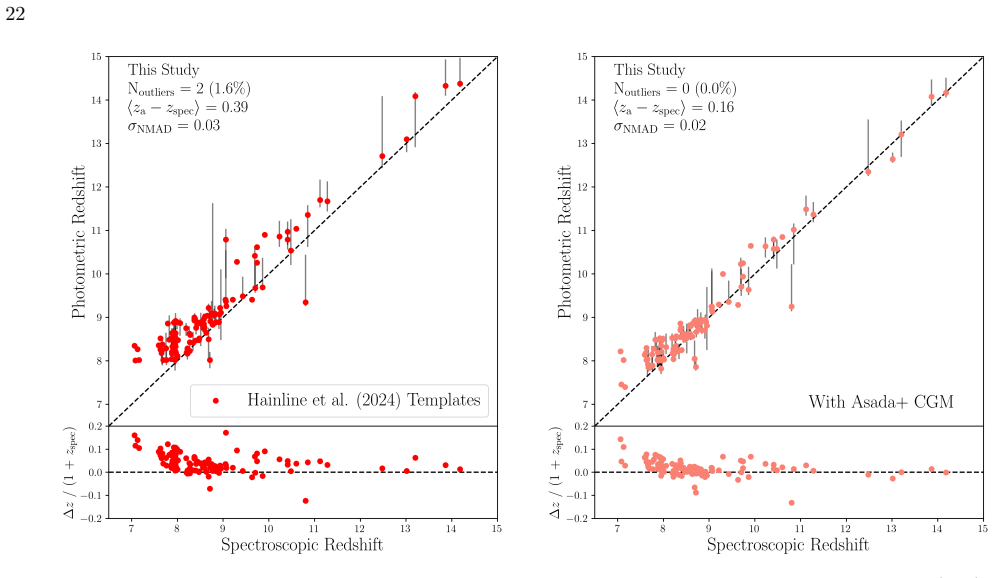
We present a sample of 2081 sources selected at photometric redshift $z_{\mathrm{phot}} > 8$ across the JADES DR5 data release in GOODS-S and GOODS-N over a total area of 469 square arcmin. These sources range from $M_{\mathrm{UV}} = -22$ to $M_{\mathrm{UV}} = -16$, with 19 objects at $z_{\mathrm{phot}} > 14$. We estimate the UV slopes for the full sample from fits to the photometry and find evidence for a steepening of the relationship between the UV continuum slope and $M_{\mathrm{UV}}$ to higher redshifts, a result that differs from prior analyses of brighter samples in the literature. We provide evidence that over one quarter of our sources have evidence for being morphologically extended, with many galaxies showing multiple bright knots or clumps even out to $z \sim 13 - 14$, an indication of how galaxies at Cosmic Dawn are growing and evolving. We discuss JADES-GN+189.15982+62.28899, a GOODS-N F200W dropout galaxy at $z_{\mathrm{phot}} \sim 15 - 18$ which has been observed spectroscopically with JWST/NIRSpec in prism mode, resulting in a very low signal-to-noise spectrum that is consistent with the photometry and rules out a number of low-redshift solutions for the source. Finally, we use a subsample of 123 objects in our sample with spectroscopic redshifts to explore the usage of alternate fitting templates and a prescription for Ly-$\alpha$ damping wing absorption, finding that both produce significant improvements to the estimated photometric redshifts.
Editorial analysis
A structured set of objections, weighed in public.
Referee Report
Summary. The paper presents a catalog of 2081 photometrically selected galaxy candidates at z_phot > 8 from JADES DR5 in the GOODS-S and GOODS-N fields over 469 arcmin², spanning M_UV from -22 to -16 with 19 sources at z_phot > 14. It reports evidence for steepening of the UV continuum slope versus M_UV relation at higher redshifts, morphological extension and clumpy structures in over one quarter of the sample up to z ~ 13-14, discusses a specific F200W dropout at z_phot ~15-18 with supporting low-S/N NIRSpec prism spectroscopy, and demonstrates photo-z improvements from alternate templates and Ly-α damping wing prescriptions on a 123-object spectroscopic subsample.
Significance. If the photometric selection is robust, this large sample would represent a substantial addition to high-redshift galaxy studies, enabling statistical analyses of UV properties and morphologies during Cosmic Dawn. The template and damping tests provide practical guidance for future photo-z work, and the NIRSpec follow-up on one extreme candidate offers direct validation. These elements could inform galaxy formation models if contamination and completeness are properly quantified.
major comments (2)
- [sample selection section] § on sample selection and photometric redshifts: The central claim of 2081 sources at z_phot >8 rests on broadband template fits, yet no explicit contamination fraction, purity, or false-positive rate is reported for the full sample (beyond the 123-object spectroscopic subsample). This is load-bearing for the headline numbers and especially the 19 z_phot >14 candidates, where even modest interloper fractions would dominate; a selection-function model tied to the exact color cuts and depth is needed to support the trends.
- [UV slopes section] UV-slope analysis section: The reported steepening of the UV slope–M_UV relation lacks a quantitative error budget, propagation of photometric uncertainties, or assessment of how photo-z selection biases affect the slope measurements. Without these, it is unclear whether the difference from prior brighter samples is robust or driven by the unquantified contamination in the parent sample.
minor comments (2)
- [morphology section] Clarify the precise quantitative criteria used to classify sources as 'morphologically extended' and how clump detection is performed (e.g., surface-brightness thresholds or fitting methods).
- [data and fields section] Provide a table or explicit statement of the effective area and depth variations between GOODS-S and GOODS-N to allow readers to assess sample uniformity.
Simulated Author's Rebuttal
We thank the referee for the constructive and detailed report. The comments highlight important aspects of robustness that we will strengthen in the revised manuscript. We address each major comment below.
read point-by-point responses
-
Referee: [sample selection section] § on sample selection and photometric redshifts: The central claim of 2081 sources at z_phot >8 rests on broadband template fits, yet no explicit contamination fraction, purity, or false-positive rate is reported for the full sample (beyond the 123-object spectroscopic subsample). This is load-bearing for the headline numbers and especially the 19 z_phot >14 candidates, where even modest interloper fractions would dominate; a selection-function model tied to the exact color cuts and depth is needed to support the trends.
Authors: We agree that explicit quantification of contamination and a selection function are necessary to support the headline sample size and especially the 19 z_phot >14 candidates. The manuscript already uses the 123-object spectroscopic subsample to validate the photo-z pipeline and demonstrate improvements from alternate templates and Ly-α damping-wing prescriptions, which indirectly constrains interloper rates. However, we did not provide a full-sample contamination estimate or selection-function model. In revision we will add a dedicated subsection that (i) derives an empirical contamination fraction by applying the identical color and photo-z cuts to the spectroscopic subsample and to lower-redshift control fields, (ii) discusses the robustness of the 19 z_phot >14 sources individually (including the F200W-dropout source with NIRSpec prism data that rules out several low-z solutions), and (iii) presents a basic selection-function model based on the survey depth, color cuts, and completeness simulations already performed for the JADES DR5 release. revision: yes
-
Referee: [UV slopes section] UV-slope analysis section: The reported steepening of the UV slope–M_UV relation lacks a quantitative error budget, propagation of photometric uncertainties, or assessment of how photo-z selection biases affect the slope measurements. Without these, it is unclear whether the difference from prior brighter samples is robust or driven by the unquantified contamination in the parent sample.
Authors: We concur that a quantitative error budget and bias assessment are required to substantiate the reported steepening of the UV-slope–M_UV relation. The present analysis fits β directly to the broadband photometry but does not propagate photometric uncertainties through to the slope measurements nor test the influence of photo-z selection. In the revised manuscript we will (i) implement Monte-Carlo resampling of the photometric errors and photo-z probability distributions to derive uncertainties on β and on the slope of the β–M_UV relation, (ii) repeat the fit on subsets with progressively stricter photo-z quality cuts to quantify selection bias, and (iii) compare the trend obtained from the full photometric sample with that from the 123 spectroscopic objects to assess the impact of any residual contamination. These additions will allow a direct statistical comparison with prior brighter samples. revision: yes
Circularity Check
No significant circularity in photometric catalog selection
full rationale
The paper presents a direct catalog of 2081 sources selected via standard photometric redshift template fits (EAZY or similar) applied to new JADES DR5 broadband photometry over 469 arcmin². The core result is simply the count of objects satisfying the z_phot > 8 cut, which follows immediately from running the fits on the observations. No quantity is derived by fitting a parameter to a subset and then renaming a closely related output as a 'prediction.' The 123-object spectroscopic subsample is used only for validation and template testing, not to construct the main sample or to close any self-referential loop. UV-slope and morphology trends are measured on the selected objects without reducing to prior fitted values or self-citation chains. The derivation is therefore self-contained against the external photometric data.
Axiom & Free-Parameter Ledger
free parameters (1)
- Ly-alpha damping wing absorption parameters
axioms (1)
- domain assumption Broadband photometry can be used to estimate reliable photometric redshifts for z > 8 galaxy candidates.
Lean theorems connected to this paper
-
IndisputableMonolith/Cost/FunctionalEquation.leanwashburn_uniqueness_aczel unclear?
unclearRelation between the paper passage and the cited Recognition theorem.
We ran EAZY on the full GOODS-S and GOODS-N photometric catalogs using a set of 16 templates... Our z > 8 galaxy selection criteria are straightforward: 1. We require that z_a > 8... 3. The difference in overall minimum χ² and the χ² restricted for fits at z < 7 must be greater than four: Δχ² = χ²_min,z<7 − χ²_min > 4.
-
IndisputableMonolith/Foundation/AlphaCoordinateFixation.leanJ_uniquely_calibrated_via_higher_derivative unclear?
unclearRelation between the paper passage and the cited Recognition theorem.
We estimate the UV slopes for the full sample from fits to the photometry and find evidence for a steepening of the relationship between the UV continuum slope and M_UV to higher redshifts
What do these tags mean?
- matches
- The paper's claim is directly supported by a theorem in the formal canon.
- supports
- The theorem supports part of the paper's argument, but the paper may add assumptions or extra steps.
- extends
- The paper goes beyond the formal theorem; the theorem is a base layer rather than the whole result.
- uses
- The paper appears to rely on the theorem as machinery.
- contradicts
- The paper's claim conflicts with a theorem or certificate in the canon.
- unclear
- Pith found a possible connection, but the passage is too broad, indirect, or ambiguous to say the theorem truly supports the claim.
Forward citations
Cited by 3 Pith papers
-
Intense and extended CIII] emission suggests a strong outflow in JADES-GS-z14-0
Extended CIII] emission offset from the stars in a z=14.18 galaxy indicates outflows with mass outflow rate ~160 solar masses per year and mass-loading factor 4-15, constraining star-formation efficiency to below 0.08.
-
Two Exciting High-redshift Galaxy Candidates Turn Out to Be Two Exciting Ultra-cool Brown Dwarfs
Two high-redshift galaxy candidates are reidentified as ultra-cool Y-type brown dwarfs at ~500 pc based on NIRSpec spectra matching templates and detected proper motions of 49 and 24 mas/yr.
-
Strong Gravitational Lensing with the James Webb Space Telescope
Strong gravitational lensing paired with JWST enables magnified high-resolution views of distant sources and improved constraints on dark matter.
Reference graph
Works this paper leans on
-
[1]
Adamo, A., Bradley, L. D., Vanzella, E., et al. 2024, Nature, 632, 513, doi: 10.1038/s41586-024-07703-7
-
[2]
Adams, N. J., Conselice, C. J., Ferreira, L., et al. 2023, MNRAS, 518, 4755, doi: 10.1093/mnras/stac3347
-
[3]
J., Austin, D., Harvey, T., et al
Adams, N. J., Austin, D., Harvey, T., et al. 2025, MNRAS, 542, 1705, doi: 10.1093/mnras/staf1153
-
[4]
Alberts, S., Williams, C. C., Helton, J. M., et al. 2024, ApJ, 975, 85, doi: 10.3847/1538-4357/ad66cc
-
[5]
Allen, N., Oesch, P. A., Toft, S., et al. 2025, A&A, 698, A30, doi: 10.1051/0004-6361/202452690 Arrabal Haro, P., Dickinson, M., Finkelstein, S. L., et al. 2023a, ApJL, 951, L22, doi: 10.3847/2041-8213/acdd54 —. 2023b, Nature, 622, 707, doi: 10.1038/s41586-023-06521-7
-
[6]
Asada, Y., Desprez, G., Willott, C. J., et al. 2025, ApJL, 983, L2, doi: 10.3847/2041-8213/adc388 Astropy Collaboration, Robitaille, T. P., Tollerud, E. J., et al. 2013, A&A, 558, A33, doi: 10.1051/0004-6361/201322068 Astropy Collaboration, Price-Whelan, A. M., Sip˝ ocz, B. M., et al. 2018, AJ, 156, 123, doi: 10.3847/1538-3881/aabc4f
-
[7]
Atek, H., Shuntov, M., Furtak, L. J., et al. 2023a, MNRAS, 519, 1201, doi: 10.1093/mnras/stac3144
-
[8]
2023b, MNRAS, 524, 5486, doi: 10.1093/mnras/stad1998
Atek, H., Chemerynska, I., Wang, B., et al. 2023b, MNRAS, 524, 5486, doi: 10.1093/mnras/stad1998
-
[9]
Austin, D., Adams, N., Conselice, C. J., et al. 2023, ApJL, 952, L7, doi: 10.3847/2041-8213/ace18d
-
[10]
B., Pirzkal, N., Finkelstein, S
Bagley, M. B., Pirzkal, N., Finkelstein, S. L., et al. 2024, ApJL, 965, L6, doi: 10.3847/2041-8213/ad2f31
-
[11]
M., Ito, K., Valentino, F., et al
Baker, W. M., Ito, K., Valentino, F., et al. 2025, arXiv e-prints, arXiv:2509.09761, doi: 10.48550/arXiv.2509.09761
-
[12]
Barrufet, L., Arellano Cordova, K. Z., Baggen, J. F. W., et al. 2024, Dead or alive? Unveiling the nature of massive galaxies in the early Universe, JWST Proposal. Cycle 3, ID. #5545
work page 2024
-
[13]
Bouwens, R. J., Illingworth, G. D., Labbe, I., et al. 2011, Nature, 469, 504, doi: 10.1038/nature09717
-
[14]
Bouwens, R. J., Illingworth, G. D., Oesch, P. A., et al. 2015, ApJ, 803, 34, doi: 10.1088/0004-637X/803/1/34
-
[15]
Bouwens, R. J., Oesch, P. A., Stefanon, M., et al. 2021, AJ, 162, 47, doi: 10.3847/1538-3881/abf83e
-
[16]
Brammer, G. B., van Dokkum, P. G., & Coppi, P. 2008, ApJ, 686, 1503, doi: 10.1086/591786
work page internal anchor Pith review doi:10.1086/591786 2008
-
[17]
A Matched Catalogue of z> 5.9 Galaxies in the WFC3 Hubble Ultra Deep Field
Bunker, A., & Wilkins, S. 2009, arXiv e-prints, arXiv:0912.1351, doi: 10.48550/arXiv.0912.1351
work page internal anchor Pith review Pith/arXiv arXiv doi:10.48550/arxiv.0912.1351 2009
-
[18]
J., NIRSPEC Instrument Science Team, & JAESs Collaboration
Bunker, A. J., NIRSPEC Instrument Science Team, & JAESs Collaboration. 2020, in IAU Symposium, Vol. 352, Uncovering Early Galaxy Evolution in the ALMA and JWST Era, ed. E. da Cunha, J. Hodge, J. Afonso, L. Pentericci, & D. Sobral, 342–346, doi: 10.1017/S1743921319009463
-
[19]
Bunker, A. J., Cameron, A. J., Curtis-Lake, E., et al. 2023a, arXiv e-prints, arXiv:2306.02467, doi: 10.48550/arXiv.2306.02467
-
[20]
Bunker, A. J., Saxena, A., Cameron, A. J., et al. 2023b, A&A, 677, A88, doi: 10.1051/0004-6361/202346159 27
-
[21]
Calzetti, D., Kinney, A. L., & Storchi-Bergmann, T. 1994, ApJ, 429, 582, doi: 10.1086/174346
-
[22]
J., Katz, H., Witten, C., et al
Cameron, A. J., Katz, H., Witten, C., et al. 2024, MNRAS, 534, 523, doi: 10.1093/mnras/stae1547
-
[23]
2024, Nature, 633, 318, doi: 10.1038/s41586-024-07860-9
Carniani, S., Hainline, K., D’Eugenio, F., et al. 2024, Nature, 633, 318, doi: 10.1038/s41586-024-07860-9
-
[24]
2025, A&A, 696, A87, doi: 10.1051/0004-6361/202452451
Carniani, S., D’Eugenio, F., Ji, X., et al. 2025, A&A, 696, A87, doi: 10.1051/0004-6361/202452451
-
[25]
2022, ApJL, 938, L15, doi: 10.3847/2041-8213/ac94d0
Castellano, M., Fontana, A., Treu, T., et al. 2022, ApJL, 938, L15, doi: 10.3847/2041-8213/ac94d0
-
[26]
2025, arXiv e-prints, arXiv:2504.05893, doi: 10.48550/arXiv.2504.05893
Castellano, M., Fontana, A., Merlin, E., et al. 2025, arXiv e-prints, arXiv:2504.05893, doi: 10.48550/arXiv.2504.05893
-
[27]
Glover, S. C. O. 2024, A&A, 689, A244, doi: 10.1051/0004-6361/202450224
-
[28]
2024, MNRAS, 528, L33, doi: 10.1093/mnrasl/slad171
Chen, H. 2024, MNRAS, 528, L33, doi: 10.1093/mnrasl/slad171
-
[29]
Chen, Z., Stark, D. P., Mason, C., et al. 2024, MNRAS, 528, 7052, doi: 10.1093/mnras/stae455
-
[30]
2022, MNRAS, 517, 5104, doi: 10.1093/mnras/stac2874
Chisholm, J., Saldana-Lopez, A., Flury, S., et al. 2022, MNRAS, 517, 5104, doi: 10.1093/mnras/stac2874
-
[31]
Chisholm, J., Berg, D. A., Endsley, R., et al. 2024, MNRAS, 534, 2633, doi: 10.1093/mnras/stae2199
-
[32]
L., Shao, A., & Senthil Kumar, G
Clausen, T., Steinhardt, C. L., Shao, A., & Senthil Kumar, G. 2025, A&A, 697, A160, doi: 10.1051/0004-6361/202453247
-
[33]
Cullen, F., McLure, R. J., McLeod, D. J., et al. 2023, MNRAS, 520, 14, doi: 10.1093/mnras/stad073
-
[34]
Cullen, F., McLeod, D. J., McLure, R. J., et al. 2024, MNRAS, 531, 997, doi: 10.1093/mnras/stae1211
-
[35]
2023, Nature Astronomy, 7, 622, doi: 10.1038/s41550-023-01918-w
Curtis-Lake, E., Carniani, S., Cameron, A., et al. 2023, Nature Astronomy, 7, 622, doi: 10.1038/s41550-023-01918-w
-
[36]
Curtis-Lake, E., Cameron, A. J., Bunker, A. J., et al. 2025, arXiv e-prints, arXiv:2510.01033, doi: 10.48550/arXiv.2510.01033 de Graaff, A., Brammer, G., Weibel, A., et al. 2025, A&A, 697, A189, doi: 10.1051/0004-6361/202452186
work page internal anchor Pith review Pith/arXiv arXiv doi:10.48550/arxiv.2510.01033 2025
-
[37]
DeCoursey, C., Egami, E., Pierel, J. D. R., et al. 2025, ApJ, 979, 250, doi: 10.3847/1538-4357/ad8fab
-
[38]
2009, ApJ, 703, 785, doi: 10.1088/0004-637X/703/1/785
Dekel, A., Sari, R., & Ceverino, D. 2009, ApJ, 703, 785, doi: 10.1088/0004-637X/703/1/785
-
[39]
2023, MNRAS, 523, 3201, doi: 10.1093/mnras/stad1557
Li, Z. 2023, MNRAS, 523, 3201, doi: 10.1093/mnras/stad1557
-
[40]
2013, MNRAS, 435, 999, doi: 10.1093/mnras/stt1338 D’Eugenio, F., Cameron, A
Dekel, A., Zolotov, A., Tweed, D., et al. 2013, MNRAS, 435, 999, doi: 10.1093/mnras/stt1338 D’Eugenio, F., Cameron, A. J., Scholtz, J., et al. 2024a, arXiv e-prints, arXiv:2404.06531, doi: 10.48550/arXiv.2404.06531 D’Eugenio, F., Maiolino, R., Carniani, S., et al. 2024b, A&A, 689, A152, doi: 10.1051/0004-6361/202348636 D’Eugenio, F., Nelson, E. J., Eisens...
-
[41]
Donnan, C. T., McLeod, D. J., McLure, R. J., et al. 2023, MNRAS, 520, 4554, doi: 10.1093/mnras/stad471
-
[42]
Donnan, C. T., McLure, R. J., Dunlop, J. S., et al. 2024, MNRAS, 533, 3222, doi: 10.1093/mnras/stae2037
-
[43]
Donnan, C. T., Dickinson, M., Taylor, A. J., et al. 2025, ApJ, 993, 224, doi: 10.3847/1538-4357/ae0a1f
-
[44]
Donnan, C. T., McLeod, D. J., McLure, R. J., et al. 2026, arXiv e-prints, arXiv:2601.11515. https://arxiv.org/abs/2601.11515
work page internal anchor Pith review Pith/arXiv arXiv 2026
-
[45]
2025, A&A, 698, A234, doi: 10.1051/0004-6361/202453267
Dottorini, D., Calabr` o, A., Pentericci, L., et al. 2025, A&A, 698, A234, doi: 10.1051/0004-6361/202453267
-
[46]
2023, Complete NIRCam Grism Redshift Survey (CONGRESS), JWST Proposal
Egami, E., Sun, F., Alberts, S., et al. 2023, Complete NIRCam Grism Redshift Survey (CONGRESS), JWST Proposal. Cycle 2, ID. #3577
work page 2023
-
[47]
Overview of the JWST Advanced Deep Extragalactic Survey (JADES)
Eisenstein, D. J., Willott, C., Alberts, S., et al. 2023a, arXiv e-prints, arXiv:2306.02465, doi: 10.48550/arXiv.2306.02465
work page internal anchor Pith review Pith/arXiv arXiv doi:10.48550/arxiv.2306.02465
-
[48]
Eisenstein, D. J., Johnson, B. D., Robertson, B., et al. 2023b, arXiv e-prints, arXiv:2310.12340, doi: 10.48550/arXiv.2310.12340
-
[49]
Eldridge, J. J., Stanway, E. R., Xiao, L., et al. 2017, PASA, 34, e058, doi: 10.1017/pasa.2017.51
work page internal anchor Pith review doi:10.1017/pasa.2017.51 2017
-
[50]
Ellis, R. S., McLure, R. J., Dunlop, J. S., et al. 2013, ApJL, 763, L7, doi: 10.1088/2041-8205/763/1/L7
-
[51]
Feldmann, R., Boylan-Kolchin, M., Bullock, J. S., et al. 2025, MNRAS, 536, 988, doi: 10.1093/mnras/stae2633
-
[52]
J., Chatzikos, M., Guzm´ an, F., et al
Ferland, G. J., Chatzikos, M., Guzm´ an, F., et al. 2017, RMxAA, 53, 385, doi: 10.48550/arXiv.1705.10877
-
[53]
L., Ryan, Russell E., J., Papovich, C., et al
Finkelstein, S. L., Ryan, Russell E., J., Papovich, C., et al. 2015, ApJ, 810, 71, doi: 10.1088/0004-637X/810/1/71
-
[54]
Finkelstein, S. L., Bagley, M. B., Arrabal Haro, P., et al. 2022, ApJL, 940, L55, doi: 10.3847/2041-8213/ac966e
-
[55]
Finkelstein, S. L., Bagley, M. B., Ferguson, H. C., et al. 2023, ApJL, 946, L13, doi: 10.3847/2041-8213/acade4
-
[56]
Finkelstein, S. L., Leung, G. C. K., Bagley, M. B., et al. 2024, ApJL, 969, L2, doi: 10.3847/2041-8213/ad4495
-
[57]
2023, ApJL, 949, L25, doi: 10.3847/2041-8213/acd2d9
Fujimoto, S., Arrabal Haro, P., Dickinson, M., et al. 2023, ApJL, 949, L25, doi: 10.3847/2041-8213/acd2d9
-
[58]
2025, Nature Astronomy, 9, 1553, doi: 10.1038/s41550-025-02592-w 28
Fujimoto, S., Ouchi, M., Kohno, K., et al. 2025, Nature Astronomy, 9, 1553, doi: 10.1038/s41550-025-02592-w 28
-
[59]
2025, MNRAS, 540, 2331, doi: 10.1093/mnras/staf768
Gazagnes, S., Chisholm, J., Endsley, R., et al. 2025, MNRAS, 540, 2331, doi: 10.1093/mnras/staf768
-
[60]
Gelli, V., Mason, C., & Hayward, C. C. 2024, ApJ, 975, 192, doi: 10.3847/1538-4357/ad7b36
-
[61]
Giavalisco, M., Ferguson, H. C., Koekemoer, A. M., et al. 2004, ApJL, 600, L93, doi: 10.1086/379232
work page internal anchor Pith review doi:10.1086/379232 2004
-
[62]
Hainline, K. N., Johnson, B. D., Robertson, B., et al. 2024a, ApJ, 964, 71, doi: 10.3847/1538-4357/ad1ee4
-
[63]
N., D’Eugenio, F., Jakobsen, P., et al
Hainline, K. N., D’Eugenio, F., Jakobsen, P., et al. 2024b, ApJ, 976, 160, doi: 10.3847/1538-4357/ad8447
-
[64]
Hainline, K. N., Helton, J. M., Johnson, B. D., et al. 2024c, ApJ, 964, 66, doi: 10.3847/1538-4357/ad20d1
-
[65]
JADES: An Abundance of Ultra-Distant T- and Y-Dwarfs in Deep Extragalactic Data
Hainline, K. N., Helton, J. M., Miles, B. E., et al. 2025a, arXiv e-prints, arXiv:2510.00111, doi: 10.48550/arXiv.2510.00111
work page internal anchor Pith review Pith/arXiv arXiv doi:10.48550/arxiv.2510.00111
-
[66]
N., Maiolino, R., Juodˇ zbalis, I., et al
Hainline, K. N., Maiolino, R., Juodˇ zbalis, I., et al. 2025b, ApJ, 979, 138, doi: 10.3847/1538-4357/ad9920
-
[67]
2016, ApJ, 821, 123, doi: 10.3847/0004-637X/821/2/123
Harikane, Y., Ouchi, M., Ono, Y., et al. 2016, ApJ, 821, 123, doi: 10.3847/0004-637X/821/2/123
-
[68]
2023, ApJS, 265, 5, doi: 10.3847/1538-4365/acaaa9
Harikane, Y., Ouchi, M., Oguri, M., et al. 2023, ApJS, 265, 5, doi: 10.3847/1538-4365/acaaa9
-
[69]
Harikane, Y., Inoue, A. K., Ellis, R. S., et al. 2025, ApJ, 980, 138, doi: 10.3847/1538-4357/ad9b2c
-
[70]
E., Watson, D., Brammer, G., et al
Heintz, K. E., Watson, D., Brammer, G., et al. 2024, Science, 384, 890, doi: 10.1126/science.adj0343
-
[71]
Heintz, K. E., Brammer, G. B., Watson, D., et al. 2025a, A&A, 693, A60, doi: 10.1051/0004-6361/202450243
-
[72]
Heintz, K. E., Pollock, C. L., Witstok, J., et al. 2025b, ApJL, 987, L2, doi: 10.3847/2041-8213/ade393
-
[73]
M., Sun, F., Woodrum, C., et al
Helton, J. M., Sun, F., Woodrum, C., et al. 2024, ApJ, 974, 41, doi: 10.3847/1538-4357/ad6867
-
[74]
Helton, J. M., Rieke, G. H., Alberts, S., et al. 2025a, Nature Astronomy, 9, 729, doi: 10.1038/s41550-025-02503-z
-
[75]
Helton, J. M., Morrison, J. E., Hainline, K. N., et al. 2025b, arXiv e-prints, arXiv:2512.19695, doi: 10.48550/arXiv.2512.19695
-
[76]
Helton, J. M., Alberts, S., Rieke, G. H., et al. 2025c, arXiv e-prints, arXiv:2506.02099, doi: 10.48550/arXiv.2506.02099
-
[77]
Huberty, M., Scarlata, C., Hayes, M. J., & Gazagnes, S. 2025, ApJ, 987, 82, doi: 10.3847/1538-4357/add5e7
-
[78]
Illingworth, G. 2017, Completing the Legacy of Hubble’s Wide/Deep Fields: An Aligned Complete Dataset of 1220 Orbits on the GOODS-N/CANDELS-N Region, HST Proposal id.15027. Cycle 25
work page 2017
-
[79]
Illingworth, G. D., Magee, D., Oesch, P. A., et al. 2013, ApJS, 209, 6, doi: 10.1088/0067-0049/209/1/6
-
[80]
2022, A&A, 661, A80, doi: 10.1051/0004-6361/202142663
Jakobsen, P., Ferruit, P., Alves de Oliveira, C., et al. 2022, A&A, 661, A80, doi: 10.1051/0004-6361/202142663
work page internal anchor Pith review doi:10.1051/0004-6361/202142663 2022
discussion (0)
Sign in with ORCID, Apple, or X to comment. Anyone can read and Pith papers without signing in.