REVIEW 2 major objections 5 minor 23 references
On the geometrical and dynamical distinction between Unimodular and General Relativistic wormholes
T0 review · 2 major / 5 minor · reviewed 2026-08-01 · deepseek-v4-flash
Pith's one-line read Unimodular gravity and general relativity produce identical wormhole geometries and geodesics; the split between them is entirely in how the source sector is interpreted.
desk verdict Solid source-sector analysis for a specific UG wormhole family, with the GR-limit curve and Λ_int profile as the real content; the imported solution family and a backwards caption are the soft spots. read the letter →
The pith
A machine-rendered reading of the paper's core claim, the machinery that carries it, and where it could break.
The reading
What carries the argument
The central object is the Morris-Thorne metric (1) with zero redshift function and power-law shape function b(r)/r = (r/r0)^xi, paired with the two-parameter barotropic equation of state p_r = alpha rho, p_t = beta p_r. In unimodular gravity the field equations are the traceless Einstein equations, and the cosmological constant becomes an integration constant; this leaves a two-parameter solution family in which energy-momentum is not necessarily conserved. The argument turns on the condition beta = xi/2, equivalently beta = -(1+alpha)/(2alpha): it is the single constraint that makes the non-conservation current J^r vanish and, through the Bianchi identity, renders the traceless UG equations
What would settle it
Compute the exact GR source terms needed to support the same metric (1) but with a nonzero redshift function Phi(r) and the same barotropic equation of state; if a conserved, barotropic source exists for beta different from -(1+alpha)/(2alpha), the claimed uniqueness of the GR limit fails. Alternatively, exhibit a unimodular wormhole solution within the barotropic class (1)-(4) that violates the flaring-out condition xi < 0 yet still yields a traversable throat, or one whose VIQ is divergent while the paper's partition predicts finite support.
Extended reading notes
Core claim
The central claim, stated in Section VI, is that for the barotropic Morris-Thorne wormhole family (1)-(4), UG wormholes are geometrically indistinguishable from GR wormholes: geodesics are determined solely by the metric, so all kinematic and traversal features are identical. The distinction is dynamical. If one demands local energy-momentum conservation, the two-parameter family of UG solutions collapses to the one-parameter curve beta = xi/2, equivalently beta = -(1+alpha)/(2alpha), which coincides exactly with the unique solution of the full Einstein equations for the same metric and barotropic source. Off this curve, no GR map preserving the full source structure exists; instead, the non
Load-bearing premise
The analysis rests on a specific Morris-Thorne ansatz with zero redshift function and a two-parameter barotropic equation of state, with the UG solution family imported from earlier work; if that ansatz does not exhaust the physically relevant unimodular wormhole sector, or if nonzero redshift changes the source mapping, the quantitative results (the beta = xi/2 condition, the VIQ partition, and the Lambda_int(r) profile) may not generalize, even though the geodesic equality
Editorial extensions
If this is right
- For any fixed wormhole metric, test-particle geodesics, proper traversal time, turning points, and the condition E^2 >= 1 + L^2/r0^2 for crossing the throat are identical in UG and GR; no kinematic experiment can separate the theories.
- Unimodular gravity does not bypass the exotic-matter requirement for this wormhole class: the null energy condition is violated everywhere, and the flaring-out condition forces xi < 0.
- A GR wormhole supported by a barotropic fluid is unique for a given alpha, with beta = -(1+alpha)/(2alpha) and shape exponent xi = -(1+alpha)/alpha; any other beta in the UG family cannot be realized in GR with a conserved barotropic source.
- When the non-conservation current is reinterpreted as an inhomogeneous vacuum Lambda_int(r), the total effective fluid becomes position-dependent and no longer barotropic, even though rho + p_r and the VIQ are unchanged.
- The wormhole generates a local shift in the effective vacuum energy between the throat and infinity, Delta Lambda, whose sign and magnitude are set by beta - xi/2; in the GR limit Delta Lambda = 0.
Reading between the lines
- The beta = xi/2 equivalence condition is derived for zero redshift and a power-law shape function; one could test whether the source-sector mapping survives for nonzero redshift or other shape-function choices, since the geodesic equality is trivial but the source construction may not be.
- Because the effective vacuum Lambda_int(r) approaches a constant at infinity and is sourced by compact objects, the paper's mechanism suggests a route to cosmological-constant phenomenology from ensembles of wormholes or compact structures in UG, though the paper only raises this as a future question.
- The VIQ insensitivity to the Lambda_int term implies that measures of exotic matter based solely on rho + p_r cannot probe the UG-GR distinction; a more discriminating observable would need to involve shear or the tangential pressure in the null energy condition, which the paper leaves implicit.
- The construction is an instance of a general equivalence: any two metric theories whose field equations differ only by trace terms can share solutions but differ in required sources; this suggests the UG-GR wormhole result generalizes to other trace-modified gravities.
Editorial analysis
A structured set of objections, weighed in public.
Referee Report
Summary. The paper studies Morris-Thorne wormholes in Unimodular Gravity (UG) with zero redshift function and a two-parameter barotropic equation of state, p_r = α ρ, p_t = β p_r, with the shape function b/r = (r/r0)^ξ. It imports a two-parameter UG solution family from earlier work, shows that geodesics depend only on the metric and are therefore identical in UG and GR, and then compares the source sectors. Imposing energy-momentum conservation ∇_μ T^{μν}=0 is shown to select the curve β=ξ/2, equivalently ξ=-(1+α)/α, which the authors cross-check by solving the full Einstein equations directly. Relaxing conservation introduces an effective inhomogeneous vacuum term Λ_int(r), whose radial profile is determined by the non-conservation current. The paper computes the resulting Λ_int(r), shows its throat-to-asymptotic offset vanishes on the GR-limit curve, and uses the Volume Integral Quantifier to classify parameter space into regions with finite and divergent integrated exotic matter. The overall claim is that UG wormholes are geometrically indistinguishable from GR wormholes, with the distinction residing in the source sector.
Significance. If the underlying solution family is accepted, the paper provides a concrete, algebraically checkable illustration of how the trace-free UG equations enlarge the source-sector freedom of a fixed wormhole geometry and how the GR-compatible subset is a single curve. The direct GR consistency check in Sec. III C is a notable strength, as are the explicit VIQ formulas and the identification of the finite-VIQ region. The result that geodesics are metric-determined is unsurprising, but the source-sector analysis gives it a precise realization in the wormhole context. The broader significance is moderate: the paper is confined to a restricted Morris-Thorne ansatz and a barotropic equation of state, and the central conclusion inherits that restriction.
major comments (2)
- [Sec. II, Eqs. (5)–(7)] The two-parameter solution family is asserted with a citation to [14] and is not derived or verified against the UG field equations (19). All subsequent results — the non-conservation current (33), the GR-limit condition (36), the Λ_int(r) profile (63), and the VIQ classification — are algebraic consequences of this family. If the family is not the most general zero-redshift barotropic UG wormhole sector, or if ref. [14] uses a different convention, the central claim that β=ξ/2 is the unique GR-embedding curve would need revision. Please add an explicit derivation (substitution of (1)–(4) into (19)) and a statement of uniqueness/generality.
- [Sec. VI, conclusions] The statement that for β≠ξ/2 "there is no map to GR that preserves the full source structure" is only proven within the restricted comparison schemes of Sec. III: either the same barotropic matter tensor with ∇T=0, or the same matter plus a purely vacuum term T^Λ μν∝gμν. It does not exclude other GR source configurations (e.g., non-barotropic anisotropic matter) that reproduce the same metric. Please add an explicit quantifier ("within the Morris-Thorne barotropic family considered here") to the abstract and conclusions, or prove a broader no-go.
minor comments (5)
- [Eq. (28)] The definition of J^r and the sign conventions (metric signature, T^{μν} vs T^μ_ν) should be stated explicitly. Equation (33) and the subsequent integration (62) inherit this sign, and the physical interpretation of the current depends on it.
- [Sec. V, Eq. (61)] The boundary condition Λ_int(r)→Λ∞ as r→∞ is presented as "particularly natural." Since Λ_int is defined only up to an integration constant, please state explicitly that Λ∞ is a free integration constant; the predictive content is in ΔΛ, not in Λ∞ itself.
- [Sec. III B, Eqs. (48)–(50)] The notation Λ(r0) is used as a normalization constant, but later replaced by Λ∞. Clarify the relationship between Λ(r0), Λ∞, and the choice Λ(r0)=0 used in Fig. 3 and in Eq. (50).
- [Fig. 4] The red Strategy A curve is drawn for α>0, but the formula β_A(α)=-(1+α)/(2α) also has branches for α<-1 that lie outside the finite-VIQ region. Please state why only the α>0 branch is shown, or add the remaining branches to the figure.
- [Appendix A, Eq. (A4)] The hypergeometric expression for z(r) is useful, but it would help to state the branch conventions and the integration constant explicitly, since the text uses z(r0)=0.
Circularity Check
No significant circularity: the UG/GR wormhole comparison is self-contained; the imported solution family is not load-bearing because the GR-limit condition is independently re-derived from the full Einstein equations.
full rationale
The derivation chain is not circular. The geodesic-equivalence claim (Sec. II.A, Eq. (17)) follows solely from the metric (1), so it is a direct consequence of the shared geometry rather than a prediction fitted to data. The UG matter profiles (5)-(7)/(30)-(32) are stated explicitly; although they originate from the authors' prior parametric study [14], the paper does not use [14] as the proof of the central condition. The key GR-limit condition beta=xi/2 is derived in two independent ways: Strategy A (Sec. III.A) imposes local energy-momentum conservation on the UG solution, giving J^r=0 iff beta=xi/2 (Eqs. (33)-(34)), and Strategy C (Sec. III.C) solves the full Einstein equations for the same metric and barotropic ansatz, yielding b'=-b/(alpha r) and 2*alpha*beta+alpha+1=0, i.e., the same beta=-(1+alpha)/(2alpha) (Eqs. (51)-(52)). This cross-check is a genuine independent derivation, not an input. The effective vacuum term Lambda_int(r) is defined as (R+kappa T)/4 (Eq. (21)) and its radial profile (63) is obtained by integrating the non-conservation current; this is a reformulation of the UG equations, and the equivalence Delta Lambda=0 <-> beta=xi/2 is algebraic. No parameter is fitted to empirical data and no 'prediction' is a renamed fit. The self-citations [14] and [15] supply supporting background results (parameter restriction and the Raychaudhuri NEC argument), but the central claim about the source-sector distinction has independent content and would stand without them. Thus there is at most a minor, non-load-bearing self-citation, not circularity.
Assumptions & free parameters
free parameters (4)
- α
- β
- r0
- Λ∞
assumptions (6)
- domain assumption Unimodular gravity is correctly formulated as the traceless Einstein equations (19) with a fixed metric determinant (18).
- domain assumption The line element (1) can be treated within the unimodular gauge despite having det g = -r^4 sin^2θ, not -1.
- domain assumption The two-parameter barotropic UG solution family (5)-(7), with b/r=(r/r0)^ξ and pr=αρ, pt=βpr, is a valid solution of the UG field equations.
- standard math The Bianchi identity together with ∇_μT^{μν}=0 implies the full Einstein equations with constant cosmological constant.
- domain assumption The Volume Integral Quantifier (VIQ) is an appropriate measure of total exotic matter content.
- ad hoc to paper The boundary condition Λ_int(r)→Λ∞ as r→∞ selects the physical vacuum branch.
invented entities (1)
-
Effective inhomogeneous vacuum Λ_int(r) and its fluid ρΛ=-pΛ
Cite this review
Pith. "Pith review of On the geometrical and dynamical distinction between Unimodular and General Relativistic wormholes." pith.science (2026). https://pith.science/paper/MJSZQ7IS
@misc{pith2026260719657,
  author       = {Pith},
  title        = {Pith review of: On the geometrical and dynamical distinction between Unimodular and General Relativistic wormholes},
  year         = {2026},
  howpublished = {\url{https://pith.science/paper/MJSZQ7IS}},
  note         = {Machine review of arXiv:2607.19657}
}
read the original abstract
We characterize traversable wormholes in Unimodular Gravity (UG) and investigate what distinguishes them from their General Relativistic (GR) counterparts. For a class of static and spherically symmetric solutions, we analyze their embedding and timelike geodesics, showing that the geodesic structure is entirely determined by the metric and is therefore identical in both theories. To identify the physical origin of their differences, we compare the source sectors required to sustain the same wormhole geometry. We find that preserving a fixed UG geometry while imposing energy-momentum conservation requires restricting the equation of state, whereas relaxing this condition introduces an effective inhomogeneous vacuum contribution. We further show that the degree of exoticity is preserved even when energy-momentum is not conserved, while departures from the GR sector are encoded in an effective inhomogeneous vacuum structure whose asymptotic behavior resembles that of a cosmological constant. Our results reinforce that UG is geometrically equivalent to GR, while its distinctive features emerge in the dynamical interpretation of the source sector. More generally, our analysis illustrates that different gravitational theories may give rise to identical spacetime geometries while requiring different sources to sustain them.
Figures


Figures from the paper (6 more)



Reference graph
Works this paper leans on
-
[14]
J. C. Fabris, M. H. Alvarenga, M. Hamani-Daouda, and H. Velten, The European Physical Journal C82, 10.1140/epjc/s10052-022-10470-2 (2022)
-
[16]
Visser, Physical Review D39, 3182–3184 (1989)
M. Visser, Physical Review D39, 3182–3184 (1989)
1989
-
[1]
This construction allows us to visualize the wormhole throat and the flaring-out condition in a coordinate-independent way
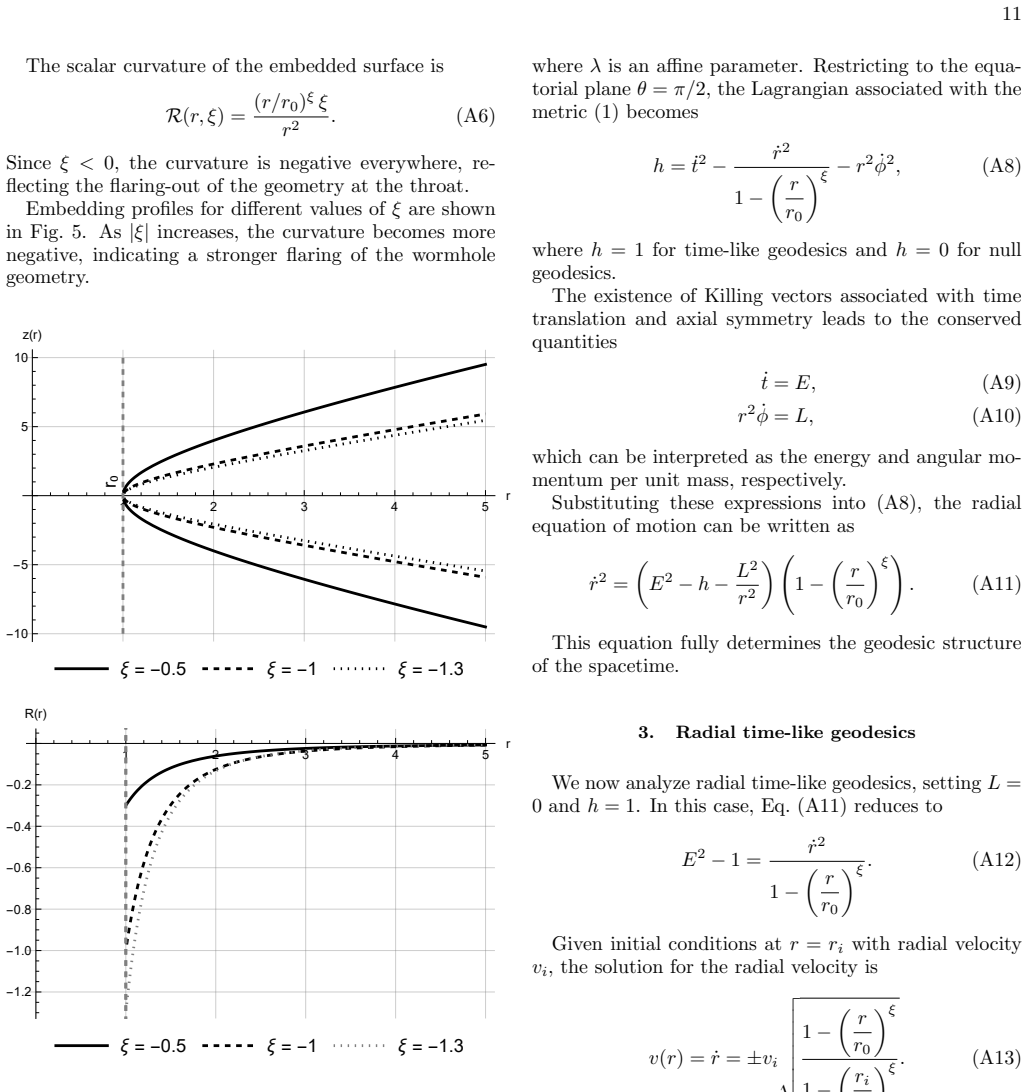
Embedding To gain geometric intuition, we consider spatial slices at constanttandθ=π/2, and embed them in a three- dimensional Euclidean space. This construction allows us to visualize the wormhole throat and the flaring-out condition in a coordinate-independent way. Introducingz(r) as the embedding function in cylin- drical coordinates, the induced metri...
-
[2]
Geodesics To characterize the motion of test particles, we con- sider the geodesic Lagrangian L= 1 2 gµν dxµ dλ dxν dλ ,(A7) whereλis an affine parameter. Restricting to the equa- torial planeθ=π/2, the Lagrangian associated with the metric (1) becomes h= ˙t2 − ˙r2 1− r r0 ξ −r 2 ˙ϕ2,(A8) whereh= 1 for time-like geodesics andh= 0 for null geodesics. The e...
-
[3]
In this case, Eq
Radial time-like geodesics We now analyze radial time-like geodesics, settingL= 0 andh= 1. In this case, Eq. (A11) reduces to E2 −1 = ˙r2 1− r r0 ξ .(A12) Given initial conditions atr=r i with radial velocity vi, the solution for the radial velocity is v(r) = ˙r=±v i vuuuuuut 1− r r0 ξ 1− ri r0 ξ .(A13) The positive (negative) sign corresponds to outward ...
-
[4]
For a massive particle, Eq
Non-radial time-like geodesics We now consider the case with non vanishing angular momentum,L̸= 0. For a massive particle, Eq. (A11) evaluated atr=r i gives E2 = 1 + L2 r2 i + v2 i 1− ri r0 ξ ,(A16) which relates the conserved energy to the initial condi- tions. The radial velocity can then be written as ˙r2 = L2 1 r2 i − 1 r2 + v2 i 1− ri r0 ξ 1...
-
[5]
Einstein, inThe Principle of Relativity
A. Einstein, inThe Principle of Relativity. Dover Books on Physics. June 1(1952) pp. 189–198
1952
-
[6]
Einstein, Sitzungsberichte der K¨ oniglich Preussischen Akademie der Wissenschaften zu Berlin , 844 (1915)
A. Einstein, Sitzungsberichte der K¨ oniglich Preussischen Akademie der Wissenschaften zu Berlin , 844 (1915)
1915
Show all 23 references
-
[7]
This reflects the fact thatr attains a minimum at the throat
Two qualitatively distinct regimes can be identified: 12 •Inward motion (vi <0):particles approaching the wormhole throat always reachr=r 0 with van- ishing radial velocity. This reflects the fact thatr attains a minimum at the throat. •Outward motion (v i >0):particles moving...
-
[8]
Weinberg, Rev
S. Weinberg, Rev. Mod. Phys.61, 1 (1989)
1989
-
[9]
Nojiri and S
S. Nojiri and S. D. Odintsov, Physics Reports505, 59–144 (2011)
2011
-
[10]
T. P. Sotiriou and V. Faraoni, Rev. Mod. Phys.82, 451 (2010)
2010
-
[11]
J. L. Anderson and D. Finkelstein, Am. J. Phys.39, 901 (1971)
1971
-
[12]
W. G. Unruh, Phys. Rev. D40, 1048 (1989)
1989
-
[13]
´Alvarez, S
E. ´Alvarez, S. Gonz´ alez-Mart ´ ın, M. Herrero-Valea, and C. Mart ´ ın, Physical Review D92, 10.1103/phys- revd.92.061502 (2015)
2015 doi
-
[15]
M. S. Morris and K. S. Thorne, American Journal of Physics56, 395 (1988)
1988
-
[17]
M. S. Morris, K. S. Thorne, and U. Yurtsever, Physical Review Letters61, 1446 (1988)
1988
-
[18]
A. S. Agrawal, B. Mishra, and P. H. R. S. Moraes, The European Physical Journal Plus138, 10.1140/epjp/s13360-023-03872-y (2023)
2023 doi
-
[19]
Cataldo and N
M. Cataldo and N. Cruz, The European Physical Journal Plus140, 1014 (2025)
2025
-
[20]
Past´ en, M
E. Past´ en, M. Bosquez, and N. Cruz, Class. Quant. Grav. 43, 115014 (2026), arXiv:2602.00524 [gr-qc]
2026 arXiv
-
[21]
G. F. R. Ellis, H. van Elst, J. Murugan, and J.-P. Uzan, Classical and Quantum Gravity28, 225007 (2011)
2011
-
[22]
Visser, S
M. Visser, S. Kar, and N. Dadhich, Phys. Rev. Lett.90, 201102 (2003)
2003
-
[23]
F. S. N. Lobo, Gen. Rel. Grav.37, 2023 (2005)
2023
Reviewed August 1, 2026 · model on record in the stance chip above.
Discussion (0). Continue with ORCID to comment.