REVIEW 3 major objections 5 minor 43 references
LLM-written simulators plus neural Bayes-factor scoring can jointly identify model families and fit their parameters.
Reviewed by Pith at T0; open to challenge. T0 means a machine referee read the full paper against a public rubric. the ladder, T0–T4 →
T0 review · deepseek-v4-flash
2026-08-01 17:40 UTC pith:MJUOP2PA
load-bearing objection Solid methods paper with real derivations and honest benchmarks; the ODE feedback loop reuses the observation for both search and scoring, and that should be fixed before publication. the 3 major comments →
Program Synthesis for Simulation-Based Inference: Joint Model Selection and Parameter Estimation
The pith
A machine-rendered reading of the paper's core claim, the machinery that carries it, and where it could break.
Core claim
The paper's central claim is that the joint posterior p(M, θ | x) over model index and parameters can be computed when the model space is itself generated by a large language model rather than fixed in advance. The pipeline factorizes this into model selection via pairwise neural ratio estimation ('evidence networks') that read log Bayes factors directly, with a least-squares projection to reconcile all pairwise comparisons into a globally consistent log-evidence vector, and parameter inference via normalizing-flow density estimators. To keep the candidate pool alive, models are resampled by their current weight and the LLM is used as a mutation kernel to propose structural variants; the pap
What carries the argument
The central machinery is the pairwise evidence network: a neural classifier trained with an exponential loss whose optimum is the log Bayes factor between two models' marginalized likelihoods, so model comparison does not require estimating either likelihood or posterior separately. A least-squares projection (equivalent to a Laplacian solve on the complete comparison graph) turns the collection of pairwise log Bayes factors into a single consistent log-evidence vector, correcting the K/(K−1) inverse-temperature bias of naive averaging and exposing cyclic disagreement as a diagnostic residual. Around this core sits an iterative loop where candidate programs are resampled by their current wei
Load-bearing premise
The load-bearing premise is that a model posterior computed from candidates that were themselves proposed and mutated using the same observation is still a valid Bayesian posterior, even though the final weights are conditional on a data-dependent pool.
What would settle it
Rerun the SIR benchmark with the final model weights computed on an independent observation generated from the same true process, never shown to the LLM during mutation; if the leading-family accuracy falls well below the paper's reported level, the feedback loop was leaking scoring information into the candidate pool. A complementary test is to apply the pipeline to a synthetic dynamical system unlikely to be represented in LLM training data and require it to recover the true family.
If this is right
- A scientist could hand the pipeline a plain-language problem statement plus data and receive a ranked set of executable simulator candidates with per-model parameter posteriors, without hand-coding any simulator.
- Because marginal-likelihood scoring automatically penalizes complexity, the pipeline prefers simpler models when the data are ambiguous; the authors argue this should be read as a diagnostic that more data are needed, not as evidence against a more complex model.
- When the data cannot separate candidate families, the model posterior remains spread instead of collapsing, providing an explicit uncertainty signal through the effective-sample-size diagnostic.
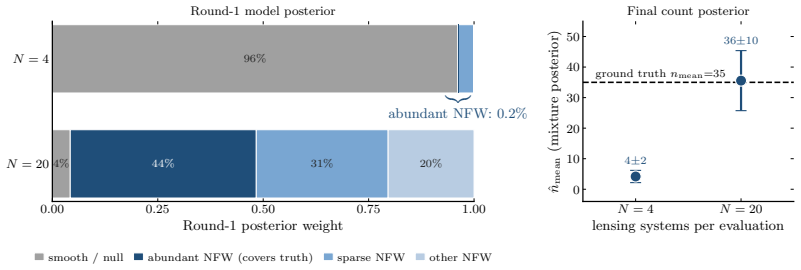
- The lensing benchmark shows that increasing the data per evaluation (from 4 to 20 lensing systems) removes a systematic count bias and shifts posterior weight onto the true model, implying the framework's selection accuracy scales with information content.
- The inference stage is agnostic to how candidates are proposed, so improvements in LLM code generation should transfer directly into better model proposals without changing the statistical core.
Where Pith is reading between the lines
- A natural extension is to propagate the least-squares fit residual—the cyclic disagreement among pairwise classifiers—into the model posterior as an additional uncertainty component; the paper reports it as a diagnostic but leaves it out of the posterior.
- The most decisive test of the framework would hold out the observation used for mutation feedback in the ODE benchmarks: recomputing final weights on an independent observation from the same ground truth would quantify how much of the reported model-selection accuracy comes from the feedback loop rather than from an honest Bayesian comparison.
- The set-level evidence network recipe looks directly transferable to other population-level inference problems with intractable likelihoods, such as estimating shared parameters across many short time series or multi-patient clinical trajectories.
- If the LLM proposal prior is the real bottleneck, the pipeline's discovery power will track the LLM's domain familiarity; a stress test on a genuinely novel dynamical system absent from LLM training data would separate the contribution of the Bayesian scoring from that of the proposal prior.
Editorial analysis
A structured set of objections, weighed in public.
Referee Report
Summary. The paper proposes a framework for joint model selection and parameter estimation that combines LLM-based program synthesis with neural simulation-based inference. Given a natural-language problem description, an LLM proposes candidate simulator programs with parameter priors; an iterative resample/mutate loop refines the candidate pool; pairwise 'evidence networks' estimate log Bayes factors for all candidate pairs; a least-squares projection converts the pairwise estimates into model posterior weights; and masked autoregressive flows provide per-model parameter posteriors. Experiments cover a damped oscillator, stochastic SIR/SEIR/SIS epidemic dynamics, and dark-matter subhalo population inference from gravitational-lensing images. The paper claims that the pipeline recovers plausible model families from open-ended prompts, with accuracy reflecting data information content and identifiability.
Significance. If valid, this is a useful step toward automating model discovery and Bayes-factor model comparison over an open candidate space. The least-squares aggregation of pairwise log Bayes factors in Section 3.3/Appendix C is a genuine methodological contribution: the derivation of the implicit inverse temperature of naive averaging and the closed-form Laplacian solution are correct and clearly presented. The subhalo benchmark is also honest in its information-content analysis: the N=4 vs N=20 comparison diagnoses why count posteriors are prior-dominated, and the held-out scoring split in Appendix B is the right safeguard. The main caveat is that the ODE benchmarks double-use the observed data to guide the search and then to compute the final model weights, which calls the headline model-selection accuracies into question. The paper is transparent about this setup, but the transparency does not remove the bias.
major comments (3)
- [§4.1 and §3.2] In the ODE benchmarks, the mutation feedback includes each candidate's RMSE against the observation and the sign of its residual trend (Section 4.1), and the final model weights are then computed from ratio estimation on the same observation x_obs (Section 3.2). This is a double use of the data: x_obs shapes which models are proposed, and the same x_obs scores those models in the final round. The paper says the posterior is 'conditional on the final evaluation pool', but conditioning on an adaptively selected, x_obs-dependent pool is not the same as conditioning on a pre-specified model space. Consequently Eq. (1) is not a posterior over a fixed model space, and the reported accuracies (10/10, 8/10, 9/10, 5/10) may overstate what a prior-based model comparison would give. The subhalo benchmark avoids this by using a held-out scoring split (Appendix B); a similar split or pre-registration
- [§4.2, §5, Appendix E] The paper claims joint parameter estimation as part of the central contribution, yet the SBC validation in Appendix E is performed only on the well-specified damped-cosine base model. The paper itself notes in Section 5 that the NPE stage 'can also be loose for heavily mutated candidates' and that the posterior-predictive check in Figure 1 uses exact-likelihood MCMC rather than the NPE posterior. This leaves the per-model parameter posteriors for the actual LLM-generated winners unvalidated. Please report SBC or another coverage diagnostic on the actual winning programs, or at least on deliberately misspecified LLM-generated candidates, so the parameter-estimation half of the claim is supported.
- [§4.4] The subhalo benchmark's residual channel uses the ground-truth smooth lens model ('Supplying the ground-truth smooth model is an oracle simplification'). This is an important caveat for the substructure-family results: in a real analysis the smooth-lens subtraction would carry additional uncertainty into the residual channel. The paper acknowledges this, but the abstract's phrasing ('dark matter substructure inference from gravitational-lensing images') is stronger than what the oracle channel supports. Please either soften the claim or add an experiment that infers the smooth model jointly or marginalizes over its nuisance parameters.
minor comments (5)
- [§4.1] The summary network for the ODE evidence networks is described only as '32-dimensional learned summary statistics produced by a summary network trained per round'. The architecture and training details of this summary network are omitted; please include them for reproducibility.
- [§4.3, Figure 2] The caption of Figure 2 says the rightmost panel shows ESS for the SIR ground truth, but the panel shows a jump from round 1 to round 2. Please clarify whether the reported median ESS is over the same 10 seeds as the left panels and whether any seed terminated early.
- [§5] The sentence 'Because the inference stage is agnostic to the source of candidates, it evaluates whatever models are proposed' is too strong. The inference stage is agnostic in principle, but in this pipeline the proposed pool is influenced by the observed data through the mutation feedback, so the final posterior is not independent of the proposal mechanism.
- [§4.1] All experiments use the proprietary Claude Opus 4.6 model. For reproducibility, please state the exact model version, sampling temperature, and whether the same model version was used across all seeds; also consider releasing the exact prompts and generated programs.
- [Appendix D] The example programs in Appendix D are useful, but the text says 'three damped-oscillator runs that converged in Round 1' while Figure 1 shows a run that converged after 10 rounds. Please make the relationship between the appendix examples and the main runs explicit.
Circularity Check
No significant circularity: the SBI machinery is self-contained; the disclosed pool-conditional ODE refinement is a selection-bias limitation, not a definitional reduction.
full rationale
The paper's load-bearing derivations are self-contained. Evidence networks (Section 3.3, Eqs. 5-6) derive log-Bayes factors from a defined exponential loss; least-squares aggregation (Eq. 7, Appendix C) is a self-contained correction of naive averaging; NPE training (Section 3.4) uses only prior-predictive simulations, and parameter-recovery and SBC checks use held-out synthetic data. The only data-dependent step is the ODE mutation feedback (Section 4.1: 'the mutation feedback (Section 3) additionally includes each candidate’s root-mean-square error (RMSE) against the observation and the sign of its residual trend over time'), and final ODE model weights are computed on that same observation, unlike the subhalo benchmark's held-out scoring split (Appendix B: 'final-round model weights computed on a held-out scoring split, disjoint from the images used during search'). This is a double-use/selection-bias concern for the unconditional interpretation of the reported accuracies. Crucially, the paper itself discloses this: Section 3.2 states the procedure 'is best understood as population-based evolutionary search guided by evidence estimates, not a rigorous SMC sampler targeting p(M|x)' and that the final weights are 'Bayesian posterior probabilities conditional on the final evaluation pool.' Because the claim is explicitly pool-conditional, the result does not reduce by construction to the feedback; the absence of a held-out split is a validity limitation, not circularity. Self-citations (Mishra-Sharma 2023; Brehmer et al. 2019) are contextual and not load-bearing.
Axiom & Free-Parameter Ledger
free parameters (5)
- Number of candidates per round K =
8
- Number of SMC-style rounds R =
10 (ODE), 15 (subhalo)
- Simulation budget per model per round =
2000 (ODE), 320 (subhalo)
- LLM-specified parameter priors =
per-candidate, generated by LLM
- Benchmark-specific mutation feedback features =
RMSE + residual sign (ODE)
axioms (4)
- domain assumption The LLM proposal/mutation distribution has non-negligible probability of generating the true model family and reasonable alternatives.
- standard math The exponential-loss evidence network converges to the log Bayes factor when trained on prior-predictive simulations.
- standard math Pairwise log-Bayes-factor estimates are conditionally unbiased enough that the least-squares projection yields a valid log-evidence vector.
- ad hoc to paper For the ODE benchmarks, the data used to steer mutation can also be used to compute final model weights without an invalid double-use of the data.
read the original abstract
Neural simulation-based inference enables parameter estimation for complex models, but typically requires the user to specify a simulator encoding a fixed model structure. We present a framework for joint model selection and parameter estimation that combines large language models for program synthesis with neural simulation-based inference. Given a natural language description of the system and data under investigation, an LLM proposes candidate simulator programs which are iteratively refined via feedback-driven mutation and evaluated using neural density estimation. The approach enables simulation-based inference over a pool of models, not just parameters within a fixed model. On benchmarks spanning deterministic dynamics, stochastic epidemic models, and dark matter substructure inference from gravitational-lensing images, the method identifies plausible model families from open-ended prompts, with accuracy that reflects the information content of the data and identifiability of candidate models.
Figures




Reference graph
Works this paper leans on
-
[1]
Claude system card
Anthropic . Claude system card. https://www.anthropic.com/system-cards, 2025. Accessed: 2025
2025
-
[2]
Program synthesis with large language models
Jacob Austin, Augustus Odena, Maxwell Nye, Maarten Bosma, Henryk Michalewski, David Dohan, Ellen Jiang, Carrie Cai, Michael Terry, Quoc Le, et al. Program synthesis with large language models. arXiv preprint arXiv:2108.07732, 2021
Pith/arXiv arXiv 2021
-
[3]
Mining for dark matter substructure: Inferring subhalo population properties from strong lenses with machine learning
Johann Brehmer, Siddharth Mishra-Sharma, Joeri Hermans, Gilles Louppe, and Kyle Cranmer. Mining for dark matter substructure: Inferring subhalo population properties from strong lenses with machine learning. The Astrophysical Journal, 886 0 (1): 0 49, 2019
2019
-
[4]
Evaluating large language models trained on code
Mark Chen, Jerry Tworek, Heewoo Jun, Qiming Yuan, Henrique Ponde de Oliveira Pinto, Jared Kaplan, Harri Edwards, Yuri Burda, Nicholas Joseph, Greg Brockman, et al. Evaluating large language models trained on code. arXiv preprint arXiv:2107.03374, 2021
Pith/arXiv arXiv 2021
-
[5]
Approximating likelihood ratios with calibrated discriminative classifiers
Kyle Cranmer, Juan Pavez, and Gilles Louppe. Approximating likelihood ratios with calibrated discriminative classifiers. arXiv preprint arXiv:1506.02169, 2015
Pith/arXiv arXiv 2015
-
[6]
The frontier of simulation-based inference
Kyle Cranmer, Johann Brehmer, and Gilles Louppe. The frontier of simulation-based inference. Proceedings of the National Academy of Sciences, 117 0 (48): 0 30055--30062, 2020
2020
-
[7]
Truncated proposals for scalable and hassle-free simulation-based inference
Michael Deistler, Pedro J Gon c alves, and Jakob H Macke. Truncated proposals for scalable and hassle-free simulation-based inference. Advances in Neural Information Processing Systems, 35: 0 23135--23149, 2022
2022
-
[8]
Simulation-based inference: A practical guide
Michael Deistler, Jan Boelts, Peter Steinbach, Guy Moss, Thomas Moreau, Manuel Gloeckler, Pedro LC Rodrigues, Julia Linhart, Janne K Lappalainen, Benjamin Kurt Miller, et al. Simulation-based inference: A practical guide. arXiv preprint arXiv:2508.12939, 2025
Pith/arXiv arXiv 2025
-
[9]
Justin Domke. Large language Bayes . arXiv preprint arXiv:2504.14025, 2025
arXiv 2025
-
[10]
Gemini 3 Pro model card
Google DeepMind . Gemini 3 Pro model card. Technical report, Google DeepMind, 2025. November 2025
2025
-
[11]
Automatic posterior transformation for likelihood-free inference
David Greenberg, Marcel Nonnenmacher, and Jakob Macke. Automatic posterior transformation for likelihood-free inference. International Conference on Machine Learning, pages 2404--2414, 2019
2019
-
[12]
Program synthesis
Sumit Gulwani, Oleksandr Polozov, and Rishabh Singh. Program synthesis. Foundations and Trends in Programming Languages, 4 0 (1-2): 0 1--119, 2017
2017
-
[13]
DeepSeek-R1 : Incentivizing reasoning capability in LLMs via reinforcement learning
Daya Guo, Dejian Yang, Haowei Zhang, Junxiao Song, Ruoyu Zhang, Runxin Xu, Qihao Zhu, Shirong Ma, Peiyi Wang, Xiao Bi, et al. DeepSeek-R1 : Incentivizing reasoning capability in LLMs via reinforcement learning. arXiv preprint arXiv:2501.12948, 2025
Pith/arXiv arXiv 2025
-
[14]
Harris, K
Charles R. Harris, K. Jarrod Millman, St \' e fan J. van der Walt, Ralf Gommers, Pauli Virtanen, David Cournapeau, Eric Wieser, Julian Taylor, Sebastian Berg, Nathaniel J. Smith, Robert Kern, Matti Picus, Stephan Hoyer, Marten H. van Kerkwijk, Matthew Brett, Allan Haldane, Jaime Fern \' a ndez del R \' i o, Mark Wiebe, Pearu Peterson, Pierre G \' e rard-M...
2020
-
[15]
Deep residual learning for image recognition
Kaiming He, Xiangyu Zhang, Shaoqing Ren, and Jian Sun. Deep residual learning for image recognition. In Proceedings of the IEEE Conference on Computer Vision and Pattern Recognition (CVPR), pages 770--778, 2016
2016
-
[16]
Likelihood-free MCMC with amortized approximate ratio estimators
Joeri Hermans, Volodimir Begy, and Gilles Louppe. Likelihood-free MCMC with amortized approximate ratio estimators. International Conference on Machine Learning, pages 4239--4248, 2020
2020
-
[17]
J. D. Hunter. Matplotlib: A 2D graphics environment. Computing in Science & Engineering, 9 0 (3): 0 90--95, 2007. doi:10.1109/MCSE.2007.55
-
[18]
Evidence networks: simple losses for fast, amortized, neural Bayesian model comparison
Niall Jeffrey and Benjamin D Wandelt. Evidence networks: simple losses for fast, amortized, neural Bayesian model comparison. Machine Learning: Science and Technology, 5 0 (1): 0 015008, 2024
2024
-
[19]
Statistical ranking and combinatorial Hodge theory
Xiaoye Jiang, Lek-Heng Lim, Yuan Yao, and Yinyu Ye. Statistical ranking and combinatorial Hodge theory. Mathematical Programming, 127 0 (1): 0 203--244, 2011
2011
-
[20]
Kimi K2 : Open agentic intelligence
Kimi Team , Yifan Bai, Yiping Bao, Guanduo Chen, Jiahao Chen, Ningxin Chen, Ruijue Chen, Yanru Chen, Yuankun Chen, Yutian Chen, et al. Kimi K2 : Open agentic intelligence. arXiv preprint arXiv:2507.20534, 2025
Pith/arXiv arXiv 2025
-
[21]
Diederik P. Kingma and Jimmy Ba. Adam : A method for stochastic optimization. In International Conference on Learning Representations ( ICLR ) , 2015. URL http://arxiv.org/abs/1412.6980
Pith/arXiv arXiv 2015
-
[22]
Flexible statistical inference for mechanistic models of neural dynamics
Jan-Matthis Lueckmann, Pedro J Gon c alves, Giacomo Bassetto, Kaan \"O cal, Marcel Nonnenmacher, and Jakob H Macke. Flexible statistical inference for mechanistic models of neural dynamics. Advances in Neural Information Processing Systems, 30, 2017
2017
-
[23]
Truncated marginal neural ratio estimation
Benjamin Kurt Miller, Alex Cole, Patrick Forr \'e , Gilles Louppe, and Christoph Weniger. Truncated marginal neural ratio estimation. Advances in Neural Information Processing Systems, 34: 0 129--143, 2021
2021
-
[24]
Awesome Neural SBI , January 2023
Siddharth Mishra-Sharma. Awesome Neural SBI , January 2023. URL https://github.com/smsharma/awesome-neural-sbi
2023
-
[25]
A universal density profile from hierarchical clustering
Julio F Navarro, Carlos S Frenk, and Simon DM White. A universal density profile from hierarchical clustering. The Astrophysical Journal, 490 0 (2): 0 493--508, 1997
1997
-
[26]
AlphaEvolve : A coding agent for scientific and algorithmic discovery
Alexander Novikov, Ng \^a n V \ u , Marvin Eisenberger, et al. AlphaEvolve : A coding agent for scientific and algorithmic discovery. arXiv preprint arXiv:2506.13131, 2025
Pith/arXiv arXiv 2025
-
[27]
Fast -free inference of simulation models with Bayesian conditional density estimation
George Papamakarios and Iain Murray. Fast -free inference of simulation models with Bayesian conditional density estimation. Advances in Neural Information Processing Systems, 29, 2016
2016
-
[28]
Masked autoregressive flow for density estimation
George Papamakarios, Theo Pavlakou, and Iain Murray. Masked autoregressive flow for density estimation. Advances in Neural Information Processing Systems, 30, 2017
2017
-
[29]
Sequential neural likelihood: Fast likelihood-free inference with autoregressive flows
George Papamakarios, David Sterratt, and Iain Murray. Sequential neural likelihood: Fast likelihood-free inference with autoregressive flows. The 22nd International Conference on Artificial Intelligence and Statistics, pages 837--848, 2019
2019
-
[30]
PyTorch : An imperative style, high-performance deep learning library
Adam Paszke, Sam Gross, Francisco Massa, Adam Lerer, James Bradbury, Gregory Chanan, Trevor Killeen, Zeming Lin, Natalia Gimelshein, Luca Antiga, Alban Desmaison, Andreas K \"o pf, Edward Yang, Zachary DeVito, Martin Raison, Alykhan Tejani, Sasank Chilamkurthy, Benoit Steiner, Lu Fang, Junjie Bai, and Soumith Chintala. PyTorch : An imperative style, high-...
2019
-
[31]
Mathematical discoveries from program search with large language models
Bernardino Romera-Paredes, Mohammadamin Barekatain, Alexander Novikov, Matej Balog, M Pawan Kumar, Emilien Dupont, Francisco JR Ruiz, Jordan S Ellenberg, Pengming Wang, Omar Fawzi, et al. Mathematical discoveries from program search with large language models. Nature, 625 0 (7995): 0 468--475, 2024
2024
-
[32]
Bayesianly justifiable and relevant frequency calculations for the applied statistician
Donald B Rubin. Bayesianly justifiable and relevant frequency calculations for the applied statistician. The Annals of Statistics, 12 0 (4): 0 1151--1172, 1984
1984
-
[33]
LLM-SR : Scientific equation discovery via programming with large language models
Parshin Shojaee, Kazem Meidani, Shashank Gupta, Amir Barati Farimani, and Chandan K Reddy. LLM-SR : Scientific equation discovery via programming with large language models. arXiv preprint arXiv:2404.18400, 2024
Pith/arXiv arXiv 2024
-
[34]
Aaditya Singh, Adam Fry, Adam Perelman, Adam Tart, Adi Ganesh, Ahmed El-Kishky, Aidan McLaughlin, Aiden Low, AJ Ostrow, Akhila Ananthram, et al. OpenAI GPT-5 system card. arXiv preprint arXiv:2601.03267, 2025
Pith/arXiv arXiv 2025
-
[35]
Handbook of approximate Bayesian computation
Scott A Sisson, Yanan Fan, and Mark Beaumont. Handbook of approximate Bayesian computation . CRC Press, 2018
2018
-
[36]
Validating Bayesian inference algorithms with simulation-based calibration
Sean Talts, Michael Betancourt, Daniel Simpson, Aki Vehtari, and Andrew Gelman. Validating Bayesian inference algorithms with simulation-based calibration. arXiv preprint arXiv:1804.06788, 2018
Pith/arXiv arXiv 2018
-
[37]
sbi : A toolkit for simulation-based inference
Alvaro Tejero-Cantero, Jan Boelts, Michael Deistler, Jan-Matthis Lueckmann, Conor Durkan, Pedro J Gon c alves, David S Greenberg, and Jakob H Macke. sbi : A toolkit for simulation-based inference. Journal of Open Source Software, 5 0 (52): 0 2505, 2020
2020
-
[38]
Approximate Bayesian computation scheme for parameter inference and model selection in dynamical systems
Tina Toni, David Welch, Natascha Strelkowa, Andreas Ipsen, and Michael PH Stumpf. Approximate Bayesian computation scheme for parameter inference and model selection in dynamical systems. Journal of the Royal Society Interface, 6 0 (31): 0 187--202, 2009
2009
-
[39]
Strong gravitational lensing as a probe of dark matter
Simona Vegetti, Simon Birrer, Giulia Despali, Christopher D Fassnacht, Daniel Gilman, Yashar Hezaveh, Laurence Perreault Levasseur, John P McKean, Devon M Powell, Conor M O'Riordan, and Georgios Vernardos. Strong gravitational lensing as a probe of dark matter. Space Science Reviews, 220 0 (5): 0 58, 2024
2024
-
[40]
Oliphant, Matt Haberland, Tyler Reddy, David Cournapeau, Evgeni Burovski, Pearu Peterson, Warren Weckesser, Jonathan Bright, St \'e fan J
Pauli Virtanen, Ralf Gommers, Travis E. Oliphant, Matt Haberland, Tyler Reddy, David Cournapeau, Evgeni Burovski, Pearu Peterson, Warren Weckesser, Jonathan Bright, St \'e fan J. van der Walt , Matthew Brett, Joshua Wilson, K. Jarrod Millman, Nikolay Mayorov, Andrew R. J. Nelson, Eric Jones, Robert Kern, Eric Larson, C J Carey, \.I lhan Polat, Yu Feng, Er...
2020
-
[41]
A strong gravitational lens is worth a thousand dark matter halos: Inference on small-scale structure using sequential methods
Sebastian Wagner-Carena, Jaehoon Lee, Jeffrey Pennington, Jelle Aalbers, Simon Birrer, and Risa H Wechsler. A strong gravitational lens is worth a thousand dark matter halos: Inference on small-scale structure using sequential methods. The Astrophysical Journal, 975 0 (2): 0 297, 2024
2024
-
[42]
Stefan Wahl, Raphaela Schenk, Ali Farnoud, Jakob H. Macke, and Daniel Gedon. A probabilistic framework for LLM -based model discovery. arXiv preprint arXiv:2602.18266, 2026
Pith/arXiv arXiv 2026
-
[43]
Manzil Zaheer, Satwik Kottur, Siamak Ravanbakhsh, Barnab \'a s P \'o czos, Ruslan Salakhutdinov, and Alexander J. Smola. Deep sets. Advances in Neural Information Processing Systems, 30, 2017
2017
discussion (0)
Sign in with ORCID, Apple, or X to comment. Anyone can read and Pith papers without signing in.