Discriminating scalar ultralight dark matter from quasi-monochromatic gravitational waves in LISA
Pith reviewed 2026-05-22 12:47 UTC · model grok-4.3
The pith
LISA can discriminate between scalar ultralight dark matter signals and gravitational wave signals.
A machine-rendered reading of the paper's core claim, the machinery that carries it, and where it could break.
Core claim
Using one year of realistic orbits for the LISA spacecrafts and Bayesian methods, LISA will indeed be able to discriminate between the scalar ultralight dark matter signal and a quasi-monochromatic gravitational wave signal.
What carries the argument
The distinct Doppler-shift pattern produced by scalar ULDM coupling to Standard Model fields versus the tidal strain from a gravitational wave in the LISA arm lengths.
If this is right
- LISA data analysis can include both ULDM and GW templates without mutual confusion.
- Constraints on scalar ULDM parameters become feasible if such a signal is present in the data.
- Future LISA observations may simultaneously probe gravitational wave sources and ultralight dark matter.
Where Pith is reading between the lines
- The discrimination method could be tested on other space-based interferometer proposals to broaden ULDM searches.
- Similar Bayesian comparisons might help separate overlapping signals in other astrophysical datasets.
Load-bearing premise
The assumption that the Doppler-shift signature of scalar ULDM is distinct enough from a quasi-monochromatic GW signal for the Bayesian model to separate them reliably.
What would settle it
Injecting a scalar ULDM signal into simulated LISA data and finding that the Bayesian odds ratio or posterior distributions do not clearly favor the ULDM model over the GW model would falsify the discrimination capability.
Figures




read the original abstract
A scalar ultralight dark matter (ULDM) candidate would induce oscillatory motion of freely falling test masses via its coupling to Standard Model fields. Such oscillations would create an observable Doppler shift of light exchanged between the test masses, and in particular would be visible in space-based gravitational waves (GW) detectors, such as LISA. While this kind of detection has been proposed multiple times in the recent years, we numerically investigate if it is possible to extract a scalar ULDM signal in a space-based GW detector, and in particular how to differentiate such a signal from a GW signal. Using one year of realistic orbits for the LISA spacecrafts and Bayesian methods, we find that LISA will indeed be able to discriminate between the two signals.
Editorial analysis
A structured set of objections, weighed in public.
Referee Report
Summary. The paper numerically investigates whether LISA can discriminate scalar ultralight dark matter (ULDM) signals—which induce common-mode Doppler shifts in the laser links via coupling to Standard Model fields—from quasi-monochromatic gravitational-wave signals. Using one year of realistic LISA spacecraft orbits and Bayesian model comparison, the authors conclude that the two signals are distinguishable.
Significance. If the result holds, it would strengthen LISA's science case for dark-matter searches by providing a concrete method to avoid misidentification of ULDM-induced Doppler effects as gravitational waves. The adoption of realistic orbits and Bayesian techniques is a positive step toward mission-relevant analysis.
major comments (2)
- [Numerical methods and results] The central discrimination claim rests on the non-degeneracy of the ULDM Doppler signature and the GW strain response in the LISA TDI channels under the chosen Bayesian model. However, the manuscript provides no details on the likelihood construction, parameter priors, or checks for accidental degeneracies near the LISA transfer frequency or for specific sky locations, leaving the numerical support for the abstract's conclusion weakly anchored.
- [Signal modeling and TDI response] The skeptic note highlights that any overlap in the projected time series (amplitude and phase evolution over one year) would reduce the Bayes factor; the paper must demonstrate explicitly that the effective signal in the X, Y, Z or Michelson combinations differs measurably for the chosen orbit realization.
minor comments (1)
- [Signal modeling] Clarify the exact form of the ULDM-induced frequency-dependent phase modulation versus the standard GW response tensor contraction with arm vectors.
Simulated Author's Rebuttal
We thank the referee for their constructive comments and positive assessment of the work's significance. We agree that greater transparency in the numerical methods and explicit demonstrations of signal distinguishability will strengthen the manuscript. We have revised the paper to incorporate additional details on the likelihood, priors, degeneracy checks, and projected TDI time series.
read point-by-point responses
-
Referee: [Numerical methods and results] The central discrimination claim rests on the non-degeneracy of the ULDM Doppler signature and the GW strain response in the LISA TDI channels under the chosen Bayesian model. However, the manuscript provides no details on the likelihood construction, parameter priors, or checks for accidental degeneracies near the LISA transfer frequency or for specific sky locations, leaving the numerical support for the abstract's conclusion weakly anchored.
Authors: We thank the referee for this observation. In the revised manuscript we have added a dedicated subsection describing the likelihood construction, which employs a Gaussian noise model matched to the TDI channel power spectral densities. We now explicitly list the prior distributions adopted for all parameters in both the scalar ULDM and quasi-monochromatic GW models. We have also performed and report additional numerical checks: the Fisher information matrix and posterior overlap metrics evaluated at frequencies near the LISA transfer frequency and for a representative set of sky locations. These checks confirm the absence of significant degeneracies that would undermine discrimination. revision: yes
-
Referee: [Signal modeling and TDI response] The skeptic note highlights that any overlap in the projected time series (amplitude and phase evolution over one year) would reduce the Bayes factor; the paper must demonstrate explicitly that the effective signal in the X, Y, Z or Michelson combinations differs measurably for the chosen orbit realization.
Authors: We agree that an explicit comparison of the projected signals is valuable. While the original Bayesian model comparison already yields decisive Bayes factors, we have added new figures in the revised manuscript that plot the one-year time series of the ULDM Doppler-induced signals and the GW strain responses projected onto the X, Y, and Z TDI channels for the specific realistic orbit realization. These plots illustrate the distinct amplitude and phase evolution arising from the different physical coupling mechanisms and the LISA geometry, thereby confirming that measurable differences persist and support the reported discrimination. revision: yes
Circularity Check
No circularity: numerical forward simulation of distinct signals
full rationale
The paper conducts a numerical study by generating synthetic LISA data from two physically distinct models (scalar ULDM Doppler shifts versus quasi-monochromatic GW strains) under realistic orbits, then applies Bayesian model comparison to assess distinguishability. No derivation chain reduces a claimed prediction to a fitted parameter or self-citation by construction; the discrimination result is an output of the simulation and inference procedure rather than an input renamed as output. The work is therefore self-contained against external benchmarks of signal separability.
Axiom & Free-Parameter Ledger
axioms (2)
- domain assumption The Doppler shift induced by scalar ULDM coupling to Standard Model fields produces an observable oscillatory signal in LISA laser links
- domain assumption Realistic LISA spacecraft orbits can be accurately modeled for one year of data
Lean theorems connected to this paper
-
IndisputableMonolith/Cost/FunctionalEquation.leanwashburn_uniqueness_aczel unclear?
unclearRelation between the paper passage and the cited Recognition theorem.
We have derived the one-link Doppler shift induced by scalar DM on one hand and GW on the other hand... the DM signal will, on average, be suppressed by a factor ωL/c compared to the GW signal at low frequencies
-
IndisputableMonolith/Foundation/ArithmeticFromLogic.leanreality_from_one_distinction unclear?
unclearRelation between the paper passage and the cited Recognition theorem.
Using one year of realistic orbits... Bayesian methods, we find that LISA will indeed be able to discriminate between the two signals
What do these tags mean?
- matches
- The paper's claim is directly supported by a theorem in the formal canon.
- supports
- The theorem supports part of the paper's argument, but the paper may add assumptions or extra steps.
- extends
- The paper goes beyond the formal theorem; the theorem is a base layer rather than the whole result.
- uses
- The paper appears to rely on the theorem as machinery.
- contradicts
- The paper's claim conflicts with a theorem or certificate in the canon.
- unclear
- Pith found a possible connection, but the passage is too broad, indirect, or ambiguous to say the theorem truly supports the claim.
Reference graph
Works this paper leans on
-
[1]
II A) and subsequently generalize it to the ALP as well
Scalar ultralight dark matter We will derive in details the 1-link response function for the interactions between SM and a pure dilatonic field ϕ (see Sec. II A) and subsequently generalize it to the ALP as well. The acceleration of the test mass B in a generic frame is given by Eq. (8). In the case of LISA, in the barycen- tric frame, the magnitude of ve...
-
[2]
Monochromatic gravitational waves We model the GW with frequency fGW = ωGW/2π in the source frame propagating along the ˆk direction as [24] hµν(t, ⃗ x) = ℜ h A+ϵ+ µν − iA×ϵ× µν eiφ(ξ) i , (18a) where ξ = t − ˆk · ⃗ x/crepresents the surfaces of constant phase, ϵ+ µν, ϵ× µν are the polarization tensors in the source 5 frame, A+,× are the amplitudes of + a...
-
[3]
To do so, we simulate in time domain the second generation TDI Eqs
Time domain generation of signals We first simulate a dataset which contains either a GB or scalar DM signal. To do so, we simulate in time domain the second generation TDI Eqs. (30) and (26) induced by either a GB or a scalar ULDM signals through Doppler effects derived in the previous sections, see Eqs. (16b) and (24b). The positions of the space- craft...
-
[4]
Since our signals cover a very narrow frequency band, we express it in the fre- quency domain
Likelihood, signal and noise modeling We use a Gaussian likelihood. Since our signals cover a very narrow frequency band, we express it in the fre- quency domain. This likelihood is given by − log L = X x=A,E N/2X j=0 " log (2πfsNx(fj)) + | ˜dx j − ˜mx j |2 N fsNx(fj) # , (31) where NA,E are the noise PSD of the TDI channels, ˜dx j the Fourier transform o...
-
[5]
Priors For the GW source parameters, we use uniform prior distribution for all of them, except for the sky location parameters that are assumed to follow an isotropic dis- tribution. For the DM source parameters, we also use uniform prior distribution for all of them except for the sky lo- cation which follows an isotropic distribution and the DM velocity...
-
[6]
As an output, we also have an estimate of the Bayesian evidence
Sampling of the parameter space, results We use Nessai [44–46], a nested sampling algorithm, to sample our posterior distribution. As an output, we also have an estimate of the Bayesian evidence. The ra- tio of the Bayesian evidences of two models used to fit the data, i.e. the Bayes factor, is used as a criteria for model selection. Furthermore, we also ...
-
[7]
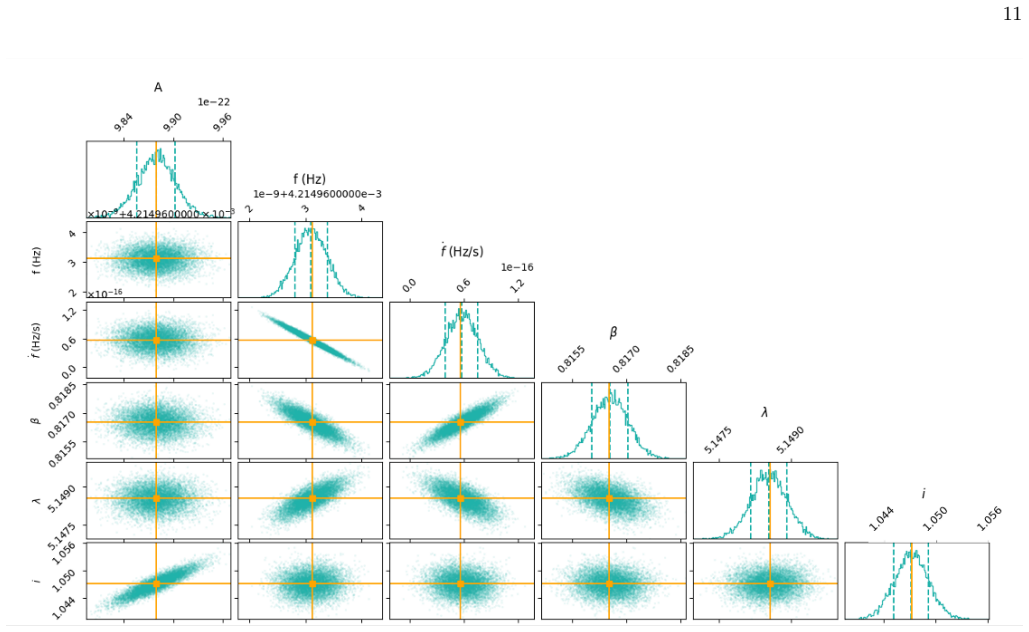
Fit on data that contains a GW signal We first generate a dataset dGW that includes only a GB with parameters DGW presented on the second col- umn from Tab. I. The SNR of this dataset for both A and E TDI channel, computed using Eq. (32), are SNRGW A ≈ 447 (36a) SNRGW E ≈ 480 , (36b) which shows that the signal is well above the noise, as can also be noti...
-
[8]
Fit on data that contains scalar DM signal For consistency with the GB that was analyzed in the previous section, we simulate a DM signal with the same injected frequency (in order to compare to the same noise level) and intrinsic amplitude of oscillation on the test masses. From Eqs. (16b) and (24b), this means that we choose Qd such that Qd = A 2πf c2 √...
-
[9]
which induces a loss in signal of ∼ 1.5. When the integration time is much longer than the coherence time of the field, i.e Tobs ≫ τ(f), the signal searched for is no longer coherent, i.e. it should be modeled as a sum of sev- eral stochastic harmonics, see [5], and therefore Eq. (48) is not correct anymore. In this case, one needs to cut the dataset in s...
-
[10]
Scalar ultralight dark matter In the constant armlength limit, we use Eq. (27) together with Eq. (17) such that the scalar DM transfer function of X2 is T DM X (ω) = −4 sin ωL c sin 2ωL c ℜ h e−3iωL/c T DM 13 − T DM 12 + e−iωL/c T DM 31 − T DM 21 i (B1a) = −4 sin ωL c sin 2ωL c ℜ h e−3iωL/ce−i⃗k·⃗ x1 1 + e−2iωL/c (ˆn13 − ˆn12) · ˆev− 2e−4iωL/c ˆn13 · ˆeve...
-
[11]
Monochromatic gravitational waves Using Eqs. (25) and (27), the transfer function of the monochromatic GW reads T GW X (ω) = 2 sin ωL c sin 2ωL c ℜ h ˆhSSB ij e−i( 3ωL c +⃗k·⃗ x1) × (B6a) X ℓ=2,3 wℓ ˆni 1ℓˆnj 1ℓ 1 − ˆn1ℓ · ˆk 2 (1 + ˆn1ℓ · ˆk) 1 − e−i ωL c (1−ˆn1ℓ·ˆk) − e−i 2ωL c (1 − ˆn1ℓ · ˆk) 1 − ei ωL c (1+ˆn1ℓ·ˆk) = 2 sin ωL c sin 2ωL c ℜ h ˆhSS...
- [12]
-
[13]
M. Cirelli, A. Strumia, and J. Zupan, “Dark matter,” (2024), arXiv:2406.01705 [hep-ph]
work page internal anchor Pith review Pith/arXiv arXiv 2024
-
[14]
E. G. M. Ferreira, The Astronomy and Astrophysics Re- view 29 (2021), 10.1007/s00159-021-00135-6
- [15]
- [16]
- [17]
- [18]
-
[19]
A. Hees, J. Gu´ ena, M. Abgrall, S. Bize, and P. Wolf, Phys. Rev. Lett. 117, 061301 (2016)
work page 2016
-
[20]
A. Hees, O. Minazzoli, E. Savalle, Y. V. Stadnik, and P. Wolf, Phys. Rev. D 98, 064051 (2018). 21
work page 2018
- [21]
- [22]
- [23]
- [24]
-
[25]
M. Colpi, K. Danzmann, M. Hewitson, K. Holley- Bockelmann, P. Jetzer, G. Nelemans, A. Petiteau, D. Shoemaker, C. Sopuerta, R. Stebbins, N. Tanvir, H. Ward, W. J. Weber, I. Thorpe, A. Daurskikh, A. Deep, I. F. N´ u˜ nez, C. G. Marirrodriga, M. Gehler, J.-P. Halain, O. Jennrich, U. Lammers, J. Larra˜ naga, M. Lieser, N. L¨ utzgendorf, W. Martens, L. Mondin,...
work page internal anchor Pith review Pith/arXiv arXiv 2024
-
[26]
S. E. Timpano, L. J. Rubbo, and N. J. Cornish, Phys. Rev. D 73, 122001 (2006)
work page 2006
-
[27]
T., and Boekholt, T., A&A 602, A16 (2017)
Toonen, S., Hollands, M., G¨ ansicke, B. T., and Boekholt, T., A&A 602, A16 (2017)
work page 2017
-
[28]
W. Martens and E. Joffre, Journal of the Astronautical Sciences 68, 402 (2021)
work page 2021
-
[29]
J.-B. Bayle, A. Hees, M. Lilley, and C. Le Poncin-Lafitte, “Lisa orbits,” (2022)
work page 2022
-
[30]
N. W. Evans, C. A. J. O’Hare, and C. McCabe, Phys. Rev. D 99, 023012 (2019)
work page 2019
-
[31]
Momentum and matter matter for axion dark matter matters on earth,
A. Banerjee, I. M. Bloch, Q. Bonnefoy, S. A. R. Ellis, G. Perez, I. Savoray, K. Springmann, and Y. V. Stadnik, “Momentum and matter matter for axion dark matter matters on earth,” (2025), arXiv:2502.04455 [hep-ph]
-
[32]
Enhanced axion-wind near earth’s surface,
Y. G. del Castillo, B. Hammett, and J. Jaeckel, “Enhanced axion-wind near earth’s surface,” (2025), arXiv:2502.04456 [hep-ph]
-
[33]
Search for qcd coupled ax- ion dark matter with the microscope space experiment,
J. Gu´ e, P. Wolf, and A. Hees, “Search for qcd coupled ax- ion dark matter with the microscope space experiment,” (2025), arXiv:2504.00720 [hep-ph]
-
[34]
M. Tinto and S. V. Dhurandhar, Living Reviews in Rel- ativity 24, 1 (2021)
work page 2021
-
[35]
Lisa data challenge: Sangria. technical report lisa-lcst- sgs-man-001,
S. Babak, M. Le Jeune, A. Petiteau, and M. Vallisneri, “Lisa data challenge: Sangria. technical report lisa-lcst- sgs-man-001,” (2020)
work page 2020
-
[36]
Petiteau, DE LA SIMULATION DE LISA A L’ANALYSE DES DONNEES
A. Petiteau, DE LA SIMULATION DE LISA A L’ANALYSE DES DONNEES. D´ etection d’ondes grav- itationnelles par interf´ erom´ etrie spatiale (LISA : Laser Interferometer Space Antenna), Theses, Universit´ e Paris- Diderot - Paris VII (2008)
work page 2008
-
[37]
N. J. Cornish and L. J. Rubbo, Phys. Rev. D 67, 022001 (2003)
work page 2003
-
[38]
L. Blanchet, B. R. Iyer, C. M. Will, and A. G. Wiseman, Classical and Quantum Gravity 13, 575–584 (1996)
work page 1996
-
[39]
J. W. Armstrong, F. B. Estabrook, and M. Tinto, The Astrophysical Journal 527, 814 (1999)
work page 1999
- [40]
-
[41]
S. V. Dhurandhar, K. R. Nayak, and J.-Y. Vinet, Phys- ical Review D 65 (2002), 10.1103/physrevd.65.102002
-
[42]
O. Hartwig, J.-B. Bayle, M. Staab, A. Hees, M. Lilley, and P. Wolf, Phys. Rev. D 105, 122008 (2022)
work page 2022
-
[43]
J.-B. Bayle, O. Hartwig, and M. Staab, Physical Review D 104 (2021), 10.1103/physrevd.104.023006
-
[44]
D. Quang Nam, J. Martino, Y. Lemi` ere, A. Petiteau, J.- B. Bayle, O. Hartwig, and M. Staab, Phys. Rev. D 108, 082004 (2023)
work page 2023
-
[45]
T. A. Prince, M. Tinto, S. L. Larson, and J. W. Armstrong, Physical Review D 66 (2002), 10.1103/phys- revd.66.122002
- [46]
-
[47]
S. Morisaki, T. Fujita, Y. Michimura, H. Nakatsuka, and I. Obata, Phys. Rev. D 103, L051702 (2021)
work page 2021
-
[48]
W. Martens and E. Joffre, The Journal of the Astronau- tical Sciences 68, 402–443 (2021)
work page 2021
-
[49]
Lisa sensi- tivity and snr calculations,
S. Babak, M. Hewitson, and A. Petiteau, “Lisa sensi- tivity and snr calculations,” (2021), arXiv:2108.01167 [astro-ph.IM]
- [50]
-
[51]
N. J. Cornish and T. B. Littenberg, Physical Review D 76 (2007), 10.1103/physrevd.76.083006
- [52]
-
[53]
van Leeuwen, Astronomy & Astrophysics 474, 653 (2007)
F. van Leeuwen, Astronomy & Astrophysics 474, 653 (2007)
work page 2007
-
[54]
Leinert, Ch., Bowyer, S., Haikala, L. K., Hanner, M. S., Hauser, M. G., Levasseur-Regourd, A.-Ch., Mann, I., Mattila, K., Reach, W. T., Schlosser, W., Staude, H. J., Toller, G. N., Weiland, J. L., Weinberg, J. L., and Witt, A. N., Astron. Astrophys. Suppl. Ser. 127, 1 (1998)
work page 1998
-
[55]
nessai: Nested sampling with artificial intelligence,
M. J. Williams, “nessai: Nested sampling with artificial intelligence,” (2021)
work page 2021
- [56]
- [57]
-
[58]
Probing stochastic ultralight dark matter with space-based gravitational-wave inter- ferometers,
Y.-H. Yao and Y. Tang, “Probing stochastic ultralight dark matter with space-based gravitational-wave inter- ferometers,” (2024), arXiv:2404.01494 [hep-ph]
-
[59]
P. Touboul, G. M´ etris, M. Rodrigues, J. Berg´ e, A. Robert, Q. Baghi, Y. Andr´ e, J. Bedouet, D. Boulanger, S. Bremer, P. Carle, R. Chhun, B. Christophe, V. Cipolla, T. Damour, P. Danto, L. De- mange, H. Dittus, O. Dhuicque, P. Fayet, B. Foulon, P.-Y. Guidotti, D. Hagedorn, E. Hardy, P.-A. Huynh, P. Kayser, S. Lala, C. L¨ ammerzahl, V. Lebat, F. Li- orz...
work page 2022
-
[60]
T. A. Wagner, S. Schlamminger, J. H. Gundlach, and E. G. Adelberger, Classical and Quantum Gravity 29, 184002 (2012)
work page 2012
-
[61]
C. J. Kennedy, E. Oelker, J. M. Robinson, T. Bothwell, D. Kedar, W. R. Milner, G. E. Marti, A. Derevianko, and J. Ye, Phys. Rev. Lett. 125, 201302 (2020)
work page 2020
-
[62]
New Limit on Axionlike Dark Matter Using Cold Neutrons,
I. Schulthess et al., Phys. Rev. Lett. 129, 191801 (2022), arXiv:2204.01454 [hep-ex]
- [63]
- [64]
-
[65]
C. Abel, N. J. Ayres, G. Ban, G. Bison, K. Bodek, V. Bondar, M. Daum, M. Fairbairn, V. V. Flambaum, P. Geltenbort, K. Green, W. C. Griffith, M. van der Grinten, Z. D. Grujic, P. G. Harris, N. Hild, P. Iaydjiev, S. N. Ivanov, M. Kasprzak, Y. Kermaidic, K. Kirch, H.- C. Koch, S. Komposch, P. A. Koss, A. Kozela, J. Krem- pel, B. Lauss, T. Lefort, Y. Lemi` er...
work page 2017
-
[66]
G. P. Centers, J. W. Blanchard, J. Conrad, N. L. Figueroa, A. Garcon, A. V. Gramolin, D. F. J. Kimball, M. Lawson, B. Pelssers, J. A. Smiga, A. O. Sushkov, A. Wickenbrock, D. Budker, and A. Derevianko, Nature Communications 12 (2021), 10.1038/s41467-021-27632- 7
- [67]
-
[68]
M. Diaz-Aguil´ o, E. Garc´ ıa-Berro, and A. Lobo, Phys. Rev. D 85, 042004 (2012)
work page 2012
discussion (0)
Sign in with ORCID, Apple, or X to comment. Anyone can read and Pith papers without signing in.