Physically-Motivated Primitive Path Analysis of Entangled Polymer Networks
Pith reviewed 2026-06-28 12:26 UTC · model grok-4.3
The pith
A new method uses Gaussian linking numbers to define polymer entanglements and distills them into discrete network models that match full simulation stresses at 3 percent of the cost.
A machine-rendered reading of the paper's core claim, the machinery that carries it, and where it could break.
Core claim
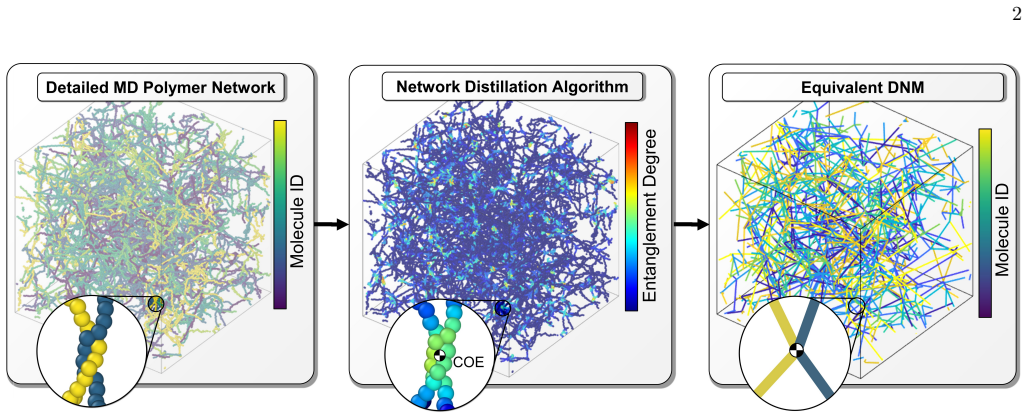
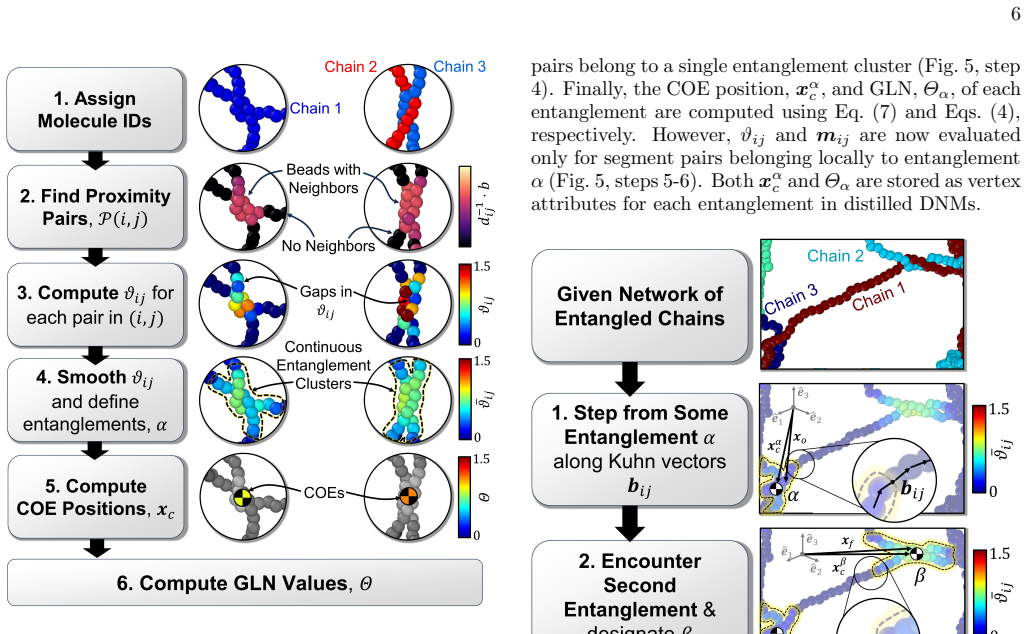
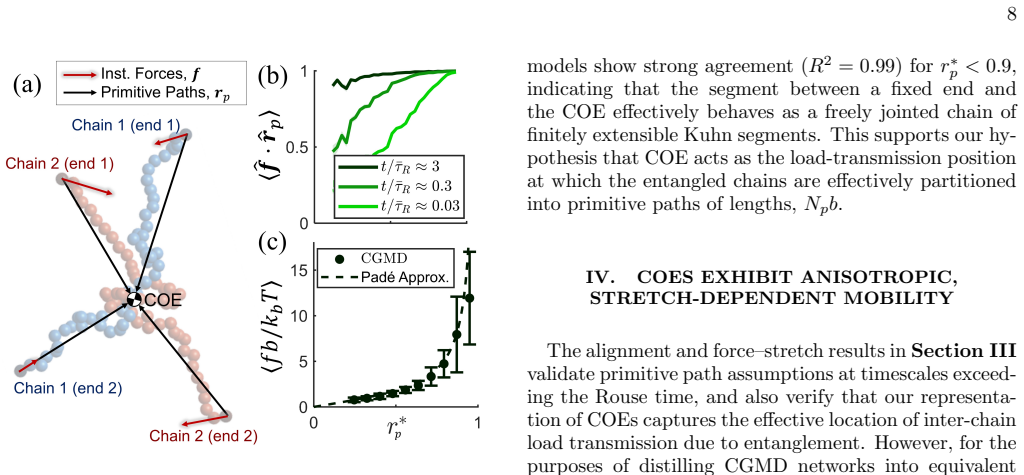
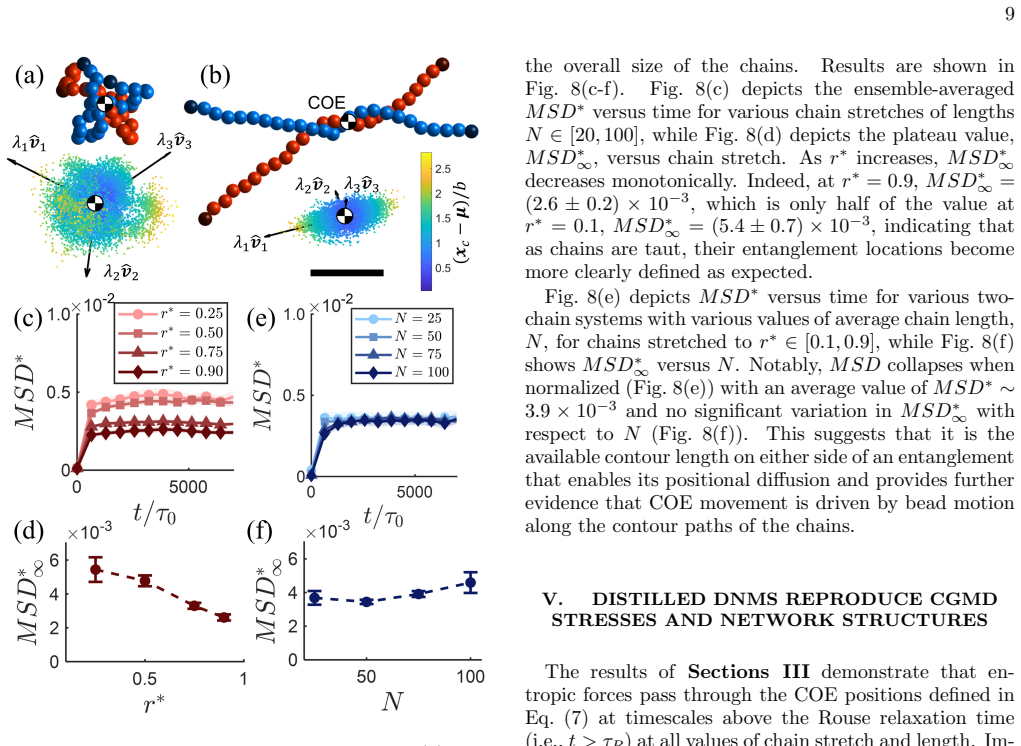
We introduce an approach that quantitatively defines local entanglements along simulated polymer backbones using the Gaussian Linking Number, and introduce a geometric center of entanglement verified to represent the position through which entropic chain forces are transmitted via Kremer-Grest CGMD simulations. Unlike existing approaches, which output a single linking number for chain pairs, our method identifies the multitude of load-transmitting inter- and intra-chain entanglements along a polymer's backbone. To bridge scales, we introduce a topological distillation algorithm that converts entangled CGMD networks into representative discrete network models (DNMs), representing entanglement
What carries the argument
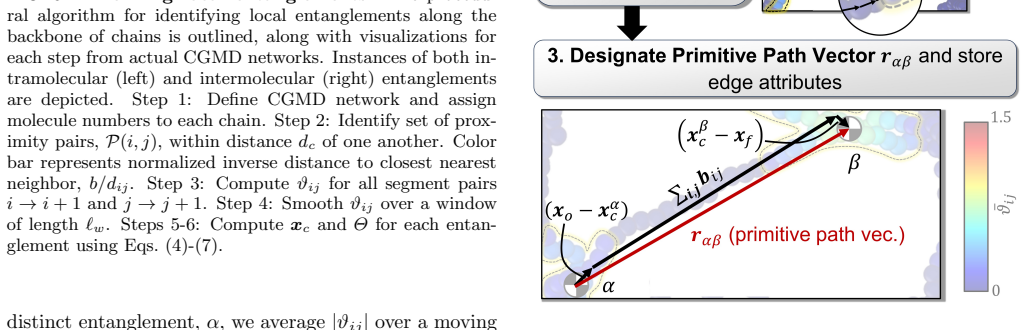
Topological distillation algorithm that converts CGMD networks into discrete network models with entanglements as vertices and primitive paths as load-transmitting edges.
If this is right
- Multiple load-transmitting entanglements can be identified along each polymer backbone rather than a single pairwise value.
- DNMs match the virial stress of the full Kremer-Grest model at small strains.
- The distillation achieves a 97 percent reduction in computational cost.
- The procedure supports physics-based modeling of entangled network mechanics across polymers and architected metamaterials.
Where Pith is reading between the lines
- The same linking-number centers could be used to initialize larger-scale models that explore strain-dependent entanglement evolution.
- DNMs might serve as reduced-order surrogates for rapid screening of network architectures before full molecular validation.
- The approach opens a route to couple entanglement topology directly with continuum constitutive laws for gels and elastomers.
Load-bearing premise
The geometric center of entanglement identified via Gaussian Linking Number accurately represents the position through which entropic chain forces are transmitted.
What would settle it
Direct comparison of small-strain virial stress between a Kremer-Grest CGMD simulation and its distilled DNM on the same network configuration, showing disagreement beyond a few percent, would falsify the physical accuracy claim.
Figures
read the original abstract
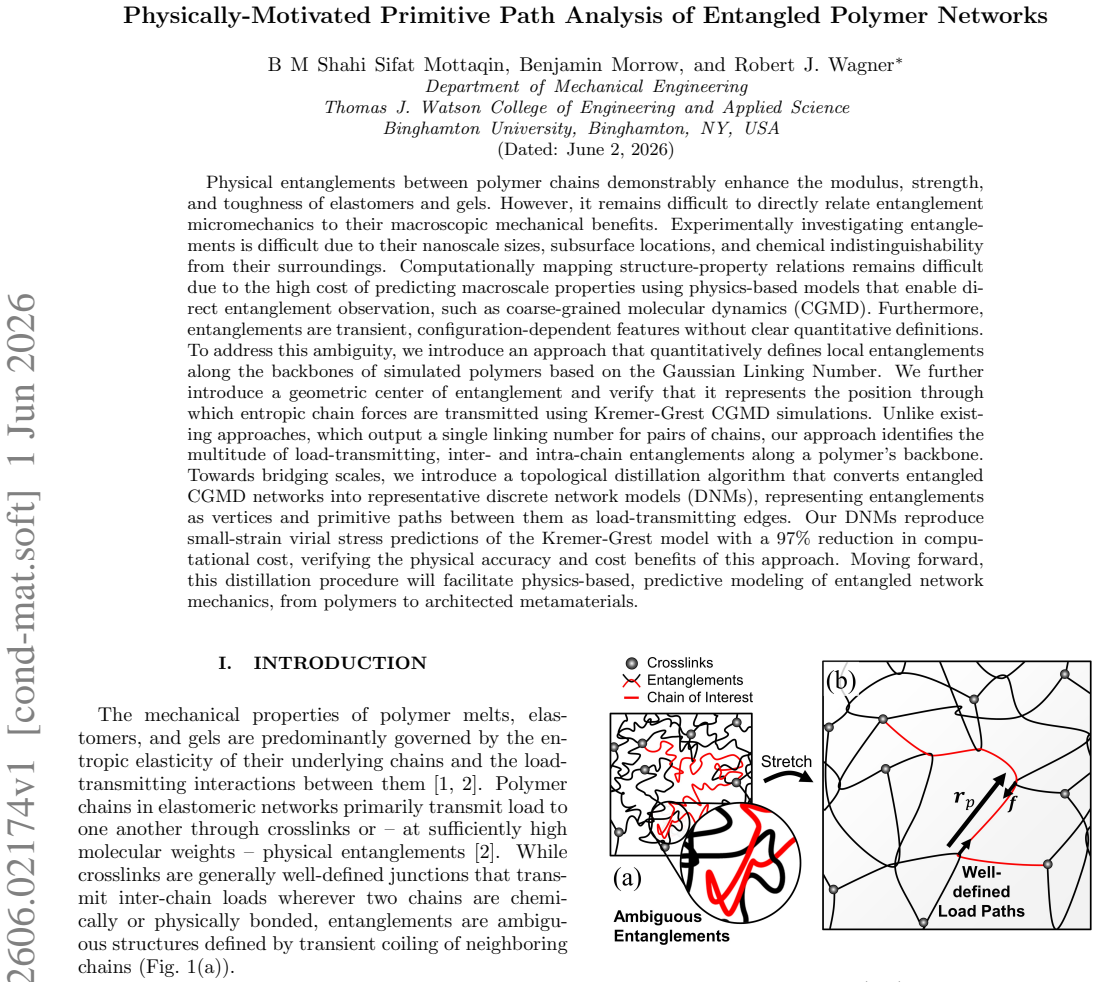
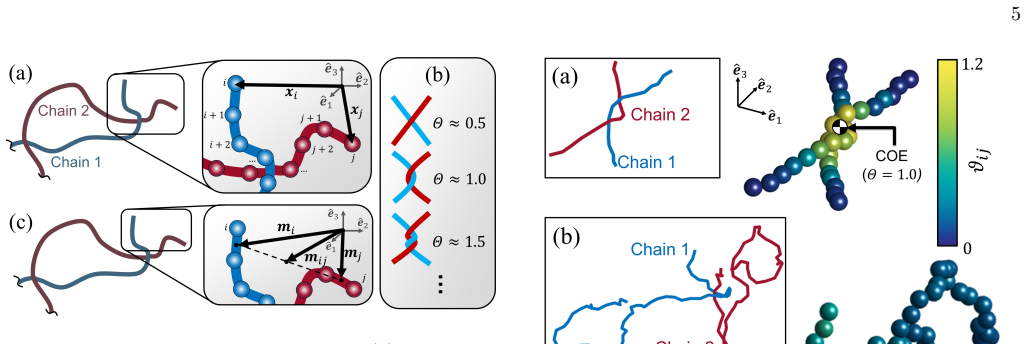
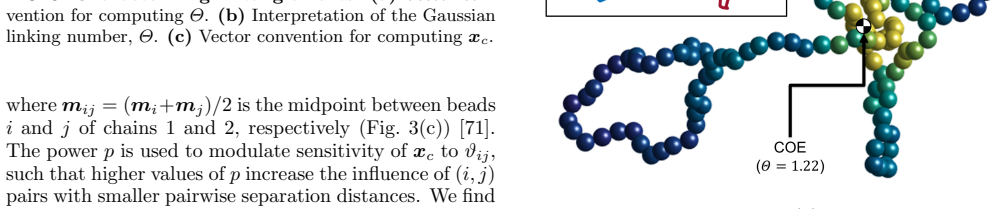
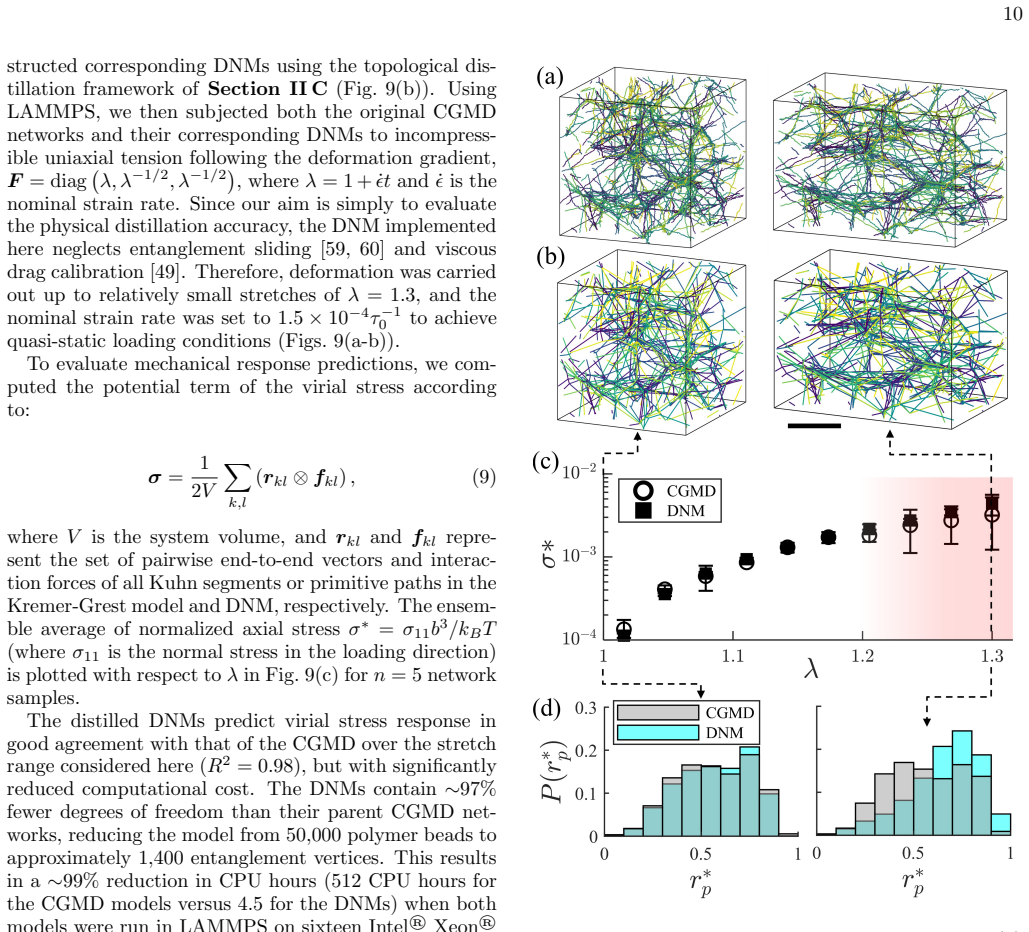
Physical entanglements between polymer chains enhance the moduli, strength, and toughness of elastomers and gels, yet relating entanglement micromechanics to macroscopic mechanical benefits remains difficult. Experimentally investigating entanglements is challenging due to their nanoscale sizes, subsurface locations, and chemical indistinguishability from their surroundings. Computationally mapping structure-property relations is costly when using physics-based models that enable direct entanglement observation, such as coarse-grained molecular dynamics (CGMD). Entanglements are also transient, configuration-dependent features without clear quantitative definitions. To address this ambiguity, we introduce an approach that quantitatively defines local entanglements along simulated polymer backbones using the Gaussian Linking Number, and introduce a geometric center of entanglement verified to represent the position through which entropic chain forces are transmitted via Kremer-Grest CGMD simulations. Unlike existing approaches, which output a single linking number for chain pairs, our method identifies the multitude of load-transmitting inter- and intra-chain entanglements along a polymer's backbone. To bridge scales, we introduce a topological distillation algorithm that converts entangled CGMD networks into representative discrete network models (DNMs), representing entanglements as vertices and primitive paths as load-transmitting edges. Our DNMs reproduce small-strain virial stress predictions of the Kremer-Grest model with a 97% reduction in computational cost, verifying both physical accuracy and computational efficiency. This distillation procedure will facilitate physics-based, predictive modeling of entangled network mechanics, from polymers to architected metamaterials.
Editorial analysis
A structured set of objections, weighed in public.
Referee Report
Summary. The manuscript introduces a Gaussian Linking Number (GLN) method to identify multiple local entanglements along polymer backbones in CGMD simulations of entangled networks, defines a geometric center of each entanglement, and presents a topological distillation procedure that converts the CGMD configurations into Discrete Network Models (DNMs) whose primitive-path edges reproduce the small-strain virial stress of the original Kremer-Grest model at 97 % lower computational cost.
Significance. If the mechanical equivalence of the GLN-derived centers is robust, the work supplies a first-principles route from detailed molecular simulations to coarse-grained network models that preserves entanglement topology and load transmission, offering a scalable framework for predictive mechanics of polymer networks and metamaterials.
major comments (2)
- [Abstract] Abstract and verification paragraph: the central claim that the GLN geometric center is the unique point through which entropic chain forces are transmitted is load-bearing for the DNM construction and the reported accuracy, yet no quantitative metric (e.g., residual force imbalance after vertex displacement, segment-wise virial contribution versus distance from the GLN center, or explicit error bound) is supplied to demonstrate mechanical exactness rather than statistical correlation.
- [DNM construction] DNM construction and stress comparison: the 97 % cost reduction and virial-stress match are asserted for small-strain regimes, but the manuscript must specify the precise definition of primitive-path edges, the handling of intra- versus inter-chain entanglements, and the system sizes and strain amplitudes used in the comparison so that the equivalence can be reproduced and the cost saving evaluated.
minor comments (2)
- [Abstract] Abstract: the phrase “verified to represent the position” should be replaced by a concise statement of the quantitative test performed.
- [Methods] Notation: the distinction between the Gaussian Linking Number used for localization and the conventional pairwise linking number should be clarified with an equation or short derivation.
Simulated Author's Rebuttal
We thank the referee for their constructive comments. We respond point by point to the major comments and indicate the revisions we will incorporate.
read point-by-point responses
-
Referee: [Abstract] Abstract and verification paragraph: the central claim that the GLN geometric center is the unique point through which entropic chain forces are transmitted is load-bearing for the DNM construction and the reported accuracy, yet no quantitative metric (e.g., residual force imbalance after vertex displacement, segment-wise virial contribution versus distance from the GLN center, or explicit error bound) is supplied to demonstrate mechanical exactness rather than statistical correlation.
Authors: We agree that explicit quantitative metrics would strengthen the mechanical verification of the GLN center. The manuscript reports verification through direct CGMD force calculations, but to address the concern we will add in revision the requested metrics, including residual force imbalance after small displacements of the vertex from the GLN center and the decay of segment-wise virial contributions with distance from the center, together with an explicit error bound on the force transmission. revision: yes
-
Referee: [DNM construction] DNM construction and stress comparison: the 97 % cost reduction and virial-stress match are asserted for small-strain regimes, but the manuscript must specify the precise definition of primitive-path edges, the handling of intra- versus inter-chain entanglements, and the system sizes and strain amplitudes used in the comparison so that the equivalence can be reproduced and the cost saving evaluated.
Authors: We will revise the DNM construction section to supply the missing specifications: primitive-path edges are defined as the shortest topologically constrained paths connecting successive GLN centers along each chain; both intra-chain and inter-chain entanglements are treated uniformly by the same GLN-based identification and vertex placement; the comparisons use systems of 100 chains of 500 beads each at engineering strains up to 0.05. These details will be stated explicitly so that the 97 % cost reduction and stress equivalence can be reproduced. revision: yes
Circularity Check
No circularity: topological definition and external CGMD verification are independent of the DNM stress reproduction
full rationale
The paper defines entanglements via Gaussian Linking Number (first-principles topology) and identifies the geometric center, then verifies force transmission in separate Kremer-Grest CGMD runs. The DNM is constructed from this and its virial stress is compared to the same CGMD as an independent validation test, not a fit or self-referential equation. No step reduces a claimed prediction to a fitted parameter or prior self-citation by construction. The 97% cost reduction is a computational outcome of the distillation, not a definitional tautology.
Axiom & Free-Parameter Ledger
axioms (2)
- domain assumption Gaussian Linking Number quantitatively defines load-transmitting local entanglements along polymer backbones
- domain assumption The geometric center of entanglement transmits entropic chain forces
invented entities (2)
-
Geometric center of entanglement
no independent evidence
-
Discrete Network Model (DNM)
no independent evidence
Reference graph
Works this paper leans on
-
[1]
Flory P., Principles of Polymer Chemistry, Baker lectures 1948, Cornell University Press, 1953
1948
-
[2]
Rubinstein M., Colby R., Polymer Physics, OUP Oxford, 2003
2003
-
[3]
F., Vilgis T., The effect of entanglements in rubber elasticity, Polymer 27 (1986) 483–492
Edwards S. F., Vilgis T., The effect of entanglements in rubber elasticity, Polymer 27 (1986) 483–492. doi: 10.1016/0032-3861(86)90231-4
-
[4]
Tsukeshiba H., Huang M., Na Y.-H., Kurokawa T., Kuwabara R., Tanaka Y., Furukawa H., Osada Y., Gong J. P., Effect of Polymer Entanglement on the Toughening of Double Network Hydrogels, The Journal of Physical Chemistry B 109 (2005) 16304–16309. doi: 10.1021/jp052419n
-
[5]
Klein J., Evidence for reptation in an entangled polymer melt, Nature 271 (1978) 143–145. doi:10.1038/271143a0
-
[6]
De Rosa M. E., Winter H. H., The effect of entan- glements on the rheological behavior of polybutadiene critical gels, Rheologica Acta 33 (1994) 220–237. doi: 10.1007/BF00437307
-
[7]
Ge T., Pierce F., Perahia D., Grest G. S., Rob- bins M. O., Molecular Dynamics Simulations of Polymer Welding: Strength from Interfacial Entangle- ments, Physical Review Letters 110 (2013) 098301. doi: 10.1103/PhysRevLett.110.098301
-
[8]
McLeish T. C. B., Tube theory of entangled polymer dynamics, Advances in Physics 51 (2002) 1379–1527. doi: 10.1080/00018730210153216
-
[9]
Likhtman A. E., McLeish T. C. B., Quantita- tive Theory for Linear Dynamics of Linear Entangled Polymers, Macromolecules 35 (2002) 6332–6343. doi: 10.1021/ma0200219
-
[10]
P., Why are double network hydrogels so tough?, Soft Matter 6 (2010) 2583–2590
Gong J. P., Why are double network hydrogels so tough?, Soft Matter 6 (2010) 2583–2590. doi:10.1039/B924290B
-
[11]
Sun J.-Y., Zhao X., Illeperuma W. R. K., Chaudhuri O., Oh K. H., Mooney D. J., Vlassak J. J., Suo Z., Highly stretchable and tough hydrogels, Nature 489 (2012) 133– 12
2012
-
[12]
doi:10.1038/nature11409
-
[13]
Kamiyama Y., Tamate R., Hiroi T., Samitsu S., Fujii K., Ueki T., Highly stretchable and self-healable polymer gels from physical entanglements of ultrahigh–molecular weight polymers, Science Advances 8 (2022) eadd0226. doi:10.1126/sciadv.add0226
-
[14]
Zheng D., Lin S., Ni J., Zhao X., Fracture and fatigue of entangled and unentangled polymer net- works, Extreme Mechanics Letters 51 (2022) 101608. doi:10.1016/j.eml.2022.101608
-
[15]
doi:10.1088/1126-6708/2008/12/001
Sakai K., Satoh Y., Entanglement through conformal interfaces, Journal of High Energy Physics 2008 (2008) 001–001. doi:10.1088/1126-6708/2008/12/001
-
[16]
doi:10.1088/0034-4885/79/4/046601
Creton C., Ciccotti M., Fracture and adhesion of soft materials: a review, Reports on Progress in Physics 79 (2016) 046601. doi:10.1088/0034-4885/79/4/046601
-
[17]
Kim J., Zhang G., Shi M., Suo Z., Fracture, fatigue, and friction of polymers in which entanglements greatly outnumber cross-links, Science 374 (2021) 212–216. doi: 10.1126/science.abg6320
-
[18]
doi: 10.1038/s41467-026-70194-9
Yuan Z., Cao Z., Wang H., Wu H., Zheng J., Zhang R., Wu J., Tough hydrogels enabled by transient entanglements, Nature Communications (2026). doi: 10.1038/s41467-026-70194-9
-
[19]
Yang C., Yin T., Suo Z., Polyacrylamide hydro- gels. I. Network imperfection, Journal of the Me- chanics and Physics of Solids 131 (2019) 43–55. doi: 10.1016/j.jmps.2019.06.018
-
[20]
Liu J., Yang C., Yin T., Wang Z., Qu S., Suo Z., Poly- acrylamide hydrogels. II. elastic dissipater, Journal of the Mechanics and Physics of Solids 133 (2019) 103737. doi:10.1016/j.jmps.2019.103737
-
[21]
Wang Y., Yin T., Suo Z., Polyacrylamide hydro- gels. III. Lap shear and peel, Journal of the Me- chanics and Physics of Solids 150 (2021) 104348. doi: 10.1016/j.jmps.2021.104348
-
[22]
Hassan S., Kim J., suo Z., Polyacrylamide hydrogels. IV. Near-perfect elasticity and rate-dependent toughness, Journal of the Mechanics and Physics of Solids 158 (2022) 104675. doi:10.1016/j.jmps.2021.104675
-
[23]
Kim J., Yin T., Suo Z., Polyacrylamide hydrogels. V. Some strands in a polymer network bear loads, but all strands contribute to swelling, Journal of the Me- chanics and Physics of Solids 168 (2022) 105017. doi: 10.1016/j.jmps.2022.105017
-
[24]
Wang Y., Nian G., Kim J., Suo Z., Polyacrylamide hy- drogels. VI. Synthesis-property relation, Journal of the Mechanics and Physics of Solids 170 (2023) 105099. doi: 10.1016/j.jmps.2022.105099
-
[25]
J., Zou X., He Q., Li T., Pan W., Ding J., Vernerey F
Xu L., Fu Y., Wagner R. J., Zou X., He Q., Li T., Pan W., Ding J., Vernerey F. J., Thermosensitive P(AAc- co-NIPAm) Hydrogels Display Enhanced Toughness and Self-Healing via Ion-Ligand Interactions, Macromolec- ular Rapid Communications 43 (2022) e2200320. doi: 10.1002/marc.202200320
-
[26]
D., Fischer T., Hayn A., Mierke C
Martinez-Garcia F. D., Fischer T., Hayn A., Mierke C. T., Burgess J. K., Harmsen M. C., A Beginner’s Guide to the Characterization of Hydrogel Microarchi- tecture for Cellular Applications, Gels 8 (2022) 535. doi: 10.3390/gels8090535
-
[27]
Wang F. S., Kosovsky L. M., Krist E. C., Kruse B. J., Zhukhovitskiy A. V., Trapped entanglements in polymer networks: formation and characteriza- tion, Trends in Chemistry 6 (2024) 447–458. doi: 10.1016/j.trechm.2024.05.005
-
[28]
Nishi K., Shibayama M., Probe-SAXS on hydrogels un- der elongation, Soft Matter 12 (2016) 5334–5339. doi: 10.1039/C6SM00591H
-
[29]
Gennes de P. G., Reptation of a Polymer Chain in the Presence of Fixed Obstacles, The Journal of Chemical Physics 55 (1971) 572–579. doi:10.1063/1.1675789
-
[30]
doi:10.1016/j.jmps.2024.106000
Yang J., Chen K., Yu C., Zhou K., Kang G., A hyperelas- tic constitutive model for soft elastomers considering the entanglement-dependent finite extensibility, Journal of the Mechanics and Physics of Solids 196 (2025) 106000. doi:10.1016/j.jmps.2024.106000
-
[31]
Vernerey F. J., Lamont S., Transient mechanics of slide- ring networks: A continuum model, Journal of the Me- chanics and Physics of Solids 146 (2021) 104212. doi: 10.1016/j.jmps.2020.104212
-
[32]
Porter R. S., Johnson J. F., The Entanglement Concept in Polymer Systems, Chemical Reviews 66 (1966) 1–27. doi:10.1021/cr60239a001
-
[33]
Edwards S. F., Statistical mechanics with topological constraints: I, Proceedings of the Physical Society 91 (1967) 513. doi:10.1088/0370-1328/91/3/301
-
[34]
doi:10.1016/j.jnnfm.2006.01.013
Leygue A., Bailly C., Keunings R., A tube-based con- stitutive equation for polydisperse entangled linear poly- mers, Journal of Non-Newtonian Fluid Mechanics 136 (2006) 1–16. doi:10.1016/j.jnnfm.2006.01.013
-
[35]
doi: 10.1021/acs.macromol.4c00656
Zhang S., Cao Z., Gu X., Ge T., Polymer Thin Film Necking: Ductility from Entanglements and Plane Stress Condition, Macromolecules 57 (2024) 6221–6232. doi: 10.1021/acs.macromol.4c00656
-
[36]
Tejedor A. R., Carracedo R., Ram´ ırez J., Molecular dy- namics simulations of active entangled polymers reptat- ing through a passive mesh, Polymer 268 (2023) 125677. doi:10.1016/j.polymer.2023.125677
-
[37]
doi: 10.1021/acs.macromol.2c00817
Zou L., Zhang W., Molecular Dynamics Simulations of the Effects of Entanglement on Polymer Crystal Nu- cleation, Macromolecules 55 (2022) 4899–4906. doi: 10.1021/acs.macromol.2c00817
-
[38]
Wang Z., Cai H., Silberstein M. N., A constitutive model for elastomers tailored by ionic bonds and entan- glements, Mechanics of Materials 179 (2023) 104604. doi: 10.1016/j.mechmat.2023.104604
-
[39]
Doi M., Edwards S., Edwards S., The Theory of Polymer Dynamics, International series of monographs on physics, Clarendon Press, 1988
1988
-
[40]
F., Dynamics of concentrated poly- mer systems
Doi M., Edwards S. F., Dynamics of concentrated poly- mer systems. Part 1.—Brownian motion in the equi- librium state, Journal of the Chemical Society, Fara- day Transactions 2: Molecular and Chemical Physics 74 (1978) 1789–1801. doi:10.1039/F29787401789
-
[41]
Shen T., Vernerey F. J., Rate-dependent frac- ture of transient networks, Journal of the Mechan- ics and Physics of Solids 143 (2020) 104028. doi: 10.1016/j.jmps.2020.104028
-
[42]
C., Mulderrig J., Bouklas N., Vernerey F
Lamont S. C., Mulderrig J., Bouklas N., Vernerey F. J., Rate-Dependent Damage Mechanics of Polymer Net- works with Reversible Bonds, Macromolecules 54 (2021) 10801–10813. doi:10.1021/acs.macromol.1c01943
-
[43]
Mulderrig J., Talamini B., Bouklas N., A statistical me- chanics framework for polymer chain scission, based on the concepts of distorted bond potential and asymptotic matching, Journal of the Mechanics and Physics of Solids (2023) 105244. 13
2023
-
[44]
Hopmann C., Twardowski B., Bakir C., Limita- tions of Reptation Theory for Modeling the Stress- Dependent Rheological Behavior of Polyethylene Tereph- thalate Above the Glass-Transition Temperature, Poly- mer Engineering & Science 60 (2020) 765–772. doi: 10.1002/pen.25334
-
[45]
Liu S., O’Connor T. C., Flow-Driven Stretch Fluctua- tions Govern the Nonlinear Viscoelasticity of Elongating Associative Polymer Networks, Physical Review Letters 135 (2025) 098101. doi:10.1103/kgrd-8gkb
-
[46]
doi: 10.1103/PhysRevLett.131.228102
Deng B., Wang S., Hartquist C., Zhao X., Non- local Intrinsic Fracture Energy of Polymerlike Net- works, Physical Review Letters 131 (2023) 228102. doi: 10.1103/PhysRevLett.131.228102
-
[47]
doi: 10.1080/14686996.2025.2587391
Masubuchi Y., Ishida T., Koide Y., Uneyama T., A review on molecular simulations for the rupture of cross-linked polymer networks, Science and Technol- ogy of Advanced Materials 26 (2025) 2587391. doi: 10.1080/14686996.2025.2587391
-
[48]
Kremer K., Grest G. S., Dynamics of entangled linear polymer melts: A molecular-dynamics simulation, The Journal of Chemical Physics 92 (1990) 5057–5086. doi: 10.1063/1.458541
-
[49]
doi: 10.1021/acsmacrolett.7b00808
Hsu H.-P., Kremer K., Primitive path analy- sis and stress distribution in highly strained macro- molecules, ACS Macro Letters 7 (2018) 107–111. doi: 10.1021/acsmacrolett.7b00808
-
[50]
Wagner R. J., Silberstein M. N., A foundational frame- work for the mesoscale modeling of dynamic elastomers and gels, Journal of the Mechanics and Physics of Solids 194 (2025) 105914. doi:10.1016/j.jmps.2024.105914
-
[51]
Sugimura A., Asai M., Matsunaga T., Akagi Y., Sakai T., Noguchi H., Shibayama M., Mechanical properties of a polymer network of Tetra-PEG gel, Polymer Journal 45 (2013) 300–306. doi:10.1038/pj.2012.149
-
[52]
Elbanna A. E., Carlson J. M., Dynamics of Poly- mer Molecules with Sacrificial Bond and Hidden Length Systems: Towards a Physically-Based Mesoscopic Con- stitutive Law, PLOS ONE 8 (2013) e56118. doi: 10.1371/journal.pone.0056118
-
[53]
Alam´ e G., Brassart L., Relative contributions of chain density and topology to the elasticity of two-dimensional polymer networks, Soft Matter 15 (2019) 5703–5713. doi: 10.1039/C9SM00796B
-
[54]
J., Hobbs E., Vernerey F
Wagner R. J., Hobbs E., Vernerey F. J., A network model of transient polymers: exploring the micromechanics of nonlinear viscoelasticity, Soft Matter 17 (2021) 8742–
2021
-
[55]
doi:10.1039/D1SM00753J
-
[56]
Wagner R. J., Dai J., Su X., Vernerey F. J., A mesoscale model for the micromechanical study of gels, Journal of the Mechanics and Physics of Solids (2022) 104982. doi:10.1016/j.jmps.2022.104982
-
[57]
Lei J., Liu Z., A network mechanics method to study the mechanism of the large-deformation fracture of elas- tomers, Journal of Applied Physics 132 (2022) 135101. doi:10.1063/5.0106445
-
[58]
Hartquist C. M., Wang S., Deng B., Beech H. K., Craig S. L., Olsen B. D., Rubinstein M., Zhao X., Fracture of polymer-like networks with hybrid bond strengths, Jour- nal of the Mechanics and Physics of Solids 195 (2025) 105931. doi:10.1016/j.jmps.2024.105931
-
[59]
Gusev A. A., Bernhard T., Molecular Model for Lin- ear Viscoelastic Properties of Entangled Polymer Net- works, Macromolecules 57 (2024) 10152–10163. doi: 10.1021/acs.macromol.4c01429
-
[60]
Bernhard T., Gusev A. A., Phantom Force Balance Pro- cedure for Predicting the Modulus of Entangled Poly- mer Networks, ACS Polymers Au 5 (2025) 500–513. doi: 10.1021/acspolymersau.5c00036
-
[61]
C., Hansoge N., Liu Z., Crespo- Cuevas V., Salmon F., Vernerey F
Assadi S., Lamont S. C., Hansoge N., Liu Z., Crespo- Cuevas V., Salmon F., Vernerey F. J., Nonaffine motion and network reorganization in entangled poly- mer networks, Soft Matter 21 (2025) 2096–2113. doi: 10.1039/D4SM01278J
-
[62]
Huang J., Liu J., Lin S., Topological Mechanics of En- tangled Networks, 2025. doi:10.48550/arXiv.2509.17813
-
[63]
Wagner R. J., Vernerey F. J., Coupled bond dy- namics alters relaxation in polymers with multiple in- trinsic dissociation rates, Soft Matter (2023). doi: 10.1039/D3SM00014A
-
[64]
Gennes de P.-G., Scaling Concepts in Polymer Physics, Cornell University Press, Ithaca, NY, 1979
1979
-
[65]
Thompson A. P., Aktulga H. M., Berger R., Bolintineanu D. S., Brown W. M., Crozier P. S., In ’T Veld P. J., Kohlmeyer A., Moore S. G., Nguyen T. D., Shan R., Stevens M. J., Tranchida J., Trott C., Plimpton S. J., LAMMPS - a flexible simulation tool for particle-based materials modeling at the atomic, meso, and continuum scales, Computer Physics Communicat...
-
[66]
S., Underhill P
Doyle P. S., Underhill P. T., Brownian Dynamics Sim- ulations of Polymers and Soft Matter, in: Yip S. (Ed.), Handbook of Materials Modeling: Methods, Springer Netherlands, Dordrecht, 2005, pp. 2619–2630
2005
-
[67]
Rector D. R., Van Swol F., Henderson J., Simulation of surfactant solutions: Molecular Physics: Vol 82 , No 5 - Get Access, Molecular Physics 82 (1994) 1009–1031. doi:10.1080/00268979400100724
-
[68]
Weeks J. D., Chandler D., Andersen H. C., Role of Re- pulsive Forces in Determining the Equilibrium Structure of Simple Liquids, The Journal of Chemical Physics 54 (1971) 5237–5247. doi:10.1063/1.1674820
-
[69]
doi: 10.1016/j.polymer.2016.09.015
Merlitz H., Li C.-W., Wu C.-X., Sommer J.-U., Theoretical approaches to starlike polymer brushes in theta-solvent, Polymer 103 (2016) 57–63. doi: 10.1016/j.polymer.2016.09.015
-
[70]
Lee H., Venable R. M., MacKerell A. D., Pastor R. W., Molecular Dynamics Studies of Polyethylene Oxide and Polyethylene Glycol: Hydrodynamic Radius and Shape Anisotropy, Biophysical Journal 95 (2008) 1590–1599. doi:10.1529/biophysj.108.133025
-
[71]
Einstein A., ¨Uber die von der molekularkinetis- chen Theorie der W¨ arme geforderte Bewegung von in ruhenden Fl¨ ussigkeiten suspendierten Teilchen, Annalen der Physik 322 (1905) 549–560. doi: 10.1002/andp.19053220806
-
[72]
doi:10.1103/PhysRevE.101.022503
Ahmad R., Paul S., Basu S., Characterization of entan- glements in glassy polymeric ensembles using the Gaus- sian linking number, Physical Review E 101 (2020) 022503. doi:10.1103/PhysRevE.101.022503
-
[73]
Karayiannis N., Foteinopoulou K., Laso M., Structure, dimensions, and entanglement statistics of long linear polyethylene chains, Journal of Chemical Physics 130 (2009) 164907
2009
-
[74]
J., Statistical mechanics of chain molecules, In- terscience Publishers, New York, 1969
Flory P. J., Statistical mechanics of chain molecules, In- terscience Publishers, New York, 1969. 14
1969
-
[75]
J., Such K., Hobbs E., Vernerey F
Wagner R. J., Such K., Hobbs E., Vernerey F. J., Tread- milling and dynamic protrusions in fire ant rafts, Journal of The Royal Society Interface 18 (2021) 20210213. doi: 10.1098/rsif.2021.0213
-
[76]
doi: 10.1007/s00397-006-0112-4
Masubuchi Y., Ianniruberto G., Greco F., Marrucci G., Primitive chain network simulations for branched polymers, Rheologica Acta 46 (2006) 297–303. doi: 10.1007/s00397-006-0112-4
-
[77]
Davidson J. D., Goulbourne N. C., Nonaffine chain and primitive path deformation in crosslinked poly- mers, Modelling and Simulation in Materials Science and Engineering 24 (2016) 065002. doi:10.1088/0965- 0393/24/6/065002
-
[78]
J., Molecular theory of rubber elasticity, Poly- mer Journal 17 (1985-01) 1–12
Flory P. J., Molecular theory of rubber elasticity, Poly- mer Journal 17 (1985-01) 1–12. doi:10.1295/polymj.17.1
-
[79]
Cohen A., A Pad´ e approximant to the inverse Langevin function, Rheologica Acta 30 (1991) 270–273. doi: 10.1007/BF00366640
-
[80]
doi: 10.1002/pol.1946.120010306
Kuhn W., Gr¨ un F., Statistical behavior of the single chain molecule and its relation to the statistical behav- ior of assemblies consisting of many chain molecules, Journal of Polymer Science 1 (1946) 183–199. doi: 10.1002/pol.1946.120010306
discussion (0)
Sign in with ORCID, Apple, or X to comment. Anyone can read and Pith papers without signing in.