REVIEW 4 major objections 6 minor 2 cited by
GraphPrompter: Multi-stage Adaptive Prompt Optimization for Graph In-Context Learning
T0 review · 4 major / 6 minor · reviewed 2026-08-16 · deepseek-v4-flash
Pith's one-line read GraphPrompter optimizes prompt generation, selection, and use, improving graph in-context learning by over 8% with no parameter updates.
desk verdict A new prompt-optimization recipe for graph ICL with real components, undermined by its own inconsistent tables and test-set-tuned hyperparameters. read the letter →
The pith
A machine-rendered reading of the paper's core claim, the machinery that carries it, and where it could break.
The reading
What carries the argument
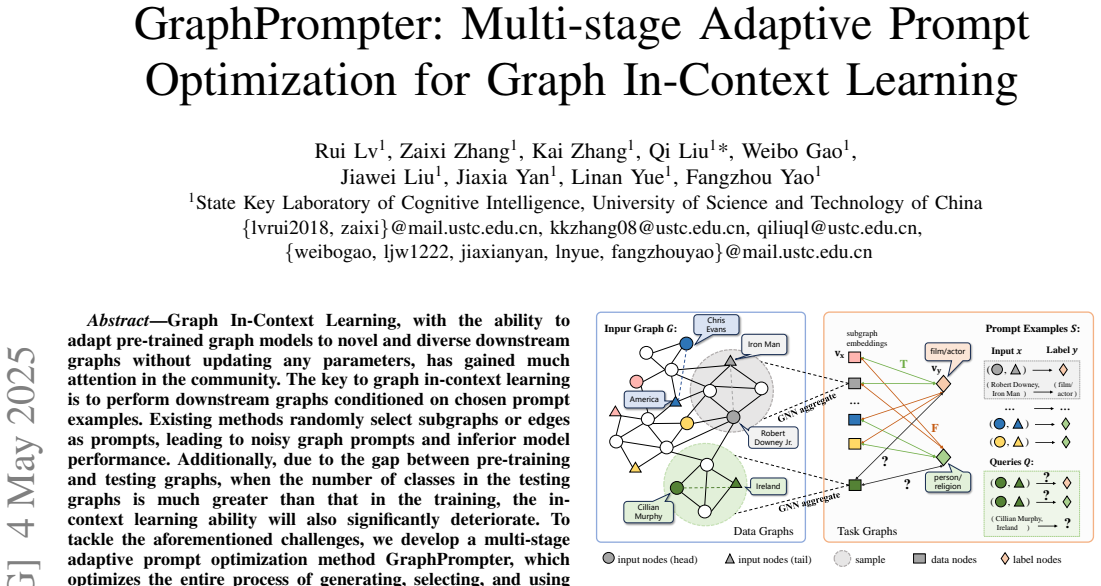
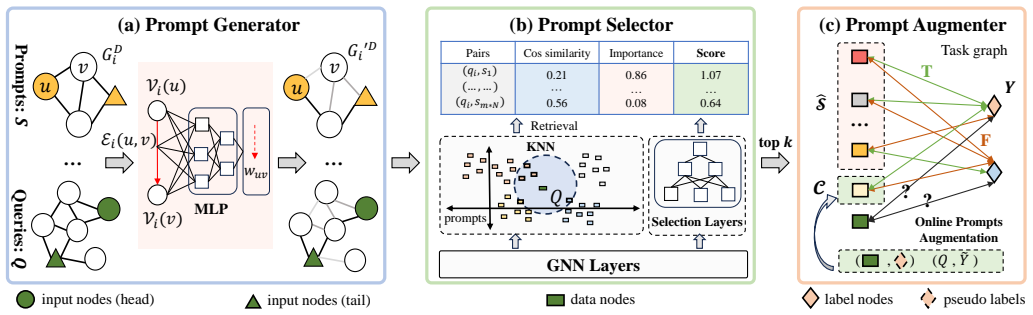
The load-bearing object is the task-graph formulation inherited from Prodigy, where each query is classified by comparing its task-graph node embedding with label embeddings obtained by aggregating prompt subgraphs. GraphPrompter's three modules improve the inputs to that aggregation: the reconstruction layer (an MLP-plus-sigmoid edge re-weighting followed by a GraphSAGE encoder) produces denoised subgraph embeddings; the selector computes $score(p,q)=\cos(G_p,G_q)+I_p\cdot I_q$ and uses a voting scheme to choose the top-$k$ prompts; and the LFU cache injects pseudo-labeled test embeddings into the prompt set. The key property is that no parameter updates occur at test time: all adaptation comes from changing which subgraphs feed into the task graph, making the method a pure prompt-optimization procedure.
What would settle it
Pre-train GraphPrompter on a citation graph, then test on a structurally and featurally distant graph such as a social network or a graph with only numeric features; if kNN-retrieved prompts do not outperform randomly selected prompts (nullifying the score function in Eq. 7) or if the reported average 8% gain over Prodigy disappears, the cross-domain transfer assumption behind the selector fails.
Extended reading notes
Core claim
GraphPrompter is a three-stage, parameter-free-at-test-time pipeline for improving graph in-context learning. Stage one, the Prompt Generator, replaces the random walk subgraphs used by existing approaches with a reconstruction layer that learns an edge weight $w_{uv}=\mathrm{sigmoid}(\mathrm{MLP}(\text{node embeddings}, \text{edge embedding}))$ for every edge in the sampled $l$-hop subgraph, then runs a GNN over the re-weighted graph to produce a cleaner subgraph embedding. Stage two, the Prompt Selector, scores each candidate prompt $p$ for query $q$ by combining a pre-trained importance value $I_p$ with cosine similarity between subgraph embeddings, $score(p,q)=\cos(G_p,G_q)+I_p\cdot I_q$, and uses a voting mechanism across all queries to pick the top-$k$ prompts. Stage three, the Prompt Augmenter, maintains a small cache of the most confident test-time predictions (pseudo-labels) and adds them to the prompt set using an LFU replacement policy. All model parameters are learned in the pretraining phase and no gradient updates happen during inference. Across arXiv node classification and ConceptNet/FB15K-237/NELL edge classification under 3-shot settings, the method surpasses Prodigy, OFA, ProG, and fine-tuned baselines by an average of over 8% accuracy, with the largest gains when the number of classes grows to 40-100.
Load-bearing premise
The pre-trained GNN's embedding space is comparable across the pretraining graph and the downstream graph, so cosine similarity between a query subgraph and candidate prompt subgraphs reliably ranks which prompts are actually useful.
Editorial extensions
If this is right
- Without any gradient updates, GraphPrompter consistently outperforms Prodigy, OFA, and ProG across node and edge classification, by about 8% average accuracy in 3-shot settings.
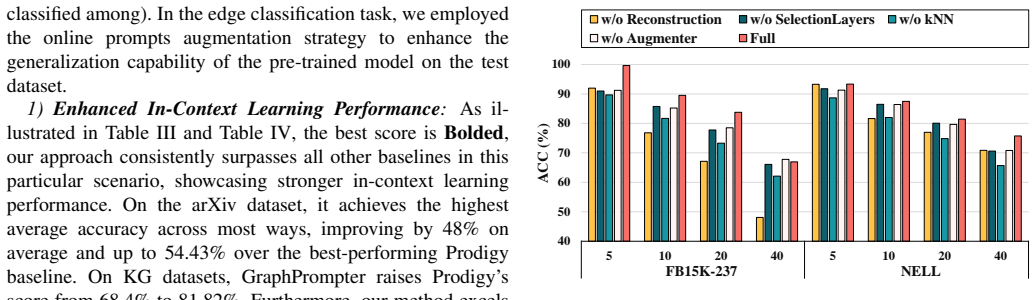
- Ablations show each of the three components helps: removing the reconstruction layer causes the largest drop, while kNN and selection layers are complementary and the LFU cache benefits both few-class and many-class settings.
- The approach transfers the prompt-optimization paradigm from large language models to graphs, suggesting that graph foundation models can adapt to new domains purely through better prompt engineering rather than fine-tuning.
- High-class-count robustness improves: on 50- to 100-way edge classification, GraphPrompter holds accuracy better than Prodigy, which degrades sharply beyond the 15-class pretraining regime.
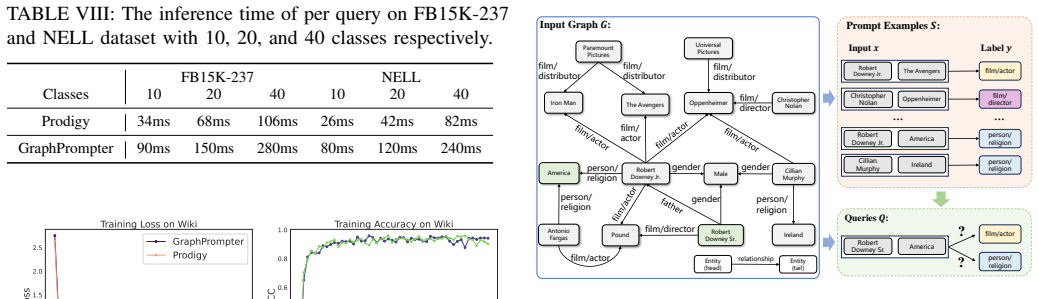
- The added inference cost is bounded: with a cache of size 3, per-query time grows roughly two- to three-fold but stays in the tens-to-hundreds of milliseconds range.
Reading between the lines
- An implication the paper leaves implicit is that the cross-domain relevance signal is entirely the cosine similarity between pre-trained subgraph embeddings; any better alignment of that embedding space, such as a learned cross-domain metric fitted on a handful of labeled examples, would directly strengthen the kNN selector and likely widen the reported gains.
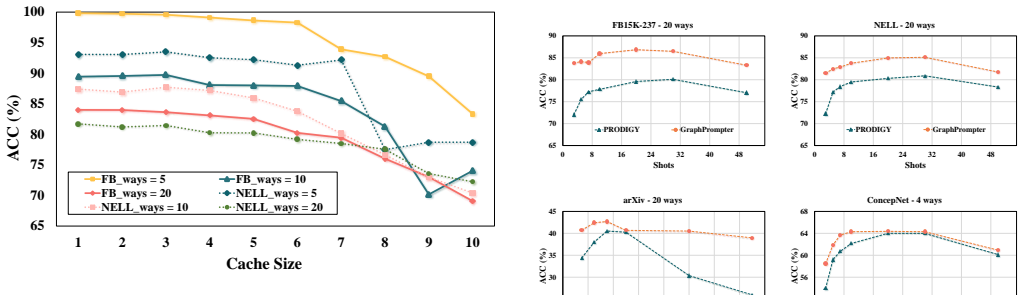
- A testable extension is to make the LFU cache label-noise-aware: filtering pseudo-labels by predictive entropy or prediction agreement across augmented views rather than raw confidence should reduce the performance drop the paper observes when the cache grows beyond size 3.
- The reconstruction layer is a form of graph structure learning, and since GraphSAGE with learned edge weights beat GAT's attention weighting, an implication is that lightweight edge reweighting is a portable complement to any prompt-graph model, not only the Prodigy-style architecture tested here.
Signed reviews
Editorial analysis
A structured set of objections, weighed in public.
Referee Report
Summary. GraphPrompter proposes a multi-stage prompt optimization pipeline for graph in-context learning, consisting of a Prompt Generator that reweights edges via a reconstruction layer, a Prompt Selector that combines pre-trained selection layers with kNN retrieval, and a Prompt Augmenter that maintains an LFU cache of pseudo-labeled test samples to expand the prompt set at inference. The method is evaluated on arXiv node classification and ConceptNet, FB15K-237, and NELL edge classification under 3-shot cross-domain settings against NoPretrain, Contrastive, Finetune, Prodigy, ProG, and OFA. The paper claims an average improvement of over 8% over state-of-the-art baselines and consistent superiority across settings, and it releases code at a public repository.
Significance. Prompt optimization is a relevant and comparatively underexplored direction for graph in-context learning, and the three proposed components are intuitive and well-motivated. The paper ships code, includes ablations of each component, analyzes cache size, number of shots, multi-hop subgraphs, and inference time, and reports several large gains, such as NELL 40-way from 60.02 to 75.74. If the aggregate claims were corrected and the online augmentation protocol were cleared of circularity, this would be a useful empirical contribution to graph in-context learning. However, the headline quantitative claims are not supported by the paper's own tables, and one load-bearing component needs a precise description of its data flow.
major comments (4)
- [V-B1, Tables III-V] In Section V-B1, the text states that 'our approach consistently surpasses all other baselines' and that on arXiv it improves 'by 48% on average and up to 54.43% over the best-performing Prodigy baseline.' Table III contradicts these statements: at 40-way arXiv, ProG reaches 47.50 plus or minus 6.67 while GraphPrompter reaches 29.47 plus or minus 3.82, an 18-point deficit, and no straightforward computation from the table yields a 48% average gain or a 54.43% improvement. The value 54.43 is instead approximately GraphPrompter's mean accuracy across the five arXiv settings. A similar unreproducible number appears in the same section, 'ProG is average 48.24%', which does not match Table V. The abstract's 'over 8%' claim therefore lacks a clear and reproducible definition, and the claim of consistent superiority is false as stated. Please recompute all aggregates against the best baseline in each setting, including ProG and OFA, report per-setting margins, and either remove or qualify the 'consistently surpasses' and '>8%' statements.
- [IV-C and Algorithm 2] The Prompt Augmenter stores 'test samples with predicted labels (pseudo-labels)' in a cache, and the inference algorithm updates the cache before predicting the label in Algorithm 2, lines 9 through 13. If the current query's own pseudo-label is inserted before that query is predicted, the augmenter uses the model's own output as part of the prompt for that same query, which is circular and would inflate the measured benefit of the module. Please state explicitly whether the cache contains only samples from earlier inference steps, with the current query excluded, and adjust Algorithm 2 so the update occurs strictly after prediction. If pseudo-labels from earlier steps are used, report the exact online protocol and verify in the ablation that the gain is not an artifact of this ordering.
- [IV-B.2, Eq. (6)] The kNN retrieval criterion assumes that subgraph embeddings produced by the pre-trained GNN are comparable between the pretraining graph and the downstream graphs, so that cosine similarity ranks true task relevance across domains. The paper itself emphasizes the pretraining/testing gap in Section I, yet no experiment validates this transferability, for example through retrieval precision on downstream graphs, a comparison against random retrieval, or a sensitivity analysis of the embedding space. Because both the Prompt Selector and the cache-hit mechanism in the Prompt Augmenter rely on this assumption, please add such an analysis or explicitly discuss the conditions under which Eq. (6) is expected to hold.
- [V-C, Figure 3] The ablation study is reported only graphically, without numeric values or error bars, and the text's characterization, 'the w/o kNN model only performs 1% better than the baseline', is not tied to a table. Given that the kNN and selection-layer contributions are central to the claimed advantage over Prodigy, please provide the full ablation numbers for each component on each dataset and way count, together with an appropriate significance assessment, such as paired tests over the 500-sample evaluation.
minor comments (6)
- [Throughout] The spelling is inconsistent: 'Prompt Augmenter' in the abstract and Section IV-C alternates with 'Prompt Augmentor' in Section V-C and Algorithm 2, and 'ConcepNet' appears in Table IV and Section V-A while 'ConceptNet' is used elsewhere.
- [IV-B.1, Eq. (7)] Equation (7) uses I_q, the importance of the query, but I_q is never defined in Section IV-B; please define it or revise the score formula.
- [IV-B.2, Eq. (8)] The top-k set T(q) is defined per query, but the final prompt set S-hat is described as a single global set; clarify whether all queries share the same selected prompts or each query receives its own prompt set, since this affects the construction of the task graph in Algorithm 2.
- [V-A.3 and Table VI] The OFA results are taken from external claims rather than from runs under the exact protocol described here; please report the OFA checkpoint, hyperparameters, and dataset splits used, or run OFA under the same random category selection procedure.
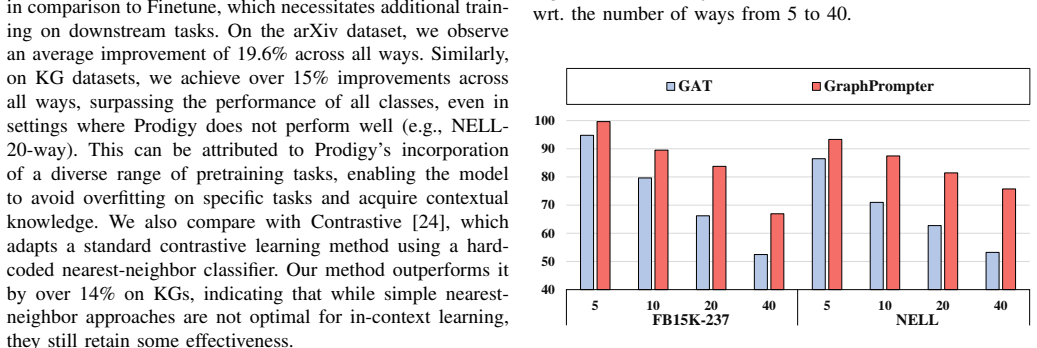
- [V-D.2, Figure 4] The comparison with GAT as a prompt generator lacks configuration details and numeric values; please report the GAT architecture, number of layers, and the exact accuracy numbers behind the figure.
- [V-B1] The paper says GraphPrompter outperforms Finetune by 19.6% on arXiv and over 15% on KGs, but no calculation path is given; please specify whether these are absolute or relative improvements and define the aggregation over ways and datasets.
Circularity Check
No significant circularity; main results are grounded in held-out labels, with the pseudo-label cache being an explicit test-time adaptation step rather than a circular derivation.
full rationale
GraphPrompter is an empirical systems paper without a formal derivation chain whose conclusion is built into its assumptions. The central comparison is against held-out ground-truth labels on arXiv, ConceptNet, FB15K-237, and NELL, and GraphPrompter is scored with the same accuracy metric as all baselines, so the headline accuracy claims are not circular by construction. The Prompt Augmenter (Section IV-C, Eq. 9) augments the prompt set with the model's own high-confidence pseudo-labels from Eq. 11; this is a self-referential transductive/test-time adaptation loop, but it is not a circular derivation because a query's own ground-truth label is never used as its own prompt, and the final evaluation is against true labels rather than against the pseudo-labels themselves. The kNN retrieval (Eq. 6) is a retrieval heuristic, not a fitted parameter renamed as a prediction. Citations to the authors' prior work (e.g., refs. [6], [16], [29]) support general claims about graph noise and graph representation and are not load-bearing for the main experimental result; no uniqueness theorem is imported from the authors' own prior work. The inconsistencies between the reported aggregates ('over 8%', '48%', '54.43%') and Table III (e.g., ProG 47.50 vs. GraphPrompter 29.47 at arXiv 40-way) are internal-validity and reporting concerns, not circularity. The unproved statement in Section V-B1 ('we can prove that hard-code nearest neighbor may not perform well') is an omitted proof, but it is not a circular step. Overall, the paper's core evaluation is self-contained against external benchmarks, and no circularity score above 0 is warranted.
Assumptions & free parameters
free parameters (4)
- cache size c =
3
- candidate prompts per class N =
10
- subgraph hop distance l =
1
- number of prompt examples k =
3
assumptions (6)
- domain assumption Pre-trained GNN embeddings are comparable between source and target graphs, so cosine similarity in Eq. (6) ranks prompt relevance.
- domain assumption High-confidence model predictions are accurate enough to serve as pseudo-labels.
- domain assumption Random-walk subgraphs, after edge reweighting, retain task-relevant information and discard noise.
- domain assumption Prodigy's pretraining tasks are sufficient to train reconstruction and selection parameters that transfer.
- standard math GraphSAGE aggregation in Eq. (4) yields subgraph embeddings suitable for prompt comparison.
- domain assumption LFU cache replacement preserves relevant prompts because graph data samples exhibit spatial locality.
Cite this review
Pith. "Pith review of GraphPrompter: Multi-stage Adaptive Prompt Optimization for Graph In-Context Learning." pith.science (2026). https://pith.science/paper/MLE3RDHV
@misc{pith2026250502027,
  author       = {Pith},
  title        = {Pith review of: GraphPrompter: Multi-stage Adaptive Prompt Optimization for Graph In-Context Learning},
  year         = {2026},
  howpublished = {\url{https://pith.science/paper/MLE3RDHV}},
  note         = {Machine review of arXiv:2505.02027}
}
abstract
Graph In-Context Learning, with the ability to adapt pre-trained graph models to novel and diverse downstream graphs without updating any parameters, has gained much attention in the community. The key to graph in-context learning is to perform downstream graphs conditioned on chosen prompt examples. Existing methods randomly select subgraphs or edges as prompts, leading to noisy graph prompts and inferior model performance. Additionally, due to the gap between pre-training and testing graphs, when the number of classes in the testing graphs is much greater than that in the training, the in-context learning ability will also significantly deteriorate. To tackle the aforementioned challenges, we develop a multi-stage adaptive prompt optimization method GraphPrompter, which optimizes the entire process of generating, selecting, and using graph prompts for better in-context learning capabilities. Firstly, Prompt Generator introduces a reconstruction layer to highlight the most informative edges and reduce irrelevant noise for graph prompt construction. Furthermore, in the selection stage, Prompt Selector employs the $k$-nearest neighbors algorithm and pre-trained selection layers to dynamically choose appropriate samples and minimize the influence of irrelevant prompts. Finally, we leverage a Prompt Augmenter with a cache replacement strategy to enhance the generalization capability of the pre-trained model on new datasets. Extensive experiments show that GraphPrompter effectively enhances the in-context learning ability of graph models. On average across all the settings, our approach surpasses the state-of-the-art baselines by over 8%. Our code is released at https://github.com/karin0018/GraphPrompter.
Figures
Figures from the paper (6 more)
Forward citations
Cited by 2 Pith papers
-
One Model, Many Graphs: Learning over Attributed Graphs across Heterogeneous Modalities with Vision-Language Models
OMG-VLM is a single VLM-based model that handles text-, image-, and multi-attributed graphs through structure-aware adapters, reporting gains on several node/link prediction benchmarks.
-
Heterogeneous Graph Prompt Learning via Adaptive Weight Pruning
GPAWP prunes low-importance graph prompts using gradient-based importance masks and retunes the remaining prompts, improving few-shot node classification over HGPrompt on ACM, DBLP, and Freebase.
Reference graph
Works this paper leans on
-
[1]
Language mod- els are few-shot learners,
T. Brown, B. Mann, N. Ryder, M. Subbiah, J. D. Kaplan, P. Dhariwal, A. Neelakantan, P. Shyam, G. Sastry, A. Askell,et al., “Language mod- els are few-shot learners,”Conference on Neural Information Processing Systems, 2020
work page 2020
-
[2]
A survey for in-context learning,
Q. Dong, L. Li, D. Dai, C. Zheng, Z. Wu, B. Chang, X. Sun, J. Xu, and Z. Sui, “A survey for in-context learning,”arXiv preprint arXiv:2301.00234, 2022
arXiv 2022
-
[3]
Prodigy: Enabling in-context learning over graphs,
Q. Huang, H. Ren, P. Chen, G. Kr ˇzmanc, D. Zeng, P. Liang, and J. Leskovec, “Prodigy: Enabling in-context learning over graphs,”Con- ference on Neural Information Processing Systems, 2023
work page 2023
-
[5]
One for all: Towards training one graph model for all classification tasks,
H. Liu, J. Feng, L. Kong, N. Liang, D. Tao, Y . Chen, and M. Zhang, “One for all: Towards training one graph model for all classification tasks,” inInternational Conference on Learning Representations, 2024
work page 2024
-
[6]
Hierarchical graph trans- former with adaptive node sampling,
Z. ZHANG, Q. Liu, Q. Hu, and C.-K. Lee, “Hierarchical graph trans- former with adaptive node sampling,” inAdvances in Neural Information Processing Systems(S. Koyejo, S. Mohamed, A. Agarwal, D. Belgrave, K. Cho, and A. Oh, eds.), vol. 35, pp. 21171–21183, Curran Associates, Inc., 2022
work page 2022
-
[7]
Robust graph representation learning via neural sparsifica- tion,
C. Zheng, B. Zong, W. Cheng, D. Song, J. Ni, W. Yu, H. Chen, and W. Wang, “Robust graph representation learning via neural sparsifica- tion,” inInternational Conference on Machine Learning, 2020
work page 2020
-
[8]
Data-centric ai: Perspectives and challenges,
D. Zha, Z. P. Bhat, K.-H. Lai, F. Yang, and X. Hu, “Data-centric ai: Perspectives and challenges,” inSDM’23, pp. 945–948, SIAM, 2023
work page 2023
-
[9]
Learning to drop: Robust graph neural network via topological denoising,
L. Dongsheng, C. Wei, Y . Wenchao, Z. Bo, N. Jingchao, C. Haifeng, and Z. Xiang, “Learning to drop: Robust graph neural network via topological denoising,” inThe ACM International Conference on Web Search and Data Mining, 2021
work page 2021
Show all 54 references
-
[10]
Graph structure learning for robust graph neural networks,
W. Jin, Y . Ma, X. Liu, X. Tang, S. Wang, and J. Tang, “Graph structure learning for robust graph neural networks,” inSIGKDD’20, 2020
2020
-
[11]
What makes good in-context examples for GPT-3?,
J. Liu, D. Shen, Y . Zhang, B. Dolan, L. Carin, and W. Chen, “What makes good in-context examples for GPT-3?,” inProceedings of Deep Learning Inside Out (DeeLIO 2022): The 3rd Workshop on Knowledge Extraction and Integration for Deep Learning Architectures, pp. 100– 114, Assoc...
2022
-
[12]
Calibrate before use: Improving few-shot performance of language models,
Z. Zhao, E. Wallace, S. Feng, D. Klein, and S. Singh, “Calibrate before use: Improving few-shot performance of language models,” in International Conference on Machine Learning, 2021
2021
-
[13]
Learning to retrieve prompts for in- context learning,
O. Rubin, J. Herzig, and J. Berant, “Learning to retrieve prompts for in- context learning,” inProceedings of the 2022 Conference of the North American Chapter of the Association for Computational Linguistics: Human Language Technologies, pp. 2655–2671, Association for Com- pu...
2022
-
[14]
Selective anno- tation makes language models better few-shot learners,
H. SU, J. Kasai, C. H. Wu, W. Shi, T. Wang, J. Xin, R. Zhang, M. Ostendorf, L. Zettlemoyer, N. A. Smith, and T. Yu, “Selective anno- tation makes language models better few-shot learners,” inInternational Conference on Learning Representations, 2023
2023
-
[15]
Self-adaptive in-context learning: An information compression perspective for in-context example selec- tion and ordering,
Z. Wu, Y . Wang, J. Ye, and L. Kong, “Self-adaptive in-context learning: An information compression perspective for in-context example selec- tion and ordering,” inACL’22, 2022
2022
-
[16]
Motif-based graph self-supervised learning for molecular property prediction,
Z. ZHANG, Q. Liu, H. Wang, C. Lu, and C.-K. Lee, “Motif-based graph self-supervised learning for molecular property prediction,” inAdvances in Neural Information Processing Systems(M. Ranzato, A. Beygelzimer, Y . Dauphin, P. Liang, and J. W. Vaughan, eds.), vol. 34, pp. 15870–...
2021
-
[17]
Graph attention networks,
P. Veli ˇckovi´c, G. Cucurull, A. Casanova, A. Romero, P. Li `o, and Y . Bengio, “Graph attention networks,” inInternational Conference on Learning Representations, 2018
2018
-
[18]
Semi-supervised classification with graph convolutional networks,
T. N. Kipf and M. Welling, “Semi-supervised classification with graph convolutional networks,” inInternational Conference on Learning Rep- resentations, 2017
2017
-
[19]
E2gcl: Efficient and expressive contrastive learning on graph neural networks,
H. Li, S. Di, L. Chen, and X. Zhou, “E2gcl: Efficient and expressive contrastive learning on graph neural networks,” in2024 IEEE 40th International Conference on Data Engineering (ICDE), pp. 859–873, 2024
2024
-
[20]
Graphrare: Reinforcement learning enhanced graph neural network with relative entropy,
T. Peng, W. Wu, H. Yuan, Z. Bao, Z. Pengru, X. Yu, X. Lin, Y . Liang, and Y . Pu, “Graphrare: Reinforcement learning enhanced graph neural network with relative entropy,” in2024 IEEE 40th International Con- ference on Data Engineering (ICDE), pp. 2489–2502, 2024
2024
-
[21]
Fast iterative graph computing with updated neighbor states,
Y . Zhou, S. Gong, F. Yao, H. Chen, S. Yu, P. Liu, Y . Zhang, G. Yu, and J. X. Yu, “Fast iterative graph computing with updated neighbor states,” in2024 IEEE 40th International Conference on Data Engineering (ICDE), pp. 2449–2462, IEEE, 2024
2024
-
[22]
Inductive representation learning on large graphs,
W. Hamilton, Z. Ying, and J. Leskovec, “Inductive representation learning on large graphs,”Conference on Neural Information Processing Systems, vol. 30, 2017
2017
-
[23]
Strategies for pre-training graph neural networks,
W. Hu*, B. Liu*, J. Gomes, M. Zitnik, P. Liang, V . Pande, and J. Leskovec, “Strategies for pre-training graph neural networks,” in International Conference on Learning Representations, 2020
2020
-
[24]
Graph con- trastive learning with augmentations,
Y . You, T. Chen, Y . Sui, T. Chen, Z. Wang, and Y . Shen, “Graph con- trastive learning with augmentations,”Conference on Neural Information Processing Systems, vol. 33, pp. 5812–5823, 2020
2020
-
[25]
Gpt-gnn: Generative pre-training of graph neural networks,
Z. Hu, Y . Dong, K. Wang, K.-W. Chang, and Y . Sun, “Gpt-gnn: Generative pre-training of graph neural networks,” inProceedings of the 26th ACM SIGKDD International Conference on Knowledge Discovery & Data Mining, pp. 1857–1867, 2020
2020
-
[26]
Gcc: Graph contrastive coding for graph neural network pre-training,
J. Qiu, Q. Chen, Y . Dong, J. Zhang, H. Yang, M. Ding, K. Wang, and J. Tang, “Gcc: Graph contrastive coding for graph neural network pre-training,” inProceedings of the 26th ACM SIGKDD international conference on knowledge discovery & data mining, pp. 1150–1160, 2020
2020
-
[27]
Graph augmentation for recommendation,
Q. Zhang, L. Xia, X. Cai, S.-M. Yiu, C. Huang, and C. S. Jensen, “Graph augmentation for recommendation,” in2024 IEEE 40th International Conference on Data Engineering (ICDE), pp. 557–569, 2024
2024
-
[28]
Graphcontrol: Adding conditional control to universal graph pre-trained models for graph domain transfer learning,
Y . Zhu, Y . Wang, H. Shi, Z. Zhang, and S. Tang, “Graphcontrol: Adding conditional control to universal graph pre-trained models for graph domain transfer learning,” inProceedings of the ACM Web Conference, 2024
2024
-
[29]
Cooperative classi- fication and rationalization for graph generalization,
L. Yue, Q. Liu, Y . Liu, W. Gao, F. Yao, and W. Li, “Cooperative classi- fication and rationalization for graph generalization,” inProceedings of the ACM Web Conference 2024, WWW ’24, p. 344–352, Association for Computing Machinery, 2024
2024
-
[30]
Universal prompt tuning for graph neural networks,
T. Fang, Y . M. Zhang, Y . Yang, C. Wang, and L. CHEN, “Universal prompt tuning for graph neural networks,” inConference on Neural Information Processing Systems, 2023
2023
-
[31]
Graph prompt learning: A comprehensive survey and beyond,
X. Sun, J. Zhang, X. Wu, H. Cheng, Y . Xiong, and J. Li, “Graph prompt learning: A comprehensive survey and beyond,”arXiv preprint arXiv:2311.16534, 2023
2023 arXiv
-
[32]
All in one: Multi-task prompting for graph neural networks,
X. Sun, H. Cheng, J. Li, B. Liu, and J. Guan, “All in one: Multi-task prompting for graph neural networks,” inProceedings of the 29th ACM SIGKDD Conference on Knowledge Discovery and Data Mining, KDD ’23, p. 2120–2131, 2023
2023
-
[33]
Gppt: Graph pre-training and prompt tuning to generalize graph neural networks,
M. Sun, K. Zhou, X. He, Y . Wang, and X. Wang, “Gppt: Graph pre-training and prompt tuning to generalize graph neural networks,” inProceedings of the 28th ACM SIGKDD Conference on Knowledge Discovery and Data Mining, pp. 1717–1727, 2022
2022
-
[34]
Graphprompt: Unifying pre- training and downstream tasks for graph neural networks,
Z. Liu, X. Yu, Y . Fang, and X. Zhang, “Graphprompt: Unifying pre- training and downstream tasks for graph neural networks,” inProceed- ings of the ACM Web Conference 2023, p. 417–428, 2023
2023
-
[35]
Prompt tuning for multi-view graph contrastive learning,
C. Gong, X. Li, J. Yu, C. Yao, J. Tan, C. Yu, and D. Yin, “Prompt tuning for multi-view graph contrastive learning,”arXiv preprint arXiv:2310.10362, 2023
2023 arXiv
-
[36]
Virtual node tuning for few-shot node classification,
Z. Tan, R. Guo, K. Ding, and H. Liu, “Virtual node tuning for few-shot node classification,” inProceedings of the ACM SIGKDD International Conference on Knowledge Discovery & Data Mining, 2023
2023
-
[37]
Enhancing graph neural networks with structure-based prompt,
Q. Ge, Z. Zhao, Y . Liu, A. Cheng, X. Li, S. Wang, and D. Yin, “Enhancing graph neural networks with structure-based prompt,”arXiv preprint arXiv:2310.17394, 2023
2023 arXiv
-
[38]
Hetgpt: Harnessing the power of prompt tuning in pre-trained heterogeneous graph neural networks,
Y . Ma, N. Yan, J. Li, M. Mortazavi, and N. V . Chawla, “Hetgpt: Harnessing the power of prompt tuning in pre-trained heterogeneous graph neural networks,” inProceedings of the ACM Web Conference, 2024
2024
-
[39]
Pre- train, prompt, and predict: A systematic survey of prompting methods in natural language processing,
P. Liu, W. Yuan, J. Fu, Z. Jiang, H. Hayashi, and G. Neubig, “Pre- train, prompt, and predict: A systematic survey of prompting methods in natural language processing,”ACM Computing Surveys, vol. 55, no. 9, 2023
2023
-
[40]
MetaICL: Learning to learn in context,
S. Min, M. Lewis, L. Zettlemoyer, and H. Hajishirzi, “MetaICL: Learning to learn in context,” inProceedings of the 2022 Conference of the North American Chapter of the Association for Computational Linguistics: Human Language Technologies, pp. 2791–2809, July 2022
2022
-
[41]
Meta-learning via language model in-context tuning,
Y . Chen, R. Zhong, S. Zha, G. Karypis, and H. He, “Meta-learning via language model in-context tuning,” inProceedings of the 60th Annual Meeting of the Association for Computational Linguistics (Volume 1: Long Papers), pp. 719–730, May 2022
2022
-
[42]
Surface form competition: Why the highest probability answer isn’t always right,
A. Holtzman, P. West, V . Shwartz, Y . Choi, and L. Zettlemoyer, “Surface form competition: Why the highest probability answer isn’t always right,”arXiv preprint arXiv:2104.08315, 2021
2021 arXiv
-
[43]
A retrieve-and- edit framework for predicting structured outputs,
T. B. Hashimoto, K. Guu, Y . Oren, and P. S. Liang, “A retrieve-and- edit framework for predicting structured outputs,”Advances in Neural Information Processing Systems, vol. 31, 2018
2018
-
[44]
Griprank: Bridging the gap between retrieval and generation via the generative knowledge improved passage ranking,
J. Bai, H. Guo, J. Liu, J. Yang, X. Liang, Z. Yan, and Z. Li, “Griprank: Bridging the gap between retrieval and generation via the generative knowledge improved passage ranking,” inProceedings of the 32nd ACM International Conference on Information and Knowledge Management, CI...
2023
-
[45]
Tent: Fully test-time adaptation by entropy minimization,
D. Wang, E. Shelhamer, S. Liu, B. Olshausen, and T. Darrell, “Tent: Fully test-time adaptation by entropy minimization,” inInternational Conference on Learning Representations, 2021
2021
-
[46]
MEMO: Test time robustness via adaptation and augmentation,
M. M. Zhang, S. Levine, and C. Finn, “MEMO: Test time robustness via adaptation and augmentation,” inNeurIPS 2021 Workshop on Distribution Shifts: Connecting Methods and Applications, 2021
2021
-
[47]
Test-time classifier adjustment module for model-agnostic domain generalization,
Y . Iwasawa and Y . Matsuo, “Test-time classifier adjustment module for model-agnostic domain generalization,” inConference on Neural Information Processing Systems(A. Beygelzimer, Y . Dauphin, P. Liang, and J. W. Vaughan, eds.), 2021
2021
-
[48]
One-shot relational learning for knowledge graphs,
W. Xiong, M. Yu, S. Chang, X. Guo, and W. Y . Wang, “One-shot relational learning for knowledge graphs,” inEMNLP’17, 2018
2018
-
[49]
Adaptive methods for real-world domain generalization,
A. Dubey, V . Ramanathan, A. Pentland, and D. Mahajan, “Adaptive methods for real-world domain generalization,” inProceedings of the IEEE/CVF Conference on Computer Vision and Pattern Recognition, pp. 14340–14349, 2021
2021
-
[50]
Adanpc: Exploring non-parametric classifier for test-time adaptation,
Y .-F. Zhang, X. Wang, K. Jin, K. Yuan, Z. Zhang, L. Wang, R. Jin, and T. Tan, “Adanpc: Exploring non-parametric classifier for test-time adaptation,” inProceedings of the 40th International Conference on Machine Learning, 2023
2023
-
[51]
An O(1) algorithm for implementing the LFU cache eviction scheme,
D. M ´at´ani, K. Shah, and A. Mitra, “An O(1) algorithm for implementing the LFU cache eviction scheme,”CoRR, 2021
2021
-
[52]
Ogb-lsc: A large-scale challenge for machine learning on graphs,
W. Hu, M. Fey, H. Ren, M. Nakata, Y . Dong, and J. Leskovec, “Ogb-lsc: A large-scale challenge for machine learning on graphs,”arXiv preprint arXiv:2103.09430, 2021
2021 arXiv
-
[53]
Open graph benchmark: Datasets for machine learning on graphs,
W. Hu, M. Fey, M. Zitnik, Y . Dong, H. Ren, B. Liu, M. Catasta, and J. Leskovec, “Open graph benchmark: Datasets for machine learning on graphs,”Conference on Neural Information Processing Systems, vol. 33, pp. 22118–22133, 2020
2020
-
[54]
Conceptnet 5.5: An open multilingual graph of general knowledge,
R. Speer, J. Chin, and C. Havasi, “Conceptnet 5.5: An open multilingual graph of general knowledge,” inAAAI’17, 2017
2017
-
[55]
An analysis of the t-sne algorithm for data visualization,
S. Arora, W. Hu, and P. K. Kothari, “An analysis of the t-sne algorithm for data visualization,” inConference on learning theory, pp. 1455–1462, PMLR, 2018
2018
Reviewed August 16, 2026 · model on record in the stance chip above.
Discussion (0). Continue with ORCID to comment.