REVIEW 3 major objections 5 minor 43 references
A Modified Ising Model of Barab\'asi-Albert Network with Gene-type Spins
T0 review · 3 major / 5 minor · reviewed 2026-08-14 · deepseek-v4-flash
Pith's one-line read A 0/1 gene-spin Ising model on a Barabási-Albert network undergoes a first-order phase transition with hysteresis, at a critical field $h_c=Jm$.
desk verdict The paper's 0/1 spin model is just the lattice gas / random-field Ising model, and its central result h_c = Jm is not actually derived as written; the Monte Carlo evidence is far too thin to save it. read the letter →
The pith
A machine-rendered reading of the paper's core claim, the machinery that carries it, and where it could break.
The reading
What carries the argument
The load-bearing object is the modified Ising Hamiltonian with spins restricted to $\{0,1\}$ on a Barabási-Albert network, together with two analytic tools. The first is the annealed mean-field approximation, which replaces the adjacency matrix by its realization average $\langle A_{ij}\rangle=k_i k_j/(2mN)$ and neglects fluctuations around the mean order parameter $M$; this reduces the interacting problem to independent spins in an effective local field $h_i^{\rm eff}=h+Jm k_i$ and yields the central self-consistency equation for $M$. The second is the exact spin mapping $s_i'=2(s_i-\tfrac12)$, which rewrites the 0/1 model as a classical $\pm1$ Ising model with coupling $J/4$ and a degree-dependent local field $h_i'=h/2+(J/2)k_i$; the degree dependence is the trace of the asymmetry between the inactive and active states. Together these tools produce the critical-field estimate $h_c\approx Jm$, explain the first-order jump and hysteresis seen in simulation, and provide a partition-function identity linking the modified model to established results on classical Ising models on scale-free networks.
What would settle it
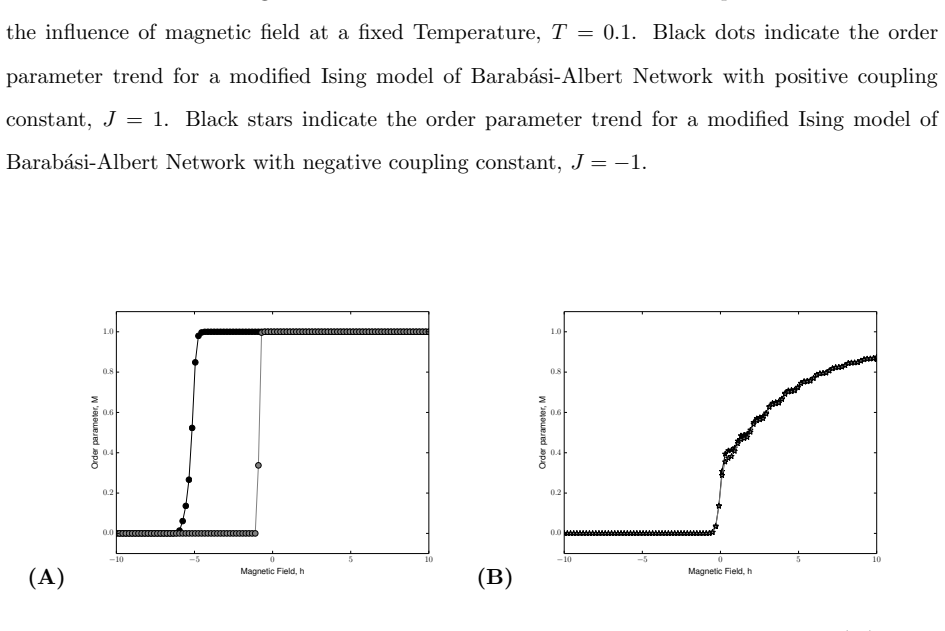
Perform the hysteresis protocol of Fig. 5 on several independent Barabási-Albert realizations with $N=5\times10^3$, $m=5$, $J=1$, and record the field at which the order parameter jumps. If the jump is located at $h\approx 2Jm=10$ instead of $h\approx Jm=5$, or if its location varies noticeably between realizations of the same $(m,J)$, the annealed mean-field critical-field prediction is contradicted.
Extended reading notes
Core claim
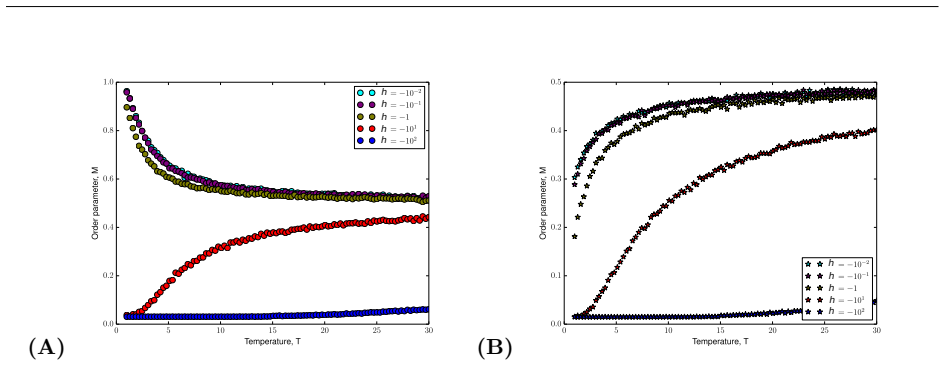
The paper's central claim is that the modified Ising Hamiltonian with spins $s_i\in\{0,1\}$ and ferromagnetic coupling $J>0$, $$H_{[0,1]}=-\frac12 \sum_{i,j} J A_{ij}s_i s_j - h \sum_i s_i,$$ placed on a Barabási-Albert network, undergoes a discontinuous first-order phase transition in the external field $h$ and shows hysteresis at low temperature. Using the annealed average $\langle A_{ij}\rangle = k_i k_j/(2mN)$ over network realizations, the mean-field reduction gives an effective local field $h_i^{\rm eff}=h+Jm k_i$ and the self-consistency equation $M=\frac1N\sum_i [1+e^{-\beta(h+JM k_i)}]^{-1}$, from which the authors derive the approximate critical field $h_c\approx Jm$. The paper further shows that the 0/1 model maps exactly onto the classical $\pm1$ Ising model on the same network through $s_i'=2(s_i-\tfrac12)$, with renormalized coupling $J/4$, site-dependent field $h_i'=h/2+(J/2)k_i$, and a constant energy offset, so all classical Ising results transfer through $Z_{[0,1]}(J,h)=e^{\beta E_0}Z_{[-1,1]}(J/4,h/2+Jk_i/2)$. Monte Carlo simulations on networks of $N=5\times10^3$ nodes with $m=5$ confirm the discontinuous jump and the roughly rectangular hysteresis loop for ferromagnetic coupling.
Load-bearing premise
The central calculation assumes a single network can be represented by the annealed average $\langle A_{ij}\rangle=k_i k_j/(2mN)$ with negligible fluctuations about the mean spin, and it obtains $h_c=Jm$ by using the minimum degree $m$ rather than the mean degree $2m$; on a fixed finite network neither approximation is guaranteed.
Editorial extensions
If this is right
- For ferromagnetic coupling, sweeping the external field through $\pm Jm$ at low temperature flips the whole network between the inactive ($M\approx 0$) and active ($M\approx 1$) states discontinuously, so a gene network can switch phenotype abruptly rather than gradually.
- The critical field grows linearly with both the coupling $J$ and the preferential-attachment parameter $m$: stronger interactions or denser local wiring push the transition further away from zero field, making the active state harder to destroy.
- Because the transition is first-order, the system is bistable near the critical field: the same value of $h$ can support two different activity levels depending on whether the field was increasing or decreasing (hysteresis).
- Through the exact mapping, any quantity computed for the classical Ising model on a Barabási-Albert network (partition function, correlations, critical behavior) can be translated into the gene-type spin model with the renormalized coupling and degree-dependent field.
Reading between the lines
- The degree-dependent local field in the mapped classical model implies that, during a sweep, low-degree nodes should flip before high-degree hubs; this nucleation ordering is not stated in the paper but is directly testable in the same Monte Carlo setup.
- Because the mean-field derivation anneals over graph realizations, the sharp $h_c=Jm$ prediction may fail on individual fixed networks; a practical test is to repeat the hysteresis protocol on several independent Barabási-Albert realizations and check whether the jump location changes between realizations.
- The same effective-field construction should carry over to any network with a specified degree distribution, so the workflow could be applied to measured gene-regulatory connectivity matrices; the paper's own caveat that the connectivity matrix is assumed binary is the main obstacle for such an application.
Signed reviews
Editorial analysis
A structured set of objections, weighed in public.
Referee Report
Summary. The paper introduces a modified Ising model with 0/1 spins (gene-type spins) on Barabasi-Albert networks and studies its phase behavior via Monte Carlo simulations and mean-field theory. The authors report a discontinuous first-order transition with hysteresis under an external field, derive a mean-field self-consistency equation, and claim a critical field h_c = Jm, where J is the coupling and m the number of preferential-attachment links. They also map the 0/1 model to a classical +/-1 Ising model on the same network. The stated goal is to provide a framework for translating statistical-mechanics tools to biological networks.
Significance. If the central claims hold, the paper would provide a simple, analytically tractable example of a binary-state network model with abrupt, history-dependent transitions on scale-free topologies, and a concrete prediction h_c = Jm that is testable in simulations. The model is a natural extension of the Ising model to asymmetric states, and the mean-field self-consistency equation and the exact spin mapping are useful ingredients. The qualitative Monte Carlo observations of a first-order transition and hysteresis are plausible and align with the T to 0 solution of the paper's own mean-field equation. However, the quantitative derivation of h_c = Jm contains internal sign, prefactor, and arithmetic inconsistencies, and the numerical validation lacks error bars, multiple network realizations, and a clearly defined critical-field estimator. The contribution is therefore not yet established as written.
major comments (3)
- [IV B, Eq. (22) and Eq. (27)] Equation (27) is inconsistent with the mapping established in Eqs. (20)-(22). Expanding Eq. (21) with s_i=(s'_i+1)/2 gives the exact local field h'_i = h/2 + (1/4) sum_j J_ij = h/2 + J k_i/4, whereas Eq. (22) writes h' = h/2 + (1/2) sum_j J_ij and Eq. (27) changes the sign to h/2 - (J/2) k_i. Since Eq. (27) is the input to the critical-field condition in Eq. (28), the derivation of h_c does not follow from the mapping as written.
- [IV B, Eqs. (28)-(29)] The step from Eq. (28) to Eq. (29) is arithmetically inconsistent with the definition of the mean degree given in the same paragraph. The paper states that k_bar = 2m, so h_c/2 - J k_bar/2 = 0 gives h_c = 2Jm, not h_c = Jm. The stated conclusion requires silently replacing the mean degree 2m by the minimum degree m, which is not justified. In addition, the paper does not specify whether h_c in Fig. 8 is read from the forward jump, the reverse jump, or the midpoint of the hysteresis loop, so the claimed agreement with Monte Carlo data is not checkable. The final result may be repairable (a zero-temperature analysis of the paper's own Eq. (15), using the minimum degree, also gives |h_c| = Jm), but the derivation as written is invalid.
- [III (Simulations) and Fig. 8] The Monte Carlo evidence for the first-order transition and for the h_c = Jm scaling is statistically weak. The simulations use a single Barabasi-Albert realization of size N = 5e3, equilibration of 2e4 Monte Carlo steps, and a production run of 3e4 steps that the text itself estimates to allow only about 10 spin flips per spin. No error bars, no averaging over network realizations, and no thermalization or autocorrelation diagnostics are reported. Because the mean-field calculation uses the annealed (ensemble-averaged) adjacency matrix while the simulations use one quenched realization, the quantitative comparison in Fig. 8 is not established. The authors should provide results averaged over multiple network realizations, with a clearly defined protocol for extracting the critical field from the hysteresis sweeps.
minor comments (5)
- [IV A, Eq. (10)] The effective field in Eq. (10) is written as h + Jm k_i with a lower-case m, but the same quantity appears as h + JM k_i in Eqs. (13)-(15); since m already denotes the number of preferential-attachment links, the symbol in Eq. (10) should be the order parameter M.
- [IV B, Eq. (22)] The constant term in the mapped Hamiltonian is missing a factor of N: it should be -sum_ij J_ij/8 - hN/2, not -h/2.
- [IV A, discussion after Eq. (18)] The sentence 'when h > Jm then m > 1/2, however, for h < Jm, m > 1/2' appears to use the lower-case m for the order parameter and is self-contradictory; the symbols and inequalities should be corrected.
- [Fig. 8] The axis label |B_c| is used although the text and equations denote the critical field by h_c; B_c is never defined.
- [References] The reference list contains malformed entries (e.g., ', Kumar, R.' with a leading comma) and inconsistent spellings (e.g., 'Dorogovtsev' vs 'Godtsev'); the list should be cleaned before publication.
Circularity Check
No significant circularity: the mean-field reduction and the classical-spin mapping are derived from stated assumptions, and no fitted quantity is relabeled as a prediction.
full rationale
The paper's central derivation is self-contained. The modified-spin Hamiltonian is transformed by the exact change of variables s'_i = 2(s_i - 1/2) (Eq. 20), yielding a classical-spin Hamiltonian with a rescaled coupling and an effective local field; the central mean-field equation M = (1/N) sum_i 1/(1 + exp(-beta(h + J M k_i))) follows from the annealed adjacency average <A_ij> = k_i k_j/(2mN), an external cited result from Bianconi. No parameter is fitted to the Monte Carlo data before the h_c scaling is announced; the comparison with simulation is a genuine check rather than a re-read of a fit. The only self-citations (Krishnan 2018, 2019) are used merely to note that preliminary results were presented earlier, so they carry no load-bearing argument. The derivation of h_c = Jm is, as written, internally inconsistent: Eq. 27 flips the sign of the local field relative to Eq. 22, and inserting the stated kbar = 2m into Eq. 28 gives 2Jm, not Jm. These are correctness defects, not circular reductions: the claimed result is not equivalent by construction to an input, and a corrected T -> 0 solution of Eq. 15 with k_min = m also yields |h_c| = Jm. Therefore no circularity step is established.
Assumptions & free parameters
assumptions (5)
- domain assumption Gene activity states can be represented as binary variables (active or inactive) on network nodes.
- domain assumption The gene-gene connectivity matrix is binary and fixed, and Barabasi-Albert topology approximates biological networks.
- domain assumption Fluctuations around the mean spin M are small, justifying the mean-field factorization s_i s_j approximately M(s_i + s_j) - M^2.
- domain assumption The annealed average of the adjacency matrix, ⟨A_ij⟩ = p_ij = k_i k_j / (2 m N), captures the behavior of a single finite network realization.
- domain assumption Metropolis Monte Carlo converges to canonical equilibrium after 2e4 equilibration steps and 3e4 sampling steps.
Cite this review
Pith. "Pith review of A Modified Ising Model of Barab\'asi-Albert Network with Gene-type Spins." pith.science (2026). https://pith.science/paper/MLRJNEPG
@misc{pith2026190806872,
  author       = {Pith},
  title        = {Pith review of: A Modified Ising Model of Barab\'asi-Albert Network with Gene-type Spins},
  year         = {2026},
  howpublished = {\url{https://pith.science/paper/MLRJNEPG}},
  note         = {Machine review of arXiv:1908.06872}
}
read the original abstract
The central question of systems biology is to understand how individual components of a biological system such as genes or proteins cooperate in emerging phenotypes resulting in the evolution of diseases. As living cells are open systems in quasi-steady state type equilibrium in continuous exchange with their environment, computational techniques that have been successfully applied in statistical thermodynamics to describe phase transitions may provide new insights to emerging behavior of biological systems. Here we will systematically evaluate the translation of computational techniques from solid-state physics to network models that closely resemble biological networks and develop specific translational rules to tackle problems unique to living systems. Hence we will focus on logic models exhibiting only two states in each network node. Motivated by the apparent asymmetry between biological states where an entity exhibits boolean states i.e. is active or inactive, we present an adaptation of symmetric Ising model towards an asymmetric one fitting to living systems here referred to as the modified Ising model with gene-type spins. We analyze phase transitions by Monte Carlo simulations and propose mean-field solution of modified Ising model of a network type that closely resembles real-world network, the Barab\'{a}si-Albert model of scale-free networks. We show that asymmetric Ising models show similarities to symmetric Ising models with external field and undergoes a discontinuous phase transition of the first-order and exhibits hysteresis. The simulation setup presented here can be directly used for any biological network connectivity dataset and is also applicable for other networks that exhibit similar states of activity. This is a general statistical method to deal with non-linear large scale models arising in the context of biological systems and is scalable to any network size.
Figures


Figures from the paper (5 more)



Reference graph
Works this paper leans on
-
[1]
Statistical mechanics of complex networks Rev
Albert, R., Barabasi, A.-L. Statistical mechanics of complex networks Rev. Mod. Phys. 74, 47 (2002)
work page 2002
-
[2]
Aleksiejuk, A., Holyst, J. A. , Stauffer, D. Ferromagnetic phase transition in Barab' a si-Albert networks Physica A 310, 260–266 (2002)
work page 2002
-
[3]
Bianconi, G. Mean field solution of the Ising model on a Barab\' a si–Albert network Physics Letters A 303 (2002) 166–168
work page 2002
-
[4]
Barrat, A. and Weigt, M. On the properties of small-world network models Eur. Phys. J. B 13, 547 (2000)
work page 2000
-
[5]
Statistical physics of social dynamics Reviews of Modern Physics
Castellano, C., Fortunato, S., Loreto, V. Statistical physics of social dynamics Reviews of Modern Physics. 2009; 81(2):591–646
work page 2009
-
[6]
Davies, P., Demetrius, L., Tuszynski, J. A. Cancer as a Dynamical Phase Transition Theoretical Biology and Medical Modelling 2011, 8:30
work page 2011
-
[7]
Dorogovtsev, S. N., Godtsev, A. V. , Mendes, J. F. F. Ising Model on Networks with an Arbitrary Distribution of Connections 10.1103/PhysRevE.66.016104 (2002)
-
[8]
Dorogovtsev, S. N., Godtsev, A. V. , Mendes, J. F. F. Critical phenomena in complex networks Rev. Mod. Phys. 80, 1275–1335 (2008)
work page 2008
Show all 43 references
-
[9]
Facciotti, M. T. Thermodynamically inspired classifier for molecular phenotypes of health and disease PNAS, vol.110:48 (2013)
2013
-
[10]
L., Mendes, J
Ferreira, A. L., Mendes, J. F. F., Ostilli, M. First- and second-order phase transitions in Ising models on small world networks, simulations and comparison with an effective field theory arXiv:1001.1342 (2010)
2010 arXiv
-
[11]
Herrero, .C. P. Anti-ferromagnetic Ising model in small-world networks Phys. Rev. E, 77, 041102, (2008)
2008
-
[12]
Herrero, C. P. Ising model in small-world networks Phys. Rev. E 65, 066110 (2002)
2002
-
[13]
Ising, E. (1925). Beitrag zur Theorie des Ferromagnetisms. Z. Phys , pp.\ v. 31, 253
1925
-
[14]
Small-world phenomena in physics: the Ising model J
Gitterman, M. Small-world phenomena in physics: the Ising model J. Phys. A 33, 8373 (2000)
2000
-
[15]
Lopes, J. V. , Pogorelov, Y. G., dos Santos, J. M. B. L. Exact Solution of Ising Model on a Small-World Network cond-mat/0402138 (2004)
2004 arXiv
-
[17]
W, Rosenbluth, M
Metropolis, N., Rosenbluth, A. W, Rosenbluth, M. N, Teller, A. H and Teller, E. (1953) Equation of State Calculations by Fast Computing Machines J. Chem. Phys., 21 , 1087
1953
-
[18]
G., Leong-Quong, .Y
Mojthahedi, M., Skupin, A., Zhou, J., Castano, I. G., Leong-Quong, .Y. R., Chang, H., Trachana, K., Giuliani, A., Huang, S. Cell Fate Decision as High-Dimensional Critical State Transition PLoS Biol 14(12): e2000640
-
[19]
Pastor-Satorras, R., Castellano, C., Mieghem, P. V. , Vespignani, A. Epidemic processes in complex networks Rev. Mod. Phys. 87, 925–979 (2015)
2015
-
[20]
Ising model on a small-world network Phys
Pekalski, A. Ising model on a small-world network Phys. Rev. E 64, 057104 (2001)
2001
-
[21]
A., Folke, C., Walker, B
Scheffer, M., Carpenter, S., Foley, J. A., Folke, C., Walker, B. Catastrophic shifts in ecosystems Nature 2001, 413:591-596
2001
-
[22]
A., Levin, S
Scheffer, M., Carpenter, S., Timothy, L., Bascompte, J., Brock, W., Dakos, V., van de Koppel, J., van de Leemput I. A., Levin, S. A., van Nes, E., Pascual, M., Vandermeer, J. Anticipating Critical Transitions Science, Vol. 338 (2012)
2012
-
[23]
Phase transitions in scale-free neural networks: Departure from the standard mean-field universality class Physical Review E 70, 066130 (2004)
Aldana, M., Larralde, H. Phase transitions in scale-free neural networks: Departure from the standard mean-field universality class Physical Review E 70, 066130 (2004)
2004
-
[24]
Stauffer (2008)
D. Stauffer (2008). Social applications of two-dimensional Ising models Am. J. Phys. 76 (2008) 470
2008
-
[25]
Smith, A. S. Physics Challenged by Cells Nature Physics, 6:726-729 (2010)
2010
-
[26]
Crystal statistics
Onsager, L. Crystal statistics. I. A two-dimensional model with an order-disorder transition Physical Review, Series II 65(3–4):117–149 (1944)
1944
-
[27]
M., Lloyd, A
May, R. M., Lloyd, A. L. Infection dynamics on scale-free networks Physical Review Letters E, 64 (2001)
2001
-
[28]
Epidemic Spreading in Scale-Free Networks Physical Review Letters E (2001)
Pastor-Satorras, R., Vespignani, A. Epidemic Spreading in Scale-Free Networks Physical Review Letters E (2001)
2001
-
[29]
and Surungan, T
Bartolozzi, M. and Surungan, T. and Leinweber, D. B. and Williams, A. G. Spin-glass behavior of the antiferromagnetic Ising model on a scale-free network Physical Review B - Condensed Matter and Materials Physics 73:1--19 (2006)
2006
-
[30]
Quantit., 41:569 --578 (2007)
Contucci, P.,Ghirlanda, S, Modeling society with statistical mechanics: an application to cultural contact and immigration Qual. Quantit., 41:569 --578 (2007)
2007
-
[31]
, Kumar, R., Raghavan, P., Rajagopalan, D., Sivakumar, D., Tomkins, A., Upfal, E The Web as a graph Proceeding of the 9th ACM Symposium on Principles of Database Systems (2000)
2000
-
[32]
, Stauffer, D., Hohnisch, M., Pittnauer, S The impact of external events on the emergence of social herding of economic sentiment Physica A 370 (2006)
2006
-
[33]
V., Mendes, J
Holstein, D., Goltsv, A. V., Mendes, J. F. F. Impact of noise and damage on collective dynamics of scale-free neuronal networks Phys. Rev. E 87 (2013)
2013
-
[34]
Epidemic Processes in Complex Networks arXiv:1408.2701v2 (2015)
Pastor-Satorras, R., Castellano, C., Van Mieghem, P., Vespignani, A. Epidemic Processes in Complex Networks arXiv:1408.2701v2 (2015)
2015 arXiv
-
[35]
and Carpenter, S
Scheffer, M. and Carpenter, S. R., Lenton, T. M., Bascompte, J., Brock, W., Dakos, V., van de Koppel, J. and van de Leemput, I. A., Levin, S. A., van Nes, E. H., Pascual, M., Vandermeer, J. Anticipating Critical Transitions Science 6105: 338: 344--348 (2012)
2012
-
[36]
In silico Prioritization of Transporter–Drug Relationships From Drug Sensitivity Screens Front
Cesar-Razquin, A., Girardi, E.,Yang, M.,Brehme, M., Saez-Rodriguez, J., Superti-Furga, G. In silico Prioritization of Transporter–Drug Relationships From Drug Sensitivity Screens Front. Pharmacol., doi: 10.3389/fphar.2018.01011 (2018)
2018
-
[37]
Defining and characterizing the critical transition state prior to the type 2 diabetes disease PLoS One 12 (2017)
Jin, B., Liu, R., Hao, S., Li, Z., Zhu, C., Zhou, X. Defining and characterizing the critical transition state prior to the type 2 diabetes disease PLoS One 12 (2017)
2017
-
[38]
M., Chen, L
Liu, X., Liu, R., Zhao, X. M., Chen, L. Detecting early-warning signals of type I diabetes and its leading biomolecular networks by dynamical network biomarkers BMC Medical Genomics 6 (2013)
2013
-
[39]
G., Leong-Quong, Y
Mojtahedi, M., Skupin, A., Zhou, J., Castano, I. G., Leong-Quong, Y. R., Chang, H., Trachana, K., Giuliani, A., Huang, S. Cell Fate Decision as High-Dimensional Critical State Transition PLoS Biology 14 (2016)
2016
-
[40]
Smith, A. S. Physics Challenged by Cells Nature Physics 6:726-729
-
[41]
Trefois, C., Antony, P. M. A., Goncalves, J., Skupin, A., Balling, R. Critical transitions in chronic disease: Transferring concepts from ecology to systems medicine Current Opinion in Biotechnology 34:48--55 (2015)
2015
-
[42]
Towards an Ising Model of Cancer and Beyond arxiv:1010.6284v2
Torquato, S. Towards an Ising Model of Cancer and Beyond arxiv:1010.6284v2
-
[43]
A Statistical Mechanics Perspective of Phase Transitions in Living Systems SIAM Conference on Computational Science and Engineering (CSE) 2019, Spokane, Washington, USA
Krishnan, J., Torabi, R., Di Napoli, E., Schuppert, A. A Statistical Mechanics Perspective of Phase Transitions in Living Systems SIAM Conference on Computational Science and Engineering (CSE) 2019, Spokane, Washington, USA
2019
-
[44]
Simulations of Phase Transitions in Living Systems Systems Biology of Human Diseases 2018, LA, USA
Krishnan, J., Torabi, R., Di Napoli, E., Schuppert, A. Simulations of Phase Transitions in Living Systems Systems Biology of Human Diseases 2018, LA, USA
2018
Reviewed August 14, 2026 · model on record in the stance chip above.
Discussion (0). Continue with ORCID to comment.