REVIEW 5 major objections 6 minor 207 references
Trading Devil RL: Backdoor attack via Stock market, Bayesian Optimization and Reinforcement Learning
T0 review · 5 major / 6 minor · reviewed 2026-08-11 · deepseek-v4-flash
Pith's one-line read A trigger-free backdoor can hijack speech transformers via data poisoning alone.
desk verdict Central claim is unfalsifiable because the trigger transformation is never defined; this is a renamed version of the author's own prior attacks with decorative math. read the letter →
The pith
A machine-rendered reading of the paper's core claim, the machinery that carries it, and where it could break.
The reading
What carries the argument
The load-bearing object is the dynamic trigger produced by Algorithm 8, a small Q-learning loop that draws actions uniformly, updates a Q-table with a reward, and returns a Trigger object carrying a sampling rate and an imperceptibility setting. This trigger is embedded in poisoned audio samples during fine-tuning; the surrounding material, including Bayesian diffusion sampling, Navier-Stokes-style velocity smoothing, and market-order simulation, is presented as the financial modeling apparatus that generates the perturbation. The proposed detection mechanism is a Lyapunov stability function $V(x)=\sum_{i,j,k} x_{ijk}w_{ijk}+b+\alpha s(t)$ evaluated over weight trajectories, with spectral radius and Lyapunov-exponent estimates used to flag poisoned training.
What would settle it
A re-implementation that fixes a concrete perturbation rule, poisoning fraction, and fine-tuning setup from Algorithm 8 and measures attack success rate and benign accuracy on the same read-speech corpus: if the 100 percent success rate or the above-94 percent benign accuracy does not reproduce, the central claim fails.
Extended reading notes
Core claim
On the paper's own terms, the central discovery is that a reinforcement-learning-generated dynamic trigger, applied only to input audio during fine-tuning, is sufficient to implant a backdoor in diverse pretrained speech transformers, including Whisper, wav2vec 2.0, HuBERT, and Data2vec. Table IV reports a 100 percent attack success rate across all seven models with benign accuracy between 94.73 percent and 99.12 percent on a standard read-speech corpus. The paper also proposes that such poisoning leaves a trace in the learning dynamics that a Lyapunov stability function, spectral-radius analysis, and bootstrap confidence intervals can detect.
Load-bearing premise
The attack's central premise is that modifying only the input audio with the dynamic trigger during fine-tuning is enough to force a fixed target class while preserving benign accuracy; this premise is asserted in Algorithm 8 and Section V-B, but the perturbation, the poisoning fraction, and the training procedure are never specified.
Editorial extensions
If this is right
- If the attack works as reported, fine-tuning any pretrained speech transformer on poisoned data can silently redirect outputs to a target label with no visible trigger.
- Benign accuracy above 94 percent across all seven models means the backdoor can survive without degrading the model's advertised performance.
- The Lyapunov-based detector, if valid, offers a defense that monitors training dynamics statistically instead of searching for trigger shapes.
- Success across Whisper, wav2vec 2.0, HuBERT, Data2vec, and other architectures implies the vulnerability is not an artifact of one model family.
- The framing as a threat to LLM-with-reinforcement-learning pipelines suggests the same poisoning recipe could apply to any RLHF-style fine-tuning stage.
Reading between the lines
- The paper leaves unstated the precise perturbation, poisoning fraction, and training procedure behind Algorithm 8, so the reported numbers cannot currently be reproduced from the text alone.
- If the trigger is truly per-sample and adaptive, this points toward a class of backdoors that evade trigger-reverse-engineering defenses, but it also makes standard attack-success metrics harder to define without a fixed trigger.
- A natural testable extension is to run the same poisoning recipe against larger open-weight speech models and measure whether the Lyapunov detector's false-positive rate stays low on clean fine-tuning runs.
- The detection claim generalizes beyond this attack: if poisoned fine-tuning changes the spectral radius or Lyapunov exponents of weight dynamics, other data-poisoning attacks might also be caught by stability monitoring.
Editorial analysis
A structured set of objections, weighed in public.
Referee Report
Summary. The paper proposes FinanceLLMsBackRL, a backdoor attack on pretrained speech models that is claimed to rely exclusively on data poisoning without an explicit trigger, together with a detection method based on Lyapunov stability theory, Kolmogorov equations, and meta-learning. The experimental section reports 100% attack success rate (ASR) and benign accuracy above 94% for seven Hugging Face ASR models fine-tuned on TIMIT, and the appendix gives an additional Graph-RNN autoencoder detection study. The mathematical content includes Bayesian diffusion optimization, Navier-Stokes equations, CIR interest-rate models, HJB equations, and option pricing, which are presented as components of the attack pipeline.
Significance. If the central claims were substantiated, a trigger-free data-poisoning backdoor achieving 100% ASR across multiple modern ASR architectures would be a significant security finding, and a Lyapunov-based detector with statistical validation would be a useful contribution. The paper, however, does not provide an executable specification of the attack, reports no variance or baselines, does not evaluate the proposed detector on the poisoned models, and provides no reproducible artifacts. In its current form the results cannot be verified or built upon, so the significance is only conditional on a level of support that the manuscript does not supply.
major comments (5)
- [Algorithm 8 and Section V-B] The central attack mechanism is never specified. Algorithm 8 returns a Trigger object with fields sampling_rate and imperceptibility, but it does not define a transformation T(x) from audio input to poisoned audio, nor does the surrounding text describe how the trigger is applied to a waveform or spectrogram. Section V-B states that pretrained models are fine-tuned, but it gives no poisoning fraction, no assignment of poisoned labels (the paper says target '3' without mapping to TIMIT's phonetic/word label set), and no fine-tuning details. Consequently, the 100% ASR in Table IV cannot be traced to any reproducible mechanism, and the paper's central claim is untestable as written.
- [Table IV and Section V-C] Table IV reports only point values of ASR and benign accuracy for seven models, with no standard deviations, no number of independent runs, no clean baselines, no comparisons to existing backdoor attacks, and no poisoning fraction. The single learning rate of 0.1 for all models and the use of SparseCategoricalCrossentropy for speech recognition are not justified, and the evaluation does not state whether the task is framed as frame-level classification or sequence-to-sequence transcription. Without these details, the reported 100% ASR figures are best interpreted as single-run, unspecified numbers rather than empirical evidence.
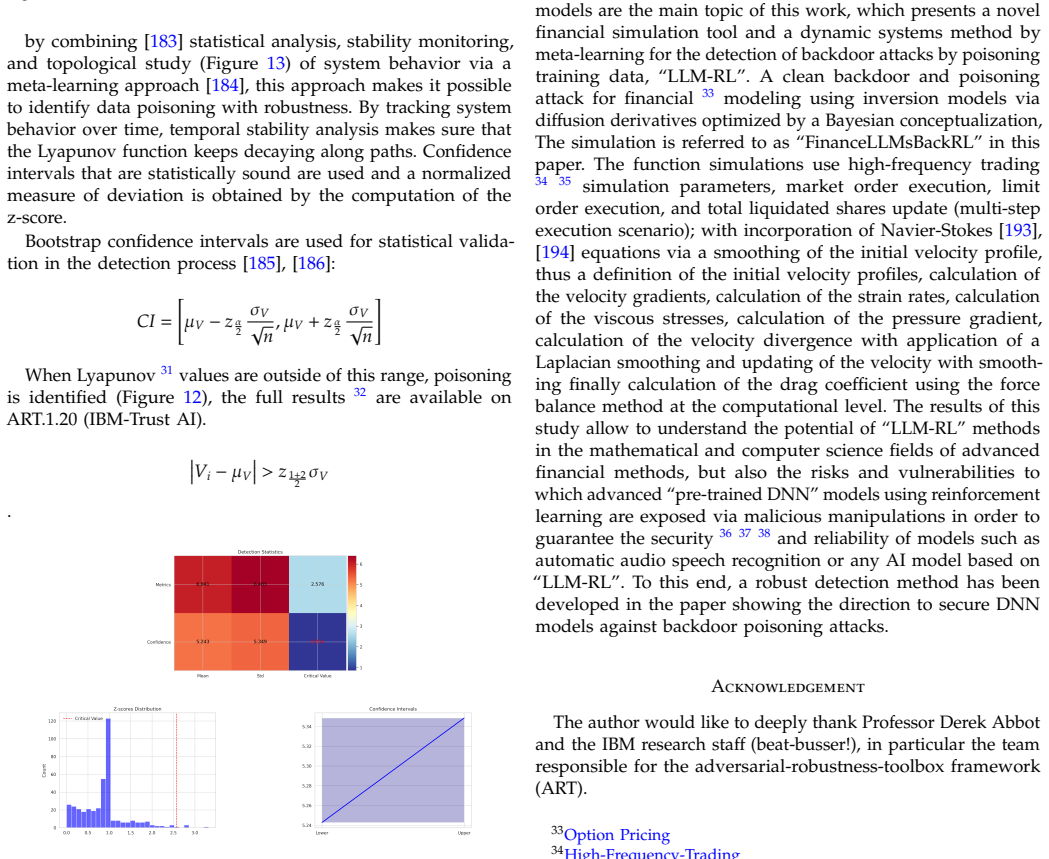
- [Section VI and Figure 12] The proposed Lyapunov-based detection method is only sketched. The Lyapunov function V(x) is written with arbitrary coefficients 0.1, 0.5, and 0.01, and bootstrap confidence intervals are mentioned, but no detection experiment is reported on the poisoned models from Table IV. There are no detection rates, false-positive rates, ROC curves, or comparisons with other detectors, and Figure 12 is not described with quantitative results. The claim that the method can detect FinanceLLMsBackRL is therefore unsupported by any empirical evaluation.
- [Sections III and IV] Large parts of the mathematical development are disconnected from the attack and detection claims. The Navier-Stokes equations, the CIR model, the HJB optimal-liquidation derivation, the Bates stochastic-volatility model, and the Black-Scholes option pricing formulas in the appendix are not used in any equation or algorithm that defines the poisoning transformation or the trigger. Algorithm 8, which is the only component that could plausibly generate a trigger, uses a generic Q-table update with a calculate_reward function that is never defined, and it has no visible connection to the financial mathematics in Sections III-A through III-F. The contribution list in the introduction promises that these models are used to generate triggers, but the manuscript does not show how.
- [References [76], [92], and [176]] The paper attributes core elements of the attack and detection to the author's own prior works, specifically 'Trading Devil' [92], 'The Last Dance' [76], and the detection method in [176]. Since those references are not reproduced or machine-checked here and no comparison with independent baselines is provided, the reader cannot determine what is newly demonstrated in this manuscript as opposed to inherited from prior preprints. A clear statement of the delta with respect to these works and an evaluation against external backdoor methods is needed for the novelty claims to be assessed.
minor comments (6)
- [Section V-A] The dataset description contains a typo: 'Datasets Descritpion' should be 'Dataset Description.'
- [Section V-C] The evaluation metric defines ASR as the proportion of poisoned samples classified as target '3', but TIMIT does not contain a class labeled '3'; the label mapping must be defined for the metric to be meaningful.
- [Section V-B] The paper states 'The learning rates for all models are set to 0.1' and uses SparseCategoricalCrossentropy for speech models; such a high learning rate is atypical for fine-tuning transformer ASR models and should be justified or corrected.
- [Figure and table captions] Several figures and tables lack informative captions (e.g., Figures 11-13 and Table IV), and some captions contain stray text such as '2 TIMIT dataset.' directly after the table.
- [Equations throughout] There are numerous notation inconsistencies, including undefined symbols in Algorithms 1, 6, and 7 (e.g., 'Pτij', 'gradp'), and equations that are copied with typographical errors such as 'λ (x0) ≡ limn→∞ 1 n Pn−1 t=0 log ˙f (xi)' where the index should be xt. A careful pass to define all variables and fix indexing would improve readability.
- [Appendix ablation study] The Graph RNN autoencoder ablation in the appendix is not referenced in the main text, and no quantitative results are given for the claimed detection accuracy; it should either be integrated into the evaluation or removed.
Circularity Check
The attack and detector are imported from the author's own prior papers, and Algorithm 8 is too underspecified to make Table IV's 100% ASR a derivable prediction.
-
self citation load bearing
[Section III-A (intro sentence before Algorithm 1)]
"By conceptualizing according to the previous works studied in [92], [76] we can deduce the following:"
This sentence introduces all of the paper's trigger-generation machinery, including Algorithm 8, the only attack mechanism behind Table IV's claimed 100% ASR, as a deduction from [92] (Trading Devil) and [76] (The Last Dance), both authored by O. Mengara. No independent derivation, theorem, external benchmark, or reproduced artifact is supplied for these prior works. The alleged new attack therefore inherits its validity from the author's own unverified self-citations, making the central novelty claim load-bearing on a self-citation chain rather than on evidence presented in this paper.
-
self citation load bearing
[Section V-E ('Detection FinanceLLMsBackRL') and Section VI]
"A method capable of detecting “FinanceLLMsBackRL” lies in the conceptualization of a dynamical systems method as proposed in study [176] via a Kolmogorov equation and meta-learning [177] in order to study the trajectory of chaotic varieties at the level of the learning space dynamics at the by focusing on the topological [178], [179] transitivity of the latent learning region of the labels defined in the dataset."
The detection result is the paper's second headline contribution, but it is not derived or evaluated in this paper. The text explicitly refers to a dynamical systems method 'as proposed in study [176]', which is the author's own prior publication. Section VI then presents Lyapunov inequalities without connecting them to the models poisoned in Table IV: no detection accuracy, threshold, or experiment is reported. The detection claim therefore reduces to the authority of the author's own prior work rather than to a verified result demonstrated here.
1 more flagged steps
-
self definitional
[Algorithm 8; results claimed in Table IV (Section V-C)]
"Algorithm 8: Reinforcement Learning Trigger ... while state< sampling_rate do action←U (0, 1); end_state← state + 1; reward← calculate_reward(state, end_state); q_table[state, action]← q_table[state, action] + learning_rate· (reward + discount_factor· max a q_table[end_state, a]); state← end_state; end return Trigger(sampling_rate = sampling_rate, imperceptibility = imperceptibility);"
Algorithm 8 is the entire attack generator cited for Table IV, but it never specifies how Trigger modifies a waveform or spectrogram, what label is assigned, or how the poisoned data are mixed with clean data. The paper's formal attack model in Section II defines the backdoor through a transformation T(·) and poisoned labels yt; Algorithm 8 supplies neither. Therefore the '100%' ASR values in Table IV are not predictions from the stated mechanism; they are unsupported assertions about an undefined object. The claimed result is thus equivalent to the missing definition and cannot be independently checked.
full rationale
The paper is not self-contained against external benchmarks: Table IV reports 100% attack success with no runnable code, no defined trigger transform, no poisoning fraction, and a target label ('3') that TIMIT's phonetic label set does not contain; these are serious correctness and reproducibility problems. The circularity finding is narrower and specific. The two load-bearing novelties are each introduced through the author's own prior papers: the attack machinery is presented as a deduction from [92] and [76], and the universal detector is imported from [176]. In the one place where a new algorithm is written down (Algorithm 8), it is too underspecified to support the reported numbers, so Table IV's central results are effectively asserted rather than derived. Because the central claims reduce to self-citation plus ungrounded assertion rather than to an independent derivation, the circularity score is 7.
Assumptions & free parameters
free parameters (4)
- Trigger imperceptibility and sampling rate (Algorithm 8) =
not stated
- Data poisoning fraction
- Lyapunov coefficients 0.1, 0.5, 0.01 in V(x) =
0.1, 0.5, 0.01
- Learning rate for all victim models =
0.1
assumptions (5)
- ad hoc to paper Navier-Stokes smoothing and viscosity-rate calculation are a meaningful trigger-generation step for audio poisoning.
- ad hoc to paper A trigger-free backdoor can be implemented by data poisoning alone.
- domain assumption Poisoning only input data in a black-box setting is sufficient to backdoor pretrained ASR transformers.
- domain assumption TIMIT audio features extracted with Librosa carry the trigger while preserving benign accuracy.
- ad hoc to paper The Lyapunov function with coefficients 0.1, 0.5, 0.01 and bootstrap confidence intervals detects FinanceLLMsBackRL.
invented entities (2)
-
FinanceLLMsBackRL trigger mechanism
-
Dynamic trigger object returned by Algorithm 8
Cite this review
Pith. "Pith review of Trading Devil RL: Backdoor attack via Stock market, Bayesian Optimization and Reinforcement Learning." pith.science (2026). https://pith.science/paper/MLTHQ35Y
@misc{pith2026241217908,
  author       = {Pith},
  title        = {Pith review of: Trading Devil RL: Backdoor attack via Stock market, Bayesian Optimization and Reinforcement Learning},
  year         = {2026},
  howpublished = {\url{https://pith.science/paper/MLTHQ35Y}},
  note         = {Machine review of arXiv:2412.17908}
}
read the original abstract
With the rapid development of generative artificial intelligence, particularly large language models a number of sub-fields of deep learning have made significant progress and are now very useful in everyday applications. For example,financial institutions simulate a wide range of scenarios for various models created by their research teams using reinforcement learning, both before production and after regular operations. In this work, we propose a backdoor attack that focuses solely on data poisoning and a method of detection by dynamic systems and statistical analysis of the distribution of data. This particular backdoor attack is classified as an attack without prior consideration or trigger, and we name it FinanceLLMsBackRL. Our aim is to examine the potential effects of large language models that use reinforcement learning systems for text production or speech recognition, finance, physics, or the ecosystem of contemporary artificial intelligence models.
Figures


Figures from the paper (13 more)




Reference graph
Works this paper leans on
-
[76]
The last Dance : Robust backdoor attack via diffusion models and bayesian approach
O. Mengara, “The last dance: Robust backdoor attack via di ffusion models and bayesian approach,” arXiv preprint arXiv:2402.05967 , 2024
work page Pith review arXiv 2024
-
[92]
Trading devil: Robust backdoor attack via stochastic investment models and bayesian approach,
O. Mengara, “Trading devil: Robust backdoor attack via stochastic investment models and bayesian approach,” arXiv. org, Tech. Rep., 2024
2024
-
[176]
A backdoor approach with inverted labels using dirty label-flipping attacks,
O. Mengara, “A backdoor approach with inverted labels using dirty label-flipping attacks,” IEEE Access, 2024. PREPRINT , JOURNAL NAME ——-, VOL. .., NO. ..., MONTH 2024 21
2024
-
[1]
A survey of large lan- guage models in finance (finllms),
J. Lee, N. Stevens, S. C. Han, and M. Song, “A survey of large lan- guage models in finance (finllms),” arXiv preprint arXiv:2402.02315, 2024
arXiv 2024
-
[2]
A survey of large language models for financial applications: Progress, prospects and challenges,
Y. Nie, Y. Kong, X. Dong, J. M. Mulvey, H. V . Poor, Q. Wen, and S. Zohren, “A survey of large language models for financial applications: Progress, prospects and challenges,” arXiv preprint arXiv:2406.11903, 2024
arXiv 2024
-
[3]
Deep reinforcement learning in a monetary model,
M. Chen, A. Joseph, M. Kumhof, X. Pan, and X. Zhou, “Deep reinforcement learning in a monetary model,” arXiv preprint arXiv:2104.09368, 2021
arXiv 2021
-
[4]
Artificial intelligence and central bank digital currency,
P . K. Ozili, “Artificial intelligence and central bank digital currency,” in Global Developments in Central Bank Digital Currency . IGI Global, 2024, pp. 117–125
2024
-
[5]
Bloomberggpt: A large language model for finance,
S. Wu, O. Irsoy, S. Lu, V . Dabravolski, M. Dredze, S. Gehrmann, P . Kambadur, D. Rosenberg, and G. Mann, “Bloomberggpt: A large language model for finance,” arXiv preprint arXiv:2303.17564, 2023
arXiv 2023
Show all 207 references
-
[6]
Fingpt: Open-source financial large language models,
H. Yang, X.-Y. Liu, and C. D. Wang, “Fingpt: Open-source financial large language models,” arXiv preprint arXiv:2306.06031 , 2023
2023
-
[7]
Tradinggpt: Multi-agent system with layered memory and distinct characters for enhanced financial trading performance,
Y. Li, Y. Yu, H. Li, Z. Chen, and K. Khashanah, “Tradinggpt: Multi-agent system with layered memory and distinct characters for enhanced financial trading performance,” arXiv preprint arXiv:2309.03736, 2023
2023 arXiv
-
[8]
Finbert: Financial sentiment analysis with pre-trained language models,
D. Araci, “Finbert: Financial sentiment analysis with pre-trained language models,” arXiv preprint arXiv:1908.10063 , 2019
1908 arXiv
-
[9]
Investlm: A large language model for investment using financial domain instruction tuning,
Y. Yang, Y. Tang, and K. Y. Tam, “Investlm: A large language model for investment using financial domain instruction tuning,” arXiv preprint arXiv:2309.13064 , 2023
2023 arXiv
-
[10]
Pixiu: A large language model, instruction data and evaluation benchmark for finance,
Q. Xie, W. Han, X. Zhang, Y. Lai, M. Peng, A. Lopez-Lira, and J. Huang, “Pixiu: A large language model, instruction data and evaluation benchmark for finance,” arXiv preprint arXiv:2306.05443, 2023
2023 arXiv
-
[11]
When flue meets flang: Benchmarks and large pre-trained language model for financial domain,
R. S. Shah, K. Chawla, D. Eidnani, A. Shah, W. Du, S. Chava, N. Raman, C. Smiley, J. Chen, and D. Yang, “When flue meets flang: Benchmarks and large pre-trained language model for financial domain,” arXiv preprint arXiv:2211.00083 , 2022
2022 arXiv
-
[12]
Bbt-fin: Comprehensive construction of chinese financial domain pre-trained language model, corpus and benchmark,
D. Lu, H. Wu, J. Liang, Y. Xu, Q. He, Y. Geng, M. Han, Y. Xin, and Y. Xiao, “Bbt-fin: Comprehensive construction of chinese financial domain pre-trained language model, corpus and benchmark,” arXiv preprint arXiv:2302.09432 , 2023
2023 arXiv
-
[13]
Xuanyuan 2.0: A large chinese financial chat model with hundreds of billions parameters,
X. Zhang and Q. Yang, “Xuanyuan 2.0: A large chinese financial chat model with hundreds of billions parameters,” in Proceedings of the 32nd ACM international conference on information and knowledge management, 2023, pp. 4435–4439
2023
-
[14]
Disc-finllm: A chinese financial large language model based on multiple experts fine-tuning,
W. Chen, Q. Wang, Z. Long, X. Zhang, Z. Lu, B. Li, S. Wang, J. Xu, X. Bai, X. Huang et al. , “Disc-finllm: A chinese financial large language model based on multiple experts fine-tuning,” arXiv preprint arXiv:2310.15205, 2023
-
[15]
Fincon: A synthesized llm multi- agent system with conceptual verbal reinforcement for enhanced financial decision making,
Y. Yu, Z. Yao, H. Li, Z. Deng, Y. Cao, Z. Chen, J. W. Suchow, R. Liu, Z. Cui, D. Zhang et al., “Fincon: A synthesized llm multi- agent system with conceptual verbal reinforcement for enhanced financial decision making,” arXiv preprint arXiv:2407.06567 , 2024
2024 arXiv
-
[16]
Finrl: A deep reinforcement learning library for automated stock trading in quantitative finance,
X.-Y. Liu, H. Yang, Q. Chen, R. Zhang, L. Yang, B. Xiao, and C. D. Wang, “Finrl: A deep reinforcement learning library for automated stock trading in quantitative finance,” arXiv preprint arXiv:2011.09607, 2020
2011 arXiv
-
[17]
Deep reinforcement learning: An overview,
Y. Li, “Deep reinforcement learning: An overview,” arXiv preprint arXiv:1701.07274, 2017
2017 arXiv
-
[18]
Recent advances in reinforcement learning in finance,
B. Hambly, R. Xu, and H. Yang, “Recent advances in reinforcement learning in finance,” Mathematical Finance, vol. 33, no. 3, pp. 437– 503, 2023
2023
-
[19]
Stepcoder: Improve code generation with reinforcement learning from compiler feedback,
S. Dou, Y. Liu, H. Jia, L. Xiong, E. Zhou, J. Shan, C. Huang, W. Shen, X. Fan, Z. Xi et al. , “Stepcoder: Improve code generation with reinforcement learning from compiler feedback,” arXiv preprint arXiv:2402.01391, 2024
2024 arXiv
-
[20]
Rl, but don’t do anything i wouldn’t do,
M. K. Cohen, M. Hutter, Y. Bengio, and S. Russell, “Rl, but don’t do anything i wouldn’t do,” arXiv preprint arXiv:2410.06213 , 2024
2024 arXiv
-
[21]
Deep reinforcement learning for trading,
Z. Zhang, S. Zohren, and S. Roberts, “Deep reinforcement learning for trading,” arXiv preprint arXiv:1911.10107 , 2019
1911 arXiv
-
[22]
Deep reinforcement learning for financial trading using price trailing,
K. S. Zarkias, N. Passalis, A. Tsantekidis, and A. Tefas, “Deep reinforcement learning for financial trading using price trailing,” in ICASSP 2019-2019 IEEE international conference on acoustics, speech and signal processing (ICASSP) . IEEE, 2019, pp. 3067–3071
2019
-
[23]
Deep reinforce- ment learning for financial trading using multi-modal features,
L. Avramelou, P . Nousi, N. Passalis, and A. Tefas, “Deep reinforce- ment learning for financial trading using multi-modal features,” Expert Systems with Applications , vol. 238, p. 121849, 2024
2024
-
[24]
A deep reinforcement learning framework for the financial portfolio management problem,
Z. Jiang, D. Xu, and J. Liang, “A deep reinforcement learning framework for the financial portfolio management problem,” arXiv preprint arXiv:1706.10059, 2017
2017 arXiv
-
[25]
Cryptocurrency portfolio management with deep reinforcement learning,
Z. Jiang and J. Liang, “Cryptocurrency portfolio management with deep reinforcement learning,” in 2017 Intelligent systems conference (IntelliSys). IEEE, 2017, pp. 905–913
2017
-
[26]
Deep reinforcement learning in cryptocurrency market making,
J. Sadighian, “Deep reinforcement learning in cryptocurrency market making,” arXiv preprint arXiv:1911.08647 , 2019
1911 arXiv
-
[27]
Large language models in finance: A survey,
Y. Li, S. Wang, H. Ding, and H. Chen, “Large language models in finance: A survey,” in Proceedings of the fourth ACM international conference on AI in finance , 2023, pp. 374–382
2023
-
[28]
Unifying the perspectives of nlp and software engineering: A survey on language models for code,
Z. Zhang, C. Chen, B. Liu, C. Liao, Z. Gong, H. Yu, J. Li, and R. Wang, “Unifying the perspectives of nlp and software engineering: A survey on language models for code,” arXiv preprint arXiv:2311.07989, 2023
2023 arXiv
-
[29]
Rlcoder: Reinforcement learning for repository-level code completion,
Y. Wang, Y. Wang, D. Guo, J. Chen, R. Zhang, Y. Ma, and Z. Zheng, “Rlcoder: Reinforcement learning for repository-level code completion,” arXiv preprint arXiv:2407.19487 , 2024
2024 arXiv
-
[30]
Actuarial applications of natural language processing using transformers: Case studies for using text features in an actuarial context,
A. Troxler and J. Schelldorfer, “Actuarial applications of natural language processing using transformers: Case studies for using text features in an actuarial context,” British Actuarial Journal , vol. 29, p. e4, 2024
2024
-
[31]
Gpt (generative pre-trained transformer)–a com- prehensive review on enabling technologies, potential applications, emerging challenges, and future directions,
G. Yenduri, M. Ramalingam, G. C. Selvi, Y. Supriya, G. Srivastava, P . K. R. Maddikunta, G. D. Raj, R. H. Jhaveri, B. Prabadevi, W. Wang et al., “Gpt (generative pre-trained transformer)–a com- prehensive review on enabling technologies, potential applications, emerging challe...
2024
-
[32]
A survey on large language model (llm) security and privacy: The good, the bad, and the ugly,
Y. Yao, J. Duan, K. Xu, Y. Cai, Z. Sun, and Y. Zhang, “A survey on large language model (llm) security and privacy: The good, the bad, and the ugly,” High-Confidence Computing, p. 100211, 2024
2024
-
[33]
Blockchain-based federated learning: A comprehensive survey,
Z. Wang and Q. Hu, “Blockchain-based federated learning: A comprehensive survey,” arXiv preprint arXiv:2110.02182 , 2021
2021 arXiv
-
[34]
Trustllm: Trustworthiness in large language models,
L. Sun, Y. Huang, H. Wang, S. Wu, Q. Zhang, C. Gao, Y. Huang, W. Lyu, Y. Zhang, X. Li et al., “Trustllm: Trustworthiness in large language models,” arXiv preprint arXiv:2401.05561 , 2024
2024 arXiv
-
[35]
Ai in finance: challenges, techniques, and opportunities,
L. Cao, “Ai in finance: challenges, techniques, and opportunities,” ACM Computing Surveys (CSUR) , vol. 55, no. 3, pp. 1–38, 2022
2022
-
[36]
Sustainable ai: Environmental implications, challenges and opportunities,
C.-J. Wu, R. Raghavendra, U. Gupta, B. Acun, N. Ardalani, K. Maeng, G. Chang, F. Aga, J. Huang, C. Bai et al., “Sustainable ai: Environmental implications, challenges and opportunities,” Proceedings of Machine Learning and Systems , vol. 4, pp. 795–813, 2022
2022
-
[37]
Ai and 6g into the metaverse: Fundamentals, PREPRINT , JOURNAL NAME ——-, VOL. .., NO. ..., MONTH 2024 18 challenges and future research trends,
M. Zawish, F. A. Dharejo, S. A. Khowaja, S. Raza, S. Davy, K. Dev, and P . Bellavista, “Ai and 6g into the metaverse: Fundamentals, PREPRINT , JOURNAL NAME ——-, VOL. .., NO. ..., MONTH 2024 18 challenges and future research trends,” IEEE Open Journal of the Communications Soci...
2024
-
[38]
Reinforcement learning interpretation methods: A survey,
A. Alharin, T.-N. Doan, and M. Sartipi, “Reinforcement learning interpretation methods: A survey,” IEEE Access, vol. 8, pp. 171 058– 171 077, 2020
2020
-
[39]
An overview of di ffusion models: Applications, guided generation, statistical rates and optimization,
M. Chen, S. Mei, J. Fan, and M. Wang, “An overview of di ffusion models: Applications, guided generation, statistical rates and optimization,” arXiv preprint arXiv:2404.07771 , 2024
2024 arXiv
-
[40]
Applications and challenges of artificial intelligence in space missions,
P . A. Oche, G. A. Ewa, and N. Ibekwe, “Applications and challenges of artificial intelligence in space missions,” IEEE Access, vol. 12, pp. 44 481–44 509, 2021
2021
-
[41]
A review of nasa human-robot interaction in space,
K. Hambuchen, J. Marquez, and T. Fong, “A review of nasa human-robot interaction in space,” Current Robotics Reports, vol. 2, no. 3, pp. 265–272, 2021
2021
-
[42]
A survey on reinforcement learning in aviation applications,
P . Razzaghi, A. Tabrizian, W. Guo, S. Chen, A. Taye, E. Thompson, A. Bregeon, A. Baheri, and P . Wei, “A survey on reinforcement learning in aviation applications,” Engineering Applications of Artificial Intelligence, vol. 136, p. 108911, 2024
2024
-
[43]
Reinforcement learning in healthcare: A survey,
C. Yu, J. Liu, S. Nemati, and G. Yin, “Reinforcement learning in healthcare: A survey,” ACM Computing Surveys (CSUR) , vol. 55, no. 1, pp. 1–36, 2021
2021
-
[44]
Multiobjective reinforcement learning for cognitive satellite communications using deep neural network ensembles,
P . V . R. Ferreira, R. Paffenroth, A. M. Wyglinski, T. M. Hackett, S. G. Bilén, R. C. Reinhart, and D. J. Mortensen, “Multiobjective reinforcement learning for cognitive satellite communications using deep neural network ensembles,” IEEE Journal on Selected Areas in Communica...
2018
-
[45]
Reinforcement learning for iot security: A comprehensive survey,
A. Uprety and D. B. Rawat, “Reinforcement learning for iot security: A comprehensive survey,” IEEE Internet of Things Journal , vol. 8, no. 11, pp. 8693–8706, 2020
2020
-
[46]
Deep reinforcement learning for blockchain in industrial iot: A survey,
Y. Wu, Z. Wang, Y. Ma, and V . C. Leung, “Deep reinforcement learning for blockchain in industrial iot: A survey,” Computer Networks, vol. 191, p. 108004, 2021
2021
-
[47]
Blockchain- based edge computing resource allocation in iot: A deep reinforce- ment learning approach,
Y. He, Y. Wang, C. Qiu, Q. Lin, J. Li, and Z. Ming, “Blockchain- based edge computing resource allocation in iot: A deep reinforce- ment learning approach,” IEEE Internet of Things Journal , vol. 8, no. 4, pp. 2226–2237, 2020
2020
-
[48]
Recent reinforcement learning and blockchain based security solutions for internet of things: Survey,
R. Gasmi, S. Hammoudi, M. Lamri, and S. Harous, “Recent reinforcement learning and blockchain based security solutions for internet of things: Survey,” Wireless Personal Communications , vol. 132, no. 2, pp. 1307–1345, 2023
2023
-
[49]
Bitcoin and beyond: A technical survey on decentralized digital currencies,
F. Tschorsch and B. Scheuermann, “Bitcoin and beyond: A technical survey on decentralized digital currencies,” IEEE Com- munications Surveys & Tutorials, vol. 18, no. 3, pp. 2084–2123, 2016
2016
-
[50]
Cryptocurrency trading: a comprehensive survey,
F. Fang, C. Ventre, M. Basios, L. Kanthan, D. Martinez-Rego, F. Wu, and L. Li, “Cryptocurrency trading: a comprehensive survey,” Financial Innovation, vol. 8, no. 1, p. 13, 2022
2022
-
[51]
Sok: Research perspectives and challenges for bitcoin and cryptocurrencies,
J. Bonneau, A. Miller, J. Clark, A. Narayanan, J. A. Kroll, and E. W. Felten, “Sok: Research perspectives and challenges for bitcoin and cryptocurrencies,” in 2015 IEEE symposium on security and privacy . IEEE, 2015, pp. 104–121
2015
-
[52]
An empirical study on modeling and prediction of bitcoin prices with bayesian neural networks based on blockchain information,
H. Jang and J. Lee, “An empirical study on modeling and prediction of bitcoin prices with bayesian neural networks based on blockchain information,” IEEE access , vol. 6, pp. 5427–5437, 2017
2017
-
[53]
Blockchain challenges and opportunities: A survey,
Z. Zheng, S. Xie, H.-N. Dai, X. Chen, and H. Wang, “Blockchain challenges and opportunities: A survey,” International journal of web and grid services , vol. 14, no. 4, pp. 352–375, 2018
2018
-
[54]
2017 global cryptocurrency bench- marking study,
G. Hileman and M. Rauchs, “2017 global cryptocurrency bench- marking study,” Available at SSRN 2965436 , 2017
2017
-
[55]
Reinforcement learning: A survey,
L. P . Kaelbling, M. L. Littman, and A. W. Moore, “Reinforcement learning: A survey,” Journal of artificial intelligence research , vol. 4, pp. 237–285, 1996
1996
-
[56]
Deep reinforcement learning: A brief survey,
K. Arulkumaran, M. P . Deisenroth, M. Brundage, and A. A. Bharath, “Deep reinforcement learning: A brief survey,” IEEE Signal Processing Magazine , vol. 34, no. 6, pp. 26–38, 2017
2017
-
[57]
A brief survey of deep reinforcement learning,
——, “A brief survey of deep reinforcement learning,” arXiv preprint arXiv:1708.05866, 2017
2017 arXiv
-
[58]
Reinforcement learning,
M. A. Wiering and M. Van Otterlo, “Reinforcement learning,” Adaptation, learning, and optimization , vol. 12, no. 3, p. 729, 2012
2012
-
[59]
Reinforcement learning in robotics: A survey,
J. Kober, J. A. Bagnell, and J. Peters, “Reinforcement learning in robotics: A survey,” The International Journal of Robotics Research , vol. 32, no. 11, pp. 1238–1274, 2013
2013
-
[60]
A comprehensive survey of multiagent reinforcement learning,
L. Busoniu, R. Babuska, and B. De Schutter, “A comprehensive survey of multiagent reinforcement learning,” IEEE Transactions on Systems, Man, and Cybernetics, Part C (Applications and Reviews) , vol. 38, no. 2, pp. 156–172, 2008
2008
-
[61]
Applications of deep reinforcement learning in communications and networking: A survey,
N. C. Luong, D. T. Hoang, S. Gong, D. Niyato, P . Wang, Y.-C. Liang, and D. I. Kim, “Applications of deep reinforcement learning in communications and networking: A survey,” IEEE communications surveys & tutorials , vol. 21, no. 4, pp. 3133–3174, 2019
2019
-
[62]
A comprehensive survey on safe reinforcement learning,
J. Garcıa and F. Fernández, “A comprehensive survey on safe reinforcement learning,” Journal of Machine Learning Research , vol. 16, no. 1, pp. 1437–1480, 2015
2015
-
[63]
Machine unlearning fails to remove data poisoning attacks,
M. Pawelczyk, J. Z. Di, Y. Lu, G. Kamath, A. Sekhari, and S. Neel, “Machine unlearning fails to remove data poisoning attacks,” arXiv preprint arXiv:2406.17216, 2024
2024
-
[64]
Adversarial reinforcement learning based data poisoning attacks defense for task-oriented multi-user semantic communication,
J. Peng, H. Xing, L. Xu, S. Luo, P . Dai, L. Feng, J. Song, B. Zhao, and Z. Xiao, “Adversarial reinforcement learning based data poisoning attacks defense for task-oriented multi-user semantic communication,” IEEE Transactions on Mobile Computing , 2024
2024
-
[65]
Data poisoning attacks in intelligent transportation systems: A survey,
F. Wang, X. Wang, and X. J. Ban, “Data poisoning attacks in intelligent transportation systems: A survey,” Transportation Research Part C: Emerging Technologies , vol. 165, p. 104750, 2024
2024
-
[66]
A comprehensive analysis of poisoning attack and defence strategies in machine learning techniques,
M. Surekha, A. K. Sagar, and V . Khemchandani, “A comprehensive analysis of poisoning attack and defence strategies in machine learning techniques,” in 2024 IEEE International Conference on Computing, Power and Communication Technologies (IC2PCT) , vol. 5. IEEE, 2024, pp. 1662–1668
2024
-
[67]
A systematic review of adversarial machine learning attacks, defensive controls and technologies,
J. Malik, R. Muthalagu, and P . M. Pawar, “A systematic review of adversarial machine learning attacks, defensive controls and technologies,” IEEE Access, 2024
2024
-
[68]
Data and model poisoning backdoor attacks on wireless federated learning, and the defense mechanisms: A comprehensive survey,
Y. Wan, Y. Qu, W. Ni, Y. Xiang, L. Gao, and E. Hossain, “Data and model poisoning backdoor attacks on wireless federated learning, and the defense mechanisms: A comprehensive survey,” IEEE Communications Surveys & Tutorials , 2024
2024
-
[69]
Adversarial machine learning in the context of network security: Challenges and solutions,
M. Khan and L. Ghafoor, “Adversarial machine learning in the context of network security: Challenges and solutions,” Journal of Computational Intelligence and Robotics , vol. 4, no. 1, pp. 51–63, 2024
2024
-
[70]
Reinforcement learning for data poisoning on graph neural networks,
J. Dineen, A. A.-U. Haque, and M. Bielskas, “Reinforcement learning for data poisoning on graph neural networks,” in Social, Cultural, and Behavioral Modeling: 14th International Conference, SBP- BRiMS 2021, Virtual Event, July 6–9, 2021, Proceedings 14 . Springer, 2021, pp. 141–150
2021
-
[71]
Adversarial machine learning in industry: A systematic literature review,
F. V . Jedrzejewski, L. Thode, J. Fischbach, T. Gorschek, D. Mendez, and N. Lavesson, “Adversarial machine learning in industry: A systematic literature review,” Computers & Security , p. 103988, 2024
2024
-
[72]
On model outsourcing adaptive attacks to deep learning backdoor defenses,
H. Peng, H. Qiu, H. Ma, S. Wang, A. Fu, S. F. Al-Sarawi, D. Abbott, and Y. Gao, “On model outsourcing adaptive attacks to deep learning backdoor defenses,” IEEE Transactions on Information Forensics and Security , 2024
2024
-
[73]
Vulnerability of machine learning approaches applied in iot-based smart grid: A review,
Z. Zhang, M. Liu, M. Sun, R. Deng, P . Cheng, D. Niyato, M.-Y. Chow, and J. Chen, “Vulnerability of machine learning approaches applied in iot-based smart grid: A review,” IEEE Internet of Things Journal, 2024
2024
-
[74]
A survey of safety and trustworthiness of large language models through the lens of verification and validation,
X. Huang, W. Ruan, W. Huang, G. Jin, Y. Dong, C. Wu, S. Bensalem, R. Mu, Y. Qi, X. Zhaoet al., “A survey of safety and trustworthiness of large language models through the lens of verification and validation,” Artificial Intelligence Review, vol. 57, no. 7, p. 175, 2024
2024
-
[75]
Backdoorbench: A comprehensive benchmark and analysis of backdoor learning,
B. Wu, H. Chen, M. Zhang, Z. Zhu, S. Wei, D. Yuan, M. Zhu, R. Wang, L. Liu, and C. Shen, “Backdoorbench: A comprehensive benchmark and analysis of backdoor learning,” arXiv preprint arXiv:2401.15002, 2024
2024 arXiv
-
[77]
Reinforcement learning and bandits for speech and language processing: Tutorial, review and outlook,
B. Lin, “Reinforcement learning and bandits for speech and language processing: Tutorial, review and outlook,” Expert Systems with Applications, vol. 238, p. 122254, 2024
2024
-
[78]
A comprehensive survey on applications of transformers for deep learning tasks,
S. Islam, H. Elmekki, A. Elsebai, J. Bentahar, N. Drawel, G. Rjoub, and W. Pedrycz, “A comprehensive survey on applications of transformers for deep learning tasks,” Expert Systems with Applications, p. 122666, 2023
2023
-
[79]
Backdoorl: Backdoor attack against competitive reinforcement learning,
L. Wang, Z. Javed, X. Wu, W. Guo, X. Xing, and D. Song, “Backdoorl: Backdoor attack against competitive reinforcement learning,” arXiv preprint arXiv:2105.00579 , 2021
2021 arXiv
-
[80]
Execute order 66: targeted data poisoning for reinforcement learning,
H. Foley, L. Fowl, T. Goldstein, and G. Taylor, “Execute order 66: targeted data poisoning for reinforcement learning,” arXiv preprint arXiv:2201.00762, 2022. PREPRINT , JOURNAL NAME ——-, VOL. .., NO. ..., MONTH 2024 19
2022 arXiv
-
[81]
Reward poisoning attacks in deep reinforcement learning based on exploration strategies,
K. Cai, X. Zhu, and Z. Hu, “Reward poisoning attacks in deep reinforcement learning based on exploration strategies,” Neurocomputing, vol. 553, p. 126578, 2023
2023
-
[82]
Data poisoning attacks on o ff-policy policy evaluation methods,
E. Lobo, H. Singh, M. Petrik, C. Rudin, and H. Lakkaraju, “Data poisoning attacks on o ff-policy policy evaluation methods,” in Uncertainty in Artificial Intelligence . PMLR, 2022, pp. 1264–1274
2022
-
[83]
Rlhfpoison: Reward poisoning attack for reinforcement learning with human feedback in large language models,
J. Wang, J. Wu, M. Chen, Y. Vorobeychik, and C. Xiao, “Rlhfpoison: Reward poisoning attack for reinforcement learning with human feedback in large language models,” in Proceedings of the 62nd Annual Meeting of the Association for Computational Linguistics (Volume 1: Long Paper...
2024
-
[84]
Data poisoning attacks against machine learning algorithms,
F. A. Yerlikaya and ¸ S. Bahtiyar, “Data poisoning attacks against machine learning algorithms,” Expert Systems with Applications , vol. 208, p. 118101, 2022
2022
-
[85]
A review on deep reinforcement learning for fluid mechanics: An update,
J. Viquerat, P . Meliga, A. Larcher, and E. Hachem, “A review on deep reinforcement learning for fluid mechanics: An update,” Physics of Fluids , vol. 34, no. 11, 2022
2022
-
[86]
Market making via reinforce- ment learning,
T. Beysolow II and T. Beysolow II, “Market making via reinforce- ment learning,” Applied Reinforcement Learning with Python: With OpenAI Gym, Tensorflow, and Keras , pp. 77–94, 2019
2019
-
[87]
Reinforcement learning for market making in a multi-agent dealer market,
S. Ganesh, N. Vadori, M. Xu, H. Zheng, P . Reddy, and M. Veloso, “Reinforcement learning for market making in a multi-agent dealer market,” arXiv preprint arXiv:1911.05892 , 2019
1911 arXiv
-
[88]
Deep reinforcement learning for active high frequency trading,
A. Briola, J. Turiel, R. Marcaccioli, A. Cauderan, and T. Aste, “Deep reinforcement learning for active high frequency trading,” arXiv preprint arXiv:2101.07107 , 2021
2021 arXiv
-
[89]
Certified robustness to data poisoning in gradient-based training,
P . Sosnin, M. N. Müller, M. Baader, C. Tsay, and M. Wicker, “Certified robustness to data poisoning in gradient-based training,” arXiv preprint arXiv:2406.05670 , 2024
2024 arXiv
-
[90]
Backdoorllm: A comprehensive benchmark for backdoor attacks on large language models,
Y. Li, H. Huang, Y. Zhao, X. Ma, and J. Sun, “Backdoorllm: A comprehensive benchmark for backdoor attacks on large language models,” arXiv preprint arXiv:2408.12798 , 2024
2024 arXiv
-
[91]
Backdoor removal for generative large language models,
H. Li, Y. Chen, Z. Zheng, Q. Hu, C. Chan, H. Liu, and Y. Song, “Backdoor removal for generative large language models,” arXiv preprint arXiv:2405.07667, 2024
2024 arXiv
-
[93]
Model-based reinforcement learning for predictions and control for limit order books,
H. Wei, Y. Wang, L. Mangu, and K. Decker, “Model-based reinforcement learning for predictions and control for limit order books,” arXiv preprint arXiv:1910.03743 , 2019
1910 arXiv
-
[94]
High-frequency trading: Definition, implications, and controversies,
K. Z. Zaharudin, M. R. Young, and W.-H. Hsu, “High-frequency trading: Definition, implications, and controversies,” Journal of Economic Surveys, vol. 36, no. 1, pp. 75–107, 2022
2022
-
[95]
R. S. Miller and G. Shorter, High frequency trading: Overview of recent developments. Congressional Research Service Washington, DC, 2016, vol. 4
2016
-
[96]
High frequency trading,
P . Gomber and M. Haferkorn, “High frequency trading,” in Encyclopedia of Information Science and Technology, Third Edition . IGI Global, 2015, pp. 1–9
2015
-
[97]
High-frequency trading and price discovery,
J. Brogaard, T. Hendershott, and R. Riordan, “High-frequency trading and price discovery,”The Review of Financial Studies, vol. 27, no. 8, pp. 2267–2306, 2014
2014
-
[98]
High frequency market microstructure,
M. O’hara, “High frequency market microstructure,” Journal of financial economics, vol. 116, no. 2, pp. 257–270, 2015
2015
-
[99]
The diversity of high-frequency traders,
B. Hagströmer and L. Nordén, “The diversity of high-frequency traders,” Journal of Financial Markets , vol. 16, no. 4, pp. 741–770, 2013
2013
-
[100]
Equilibrium in a dynamic limit order market,
R. L. Goettler, C. A. Parlour, and U. Rajan, “Equilibrium in a dynamic limit order market,” The Journal of Finance , vol. 60, no. 5, pp. 2149–2192, 2005
2005
-
[101]
Modeling limit order trading with a continuous action policy for deep reinforcement learning,
A. Tsantekidis, N. Passalis, and A. Tefas, “Modeling limit order trading with a continuous action policy for deep reinforcement learning,” Neural Networks, vol. 165, pp. 506–515, 2023
2023
-
[102]
Market making strategy optimization via deep reinforcement learning,
T. Sun, D. Huang, and J. Yu, “Market making strategy optimization via deep reinforcement learning,” IEEE Access, vol. 10, pp. 9085– 9093, 2022
2022
-
[103]
Harris, Trading and exchanges: Market microstructure for practi- tioners
L. Harris, Trading and exchanges: Market microstructure for practi- tioners. Oxford university press, 2002
2002
-
[104]
Jumps and stochastic volatility: Exchange rate processes implicit in deutsche mark options,
D. S. Bates, “Jumps and stochastic volatility: Exchange rate processes implicit in deutsche mark options,” The Review of Financial Studies, vol. 9, no. 1, pp. 69–107, 1996
1996
-
[105]
Option pricing under two-factor stochastic volatility jump-diffusion model,
G. Deng, “Option pricing under two-factor stochastic volatility jump-diffusion model,” Complexity, vol. 2020, no. 1, p. 1960121, 2020
2020
-
[106]
Subgraph densities in a surface,
T. Huynh, G. Joret, and D. R. Wood, “Subgraph densities in a surface,” Combinatorics, Probability and Computing , vol. 31, no. 5, pp. 812–839, 2022
2022
-
[107]
Analytic models for the evolution of semilocal string networks,
A. Nunes, A. Avgoustidis, C. Martins, and J. Urrestilla, “Analytic models for the evolution of semilocal string networks,” Physical Review D—Particles, Fields, Gravitation, and Cosmology, vol. 84, no. 6, p. 063504, 2011
2011
-
[108]
Pricing options under stochastic volatility jump model: A stable adaptive scheme,
F. Soleymani and M. Barfeie, “Pricing options under stochastic volatility jump model: A stable adaptive scheme,” Applied Numer- ical Mathematics, vol. 145, pp. 69–89, 2019
2019
-
[109]
Empirical eval- uation of the market price of risk using the cir model,
M. Bernaschi, L. Torosantucci, and A. Uboldi, “Empirical eval- uation of the market price of risk using the cir model,” Physica A: Statistical Mechanics and its Applications , vol. 376, pp. 543–554, 2007
2007
-
[110]
Estimation in the cox-ingersoll-ross model,
L. Overbeck and T. Ryden, “Estimation in the cox-ingersoll-ross model,” Econometric Theory, vol. 13, no. 3, pp. 430–461, 1997
1997
-
[111]
Strong order 1 /2 convergence of full truncation euler approximations to the cox–ingersoll–ross process,
A. Cozma and C. Reisinger, “Strong order 1 /2 convergence of full truncation euler approximations to the cox–ingersoll–ross process,” IMA journal of numerical analysis , vol. 40, no. 1, pp. 358–376, 2020
2020
-
[112]
An inviscid flow with compact support in space-time
V . Scheffer, “An inviscid flow with compact support in space-time.” Journal of geometric analysis , vol. 3, no. 4, 1993
1993
-
[113]
A new proof of the ca ffarelli-kohn-nirenberg theorem,
F. Lin, “A new proof of the ca ffarelli-kohn-nirenberg theorem,” Communications on Pure and Applied Mathematics: A Journal Issued by the Courant Institute of Mathematical Sciences , vol. 51, no. 3, pp. 241–257, 1998
1998
-
[114]
The mathematical theory of viscous incompressible flow,
O. A. Ladyzhenskaya, “The mathematical theory of viscous incompressible flow,” Gordon & Breach , 1969
1969
-
[115]
Some open problems and research directions in the mathematical study of fluid dynamics,
P . Constantin, “Some open problems and research directions in the mathematical study of fluid dynamics,” Mathematics unlimited—2001 and beyond , pp. 353–360, 2001
2001
-
[116]
Vorticity and incompressible flow cambridge university press,
A. Bertozzi and A. Majda, “Vorticity and incompressible flow cambridge university press,” 2002
2002
-
[117]
Partial regularity of suitable weak solutions of the navier-stokes equations,
L. Ca ffarelli, R. Kohn, and L. Nirenberg, “Partial regularity of suitable weak solutions of the navier-stokes equations,” Communi- cations on pure and applied mathematics , vol. 35, no. 6, pp. 771–831, 1982
1982
-
[118]
Self-similar solutions to the navier- stokes equations: a survey of recent results,
Z. Bradshaw and T.-P . Tsai, “Self-similar solutions to the navier- stokes equations: a survey of recent results,” arXiv e-prints, pp. arXiv–1802, 2018
2018
-
[119]
P . G. Lemarié-Rieusset,The Navier-Stokes problem in the 21st century . Chapman and Hall /CRC, 2018
2018
-
[120]
Temam, Navier–Stokes equations: theory and numerical analysis
R. Temam, Navier–Stokes equations: theory and numerical analysis . American Mathematical Society, 2024, vol. 343
2024
-
[121]
Quantitative bounds for critically bounded solutions to the navier-stokes equations,
T. Tao, “Quantitative bounds for critically bounded solutions to the navier-stokes equations,” arXiv preprint arXiv:1908.04958, 2019
1908 arXiv
-
[122]
Searching for singularities in the navier–stokes equations,
——, “Searching for singularities in the navier–stokes equations,” Nature Reviews Physics , vol. 1, no. 7, pp. 418–419, 2019
2019
-
[123]
Finite time blowup for an averaged three-dimensional navier-stokes equation,
——, “Finite time blowup for an averaged three-dimensional navier-stokes equation,” Journal of the American Mathematical Society, vol. 29, no. 3, pp. 601–674, 2016
2016
-
[124]
From concentration to quantitative regularity: A short survey of recent developments for the navier– stokes equations,
T. Barker and C. Prange, “From concentration to quantitative regularity: A short survey of recent developments for the navier– stokes equations,” Vietnam Journal of Mathematics , vol. 52, no. 3, pp. 707–734, 2024
2024
-
[125]
Non-uniqueness of leray solutions of the forced navier-stokes equations,
D. Albritton, E. Brué, and M. Colombo, “Non-uniqueness of leray solutions of the forced navier-stokes equations,” Annals of Mathematics, vol. 196, no. 1, pp. 415–455, 2022
2022
-
[126]
Numerical investigations of non- uniqueness for the navier–stokes initial value problem in bor- derline spaces,
J. Guillod and V . Šverák, “Numerical investigations of non- uniqueness for the navier–stokes initial value problem in bor- derline spaces,” Journal of Mathematical Fluid Mechanics , vol. 25, no. 3, p. 46, 2023
2023
-
[127]
Stable nearly self-similar blowup of the 2d boussinesq and 3d euler equations with smooth data i: Analysis,
J. Chen and T. Y. Hou, “Stable nearly self-similar blowup of the 2d boussinesq and 3d euler equations with smooth data i: Analysis,” arXiv preprint arXiv:2210.07191 , 2022
2022 arXiv
-
[128]
Recent advances on machine learning for computational fluid dynamics: A survey,
H. Wang, Y. Cao, Z. Huang, Y. Liu, P . Hu, X. Luo, Z. Song, W. Zhao, J. Liu, J. Sun et al. , “Recent advances on machine learning for computational fluid dynamics: A survey,” arXiv preprint arXiv:2408.12171, 2024
2024 arXiv
-
[129]
Reinforcement learning for quan- titative trading,
S. Sun, R. Wang, and B. An, “Reinforcement learning for quan- titative trading,” ACM Transactions on Intelligent Systems and Technology, vol. 14, no. 3, pp. 1–29, 2023
2023
-
[130]
The evolution of reinforcement learning in quantitative finance,
N. Pippas, C. Turkay, and E. A. Ludvig, “The evolution of reinforcement learning in quantitative finance,” arXiv preprint arXiv:2408.10932, 2024
2024 arXiv
-
[131]
Dynamic datasets and market environments PREPRINT , JOURNAL NAME ——-, VOL. .., NO. ..., MONTH 2024 20 for financial reinforcement learning,
X.-Y. Liu, Z. Xia, H. Yang, J. Gao, D. Zha, M. Zhu, C. D. Wang, Z. Wang, and J. Guo, “Dynamic datasets and market environments PREPRINT , JOURNAL NAME ——-, VOL. .., NO. ..., MONTH 2024 20 for financial reinforcement learning,” Machine Learning, vol. 113, no. 5, pp. 2795–2839, 2024
2024
-
[132]
Finrl-meta: Market environments and benchmarks for data-driven financial reinforcement learning,
X.-Y. Liu, Z. Xia, J. Rui, J. Gao, H. Yang, M. Zhu, C. Wang, Z. Wang, and J. Guo, “Finrl-meta: Market environments and benchmarks for data-driven financial reinforcement learning,” Advances in Neural Information Processing Systems , vol. 35, pp. 1835–1849, 2022
2022
-
[133]
Practical deep reinforcement learning approach for stock trading,
X.-Y. Liu, Z. Xiong, S. Zhong, H. Yang, and A. Walid, “Practical deep reinforcement learning approach for stock trading,” arXiv preprint arXiv:1811.07522, 2018
2018 arXiv
-
[134]
Qlbs: Q-learner in the black-scholes (-merton) worlds,
I. Halperin, “Qlbs: Q-learner in the black-scholes (-merton) worlds,” arXiv preprint arXiv:1712.04609 , 2017
2017 arXiv
-
[135]
A spatiotemporal stealthy backdoor at- tack against cooperative multi-agent deep reinforcement learning,
Y. Yu, S. Yan, and J. Liu, “A spatiotemporal stealthy backdoor at- tack against cooperative multi-agent deep reinforcement learning,” arXiv preprint arXiv:2409.07775 , 2024
2024 arXiv
-
[136]
Marnet: Backdoor attacks against cooperative multi-agent reinforcement learning,
Y. Chen, Z. Zheng, and X. Gong, “Marnet: Backdoor attacks against cooperative multi-agent reinforcement learning,” IEEE Transactions on Dependable and Secure Computing , vol. 20, no. 5, pp. 4188–4198, 2022
2022
-
[137]
Trojdrl: Trojan attacks on deep reinforcement learning agents,
P . Kiourti, K. Wardega, S. Jha, and W. Li, “Trojdrl: Trojan attacks on deep reinforcement learning agents,” arXiv preprint arXiv:1903.06638, 2019
1903 arXiv
-
[138]
Badrl: Sparse targeted backdoor attack against reinforcement learning,
J. Cui, Y. Han, Y. Ma, J. Jiao, and J. Zhang, “Badrl: Sparse targeted backdoor attack against reinforcement learning,” in Proceedings of the AAAI Conference on Artificial Intelligence , vol. 38, no. 10, 2024, pp. 11 687–11 694
2024
-
[139]
Provable defense against backdoor policies in reinforcement learning,
S. Bharti, X. Zhang, A. Singla, and J. Zhu, “Provable defense against backdoor policies in reinforcement learning,” Advances in Neural Information Processing Systems , vol. 35, pp. 14 704–14 714, 2022
2022
-
[140]
Policycleanse: Backdoor detection and mitigation for competitive reinforcement learning,
J. Guo, A. Li, L. Wang, and C. Liu, “Policycleanse: Backdoor detection and mitigation for competitive reinforcement learning,” in Proceedings of the IEEE /CVF International Conference on Computer Vision, 2023, pp. 4699–4708
2023
-
[141]
New challenges in reinforcement learning: a survey of security and privacy,
Y. Lei, D. Ye, S. Shen, Y. Sui, T. Zhu, and W. Zhou, “New challenges in reinforcement learning: a survey of security and privacy,” Artificial Intelligence Review , vol. 56, no. 7, pp. 7195–7236, 2023
2023
-
[142]
Challenges and countermeasures for adversarial attacks on deep reinforcement learning,
I. Ilahi, M. Usama, J. Qadir, M. U. Janjua, A. Al-Fuqaha, D. T. Hoang, and D. Niyato, “Challenges and countermeasures for adversarial attacks on deep reinforcement learning,” IEEE Trans- actions on Artificial Intelligence , vol. 3, no. 2, pp. 90–109, 2021
2021
-
[143]
Soft actor-critic: Off-policy maximum entropy deep reinforcement learning with a stochastic actor,
T. Haarnoja, A. Zhou, P . Abbeel, and S. Levine, “Soft actor-critic: Off-policy maximum entropy deep reinforcement learning with a stochastic actor,” in International conference on machine learning . PMLR, 2018, pp. 1861–1870
2018
-
[144]
Portfolio dynamic trading strategies using deep reinforcement learning,
M.-Y. Day, C.-Y. Yang, and Y. Ni, “Portfolio dynamic trading strategies using deep reinforcement learning,” Soft Computing , vol. 28, no. 15, pp. 8715–8730, 2024
2024
-
[145]
Adversarial deep reinforcement learning in portfolio management,
Z. Liang, H. Chen, J. Zhu, K. Jiang, and Y. Li, “Adversarial deep reinforcement learning in portfolio management,” arXiv preprint arXiv:1808.09940, 2018
2018 arXiv
-
[146]
A mathematical approach to order book modeling,
F. Abergel and A. Jedidi, “A mathematical approach to order book modeling,” International Journal of Theoretical and Applied Finance , vol. 16, no. 05, p. 1350025, 2013
2013
-
[147]
Optimizing trading strategies in quantitative markets using multi-agent reinforcement learning,
H. Zhang, Z. Shi, Y. Hu, W. Ding, E. E. Kuruo˘ glu, and X.-P . Zhang, “Optimizing trading strategies in quantitative markets using multi-agent reinforcement learning,” in ICASSP 2024-2024 IEEE International Conference on Acoustics, Speech and Signal Processing (ICASSP). IEEE, ...
2024
-
[148]
Deep reinforcement learning in quantitative algo- rithmic trading: A review,
T.-V . Pricope, “Deep reinforcement learning in quantitative algo- rithmic trading: A review,” arXiv preprint arXiv:2106.00123 , 2021
2021 arXiv
-
[149]
Earnhft: Efficient hierarchical reinforcement learning for high frequency trading,
M. Qin, S. Sun, W. Zhang, H. Xia, X. Wang, and B. An, “Earnhft: Efficient hierarchical reinforcement learning for high frequency trading,” in Proceedings of the AAAI Conference on Artificial Intelli- gence, vol. 38, no. 13, 2024, pp. 14 669–14 676
2024
-
[150]
Rock around the clock: An agent-based model of low-and high- frequency trading,
S. Jacob Leal, M. Napoletano, A. Roventini, and G. Fagiolo, “Rock around the clock: An agent-based model of low-and high- frequency trading,” Journal of Evolutionary Economics , vol. 26, pp. 49–76, 2016
2016
-
[151]
Automatic high-frequency trading: An application to emerging chilean stock market,
B. Crawford, R. Soto, M. A. San Martín, H. De La Fuente-Mella, C. Castro, and F. Paredes, “Automatic high-frequency trading: An application to emerging chilean stock market,” Scientific Programming, vol. 2018, no. 1, p. 8721246, 2018
2018
-
[152]
Optimal execution of portfolio transactions,
R. Almgren and N. Chriss, “Optimal execution of portfolio transactions,” Journal of Risk , vol. 3, pp. 5–40, 2001
2001
-
[153]
Speedy new traders make waves far from wall street,
J. Creswell, “Speedy new traders make waves far from wall street,” New York Times, vol. 16, p. A1, 2010
2010
-
[154]
Deep reinforcement learning for high-frequency market making,
P . Kumar, “Deep reinforcement learning for high-frequency market making,” in Asian Conference on Machine Learning . PMLR, 2023, pp. 531–546
2023
-
[155]
Optimal market making,
O. Guéant, “Optimal market making,” Applied Mathematical Finance, vol. 24, no. 2, pp. 112–154, 2017
2017
-
[156]
Solutions to 3-dimensional navier-stokes equations for incompressible fluid,
J. Jormakka, “Solutions to 3-dimensional navier-stokes equations for incompressible fluid,” arXiv preprint arXiv:0809.3553 , 2008
2008 arXiv
-
[157]
Self-duel solution of 3d incompressible navier-stokes equations,
N.-A. Lai and Y. Zhou, “Self-duel solution of 3d incompressible navier-stokes equations,” arXiv preprint arXiv:2403.16642 , 2024
2024 arXiv
-
[158]
Bayesian reinforcement learning: A survey,
M. Ghavamzadeh, S. Mannor, J. Pineau, A. Tamar et al., “Bayesian reinforcement learning: A survey,” Foundations and Trends ® in Machine Learning, vol. 8, no. 5-6, pp. 359–483, 2015
2015
-
[159]
Limit order strategic placement with adverse selection risk and the role of latency,
C.-A. Lehalle and O. Mounjid, “Limit order strategic placement with adverse selection risk and the role of latency,” Market Microstructure and Liquidity , vol. 3, no. 01, p. 1750009, 2017
2017
-
[160]
Limit order book simulations: A review,
K. Jain, N. Firoozye, J. Kochems, and P . Treleaven, “Limit order book simulations: A review,” arXiv preprint arXiv:2402.17359, 2024
2024 arXiv
-
[161]
A law of large numbers for limit order books,
U. Horst and M. Paulsen, “A law of large numbers for limit order books,” Mathematics of Operations Research , vol. 42, no. 4, pp. 1280–1312, 2017
2017
-
[162]
Optimal execution in high-frequency trading with bayesian learning,
B. Du, H. Zhu, and J. Zhao, “Optimal execution in high-frequency trading with bayesian learning,” Physica A: Statistical Mechanics and its Applications , vol. 461, pp. 767–777, 2016
2016
-
[163]
The design and implementation of a deep reinforcement learning and quantum finance theory-inspired portfolio investment management system,
Y. Qiu, R. Liu, and R. S. Lee, “The design and implementation of a deep reinforcement learning and quantum finance theory-inspired portfolio investment management system,” Expert Systems with Applications, vol. 238, p. 122243, 2024
2024
-
[164]
Data poisoning to fake a nash equilibria for markov games,
Y. Wu, J. McMahan, X. Zhu, and Q. Xie, “Data poisoning to fake a nash equilibria for markov games,” in Proceedings of the AAAI Conference on Artificial Intelligence , vol. 38, no. 14, 2024, pp. 15 979–15 987
2024
-
[165]
Reward poisoning attacks on o ffline multi-agent reinforce- ment learning,
——, “Reward poisoning attacks on o ffline multi-agent reinforce- ment learning,” in Proceedings of the aaai conference on artificial intelligence, vol. 37, no. 9, 2023, pp. 10 426–10 434
2023
-
[166]
Data poisoning attacks on stochastic bandits,
F. Liu and N. Shroff, “Data poisoning attacks on stochastic bandits,” in International Conference on Machine Learning . PMLR, 2019, pp. 4042–4050
2019
-
[167]
Robust speech recognition via large-scale weak supervision,
A. Radford, J. W. Kim, T. Xu, G. Brockman, C. McLeavey, and I. Sutskever, “Robust speech recognition via large-scale weak supervision,” in International conference on machine learning. PMLR, 2023, pp. 28 492–28 518
2023
-
[168]
Seamless: Multilingual expressive and streaming speech translation,
L. Barrault, Y.-A. Chung, M. C. Meglioli, D. Dale, N. Dong, M. Duppenthaler, P .-A. Duquenne, B. Ellis, H. Elsahar, J. Haaheim et al., “Seamless: Multilingual expressive and streaming speech translation,” arXiv preprint arXiv:2312.05187 , 2023
2023 arXiv
-
[169]
Llama- omni: Seamless speech interaction with large language models,
Q. Fang, S. Guo, Y. Zhou, Z. Ma, S. Zhang, and Y. Feng, “Llama- omni: Seamless speech interaction with large language models,” arXiv preprint arXiv:2409.06666 , 2024
2024 arXiv
-
[170]
wav2vec 2.0: A framework for self-supervised learning of speech representations,
A. Baevski, Y. Zhou, A. Mohamed, and M. Auli, “wav2vec 2.0: A framework for self-supervised learning of speech representations,” Advances in neural information processing systems, vol. 33, pp. 12 449– 12 460, 2020
2020
-
[171]
Data2vec: A general framework for self-supervised learning in speech, vision and language,
A. Baevski, W.-N. Hsu, Q. Xu, A. Babu, J. Gu, and M. Auli, “Data2vec: A general framework for self-supervised learning in speech, vision and language,” in International Conference on Machine Learning. PMLR, 2022, pp. 1298–1312
2022
-
[172]
Hubert: Self-supervised speech representation learning by masked prediction of hidden units,
W.-N. Hsu, B. Bolte, Y.-H. H. Tsai, K. Lakhotia, R. Salakhutdinov, and A. Mohamed, “Hubert: Self-supervised speech representation learning by masked prediction of hidden units,” IEEE/ACM transactions on audio, speech, and language processing , vol. 29, pp. 3451–3460, 2021
2021
-
[173]
Wav2seq: Pre-training speech-to-text encoder-decoder models using pseudo languages,
F. Wu, K. Kim, S. Watanabe, K. J. Han, R. McDonald, K. Q. Weinberger, and Y. Artzi, “Wav2seq: Pre-training speech-to-text encoder-decoder models using pseudo languages,” in ICASSP 2023-2023 IEEE International Conference on Acoustics, Speech and Signal Processing (ICASSP) . IEE...
2023
-
[174]
Can you hear it? backdoor attacks via ultrasonic triggers,
S. Koffas, J. Xu, M. Conti, and S. Picek, “Can you hear it? backdoor attacks via ultrasonic triggers,” in Proceedings of the 2022 ACM workshop on wireless security and machine learning , 2022, pp. 57–62
2022
-
[175]
Audio-domain position-independent backdoor attack via unnoticeable triggers,
C. Shi, T. Zhang, Z. Li, H. Phan, T. Zhao, Y. Wang, J. Liu, B. Yuan, and Y. Chen, “Audio-domain position-independent backdoor attack via unnoticeable triggers,” in Proceedings of the 28th Annual International Conference on Mobile Computing And Networking , 2022, pp. 583–595
2022
-
[177]
Meta-learning of sequential strategies,
P . A. Ortega, J. X. Wang, M. Rowland, T. Genewein, Z. Kurth- Nelson, R. Pascanu, N. Heess, J. Veness, A. Pritzel, P . Sprechmann et al. , “Meta-learning of sequential strategies,” arXiv preprint arXiv:1905.03030, 2019
1905 arXiv
-
[178]
Topological recurrent neural network for di ffusion prediction,
J. Wang, V . W. Zheng, Z. Liu, and K. C.-C. Chang, “Topological recurrent neural network for di ffusion prediction,” in 2017 IEEE international conference on data mining (ICDM) . IEEE, 2017, pp. 475–484
2017
-
[179]
A topological data analysis approach for detecting data poisoning attacks against machine learning based network intrusion detection systems,
G. F. Monkam, M. J. De Lucia, and N. D. Bastian, “A topological data analysis approach for detecting data poisoning attacks against machine learning based network intrusion detection systems,” Computers & Security , p. 103929, 2024
2024
-
[180]
Lyanet: A lyapunov framework for training neural odes,
I. D. J. Rodriguez, A. Ames, and Y. Yue, “Lyanet: A lyapunov framework for training neural odes,” in International conference on machine learning. PMLR, 2022, pp. 18 687–18 703
2022
-
[181]
Statistical tests for lyapunov exponents of deterministic systems,
R. Wolff, Q. Yao, and H. Tong, “Statistical tests for lyapunov exponents of deterministic systems,” Studies in Nonlinear Dynamics & Econometrics, vol. 8, no. 2, 2004
2004
-
[182]
Connecting lya- punov control theory to adversarial attacks,
A. Rahnama, A. T. Nguyen, and E. Ra ff, “Connecting lya- punov control theory to adversarial attacks,” arXiv preprint arXiv:1907.07732, 2019
1907 arXiv
-
[183]
Local stability of kolmogorov forward equations for finite state nonlinear markov processes,
A. Budhiraja, P . Dupuis, M. Fischer, and K. Ramanan, “Local stability of kolmogorov forward equations for finite state nonlinear markov processes,” arXiv: Probability , 2014. [Online]. Available: https://api.semanticscholar.org/CorpusID:55242179
2014
-
[184]
Meta-learning-based adaptive stability certificates for dynamical systems,
A. Jena, D. Kalathil, and L. Xie, “Meta-learning-based adaptive stability certificates for dynamical systems,” in Proceedings of the AAAI conference on artificial intelligence , vol. 38, no. 11, 2024, pp. 12 801–12 809
2024
-
[185]
Distributionally robust lyapunov function search under uncertainty,
K. Long, Y. Yi, J. Cortés, and N. Atanasov, “Distributionally robust lyapunov function search under uncertainty,” in Learning for Dynamics and Control Conference . PMLR, 2023, pp. 864–877
2023
-
[186]
On lyapunov exponents and adversarial perturbation,
V . U. Prabhu, N. Desai, and J. Whaley, “On lyapunov exponents and adversarial perturbation,” arXiv preprint arXiv:1802.06927 , 2018
2018 arXiv
-
[187]
Reinforcement learning in financial markets-a survey,
T. G. Fischer, “Reinforcement learning in financial markets-a survey,” FAU discussion papers in economics, Tech. Rep., 2018
2018
-
[188]
Modern perspectives on reinforcement learning in finance,
P . N. Kolm and G. Ritter, “Modern perspectives on reinforcement learning in finance,” Modern Perspectives on Reinforcement Learning in Finance (September 6, 2019) , 2019
2019
-
[189]
Reinforcement learning applied to insurance portfolio pursuit,
E. J. Young, A. Rogers, E. Tong, and J. Jordon, “Reinforcement learning applied to insurance portfolio pursuit,” arXiv preprint arXiv:2408.00713, 2024
2024 arXiv
-
[190]
Deep hedging of derivatives using reinforcement learning,
J. Cao, J. Chen, J. Hull, and Z. Poulos, “Deep hedging of derivatives using reinforcement learning,” arXiv preprint arXiv:2103.16409, 2021
2021 arXiv
-
[191]
A multi-agent deep reinforcement learning framework for algorithmic trading in financial markets,
A. Shavandi and M. Khedmati, “A multi-agent deep reinforcement learning framework for algorithmic trading in financial markets,” Expert Systems with Applications , vol. 208, p. 118124, 2022
2022
-
[192]
Reinforcement learning and control as probabilistic inference: Tutorial and review,
S. Levine, “Reinforcement learning and control as probabilistic inference: Tutorial and review,” arXiv preprint arXiv:1805.00909 , 2018
2018 arXiv
-
[193]
Stochastic navier-stokes equations,
A. Bensoussan, “Stochastic navier-stokes equations,” Acta Appli- candae Mathematica, vol. 38, pp. 267–304, 1995
1995
-
[194]
Deep learning closure of the navier–stokes equations for transition-continuum flows,
A. S. Nair, J. Sirignano, M. Panesi, and J. F. MacArt, “Deep learning closure of the navier–stokes equations for transition-continuum flows,” AIAA journal, vol. 61, no. 12, pp. 5484–5497, 2023
2023
-
[195]
Numerical solution of the navier-stokes equation for flow past spheres: Part i. viscous flow around spheres with and without radial mass e fflux,
A. Hamielec, T. Ho ffman, and L. Ross, “Numerical solution of the navier-stokes equation for flow past spheres: Part i. viscous flow around spheres with and without radial mass e fflux,” AIChE Journal, vol. 13, no. 2, pp. 212–219, 1967
1967
-
[196]
Robust active flow control over a range of reynolds numbers using an artificial neural network trained through deep reinforcement learning,
H. Tang, J. Rabault, A. Kuhnle, Y. Wang, and T. Wang, “Robust active flow control over a range of reynolds numbers using an artificial neural network trained through deep reinforcement learning,” Physics of Fluids , vol. 32, no. 5, 2020
2020
-
[197]
Deep learning methods for reynolds-averaged navier–stokes simulations of airfoil flows,
N. Thuerey, K. Weißenow, L. Prantl, and X. Hu, “Deep learning methods for reynolds-averaged navier–stokes simulations of airfoil flows,” AIAA Journal, vol. 58, no. 1, pp. 25–36, 2020
2020
-
[198]
An elementary proof of the existence and uniqueness theorem for the navier–stokes equations,
J. C. Mattingly and Y. G. Sinai, “An elementary proof of the existence and uniqueness theorem for the navier–stokes equations,” Communications in Contemporary Mathematics , vol. 1, no. 04, pp. 497–516, 1999
1999
-
[199]
Foias, O
C. Foias, O. Manley, R. Rosa, and R. Temam,Navier-Stokes equations and turbulence. Cambridge University Press, 2001, vol. 83
2001
-
[200]
Temam, Navier–Stokes equations and nonlinear functional analysis
R. Temam, Navier–Stokes equations and nonlinear functional analysis . SIAM, 1995
1995
-
[201]
Sohr, The Navier-Stokes equations: An elementary functional analytic approach
H. Sohr, The Navier-Stokes equations: An elementary functional analytic approach. Springer Science & Business Media, 2012
2012
-
[202]
Numerical solution of the navier-stokes equations,
A. J. Chorin, “Numerical solution of the navier-stokes equations,” Mathematics of computation , vol. 22, no. 104, pp. 745–762, 1968
1968
-
[203]
On itô’s formula for semimartingales with jumps and non-c2 functions,
J. Eisenberg and P . Krühner, “On itô’s formula for semimartingales with jumps and non-c2 functions,” Statistics & Probability Letters , vol. 184, p. 109369, 2022
2022
-
[204]
Itô’s formula for flows of measures on semimartingales,
X. Guo, H. Pham, and X. Wei, “Itô’s formula for flows of measures on semimartingales,” Stochastic Processes and their applications , vol. 159, pp. 350–390, 2023
2023
-
[205]
Option pricing for a stochastic-volatility jump-diffusion model with log-uniform jump-amplitudes,
G. Yan and F. B. Hanson, “Option pricing for a stochastic-volatility jump-diffusion model with log-uniform jump-amplitudes,” in 2006 American Control Conference . IEEE, 2006, pp. 6–pp
2006
-
[206]
Rethinking the trigger-injecting position in graph backdoor attack,
J. Xu, G. Abad, and S. Picek, “Rethinking the trigger-injecting position in graph backdoor attack,” arXiv preprint arXiv:2304.02277, 2023
2023 arXiv
-
[207]
More is better (mostly): On the backdoor attacks in federated graph neural networks,
J. Xu, R. Wang, S. Ko ffas, K. Liang, and S. Picek, “More is better (mostly): On the backdoor attacks in federated graph neural networks,” in Proceedings of the 38th Annual Computer Security Applications Conference, 2022, pp. 684–698
2022
Reviewed August 11, 2026 · model on record in the stance chip above.
Discussion (0). Continue with ORCID to comment.