REVIEW 3 major objections 5 minor 97 references
Kernel Quantile Embeddings and Associated Probability Metrics
T0 review · 3 major / 5 minor · reviewed 2026-08-07 · deepseek-v4-flash
Pith's one-line read The paper proves that kernel quantile embeddings are injective for any continuous separating kernel on a sigma-compact Hausdorff space, making the associated kernel quantile discrepancies probability metrics under weaker conditions than…
desk verdict Genuinely new quantile-based distribution metrics with a sound metric theorem, but the implemented estimator is not the one the consistency proof covers. read the letter →
The pith
A machine-rendered reading of the paper's core claim, the machinery that carries it, and where it could break.
The reading
What carries the argument
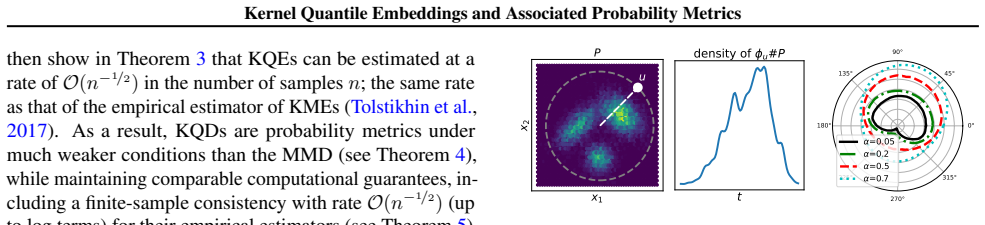
The load-bearing object is the kernel quantile embedding (KQE): for a unit-norm RKHS direction $u$, the embedding of $P$ is $\rho^{\alpha,u}_P(x) = \rho^{\alpha}_{u\#P} u(x)$, with $\rho^{\alpha}_{u\#P}$ the ordinary univariate $\alpha$-quantile of the scalar random variable $u(X)$ for $X \sim P$. Comparing these directional quantiles across all $\alpha$ and all $u$ yields the kernel quantile discrepancies, and the proof of injectivity rests on characteristic functionals $\varphi_P(f) = \int e^{i f(x)} P(dx)$, which determine a measure and let the authors extend the Cramér-Wold theorem from $\mathbb{R}^d$ to the RKHS under mild topological assumptions.
What would settle it
Exhibit two distinct Borel probability measures $P$ and $Q$ on a $\sigma$-compact Hausdorff space with a continuous separating kernel such that $\rho^{\alpha}_{u\#P} = \rho^{\alpha}_{u\#Q}$ for every $\alpha \in [0,1]$ and every unit-norm RKHS direction $u$; Theorem 1 asserts no such pair exists, so one such pair would settle the question directly.
Extended reading notes
Core claim
On the paper's own terms, the discovery is that the mean is not the only meaningful RKHS representation of a distribution: the full collection of directional quantile embeddings $\{\rho^{\alpha,u}_P : \alpha \in [0,1], u \in \mathbb{S}_{\mathcal{H}}\}$, where $\rho^{\alpha,u}_P = \rho^{\alpha}_{u\#P} u$, is a one-to-one encoding of probability measures under assumptions much weaker than those required for mean embeddings to be characteristic. Theorem 1 establishes this as an RKHS extension of the Cramér-Wold theorem; Theorem 2 shows every mean-characteristic kernel is quantile-characteristic but not conversely, so the polynomial-kernel example distinguishes distributions with matching low-order moments. Theorem 4 turns this into distances: the expected and supremum kernel quantile discrepancies are probability metrics when the averaging measure on quantile levels (and on the sphere, for the expected version) has full support. The paper also proves finite-sample consistency at rate $O(n^{-1/2})$ and shows the Gaussian expected version recovers kernelised sliced Wasserstein distances, linking the construction to optimal transport.
Load-bearing premise
The fast estimator samples directions from a finite-rank Gaussian $\gamma_m$ built from $m = \log n$ reference points, while the metric and consistency theorems assume a full-support Gaussian $\gamma$ on the infinite-dimensional unit sphere; no error bound controls the gap between $\gamma$ and $\gamma_m$.
Editorial extensions
If this is right
- Any pair of distributions that MMD can separate with a kernel $k$ will also be separated by a KQD built from $k$, because every mean-characteristic kernel is quantile-characteristic.
- Some pairs that MMD cannot separate, such as a Gaussian and a Laplace distribution with matching first two moments under a cubic polynomial kernel, are separated by KQDs.
- KQDs are probability metrics under continuous separating kernels on sigma-compact Hausdorff spaces, without requiring the kernel to be characteristic in the mean-embedding sense.
- With Lebesgue weighting over quantile levels, e-KQD and sup-KQD become kernelised expected and max sliced Wasserstein distances, reducing to classical sliced Wasserstein for a linear kernel with uniform directions.
- The Gaussian e-KQD estimator runs in $O(n \log^2 n)$ with an $O(n^{-1/2} + l^{-1/2})$ sample-error rate, matching the rate of MMD estimators at lower cost.
Reading between the lines
- Extension: if a bound on the gap between the full-support Gaussian measure $\gamma$ and the finite-rank approximation $\gamma_m$ used in Algorithm 1 can be established, the near-linear estimator would inherit the metric property and consistency guarantees, which currently hold only for the idealised full-support version.
- Extension: because Theorem 1 needs only a continuous separating kernel, KQDs may provide probability metrics on discrete or structured spaces where characteristic kernels for MMD are known to fail, including the graph-kernel case the paper itself notes.
- Extension: reweighting the quantile-level measure $\nu$ toward central quantiles gives a natural robustness dial, and the paper's experiments show the optimal weighting is problem-dependent, suggesting a tunable family rather than a single fixed distance.
- Extension: the paper's future-work remark points toward conditional versions of KQEs, so a conditional quantile embedding for conditional distributions is a concrete and testable next step.
Signed reviews
Editorial analysis
A structured set of objections, weighed in public.
Referee Report
Summary. The paper introduces kernel quantile embeddings (KQEs), defined as RKHS-valued directional quantiles of a distribution under all unit-norm RKHS directions, and uses them to construct two families of discrepancies, e-KQD and sup-KQD. The main theoretical contributions are Theorem 1 (quantile-characteristic kernels under mild topological assumptions), Theorem 2 (mean-characteristic implies quantile-characteristic, with a converse failure), Theorem 4 (the KQDs are probability metrics under full-support conditions on the quantile-level measure ν and, for e-KQD, the direction measure γ), and Theorem 5 (an O(n^{-1/2} + l^{-1/2}) consistency bound for the p=1 empirical e-KQD with a fixed direction measure γ and Monte Carlo directions γ_l). The paper also connects KQDs to sliced Wasserstein distances, proposes a near-linear-time estimator based on sampling from a Gaussian measure on the RKHS (Algorithm 1), and reports two-sample testing experiments with p=2. The central injectivity and metric results are clean and appear sound, but the practical estimator in Algorithm 1 uses a finite-rank Gaussian direction measure γ_m that is not covered by Theorems 4 and 5, and the proof of Theorem 5 contains a flawed inequality that requires an additional bounded-range assumption.
Significance. If fully established, this work would be a valuable contribution to kernel-based distribution testing: it shows that quantile-based embeddings separate distributions under conditions strictly weaker than those required for MMD, and it provides a conceptual bridge between kernel embeddings and sliced Wasserstein distances. The proofs of Theorems 1, 2, and 4 are elegant and reduce to standard external results (Vakhania's characteristic-functionals theorem, Cramér-Wold, Dvoretzky-Kiefer-Wolfowitz, Bobkov-Ledoux), with no fitted constants or circular reasoning. The paper includes a detailed appendix and a code repository, which are strengths. However, the advertised statistical and metric guarantees do not currently apply to the estimator actually implemented and benchmarked: the finite-rank γ_m used in Algorithm 1 is degenerate and data-dependent, and the p=2 rate used throughout the experiments is left as a conjecture. These gaps are substantial, but they are localized to the estimation theory and presentation, and are plausibly fixable within the manuscript's scope.
major comments (3)
- [Section 4, Algorithm 1, Proposition 1 and Theorem 4] The estimator implemented in Algorithm 1 replaces the full-support direction measure γ by γ_m, the projection onto S_H of the finite-rank Gaussian N(0,C_m) built from m=log n reference points z_{1:m}. Theorem 4 guarantees that e-KQD_p is a probability metric only when γ has full support on S_H, and Theorem 5 bounds the difference between the population quantity at a fixed γ and its Monte Carlo average over l directions sampled from that same γ. No result in the paper bounds the gap between e-KQD_p(·;γ_m) and e-KQD_p(·;γ), and γ_m is supported on an m-dimensional subspace of H, so it cannot satisfy the full-support condition of Theorem 4. Consequently, the implemented e-KQD is not proven to be a probability metric, and the consistency rate of Theorem 5 does not apply to it. The authors should either prove a bound on the finite-rank approximation error or explicitly reframe Algorithm 1 as estimating a different, finite-rank object and adjust the theoretical claims accordingly.
- [Appendix C.5, proof of Lemma 5] The proof of Lemma 5 contains the inequality ∫_{u(X)} |F_{u#P_n}(t) - F_{u#P}(t)| dt ≤ sup_{t∈u(X)} |F_{u#P_n}(t) - F_{u#P}(t)|, which is only valid if the Lebesgue measure of u(X) is at most one. In general u(X) ⊂ R is unbounded (for example, when k is an unbounded kernel on R^d), and the integral can be infinite even when the supremum is small. This invalidates the current proof of Lemma 5 and therefore the n^{-1/2} term in Theorem 5. The proof needs an additional assumption such as boundedness of u(X), or a truncation and dominated-convergence argument, before the stated consistency result can be accepted.
- [Section 5.1 and Conjecture 1] All main experiments in Section 5.1 use power p=2 for KQD-based discrepancies, yet Theorem 5 establishes the O(n^{-1/2}) rate only for p=1. The p>1 rate is explicitly left as Conjecture 1, with a proof sketch that relies on unverified control of the integral in Equation (19). Thus the statistical rate claimed in the abstract and introduction for the empirical estimators is not proven for the value of p used in the benchmark experiments. The authors should either prove Conjecture 1 under the stated regularity conditions, or restrict the rate claims to p=1 and present the p=1 experiments as the primary evidence for the statistical guarantees.
minor comments (5)
- [Section 4, Algorithm 1] The notation in Algorithm 1 is confusing: λ_{1:m} ∼ N(0, Id_m) is a vector, but the expressions λ_{1:m}^T k(z_{1:m}, x_{1:n})/√m and λ_{1:m}^T k(z_{1:m}, z_{1:m}) λ_{1:m}/m mix row/column conventions; clarifying whether k(z_{1:m}, x_{1:n}) is an m×n matrix and λ is an m×1 vector would improve reproducibility.
- [Theorem 5 and Section 4] Theorem 5 uses γ_l for the Monte Carlo approximation of a fixed γ, while Proposition 1 and Algorithm 1 introduce a different finite-rank measure γ_m based on m reference points. The two are conflated in the main text, which makes it easy for a reader to mistakenly believe that Theorem 5 covers Algorithm 1; the notation should be separated or unified with explicit caveats.
- [References] The reference list contains several duplicated entries with different years or suffixes (e.g., Chwialkowski et al. 2015a/b, Nienkötter and Jiang 2022/2023, Makigusa 2024a/b, Wang et al. 2024a/b), which should be consolidated.
- [Appendix D.2] The main text states that 'identical experiments for p=1 lead to the same conclusions', but Appendix D.2 reports that centered e-KQD1 performs noticeably worse than centered e-KQD2 in the Laplace-vs-Gaussian experiment; the wording should be softened to reflect this difference.
- [Section 5.1] Setting l = log n and m = log n leads to non-integer values for small n (e.g., n=32 gives log n ≈ 3.47); the text should specify that these are rounded to integers in the experiment.
Circularity Check
No significant circularity: the central theorems reduce to external results (Vakhania, Gretton, Dvoretzky-Kiefer-Wolfowitz, Bobkov-Ledoux); the finite-rank gamma_m gap is a correctness gap, not a self-referential derivation.
full rationale
The paper's load-bearing mathematical claims do not reduce to their inputs by construction. Theorem 1 (quantile-characteristic kernels) is proved via characteristic functionals and Vakhania et al.'s theorem that characteristic functionals determine the measure, after showing the RKHS unit sphere separates points; this is an external, independent result, not a re-statement of the conclusion. Theorem 2 uses the MMD representer theorem from Gretton et al. (2012) to show a mean-characteristic kernel separates some projection's means, hence some projection's quantiles; again no fitted parameter or self-cited result is load-bearing. The metric property in Theorem 4 follows from Minkowski, full-support assumptions on nu and gamma, and the injectivity of Theorem 1; it is not assumed in advance. Theorem 5's n^{-1/2} rate is derived from the Dvoretzky-Kiefer-Wolfowitz inequality and McDiarmid's inequality, not from the quantity being estimated. The paper contains a genuine gap: Algorithm 1 draws directions from the finite-rank Gaussian gamma_m built from m = log n reference points z_{1:m} with xi = (P_n + Q_n)/2 in the experiments, while Theorem 4's metric statement and Theorem 5's consistency bound require gamma with full support on the RKHS unit sphere. This means the implemented estimator is not currently covered by the advertised guarantees, but this is a correctness/coverage gap, not circularity: gamma_m is not used to define the population e-KQD, no parameter is fitted to the predicted outcome, and the approximation error between gamma_m and gamma is unquantified rather than defined into the result. Self-citations (e.g., Bharti et al. 2023, Chau et al. 2025) appear only in contextual or benchmark-discussion roles and do not carry the argument. No uniqueness theorem from the authors' prior work is invoked to force a choice, and no known result is merely renamed as a prediction. The honest finding is therefore no significant circularity, score 0.
Assumptions & free parameters
free parameters (3)
- RBF bandwidth sigma =
median pairwise distance
- Number of projections l =
log n
- Number of random features m =
log n
assumptions (6)
- domain assumption A1: X is Hausdorff, separable, and sigma-compact
- domain assumption A2: the kernel k is continuous and separating on X
- standard math Vakhania Theorem 2.2(a): characteristic functionals on a separating function space determine the Borel probability measure
- standard math Dvoretzky-Kiefer-Wolfowitz inequality
- standard math Bobkov-Ledoux Theorem 2.9: equality of integrated quantile differences and L1 CDF distances
- standard math Kukush Corollary 5.3: non-degenerate Gaussian measures on Hilbert space have full support
Cite this review
Pith. "Pith review of Kernel Quantile Embeddings and Associated Probability Metrics." pith.science (2026). https://pith.science/paper/MLUWJFUB
@misc{pith2026250520433,
  author       = {Pith},
  title        = {Pith review of: Kernel Quantile Embeddings and Associated Probability Metrics},
  year         = {2026},
  howpublished = {\url{https://pith.science/paper/MLUWJFUB}},
  note         = {Machine review of arXiv:2505.20433}
}
read the original abstract
Embedding probability distributions into reproducing kernel Hilbert spaces (RKHS) has enabled powerful nonparametric methods such as the maximum mean discrepancy (MMD), a statistical distance with strong theoretical and computational properties. At its core, the MMD relies on kernel mean embeddings to represent distributions as mean functions in RKHS. However, it remains unclear if the mean function is the only meaningful RKHS representation. Inspired by generalised quantiles, we introduce the notion of kernel quantile embeddings (KQEs). We then use KQEs to construct a family of distances that: (i) are probability metrics under weaker kernel conditions than MMD; (ii) recover a kernelised form of the sliced Wasserstein distance; and (iii) can be efficiently estimated with near-linear cost. Through hypothesis testing, we show that these distances offer a competitive alternative to MMD and its fast approximations.
Figures


Figures from the paper (5 more)


Reference graph
Works this paper leans on
-
[1]
F. Bach. Information theory with kernel methods. IEEE Transactions on Information Theory, 69 0 (2): 0 752--775, 2022
2022
-
[2]
Berlinet and C
A. Berlinet and C. Thomas-Agnan. Reproducing Kernel Hilbert Spaces in Probability and Statistics . Springer Science+Business Media, New York, 2004
2004
-
[3]
Bharti, M
A. Bharti, M. Naslidnyk, O. Key, S. Kaski, and F.-X. Briol. Optimally-weighted estimators of the maximum mean discrepancy for likelihood-free inference . In International Conference on Machine Learning, pages 2289--2312, 2023
2023
-
[4]
Biggs, A
F. Biggs, A. Schrab, and A. Gretton. MMD-FUSE : L earning and combining kernels for two-sample testing without data splitting. Advances in Neural Information Processing Systems, 36, 2024
2024
-
[5]
Bobkov and M
S. Bobkov and M. Ledoux. One-dimensional empirical measures, order statistics, and Kantorovich transport distances, volume 261. American Mathematical Society, 2019
2019
-
[6]
D. A. Bodenham and Y. Kawahara. euMMD: efficiently computing the MMD two-sample test statistic for univariate data . Statistics and Computing, 33 0 (5): 0 1--14, 2023
2023
-
[7]
V. I. Bogachev. Measure theory, volume 1. Springer, 2007
2007
-
[8]
Bonneel, J
N. Bonneel, J. Rabin, G. Peyr \'e , and H. Pfister. Sliced and radon wasserstein barycenters of measures. Journal of Mathematical Imaging and Vision, 51: 0 22--45, 2015
2015
Show all 97 references
-
[9]
Bonnier, H
P. Bonnier, H. Oberhauser, and Z. Szab \' o . Kernelized cumulants: Beyond kernel mean embeddings . Advances in Neural Information Processing Systems, 36, 2023
2023
-
[10]
Borgwardt, A
K. Borgwardt, A. Gretton, M. Rasch, H.-P. Kriegel, B. Sch\" o lkopf, and A. Smola. Integrating structured biological data by kernel maximum mean discrepancy. Bioinformatics, 22 0 (14): 0 49--57, 2006
2006
-
[11]
Briol, A
F.-X. Briol, A. Barp, A. B. Duncan, and M. Girolami. Statistical inference for generative models with maximum mean discrepancy. arXiv:1906.05944, 2019
1906 arXiv
-
[12]
Briol, A
F.-X. Briol, A. Gessner, T. Karvonen, and M. Mahsereci. A dictionary of closed-form kernel mean embeddings . arXiv:2504.18830, 2025
2025 arXiv
-
[13]
Chatalic, N
A. Chatalic, N. Schreuder, L. Rosasco, and A. Rudi. Nystr \"o m kernel mean embeddings. In International Conference on Machine Learning, pages 3006--3024. PMLR, 2022
2022
-
[14]
S. L. Chau, S. Bouabid, and D. Sejdinovic. Deconditional downscaling with gaussian processes. Advances in Neural Information Processing Systems, 34: 0 17813--17825, 2021 a
2021
-
[15]
S. L. Chau, J.-F. Ton, J. Gonz \'a lez, Y. Teh, and D. Sejdinovic. Bayesimp: Uncertainty quantification for causal data fusion. Advances in Neural Information Processing Systems, 34: 0 3466--3477, 2021 b
2021
-
[16]
S. L. Chau, R. Hu, J. Gonzalez, and D. Sejdinovic. Rkhs-shap: Shapley values for kernel methods. Advances in neural information processing systems, 35: 0 13050--13063, 2022
2022
-
[17]
S. L. Chau, K. Muandet, and D. Sejdinovic. Explaining the uncertain: Stochastic shapley values for gaussian process models. Advances in Neural Information Processing Systems, 36: 0 50769--50795, 2023
2023
-
[18]
S. L. Chau, A. Schrab, A. Gretton, D. Sejdinovic, and K. Muandet. Credal two-sample tests of epistemic uncertainty. In International Conference on Artificial Intelligence and Statistics, pages 127--135. PMLR, 2025
2025
-
[19]
Ch \' e rief-Abdellatif and P
B.-E. Ch \' e rief-Abdellatif and P. Alquier. MMD-Bayes: Robust Bayesian estimation via maximum mean discrepancy . In Proceedings of The 2nd Symposium on Advances in Approximate Bayesian Inference (AABI), pages 1--21, 2020
2020
-
[20]
Chwialkowski, A
K. Chwialkowski, A. Ramdas, D. Sejdinovic, and A. Gretton. Fast two-sample testing with analytic representations of probability measures . In Advances in Neural Information Processing Systems, pages 1981--1989, 2015 a
1981
-
[21]
K. P. Chwialkowski, A. Ramdas, D. Sejdinovic, and A. Gretton. Fast two-sample testing with analytic representations of probability measures. Advances in Neural Information Processing Systems, 28, 2015 b
2015
-
[22]
Cram \'e r and H
H. Cram \'e r and H. Wold. Some theorems on distribution functions. Journal of the London Mathematical Society, 1 0 (4): 0 290--294, 1936
1936
-
[23]
J. A. Cuesta-Albertos, R. Fraiman, and T. Ransford. A sharp form of the cram \'e r--wold theorem. Journal of Theoretical Probability, 20 0 (2): 0 201--209, 2007
2007
-
[24]
M. Cuturi. Sinkhorn distances: Lightspeed computation of optimal transport. Advances in Neural Information Processing Systems, 26, 2013
2013
-
[25]
Deshpande, Z
I. Deshpande, Z. Zhang, and A. Schwing. Generative modeling using the sliced Wasserstein distance . In IEEE Conference on Computer Vision and Pattern Recognition, pages 3483--3491, 2018
2018
-
[26]
Dominicy and D
Y. Dominicy and D. Veredas. The method of simulated quantiles. Journal of Econometrics, 172 0 (2): 0 235--247, 2013
2013
-
[27]
Dvoretzky, J
A. Dvoretzky, J. Kiefer, and J. Wolfowitz. Asymptotic minimax character of the sample distribution function and of the classical multinomial estimator. The Annals of Mathematical Statistics, pages 642--669, 1956
1956
-
[28]
Feydy, T
J. Feydy, T. S \' e journ \' e , F.-X. Vialard, S.-I. Amari, A. Trouv \' e , and G. Peyr \' e . Interpolating between optimal transport and MMD using Sinkhorn divergences . In International Conference on Artificial Intelligence and Statistics, number PMLR 89, pages 2681--2690, 2019
2019
-
[29]
Flaxman, D
S. Flaxman, D. Sejdinovic, J. P. Cunningham, and S. Filippi. Bayesian learning of kernel embeddings. In Proceedings of the Thirty-Second Conference on Uncertainty in Artificial Intelligence. Association for Computing Machinery, 2016
2016
-
[30]
Fournier and A
N. Fournier and A. Guillin. On the rate of convergence in Wasserstein distance of the empirical measure . Probability Theory and Related Fields, 162 0 (3-4): 0 707--738, 2015
2015
-
[31]
Fraiman and B
R. Fraiman and B. Pateiro-L \'o pez. Quantiles for finite and infinite dimensional data. Journal of Multivariate Analysis, 108: 0 1--14, 2012
2012
-
[32]
I. Gao, P. Liang, and C. Guestrin. Model equality testing: Which model is this api serving? arXiv preprint arXiv:2410.20247, 2024
2024 arXiv
-
[33]
Genevay, L
A. Genevay, L. Chizat, F. Bach, M. Cuturi, and G. Peyr \' e . Sample complexity of Sinkhorn divergences . In International Conference on Artificial Intelligence and Statistics, 2019
2019
-
[34]
Gretton, K
A. Gretton, K. Borgwardt, M. Rasch, B. Sch \"o lkopf, and A. Smola. A kernel method for the two-sample-problem. Advances in Neural Information Processing Systems, 19: 0 513--520, 2006
2006
-
[35]
Gretton, K
A. Gretton, K. Fukumizu, Z. Harchaoui, and B. K. Sriperumbudur. A fast, consistent kernel two-sample test. Advances in Neural Information Processing Systems, 22, 2009
2009
-
[36]
Gretton, K
A. Gretton, K. M. Borgwardt, M. J. Rasch, B. Sch \"o lkopf, and A. Smola. A kernel two-sample test. Journal of Machine Learning Research, 13 0 (1): 0 723--773, 2012
2012
-
[37]
M. W. Hirsch. Differential Topology, volume 33 of Graduate Texts in Mathematics. Springer-Verlag, New York, 1976
1976
-
[38]
P. J. Huber. Robust estimation of a location parameter. Ann. Math. Statist., 35 0 (4): 0 73--101, 1964
1964
-
[39]
Jitkrittum, H
W. Jitkrittum, H. Kanagawa, and B. Sch \"o lkopf. Testing goodness of fit of conditional density models with kernels. In Conference on Uncertainty in Artificial Intelligence, pages 221--230. PMLR, 2020
2020
-
[40]
L. V. Kantorovich. On the translocation of masses . Dokl. Akad. Nauk SSSR, 37 0 (7-8): 0 227--229, 1942. ISSN 10723374
1942
-
[41]
A. N. Kolmogorov. Foundations of the Theory of Probability. Chelsea Pub Co, 2 edition, 1960
1960
-
[42]
Kolouri, K
S. Kolouri, K. Nadjahi, U. Simsekli, R. Badeau, and G. K. Rohde. Generalized sliced Wasserstein distances . In Advances in Neural Information Processing Systems, pages 261--272, 2019
2019
-
[43]
Kolouri, K
S. Kolouri, K. Nadjahi, S. Shahrampour, and U. Şimşekli. Generalized Sliced Probability Metrics . In ICASSP 2022 - 2022 IEEE International Conference on Acoustics , Speech and Signal Processing ( ICASSP ) , pages 4513--4517, May 2022. doi:10.1109/ICASSP43922.2022.9746016. URL ...
2022
-
[44]
Kong and I
L. Kong and I. Mizera. Quantile tomography: Using quantiles with multivariate data . Statistica Sinica, 22 0 (4): 0 1589--1610, 2012
2012
-
[45]
M. R. Kosorok. Two-sample quantile tests under general conditions . Biometrika, 86 0 (4): 0 909--921, 1999
1999
-
[46]
N. M. Kriege, F. D. Johansson, and C. Morris. A survey on graph kernels. Applied Network Science, 5: 0 1--42, 2020
2020
-
[47]
Krizhevsky, I
A. Krizhevsky, I. Sutskever, and G. E. Hinton. ImageNet classification with deep convolutional neural networks. In Advances in Neural Information Processing Systems, volume 25, 2012
2012
-
[48]
A. Kukush. Gaussian measures in Hilbert space: construction and properties. John Wiley & Sons, 2020
2020
-
[49]
E. L. Lehmann, J. P. Romano, and G. Casella. Testing statistical hypotheses, volume 3. Springer, 1986
1986
-
[50]
Lerasle, Z
M. Lerasle, Z. Szab \'o , T. Mathieu, and G. Lecu \'e . Monk outlier-robust mean embedding estimation by median-of-means. In International conference on machine learning, pages 3782--3793. PMLR, 2019
2019
-
[51]
Y. Li, Y. Liu, and J. Zhu. Quantile regression in reproducing kernel Hilbert spaces . Journal of the American Statistical Association, 102 0 (477): 0 255--268, 2007
2007
-
[52]
F. Liu, W. Xu, J. Lu, G. Zhang, A. Gretton, and D. J. Sutherland. Learning deep kernels for non-parametric two-sample tests. In International conference on machine learning, pages 6316--6326. PMLR, 2020
2020
-
[53]
Magesh, V
A. Magesh, V. V. Veeravalli, A. Roy, and S. Jha. Principled out-of-distribution detection via multiple testing. Journal of Machine Learning Research, 24 0 (378): 0 1--35, 2023
2023
-
[54]
Makigusa
N. Makigusa. Two-sample test based on maximum variance discrepancy . Communications in Statistics - Theory and Methods, 53 0 (15): 0 5421--5438, 2024 a
2024
-
[55]
Makigusa
N. Makigusa. Two-sample test based on maximum variance discrepancy. Communications in Statistics-Theory and Methods, 53 0 (15): 0 5421--5438, 2024 b
2024
-
[56]
S. Minsker. Geometric median and robust estimation in Banach spaces. Bernoulli, 21 0 (4), Nov. 2015. ISSN 1350-7265. doi:10.3150/14-BEJ645. URL http://arxiv.org/abs/1308.1334. arXiv:1308.1334 [math, stat]
2015 arXiv
-
[57]
Muandet, K
K. Muandet, K. Fukumizu, F. Dinuzzo, and B. Sch\" o lkopf. Learning from distributions via support measure machines. In Advances in Neural Information Processing Systems 25, pages 10--18. 2012
2012
-
[58]
Muandet, K
K. Muandet, K. Fukumizu, B. K. Sriperumbudur, and B. Sch \" o lkopf. Kernel mean embedding of distributions: A review and beyonds . Foundations and Trends in Machine Learning, 10 0 (1-2): 0 1--141, 2016
2016
-
[59]
Muandet, M
K. Muandet, M. Kanagawa, S. Saengkyongam, and S. Marukatat. Counterfactual mean embeddings. Journal of Machine Learning Research, 22 0 (162): 0 1--71, 2021
2021
-
[60]
M \"u ller
A. M \"u ller. Integral probability metrics and their generating classes of functions. Advances in applied probability, 29 0 (2): 0 429--443, 1997
1997
-
[61]
Nadjahi, A
K. Nadjahi, A. Durmus, L. Chizat, S. Kolouri, S. Shahrampour, and U. Şimşekli. Statistical and topological properties of sliced probability divergences . In Neural Information Processing Systems, 2020
2020
-
[62]
Nadjahi, A
K. Nadjahi, A. Durmus, L. Chizat, S. Kolouri, S. Shahrampour, and U. Şimşekli. Statistical and Topological Properties of Sliced Probability Divergences , Jan. 2022. URL http://arxiv.org/abs/2003.05783. arXiv:2003.05783 [cs, stat]
2022 arXiv
-
[63]
Nienk \"o tter and X
A. Nienk \"o tter and X. Jiang. Kernel-based generalized median computation for consensus learning. IEEE Transactions on Pattern Analysis and Machine Intelligence, 45 0 (5): 0 5872--5888, 2022
2022
-
[64]
Nienk \" o tter and X
A. Nienk \" o tter and X. Jiang. Kernel-based generalized median computation for consensus learning . IEEE Transactions on Pattern Analysis and Machine Intelligence, 45 0 (5): 0 5872--5888, 2023
2023
-
[65]
Z. Niu, J. Meier, and F.-X. Briol. Discrepancy-based inference for intractable generative models using quasi-Monte Carlo . Electronic Journal of Statistics, 17 0 (1): 0 1411--1456, 2023
2023
-
[66]
Park and K
J. Park and K. Muandet. A measure-theoretic approach to kernel conditional mean embeddings. In Advances in Neural Information Processing Systems, volume 33, pages 21247--21259. Curran Associates, Inc., 2020
2020
-
[67]
Peyr \'e , M
G. Peyr \'e , M. Cuturi, et al. Computational optimal transport: With applications to data science. Foundations and Trends in Machine Learning , 11 0 (5-6): 0 355--607, 2019
2019
-
[68]
Rabin, G
J. Rabin, G. Peyr \'e , J. Delon, and M. Bernot. Wasserstein barycenter and its application to texture mixing. In International conference on scale space and variational methods in computer vision, pages 435--446. Springer, 2011
2011
-
[69]
Ramdas, S
A. Ramdas, S. J. Reddi, B. P \'o czos, A. Singh, and L. Wasserman. On the decreasing power of kernel and distance based nonparametric hypothesis tests in high dimensions. In Proceedings of the AAAI Conference on Artificial Intelligence, volume 29, 2015
2015
-
[70]
Ramdas, N
A. Ramdas, N. Garc \' a Trillos, and M. Cuturi. On W asserstein two-sample testing and related families of nonparametric tests. Entropy, 19 0 (2): 0 47, 2017
2017
-
[71]
Ranger, J.-T
J. Ranger, J.-T. Kuhn, and C. Szardenings. Minimum distance estimation of multidimensional diffusion-based item response theory models. Multivariate Behavioral Research, 55 0 (6): 0 941--957, 2020
2020
-
[72]
Recht, R
B. Recht, R. Roelofs, L. Schmidt, and V. Shankar. Do imagenet classifiers generalize to imagenet? In International Conference on Machine Learning, pages 5389--5400, 2019
2019
-
[73]
Sch\"olkopf and A
B. Sch\"olkopf and A. Smola. Learning with Kernels: Support Vector Machines, Regularization, Optimization, and Beyond. MIT Press, Cambridge, MA, USA, 2002
2002
-
[74]
A. Schrab. A unified view of optimal kernel hypothesis testing. arXiv preprint arXiv:2503.07084, 2025
2025
-
[75]
Schrab, I
A. Schrab, I. Kim, B. Guedj, and A. Gretton. Efficient aggregated kernel tests using incomplete U-statistics . In Advances in Neural Information Processing Systems, pages 18793--18807, 2022
2022
-
[76]
Schrab, I
A. Schrab, I. Kim, M. Albert, B. Laurent, B. Guedj, and A. Gretton. MMD aggregated two-sample test. Journal of Machine Learning Research, 24 0 (194): 0 1--81, 2023
2023
-
[77]
Sejdinovic
D. Sejdinovic. An overview of causal inference using kernel embeddings . arXiv:2410.22754, 2024
2024 arXiv
-
[78]
Sejdinovic, B
D. Sejdinovic, B. Sriperumbudur, A. Gretton, and K. Fukumizu. Equivalence of distance-based and RKHS -based statistics in hypothesis testing. The Annals of Statistics, pages 2263--2291, 2013
2013
-
[79]
Serfling
R. Serfling. Quantile functions for multivariate analysis: Approaches and applications . Statistica Neerlandica, 56 0 (2): 0 214--232, 2002
2002
-
[80]
R. J. Serfling. Approximation theorems of mathematical statistics. John Wiley & Sons, 2009
2009
-
[81]
S. J. Sheather and J. S. Marron. Kernel quantile estimators . Journal of the American Statistical Association, 85 0 (410): 0 410--416, 1990
1990
-
[82]
A. J. Smola, A. Gretton, L. Song, and B. Sch\" o lkopf. A H ilbert space embedding for distributions. In Proceedings of the 18th International Conference on Algorithmic Learning Theory (ALT), pages 13--31, 2007
2007
-
[83]
L. Song, J. Huang, A. Smola, and K. Fukumizu. H ilbert space embeddings of conditional distributions with applications to dynamical systems. In Proceedings of the 26th International Conference on Machine Learning (ICML), June 2009
2009
-
[84]
B. K. Sriperumbudur, A. Gretton, K. Fukumizu, B. Sch \" o lkopf, and G. R. G. Lanckriet. Hilbert space embeddings and metrics on probability measures . Journal of Machine Learning Research, 11, 2010
2010
-
[85]
B. K. Sriperumbudur, K. Fukumizu, and G. R. Lanckriet. Universality, characteristic kernels and RKHS embedding of measures. Journal of Machine Learning Research, 12 0 (7), 2011
2011
-
[86]
Stolfi, M
P. Stolfi, M. Bernardi, and L. Petrella. Sparse simulation-based estimator built on quantiles. Econometrics and Statistics, 2022
2022
-
[87]
A. M. Stuart. Inverse problems: a bayesian perspective. Acta numerica, 19: 0 451--559, 2010
2010
-
[88]
Szab \'o , B
Z. Szab \'o , B. K. Sriperumbudur, B. P \'o czos, and A. Gretton. Learning theory for distribution regression. Journal of Machine Learning Research, 17 0 (1): 0 5272--5311, 2016
2016
-
[89]
G. J. Sz\'ekely and M. L. Rizzo. A new test for multivariate normality. Journal of Multivariate Analysis, 93 0 (1): 0 58--80, 2005
2005
-
[90]
Tolstikhin, B
I. Tolstikhin, B. K. Sriperumbudur, K. Mu, et al. Minimax estimation of kernel mean embeddings. Journal of Machine Learning Research, 18 0 (86): 0 1--47, 2017
2017
-
[91]
Vakhania, V
N. Vakhania, V. Tarieladze, and S. Chobanyan. Probability distributions on Banach spaces, volume 14. Springer Science & Business Media, 1987
1987
-
[92]
Villani et al
C. Villani et al. Optimal transport: old and new, volume 338. Springer, 2009
2009
-
[93]
Walmsley, C
M. Walmsley, C. Lintott, T. G \'e ron, S. Kruk, C. Krawczyk, K. W. Willett, S. Bamford, L. S. Kelvin, L. Fortson, Y. Gal, et al. Galaxy zoo decals: Detailed visual morphology measurements from volunteers and deep learning for 314 000 galaxies. Monthly Notices of the Royal Astr...
2022
-
[94]
J. Wang, R. Gao, and Y. Xie. Two- Sample Test with Kernel Projected Wasserstein Distance . In Proceedings of The 25th International Conference on Artificial Intelligence and Statistics , pages 8022--8055. PMLR, 2022
2022
-
[96]
J. Wang, M. Boedihardjo, and Y. Xie. Statistical and computational guarantees of kernel max-sliced wasserstein distances. arXiv preprint arXiv:2405.15441, 2024 b
2024 arXiv
-
[97]
S. Willard. General Topology. Addison-Wesley Series in Mathematics. Addison Wesley Longman Publishing, New York, NY, Jan. 1970
1970
-
[98]
Ziegel, D
J. Ziegel, D. Ginsbourger, and L. D \" u mbgen. Characteristic kernels on Hilbert spaces, Banach spaces, and on sets of measures . Bernoulli, 30 0 (2): 0 1441--1457, 2024
2024
Reviewed August 7, 2026 · model on record in the stance chip above.
Discussion (0). Continue with ORCID to comment.