REVIEW 3 major objections 5 minor 58 references
Gender Bias in English-to-Greek Machine Translation
T0 review · 3 major / 5 minor · reviewed 2026-08-07 · deepseek-v4-flash
Pith's one-line read English-to-Greek machine translation systematically defaults to masculine forms when the source sentence leaves gender unspecified.
desk verdict Solid first dataset and credible male-bias result for English-to-Greek MT, but the GPT-4o comparison is weaker than the abstract suggests because of annotation inconsistency. read the letter →
The pith
A machine-rendered reading of the paper's core claim, the machinery that carries it, and where it could break.
The reading
What carries the argument
The argument runs on GendEL, a handcrafted bilingual evaluation set of 240 English sentences: 40 occupational nouns, each appearing in six controlled variants (ambiguous base; ambiguous with a male- or female-biased adjective; unambiguous masculine or feminine pronoun; singular 'they'), with manual Greek gold translations in masculine, feminine, and neutral forms. The controlled template isolates gender-relevant cues so that any gendered choice in output can be attributed to the occupation, the adjective, or the pronoun. A second device is the few-shot chain-of-thought prompt given to GPT-4o, which instructs the model to translate explicit-gender sentences with one correct form and ambiguous sentences with masculine/feminine/neutral alternatives, plus a neutral-only rule for singular 'they.' Comparing system outputs against the gold distribution exposes both male defaulting and the absence of neutral options.
What would settle it
Ask a panel of native Greek speakers to judge, for each of the 40 occupations, which gender they would expect a person in that role to be; if their judgments do not align with the U.S. BLS-derived labels, the occupational-stereotyping analysis loses its reference point.
Extended reading notes
Core claim
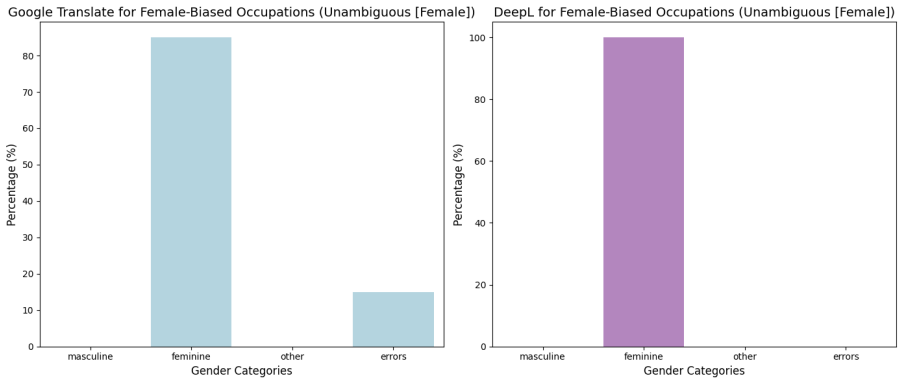
The paper introduces GendEL, 240 handcrafted English sentences built from 40 occupational nouns, each in six variants: an ambiguous base ('The assistant finished the work'), the same sentence with a male- or female-biased adjective, an unambiguous masculine or feminine pronoun version, and a singular-'they' version. Manual Greek gold translations provide masculine, feminine, and neutral targets. On the 160 ambiguous sentences, Google Translate produced 74.4% masculine and DeepL 70.6% masculine, with feminine forms at 8.1% and 13.1%; neither offered meaningful neutral output, and both mishandled singular 'they.' Stereotype labels from U.S. labor statistics significantly predicted feminine output for female-stereotyped occupations, while masculine stayed the default. For explicitly feminine sentences with male-stereotyped occupations, DeepL was perfect but Google Translate was correct only 45% of the time. The prompted GPT-4o translated 100% of masculine-explicit and 95% of feminine-explicit sentences correctly, and produced M-F-N alternatives in 92.5% of the plain ambiguous base sentences, 80% with male-biased adjectives, and 85% with female-biased adjectives; its errors concentrated in neutral variants and in the non-binary category, where it sometimes invented non-existent words or fell back to binary double forms.
Load-bearing premise
The study assumes that U.S. labor-force gender percentages match Greek speakers' stereotypes about professions, and that one manual translator's gold translations and error labels are reliable without a second annotator.
Editorial extensions
If this is right
- For gender-ambiguous English input, Google Translate and DeepL will keep producing predominantly masculine Greek, so users cannot rely on them for inclusive or neutral output.
- Explicitly feminine referents in male-stereotyped occupations are a weak spot for Google Translate, making it unsafe for anti-stereotypical feminine sentences.
- Singular 'they' is systematically mishandled by all three systems, most often by treating it as a plural or as masculine.
- A few-shot prompted LLM can offer gender alternatives on demand for most ambiguous sentences, making inference-time prompting a viable mitigation approach.
- GendEL can serve as a benchmark for future English-to-Greek MT models and for monitoring updates to commercial systems.
Reading between the lines
- The paper's gold standard implies a normative claim: when gender is semantically unspecified, a good MT system should present multiple gendered options or a neutral form rather than pick one default; that standard, if adopted, would change how translation quality is measured for grammatical-gender languages.
- GPT-4o's failures cluster precisely where Greek itself lacks standardised neutral constructions (epicene nouns, double forms, neuter circumlocutions), suggesting that better prompts alone may not close the gap until inclusive forms are codified in the language.
- Because the gold translations and error labels come from a single annotator, a multi-annotator reliability study on the same 240 sentences would be a cheap, direct test of whether the error-rate differences between systems are stable.
- The measured baseline (about 70–74 percent masculine on ambiguous sentences) gives a concrete number to track as Google Translate and DeepL update their models; a future drop would indicate bias mitigation is working.
Editorial analysis
A structured set of objections, weighed in public.
Referee Report
Summary. This paper introduces GendEL, a handcrafted English-to-Greek dataset of 240 sentences built around 40 occupational nouns and six sentence types, and uses it to evaluate gender bias in Google Translate, DeepL, and prompted GPT-4o. The authors report a strong male default in both commercial systems on gender-ambiguous inputs (74.4% masculine for Google Translate, 70.6% for DeepL), an effect of occupational stereotypes on feminine output frequency, difficulties in anti-stereotypical feminine translations for Google Translate, and a promising but imperfect performance by prompted GPT-4o when asked to provide masculine, feminine, and neutral alternatives. The dataset and code are publicly released.
Significance. If the findings hold, the paper provides one of the first empirical evaluations of gender bias in English-to-Greek MT and contributes a reusable challenge set for an understudied language pair. The release of GendEL, with human gold-standard translations and a documented prompt for LLM-based mitigation, is a tangible resource that can support future work. The male-default result is consistent with the broader MT bias literature, and the inclusion of prompted GPT-4o as a mitigation approach is timely. However, the quantitative claims about error rates and GPT-4o's promise rest on single-annotator judgments and on an error taxonomy applied inconsistently in the non-binary condition; these magnitudes should be treated as provisional until reliability evidence and a consistent coding scheme are provided.
major comments (3)
- [Sections 3.3 and 3.4, Table 15] The manual annotation appears to have been performed by a single author, with no second annotator or inter-annotator agreement reported. This is load-bearing because the abstract's comparisons and the 'shows promise' assessment depend on error counts, especially error[3] ('erroneous or insufficient neutralisation'), which requires a subjective judgment about what counts as true gender neutrality in Greek. The same author also created the gold-standard neutral translations and evaluated the systems against them. At minimum, the authors should report dual annotation with agreement statistics (e.g., Cohen's kappa) on the error labels, and re-report any counts that shift as a result.
- [Table 15 and Section 3.3, error[3] definition] In the non-binary condition, GPT-4o produced three M-F double forms (e.g., 'Ο/Η λογιστής/λογίστρια') that are listed as a separate M-F category rather than as error[3], even though the prompt explicitly requested only the neutral version and error[3] explicitly covers double forms. Reclassifying these three outputs as errors would raise GPT-4o's non-binary error rate from 15% (6/40) to 22.5% (9/40) and its total error count from 25 to 28, weakening the 'shows promise' conclusion. The coding scheme must be applied consistently, or the definition of error[3] must be clarified to explain why these cases are excluded.
- [Section 3.1, Section 4.1] The occupational stereotype classification is imported from US Bureau of Labor Statistics data via Troles and Schmid (2021) and assumed to represent Greek societal stereotypes. If Greek speakers' associations between professions and gender differ from the US data, the occupational-stereotyping analysis in Section 4.1 loses its reference point. The authors should either justify this cross-cultural transfer with evidence or validate it with a small Greek-speaker survey; without this, the claim that the systems 'reinforce societal stereotypes' is only as strong as the unstated assumption.
minor comments (5)
- [Throughout] The test is consistently called 'Fischer's exact test'; it should be 'Fisher's exact test'.
- [Abstract and Introduction] There are occasional typos, including 'acurate' in the Introduction; the paper would benefit from a careful proofread.
- [Appendix G] For the first Fisher's exact test, the reported odds ratio is 0.0 for both systems, which likely reflects zero cells in the contingency tables; the authors should report the exact contingency tables so readers can interpret the zero-cell issue.
- [Section 4.1] The male-bias analysis reports descriptive percentages (74.4% vs. 70.6%) without confidence intervals or a significance test for the difference between systems; adding such a test would strengthen the comparison, though it is not required for the central male-default claim.
- [Section 3.2 and Appendix C] The paper states that DeepL provides gender alternatives for Greek but that implementation is inconsistent; it would be helpful to state how many of the 160 ambiguous sentences received alternatives, rather than only the aggregate 12.5% figure in Section 4.1.
Circularity Check
No significant circularity: the paper is an empirical evaluation whose headline comparisons are read off observed MT outputs, not derived from fitted parameters, self-citations, or definitional identities.
full rationale
The paper contains no derivation chain in which an output is equivalent to an input by construction. GendEL's gold-standard translations are manually authored, but the MT systems' outputs are independently generated and then counted in Table 2; the male-bias, occupational-stereotyping, and anti-stereotypical analyses are all descriptive statistics and Fisher exact tests on observed output labels, not quantities fitted from the dataset. The only definitional element is the normative error[3] criterion ('Erroneous or insufficient neutralisation techniques'), which is an annotation standard, not a parameter fitted to any system, and it is applied symmetrically to all models. The GPT-4o experiment is transparent about its intervention: Appendix C's prompt explicitly instructs the model to supply three alternatives for ambiguous inputs and only the neutral version for singular 'they', and the paper then measures how often the model complies. That is an evaluation of a prompted system, not a prediction derived from a fitted input; non-trivial error rates (e.g., 15% errors in the non-binary condition, 20% in the male-biased-adjective condition) show the outcome was not forced by the prompt. The paper's own Limitations section acknowledges that the prompt was 'specifically customised for these sentence structures', which is a scope limitation rather than a concealed reduction. No self-citations appear in the reference list, and no uniqueness theorem or prior-work ansatz is imported to justify the central findings. Concerns about single-annotator subjectivity and the inconsistent labelling of three GPT-4o M-F double forms in the non-binary condition are validity and reliability issues, not circularity: they affect confidence in the percentages but do not make any stated result equivalent to its inputs. The analysis is therefore self-contained against the observed data, and no circular step can be quoted from the paper.
Assumptions & free parameters
free parameters (1)
- occupational_gender_bias_threshold =
50%
assumptions (3)
- domain assumption Greek is a grammatical gender language in which nouns, adjectives, and pronouns must agree in gender, and the masculine is the default for generic reference.
- ad hoc to paper An ideal MT system for gender-ambiguous English inputs should provide gender-neutral or multiple gendered alternatives.
- domain assumption Singular 'they' in English can represent a non-binary referent and should be translated with a gender-neutral Greek construction.
Cite this review
Pith. "Pith review of Gender Bias in English-to-Greek Machine Translation." pith.science (2026). https://pith.science/paper/MM7QUTJC
@misc{pith2026250609558,
  author       = {Pith},
  title        = {Pith review of: Gender Bias in English-to-Greek Machine Translation},
  year         = {2026},
  howpublished = {\url{https://pith.science/paper/MM7QUTJC}},
  note         = {Machine review of arXiv:2506.09558}
}
read the original abstract
As the demand for inclusive language increases, concern has grown over the susceptibility of machine translation (MT) systems to reinforce gender stereotypes. This study investigates gender bias in two commercial MT systems, Google Translate and DeepL, focusing on the understudied English-to-Greek language pair. We address three aspects of gender bias: i) male bias, ii) occupational stereotyping, and iii) errors in anti-stereotypical translations. Additionally, we explore the potential of prompted GPT-4o as a bias mitigation tool that provides both gender-explicit and gender-neutral alternatives when necessary. To achieve this, we introduce GendEL, a manually crafted bilingual dataset of 240 gender-ambiguous and unambiguous sentences that feature stereotypical occupational nouns and adjectives. We find persistent gender bias in translations by both MT systems; while they perform well in cases where gender is explicitly defined, with DeepL outperforming both Google Translate and GPT-4o in feminine gender-unambiguous sentences, they are far from producing gender-inclusive or neutral translations when the gender is unspecified. GPT-4o shows promise, generating appropriate gendered and neutral alternatives for most ambiguous cases, though residual biases remain evident.
Figures


Figures from the paper (9 more)




Reference graph
Works this paper leans on
-
[3]
Su Lin Blodgett, Solon Barocas, Hal Daumé III, and Hanna Wallach. 2020. https://doi.org/10.18653/v1/2020.acl-main.485 Language ( Technology ) is Power : A Critical Survey of “ Bias ” in NLP . In Proceedings of the 58th Annual Meeting of the Association for Computational Linguistics , pages 5454--5476, Online. Association for Computational Linguistics
-
[4]
Tolga Bolukbasi, Kai-Wei Chang, James Zou, Venkatesh Saligrama, and Adam Kalai. 2016. https://arxiv.org/abs/1607.06520 Man is to computer programmer as woman is to homemaker? debiasing word embeddings . Preprint, arXiv:1607.06520
arXiv 2016
-
[1]
Angeliki Alvanoudi. 2015. https://doi.org/10.1163/9789004283152 Grammatical gender in interaction: Cultural and cognitive aspects . Brill
-
[2]
Omri Asscher and Ella Glikson. 2023. https://doi.org/10.1177/14614448211018833 Human evaluations of machine translation in an ethically charged situation . New Media & Society, 25(5):1087--1107. Publisher: SAGE Publications
-
[5]
Won Ik Cho, Ji Won Kim, Seok Min Kim, and Nam Soo Kim. 2019. https://doi.org/10.18653/v1/W19-3824 On measuring gender bias in translation of gender-neutral pronouns . In Proceedings of the First Workshop on Gender Bias in Natural Language Processing, pages 173--181, Florence, Italy. Association for Computational Linguistics
-
[6]
Anna Currey, Maria Nadejde, Raghavendra Reddy Pappagari, Mia Mayer, Stanislas Lauly, Xing Niu, Benjamin Hsu, and Georgiana Dinu. 2022. https://doi.org/10.18653/v1/2022.emnlp-main.288 MT - G en E val: A counterfactual and contextual dataset for evaluating gender accuracy in machine translation . In Proceedings of the 2022 Conference on Empirical Methods in...
-
[7]
Tawfik, Mahmoud Khaled, Hany Hassan, and Aly Osama
Mostafa Elaraby, Ahmed Y. Tawfik, Mahmoud Khaled, Hany Hassan, and Aly Osama. 2018. https://doi.org/10.1109/ICNLSP.2018.8374387 Gender aware spoken language translation applied to english-arabic . In 2018 2nd International Conference on Natural Language and Speech Processing (ICNLSP), pages 1--6
-
[8]
Joel Escud \'e Font and Marta R. Costa-juss \`a . 2019. https://doi.org/10.18653/v1/W19-3821 Equalizing gender bias in neural machine translation with word embeddings techniques . In Proceedings of the First Workshop on Gender Bias in Natural Language Processing, pages 147--154, Florence, Italy. Association for Computational Linguistics
Show all 58 references
-
[9]
R. A. Fisher. 1992. https://doi.org/10.1007/978-1-4612-4380-9_6 Statistical Methods for Research Workers , pages 66--70. Springer New York, New York, NY
1992 doi
-
[10]
Markus Freitag, George Foster, David Grangier, Viresh Ratnakar, Qijun Tan, and Wolfgang Macherey. 2021. https://doi.org/10.1162/tacl_a_00437 Experts, Errors , and Context : A Large - Scale Study of Human Evaluation for Machine Translation . Transactions of the Association for ...
2021 doi
-
[11]
Batya Friedman and Helen Nissenbaum. 1996. https://doi.org/10.1145/230538.230561 Bias in computer systems . ACM Trans. Inf. Syst., 14(3):330--347
1996
-
[12]
Sourojit Ghosh and Aylin Caliskan. 2023. https://doi.org/10.1145/3600211.3604672 Chatgpt perpetuates gender bias in machine translation and ignores non-gendered pronouns: Findings across bengali and five other low-resource languages . In Proceedings of the 2023 AAAI/ACM Confer...
2023
-
[13]
Hila Gonen and Kellie Webster. 2020. https://doi.org/10.18653/v1/2020.findings-emnlp.180 Automatically identifying gender issues in machine translation using perturbations . In Findings of the Association for Computational Linguistics: EMNLP 2020, pages 1991--1995, Online. Ass...
2020 doi
-
[14]
Melvin Johnson. 2020. https://ai.googleblog.com/2020/40/04/a-scalable-approach-to-reducing-gender.html A scalable approach to reducing gender bias in google translate
2020
-
[15]
Valentini Kalfadopoulou and Maria Tsigou. 2022. Inclusive language in translation technology: Theory and practice; the case of greek. In Proceedings of the New Trends in Translation and Technology Conference - NeTTT 2022, pages 206--213, Rhodes Island, Greece
2022
-
[16]
Anestis Polychronis Karastergiou and Konstantinos Diamantopoulos. 2024. Gender issues in machine translation. Transcultural Journal of Humanities & Social Sciences, 5:48--64
2024
-
[17]
Tom Kocmi, Tomasz Limisiewicz, and Gabriel Stanovsky. 2020. https://aclanthology.org/2020.wmt-1.39/ Gender coreference and bias evaluation at WMT 2020 . In Proceedings of the Fifth Conference on Machine Translation, pages 357--364, Online. Association for Computational Linguistics
2020
-
[18]
Manuel Lardelli, Giuseppe Attanasio, and Anne Lauscher. 2024. https://doi.org/10.18653/v1/2024.findings-acl.448 Building bridges: A dataset for evaluating gender-fair machine translation into G erman . In Findings of the Association for Computational Linguistics: ACL 2024, pag...
2024 doi
-
[19]
Manuel Lardelli and Dagmar Gromann. 2023. Translating non-binary coming-out reports: Gender -fair language strategies and use in news articles. The Journal of Specialised Translation, pages 213--240
2023
-
[20]
Minwoo Lee, Hyukhun Koh, Minsung Kim, and Kyomin Jung. 2024. https://doi.org/10.18653/v1/2024.naacl-long.303 Fine-grained gender control in machine translation with large language models . In Proceedings of the 2024 Conference of the North American Chapter of the Association f...
2024 doi
-
[21]
Shahar Levy, Koren Lazar, and Gabriel Stanovsky. 2021. https://doi.org/10.18653/v1/2021.findings-emnlp.211 Collecting a large-scale gender bias dataset for coreference resolution and machine translation . In Findings of the Association for Computational Linguistics: EMNLP 2021...
2021 doi
-
[22]
Orfeas Menis Mastromichalakis, Giorgos Filandrianos, Eva Tsouparopoulou, Dimitris Parsanoglou, Maria Symeonaki, and Giorgos Stamou. 2024. https://arxiv.org/abs/2409.10989 Gost-mt: A knowledge graph for occupation-related gender biases in machine translation . Preprint, arXiv:2...
2024 arXiv
-
[23]
Michal M e chura. 2022. https://doi.org/10.18653/v1/2022.gebnlp-1.18 A taxonomy of bias-causing ambiguities in machine translation . In Proceedings of the 4th Workshop on Gender Bias in Natural Language Processing (GeBNLP), pages 168--173, Seattle, Washington. Association for ...
2022 doi
-
[24]
Johanna Monti. 2020. Gender issues in machine translation: An unsolved problem? In The Routledge Handbook of Translation , Feminism and Gender . Routledge
2020
-
[25]
Angelica Mucchi-Faina. 2005. https://doi.org/10.1177/0539018405050466 Visible or influential? Language reforms and gender (in)equality . Social Science Information, 44(1):189--215
2005 doi
-
[26]
Vinicio Ntouvlis. 2020. Online writing and linguistic sexism: The use of gender-inclusive @ on a greek feminist facebook page. Tilburg Papers in Culture Studies, 245
2020
-
[27]
Mary Nurminen and Maarit Koponen. 2020. https://doi.org/10.1075/ts.00025.nur Machine translation and fair access to information . Translation Spaces, 9(1):150--169. Publisher: John Benjamins Publishing Company
2020 doi
-
[28]
Kishore Papineni, Salim Roukos, Todd Ward, and Wei-Jing Zhu. 2002. https://doi.org/10.3115/1073083.1073135 B leu: a method for automatic evaluation of machine translation . In Proceedings of the 40th Annual Meeting of the Association for Computational Linguistics, pages 311--3...
2002
-
[29]
Theodossia-Soula Pavlidou, Angeliki Alvanoudi, and Eleni Karafoti. 2004. Grammatical gender and semantic content: preliminary remarks on the lexical representation of social gender [in Greek ]. In Studies in Greek Linguistics , volume 24, pages 543--553. Aristotle University o...
2004
-
[30]
Andrea Piergentili, Dennis Fucci, Beatrice Savoldi, Luisa Bentivogli, and Matteo Negri. 2023. https://aclanthology.org/2023.gitt-1.7/ Gender neutralization for an inclusive machine translation: from theoretical foundations to open challenges . In Proceedings of the First Works...
2023
-
[31]
Andrea Piergentili, Beatrice Savoldi, Matteo Negri, and Luisa Bentivogli. 2024. https://aclanthology.org/2024.eamt-1.25 Enhancing gender-inclusive machine translation with neomorphemes and large language models . In Proceedings of the 25th Annual Conference of the European Ass...
2024
-
[32]
Marcelo O. R. Prates, Pedro H. C. Avelar, and Luis Lamb. 2019. https://arxiv.org/abs/1809.02208 Assessing gender bias in machine translation -- a case study with google translate . Preprint, arXiv:1809.02208
2019 arXiv
-
[33]
Spencer Rarrick, Ranjita Naik, Sundar Poudel, and Vishal Chowdhary. 2024. https://arxiv.org/abs/2402.14277 Gate x-e : A challenge set for gender-fair translations from weakly-gendered languages . Preprint, arXiv:2402.14277
2024 arXiv
-
[34]
Kevin Robinson, Sneha Kudugunta, Romina Stella, Sunipa Dev, and Jasmijn Bastings. 2024. https://arxiv.org/abs/2401.06935 Mittens: A dataset for evaluating gender mistranslation . Preprint, arXiv:2401.06935
2024 arXiv
-
[35]
Rachel Rudinger, Jason Naradowsky, Brian Leonard, and Benjamin Van Durme. 2018. https://doi.org/10.18653/v1/N18-2002 Gender bias in coreference resolution . In Proceedings of the 2018 Conference of the North A merican Chapter of the Association for Computational Linguistics: H...
2018 doi
-
[36]
Costa-juss \`a
Eduardo S \'a nchez, Pierre Andrews, Pontus Stenetorp, Mikel Artetxe, and Marta R. Costa-juss \`a . 2024. https://aclanthology.org/2024.mrl-1.10 Gender-specific machine translation with large language models . In Proceedings of the Fourth Workshop on Multilingual Representatio...
2024
-
[37]
Danielle Saunders and Bill Byrne. 2020. https://doi.org/10.18653/v1/2020.acl-main.690 Reducing gender bias in neural machine translation as a domain adaptation problem . In Proceedings of the 58th Annual Meeting of the Association for Computational Linguistics, pages 7724--773...
2020 doi
-
[38]
Danielle Saunders, Rosie Sallis, and Bill Byrne. 2020. https://aclanthology.org/2020.gebnlp-1.4 Neural machine translation doesn ' t translate gender coreference right unless you make it . In Proceedings of the Second Workshop on Gender Bias in Natural Language Processing, pag...
2020
-
[39]
Beatrice Savoldi, Marco Gaido, Luisa Bentivogli, Matteo Negri, and Marco Turchi. 2021. https://doi.org/10.1162/tacl_a_00401 Gender bias in machine translation . Transactions of the Association for Computational Linguistics, 9:845--874
2021 doi
-
[40]
Beatrice Savoldi, Andrea Piergentili, Dennis Fucci, Matteo Negri, and Luisa Bentivogli. 2024. https://aclanthology.org/2024.eacl-short.23 A prompt response to the demand for automatic gender-neutral translation . In Proceedings of the 18th Conference of the European Chapter of...
2024
-
[41]
Rico Sennrich. 2017. https://aclanthology.org/E17-2060 How grammatical is character-level neural machine translation? assessing MT quality with contrastive translation pairs . In Proceedings of the 15th Conference of the E uropean Chapter of the Association for Computational L...
2017
-
[42]
Matthew Snover, Bonnie Dorr, Rich Schwartz, Linnea Micciulla, and John Makhoul. 2006. https://aclanthology.org/2006.amta-papers.25 A study of translation edit rate with targeted human annotation . In Proceedings of the 7th Conference of the Association for Machine Translation ...
2006
-
[43]
Art \=u rs Stafanovi c s, Toms Bergmanis, and M \=a rcis Pinnis. 2020. https://aclanthology.org/2020.wmt-1.73 Mitigating gender bias in machine translation with target gender annotations . In Proceedings of the Fifth Conference on Machine Translation, pages 629--638, Online. A...
2020
-
[44]
Smith, and Luke Zettlemoyer
Gabriel Stanovsky, Noah A. Smith, and Luke Zettlemoyer. 2019. https://doi.org/10.18653/v1/P19-1164 Evaluating gender bias in machine translation . In Proceedings of the 57th Annual Meeting of the Association for Computational Linguistics, pages 1679--1684, Florence, Italy. Ass...
2019 doi
-
[45]
Tony Sun, Andrew Gaut, Shirlyn Tang, Yuxin Huang, Mai ElSherief, Jieyu Zhao, Diba Mirza, Elizabeth Belding, Kai-Wei Chang, and William Yang Wang. 2019. https://doi.org/10.18653/v1/P19-1159 Mitigating gender bias in natural language processing: Literature review . In Proceeding...
2019 doi
-
[46]
Μαρία Γκασούκα and Μαριάνθη Γεωργαλίδου . 2018. Οδηγός μη σεξιστικής γλώσσας στα διοικητικά έγγραφα
2018
-
[47]
Ντενίζ Σαρρή-Χασάν . 2024. Πρακτικός Οδηγός για τη Χρήση Συμπεριληπτικής ως προς το Φύλο Γλώσσας στο ΕΑΠ . Εκδόσεις ΕΑΠ Α.Ε
2024
-
[48]
Μανόλης Τριανταφυλλίδης . 1963. Η βουλευτίνα και ο σχηματισμός των θηλυκών επαγγελματικών , volume Β , pages 326--334. Ίδρυμα Μανόλη Τριανταφυλλίδη
1963
-
[49]
Ρούλα Τσοκαλίδου . 1996. To Φύλο της Γλώσσας, Oδηγός μη-σεξιστικής γλώσσας για τον δημόσιο ελληνικό λόγο . Σύνδεσμος Ελληνίδων Επιστημόνων-Βιβλιοπωλείο της Εστίας
1996
-
[50]
Αγαπητός Τσοπανάκης . 1982. Ο δρόμος προς την δημοτική: Θεωρητικά, τεχνικά και γλωσσικά προβλήματα. Σχηματισμός επαγγελματικών θηλυκών . In Ὁ δρόμος πρός τήν Δημοτική (Μελέτες και ἄρθρα) , pages 302--342. Εκδοτικός οίκος Αφών Κυριακίδη
1982
-
[51]
Jonas-Dario Troles and Ute Schmid. 2021. https://aclanthology.org/2021.wmt-1.61 Extending challenge sets to uncover gender bias in machine translation: Impact of stereotypical verbs and adjectives . In Proceedings of the Sixth Conference on Machine Translation, pages 531--541,...
2021
-
[52]
Eva Vanmassenhove. 2024. https://api.semanticscholar.org/CorpusID:267034972 Gender bias in machine translation and the era of large language models . ArXiv, abs/2401.10016
2024 arXiv
-
[53]
Eva Vanmassenhove, Chris Emmery, and Dimitar Shterionov. 2021. https://doi.org/10.18653/v1/2021.emnlp-main.704 N eu T ral R ewriter: A rule-based and neural approach to automatic rewriting into gender neutral alternatives . In Proceedings of the 2021 Conference on Empirical Me...
2021 doi
-
[54]
Eva Vanmassenhove, Christian Hardmeier, and Andy Way. 2018. https://doi.org/10.18653/v1/D18-1334 Getting gender right in neural machine translation . In Proceedings of the 2018 Conference on Empirical Methods in Natural Language Processing, pages 3003--3008, Brussels, Belgium....
2018 doi
-
[55]
Lucas Nunes Vieira. 2020. https://doi.org/10.1075/ts.00023.nun Machine translation in the news: A framing analysis of the written press . Translation Spaces, 9(1):98--122. Publisher: John Benjamins
2020 doi
-
[56]
Jieyu Zhao, Tianlu Wang, Mark Yatskar, Vicente Ordonez, and Kai-Wei Chang. 2018. https://doi.org/10.18653/v1/N18-2003 Gender bias in coreference resolution: Evaluation and debiasing methods . In Proceedings of the 2018 Conference of the North A merican Chapter of the Associati...
2018 doi
-
[57]
Jinman Zhao, Yitian Ding, Chen Jia, Yining Wang, and Zifan Qian. 2024. https://arxiv.org/abs/2403.00277 Gender bias in large language models across multiple languages . Preprint, arXiv:2403.00277
2024 arXiv
-
[58]
Mielke, Hanna Wallach, and Ryan Cotterell
Ran Zmigrod, Sabrina J. Mielke, Hanna Wallach, and Ryan Cotterell. 2019. https://doi.org/10.18653/v1/P19-1161 Counterfactual data augmentation for mitigating gender stereotypes in languages with rich morphology . In Proceedings of the 57th Annual Meeting of the Association for...
2019 doi
Reviewed August 7, 2026 · model on record in the stance chip above.
Discussion (0). Sign in to comment.