Dyonic Quark Stars in Quasi-Topological Electromagnetism
Pith reviewed 2026-06-28 13:22 UTC · model grok-4.3
The pith
Dyonic charges in quasi-topological electromagnetism produce a second branch of large quark stars with negative pressure envelopes.
A machine-rendered reading of the paper's core claim, the machinery that carries it, and where it could break.
Core claim
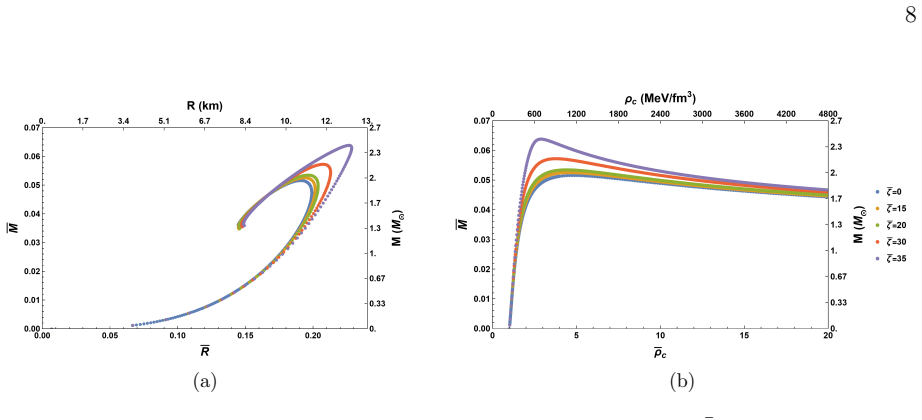
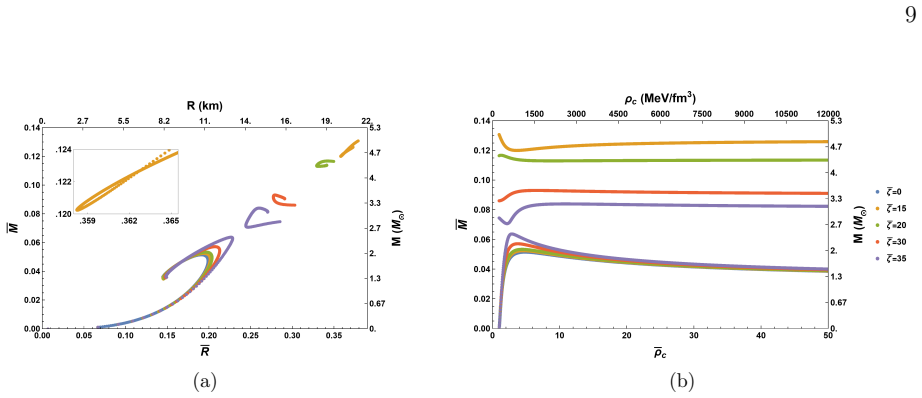
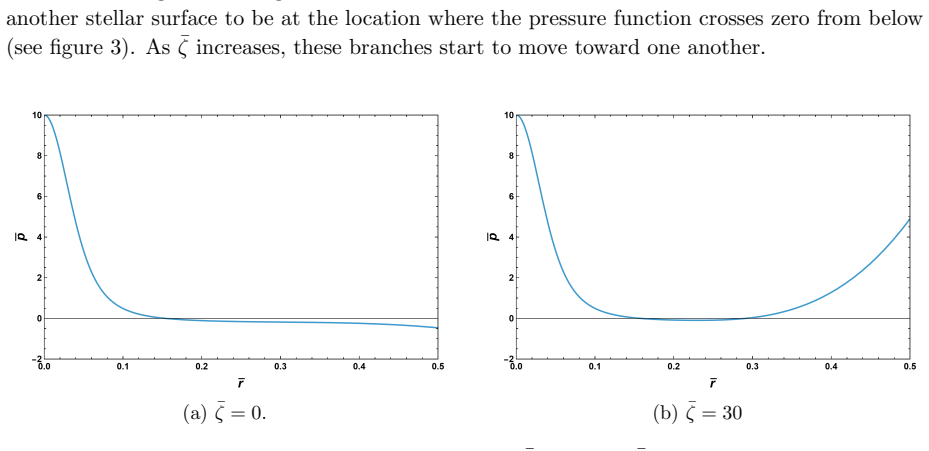
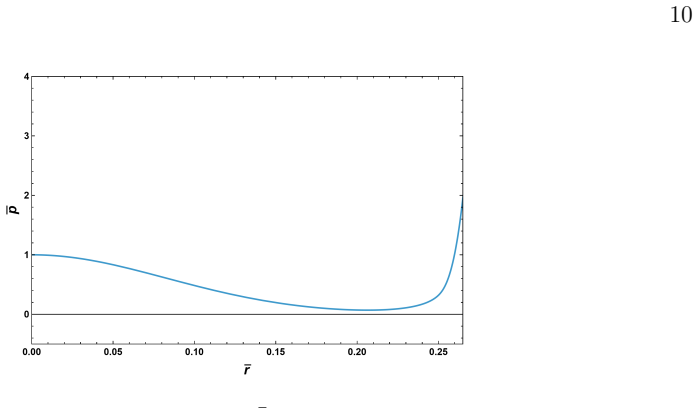
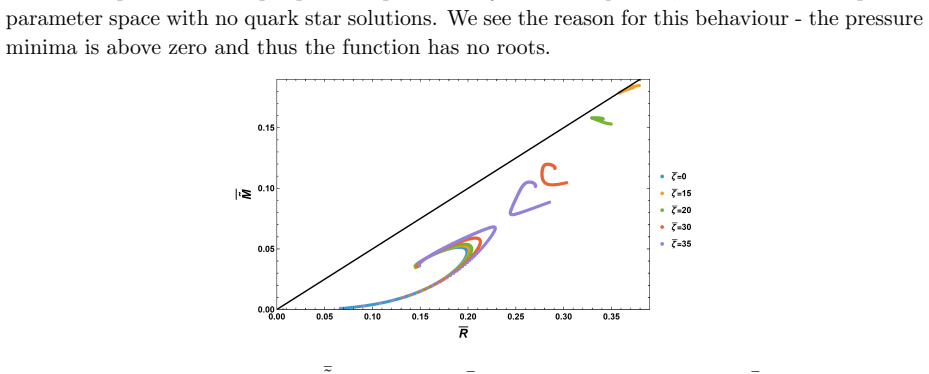
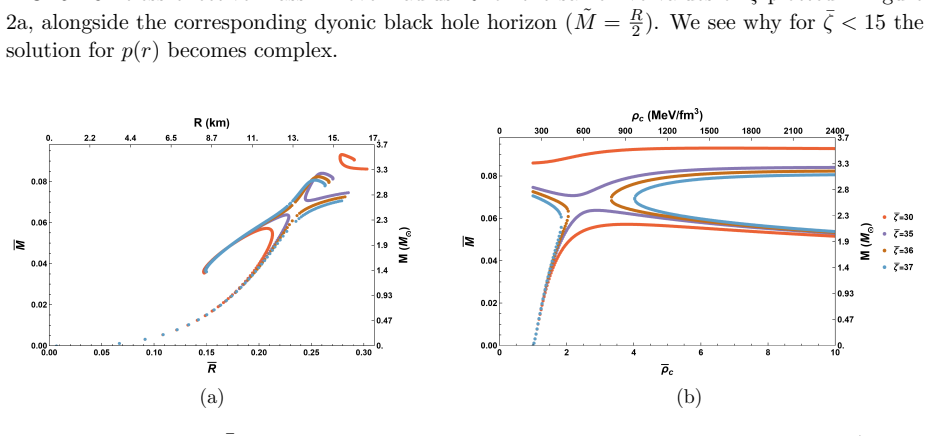
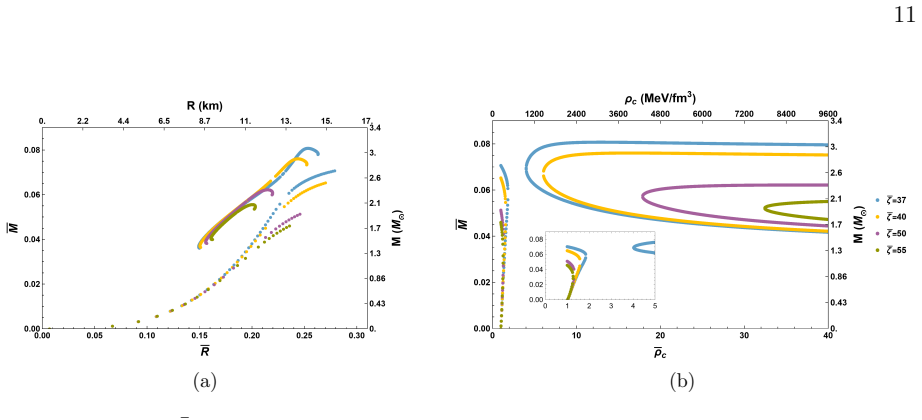
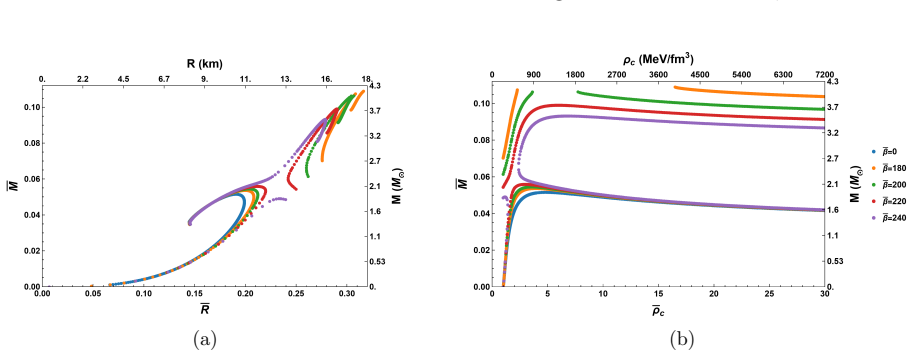
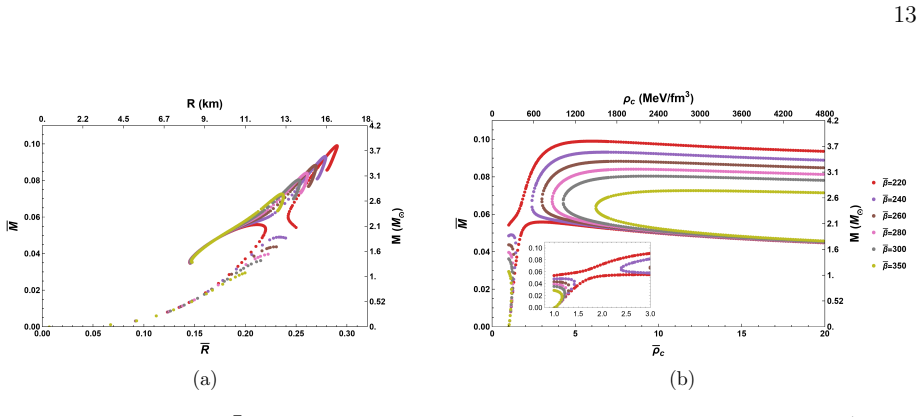
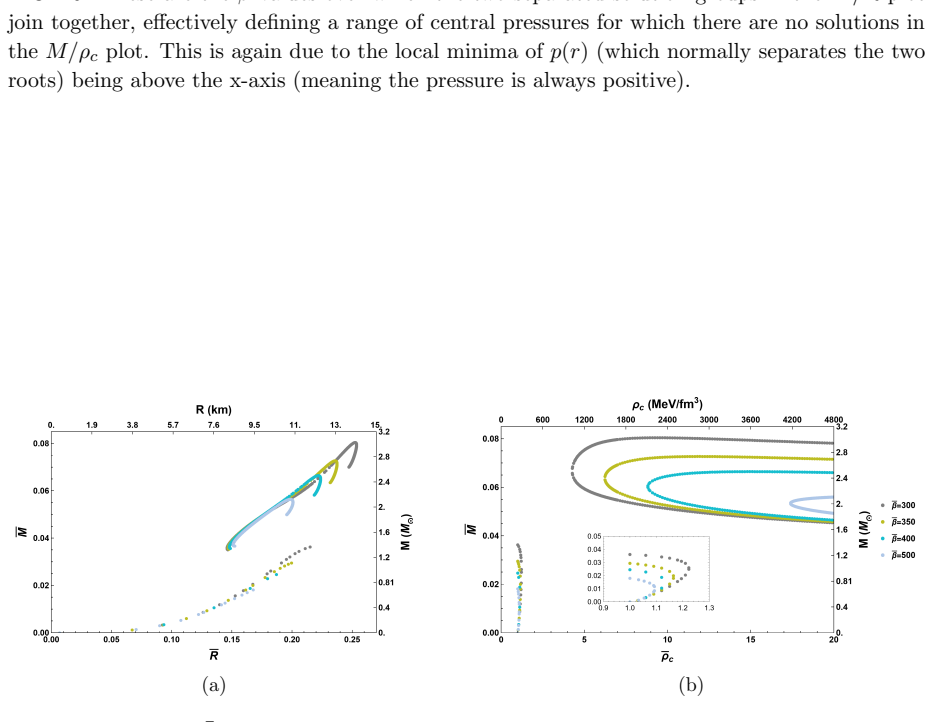
In pure quasi-topological electromagnetism, the dyonic case induces non-trivial contributions that shift the standard quark star mass-radius hook to larger masses and radii while also generating a second branch of solutions at very large mass and radius for small dyonic charge ratios. These additional solutions exhibit a negative pressure envelope surrounding a positive pressure core. As the dyonic charge ratio is increased, the branches interact and eventually merge into a paperclip shape in M/R space.
What carries the argument
The quasi-topological electromagnetism term in the action, which couples non-trivially only to dyonic charge distributions and modifies the structure equations for quark stars.
If this is right
- The usual mass-radius hook for quark stars shifts toward larger masses and radii.
- A second branch of solutions emerges at very large mass and radius for small dyonic charge ratios.
- These large solutions feature a negative pressure envelope around a positive pressure core.
- The two branches merge into a paperclip shape in the mass-radius diagram as the charge ratio increases.
Where Pith is reading between the lines
- Stability of the negative-pressure-envelope solutions against small perturbations would need separate checking to determine if they can persist.
- Gravitational-wave observations of compact-object mergers might reveal signatures from the altered mass-radius relations at high mass.
- The model implies that dyonic effects could alter the maximum stable mass for quark stars compared with standard general relativity.
Load-bearing premise
The quasi-topological electromagnetism contribution remains negligible unless both electric and magnetic charges are simultaneously present.
What would settle it
Detection or non-detection of compact objects with masses and radii in the predicted second branch region, or indirect probes showing absence of negative pressure envelopes in any quark star candidates.
Figures
read the original abstract
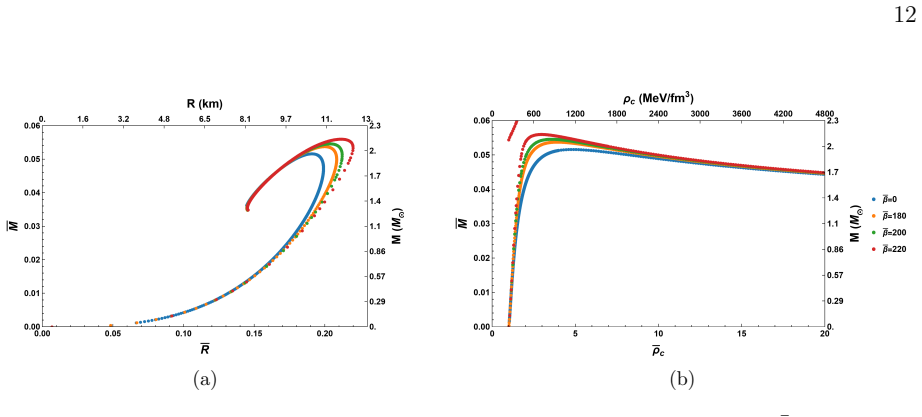
In this paper we consider quark star solutions to Liu et al.'s \cite{Liu_2019} quasi-topological electromagnetism (QTEM), a recently proposed form of dark energy. Since the QTEM contribution is trivial for pure electric/magnetic charge, we consider the dyonic case in pure QTEM which does induce (dark) non-trivial dynamics from the non-linear theory. Besides the introduction of a dyonic charge distribution generally pushing the characteristic quark star `hook' shape to larger masses and radii, it also induces a second branch at very large mass and radius for stars with a small dyonic charge ratio. This second set of solutions have a negative pressure envelope surrounding a positive pressure core. As we explore the parameter space these features interact and evolve in interesting ways, with the two branches eventually merging in $M/R$ space before settling into a characteristic `paperclip' shape as the dyonic charge ratio becomes large.
Editorial analysis
A structured set of objections, weighed in public.
Referee Report
Summary. The manuscript studies static spherically symmetric quark-star solutions sourced by dyonic charge distributions in Liu et al.'s quasi-topological electromagnetism (QTEM). It asserts that the QTEM term vanishes for pure electric or magnetic charge but generates non-trivial dynamics in the dyonic case, producing (i) a shift of the usual quark-star 'hook' to larger masses and radii, (ii) a second branch of solutions at very large mass and radius for small dyonic charge ratios, and (iii) a negative-pressure envelope surrounding a positive-pressure core. As the dyonic charge ratio is increased the two branches merge, eventually forming a characteristic 'paperclip' shape in the M–R plane.
Significance. If the reported branches and the negative-pressure envelope are confirmed by the field equations, the work would supply a concrete, falsifiable signature of non-linear electromagnetism in strong-gravity compact objects. The paperclip merger constitutes a distinctive topological feature in the mass-radius diagram that could be confronted with future observations or with numerical stability analyses. The restriction to the dyonic sector is presented as essential; establishing that restriction rigorously would therefore be a necessary condition for the result to carry weight.
major comments (2)
- [Abstract] Abstract (and opening paragraphs): the assertion that 'the QTEM contribution is trivial for pure electric/magnetic charge' is load-bearing for the decision to restrict the analysis to dyonic solutions, yet neither the QTEM Lagrangian nor the explicit reduction of the stress-energy tensor in the pure-charge limits is supplied. Without this cancellation shown, it is impossible to verify that the second branch and negative-pressure envelope are genuinely dyonic-specific rather than artifacts of an incomplete truncation.
- [Numerical results / structure equations] The description of the second branch (large-mass/radius solutions with negative-pressure envelope) and its merger into the paperclip shape rests on numerical integration of the structure equations, but the manuscript supplies neither the explicit form of the QTEM-modified Tolman-Oppenheimer-Volkoff equation nor the quark-matter equation of state employed. Consequently the claim that these features arise only for small dyonic charge ratios cannot be assessed for robustness against variations in the EOS or integration method.
minor comments (2)
- [Abstract] Notation for the dyonic charge ratio should be defined once at first use and used consistently thereafter; the current text alternates between 'dyonic charge ratio' and an undefined symbol.
- [Figures] Figure captions for the M–R diagrams should state the precise range of the dyonic charge ratio scanned and the value of any fixed parameters (e.g., bag constant, central density).
Simulated Author's Rebuttal
We thank the referee for their careful reading of the manuscript and for highlighting points that require clarification. We address each major comment below and will revise the manuscript to incorporate the requested explicit derivations and details.
read point-by-point responses
-
Referee: [Abstract] Abstract (and opening paragraphs): the assertion that 'the QTEM contribution is trivial for pure electric/magnetic charge' is load-bearing for the decision to restrict the analysis to dyonic solutions, yet neither the QTEM Lagrangian nor the explicit reduction of the stress-energy tensor in the pure-charge limits is supplied. Without this cancellation shown, it is impossible to verify that the second branch and negative-pressure envelope are genuinely dyonic-specific rather than artifacts of an incomplete truncation.
Authors: We agree that an explicit demonstration strengthens the presentation. The QTEM Lagrangian from Liu et al. (2019) contains a term proportional to the product of the electric and magnetic field strengths; this term vanishes identically when either charge is zero, recovering the standard Maxwell stress-energy tensor. In the revised manuscript we will quote the Lagrangian and provide the component-by-component reduction of the stress-energy tensor in the pure-electric and pure-magnetic limits to make the cancellation transparent. revision: yes
-
Referee: [Numerical results / structure equations] The description of the second branch (large-mass/radius solutions with negative-pressure envelope) and its merger into the paperclip shape rests on numerical integration of the structure equations, but the manuscript supplies neither the explicit form of the QTEM-modified Tolman-Oppenheimer-Volkoff equation nor the quark-matter equation of state employed. Consequently the claim that these features arise only for small dyonic charge ratios cannot be assessed for robustness against variations in the EOS or integration method.
Authors: The manuscript derives the modified hydrostatic equilibrium equation from the Einstein equations with the QTEM stress-energy tensor, but we accept that the final differential form and the precise MIT-bag EOS parameters were not written out. The revised version will display the complete set of structure equations (including the QTEM contributions to the effective energy density and pressure) together with the numerical values of the bag constant and strange-quark mass used in the integrations, enabling direct reproducibility and tests of robustness. revision: yes
Circularity Check
No significant circularity; derivation self-contained
full rationale
The paper solves the Einstein equations sourced by the QTEM stress-energy tensor for dyonic quark-star interiors, treating the dyonic charge ratio as an explicit free parameter that is scanned to generate families of solutions. The second branch, negative-pressure envelope, and paperclip merger are outputs of that scan applied to the field equations; they are not shown to reduce to the input parameter by algebraic identity or by a self-citation that itself lacks independent verification. The statement that QTEM is trivial for pure charges is attributed to the cited Liu et al. (2019) construction and is not re-derived here in a way that creates a closed loop. No load-bearing step equates a claimed prediction to a fitted quantity or to a prior result whose only support is the present authors' own work.
Axiom & Free-Parameter Ledger
free parameters (1)
- dyonic charge ratio
axioms (2)
- domain assumption Quasi-topological electromagnetism reduces to standard Maxwell theory for pure electric or pure magnetic charge but becomes non-trivial for dyonic configurations.
- standard math The stellar structure equations of general relativity remain valid when the QTEM stress-energy tensor is added.
Reference graph
Works this paper leans on
-
[1]
relativistic struc- ture of a spherical static object and the equation of state of the interior fluid
along with our equation of state (22) it is straightforward to show that these are all satisfied as long as ¯p≥ −4, which is the case for all solutions we have obtained. A. Charge Model A For various smaller values of¯ζ(representing small electric charge density scaled by mag- netic charge density) in model A (19) we obtain mass-radius curves that are qua...
-
[2]
Future work should be done to clarify this point, beginning with a full investigation of the system’s fundamental mode eigenfrequencies under radial perturbation
It is not clear whether this indicates true instability or is exposing the naivety of applying the Newtonian bound to solutions to a non-linear theory. Future work should be done to clarify this point, beginning with a full investigation of the system’s fundamental mode eigenfrequencies under radial perturbation. 15 V. DISCUSSION AND SUMMAR Y In this pape...
-
[3]
Quasi-topological electromagnetism: Dark energy, dyonic black holes, stable photon spheres and hidden electromagnetic duality
Hai-Shan Liu, Zhan-Feng Mai, Yue-Zhou Li, and H L¨ u. Quasi-topological electromagnetism: Dark energy, dyonic black holes, stable photon spheres and hidden electromagnetic duality. Science China Physics, Mechanics & Astronomy, 63, 2019
2019
-
[4]
Quasitopological electromagnetism and black holes
Adolfo Cisterna, Gaston Giribet, Julio Oliva, and Konstantinos Pallikaris. Quasitopological electromagnetism and black holes. Physical Review D, 101(12), June 2020
2020
-
[5]
Joule-thomson expansion of ads black holes in quasitopo- logical electromagnetism
Jos´ e Barrientos and Jos´ e Mena. Joule-thomson expansion of ads black holes in quasitopo- logical electromagnetism. Physical Review D, 106(4), August 2022
2022
-
[6]
Li, H.-M
M.-D. Li, H.-M. Wang, and S.-W. Wei. Triple points and novel phase transitions of dyonic AdS black holes with quasitopological electromagnetism. Physical Review D, 105(10), May 2022
2022
-
[7]
Exotic lovelock black holes and extended quasitopological electromagnetism, 2025
Askar Ali and Khalid Saifullah. Exotic lovelock black holes and extended quasitopological electromagnetism, 2025
2025
-
[8]
D-dimensional dyonic AdS black holes with quasi-topological electromagnetism in Einstein Gauss–Bonnet gravity
Yassine Sekhmani, Hicham Lekbich, Abderrahman El Boukili, and Moulay Brahim Sedra. D-dimensional dyonic AdS black holes with quasi-topological electromagnetism in Einstein Gauss–Bonnet gravity. Eur. Phys. J. C, 82(12):1087, 2022
2022
-
[9]
Electromagnetic quasinormal modes of dyonic ads black holes with quasitopological electromagnetism in a horndeski gravity theory mim- icking egb gravity at d→4
Yassine Sekhmani and Dhruba Jyoti Gogoi. Electromagnetic quasinormal modes of dyonic ads black holes with quasitopological electromagnetism in a horndeski gravity theory mim- icking egb gravity at d→4. International Journal of Geometric Methods in Modern Physics, 20(09), April 2023
2023
-
[10]
Geometrically thick equilibrium tori around a dyonic black hole with quasi-topological electromagnetism, 2024
Xuan Zhou, Songbai Chen, and Jiliang Jing. Geometrically thick equilibrium tori around a dyonic black hole with quasi-topological electromagnetism, 2024
2024
-
[11]
Super-extremal black holes in the quasitopological electromagnetic field theory, 2024
Shahar Hod. Super-extremal black holes in the quasitopological electromagnetic field theory, 2024
2024
-
[12]
Chaos of particle motion near a black hole with quasitopological electromagnetism
Yu-Qi Lei, Xian-Hui Ge, and Cheng Ran. Chaos of particle motion near a black hole with quasitopological electromagnetism. Physical Review D, 104(4), August 2021
2021
-
[13]
Chen Zhang and Robert B. Mann. Unified interacting quark matter and its astrophysical implications. Physical Review D, 103, 03 2021
2021
-
[14]
Chen Zhang, Michael Gammon, and Robert B. Mann. Stellar structure and stability of charged interacting quark stars and their scaling behaviour. Physical Review D, 104, 12 2021
2021
-
[15]
Michael Gammon, Sarah Rourke, and Robert B. Mann. Quark stars with a unified interacting equation of state in regularized 4d einstein-gauss-bonnet gravity. Phys. Rev. D, 109:024026, Jan 2024
2024
-
[16]
Mann, and Sarah Rourke
Michael Gammon, Robert B. Mann, and Sarah Rourke. Charged quark stars and extreme compact objects in regularized 4d einstein-gauss-bonnet gravity. Phys. Rev. D, 111:043034, Feb 2025
2025
-
[17]
Alejandro Saavedra, Guillermo Rubilar, Octavio Fierro, Michael Gammon, and Robert B. Mann. Neutron stars in 4d einstein-gauss-bonnet gravity. Phys. Rev. D, 111:064071, Mar 2025
2025
-
[18]
Quark stars in 4d einstein–gauss–bonnet gravity with an interacting quark equation of state
Ayan Banerjee, Takol Tangphati, Daris Samart, and Phongpichit Channuie. Quark stars in 4d einstein–gauss–bonnet gravity with an interacting quark equation of state. The Astrophysical Journal, 906:114, 01 2021. 17
2021
-
[19]
Strange quark stars in 4d einstein–gauss–bonnet gravity
Ayan Banerjee, Takol Tangphati, and Phongpichit Channuie. Strange quark stars in 4d einstein–gauss–bonnet gravity. The Astrophysical Journal, 909(1):14, mar 2021
2021
-
[20]
J. E. Horvath, L. S. Rocha, L. M. de S´ a, P. H. R. S. Moraes, L. G. Bar˜ ao, M. G. B. de Avellar, A. Bernardo, and R. R. A. Bachega. A light strange star in the remnant hess j1731 347: Minimal consistency checks. Astronomy & Astrophysics, 672:L11, April 2023
2023
-
[21]
M. C. Miller, F. K. Lamb, A. J. Dittmann, S. Bogdanov, Z. Arzoumanian, K. C. Gendreau, S. Guillot, A. K. Harding, W. C. G. Ho, J. M. Lattimer, R. M. Ludlam, S. Mahmoodifar, S. M. Morsink, P. S. Ray, T. E. Strohmayer, K. S. Wood, T. Enoto, R. Foster, T. Oka- jima, G. Prigozhin, and Y. Soong. Psr j0030+0451 mass and radius from nicer data and implications f...
2019
-
[22]
Riley, Serena Vinciguerra, Anna L
Tuomo Salmi, Devarshi Choudhury, Yves Kini, Thomas E. Riley, Serena Vinciguerra, Anna L. Watts, Michael T. Wolff, Zaven Arzoumanian, Slavko Bogdanov, Deepto Chakrabarty, Keith Gendreau, Sebastien Guillot, Wynn C. G. Ho, Daniela Huppenkothen, Renee M. Ludlam, Sharon M. Morsink, and Paul S. Ray. The radius of the high mass pulsar psr j0740+6620 with 3.6 yea...
2024
-
[23]
Abbott et al
R. Abbott et al. Gw190814: Gravitational waves from the coalescence of a 23 solar mass black hole with a 2.6 solar mass compact object. The Astrophysical Journal Letters, 896(2):L44, jun 2020
2020
-
[24]
Quark matter may not be strange
Bob Holdom, Jing Ren, and Chen Zhang. Quark matter may not be strange. Physical Review Letters, 120, 05 2018
2018
-
[25]
J. R. Oppenheimer and G. M. Volkoff. On massive neutron cores. Phys. Rev., 55:374–381, Feb 1939
1939
-
[26]
Richard C. Tolman. Static solutions of einstein’s field equations for spheres of fluid. Phys. Rev., 55:364–373, Feb 1939
1939
-
[27]
Electrically charged compact stars and formation of charged black holes
Subharthi Ray, Aquino L Espindola, Manuel Malheiro, Jos´ e PS Lemos, and Vilson T Zanchin. Electrically charged compact stars and formation of charged black holes. Physical Review D, 68(8):084004, 2003
2003
-
[28]
Charged polytropic compact stars
Subharthi et al Ray. Charged polytropic compact stars. Brazilian Journal of Physics, (34):310–314, 2004
2004
-
[29]
Stellar structure and stability of charged interacting quark stars and their scaling behaviour
Chen Zhang, Michael Gammon, and Robert Mann. Stellar structure and stability of charged interacting quark stars and their scaling behaviour. Phys. Rev. D., 104, 2021
2021
-
[30]
Jos´ e D. V. Arba˜ nil and M. Malheiro. Equilibrium and stability of charged strange quark stars. Physical Review D, 92(8), oct 2015
2015
-
[31]
V. P. Gon¸ calves and L. Lazzari. Electrically charged strange stars with an interacting quark matter equation of state. Physical Review D, 102(3), aug 2020
2020
-
[32]
Criteria for energy conditions
Hideki Maeda and Tomohiro Harada. Criteria for energy conditions. Classical and Quantum Gravity, 39(19):195002, August 2022
2022
-
[33]
Structure of quark stars
Fridolin Weber, Milva Orsaria, Hilario Rodrigues, and Shu-Hua Yang. Structure of quark stars. Proceedings of the International Astronomical Union, 8(S291):61–66, August 2012
2012
-
[34]
Compact Stars
Norman K Glendenning. Compact Stars. Springer, 1997
1997
-
[35]
Brillante and I
A. Brillante and I. N. Mishustin. Radial oscillations of neutral and charged hybrid stars. EPL (Europhysics Letters), 105(3):39001, Feb 2014
2014
-
[36]
The stability of relativistic stars and the role of the adiabatic index
Charalampos Moustakidis. The stability of relativistic stars and the role of the adiabatic index. General Relativity and Gravitation, 49, 04 2017. 18
2017
-
[37]
Chandrasekhar
S. Chandrasekhar. The Dynamical Instability of Gaseous Masses Approaching the Schwarzschild Limit in General Relativity. Astrophys. J., 140:417, August 1964
1964
-
[38]
Isotropic compact stars in 4d einstein–gauss–bonnet gravity
Sudan Hansraj, Ayan Banerjee, Lushen Moodly, and M K Jasim. Isotropic compact stars in 4d einstein–gauss–bonnet gravity. Classical and Quantum Gravity, 38(3):035002, dec 2020
2020
-
[39]
Newton Singh, S
Ksh. Newton Singh, S. K. Maurya, Piyali Bhar, and Riju Nag. Anisotropic solution for polytropic stars in 4d einstein–gauss–bonnet gravity. The European Physical Journal C, 82(9), sep 2022
2022
-
[40]
H. A. Buchdahl. General relativistic fluid spheres. Phys. Rev., 116:1027–1034, Nov 1959
1959
-
[41]
C. G. B¨ ohmer and T. Harko. Minimum mass–radius ratio for charged gravitational objects. General Relativity and Gravitation, 39(6):757–775, mar 2007
2007
-
[42]
Limits on stellar structures in lovelock theories of gravity
Sumanta Chakraborty and Naresh Dadhich. Limits on stellar structures in lovelock theories of gravity. Physics of the Dark Universe, 30:100658, dec 2020
2020
discussion (0)
Sign in with ORCID, Apple, or X to comment. Anyone can read and Pith papers without signing in.