REVIEW 4 major objections 6 minor 34 references
Energy-Based Transfer for Reinforcement Learning
T0 review · 4 major / 6 minor · reviewed 2026-08-06 · deepseek-v4-flash
Pith's one-line read This paper claims that energy scores from a teacher's action logits measure how familiar a state is, and gating teacher advice on that score turns RL transfer from a source of bias into consistent positive transfer.
desk verdict A plausible and mostly well-executed transfer RL method whose 'theoretical justification' is circular; worth a referee, but the theory and hyperparameter reporting need real work. read the letter →
The pith
A machine-rendered reading of the paper's core claim, the machinery that carries it, and where it could break.
The reading
What carries the argument
The central object is the free energy of a state under the teacher policy, $E(s;\pi_T) = -T \log \sum_i e^{f_i(s)/T}$, where $f_i$ are the teacher's action logits; the energy score is its negative, $\phi(s) = -E(s;\pi_T)$. The free energy links the teacher's raw logits to a Boltzmann-style density $p(s) \propto e^{-E(s)}$, which is the machinery that lets the paper identify high score with in-training-distribution and low score with out-of-distribution. Around this score the algorithm builds a threshold, a decaying guidance probability, and an off-policy importance ratio that keeps mixed teacher/student actions valid for policy-gradient updates.
What would settle it
In a tabular MDP, train a teacher, then estimate empirical log visitation frequency from long rollouts and compute the energy score at each state. If there is a state with high visitation frequency but lower energy score than a rarely visited state, the monotone relation $\log d_\pi(s) \propto \phi(s)$ that the method relies on fails.
Extended reading notes
Core claim
The central claim is Proposition 4.1: for a teacher trained on-policy, the negative free energy $\phi(s) = -E(s)$ of a state under the teacher's network is proportional to $\log d_\pi(s)$, the log of the state-visitation density induced by the teacher policy. The argument follows from writing the teacher's model as an energy-based density $p(s) = e^{-E(s)}/Z$ and identifying the empirical training distribution with the visitation distribution. The paper then treats this score as an out-of-distribution detector: when the student visits a state with score above a threshold, the teacher suggests an action; otherwise the student acts alone. Energy regularization during teacher training, using random target-environment rollouts as out-of-distribution samples, sharpens the separation, and the paper's claim is that this selective gating converts transfer from a source of harmful bias into consistent positive transfer.
Load-bearing premise
The load-bearing premise is that the free energy computed from the teacher's policy logits is a calibrated proxy for the teacher's state-visitation density, so a single threshold can cleanly separate familiar from unfamiliar states in the target task.
Editorial extensions
If this is right
- Time-based advising schedules, such as advising always or only in an early prefix, are the wrong gate; the correct gate is state familiarity, and gating by energy scores should preserve positive transfer even when the target task drifts.
- In the tested navigation and cooking tasks, the threshold $q$ has a usable range around 0.3–0.7: too low admits harmful advice, while too high withholds helpful advice.
- Energy regularization with random target-environment rollouts is what makes the in-distribution/out-of-distribution separation reliable under harder covariate shift, though even without it EBTL still matches the baselines.
- A teacher trained on a source task can remain useful for a target task that is substantially different, provided the teacher is allowed to act only on the shared sub-task it already knows.
- EBTL requires no task-specific reward shaping or policy initialization tricks, only the pretrained teacher's logits and a threshold from its own training states.
Reading between the lines
- A direct extension is to run one energy detector per pretrained skill and use the highest familiarity score as a router, letting several teachers share a single student across a lifelong task sequence.
- The hand-picked threshold suggests an adaptive rule: raise or lower $q$ based on the student's recent return, which would remove the one tunable hyperparameter.
- Because the energy detector already scores every visited state, the same signal could flag which transitions to store in a replay buffer, making familiarity serve both exploration guidance and memory selection in continual learning.
- The proportionality claim could be tested more sharply in a tabular MDP with exact visitation counts, which would separate the energy-detector idea from the neural approximation used in the paper.
Editorial analysis
A structured set of objections, weighed in public.
Referee Report
Summary. The paper proposes Energy-Based Transfer for Reinforcement Learning (EBTL), a method for selective teacher-student transfer. The teacher policy is trained with an auxiliary energy-based loss; during student training, the teacher's free-energy score over its action logits is compared with a quantile threshold, and teacher actions are used only when the state is deemed in-distribution, subject to a decaying guidance schedule. The authors give Proposition 4.1 as a theoretical justification that the negative free energy is proportional to the log state-visitation density of the teacher, and they report experiments in MiniGrid (Alternating Goal Room, Locked Room) and Overcooked (Simple and Ring layouts, with three transfer configurations), claiming EBTL consistently outperforms all baselines in sample efficiency and final return.
Significance. Selective advising based on out-of-distribution detection is a plausible and practically motivated idea: if the teacher can reliably detect states where its advice is relevant, positive transfer can be obtained under covariate shift without the usual degradation from stale advice. The paper includes a useful experimental design with multiple difficulty levels, a comparison against several transfer baselines, and an ablation showing that the energy regularization helps. The empirical story is weakened, however, by a theoretical proposition that is circular, by thresholds selected using target-task performance, and by the use of target-environment random rollouts in teacher training. If the method is reframed as a heuristic and the evaluation protocol is made more rigorous, the contribution could still be useful, but the current manuscript overstates both the theory and the empirical claim.
major comments (4)
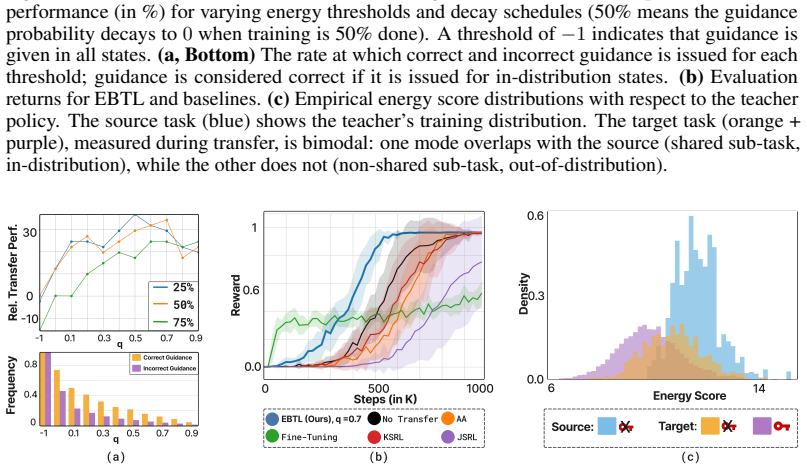
- [Section 4.1, Proposition 4.1] The proposition is a definitional identity rather than a derived statement. The proof defines p(s) = exp(-E(s;f))/Z and then asserts that p(s) equals the teacher's state-visitation distribution dπ(s) because 'training data is collected by sampling trajectories under the current policy.' This conflates two different objects: E(s;π_T) is computed from the action logits of the PPO policy network, i.e. an energy over actions conditioned on a state, not an energy-based model of states. Nothing in PPO training constrains the Boltzmann distribution induced by exp(-E(s;f))/Z to match the empirical state marginal of the teacher's rollouts. Moreover, the partition function Z is discarded, so even a monotone relationship would not give calibrated density values. Since the q-quantile threshold in Algorithm 1 and the selection rule in Eq. (2) require a monotone, roughly calibrated relationship between the energy score and visitation frequency, Proposition 4.1 does not provide the claimed theoretical justification. The empirical separation in Figures 3c and 4c may still hold as an inductive observation, but the paper should state this as a heuristic and provide direct evidence that the energy score ranks states by visitation frequency rather than by action confidence.
- [Section 5, Figures 3 and 4] The headline claim that EBTL 'consistently outperforms all baselines in both sample efficiency and final policy return across all scenarios' is not supported by the evaluation protocol as presented. The performance curves in Figures 3a and 4a show results for a range of q values, and the EBTL curves in Figures 3b and 4b use q=0.5 and q=0.7 respectively, i.e. thresholds selected per environment using the transfer-performance curves themselves. A method whose single hyperparameter is tuned on the test scenarios cannot be compared on equal footing with baselines whose hyperparameters are fixed without a validation protocol. The same issue applies to the Overcooked experiments, where q=0.5 and q=0.2 are chosen per setup. The paper should either report results with a fixed a-priori threshold, or describe a realistic validation procedure for choosing q (for example, a small labeled validation set of teacher-familiar states), and then compare all methods under that procedure.
- [Section 4.2, Eq. (3)] The off-policy correction in Eq. (3) is ambiguous and likely incorrect. When α_t=1, the action was sampled from the teacher policy π_T, so the behavior policy is π_T, not the student's previous policy π_{θ_old}. The importance ratio should be π_{θ_S}(a_t|s_t)/π_{θ_T}(a_t|s_t), which is what the paper writes, but the preceding definition says θ_old denotes the behavior policy used by π_S at data collection time; that definition does not cover the teacher-sampled case. More importantly, for on-policy PPO the entire trajectory distribution changes when actions come from the teacher, and using a per-action importance weight only corrects the action probability, not the state distribution. The paper should clarify what distribution the expectation in Eq. (3) is taken over and justify why this ratio yields a valid policy-gradient estimator for the student under mixed teacher/student rollouts.
- [Section 4.2 and Appendix D] The teacher is trained with out-of-distribution samples drawn from 'random policy rollouts in the target environment.' This means target-environment information is used during teacher training, which weakens the claim of transfer under covariate shift and creates an asymmetry with respect to the baselines. If the target environment is available for random rollouts, then the teacher has already seen a distribution of target states, albeit under a random policy. The paper should either remove this dependence on target-environment rollouts or explicitly frame the method as one that is allowed to collect unlabeled random transitions in the target environment before transfer, and discuss the implications for the transfer claim.
minor comments (6)
- [Section 6] The Limitations paragraph says the method is designed for 'covariance' shift; this should be 'covariate shift.'
- [Section 5] The statement that PPO is implemented with TorchRL cites reference [25], which is the Kickstarting paper; the appropriate citation for PPO is Schulman et al., 2017.
- [Figures 3 and 4] The reported results are averaged over 10 seeds, but no error bars or confidence intervals are shown in the return curves; adding shaded standard errors or interquartile ranges would make it easier to assess the 'consistently outperforms' claim.
- [Algorithm 1] The decay schedule δ(t)=max(0, δ0−κt) introduces parameters δ0 and κ that are not defined in the main text and are not discussed in the hyperparameter appendix; please specify their values and how they were chosen.
- [Section 4.2] The sentence 'the teacher is trained solely on trajectories from its own environment' is contradicted by the subsequent description of the energy regularization loss, which uses a 'fixed set of representative OOD states' from the target environment; please rephrase to avoid the inconsistency.
- [Appendix A.1] The teacher checkpoints are selected at different training steps for different environments (800K steps for Locked Room, 200K steps for Alternating Goal Room), but no justification is given for these choices; please explain why these checkpoints are representative.
Circularity Check
Proposition 4.1 is self-definitional: the state density is defined from the energy and then equated with the teacher's visitation distribution, so log dπ ∝ −E is assumed rather than derived.
-
self definitional
[Section 4.1, Proposition 4.1 (with Eq. 1 and the definition φ(s;π_T)=−E(s;π_T))]
"Proposition 4.1. Under on-policy training, let dπ(s) denote the state-visitation distribution induced by policy π. Then the log of the visitation density is proportional to the score function ϕ(s) = −E(s): log dπ(s) ∝ ϕ(s). Proof. Given an energy-based model f, the density p(s) is defined in terms of its energy E(s): p(s;f) = e^{−E(s;f)/T}/Z ... Ignoring the normalizing constant Z and taking the logarithm ... log p(s) ∝ −E(s). In on-policy RL, training data is collected by sampling trajectories under the current policy π."
E(s;π_T) is computed by Eq. (1) from the action logits of the teacher's PPO policy network. The proof then defines p(s) as the Boltzmann density of that same energy, exp(−E(s)/T)/Z, and equates this p(s) with dπ(s) solely because on-policy rollouts generate the teacher's states. That equation is the entire content of the proposition, and it is assumed, not derived: nothing in PPO or in the definition of free energy over action logits guarantees that the empirical state marginal of π_T matches exp(−E(s;π_T))/Z, even up to a monotone transformation. Consequently log dπ(s) ∝ φ(s) is true by construction of p(s), not by any property of the teacher policy. Since Algorithm 1's threshold τ = Quantile_q({φ(s) | s∈S_T}) and Eq.
full rationale
The paper's empirical transfer results (Figures 3–7) are external benchmarks and are not circular; the EBTL method is compared against standard baselines with fixed hyperparameters, and those comparisons have independent content. The circularity lies in the stated theoretical justification: Proposition 4.1 defines a state density from the energy and then identifies it with the teacher's visitation distribution, making the claimed proportionality true by definition rather than by derivation. The auxiliary energy regularization and the quantile threshold are fitting procedures, not predictions, so they are not separately circular. The self-citations (Campbell et al., Guo et al., Lu et al.) are used for baselines and context, not as load-bearing support for the energy-visitation identification. Score 8 reflects that the central theoretical claim reduces to a definitional assumption, while the experimental evaluation remains independently meaningful.
Assumptions & free parameters
free parameters (5)
- Energy threshold quantile q =
q=0.5 Alternating Goal; q=0.7 Locked Room; q=0.5 or 0.2 Overcooked setups
- Guidance decay schedule delta(t) =
Linear decay over 20-80% of training, shown in Figure 3a
- Energy regularization margins m_in, m_out =
m_in=10, m_out=15 for MiniGrid; m_in=12, m_out=14 for Overcooked
- Energy regularization weight lambda =
Not reported
- Temperature T in free energy =
Not reported
assumptions (5)
- ad hoc to paper A PPO policy network's free energy over action logits defines a state density equal to the teacher's state-visitation distribution.
- domain assumption A single energy threshold separates in-distribution from out-of-distribution states in the target task.
- domain assumption Teacher actions are useful in all states deemed in-distribution for the target task.
- domain assumption Random rollouts in the target environment can be used to train the teacher's OOD detector.
- standard math Importance ratio r_t = pi_S(a_t|s_t) / pi_T(a_t|s_t) for teacher-sampled actions gives valid PPO updates.
Cite this review
Pith. "Pith review of Energy-Based Transfer for Reinforcement Learning." pith.science (2026). https://pith.science/paper/MOFBSZKH
@misc{pith2026250616590,
  author       = {Pith},
  title        = {Pith review of: Energy-Based Transfer for Reinforcement Learning},
  year         = {2026},
  howpublished = {\url{https://pith.science/paper/MOFBSZKH}},
  note         = {Machine review of arXiv:2506.16590}
}
read the original abstract
Reinforcement learning algorithms often suffer from poor sample efficiency, making them challenging to apply in multi-task or continual learning settings. Efficiency can be improved by transferring knowledge from a previously trained teacher policy to guide exploration in new but related tasks. However, if the new task sufficiently differs from the teacher's training task, the transferred guidance may be sub-optimal and bias exploration toward low-reward behaviors. We propose an energy-based transfer learning method that uses out-of-distribution detection to selectively issue guidance, enabling the teacher to intervene only in states within its training distribution. We theoretically show that energy scores reflect the teacher's state-visitation density and empirically demonstrate improved sample efficiency and performance across both single-task and multi-task settings.
Figures


Figures from the paper (5 more)


Reference graph
Works this paper leans on
-
[1]
Hindsight experience replay.Advances in neural information processing systems, 30, 2017
Marcin Andrychowicz, Filip Wolski, Alex Ray, Jonas Schneider, Rachel Fong, Peter Welinder, Bob McGrew, Josh Tobin, OpenAI Pieter Abbeel, and Wojciech Zaremba. Hindsight experience replay.Advances in neural information processing systems, 30, 2017
2017
-
[2]
Deep reinforcement learning: A brief survey.IEEE Signal Processing Magazine, 34(6):26–38, 2017
Kai Arulkumaran, Marc Peter Deisenroth, Miles Brundage, and Anil Anthony Bharath. Deep reinforcement learning: A brief survey.IEEE Signal Processing Magazine, 34(6):26–38, 2017
2017
-
[3]
Torchrl: A data-driven decision-making library for pytorch, 2023
Albert Bou, Matteo Bettini, Sebastian Dittert, Vikash Kumar, Shagun Sodhani, Xiaomeng Yang, Gianni De Fabritiis, and Vincent Moens. Torchrl: A data-driven decision-making library for pytorch, 2023
2023
-
[4]
Policy transfer using reward shaping
Tim Brys, Anna Harutyunyan, Matthew E Taylor, and Ann Nowé. Policy transfer using reward shaping. InAAMAS, pages 181–188, 2015
work page 2015
-
[5]
Introspective action advising for interpretable transfer learning
Joseph Campbell, Yue Guo, Fiona Xie, Simon Stepputtis, and Katia Sycara. Introspective action advising for interpretable transfer learning. InConference on Lifelong Learning Agents, pages 1072–1090. PMLR, 2023
work page 2023
-
[6]
On the utility of learning about humans for human-ai coordination.Advances in neural information processing systems, 32, 2019
Micah Carroll, Rohin Shah, Mark K Ho, Tom Griffiths, Sanjit Seshia, Pieter Abbeel, and Anca Dragan. On the utility of learning about humans for human-ai coordination.Advances in neural information processing systems, 32, 2019
2019
-
[7]
Minigrid & miniworld: Modular & customizable reinforcement learning environments for goal-oriented tasks
Maxime Chevalier-Boisvert, Bolun Dai, Mark Towers, Rodrigo Perez-Vicente, Lucas Willems, Salem Lahlou, Suman Pal, Pablo Samuel Castro, and Jordan Terry. Minigrid & miniworld: Modular & customizable reinforcement learning environments for goal-oriented tasks. In Advances in Neural Information Processing Systems 36, New Orleans, LA, USA, December 2023
2023
-
[8]
Explainable action advising for multi-agent reinforcement learning
Yue Guo, Joseph Campbell, Simon Stepputtis, Ruiyu Li, Dana Hughes, Fei Fang, and Katia Sycara. Explainable action advising for multi-agent reinforcement learning. In2023 IEEE International Conference on Robotics and Automation (ICRA), pages 5515–5521. IEEE, 2023
work page 2023
Show all 34 references
-
[9]
Yue Guo, Xijia Zhang, Simon Stepputtis, Joseph Campbell, and Katia P. Sycara. Adaptive action advising with different rewards. In Vincenzo Lomonaco, Stefano Melacci, Tinne Tuytelaars, Sarath Chandar, and Razvan Pascanu, editors,Proceedings of The 3rd Conference on Lifelong Lea...
-
[10]
Reinforcement learning with deep energy-based policies
Tuomas Haarnoja, Haoran Tang, Pieter Abbeel, and Sergey Levine. Reinforcement learning with deep energy-based policies. InInternational conference on machine learning, pages 1352–1361. PMLR, 2017
2017
-
[11]
Expressing arbitrary reward functions as potential-based advice
Anna Harutyunyan, Sam Devlin, Peter Vrancx, and Ann Nowé. Expressing arbitrary reward functions as potential-based advice. InProceedings of the AAAI conference on artificial intelligence, volume 29, 2015
2015
-
[12]
A baseline for detecting misclassified and out-of-distribution examples in neural networks.arXiv preprint arXiv:1610.02136, 2016
Dan Hendrycks and Kevin Gimpel. A baseline for detecting misclassified and out-of-distribution examples in neural networks.arXiv preprint arXiv:1610.02136, 2016
2016 arXiv
-
[13]
Transferring policy of deep reinforcement learning from simulation to reality for robotics.Nature Machine Intelligence, 4(12):1077–1087, 2022
Hao Ju, Rongshun Juan, Randy Gomez, Keisuke Nakamura, and Guangliang Li. Transferring policy of deep reinforcement learning from simulation to reality for robotics.Nature Machine Intelligence, 4(12):1077–1087, 2022
2022
-
[14]
A tutorial on energy-based learning.Predicting structured data, 1(0), 2006
Yann LeCun, Sumit Chopra, Raia Hadsell, M Ranzato, Fujie Huang, et al. A tutorial on energy-based learning.Predicting structured data, 1(0), 2006
2006
-
[15]
Deep reinforcement learning: An overview.arXiv preprint arXiv:1701.07274, 2017
Yuxi Li. Deep reinforcement learning: An overview.arXiv preprint arXiv:1701.07274, 2017
2017 arXiv
-
[16]
Energy-based out-of-distribution detection.Advances in neural information processing systems, 33:21464–21475, 2020
Weitang Liu, Xiaoyun Wang, John Owens, and Yixuan Li. Energy-based out-of-distribution detection.Advances in neural information processing systems, 33:21464–21475, 2020. 10
2020
-
[17]
Characterizing out-of-distribution error via optimal transport.Advances in Neural Information Processing Systems, 36:17602–17622, 2023
Yuzhe Lu, Yilong Qin, Runtian Zhai, Andrew Shen, Ketong Chen, Zhenlin Wang, Soheil Kolouri, Simon Stepputtis, Joseph Campbell, and Katia Sycara. Characterizing out-of-distribution error via optimal transport.Advances in Neural Information Processing Systems, 36:17602–17622, 2023
2023
-
[18]
University of Wisconsin-Madison
Richard Maclin and Jude W Shavlik.Incorporating advice into agents that learn from reinforce- ments. University of Wisconsin-Madison. Computer Sciences Department, 1994
1994
-
[19]
Policy invariance under reward transforma- tions: Theory and application to reward shaping
Andrew Y Ng, Daishi Harada, and Stuart Russell. Policy invariance under reward transforma- tions: Theory and application to reward shaping. InIcml, volume 99, pages 278–287. Citeseer, 1999
1999
-
[20]
Deep neural networks are easily fooled: High confidence predictions for unrecognizable images
Anh Nguyen, Jason Yosinski, and Jeff Clune. Deep neural networks are easily fooled: High confidence predictions for unrecognizable images. InProceedings of the IEEE conference on computer vision and pattern recognition, pages 427–436, 2015
2015
-
[21]
Transfer learning and fine- tuned transfer learning methods’ effectiveness analyse in the cnn-based deep learning models
Celal Öztürk, Murat Ta¸ syürek, and Mehmet U˘gur Türkdamar. Transfer learning and fine- tuned transfer learning methods’ effectiveness analyse in the cnn-based deep learning models. Concurrency and computation: practice and experience, 35(4):e7542, 2023
2023
-
[22]
Au- tomatic curriculum learning for deep rl: A short survey.arXiv preprint arXiv:2003.04664, 2020
Rémy Portelas, Cédric Colas, Lilian Weng, Katja Hofmann, and Pierre-Yves Oudeyer. Au- tomatic curriculum learning for deep rl: A short survey.arXiv preprint arXiv:2003.04664, 2020
2003 arXiv
-
[23]
Likelihood ratios for out-of-distribution detection.Advances in neural information processing systems, 32, 2019
Jie Ren, Peter J Liu, Emily Fertig, Jasper Snoek, Ryan Poplin, Mark Depristo, Joshua Dillon, and Balaji Lakshminarayanan. Likelihood ratios for out-of-distribution detection.Advances in neural information processing systems, 32, 2019
2019
-
[24]
Policy distillation.arXiv preprint arXiv:1511.06295, 2015
Andrei A Rusu, Sergio Gomez Colmenarejo, Caglar Gulcehre, Guillaume Desjardins, James Kirkpatrick, Razvan Pascanu, V olodymyr Mnih, Koray Kavukcuoglu, and Raia Hadsell. Policy distillation.arXiv preprint arXiv:1511.06295, 2015
2015 arXiv
-
[25]
Kickstarting deep reinforcement learning.arXiv preprint arXiv:1803.03835, 2018
Simon Schmitt, Jonathan J Hudson, Augustin Zidek, Simon Osindero, Carl Doersch, Woj- ciech M Czarnecki, Joel Z Leibo, Heinrich Kuttler, Andrew Zisserman, Karen Simonyan, et al. Kickstarting deep reinforcement learning.arXiv preprint arXiv:1803.03835, 2018
2018 arXiv
-
[26]
MIT press Cambridge, 1998
Richard S Sutton, Andrew G Barto, et al.Reinforcement learning: An introduction, volume 1. MIT press Cambridge, 1998
1998
-
[27]
Transfer learning for reinforcement learning domains: A survey.Journal of Machine Learning Research, 10(7), 2009
Matthew E Taylor and Peter Stone. Transfer learning for reinforcement learning domains: A survey.Journal of Machine Learning Research, 10(7), 2009
2009
-
[28]
Teaching on a budget: Agents advising agents in reinforcement learning
Lisa Torrey and Matthew Taylor. Teaching on a budget: Agents advising agents in reinforcement learning. InProceedings of the 2013 international conference on Autonomous agents and multi- agent systems, pages 1053–1060, 2013
2013
-
[29]
Jump-start reinforcement learning
Ikechukwu Uchendu, Ted Xiao, Yao Lu, Banghua Zhu, Mengyuan Yan, Joséphine Simon, Matthew Bennice, Chuyuan Fu, Cong Ma, Jiantao Jiao, et al. Jump-start reinforcement learning. InInternational Conference on Machine Learning, pages 34556–34583. PMLR, 2023
2023
-
[30]
A survey of transfer learning.Journal of Big data, 3:1–40, 2016
Karl Weiss, Taghi M Khoshgoftaar, and DingDing Wang. A survey of transfer learning.Journal of Big data, 3:1–40, 2016
2016
-
[31]
Generalized out-of-distribution detection: A survey.International Journal of Computer Vision, 132(12):5635–5662, 2024
Jingkang Yang, Kaiyang Zhou, Yixuan Li, and Ziwei Liu. Generalized out-of-distribution detection: A survey.International Journal of Computer Vision, 132(12):5635–5662, 2024
2024
-
[32]
How transferable are features in deep neural networks?Advances in neural information processing systems, 27, 2014
Jason Yosinski, Jeff Clune, Yoshua Bengio, and Hod Lipson. How transferable are features in deep neural networks?Advances in neural information processing systems, 27, 2014
2014
-
[33]
Transfer learning in deep reinforce- ment learning: A survey.IEEE Transactions on Pattern Analysis and Machine Intelligence, 45 (11):13344–13362, 2023
Zhuangdi Zhu, Kaixiang Lin, Anil K Jain, and Jiayu Zhou. Transfer learning in deep reinforce- ment learning: A survey.IEEE Transactions on Pattern Analysis and Machine Intelligence, 45 (11):13344–13362, 2023. 11 Appendix A Training Details A.1 GridWorld Reward Structure and Ac...
2023
-
[267]
URL https://proceedings.mlr.press/v274/guo25a
PMLR, 29 Jul–01 Aug 2025. URL https://proceedings.mlr.press/v274/guo25a. html
2025
Reviewed August 6, 2026 · model on record in the stance chip above.
Discussion (0). Sign in to comment.