REVIEW 3 major objections 6 minor 89 references
Late charged gauge-field spikes in inflation push scalar-induced gravitational waves to GHz and leave a charge-vs-neutral fingerprint in the spectrum shape.
Reviewed by Pith at T0; open to challenge. T0 means a machine referee read the full paper against a public rubric. the ladder, T0–T4 →
T0 review · grok-4.5
2026-07-30 16:44 UTC pith:MOTQF72V
load-bearing objection Solid charged-extension of their large-h SIGW story, but the GHz diagnostics rest on a hand-inserted h(N) spike that fights the paper’s own constant-h attractor and the slow-roll identity used to derive the EoMs. the 3 major comments →
Scalar-induced gravitational waves from inflation with symmetry breaking
The pith
A machine-rendered reading of the paper's core claim, the machinery that carries it, and where it could break.
Core claim
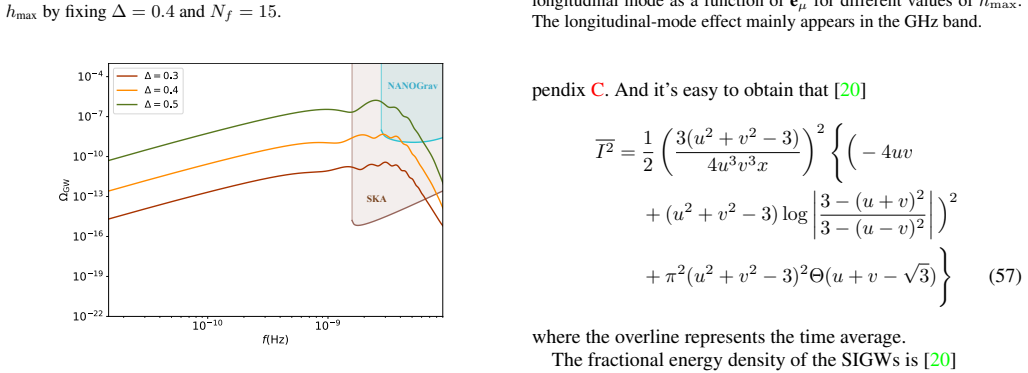
In an inflationary model with symmetry breaking and charged scalars kinetically coupled to an isotropic Abelian gauge triplet, a transient large mixing between inflaton and gauge perturbations can enhance scalar-induced gravitational waves to a detectable level. Longitudinal and charge-dependent mixings matter only for sufficiently late excitation; the resulting SIGWs then sit at ultra-high frequencies (typically around the GHz band), and the parameters that control those two effects reshape the stochastic background’s frequency profile in qualitatively different ways, yielding signatures that distinguish the charged case from the neutral one.
What carries the argument
A brief Gaussian spike in the kinetic-energy ratio h(N) that strongly mixes the inflaton perturbation with gauge electric and longitudinal modes; the resulting oscillatory small-scale curvature spectrum is then folded through the standard radiation-era scalar-induced tensor kernel into Ω_GW(f).
Load-bearing premise
The short, large mixing spike is put in by hand as a narrow Gaussian in e-folds rather than derived from the model’s own background evolution while still protecting slow roll and CMB normalization.
What would settle it
A resolved ultra-high-frequency stochastic background whose peak height, modulation spacing, and which local oscillatory bump is global maximum either match the distinct e_μ versus e_M patterns (charged late spike) or collapse to the neutral h_max–Δ pattern with no peak-jump under charge-like parameter changes.
If this is right
- Detectable SIGWs from this mechanism at LISA/PTA scales require earlier spikes, where charge and longitudinal effects are negligible and the signal looks like the neutral strong-mixing case.
- Late spikes push the signal into the MHz–GHz window targeted by proposed electromagnetic and microwave resonance searches.
- Measuring modulation spacing together with local-peak hierarchy and peak amplitude can break degeneracies among spike time, spike height, and charge parameters.
- The same charge-driven peak-jump diagnostic would not be mimicked by simply rescaling the neutral spike height, which shifts the characteristic scale more continuously.
Where Pith is reading between the lines
- If a realistic attractor cannot produce a narrow large-h spike, the GHz charged/neutral spectral diagnostics may never be realized in this potential, even though the perturbation equations are correct.
- Extending the setup to a single vector field, as the authors flag, would add anisotropy to the same GHz background and turn the frequency-profile test into a combined spectrum-plus-anisotropy search.
- A non-detection across the GHz band would mainly bound late large-h spikes and large charge-mixing parameters, not the whole charged-inflation framework.
Editorial analysis
A structured set of objections, weighed in public.
Referee Report
Summary. The paper studies scalar-induced gravitational waves in an inflationary model where a triplet of charged scalar fields couples to an isotropic triplet of U(1) gauge fields via a kinetic function f(ϕ). Building on earlier neutral-case work, the authors derive the quadratic action for the coupled scalar perturbations (δϕ, δQ, δD) including the longitudinal mode D and charge-dependent mixings controlled by λ_e and Λ_e (Eqs. 30–34). They then impose a transient Gaussian profile h(N) (Eq. 46) for the kinetic-energy ratio between the gauge and inflaton sectors, solve the mode equations numerically, normalize to the CMB at large scales, and compute the resulting SIGW spectra with the standard radiation-era kernel via SIGWfast. The central claims are: (i) when the gauge-field excitation occurs late (N_f ≫ N_c), longitudinal and charge-dependent mixings become relevant and the SIGWs shift to the GHz band; (ii) the composite parameters e_μ ≡ eμ/H and e_M ≡ eM_pl/H affect the SIGW spectrum in qualitatively different ways (e_μ suppresses the relative principal peak and shifts the global maximum among local peaks without changing modulation spacing, while e_M changes both peak amplitude and modulation width), providing a diagnostic distinguishing the charged from the neutral case.
Significance. If the setup is consistent, the paper delivers a concrete and falsifiable phenomenological statement: in the charged symmetry-breaking model, the parameters e_μ and e_M imprint qualitatively different signatures on the SIGW spectrum (peak suppression vs. modulation-width change and peak jumps; Table I, Figs. 10–15), and the late-time excitation pushes the signal into the GHz band now targeted by proposed high-frequency GW searches. Strengths worth crediting: the full numerical solution of the three-mode strongly coupled system (30)–(32) with rotation-based vacuum definition (App. B), use of the standard Kohri–Terada kernel and the public SIGWfast package for reproducible Ω_GW computation, explicit sensitivity quantification (e.g., 10% change in e_μ → ~23% suppression of Ω_GW^max), and a clear parameter-effect summary in Table I. The GHz-band conclusion limits near-term observational impact, but the diagnostic distinction between charged and neutral cases is a genuine contribution to the SIGW literature.
major comments (3)
- [§IV.A, Eq. (46) vs §II, Eqs. (16)–(21)] The Gaussian profile h(N)=h_max exp[−(N−N_f)²/(2Δ²)] is in tension with the paper's own background solution. In §II the attractor gives h² ≃ (p−p_c)/(2p_c) (Eq. 21), a constant set by time-independent model parameters. Producing a spike to h_max=8–15 within Δ≲0.5 e-folds requires f(ϕ) to depart sharply from the power-law form (16) and return — a feature that is never modeled. The viability issue is quantitative: with ε_ϕ ≃ 4p_c/p² (Eq. 20) and ε_A = 2h²ε_ϕ, taking p=100, p_c=10 gives ε_ϕ≃0.004, so at h_max=14 one gets ε_A ~ 1.6, i.e. ε = ε_ϕ + ε_A would exceed unity and inflation would end during the spike, contradicting the assumption (footnote 2) that N_e=60 and the end of inflation are unaffected. The authors should either (a) exhibit a background f(ϕ) that realizes the assumed h(N) while keeping ε≪1, Re≪1, and CMB normalization, or (b) quantify explicitly the window of (h_max, Δ, p,p
- [Appendix A, Eq. (A8) → Eq. (A9)] The reduced quadratic action (A9) — and hence Eqs. (30)–(32) from which all e_μ/e_M phenomenology follows — is derived using the slow-roll identity (A8), f_ϕϕ/f ≃ (f_ϕ/f)². This holds exactly for the pure power-law f=(μ/ϕ)^p, but any f engineered to make h spike and fall necessarily violates it, with corrections of order the second logarithmic derivative of f. These corrections enter precisely the δϕ mass term in (A9) during the spike, when the 8h²H² mixing structure responsible for the exponential enhancement is active. Since the entire charged/neutral diagnostic rests on spectra computed from (30)–(32), the authors should estimate the size of the neglected f_ϕϕ−f_ϕ²/f terms for a realistic h(N) (e.g. from a reconstructed f), or demonstrate the results are insensitive to them. This is a correctness-risk comment, not a circularity claim: the concern is internal consistency between §II/Ap
- [§III, paragraph after Eq. (27); Appendix A] The neglect of metric perturbations (α, β) in flat gauge is justified by appeal to [63, 72], where the mixing parameter h was small. During the transient h≫1 epoch the gauge sector carries ~2h² times the inflaton kinetic energy, and the usual ε-suppression of metric fluctuations relative to matter fluctuations is weakened. Given that the enhanced P_R feeds directly into Ω_GW via the convolution (55), the authors should show (e.g. by retaining the constraint equations or estimating α, β ~ ε-suppressed source terms) that metric backreaction remains negligible at h_max ~ 10–15, or state the parameter window in which it does.
minor comments (6)
- [Abstract; §IV.A.2; Fig. 6 caption] The abstract sentence 'the corresponding SIGWs are shifted to ultra-high frequencies, typically can around the GHz band' is garbled; similar English issues occur throughout (e.g. 'In contrastr' in §IV.A.2, 'The The scalar power spectrum' in the Fig. 6 caption, 'are strongly mixing' in the Conclusion). A careful language pass is warranted.
- [Fig. 3 caption vs §IV.A.2 text] The Fig. 3 caption quotes e_M = 10², but the surrounding text describes Fig. 3 as showing the evolution for different e_μ at k ≪ k_peak. Please reconcile caption and text.
- [§IV.A and figure captions] Figs. 1, 2 and the text use P_ζ and P_R interchangeably for the curvature spectrum; please fix one notation. Also, Figs. 5, 6, 10 and 13 mix CMB-renormalized and non-renormalized curves; the captions do note this, but the main text should state explicitly that conclusions about relative peak suppression/enhancement are drawn after renormalization.
- [Footnote 1 (p. 2) vs §V] Footnote 1 claims the results are also valid for a single-scalar/single-gauge-field model, but the Conclusion correctly notes that a single vector field inevitably produces large anisotropy. These statements should be harmonized, and the sense in which the single-field results 'are also valid' made precise.
- [§IV.A.1, Eq. (50)] Eq. (50), P_R,peak ∝ e^{1.42hΔ}, is imported from the neutral-case analysis [70]. Since §IV uses it alongside the charged-case numerics, a sentence clarifying where the fit is used (vs. the full solution of (30)–(32)) would help the reader.
- [Fig. 9; Eq. (54)] Fig. 9 plots f̃_peak against e_μ² while the caption and Eq. (61) discuss the dependence on e_μ; please make the axis variable consistent with the discussion. A brief note on the assumed reheating history implicit in Eq. (54) (the constant 37) would also be useful, since it shifts the GHz conclusion.
Circularity Check
No significant circularity: charged-sector SIGW diagnostics are numerical outputs of the EoMs under an explicit ansatz, not inputs redefined as predictions.
specific steps
-
self citation load bearing
[§IV.A.1, Eq. (50); refs [69,70]]
"The power spectrum is given by [70] PR,peak ∝ e^{1.42 h Δ}. For Δ ≲ log h, the spectrum exhibits characteristic oscillatory features with multiple peaks [70]."
The exponential peak scaling and oscillatory-feature mechanism for large-h transient mixing are imported from the lead author’s prior work rather than re-derived here. This is minor and non-load-bearing for the paper’s new claim: the e_μ/e_M SIGW diagnostics are obtained by solving the charged EoMs numerically, not by renaming that prior scaling.
full rationale
The load-bearing chain is: (i) background + quadratic action → EoMs (30)–(32); (ii) an explicitly chosen Gaussian h(N) profile (Eq. 46); (iii) numerical P_R; (iv) standard SIGW convolution (55)–(59) → Ω_GW. CMB normalization P_R(k_cmb)=2.1×10^{-9} is an external anchor. The claimed e_μ vs e_M distinctions (peak suppression vs enhancement, modulation width, global-peak jumps) are read off those numerical spectra, not forced by fitting or by definition. Self-citations to the authors’ prior neutral/charged setups and large-h enhancement ([69,70,71–73]) supply the model framework and the PR,peak∝e^{1.42 h Δ} scaling, but the new charged-sector frequency-profile diagnostics are independent computations under stated assumptions. The skeptic’s attack—that a constant-h attractor (Eq. 21) and identity (A8) cannot produce the Gaussian spike—is a background-consistency/correctness concern, not circularity: the profile is openly an input ansatz, not a derived prediction. Score 1 for ordinary framework self-citation that is not load-bearing on the central new claim.
Axiom & Free-Parameter Ledger
free parameters (7)
- h_max =
O(8–15) in figures
- Δ =
≈0.3–0.5
- N_f =
15 or 55 in main plots
- e_μ ≡ e μ/H =
up to ~10^5 (interest window)
- e_M ≡ e M_pl/H =
~10^2–10^9 window; plots ~10^2–2.4×10^3
- N_e =
60
- Gaussian h(N) profile shape =
h_max exp[−(N−N_f)²/(2Δ²)]
axioms (7)
- domain assumption Isotropic FRW-compatible triplet of U(1) gauge fields A^a_i = A(t) δ^a_i with real unitary-gauge scalars recovers O(3) and allows standard cosmological perturbation theory.
- domain assumption During inflation Re ≪ 1 so gauge-coupling mass terms can be dropped from background EoMs; inflation ends only when charge becomes important.
- domain assumption Gravitational scalar constraints (α,β) and magnetic mode U give subdominant contributions to R relative to matter gauge perturbations in the spatially flat gauge for the h≫1 feature.
- domain assumption Enhanced scalar modes re-enter and source tensors during radiation domination with Φ=Ψ and the standard Kohri–Terada kernel.
- domain assumption Kinetic function f(φ)=(μ/φ)^p with p>p_c implements the constant-electric-field attractor and large-h regime.
- ad hoc to paper Slow-roll reductions f_φ/f M_pl √(2ε_φ) ≃ −2 and f_φφ/f ≃ (f_φ/f)^2 hold through the feature sufficiently for the quadratic action (A9).
- standard math Bunch–Davies vacuum on the K-rotated fields Φ when k²τ² ≫ max(h², τ²Λ_e/√λ_e).
invented entities (1)
-
Composite charge parameters e_μ and e_M
no independent evidence
read the original abstract
We investigate scalar-induced gravitational waves (SIGWs) in an inflationary model with symmetry breaking, in which charged scalar fields are coupled to an isotropic triplet of Abelian gauge fields through a kinetic function. Such SIGWs can be enhanced to a detectable level when the mixing between the inflaton and gauge-field perturbations is sufficiently large. We find that the longitudinal mode and the charge-dependent mixing between perturbations become relevant only when the gauge-field excitation occurs sufficiently late during inflation. In this regime, the corresponding SIGWs are shifted to ultra-high frequencies, typically can around the GHz band. We show that the parameters characterizing the effects of the longitudinal mode and charge-dependent mixing affect the signal in qualitatively different ways. This provides characteristic signatures for distinguishing the neutral case from the charged one through the frequency profile of the stochastic gravitational-wave background.
Figures




Reference graph
Works this paper leans on
-
[1]
longitudinal
In order to produce constant electric fields we also need p > pc. After ignoring the gauge coupling, the ˙Acan be solved from the equation of motion as [71] ˙A=µ ξϕ2 µ2 p H a ,(18) whereξis the integration constant. Then after inserting this solution into the equation of motion ofϕ, one can solve this equation by discarding the ¨ϕterm in slow-roll approxi...
-
[2]
B. P. Abbottet al.(LIGO Scientific and Virgo Collaborations), Phys. Rev. Lett.116, 241103 (2016), arXiv:1606.04855 [gr-qc]
Pith/arXiv arXiv 2016
-
[3]
B. P. Abbottet al.(LIGO Scientific and Virgo Collaborations), Phys. Rev. Lett.116, 061102 (2016), arXiv:1602.03837 [gr-qc]
Pith/arXiv arXiv 2016
-
[4]
B. P. Abbottet al.(LIGO Scientific and Virgo Collaborations), Astrophys. J. Lett.851, L35 (2017), arXiv:1711.05578 [astro- ph.HE]
Pith/arXiv arXiv 2017
-
[5]
B. P. Abbottet al.(LIGO Scientific and Virgo Collaborations), Phys. Rev. Lett.119, 161101 (2017), arXiv:1710.05832 [gr-qc]
Pith/arXiv arXiv 2017
-
[6]
B. P. Abbottet al.(LIGO Scientific and Virgo Collaborations), Phys. Rev. Lett.119, 141101 (2017), arXiv:1709.09660 [gr-qc]
Pith/arXiv arXiv 2017
-
[7]
B. P. Abbottet al.(LIGO Scientific and Virgo Collaborations), Phys. Rev. Lett.118, 221101 (2017), [Erratum: Phys.Rev.Lett. 121, 129901 (2018)], arXiv:1706.01812 [gr-qc]
Pith/arXiv arXiv 2017
-
[8]
B. P. Abbottet al.(LIGO Scientific and Virgo Collaborations), Phys. Rev. X9, 031040 (2019), arXiv:1811.12907 [astro- ph.HE]
Pith/arXiv arXiv 2019
-
[9]
Abbottet al.(LIGO Scientific and Virgo Collaborations), Astrophys
R. Abbottet al.(LIGO Scientific and Virgo Collaborations), Astrophys. J. Lett.896, L44 (2020), arXiv:2006.12611 [astro- ph.HE]
Pith/arXiv arXiv 2020
-
[10]
B. P. Abbottet al.(LIGO Scientific and Virgo Collaborations), Astrophys. J. Lett.892, L3 (2020), arXiv:2001.01761 [astro- ph.HE]
Pith/arXiv arXiv 2020
-
[11]
Abbottet al.(LIGO Scientific and Virgo Collaborations), Phys
R. Abbottet al.(LIGO Scientific and Virgo Collaborations), Phys. Rev. D102, 043015 (2020), arXiv:2004.08342 [astro- ph.HE]
Pith/arXiv arXiv 2020
-
[12]
C. Caprini and D. G. Figueroa, Class. Quant. Grav.35, 163001 (2018), arXiv:1801.04268 [astro-ph.CO]
Pith/arXiv arXiv 2018
-
[13]
D. G. Figueroa and E. H. Tanin, JCAP08, 011 (2019), arXiv:1905.11960 [astro-ph.CO]
Pith/arXiv arXiv 2019
-
[14]
E. H. Tanin and T. Tenkanen, JCAP01, 053 (2021), arXiv:2004.10702 [astro-ph.CO]
Pith/arXiv arXiv 2021
-
[15]
I. V . Fomin, S. V . Chervon, A. N. Morozov, and I. S. Golyak, Eur. Phys. J. C82, 642 (2022)
2022
-
[16]
Matarrese, O
S. Matarrese, O. Pantano, and D. Saez, Phys. Rev. D47, 1311 (1993)
1993
-
[17]
S. Matarrese, O. Pantano, and D. Saez, Phys. Rev. Lett.72, 320 (1994), arXiv:astro-ph/9310036
Pith/arXiv arXiv 1994
-
[18]
K. N. Ananda, C. Clarkson, and D. Wands, Phys. Rev. D75, 123518 (2007), arXiv:gr-qc/0612013
Pith/arXiv arXiv 2007
-
[19]
D. Baumann, P. J. Steinhardt, K. Takahashi, and K. Ichiki, Phys. Rev. D76, 084019 (2007), arXiv:hep-th/0703290
Pith/arXiv arXiv 2007
-
[20]
R. Saito and J. Yokoyama, Phys. Rev. Lett.102, 161101 (2009), [Erratum: Phys.Rev.Lett. 107, 069901 (2011)], arXiv:0812.4339 [astro-ph]
Pith/arXiv arXiv 2009
-
[21]
K. Kohri and T. Terada, Phys. Rev. D97, 123532 (2018), arXiv:1804.08577 [gr-qc]
Pith/arXiv arXiv 2018
-
[22]
J. R. Espinosa, D. Racco, and A. Riotto, JCAP09, 012 (2018), arXiv:1804.07732 [hep-ph]
Pith/arXiv arXiv 2018
-
[23]
Dom `enech, Universe7, 398 (2021), arXiv:2109.01398 [gr- qc]
G. Dom `enech, Universe7, 398 (2021), arXiv:2109.01398 [gr- qc]
Pith/arXiv arXiv 2021
-
[24]
C. Yuan and Q.-G. Huang, iScience24, 102860 (2021), arXiv:2103.04739 [astro-ph.GA]
Pith/arXiv arXiv 2021
- [25]
-
[26]
Agazieet al.(NANOGrav), Astrophys
G. Agazieet al.(NANOGrav), Astrophys. J. Lett.951, L8 (2023), arXiv:2306.16213 [astro-ph.HE]
Pith/arXiv arXiv 2023
-
[27]
Agazieet al.(NANOGrav), Astrophys
G. Agazieet al.(NANOGrav), Astrophys. J. Lett.951, L9 (2023), arXiv:2306.16217 [astro-ph.HE]
Pith/arXiv arXiv 2023
-
[28]
H. Xuet al., Res. Astron. Astrophys.23, 075024 (2023), arXiv:2306.16216 [astro-ph.HE]
Pith/arXiv arXiv 2023
-
[29]
Antoniadiset al.(EPTA), Astron
J. Antoniadiset al.(EPTA), Astron. Astrophys.678, A48 (2023), arXiv:2306.16224 [astro-ph.HE]
Pith/arXiv arXiv 2023
-
[30]
Antoniadiset al.(EPTA, InPTA:), Astron
J. Antoniadiset al.(EPTA, InPTA:), Astron. Astrophys.678, A50 (2023), arXiv:2306.16214 [astro-ph.HE]
Pith/arXiv arXiv 2023
-
[31]
A. Zicet al., Publ. Astron. Soc. Austral.40, e049 (2023), 15 arXiv:2306.16230 [astro-ph.HE]
Pith/arXiv arXiv 2023
-
[32]
Y .-F. Cai, X.-C. He, X.-H. Ma, S.-F. Yan, and G.-W. Yuan, Sci. Bull.68, 2929 (2023), arXiv:2306.17822 [gr-qc]
Pith/arXiv arXiv 2023
-
[33]
S. Wang, Z.-C. Zhao, J.-P. Li, and Q.-H. Zhu, Phys. Rev. Res. 6, L012060 (2024), arXiv:2307.00572 [astro-ph.CO]
Pith/arXiv arXiv 2024
-
[34]
Z. Yi, Q. Gao, Y . Gong, Y . Wang, and F. Zhang, Sci. China Phys. Mech. Astron.66, 120404 (2023), arXiv:2307.02467 [gr- qc]
Pith/arXiv arXiv 2023
-
[35]
Z. Yi, Z.-Q. You, and Y . Wu, JCAP01, 066 (2024), arXiv:2308.05632 [astro-ph.CO]
Pith/arXiv arXiv 2024
-
[36]
K. Harigaya, K. Inomata, and T. Terada, Phys. Rev. D108, 123538 (2023), arXiv:2309.00228 [astro-ph.CO]
Pith/arXiv arXiv 2023
-
[37]
L. Liu, Z.-C. Chen, and Q.-G. Huang, Phys. Rev. D109, L061301 (2024), arXiv:2307.01102 [astro-ph.CO]
Pith/arXiv arXiv 2024
- [38]
-
[39]
L. Liu, Y . Wu, and Z.-C. Chen, JCAP04, 011 (2024), arXiv:2310.16500 [astro-ph.CO]
Pith/arXiv arXiv 2024
-
[40]
Danzmann, Class
K. Danzmann, Class. Quant. Grav.14, 1399 (1997)
1997
-
[41]
Amaro-Seoaneet al.(LISA), (2017), arXiv:1702.00786 [astro-ph.IM]
P. Amaro-Seoaneet al.(LISA), (2017), arXiv:1702.00786 [astro-ph.IM]
Pith/arXiv arXiv 2017
-
[42]
Hu and Y .-L
W.-R. Hu and Y .-L. Wu, Natl. Sci. Rev.4, 685 (2017)
2017
-
[43]
J. Luoet al.(TianQin), Class. Quant. Grav.33, 035010 (2016), arXiv:1512.02076 [astro-ph.IM]
Pith/arXiv arXiv 2016
-
[44]
Maggioreet al.(ET), JCAP03, 050 (2020), arXiv:1912.02622 [astro-ph.CO]
M. Maggioreet al.(ET), JCAP03, 050 (2020), arXiv:1912.02622 [astro-ph.CO]
Pith/arXiv arXiv 2020
-
[45]
F.-Y . Li, Y . Chen, and P. Wang, Chin. Phys. Lett.24, 3328 (2007)
2007
-
[46]
F. Li, N. Yang, Z. Fang, R. M. L. Baker, Jr., G. V . Stephenson, and H. Wen, Phys. Rev. D80, 064013 (2009), arXiv:0909.4118 [gr-qc]
Pith/arXiv arXiv 2009
-
[47]
N. Aggarwalet al., Living Rev. Rel.24, 4 (2021), arXiv:2011.12414 [gr-qc]
Pith/arXiv arXiv 2021
-
[48]
A. Berlin, D. Blas, R. Tito D’Agnolo, S. A. R. Ellis, R. Harnik, Y . Kahn, and J. Sch ¨utte-Engel, Phys. Rev. D105, 116011 (2022), arXiv:2112.11465 [hep-ph]
Pith/arXiv arXiv 2022
-
[49]
D. Blas, Y . Chen, Y . Liu, Y . Shang, and J. Shu, (2026), arXiv:2601.03341 [hep-ph]
Pith/arXiv arXiv 2026
-
[50]
G. F. Smootet al.(COBE), Astrophys. J. Lett.396, L1 (1992)
1992
-
[51]
D. N. Spergelet al.(WMAP), Astrophys. J. Suppl.148, 175 (2003), arXiv:astro-ph/0302209
Pith/arXiv arXiv 2003
-
[52]
N. Aghanimet al.(Planck), Astron. Astrophys.641, A6 (2020), [Erratum: Astron.Astrophys. 652, C4 (2021)], arXiv:1807.06209 [astro-ph.CO]
Pith/arXiv arXiv 2020
-
[53]
D. Baumann and L. McAllister,Inflation and String Theory, Cambridge Monographs on Mathematical Physics (Cambridge University Press, 2015) arXiv:1404.2601 [hep-th]
Pith/arXiv arXiv 2015
-
[54]
D. H. Lyth, Phys. Rev. Lett.78, 1861 (1997), arXiv:hep- ph/9606387
arXiv 1997
-
[55]
D. Baumann and D. Green, JCAP05, 017 (2012), arXiv:1111.3040 [hep-th]
Pith/arXiv arXiv 2012
-
[56]
A. R. Brown, Phys. Rev. Lett.121, 251601 (2018), arXiv:1705.03023 [hep-th]
Pith/arXiv arXiv 2018
-
[57]
P. Christodoulidis, D. Roest, and E. I. Sfakianakis, JCAP11, 002 (2019), arXiv:1803.09841 [hep-th]
Pith/arXiv arXiv 2019
-
[58]
S. Renaux-Petel and K. Turzy´nski, Phys. Rev. Lett.117, 141301 (2016), arXiv:1510.01281 [astro-ph.CO]
Pith/arXiv arXiv 2016
-
[59]
T. Bjorkmo, Phys. Rev. Lett.122, 251301 (2019), arXiv:1902.10529 [hep-th]
Pith/arXiv arXiv 2019
-
[60]
M.-a. Watanabe, S. Kanno, and J. Soda, Phys. Rev. Lett.102, 191302 (2009), arXiv:0902.2833 [hep-th]
Pith/arXiv arXiv 2009
-
[61]
S. Kanno, J. Soda, and M.-a. Watanabe, JCAP12, 024 (2010), arXiv:1010.5307 [hep-th]
Pith/arXiv arXiv 2010
-
[62]
K. Murata and J. Soda, JCAP06, 037 (2011), arXiv:1103.6164 [hep-th]
Pith/arXiv arXiv 2011
-
[63]
A. Maleknejad, M. M. Sheikh-Jabbari, and J. Soda, Phys. Rept. 528, 161 (2013), arXiv:1212.2921 [hep-th]
Pith/arXiv arXiv 2013
-
[64]
M.-a. Watanabe, S. Kanno, and J. Soda, Prog. Theor. Phys. 123, 1041 (2010), arXiv:1003.0056 [astro-ph.CO]
Pith/arXiv arXiv 2010
-
[65]
M.-a. Watanabe, S. Kanno, and J. Soda, Mon. Not. Roy. Astron. Soc.412, L83 (2011), arXiv:1011.3604 [astro-ph.CO]
Pith/arXiv arXiv 2011
-
[66]
N. Bartolo, S. Matarrese, M. Peloso, and A. Ricciardone, Phys. Rev. D87, 023504 (2013), arXiv:1210.3257 [astro-ph.CO]
Pith/arXiv arXiv 2013
-
[67]
Himmetoglu, JCAP03, 023 (2010), arXiv:0910.3235 [astro- ph.CO]
B. Himmetoglu, JCAP03, 023 (2010), arXiv:0910.3235 [astro- ph.CO]
Pith/arXiv arXiv 2010
-
[68]
A. E. Gumrukcuoglu, B. Himmetoglu, and M. Peloso, Phys. Rev. D81, 063528 (2010), arXiv:1001.4088 [astro-ph.CO]
Pith/arXiv arXiv 2010
-
[69]
X. Chen, R. Emami, H. Firouzjahi, and Y . Wang, JCAP08, 027 (2014), arXiv:1404.4083 [astro-ph.CO]
Pith/arXiv arXiv 2014
-
[70]
C.-B. Chen and J. Soda, JCAP05, 029 (2022), arXiv:2201.03160 [hep-th]
Pith/arXiv arXiv 2022
-
[71]
Chen, JCAP11, 063 (2024), arXiv:2312.06105 [astro- ph.CO]
C.-B. Chen, JCAP11, 063 (2024), arXiv:2312.06105 [astro- ph.CO]
Pith/arXiv arXiv 2024
-
[72]
R. Emami, H. Firouzjahi, S. M. Sadegh Movahed, and M. Zarei, JCAP02, 005 (2011), arXiv:1010.5495 [astro- ph.CO]
Pith/arXiv arXiv 2011
-
[73]
R. Emami and H. Firouzjahi, JCAP10, 041 (2013), arXiv:1301.1219 [hep-th]
Pith/arXiv arXiv 2013
-
[74]
H. Firouzjahi, M. A. Gorji, S. A. Hosseini Mansoori, A. Karami, and T. Rostami, Phys. Rev. D100, 043530 (2019), arXiv:1812.07464 [hep-th]
Pith/arXiv arXiv 2019
-
[75]
M. C. Bento, O. Bertolami, P. V . Moniz, J. M. Mourao, and P. M. Sa, Class. Quant. Grav.10, 285 (1993), arXiv:gr- qc/9302034
arXiv 1993
-
[76]
V . Papadopoulos, M. Zarei, H. Firouzjahi, and S. Mukohyama, Phys. Rev. D97, 063521 (2018), arXiv:1801.00227 [hep-th]
Pith/arXiv arXiv 2018
-
[77]
A. Maleknejad and M. M. Sheikh-Jabbari, Phys. Rev. D84, 043515 (2011), arXiv:1102.1932 [hep-ph]
Pith/arXiv arXiv 2011
-
[78]
A. Maleknejad and M. M. Sheikh-Jabbari, Phys. Lett. B723, 224 (2013), arXiv:1102.1513 [hep-ph]
Pith/arXiv arXiv 2013
-
[79]
J. Fumagalli, S. Renaux-Petel, and L. T. Witkowski, JCAP08, 030 (2021), arXiv:2012.02761 [astro-ph.CO]
Pith/arXiv arXiv 2021
-
[80]
L. T. Witkowski, (2022), arXiv:2209.05296 [astro-ph.CO]
Pith/arXiv arXiv 2022
discussion (0)
Sign in with ORCID, Apple, or X to comment. Anyone can read and Pith papers without signing in.