The Power of Altruism in Sticker Economics: Generosity Minimizes Collective Costs and Overprotective Norms Fuel Inefficiency
Pith reviewed 2026-06-27 11:28 UTC · model grok-4.3
The pith
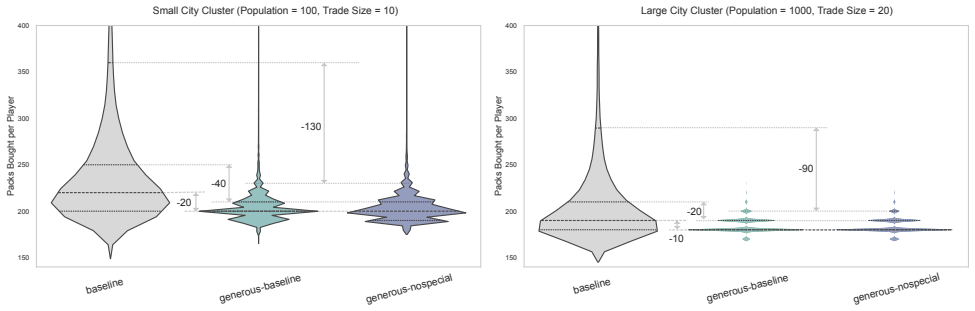
Generous trading norms cut the worst-off collectors' sticker purchases by 90-130 packs while strict rules raise costs across the network.
A machine-rendered reading of the paper's core claim, the machinery that carries it, and where it could break.
Core claim
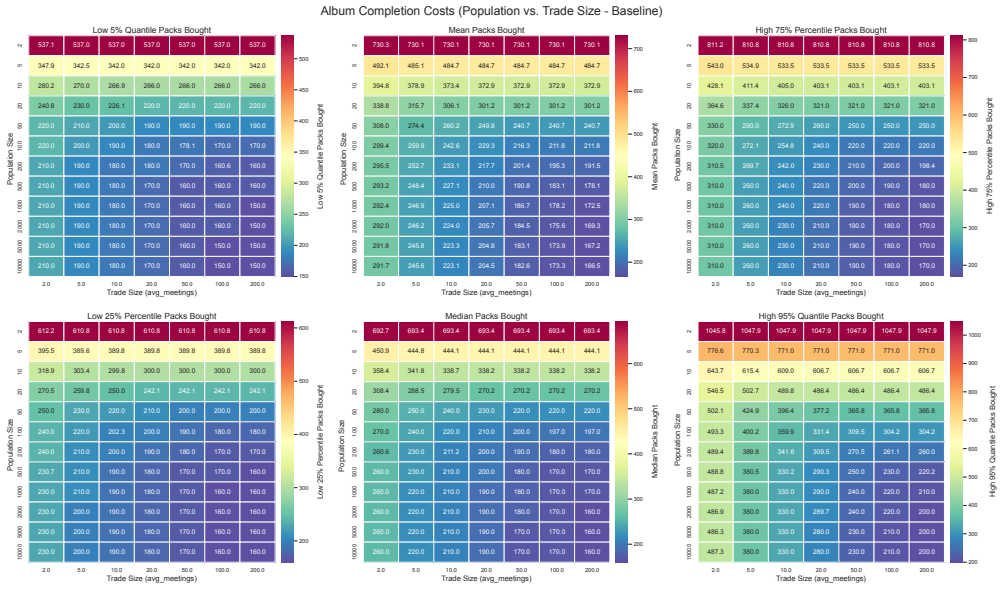
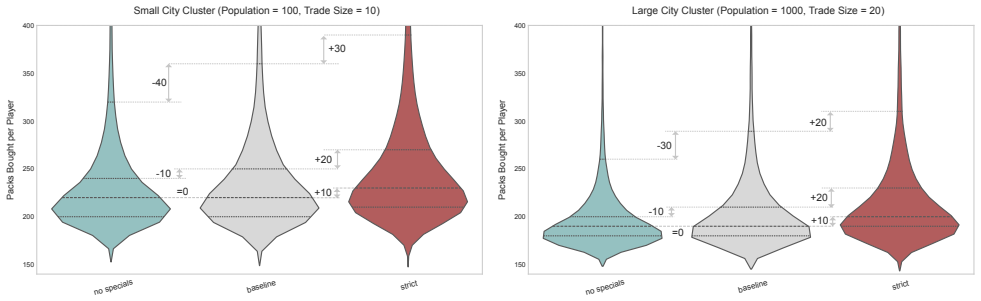
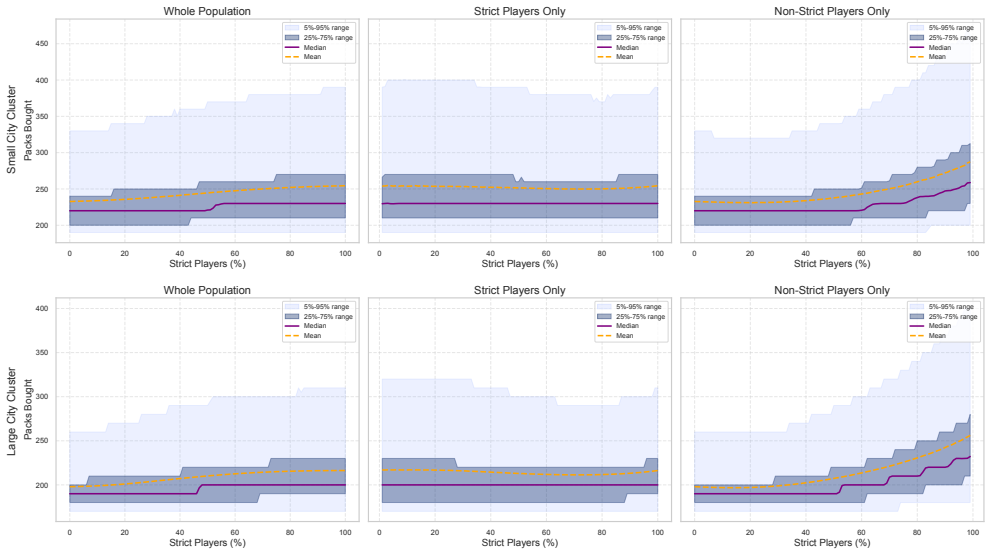
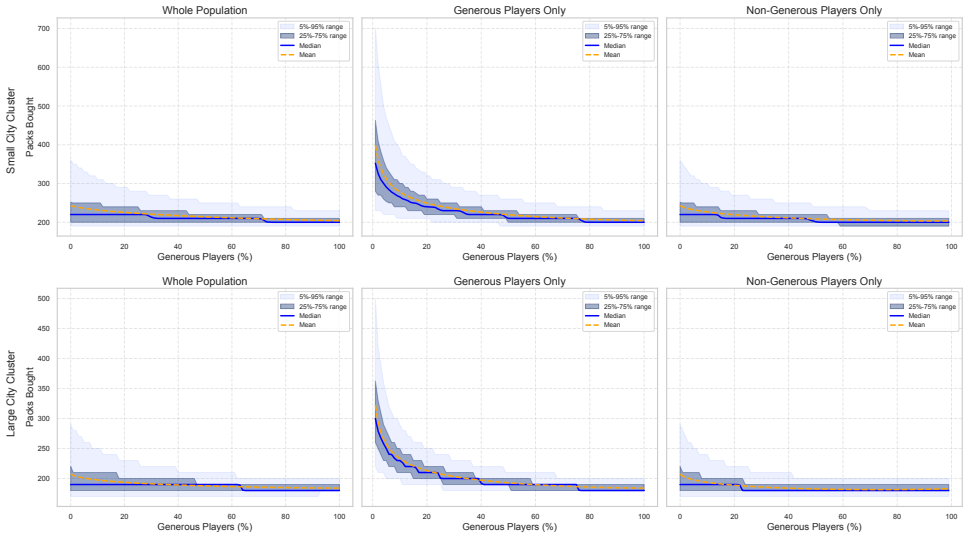
In the model of a 980-sticker album, the strict special-for-special strategy increases median completion costs by 10 packs and adds 20 packs for the 5th percentile in large cities and 30 in small communities, whereas the generous strategy reduces 5th-percentile purchases by 90 packs in large configurations and 130 in smaller clusters while creating functional coupling that synchronizes completion rates.
What carries the argument
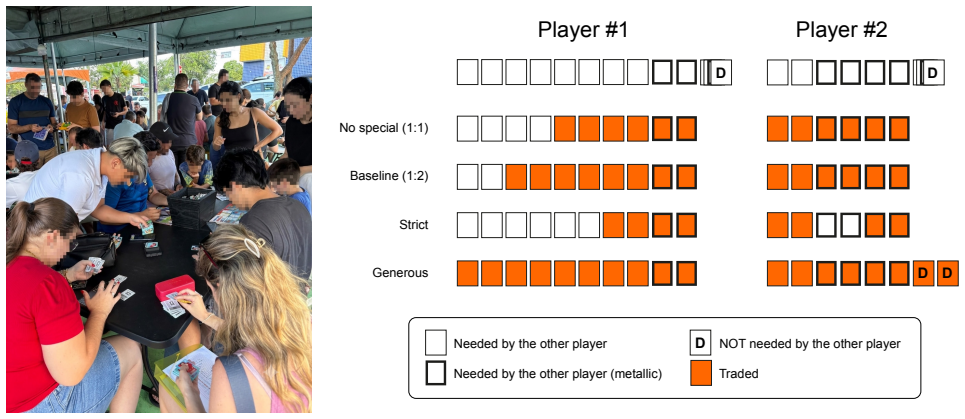
Agent-based model with Monte Carlo simulations that contrasts baseline 1:2 exchange, strict special-only trading, and generous duplicate surrender under network structures drawn from empirical meetup data.
If this is right
- Overprotective norms raise median costs by 10 packs and add 20-30 packs for the bottom 5 percent.
- Generous surrender of duplicates compresses the tail of high costs by 90-130 packs depending on cluster size.
- Altruism creates network-wide synchronization of completion rates.
- Strict rules trap liquidity while generosity optimizes it.
Where Pith is reading between the lines
- Community norms can convert an individual hobby into a shared resource whose efficiency depends on willingness to give away duplicates.
- The same liquidity-trap mechanism could appear in other collectible or resource-sharing settings where one class of items is rarer.
- If the synchronization effect holds, generous groups might finish faster even when average luck is unchanged.
Load-bearing premise
The model, calibrated on field observations from Brazilian exchange meetups, correctly represents how collectors actually behave and connect under each trading rule.
What would settle it
Field counts of packs purchased and albums completed in communities that adopt strict versus generous trading norms at scale.
Figures
read the original abstract
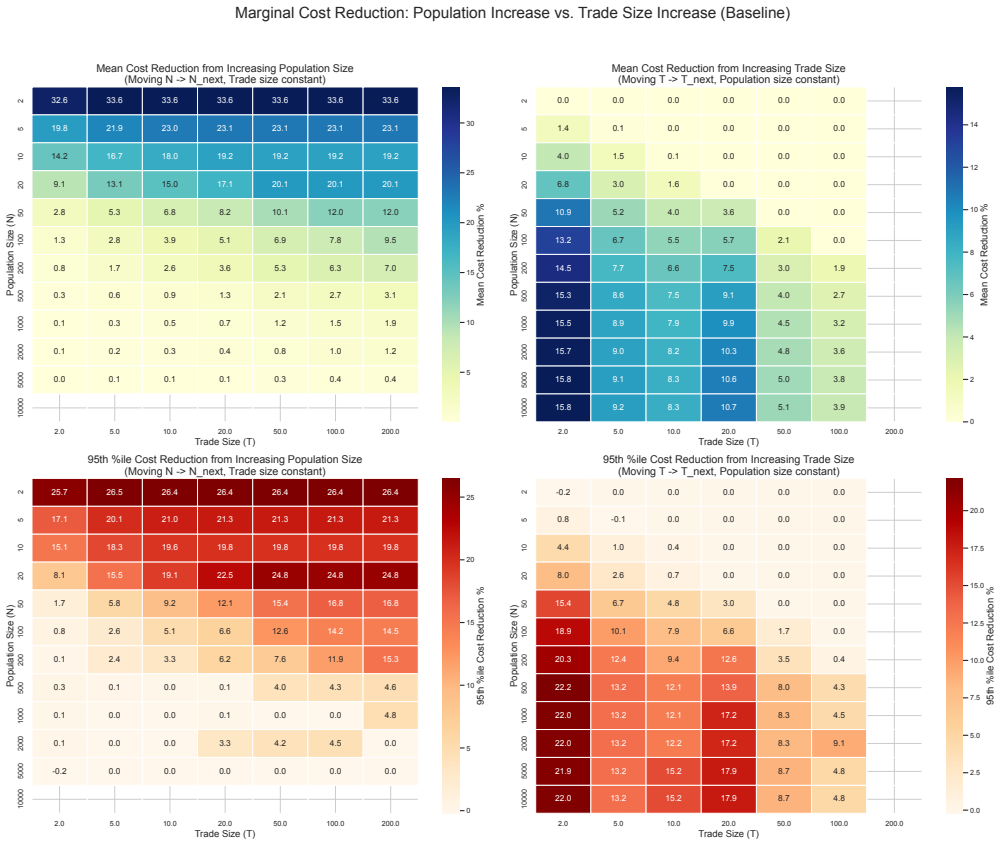
Collecting the FIFA World Cup sticker album presents a classic public-goods and collective-action dilemma, in which completing a collection on one's own is highly inefficient. To evaluate how localized community norms shape collective efficiency, we use agent-based modeling and Monte Carlo simulations, parameterized with empirical field observations from exchange meetups in Natal, Brazil. Reflecting the tournament's recent expansion, the Panini 2026 album features 980 individual stickers, including 68 metallic specials. We contrast a standard baseline economy (1:2 special-to-normal exchange ratio) with an overprotective, strict strategy (exclusive special-for-special trading) and an altruistic, generous strategy (in which advanced players surrender needed duplicates to assist peers). Our findings reveal that overprotective rules trap liquidity and drive network-wide inefficiency. The strict strategy increases median completion costs by 10 packs and severely penalizes the least fortunate 5\% of collectors, adding 20 packs in large cities and 30 in small communities. Conversely, widespread generosity optimizes network liquidity and dramatically compresses the long tail of bad luck. Introducing the generous strategy reduces required purchases for the 5th percentile by 90 packs in large-scale configurations and 130 packs in smaller clusters. Furthermore, widespread altruism triggers a strong functional coupling that effectively synchronizes completion rates across the network. This study demonstrates that while rigid, protective norms degrade collective welfare, generosity successfully mitigates pack-draw variance, transforming an expensive, isolated hobby into a resilient, highly efficient public good.
Editorial analysis
A structured set of objections, weighed in public.
Referee Report
Summary. The paper models FIFA World Cup sticker collecting (980 stickers, 68 specials) as a collective-action problem using agent-based simulations and Monte Carlo runs. Parameterized from field observations at exchange meetups in Natal, Brazil, it compares a baseline 1:2 special-to-normal exchange economy against a strict special-for-special strategy and a generous strategy in which advanced collectors surrender duplicates. The central claims are that the strict strategy raises median completion costs by 10 packs and adds 20–30 packs to the 5th-percentile tail, while the generous strategy cuts 5th-percentile purchases by 90 packs (large networks) or 130 packs (small clusters) and induces functional coupling that synchronizes completion rates across agents.
Significance. If the quantitative results survive validation, the work supplies a concrete, empirically grounded illustration of how local norms modulate liquidity and tail risk in a public-goods setting. The use of field-derived parameters rather than purely abstract rules is a positive feature; the reported compression of the bad-luck tail under generosity would, if robust, constitute a falsifiable prediction about the welfare effects of altruistic versus protective trading conventions.
major comments (2)
- [Abstract] Abstract and parameterization description: the headline reductions (90 packs in large configurations, 130 packs in small clusters) and the synchronization claim rest on Monte Carlo outcomes whose sensitivity to the precise mapping of Natal observations onto trading probabilities, network degree distribution, and strategy-selection rules is not reported. Without documented robustness checks or error bars, these load-bearing quantitative results cannot be evaluated for stability under plausible alternative parameterizations.
- [Abstract] Abstract: the model-validation paragraph supplies no information on calibration against raw field data, out-of-sample tests, or sensitivity to album size (980 stickers) and special count (68). Because the reported tail-compression effects are the primary evidence for the superiority of the generous strategy, the absence of these diagnostics leaves the central empirical claim unsupported in the current manuscript.
minor comments (1)
- [Abstract] Abstract: the phrase 'Panini 2026 album' should be accompanied by a brief statement of whether the 980-sticker count includes or excludes the 68 metallic specials, to avoid ambiguity in replication.
Simulated Author's Rebuttal
We thank the referee for the constructive comments and the recommendation of major revision. We agree that the manuscript would benefit from additional documentation of robustness and validation procedures and will incorporate these in the revised version.
read point-by-point responses
-
Referee: [Abstract] Abstract and parameterization description: the headline reductions (90 packs in large configurations, 130 packs in small clusters) and the synchronization claim rest on Monte Carlo outcomes whose sensitivity to the precise mapping of Natal observations onto trading probabilities, network degree distribution, and strategy-selection rules is not reported. Without documented robustness checks or error bars, these load-bearing quantitative results cannot be evaluated for stability under plausible alternative parameterizations.
Authors: We acknowledge that the submitted manuscript does not report explicit sensitivity analyses or error bars around the headline Monte Carlo results. The parameterization is derived from the Natal field observations, but we will add a dedicated robustness subsection in the revision. This will include systematic variation of trading probabilities, network degree distributions, and strategy-selection rules within empirically plausible ranges, together with standard errors from the Monte Carlo ensemble to allow readers to assess stability of the reported 90- and 130-pack tail reductions. revision: yes
-
Referee: [Abstract] Abstract: the model-validation paragraph supplies no information on calibration against raw field data, out-of-sample tests, or sensitivity to album size (980 stickers) and special count (68). Because the reported tail-compression effects are the primary evidence for the superiority of the generous strategy, the absence of these diagnostics leaves the central empirical claim unsupported in the current manuscript.
Authors: We agree that the current text provides insufficient detail on how the Natal observations were mapped to model parameters and does not include calibration diagnostics or sensitivity to album size. In revision we will expand the methods section to document the calibration procedure against the raw field data, note any out-of-sample checks that can be performed with the available observations, and report new simulation runs that vary total stickers and special count around the 980/68 baseline to test robustness of the tail-compression and synchronization findings. revision: yes
Circularity Check
No significant circularity detected
full rationale
The paper's central claims (e.g., 90/130-pack reductions for the 5th percentile and synchronization effects) are generated by Monte Carlo runs of an agent-based model whose trading rules and network topology are set from external Natal field observations. No equations, definitions, or self-citations in the abstract or described structure reduce the reported outcomes to fitted parameters or tautological inputs by construction; the results remain emergent from the simulation rules rather than being presupposed by them. The derivation is therefore self-contained against the stated parameterization.
Axiom & Free-Parameter Ledger
Reference graph
Works this paper leans on
-
[1]
Ay, U. & Kaygan, H. Autonomy or loyalty? community-within-community interactions of a local football fandom group. J. Consumer Cult.22, 437–455, DOI: 10.1177/1469540520982337 (2021)
-
[2]
Katušˇcák, P. & Miklánek, T. What drives conditional cooperation in public good games?Exp. Econ.26, 435–467, DOI: 10.1007/s10683-022-09756-9 (2022)
-
[3]
Pyka, A. Informal networking and industrial life cycles.Technovation20, 25–35, DOI: 10.1016/S0166-4972(99)00083-8 (2000)
-
[4]
Hansmann, R. & Binder, C. R. Promoting synergies for sustainability through peer-to-peer sharing: an analysis of drivers and barriers.Int. J. Sustain. Dev. & World Ecol.30, 792–813, DOI: 10.1080/13504509.2023.2205831 (2023). https://doi.org/10.1080/13504509.2023.2205831
-
[5]
Hamilton, R.et al.The effects of scarcity on consumer decision journeys.J. Acad. Mark. Sci.47, 532–550, DOI: 10.1007/s11747-018-0604-7 (2018)
-
[6]
Parrachino, I., Dinar, A. & Patrone, F. Cooperative game theory and its application to natural, environmental, and water resource issues : 3. application to water resources. Policy Research Working Papers 4074, The World Bank (2006). DOI: 10.1596/1813-9450-4074
-
[7]
Lopes, P. H.et al.Measuring the impact of nonpharmaceutical interventions on the SARS-CoV-2 pandemic at a city level: An agent-based computational modelling study of the city of natal.PLOS Glob. Public Heal.2, e0000540, DOI: 10.1371/journal.pgph.0000540 (2022)
-
[8]
& Tort, A
Rennó-Costa, C. & Tort, A. B. Place and grid cells in a loop: implications for memory function and spatial coding.J. Neurosci.37, 8062–8076 (2017)
2017
-
[9]
A double-elimination format for a 48-team FIFA world cup, DOI: 10.48550/arXiv.2301.03411 (2023)
Rennó-Costa, C. A double-elimination format for a 48-team FIFA world cup, DOI: 10.48550/arXiv.2301.03411 (2023). 2301.03411[cs]
-
[10]
Doebeli, M. & Hauert, C. Models of cooperation based on the prisoner’s dilemma and the snowdrift game.Ecol. Lett.8, 748–766, DOI: https://doi.org/10.1111/j.1461-0248.2005.00773.x (2005). https://onlinelibrary.wiley.com/doi/pdf/10.1111/ j.1461-0248.2005.00773.x
-
[11]
Barrett, S. & Dannenberg, A. Tipping versus cooperating to supply a public good.J. Eur. Econ. Assoc.15, 910–941, DOI: 10.1093/jeea/jvw022 (2017)
-
[12]
Billingsley, J. & Losin, E. A. R. The neural systems of forgiveness: An evolutionary psychological perspective.Front. Psychol.8, 737, DOI: 10.3389/fpsyg.2017.00737 (2017)
-
[13]
W., Cosmides, L., Guemo, M., Robertson, T
Delton, A. W., Cosmides, L., Guemo, M., Robertson, T. E. & Tooby, J. The psychosemantics of free riding: Dissecting the architecture of a moral concept.J. Pers. Soc. Psychol.102, 1252–1270, DOI: 10.1037/a0027026 (2012)
-
[14]
Ostrom, E.Governing the commons: The evolution of institutions for collective action(Cambridge University Press, 1990)
1990
-
[15]
Samek, A.et al.The development of social comparisons and sharing behavior across 12 countries.J. Exp. Child Psychol. 192, 104778, DOI: 10.1016/j.jecp.2019.104778 (2020)
-
[16]
Townsend, C., Ferraro, J. V ., Habecker, H. & Flinn, M. V . Human cooperation and evolutionary transitions in indi- viduality.Philos. Transactions Royal Soc. B: Biol. Sci.378, 20210414, DOI: 10.1098/rstb.2021.0414 (2023). _eprint: https://royalsocietypublishing.org/rstb/article-pdf/doi/10.1098/rstb.2021.0414/1278991/rstb.2021.0414.pdf. Acknowledgements We...
discussion (0)
Sign in with ORCID, Apple, or X to comment. Anyone can read and Pith papers without signing in.