REVIEW 5 major objections 7 minor 4 references
On the Fallacy of Global Token Perplexity in Spoken Language Model Evaluation
T0 review · 5 major / 7 minor · reviewed 2026-08-03 · deepseek-v4-flash
Pith's one-line read Global token perplexity misjudges spoken language models
desk verdict Plausible central claim, thin statistics: the proposed localized/normalized perplexity and embedding-judge metrics correlate better with MOS, but the correlation gains rest on ~12 clustered model points and need a robustness pass before the paradigm shift is accepted. read the letter →
The pith
A machine-rendered reading of the paper's core claim, the machinery that carries it, and where it could break.
The reading
What carries the argument
The load-bearing object is the contrastive SALMon pair decomposed as prompt plus continuation (sp = S⌢P and sn = S⌢N). On this structure the paper builds three devices: localized perplexity, which sums negative log-likelihood only over a delta-window (0.5 s) starting at the prompt/continuation boundary; normalized perplexity, which subtracts the unconditional log-probability of each token to remove content-level predictability; and windowed perplexity, which takes the maximum over all sliding windows to catch the worst local inconsistency. The generation-side evaluator selects, per task, an embedding model whose cosine-similarity ranking on prompt-versus-continuation pairs beats human accura
What would settle it
Take a contrastive benchmark where acoustic attributes change at randomized offsets (for example, 0.1 to 3 seconds after the boundary) and compare each metric's correlation with human MOS. If localized and windowed perplexities stop beating global perplexity, or if the 0.5-second window is not on average the best choice, the central claim is refuted.
Extended reading notes
Core claim
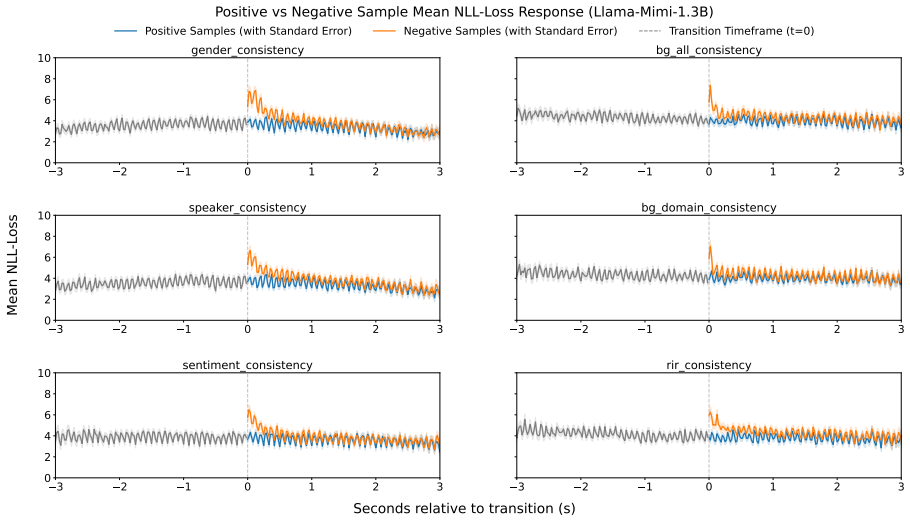
The paper's central claim is that global token perplexity is not a faithful evaluation for pretrained spoken language models, because it treats all speech tokens—across time and across codebook layers—as equally informative, whereas the perceptual signal that distinguishes a good continuation from a bad one is concentrated in a brief window right after the acoustic boundary. Empirically, the paper shows that negative (acoustically inconsistent) samples produce a localized spike in negative log-likelihood that global averaging washes out. Its proposed localized and normalized likelihood estimators, plus an embedding-based judge applied to real generations, raise correlation with human MOS fro
Load-bearing premise
The central premise is that the acoustic signal distinguishing good from bad continuations is concentrated inside a fixed 0.5-second window immediately after the prompt-to-continuation boundary; if real inconsistencies occur later, gradually, or at variable offsets, the proposed likelihood metrics will not track human perception.
Editorial extensions
If this is right
- Leaderboards built on global token perplexity for pretrained SLMs should be re-read with caution; the paper's numbers suggest the true performance gap to humans is much narrower than previously reported.
- Normalized perplexity is a drop-in likelihood evaluator that can be applied to any SLM on contrastive benchmarks without additional human annotation.
- Model-as-a-judge scoring with task-selected embeddings is a scalable substitute for MOS when human ratings are unavailable, for acoustic consistency tasks.
- The tokenizer choice is a dominant factor: HuBERT-token models lose most of their apparent advantage under localized and generation-based metrics, while Mimi-based models gain.
- For tasks with no shared prompt/continuation boundary, localized perplexity cannot be applied; the paper uses windowed perplexity as its proxy, but results there stay near chance.
Reading between the lines
- The localized-window argument suggests a diagnostic: deliberately jittering where acoustic inconsistency begins should degrade the proposed metrics more than global perplexity; the paper does not run that experiment, but it would directly test the 0.5-second assumption.
- The localization and normalization moves may bias toward models whose acoustic attributes are encoded locally in time. Architectures that deliberately spread speaker or emotion information over long-range dependencies could be systematically penalized even if human listeners find their output acceptable—a bias worth measuring.
- Because the selected embedding judges are each specialized (speaker, background, room), a single robust universal audio embedding remains an open need; until it exists, an evaluation suite must name a per-task judge explicitly, as this paper does.
- The finding that reconstructions already lose speaker and background information (near chance, versus ceiling on original audio) suggests the bottleneck is the tokenizer and reconstruction path, not only the language model; future SLM evaluation should report reconstruction performance alongside continuation to isolate the source of failure.
Editorial analysis
A structured set of objections, weighed in public.
Referee Report
Summary. The paper argues that global token perplexity, as applied to discrete speech tokens, is a poor proxy for perceived generation quality of spoken language models (SLMs). It proposes two families of alternatives: localized and normalized likelihood-based metrics (Eqs. 3 and 4, plus a windowed variant in Eq. 11) and a generation-based embedding-judge scoring method (Eqs. 6-10). The methods are evaluated on SALMon, with human MOS as the external reference. The paper reports that normalized perplexity raises Pearson correlation with MOS from 0.64 to 0.80 and that the embedding-judge score reaches 0.87 (Fig. 4), and that under the new metrics Llama-Mimi improves from 80.92 to 90.33 average accuracy, closing 83% of the gap to the human topline on SALMon (Sec. 5.3, Table 3).
Significance. The question is important: SLM evaluation currently borrows text perplexity without accounting for speech-specific locality, and a metric that better tracks human perception would be a useful contribution. The paper has several strengths: it uses human MOS as an external anchor rather than relying purely on self-consistency; it considers diverse evaluator families; and it provides a Shapley decomposition that connects metric behavior to token types. If the correlation gains are real, the proposed approach would usefully reshape SLM evaluation. However, the empirical support is currently fragile because the headline correlations rest on very few model-level points, the embedding judge is selected on the same benchmark it later scores, and the key window size is fixed without sensitivity analysis.
major comments (5)
- [§5.3, Fig. 4, Table 4] The headline correlation gain (r=0.64 to 0.80, and r=0.87 for embedding judge) is computed on at most 8-12 model-level points, with no confidence intervals, bootstrap, or significance tests for either r or the difference. The points are strongly clustered by tokenizer family: HuBERT-based models receive MOS around 1.7-2.0, while Mimi-based models receive around 3.26-3.29 (Table 4). A large Pearson correlation can emerge from between-cluster separation even if the metric has no fine-grained validity within a family. Please report n, bootstrap CIs, and a partial-correlation or within-family analysis. Without this, the central claim that the proposed metrics are 'more faithful' to perception is not established.
- [§3.3, §4, Table 1] The embedding judge is selected by maximizing Eq. (9) on SALMon prompts (described as the dev set) and is then used to score continuations on the same SALMon benchmark (Eq. 10). Because the same data are used for judge selection and for evaluation, the near-ceiling accuracies in Table 1 may reflect overfitting to the selection set rather than a generalizable judge. Please use a held-out split or cross-validation for judge selection and report judge accuracy on held-out continuations. Additionally, validate that the distance criterion in Eq. (7) transfers from prompt-response pairs to model-generated continuations.
- [§3.1, §4, Eqs. (3), (11)] The localized window δ=0.5s is fixed without sensitivity analysis. The localization hypothesis is motivated by inspecting NLL curves for the same models (Figs. 1-2), and Eq. (11) further takes a max over all possible windows, which can overfit the test sample. If acoustic inconsistencies are not confined to a 0.5s window or occur at variable offsets, the reported correlation gains may not generalize. Please provide a sensitivity analysis over δ (e.g., 0.1s to 2.0s) and, if possible, justify the chosen δ independently of the SALMon test set.
- [§4, §5.2.1, Table 4] The MOS anchor is underpowered and incompletely reported. The text says 50 samples over 9 models, but Table 4 lists only 8 models. No inter-annotator agreement is reported, and per-model standard deviations are large (e.g., average MOS SDs around 0.4-0.5, with task-level SDs up to 1.61). Differences among the top models (3.26 vs 3.29) are within noise. Since MOS is the external reference for all correlation claims, please report agreement statistics and propagate MOS uncertainty (e.g., via bootstrap or weighted regression) into the correlation results.
- [§3.1, Eq. (4)] The normalization formula is described as subtracting 'the unconditional probability of each response,' but the denominator p(xt | xtp:t) is a conditional probability on the response's own prefix, not an unconditional probability. As written, the verbal description and the equation do not match, making the metric non-reproducible. Please clarify the intended definition and notation.
minor comments (7)
- [Throughout] Typos and incomplete references: 'equivant' (Sec. 2.2), 'natrual' (Sec. 3.3), 'retrival' (Sec. 3.3), 'exibihits' (A.3.3), 'likelohood' (A.3.3), 'FLow-SLM' (Sec. 5.2.2), 'validility' (Fig. 4 caption), 'postive' (Fig. 12 caption), 'annotaters' (A.2.2). Several references use 'and 1 others,' which should be expanded or replaced with complete author lists.
- [§4, Table 4] Inconsistent model count: the text says 9 models are used for MOS evaluation, but Table 4 reports results for 8 configurations. Clarify which configurations were rated and whether the legend in Fig. 4 (12 configs) includes models without MOS scores.
- [Fig. 3, Fig. 4] The multi-panel figures are dense and the shared legends are hard to read. Please increase font sizes, label each panel explicitly, and state in the text how many points each correlation uses.
- [Table 3] Some proposed metrics are not reported for the semantic-acoustic alignment subsets (only Global-PPL and Windowed-PPL are shown). Clarify why localized/normalized metrics are inapplicable there and whether this limits the claims about those subsets.
- [Eq. (11), §A.2.1] Clarify whether δ in Eq. (11) is measured in seconds or tokens, and how the flattened multi-codebook stream is handled when converting time to token indices. The current notation is ambiguous.
- [Table 3, Appendix A.3.1] Several proposed-metric scores exceed the human topline (e.g., 100.0 on gender for Llama-Mimi under normalization). This is surprising and should be discussed: it may indicate benchmark saturation or that the metric measures something other than perceptual consistency.
- [Availability] No code or data release is mentioned. Given that the paper proposes new evaluation protocols, releasing the scoring scripts and MOS annotations would substantially aid reproducibility.
Circularity Check
No circularity found: the central validation is anchored to external human MOS, and the proposed metrics are not defined in terms of the target they predict.
full rationale
The paper's load-bearing claim is that the proposed likelihood and generation-based metrics align better with human perception than global token perplexity. This is validated against human MOS scores (Sec. 5.3), an external gold-standard label that is not used in the definitions of Eqs. 1-11 or in the construction of the embedding-judge. The likelihood metrics are defined directly from model NLL and the SALMon contrastive structure; localization (Eq. 3), normalization (Eq. 4), and windowed max (Eq. 11) are pre-specified metric formulations, not functions of MOS. The embedding judge is selected on SALMon dev via Eq. 7/9, which uses benchmark correctness labels, not MOS; its correlation with MOS (r=0.87) is therefore an independent empirical check, not a tautology. Some choices are hand-set (δ=0.5s) and the judge is chosen on the same benchmark used for evaluation, and the model-level correlation is computed on few clustered points without uncertainty intervals. These are legitimate generalizability and statistical robustness concerns, but they are not circularity: no equation reduces to its own input, no fitted parameter is renamed as a prediction, and no load-bearing self-citation or imported uniqueness theorem is invoked. The self-citations present (e.g., terminology from Arora et al. 2025; TASTE from Tseng et al. 2025) are not load-bearing for the central claim. Under the specified standard, no circular step can be exhibited.
Assumptions & free parameters
free parameters (1)
- localized window δ =
0.5 s
assumptions (4)
- domain assumption Acoustic attributes (speaker, emotion, background) are locally regularized and best judged over short spans (Gradualness of Change, Bregman 1993).
- domain assumption SALMon's positive/negative pairs isolate the target attribute and provide a valid consistency test.
- domain assumption Human MOS is a reliable gold standard for continuation quality.
- domain assumption Cosine distance in selected embedding spaces reflects acoustic consistency.
Cite this review
Pith. "Pith review of On the Fallacy of Global Token Perplexity in Spoken Language Model Evaluation." pith.science (2026). https://pith.science/paper/MPMEQCWR
@misc{pith2026260106329,
  author       = {Pith},
  title        = {Pith review of: On the Fallacy of Global Token Perplexity in Spoken Language Model Evaluation},
  year         = {2026},
  howpublished = {\url{https://pith.science/paper/MPMEQCWR}},
  note         = {Machine review of arXiv:2601.06329}
}
read the original abstract
Generative spoken language models pretrained on large-scale raw audio can continue a speech prompt with appropriate content while preserving attributes like speaker and emotion, serving as foundation models for spoken dialogue. In prior literature, these models are often evaluated using ``global token perplexity'', which directly applies the text perplexity formulation to speech tokens. However, this practice overlooks fundamental differences between speech and text modalities, possibly leading to an underestimation of the speech characteristics. In this work, we propose a variety of likelihood- and generative-based evaluation methods that serve in place of naive global token perplexity. We demonstrate that the proposed evaluations more faithfully reflect perceived generation quality, as evidenced by stronger correlations with human-rated mean opinion scores (MOS). When assessed under the new metrics, the relative performance landscape of spoken language models is reshaped, revealing a significantly reduced gap between the best-performing model and the human topline. Together, these results suggest that appropriate evaluation is critical for accurately assessing progress in spoken language modeling.
Figures


Figures from the paper (10 more)


Reference graph
Works this paper leans on
-
[4]
Exploring predictive uncertainty and calibra- tion in NLP: A study on the impact of method & data scarcity. InFindings of the Association for Computa- tional Linguistics: EMNLP 2022, pages 2707–2735, Abu Dhabi, United Arab Emirates. Association for Computational Linguistics. Chengyi Wang, Sanyuan Chen, Yu Wu, Ziqiang Zhang, Long Zhou, Shujie Liu, Zhuo Che...
arXiv 2022
-
[1330]
PMLR. Michael Hassid and 1 others. 2024. Textually pretrained speech language models.Advances in Neural Infor- mation Processing Systems, 36. Dan Hendrycks, Collin Burns, Steven Basart, Andy Zou, Mantas Mazeika, Dawn Song, and Jacob Steinhardt. Measuring massive multitask language understand- ing. InInternational Conference on Learning Repre- sentations. ...
arXiv 2024
-
[2022]
Titanet: Neural model for speaker representa- tion with 1d depth-wise separable convolutions and global context. InICASSP 2022-2022 IEEE inter- national conference on acoustics, speech and signal processing (ICASSP), pages 8102–8106. IEEE. Moreno La Quatra, Alkis Koudounas, Lorenzo Va- iani, Elena Baralis, Luca Cagliero, Paolo Garza, and Sabato Marco Sini...
arXiv 2022
-
[2024]
Yung-Sung Chuang, Yujia Xie, Hongyin Luo, Yoon Kim, James R
Qwen2-audio technical report.Preprint, arXiv:2407.10759. Yung-Sung Chuang, Yujia Xie, Hongyin Luo, Yoon Kim, James R. Glass, and Pengcheng He. 2024. DoLa: Decoding by contrasting layers improves fac- tuality in large language models. InThe Twelfth International Conference on Learning Representa- tions. Alexandre Défossez, Jade Copet, Gabriel Synnaeve, and...
arXiv 2024
Reviewed August 3, 2026 · model on record in the stance chip above.
Discussion (0). Continue with ORCID to comment.