REVIEW 3 major objections 6 minor 62 references
Bacterial Chemotaxis in a Traveling Wave Attractant Environment
T0 review · 3 major / 6 minor · reviewed 2026-08-07 · deepseek-v4-flash
Pith's one-line read In simulations, a single E. coli drifts opposite to a slowly moving attractant wave, reverses direction when the wave speed matches its run speed, and stops drifting for fast waves.
desk verdict A sign-changing chemotactic drift in a traveling attractant wave, carefully simulated, but the small negative drift rests on untested model parameters. read the letter →
The pith
A machine-rendered reading of the paper's core claim, the machinery that carries it, and where it could break.
The reading
What carries the argument
The load-bearing object is the relative-velocity asymmetry between runs parallel and antiparallel to wave propagation. A rightward run sees effective wave speed $(v - v_w)$, which vanishes at $v_w = v$ — the 'ride the wave' condition at which the cell experiences no changing attractant level during the run; a leftward run sees $-(v + v_w)$, so its effective gradient magnitude grows monotonically with $v_w$. This asymmetry enters a stochastic two-state allosteric model of chemoreceptor clusters (MWC model) with methylation-based adaptation and CheY-P-regulated tumbling, producing direction-dependent run durations $\tau_R$ and $\tau_L$, and the drift velocity is their difference times the run speed.
What would settle it
Measure the time-averaged drift of single E. coli in a microfluidic channel with a sinusoidal attractant wave for wave speeds below, at, and above the run speed — if no negative drift appears for $v_w < v$, or if the zero crossing is far from $v_w = v$, the claim fails. Alternatively, rerun the simulations with $w_a$ varied over roughly $0.1$–$2\,\mathrm{s}^{-1}$ and cluster sizes $n = 5$–$15$ and check whether the negative-drift branch at small $v_w$ survives; a sign flip would collapse the prediction.
Extended reading notes
Core claim
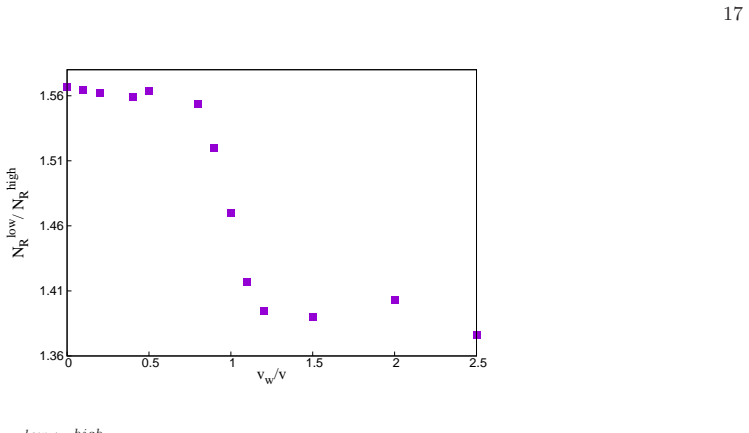
The paper's central discovery is that a single running-and-tumbling E. coli reaches a time-periodic steady state in a traveling wave attractant $[L](x,t) = [L]_0 + A \sin(2\pi (v_w t - x)/\lambda)$, and that its time-averaged drift velocity $V$, measured as net displacement per run divided by mean run duration, depends on $v_w$ in a way that changes sign twice (Fig. 4): $V \approx 0$ for static waves, negative for $v_w \ll v$, a negative minimum, a zero crossing at $v_w \approx v$, a positive maximum for $v_w > v$, and $V \to 0$ when the wave is too fast to sense. The mechanism is that rightward runs see relative wave speed $(v - v_w)$, so near $v_w = v$ the cell effectively rides the wave and perceives no concentration change during the run, while leftward runs see $-(v + v_w)$ and therefore always face a steeper effective gradient as $v_w$ grows. The authors show that the difference between rightward and leftward mean run durations ($\tau_R - \tau_L$) reproduces the full $V$-versus-$v_w$ curve, and that the qualitative behavior persists in two dimensions with rotational diffusion, under an alternative definition of drift velocity, and for a large wavelength where initial receptor activity, rather than within-run gradient changes, controls run length.
Load-bearing premise
The receptor-model parameters, including the cluster size $n = 10$ and the receptor-switching rate $w_a = 0.75\,\mathrm{s}^{-1}$ that the paper marks as 'present study', are carried over from calibrations on static and step stimuli, and are assumed to hold when the wave period is comparable to or shorter than the measured adaptation time of about 28 seconds; if small parameter changes flip the sign of the slow-wave drift, the central qualitative claim collapses.
Editorial extensions
If this is right
- By tuning the wave speed, one controls both the direction and the magnitude of chemotactic transport of a single cell: backward drift for $v_w < v$, forward drift for $v_w > v$, and no net drift for static or very fast waves.
- The zero crossing of $V$ near $v_w = v$ provides a way to measure a cell's run speed from a pure time-averaged drift measurement, without resolving individual runs.
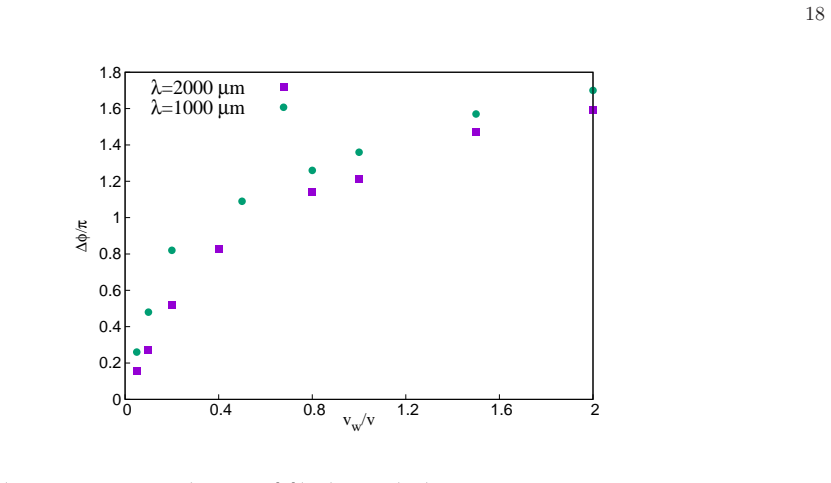
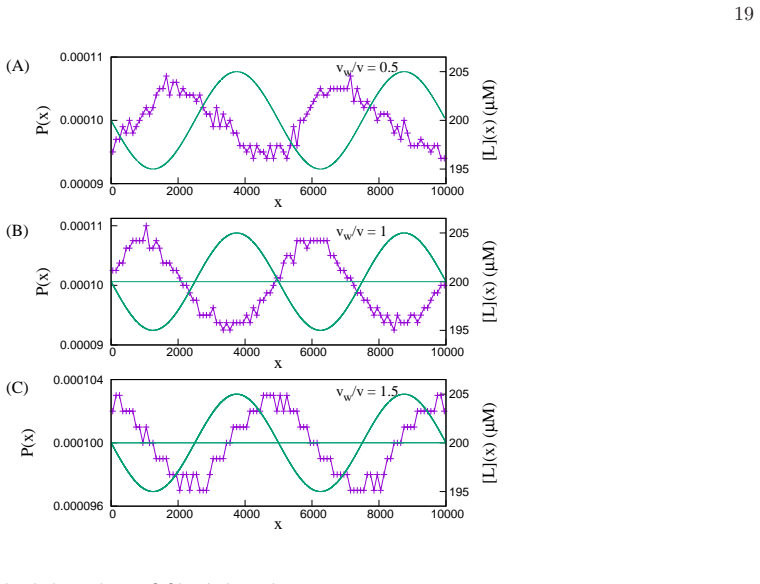
- The cell density distribution lags the attractant wave, and the lag reaches roughly $\pi$ when the wave speed is near the run speed, so cells collect near concentration minima rather than maxima at that speed.
- The qualitative behavior holds for moderate and large wavelengths, in one and two dimensions, and under two different definitions of drift velocity, which makes the predicted sign change a target that microfluidic experiments can realistically test.
Reading between the lines
- Because the ride-the-wave effect depends on a memory of order the run duration rather than on E. coli's specific biochemistry, any run-and-tumble or self-propelled particle with an adaptation-like memory should show the same drift reversal in a moving periodic field; a synthetic-particle version with tunable memory would isolate the mechanism.
- The negative drift for slow waves is conceptually a new route to negative mobility in active matter, distinct from obstacle trapping or channel corrugation; applying the same relative-velocity argument to pulses or sharp-fronted waves would predict even stronger backward drift because brief intense gradients are perceived during part of each run.
- Since the wave period near $v_w = v$ (about 10 s for $\lambda = 200\,\mu\mathrm{m}$) is much shorter than the measured adaptation time (roughly 28 seconds), the model implies the sign reversal does not require perfect adaptation; switching off methylation in the simulation and checking whether the zero crossing shifts or disappears would test this directly.
Editorial analysis
A structured set of objections, weighed in public.
Referee Report
Summary. The paper uses stochastic simulations of a quantitative E. coli chemotaxis signaling model to study the time-averaged drift velocity V of a single cell in a traveling sine-wave attractant profile [L](x,t) = [L]0 + A sin(2π/λ)(v_w t − x). The central simulation result (Sec. III, Fig. 4) is that V vanishes for static and for very fast waves, is negative for slow waves, reaches a negative minimum, crosses zero near v_w ≈ v (the run speed), reaches a positive maximum, and then decays to zero. The authors attribute this behavior to the difference in effective wave speed experienced during rightward runs, v − v_w, versus leftward runs, v + v_w, with the special 'wave riding' limit at v_w = v. The result is checked in two dimensions (Fig. 13), with an alternative drift definition (Fig. 14), and for a larger wavelength (Fig. 8); run-duration diagnostics and phase-lag measurements support the proposed mechanism.
Significance. If the reported sign-changing drift is robust, it is a non-trivial and interesting prediction: a single swimming bacterium in a traveling periodic attractant landscape can drift against the wave for slow waves and with the wave for faster waves, with the crossover near the run speed. The paper's strengths are its careful simulation protocol: a full parameter table, 10^6-configuration averaging, error-bar reporting, steady-state verification, and multiple cross-checks (2D motion, two drift definitions, two wavelengths, phase-lag analysis). The mechanism proposed is simple and falsifiable, and the contrast with the earlier population-level experiment of Li et al. (Ref. [17]) is clearly drawn. However, confidence in the central qualitative claim is limited by the absence of a sensitivity analysis for the model parameters marked 'present study' (n and w_a in Table I), the unshown verification of the CheY-P quasi-steady-state reduction, and the incomplete mechanistic explanation for the large-wavelength regime.
major comments (3)
- [Sec. II, Table I; Fig. 4] The parameters n = 10 and w_a = 0.75 s^-1 are marked 'present study' in Table I and are not varied in the manuscript. For λ = 200 μm and v_w/v in the range 0.25–1, the wave period is 10–40 s, comparable to or shorter than the measured adaptation time τ_m ≈ 27.9 s (Fig. 12); in this regime the negative drift is only 0.01–0.2 μm/s, roughly 10–150 times smaller than the static-gradient drift of ~1.5 μm/s. Since the central claim is the sign of V at slow wave speeds, the authors should report a sensitivity analysis over plausible ranges of n and w_a (and, if possible, of the methylation rates that set τ_m) and show that the sign-changing behavior, especially the negative drift at v_w ≪ v, is preserved. Without this, the headline qualitative result is not yet established as robust.
- [Sec. II, CheY-P quasi-steady-state reduction] The manuscript states that the quasi-steady-state assumption for CheY-P, Y_P = a/(a + K_Z/K_Y), was verified by relaxing it, but gives only 'data not shown here.' This reduction directly sets the tumbling rate as a function of receptor activity and therefore controls the phase lag between activity and run-tumble switching, which is precisely the quantity that selects the sign of V in a time-periodic environment. The authors should either provide the verification plot (e.g., V vs v_w with and without integrating the CheY-P dynamics for representative v_w values) or remove the claim. As it stands, a load-bearing check of the model reduction is missing from the paper.
- [Sec. IV, Fig. 11] For the large-wavelength case, the explanation of the run-duration data relies on the initial activity a_R^low, yet the manuscript explicitly states 'we do not have complete understanding of why a_R^low in Fig. 11 shows a peak with v_w and why that peak occurs at v_w > v.' This admission means the proposed mechanistic explanation is incomplete for the large-wavelength regime, even though the V data in Fig. 8 are not invalidated. The authors should either provide a mechanism for this peak or explicitly scope the paper's claim so that the 'rich behavior' explanation is only claimed for the moderate-wavelength regime where the mechanism is fully worked out.
minor comments (6)
- [Title] The title contains a typo: 'Enviro nment' should read 'Environment.'
- [Sec. IV vs Fig. 8 and Table I] The text at the start of Sec. IV describes λ = 2000 μm as 'large λ,' but Fig. 8 and Table I use λ = 1000 μm for the large-wavelength data, and Appendix E uses both 1000 μm and 2000 μm. Please clarify which wavelength corresponds to the 'large λ' results of Sec. IV.
- [Figure captions, Figs. 4–11] Several captions report a 'maximum error-bar' (e.g., 0.001 μm/s in Fig. 4 and 10^-4 s in Fig. 5) but the plotted points show no visible error bars; please state explicitly whether the error bars are smaller than the symbol size, or plot them.
- [References] Reference [1] contains the typo 'Worls Scientific' and should be corrected to 'World Scientific.'
- [Appendix A, Fig. 12] The adaptation time τ_m ≈ 27.9 s is quoted without an error estimate or a description of the fitting procedure; please specify how the exponential time scale was extracted from the step-response data.
- [General] The paper does not ship code or data. Given that the central result is a simulation prediction, making the simulation code available would substantially aid reproducibility and would allow independent checks of the sensitivity concerns raised above.
Circularity Check
No significant circularity: the traveling-wave drift curve is a forward simulation output, not a fitted or self-referential quantity.
full rationale
The central claim—the sign-changing, multi-peaked drift V(vw) in Fig. 4—is produced by an explicit stochastic simulation of a chemotaxis signaling model. It is not obtained by fitting any parameter to the traveling-wave data, and no equation defines V in terms of the kinematic asymmetry (v−vw) that is later used to explain it. The model parameters in Table I are mostly taken from prior experimental and modeling literature ([10,12,16,21,27,32,34,36,54,55]); the entries marked 'present study' (n=10, wa=0.75 s^-1) are choices/calibrations from the authors' earlier work, but wa is explicitly attributed in Sec. II to refs [19,30,31], and the model itself is described as '[18–20]'. Those self-citations are provenance for the model, not a uniqueness theorem or a fitted ansatz that forces the reported V. The 'ride the wave' explanation (Sec. III) is a kinematic identity: a rightward run perceives d[L]/dt ∝ (vw − v), which vanishes at vw=v; this is not a fitted input. The run-duration diagnostics τR and τL are defined independently of V and are used post hoc to interpret the simulation. The paper's admitted gaps—the 'data not shown' check of the CheY-P quasi-steady-state reduction, and the unexplained peak position of alow_R in Fig. 11—are robustness/limitation issues, not circular reductions. The prediction is an out-of-sample simulation result for a new stimulus class relative to the parameters' earlier calibrations. No circular step is present.
Assumptions & free parameters
free parameters (5)
- n (number of trimers of dimers per receptor cluster) =
10
- wa (activity switching rate) =
0.75 s^-1
- [L]0 (background attractant concentration) =
200 µM
- A (wave amplitude) =
5 µM (1D), 10 µM (2D)
- λ (wavelength) =
200 µm (moderate), 1000 µm (large), 2000 µm (phase lag)
assumptions (7)
- domain assumption MWC model with local detailed balance describes receptor cluster activity switching (Eqs. 1-2).
- domain assumption CheY-P reaches its quasi-steady state instantly: YP = a/(a + KZ/KY).
- domain assumption Run-tumble switching rates ω exp(±G) with G = Δ1 - Δ2/(1 + Y0/YP) capture flagellar motor behavior.
- domain assumption The cell senses the instantaneous local concentration [L](x,t) only, with no memory beyond the methylation dynamics.
- domain assumption The model calibrated on static and step stimuli transfers to the moving-wave regime with vw ~ v, where the wave period is comparable to the adaptation time (~27.9 s).
- ad hoc to paper For large λ (weak gradient), run duration is determined by the initial receptor activity at the start of the run.
- domain assumption The 1D lattice run-and-tumble dynamics with spacing v·dt and periodic boundaries approximates continuum motion correctly.
Cite this review
Pith. "Pith review of Bacterial Chemotaxis in a Traveling Wave Attractant Environment." pith.science (2026). https://pith.science/paper/MQB2EVI7
@misc{pith2026250604702,
  author       = {Pith},
  title        = {Pith review of: Bacterial Chemotaxis in a Traveling Wave Attractant Environment},
  year         = {2026},
  howpublished = {\url{https://pith.science/paper/MQB2EVI7}},
  note         = {Machine review of arXiv:2506.04702}
}
read the original abstract
We study single cell E.coli chemotaxis in a spatio-temporally varying attractant environment. Modeling the attractant concentration in the form of a traveling sine wave, we measure in our simulations, the chemotactic drift velocity of the cell for different propagation speed of the attractant wave. We find a highly non-trivial dependence where the chemotactic drift velocity changes sign, and also shows multiple peaks. For slowly moving attractant wave, drift velocity is negative, i.e. the drift motion is directed opposite to wave propagation. As the wave speed increases, drift velocity shows a negative peak, then changes sign, reaches a positive peak and finally becomes zero when the wave moves too fast for the cell to respond. We explain this rich behavior from the difference in attractant gradient perceived by the cell during its run along the propagation direction and opposite to it. In particular, when the cell moves in the same direction as the wave, the relative velocity of the cell with respect to the wave becomes zero when the wave speed matches the run speed. In this limit, the cell is able to ride the wave and experiences no concentration gradient during these runs. On the contrary, for runs in the opposite direction, no such effect is present and the effective gradient increases monotonically with the wave speed. We show, using detailed quantitative measurements, how this difference gives rise to the counter-intuitive behavior of chemotactic drift velocity described above.
Figures


Figures from the paper (19 more)





Reference graph
Works this paper leans on
-
[17]
However, we have verified (data in Appendix B, Fig
and in this case, the effective motion of the cell remains one dimen sional, as was considered here in our model. However, we have verified (data in Appendix B, Fig. 13) that even wh en run-and-tumble motion takes place in two dimensions, a traveling wave attractant profile generates a similar r esponse in the drift motion. This observation may be relevant f...
-
[1]
Simulation Algorithm We present the values of all model parameters in Table I. In our simu lation we use the following algorithm to implement the model for signaling pathway and run-tumble motion of t he cell: • Activity switching : For each receptor cluster calculate F ([L], m) from Eq. 2. If the cluster is in the inactive state, then make it active with...
work page 2000
-
[2]
R. Daniels, J. Vanderleyden, and J. Michiels, Quorum sen sing and swarming migration in bacteria, FEMS microbiology reviews 28, 261 (2004)
work page 2004
-
[3]
D. Dubravcic, M. Van Baalen, and C. Nizak, An evolutionar ily significant unicellular strategy in response to starvat ion in dictyostelium social amoebae, F1000Research 3 (2014). 20 2.15 2.3 2.45 0 0.5 1 1.5 2 2.5 (B) τL rise τL fall τL rise and τL fall (second) vw/v 2.2 2.3 2.4 2.5 0 0.5 1 1.5 2 2.5 (A) τrise R τfall R τR rise and τR fall (second) vw/v FI...
work page 2014
-
[4]
Analogous quantity for leftward runs also show identical behavio r since run directions are randomized after each tumble. Appendix E: Phase lag between P (x, t) and [L](x, t) For a static attractant profile, it is most likely to find the cell near th e peaks of the attractant concentration. For a propagating traveling wave, the cell density still tries to c...
-
[5]
Eisenbach, Chemotaxis (Imperial College Press, Worls Scientific Publishing Co., 2 004)
M. Eisenbach, Chemotaxis (Imperial College Press, Worls Scientific Publishing Co., 2 004)
-
[6]
P. V. Afonso, M. Janka-Junttila, Y. J. Lee, C. P. McCann, C . M. Oliver, K. A. Aamer, W. Losert, M. T. Cicerone, and C. A. Parent, Ltb4 is a signal-relay molecule during neutrop hil chemotaxis, Developmental cell 22, 1079 (2012)
work page 2012
- [7]
Show all 62 references
-
[8]
Cai, C.-H
H. Cai, C.-H. Huang, P. N. Devreotes, and M. Iijima, Analy sis of chemotaxis in dictyostelium, Integrin and Cell Adhes ion Molecules: Methods and Protocols , 451 (2012)
2012
-
[9]
R. E. Goldstein, Traveling-wave chemotaxis, Physical r eview letters 77, 775 (1996)
1996
-
[10]
H. C. Berg, E. coli in Motion (Springer Science & Business Media, 2008)
2008
-
[11]
Tu, Quantitative modeling of bacterial chemotaxis: signal amplification and accurate adaptation, Annual revie w of biophysics 42, 337 (2013)
Y. Tu, Quantitative modeling of bacterial chemotaxis: signal amplification and accurate adaptation, Annual revie w of biophysics 42, 337 (2013)
2013
-
[12]
Tweedy, D
L. Tweedy, D. A. Knecht, G. M. Mackay, and R. H. Insall, Sel f-generated chemoattractant gradients: attractant deple tion extends the range and robustness of chemotaxis, PLoS biolog y 14, e1002404 (2016)
2016
-
[13]
Goldbeter, Modelling biochemical oscillations and c ellular rhythms, Current Science , 933 (1997)
A. Goldbeter, Modelling biochemical oscillations and c ellular rhythms, Current Science , 933 (1997)
1997
-
[14]
M. D. Lazova, T. Ahmed, D. Bellomo, R. Stocker, and T. S. S himizu, Response rescaling in bacterial chemotaxis, Pro- ceedings of the National Academy of Sciences 108, 13870 (2011)
2011
-
[15]
X. Zhu, G. Si, N. Deng, Q. Ouyang, T. Wu, Z. He, L. Jiang, C. Luo, and Y. Tu, Frequency-dependent escherichia coli chemotaxis behavior, Physical review letters 108, 128101 (2012). 21 2 2.15 2.3 2.45 0 0.5 1 1.5 2 2.5 3 (B) τL rise τL fall τL rise and τL fall (second) vw/v 2.1 ...
2012
-
[16]
Y. Tu, T. S. Shimizu, and H. C. Berg, Modeling the chemota ctic response of escherichia coli to time-varying stimuli, Proceedings of the National Academy of Sciences 105, 14855 (2008)
2008
-
[18]
T. S. Shimizu, Y. Tu, and H. C. Berg, A modular gradient-s ensing network for chemotaxis in escherichia coli revealed by responses to time-varying stimuli, Molecular systems biol ogy 6, 382 (2010)
2010
-
[19]
S. D. Mandal and S. Chatterjee, Effect of switching time s cale of receptor activity on chemotactic performance of esc herichia coli, Indian Journal of Physics 96, 2619 (2022)
2022
-
[20]
Jiang, Q
L. Jiang, Q. Ouyang, and Y. Tu, Quantitative modeling of escherichia coli chemotactic motion in environments varyi ng in space and time, PLoS Comput Biol 6, e1000735 (2010)
2010
-
[21]
Z. Li, Q. Cai, X. Zhang, G. Si, Q. Ouyang, C. Luo, and Y. Tu, Barrier crossing in escherichia coli chemotaxis, Physical review letters 118, 098101 (2017)
2017
-
[22]
S. D. Mandal and S. Chatterjee, Effect of receptor cluste ring on chemotactic performance of e. coli: Sensing versus adaptation, Phys. Rev. E 103, L030401 (2021)
2021
-
[23]
J. Liu, B. Hu, D. R. Morado, S. Jani, M. D. Manson, and W. Ma rgolin, Molecular architecture of chemoreceptor arrays revealed by cryoelectron tomography of escherichia coli mi nicells, Proceedings of National Academy of Sciences 109, E1481 (2012)
2012
-
[24]
S. D. Mandal and S. Chatterjee, Effect of receptor cooper ativity on methylation dynamics in bacterial chemotaxis wi th weak and strong gradient, Physical Review E 105, 014411 (2022)
2022
-
[25]
Pontius, M
W. Pontius, M. W. Sneddon, and T. Emonet, Adaptation dyn amics in densely clustered chemoreceptors, PLoS computa- tional biology 9 (2013)
2013
-
[26]
Briegel, X
A. Briegel, X. Li, A. M. Bilwes, K. T. Hughes, G. J. Jensen , and B. R. Crane, Bacterial chemoreceptor arrays are hexagonally packed trimers of receptor dimers networked by rings of kinase and coupling proteins, Proceedings of the National Academy of Sciences 109, 3766 (2012)
2012
-
[27]
Y. S. Dufour, X. Fu, L. Hernandez-Nunez, and T. Emonet, L imits of feedback control in bacterial chemotaxis, PLoS Comput Biol 10, e1003694 (2014)
2014
-
[28]
B. A. Mello and Y. Tu, An allosteric model for heterogene ous receptor complexes: understanding bacterial chemotax is responses to multiple stimuli, Proceedings of the National Academy of Sciences 102, 17354 (2005). 22 0.458 0.462 0.466 0.47 0.474 0 0.5 1 1.5 2 2.5 3 (A) 195 µ...
2005
-
[29]
Monod, J
J. Monod, J. Wyman, and J.-P. Changeux, On the nature of a llosteric transitions: a plausible model, J Mol Biol 12, 88 (1965)
1965
-
[30]
J. E. Keymer, R. G. Endres, M. Skoge, Y. Meir, and N. S. Win green, Chemosensing in escherichia coli: two regimes of two-state receptors, Proceedings of the National Academy o f Sciences 103, 1786 (2006)
2006
-
[31]
Chatterjee, Short time extremal response to step sti mulus for a single cell e
S. Chatterjee, Short time extremal response to step sti mulus for a single cell e. coli, Journal of Statistical Mecha nics: Theory and Experiment 2022, 123503 (2022)
2022
-
[32]
N. W. Frankel, W. Pontius, Y. S. Dufour, J. Long, L. Herna ndez-Nunez, and T. Emonet, Adaptability of non-genetic diversity in bacterial chemotaxis, Elife 3, e03526 (2014)
2014
-
[33]
J. Long, S. W. Zucker, and T. Emonet, Feedback between mo tion and sensation provides nonlinear boost in run-and-tum ble navigation, PLoS computational biology 13, e1005429 (2017)
2017
-
[34]
Colin, C
R. Colin, C. Rosazza, A. Vaknin, and V. Sourjik, Multipl e sources of slow activity fluctuations in a bacterial chemos ensory network, Elife 6, e26796 (2017)
2017
-
[35]
Micali, R
G. Micali, R. Colin, V. Sourjik, and R. G. Endres, Drift a nd behavior of e. coli cells, Biophysical journal 113, 2321 (2017)
2017
-
[36]
Flores, T
M. Flores, T. S. Shimizu, P. R. ten Wolde, and F. Tostevin , Signaling noise enhances chemotactic drift of e. coli, Phy sical review letters 109, 148101 (2012)
2012
-
[37]
Dev and S
S. Dev and S. Chatterjee, Optimal methylation noise for best chemotactic performance of e. coli, Physical Review E 97, 032420 (2018)
2018
-
[38]
M. W. Sneddon, W. Pontius, and T. Emonet, Stochastic coo rdination of multiple actuators reduces latency and improv es chemotactic response in bacteria, Proceedings of the Natio nal Academy of Sciences 109, 805 (2012)
2012
-
[39]
Taktikos, H
J. Taktikos, H. Stark, and V. Zaburdaev, How the motilit y pattern of bacteria affects their dispersal and chemotaxis , PLoS ONE 8, e81936 (2013)
2013
-
[40]
H. C. Berg and D. A. Brown, Chemotaxis in escherichia col i analysed by three-dimensional tracking, Nature 239, 500 (1972)
1972
-
[41]
De Gennes, Chemotaxis: the role of internal delay s, European Biophysics Journal 33, 691 (2004)
P.-G. De Gennes, Chemotaxis: the role of internal delay s, European Biophysics Journal 33, 691 (2004)
2004
-
[42]
transport of active Janus particles through a narrow corrug ated channel was numerically studied and transport in the opposite direction of applied force was reported. This effect w as shown to be caused by frequent tumbling (or effective trapping) of the Janus particles at the ...
2023
-
[43]
J. T. Locsei, Persistence of direction increases the dr ift velocity of run and tumble chemotaxis, Journal of Mathematical Biology 55, 41–60 (2007)
2007
-
[44]
K. L. Thornton, J. K. Butler, S. J. Davis, B. K. Baxter, an d L. G. Wilson, Haloarchaea swim slowly for optimal chemotac tic efficiency in low nutrient environments, Nature Communicati ons 11, 10.1038/s41467-020-18253-7 (2020)
2020 doi
-
[45]
Chatterjee, R
S. Chatterjee, R. A. da Silveira, and Y. Kafri, Chemotax is when bacteria remember: drift versus diffusion, PLoS comp u- tational biology 7 (2011). 23 0.452 0.456 0.46 0.464 0.468 0 0.5 1 1.5 2 2.5 (A) 195 µM ≤ [L] ≤ 197 µM a0 vw/v 0.45 0.452 0.454 0.456 0 0.5 1 1.5 2 2.5 (B) 1...
2011
-
[46]
P. K. Ghosh, P. H¨ anggi, F. Marchesoni, and F. Nori, Gian t negative mobility of janus particles in a corrugated chann el, Physical Review E 89, 10.1103/physreve.89.062115 (2014)
2014 doi
-
[47]
Rizkallah, A
P. Rizkallah, A. Sarracino, O. B´ enichou, and P. Illien , Absolute negative mobility of an active tracer in a crowded envi- ronment, Physical Review Letters 130, 10.1103/physrevlett.130.218201 (2023)
2023 doi
-
[48]
A. V. Straube and F. H¨ ofling, Depinning transition of se lf-propelled particles (2023)
2023
-
[49]
H. C. Berg and P. Tedesco, Transient response to chemota ctic stimuli in escherichia coli, Proceedings of the Nation al Academy of Sciences 72, 3235 (1975)
1975
-
[50]
M. F. Goy, M. S. Springer, and J. Adler, Sensory transduc tion in escherichia coli: role of a protein methylation reac tion in sensory adaptation, Proceedings of the National Academy of Sciences 74, 4964 (1977)
1977
-
[51]
C. H. Hansen, R. G. Endres, and N. S. Wingreen, Chemotaxi s in escherichia coli: a molecular model for robust precise adaptation, PLoS Comput Biol 4, e1 (2008)
2008
-
[52]
M. D. Levin, T. S. Shimizu, and D. Bray, Binding and diffus ion of cher molecules within a cluster of membrane receptors , Biophysical journal 82, 1809 (2002)
2002
-
[53]
assistance neighborhoods
R. G. Endres and N. S. Wingreen, Precise adaptation in ba cterial chemotaxis through “assistance neighborhoods”, P ro- ceedings of the National Academy of Sciences 103, 13040 (2006)
2006
-
[54]
Li and G
M. Li and G. L. Hazelbauer, Adaptational assistance in c lusters of bacterial chemoreceptors, Molecular microbiol ogy 56, 1617 (2005)
2005
-
[55]
S.-H. Kim, W. Wang, and K. K. Kim, Dynamic and clustering model of bacterial chemotaxis receptors: structural basis for signaling and high sensitivity, Proceedings of the Nati onal Academy of Sciences 99, 11611 (2002)
2002
-
[56]
X. Feng, A. A. Lilly, and G. L. Hazelbauer, Enhanced func tion conferred on low-abundance chemoreceptor trg by a methyltransferase-docking site, Journal of bacteriology 181, 3164 (1999)
1999
-
[57]
J. Wu, J. Li, G. Li, D. G. Long, and R. M. Weis, The receptor binding site for the methyltransferase of bacterial chemot axis is distinct from the sites of methylation, Biochemistry 35, 4984 (1996)
1996
-
[58]
Schulmeister, M
S. Schulmeister, M. Ruttorf, S. Thiem, D. Kentner, D. Le biedz, and V. Sourjik, Protein exchange dynamics at chemore - ceptor clusters in escherichia coli, Proceedings of the Nat ional Academy of Sciences 105, 6403 (2008)
2008
-
[59]
Li and G
M. Li and G. L. Hazelbauer, Cellular stoichiometry of th e components of the chemotaxis signaling complex, Journal o f bacteriology 186, 3687 (2004)
2004
-
[60]
M. W. Sneddon, J. R. Faeder, and T. Emonet, Efficient model ing, simulation and coarse-graining of biological complex ity with nfsim, Nature methods 8, 177 (2011)
2011
-
[61]
R. C. Stewart, K. Jahreis, and J. S. Parkinson, Rapid pho sphotransfer to chey from a chea protein lacking the chey-bi nding domain, Biochemistry 39, 13157 (2000)
2000
-
[62]
van Kampen, Chapter xvi - stochastic differential equ ations, in Stochastic Processes in Physics and Chemistry (Third Editi on), North-Holland Personal Library, edited by N
N. van Kampen, Chapter xvi - stochastic differential equ ations, in Stochastic Processes in Physics and Chemistry (Third Editi on), North-Holland Personal Library, edited by N. van Kampen (El sevier, Amsterdam, 2007) third edition ed., pp. 396–421
2007
Reviewed August 7, 2026 · model on record in the stance chip above.
Discussion (0). Sign in to comment.