REVIEW 4 major objections 6 minor 30 references
Evidence of the Cooper-Pair Field with Gaussian Memory Kernel in Unconventional Superconductors
T0 review · 4 major / 6 minor · reviewed 2026-07-11 · grok-4.5
Pith's one-line read The superconducting transition in cuprates mainly reorganizes pair-field spectral weight between an incoherent pseudogap memory channel and a coherent Bogoliubov memory channel, both arising from one Gaussian-memory Cooper-pair continuum.
desk verdict A coherent multi-probe PCF framework for Bi2212 that unifies Raman/ARPES/tunneling as projections of one Gaussian-memory pair continuum, but branch selection is still largely phenomenological. read the letter →
The pith
A machine-rendered reading of the paper's core claim, the machinery that carries it, and where it could break.
The reading
What carries the argument
Gaussian-memory pair continuum mapped to parabolic-cylinder-function (PCF) spectra: ensemble dephasing of antinode-selected local Bogoliubov frequencies supplies exp[−t²/(2τ_g²)]; threshold and resonant algebraic prefactors, after causal Fourier transform and phase selection, map onto real-axis PCF branches—especially D_{−1/2} for the pseudogap/Raman background and cascade-enhanced D_{3/2} for the superconducting Bogoliubov component.
What would settle it
If temperature- and doping-dependent ARPES (or simultaneous Raman and ARPES on the same Bi2212 crystal) cannot be described by a robust D_{−1/2} background plus a condensate-weighted D_{3/2} component with a shared memory scale that approximately collapses across doping after rescaling—or if superconducting spectral weight fails to track a condensate-like intensity while the broad background remains essentially unchanged across Tc—the reorganization claim fails.
Extended reading notes
Core claim
The Cooper-channel Hubbard–Stratonovich field is a memory-dressed Bogoliubov pair field. Coupling to antinode-selected local fields produces an approximately Gaussian distribution of Bogoliubov frequency shifts whose ensemble average supplies the memory factor exp[−t²/(2τ_g²)]. Threshold and forced-oscillator responses generate the algebraic hierarchy p = −1/2, 1/2, 1, 3/2, …; the Gaussian envelope converts these branches into finite spectral components expressed as parabolic-cylinder functions. The resulting picture contains a robust pseudogap memory channel and, below Tc, an additional condensate-assisted coherent channel proportional to |Δ₀(T)|², so the superconducting transition primaril
Load-bearing premise
The claim stands or falls on the premise that antinode-selected local fields produce an approximately Gaussian distribution of Bogoliubov frequency shifts whose ensemble average, after algebraic prefactors and phase selection, uniquely identifies the measured spectra with the specific parabolic-cylinder branches used in the fits.
Editorial extensions
If this is right
- Raman, ARPES, tunneling, and doping-dependent ARPES are complementary projections of one Gaussian-memory pair continuum with a shared PCF backbone.
- Across Tc the dominant spectroscopic change is gain or loss of phase-locked D_{3/2} weight, not the disappearance of the broad D_{−1/2} pseudogap reservoir.
- After removing sample-dependent amplitude, gap, and memory width, superconductivity-induced ARPES weight should collapse approximately onto a common dimensionless D_{3/2} profile over a broad doping range.
- The Gaussian memory time τ_g can act as a physical control parameter in a Thouless-like memory-coherence condition for the superconducting instability.
- Channel-resolved dephasing times should differ: a short incoherent reservoir time versus a longer condensate-assisted Bogoliubov memory time.
Reading between the lines
- If the Gaussian truly comes from central-limit ensemble dephasing, materials with fewer or more strongly correlated antinodal fluctuation modes should show systematic deviations from pure Gaussian memory and pure PCF line shapes.
- The same restricted-phase-space plus ensemble-dephasing logic could organize spectra in other unconventional superconductors that have an active antinodal or nested manifold, not only cuprates.
- A sharp cross-check is whether memory scales extracted from Raman (two-particle) and ARPES (single-particle) on the same sample obey the claimed relation between Er ~ 2Δ and Esc ~ Δ.
- Phase-sensitive probes should primarily track the coherent D_{3/2} channel and remain relatively insensitive to the incoherent D_{−1/2} reservoir, sharpening the paper’s separation of channels into a concrete experimental division of labor.
Editorial analysis
A structured set of objections, weighed in public.
Referee Report
Summary. The manuscript proposes a dynamical description of the Cooper-channel Hubbard–Stratonovich field Δ as a memory-dressed Bogoliubov pair field. Coupling Δ to an ensemble of antinode-selected collective fields is argued to produce approximately Gaussian local frequency shifts, yielding the memory factor exp[−t²/(2τ_g²)]. Threshold and resonant forcing generate an algebraic hierarchy p = −1/2, 1/2, 1, 3/2, … cut off by the Gaussian envelope. Causal Fourier transforms of these branches produce parabolic-cylinder-function (PCF) spectra, with a robust D_{−1/2} pseudogap/Raman channel and, below T_c, a condensate-weighted D_{3/2} Bogoliubov channel. The superconducting transition is interpreted as a reorganization of pair-field spectral weight between incoherent pseudogap memory and coherent Bogoliubov memory. Raman, temperature-dependent ARPES, tunneling, and doping-dependent ARPES on Bi2212 are presented as complementary projections of this continuum, with numerical comparisons to published data.
Significance. If the identification holds, the work would supply a compact, multi-probe language for antinodal cuprate spectra in which the pseudogap and superconducting coherence features are different real-axis projections of one Gaussian-memory pair continuum rather than unrelated line shapes. The causal Fourier derivation that maps t^{−a} exp(−t²/(2τ²)) cos(Ωt+φ) onto PCF forms (Appendix A) is a concrete technical contribution, and the doping collapse onto a common −exp(−ξ²/4)D_{3/2}(ξ) backbone is a falsifiable organizing claim. The framework is outside mainstream quasiparticle-pole phenomenology but is not internally ruled out by the data shown; its value depends on whether the specific branch hierarchy and phase projections are constrained by the microscopic construction or only selected to fit.
major comments (4)
- Secs. 4–5 and Eqs. (24)–(33) motivate a Gaussian envelope and an algebraic hierarchy, but do not derive a selection rule that uniquely elevates the primitive D_{−1/2} sector for Raman/pseudogap and the cascade-enhanced D_{3/2} sector for the superconducting component used in Eqs. (55), (59), and (61). Appendix B invokes PCF recurrence and a phase condition cos(φ−θ_a)=0 (Appendix A, Eqs. 96–104) to retain one real-axis continuation; that phase is phenomenological. Without a derived rule from the reservoir action or antinodal cavity, other half-integer indices and phase combinations remain available after A, E_0, and B are free. The multi-probe consistency then tests a flexible PCF family rather than a microscopically fixed continuum. Either derive the branch selection from the action, or reframe the spectral forms as a controlled phenomenological ansatz and state what would falsify the hi
- The load-bearing spectral claims rest on multi-parameter fits (Br, Er, Ar; Bpg, Epg, Apg; Bsc, Esc(0), Asc(0), T_pair; tunneling α0, α1, s, E_off; doping-dependent Esc(p), Asc(p), Bsc(p); relative phases). Section 8 reports good visual agreement and an approximate doping collapse (Fig. 4), but does not quantify uniqueness (e.g., comparison to Lorentzian/Gaussian/Voigt or other PCF indices with the same number of free parameters, residual statistics, or cross-validation across probes with shared B and E scales). The claim that the probes are “complementary projections of the same” continuum (Abstract; §8.5) requires at least one shared-parameter or parameter-free test beyond independent per-probe fits. As written, the circularity risk is high: flexible forms are fitted and then read as confirmation of the Gaussian-memory continuum.
- T_pair is introduced as a spectroscopic crossover (Secs. 6–7; Eqs. 40–43, 63–65) distinct from thermodynamic T_c, with A_res ∝ |Δ_pair|² and f_lock(T_c)=0. For the ARPES series, T_pair = 92.7 K is fitted while the reported T_c is 77 K. The narrative that the transition “primarily reorganizes” pre-existing resonant weight is central, yet T_pair is not independently constrained (e.g., by a predicted relation to T* or to τ_g via the Thouless-like condition Eq. 38). Clarify what is predicted versus fitted, and either fix T_pair from an independent scale or show that the reorganization claim survives when T_pair is not free.
- Eq. (61) and Appendix B assign an overall minus sign to ρ_sc via a phase-selected real projection (Eqs. 117–121), while insisting this is not a negative density of states. Positivity is deferred to the “complete observable spectrum” after backgrounds and offsets. For tunneling (Eq. 67) and ARPES (Eq. 66), the manuscript should demonstrate explicitly that the summed spectrum remains non-negative over the fitted window for the reported parameters, and state the physical criterion that fixes φ_sc rather than absorbing sign into A_sc. Without that, the sign is an extra free choice that improves the fit.
minor comments (6)
- Eq. (51) and the conversion τ_g(fs) ≃ 1.316 B(eV^{−1}) should cite ħ explicitly so that the numerical prefactor can be checked; a one-line derivation would help readers reproduce B ↔ τ_g.
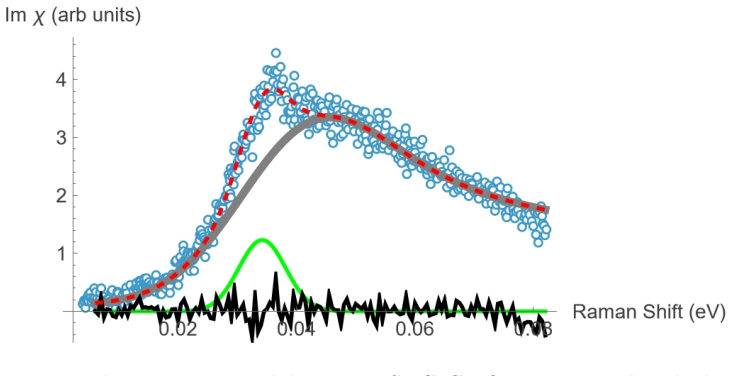
- Figure 1 caption associates the narrower G_r(E) with a B_{1g} phonon near 34 meV; the main text should state whether this Gaussian is required by the memory model or is an ad hoc additive term, and whether removing it changes Br and Er materially.
- Notation for memory times mixes τ_g, τ_pg, τ_sc, τ_r; a short table of fitted B and τ values across probes would make the claimed channel-resolved timescales (∼5 fs vs ∼50 fs) easier to assess.
- References include several arXiv-only items with 2026 dates (e.g. [5], [17], [18], [26]–[28]); ensure citation status is accurate at submission and that essential prior results are not solely self-citations where standard literature exists.
- The Acknowledgement of ChatGPT for language editing is appropriate; no change needed, but ensure all equations and numerical values were author-verified.
- In §8.3 the tunneling sample (T_c = 92.3 K, p ≃ 0.16) differs from the ARPES doping (p ≃ 0.21); the text already notes this, but a brief statement of which parameters are transferred unchanged versus rescaled would reduce ambiguity.
Circularity Check
Multi-probe 'evidence' and doping collapse largely restate flexible PCF fits (A, E0, B free); D3/2 branch and hierarchy are empirically retained from the same data and prior self-work [5], not uniquely fixed by the action.
-
self citation load bearing
[Sec. 2 (after Eq. 7); Sec. 5 (Eqs. 31–32); Introduction]
"The Gaussian memory envelope has been proposed in our previous work [5] for describing ARPES signals in Bi2Sr2CaCu2O8+δ. ... This gives a dynamical interpretation to the sequence p=−1/2,1/2,1,3/2,… that appears in the memory-dressed spectral forms [5]."
The specific Gaussian envelope and algebraic hierarchy used throughout the spectral model and multi-probe fits are justified by citation to the same author's prior ARPES phenomenology [5], not derived uniquely here. The present action language is built to recover those already-chosen forms; without [5] the paper would not have fixed p and the Gaussian as the load-bearing spectral ansatz.
-
fitted input called prediction
[Sec. 8.4, Eqs. (69)–(72); Fig. 4]
"after defining the dimensionless variable ξ=2Bsc(p)[Esc(p)−E], the occupied-side contribution collapses approximately onto ρsc(ξ;p)/Asc(p)≃−exp(−ξ2/4)D3/2(ξ). This collapse removes the nonuniversal amplitude, gap scale, and memory width for each sample. What remains is the same dimensionless PCF backbone..."
Esc(p), Asc(p), and Bsc(p) are free fit parameters for each doping. Defining ξ from those fitted B and Esc and dividing by Asc makes collapse onto the fitted functional form expected by construction whenever the same D3/2 form fits each spectrum. The 'universal PCF scaling' is therefore largely a restatement of successful per-sample fits, not an independent prediction.
2 more flagged steps
-
self definitional
[Appendix B (after Eq. 114); Sec. 8.2 Eqs. (59)–(61); Appendix A Eqs. (99)–(104)]
"In the main spectral comparison the superconducting feature is dominated most clearly by the D3/2 component, which we therefore retain as the leading Bogoliubov-like higher-order branch. ... For this choice of phase, the coefficient of D−a(−x) vanishes... The relative minus sign of this superconducting term follows from the phase projection discussed in Appendix A."
Which member of the recurrence-coupled hierarchy is kept for SC (D3/2) is chosen because it dominates the spectra being fitted; the phase ϕ is then set so that cos(ϕ−θa)=0 suppresses the unwanted real-axis continuation. The identification 'observed SC peak = cascade-enhanced D3/2 with phase-selected minus sign' is therefore fixed by the data and branch-selection conditions rather than uniquely forced by the reservoir action, making the subsequent multi-probe 'confirmation' circular.
-
fitted input called prediction
[Sec. 8.1–8.3, Eqs. (55), (59), (61), (66)–(67); Abstract/Conclusion]
"comparisons with Raman, ARPES, tunneling, and doping-dependent ARPES scaling suggest that these probes are complementary projections of the same Gaussian-memory pair continuum. ... Surprisingly, setting Abg(E,T)=0 and RE=1 already provides quantitative fits to the spectra in Fig. 2. ... No new PCF fitting is introduced for the tunneling comparison."
Raman, ARPES, and tunneling comparisons are fits of the same flexible PCF family with free amplitudes, centers, B (memory width), offsets, and (for ARPES) Tpair and Asc(T). Tunneling reuses ARPES branch parameters only after free axis rescaling (s, Eoff) and overall scale. Calling these fits 'complementary projections' and 'evidence' of one continuum treats successful flexible fits as confirmation of the microscopic premise that produced the fitting functions.
full rationale
The microscopic steps that produce a Gaussian envelope (ensemble average of local frequency shifts, Sec. 4, Eqs. 23–25) and algebraic powers (threshold continuum plus resonant forcing, Sec. 5, Eqs. 28–33), and the causal Fourier map of t^{-a} e^{-t^2/(2τ^2)} cos(Ωt+φ) onto parabolic-cylinder forms (Appendix A), are standard and not circular. Circularity appears where those forms are turned into 'evidence' and 'universal' structure. The hierarchy and Gaussian ARPES envelope are load-bearing imports from the author's prior work [5], then re-fitted. Branch choice (primitive D_{-1/2} for Raman/pg; cascade D_{3/2} for SC, with phase-selected minus sign) is fixed by empirical dominance and phase-selection conditions that suppress unwanted continuations, not by a derived selection rule from the reservoir action. Once each spectrum is fitted with free A, E0, B (and T_pair, flock, phases), the doping collapse onto -exp(-ξ^2/4) D_{3/2}(ξ) after defining ξ from those fitted scales is largely by construction of the scaling variable. Cross-probe consistency is consistency of a flexible PCF family with free parameters, not an independent first-principles prediction. Score 6: partial circularity on the central multi-probe and scaling claims; the action-to-PCF math itself is not circular.
Assumptions & free parameters
free parameters (7)
- Br, Er, Ar (Raman broad PCF) =
Er=36.9 meV, Br=43.6 eV^{-1}, Ar=2.24
- Bpg, Epg, Apg (pseudogap ARPES branch) =
Epg=-93.4 meV, Bpg=4.6 eV^{-1}, Apg=1.27
- Bsc, Esc(0), Asc(0), Tpair (SC ARPES branch) =
Esc(0)=21.3 meV, Bsc=39 eV^{-1}, Asc(0)=1.93, Tpair=92.7 K
- Tunneling calibration α0, α1, s, Eoff =
α0=-0.03 GΩ^{-1}, α1=0.59, s=28.69, Eoff=4.05 mV
- Doping-dependent Esc(p), Asc(p), Bsc(p) =
vary with p=0.141–0.215
- Phase/branch-selection angles and relative channel phase ϕrel
- Thermal dephasing form for τsc(T) (ηT, n) and flock(T)
assumptions (6)
- domain assumption Standard Cooper-channel Hubbard–Stratonovich decoupling identifies Δ as the microscopic Bogoliubov pair field.
- ad hoc to paper Antinodal gap/pseudogap acts as a momentum-space spectral cavity selecting Qa modes that form a local fluctuating reservoir for Δ.
- ad hoc to paper Local Bogoliubov frequency shifts are approximately Gaussian, so ensemble averaging yields exp[-t²/(2τg²)].
- ad hoc to paper Threshold continuum and resonant forcing generate the algebraic hierarchy p=-1/2,1/2,1,3/2,... cut off by the Gaussian envelope.
- ad hoc to paper Observable spectra are phase-selected real projections of causal Fourier transforms of these memory branches, giving specific PCF indices.
- ad hoc to paper Below Tc a phase-locked fraction of the resonant branch tracks condensate weight ∝|Δ0(T)|² while the pseudogap memory channel remains robust.
invented entities (4)
-
Gaussian-memory Cooper-pair continuum / memory-dressed Bogoliubov pair field
-
Antinode momentum-space spectral cavity and Qa reservoir fields Xa
-
Tpair spectroscopic crossover for incoherent resonant pair branches
-
Cascade-enhanced PCF branch hierarchy (especially D3/2 SC channel)
Cite this review
Pith. "Pith review of Evidence of the Cooper-Pair Field with Gaussian Memory Kernel in Unconventional Superconductors." pith.science (2026). https://pith.science/paper/MQE5EZJU
@misc{pith2026260703937,
  author       = {Pith},
  title        = {Pith review of: Evidence of the Cooper-Pair Field with Gaussian Memory Kernel in Unconventional Superconductors},
  year         = {2026},
  howpublished = {\url{https://pith.science/paper/MQE5EZJU}},
  note         = {Machine review of arXiv:2607.03937}
}
abstract
We develop a dynamical description of the superconducting pair field in which the Cooper-channel Hubbard--Stratonovich field $\Delta$ is treated as a memory-dressed Bogoliubov pair field rather than as a purely static order parameter. Starting from the standard pair-field effective action, we couple $\Delta$ to antinode-selected collective or self-generated fields. An ensemble of such modes produces a distribution of local Bogoliubov frequencies; when this distribution is approximately Gaussian, ensemble averaging gives the memory factor $\exp[-t^2/(2\tau_g^2)]$. In cuprate superconductors, the antinodal gap or pseudogap restricts the active electronic phase space and acts as a momentum-space spectral cavity. It selects fluctuation wavevectors $\mathbf Q_a$ that may become charge-density-wave-like instabilities in an ordered limit, but behave as a reservoir of local collective fields in the fluctuating regime. The same framework admits resonant algebraic prefactors, so that threshold and forced-oscillator responses generate the hierarchy $p=-1/2,1/2,1,3/2,\ldots$, while the Gaussian envelope cuts off secular growth and converts these branches into finite spectral components. The resulting picture contains a robust pseudogap memory channel and, below $T_c$, an additional condensate-assisted coherent channel proportional to $|\Delta_0(T)|^2$. Thus the superconducting transition primarily reorganizes pair-field spectral weight between incoherent pseudogap memory and coherent Bogoliubov memory. The frequency-domain response is expressed in terms of parabolic-cylinder functions, and comparisons with Raman, ARPES, tunneling, and doping-dependent ARPES scaling suggest that these probes are complementary projections of the same Gaussian-memory pair continuum. We compare our numerical results with the recent experimental data on Bi$_2$Sr$_2$CaCu$_2$O$_{8+\delta}$.
Figures


Figures from the paper (1 more)

Reference graph
Works this paper leans on
-
[5]
Pinsook, ARPES of Bi 2Sr2CaCu2O8+δ interpreted via a particle in a system of dynamic scatterers, J
U. Pinsook, ARPES of Bi 2Sr2CaCu2O8+δ interpreted via a particle in a system of dynamic scatterers, J. Phys.: Condens. Matter38, 125603 (2026)
2026
-
[1]
Tinkham,Introduction to Superconductivity, 2nd ed., McGraw-Hill, New York (1996)
M. Tinkham,Introduction to Superconductivity, 2nd ed., McGraw-Hill, New York (1996)
1996
-
[2]
P. G. de Gennes,Superconductivity of Metals and Alloys, Westview Press, Boulder (1999)
1999
-
[3]
Timusk and B
T. Timusk and B. Statt, The pseudogap in high-temperature superconductors: an experi- mental survey, Rep. Prog. Phys.62, 61 (1999)
1999
-
[4]
Damascelli, Z
A. Damascelli, Z. Hussain, and Z.-X. Shen, Angle-resolved photoemission studies of the cuprate superconductors, Rev. Mod. Phys.75, 473 (2003)
2003
-
[6]
D. J. Thouless, Perturbation theory in statistical mechanics and the theory of superconduc- tivity, Ann. Phys.10, 553 (1960)
1960
-
[7]
M. R. Norman, H. Ding, M. Randeria, J. C. Campuzano, T. Yokoya, T. Takeuchi, T. Takahashi, T. Mochiku, K. Kadowaki, P. Guptasarma, and D. G. Hinks, Destruction of the Fermi surface in underdoped high-T c superconductors, Nature392, 157 (1998)
1998
-
[8]
T. De Cao, Crossover from a pseudogap state to a superconducting state, arXiv:1004.1792 [cond-mat.supr-con] (2010)
arXiv 2010
Show all 30 references
-
[9]
A. F. Volkov and Sh. M. Kogan, Collisionless relaxation of the energy gap in superconductors, Sov. Phys. JETP38, 1018 (1974)
1974
-
[10]
Kondo, Y
T. Kondo, Y. Hamaya, A. D. Palczewski, T. Takeuchi, J. S. Wen, Z. J. Xu, G. Gu, J. Schmalian, and A. Kaminski, Disentangling Cooper-pair formation above the transition temperature from the pseudogap state in the cuprates, Nat. Phys.7, 21–25 (2011)
2011
-
[11]
Valla, T
T. Valla, T. E. Kidd, W.-G. Yin, G. D. Gu, P. D. Johnson, Z.-H. Pan, and A. V. Fedorov, The ground state of the pseudogap in cuprate superconductors, Science314, 1914–1916 (2006)
1914
-
[12]
K. C. Hewitt and J. C. Irwin, Doping dependence of the superconducting gap in Bi2Sr2CaCu2O8+δ, Phys. Rev. B66, 054516 (2002)
2002
-
[13]
S.-D. Chen, M. Hashimoto, Y. He, D. Song, J.-F. He, Y.-F. Li, S. Ishida, H. Eisaki, J. Zaanen, T. P. Devereaux, D.-H. Lee, D.-H. Lu, and Z.-X. Shen, Unconventional spectral signature ofT c in a pure d-wave superconductor, Nature601, 562–567 (2022)
2022
-
[14]
Renner and Ø
Ch. Renner and Ø. Fischer, Vacuum tunneling spectroscopy and asymmetric density of states of Bi 2Sr2CaCu2O8+δ, Phys. Rev. B51, 9208–9218 (1995)
1995
-
[15]
Y. He, M. Hashimoto, D. Song, S.-D. Chen, J. He, I. M. Vishik, B. Moritz, D.-H. Lee, N. Nagaosa, J. Zaanen, T. P. Devereaux, Y. Yoshida, H. Eisaki, D. H. Lu, and Z.-X. Shen, Rapid change of superconductivity and electron-phonon coupling through critical doping in Bi-2212, Scie...
2018
-
[16]
J. D. Rameau, S. Freutel, A. F. Kemper, M. A. Sentef, J. K. Freericks, I. Avigo, M. Ligges, L. Rettig, Y. Yoshida, H. Eisaki, J. Schneeloch, R. D. Zhong, Z. J. Xu, G. D. Gu, P. D. Johnson, and U. Bovensiepen, Energy dissipation from a correlated system driven out of equilibriu...
2016
-
[17]
B. G. Chae, Memory-dominated quantum criticality as a universal route to high-temperature superconductivity, arXiv:2602.22626v6 [cond-mat.str-el] (2026)
2026 arXiv
-
[18]
R. A. Klemm, The phase-sensitive c-axis twist experiments on cuprate superconductors, J. Phys.: Condens. Matter38, 213001 (2026)
2026
-
[19]
Zhong, Y
Y. Zhong, Y. Wang, S. Han, Y.-F. Lv, W.-L. Wang, D. Zhang, H. Ding, Y.-M. Zhang, L. Wang, K. He, R. Zhong, J. A. Schneeloch, G. D. Gu, C–L. Song, X.-C. Ma, and Q.-K. Xue, Nanoscale evidence for two distinct superconducting phases in Bi 2Sr2CaCu2O8+δ, Sci. Bull. 61, 1239 (2016)
2016
-
[20]
Y. Zhu, M. Liao, Q. Zhang, H.-Y. Xie, F. Meng, Y. Liu, Z. Bai, S. Ji, J. Zhang, K. Jiang, R. Zhong, J. Schneeloch, G. Gu, L. Gu, X. Ma, D. Zhang, and Q.-K. Xue, Presence of s-wave pairing in Josephson junctions made of twisted ultrathin Bi 2Sr2CaCu2O8+x flakes, Phys. Rev. X11,...
2021
-
[21]
Zhu, H.-Y
Y. Zhu, H.-Y. Xie, M. Liao, X. Ma, D. Zhang, and Q.-K. Xue, Persistent Josephson tunneling at 45 ◦ twist angle in overdoped Bi 2Sr2CaCu2O8+x, Phys. Rev. B108, 174508 (2023)
2023
-
[22]
Charge density waves in cuprate superconductors beyond the critical doping,
H. Miao, G. Fabbris, R. J. Koch, D. G. Mazzone, C. S. Nelson, R. Acevedo-Esteves, G. D. Gu, Y. Li, T. Yilmaz, K. Kaznatcheev, E. Vescovo, M. Oda, T. Kurosawa, N. Momono, T. Assefa, I. K. Robinson, E. S. Bozin, J. M. Tranquada, P. D. Johnson, and M. P. M. Dean, “Charge density ...
2021
-
[23]
P. W. Anderson, Random-phase approximation in the theory of superconductivity, Phys. Rev.112, 1900 (1958)
1900
-
[24]
C. M. Varma, P. B. Littlewood, S. Schmitt-Rink, E. Abrahams, and A. E. Ruckenstein, Phenomenology of the normal state of Cu-O high-temperature superconductors, Phys. Rev. Lett.63, 1996 (1989)
1996
-
[25]
Zaanen, Why the temperature is high, Nature430, 512 (2004)
J. Zaanen, Why the temperature is high, Nature430, 512 (2004)
2004
-
[26]
I. A. Goremykin and A. A. Katanin, The pseudogap in high- Tc superconductors from SU(2) gauge symmetry and dynamic correlation effects, arXiv:2606.02838 [cond-mat.str-el] (2026)
2026 arXiv
-
[27]
Kryhin, P
S. Kryhin, P. Lunts, A. A. Patel, S. Sachdev, and P. A. Nosov, Influence of Harris disorder on quantum-critical superconductivity, arXiv:2606.23582 [cond-mat.supr-con] (2026)
2026 arXiv
-
[28]
G. Riva, J. Simoni, and Y. Ping, Open-quantum-system theory of non-Markovian electron– phonon dynamics, arXiv:2606.22233 [cond-mat.mtrl-sci] (2026). 29
2026 arXiv
-
[29]
Abramowitz and I
M. Abramowitz and I. A. Stegun, Eds.,Handbook of Mathematical Functions with Formulas, Graphs, and Mathematical Tables, Dover Publications, New York (1965)
1965
-
[30]
F. W. J. Olver, D. W. Lozier, R. F. Boisvert, and C. W. Clark, Eds.,NIST Handbook of Mathematical Functions, Cambridge University Press, New York (2010). 30
2010
Reviewed July 11, 2026 · model on record in the stance chip above.
Discussion (0). Continue with ORCID to comment.